
fig11
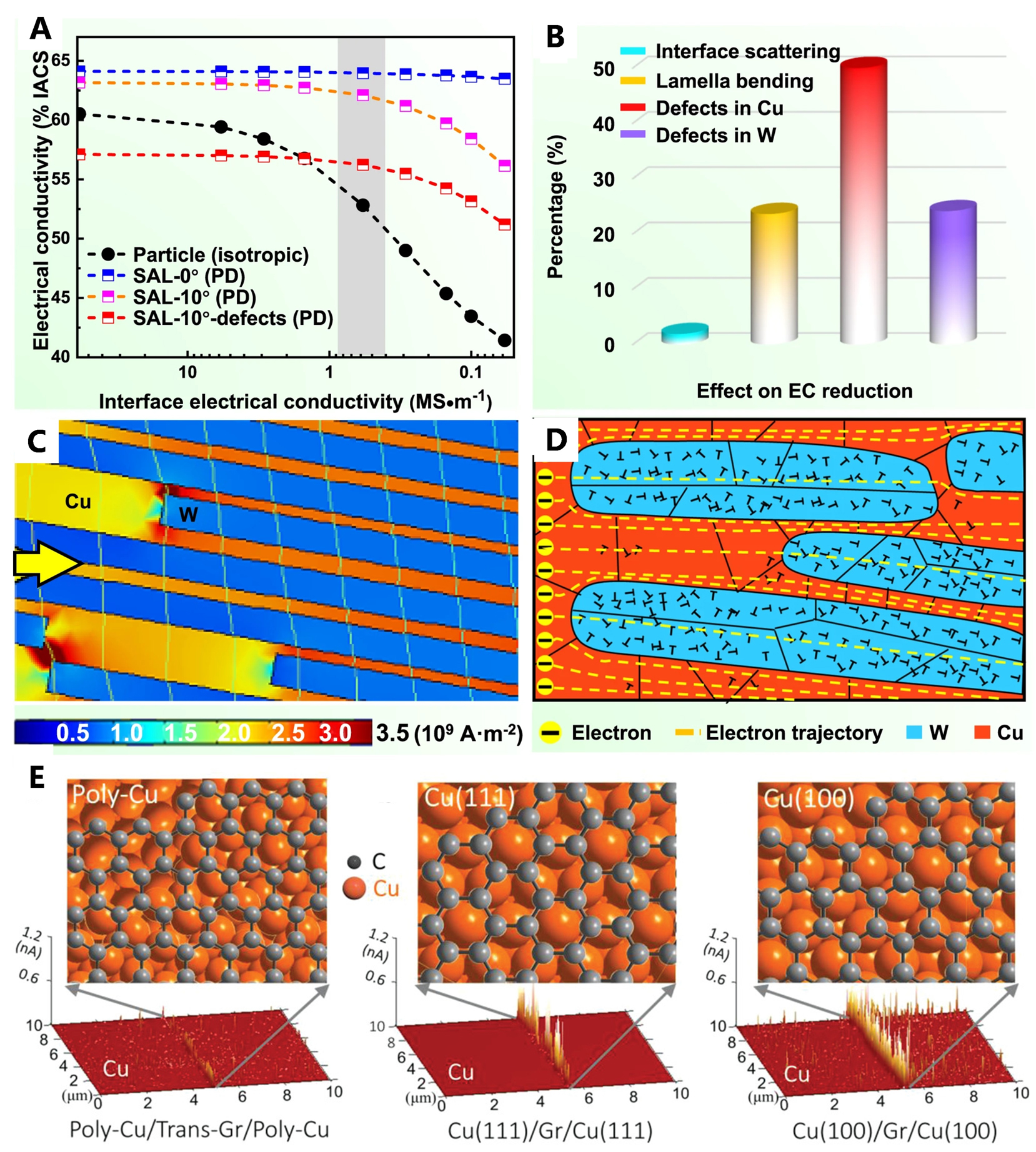
Figure 11. Conductivity mechanism analysis of copper alloys with layered heterogeneous structure. ((A-D) W-Cu[90] (Quoted with permission from Han et al.[90], under the CC BY 4.0 license, http://creativecommons.org/licenses/by/4.0/); (E) Gr/Cu[95] (Reprinted from Ref.[95], with permission from John Wiley & Sons)). (A) Evolution of electrical conductivity as a function of interfacial impedance for different models. “Particle” stands for the W particles reinforced W-Cu, “SAL” stands for SAL W-Cu with the angle representing the degree that W lamella deviates from the horizontal plane, and “defects” indicates voids, dislocations, and grain boundaries. (B) Effects of different factors on the reduction of electrical conductivity. (C) Distribution of the current density in the SAL W-Cu. The yellow arrow indicates the current direction. (D) Schematic illustration of the electron trajectories in the SAL W-Cu composite. (E) A comparison of current flow along the interface area in Gr/Cu composites with different matrices.