
fig2
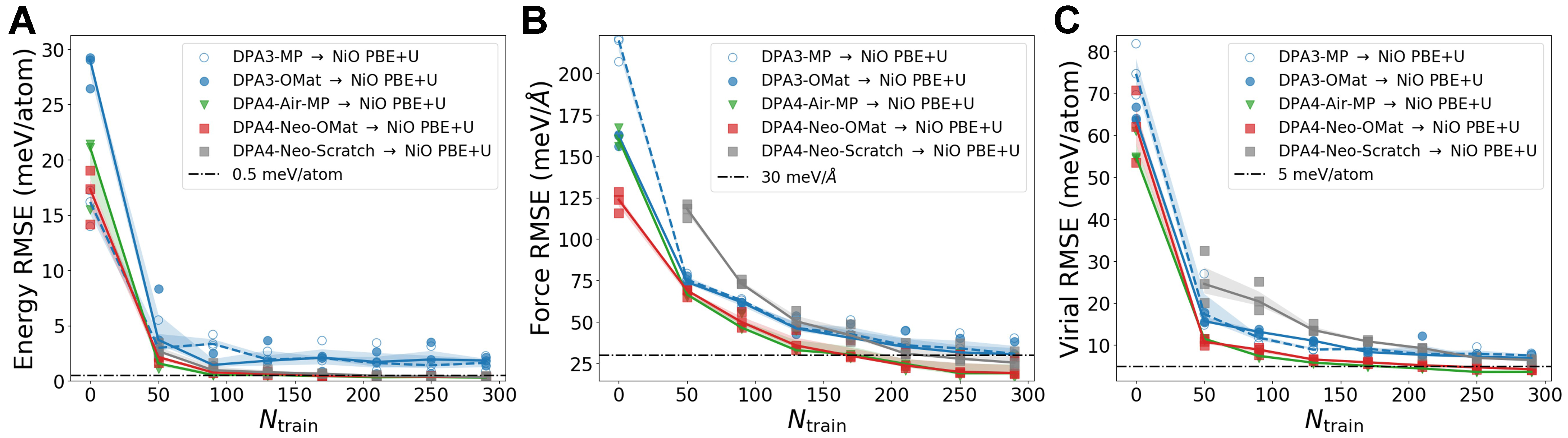
Figure 2. Data-efficient adaptation of pretrained MLFFs to the NiO PBE+U reference surface. Test-set RMSEs for (A) energies, (B) forces, and (C) virials are shown as functions of the number of PBE+U training configurations, Ntrain. Results at Ntrain = 0 correspond to zero-shot predictions of the pretrained models. The zero-shot energy errors are reported as test-set energy-offset-aligned zero-shot RMSEs, using a uniform per-atom energy shift determined from the corresponding test set as described in the Methods section. Symbols represent individual train–test splits. Open blue circles connected by dashed lines denote DPA3-MP, while the filled blue circles, green triangles, and red squares along with solid lines denote DPA3-OMat, DPA4-Air-MP, and DPA4-Neo-OMat, respectively. Filled grey squares represent DPA4-Neo models trained from random initialization using the same training-set sizes and data splits. Shaded regions indicate the interquartile range across independent train–test splits at each Ntrain. The horizontal dash-dotted lines indicate RMSEs of 0.5 meV/atom in (A), 30 meV/Å in (B), and 5 meV/atom in (C). MLFFs: Machine-learned force fields; PBE: Perdew–Burke–Ernzerhof; RMSEs: root-mean-square errors.