
fig2
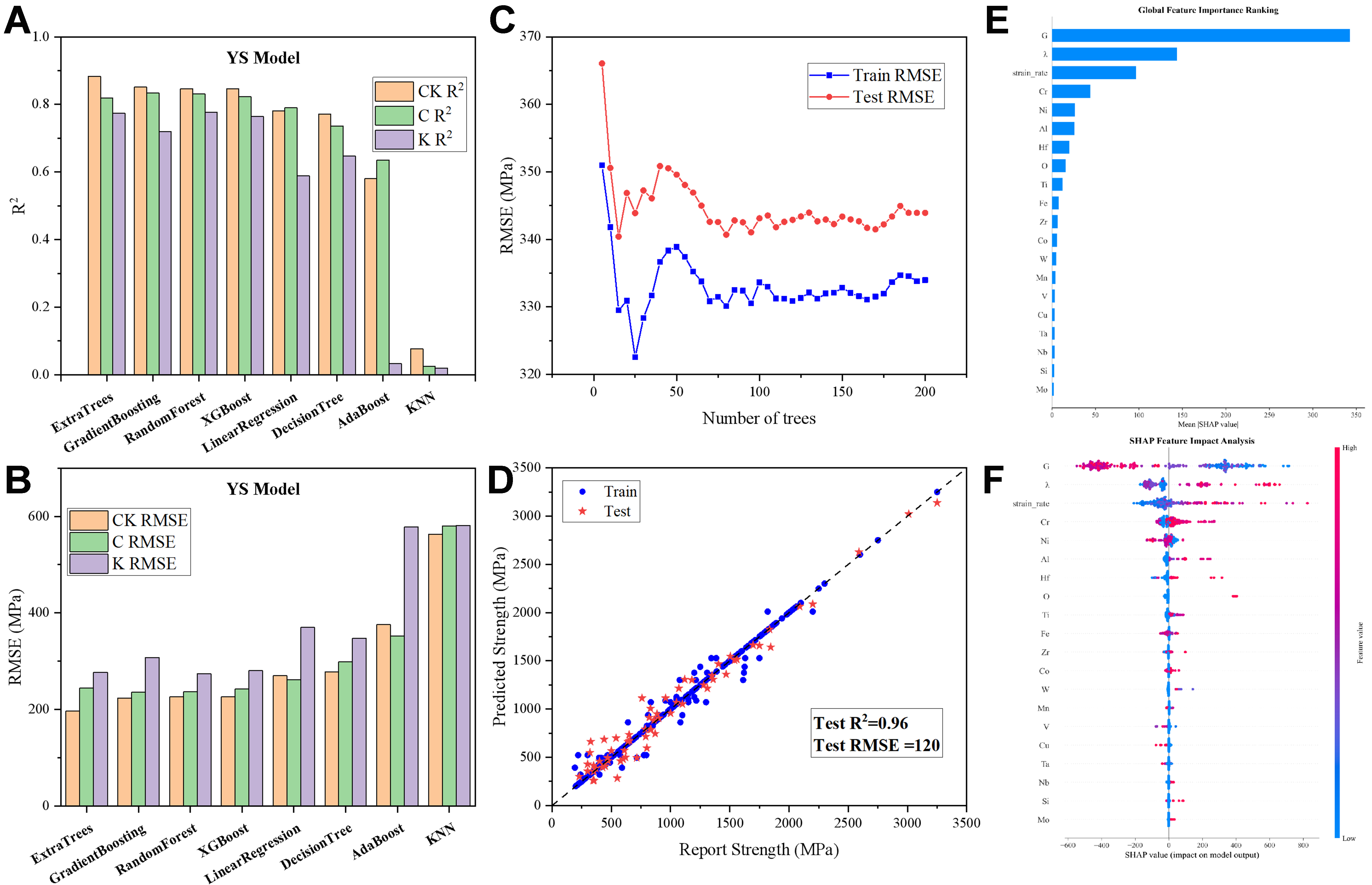
Figure 2. Performance comparison of eight ML models for strength datasets constructed based on “composition”, “domain knowledge”, and “composition + domain knowledge” strategies, and analysis of the importance of SHAP values of the features. (A) and (B) are respectively the R2 and RMSE results of the 8 fitted ML models on the test sets after 50 resampling iterations; (C) Convergence of test RMSE as a function of the number of decision trees for the ExtraTrees model built on the “composition + domain knowledge” feature set; (D) is the fitting plot of the optimal ExtraTrees model for the strength dataset constructed based on “composition + domain knowledge” after hyperparameter optimization; (E) and (F) are the bar chart and swarm chart for the importance analysis of the SHAP features of the strength dataset constructed based on “composition + domain knowledge”, respectively. ML: Machine learning; SHAP: SHapley Additive exPlanations; R2: the coefficient of determination; RMSE: root mean square error; ExtraTrees: extremely randomized trees; YS: yield strength; GradientBoosting: gradient boosting; RandomForest: random forest; XGBoost: eXtreme gradient boosting; Linear: linear regression; DecisionTree: decision tree; AdaBoost: adaptive boosting; KNN: K-nearest neighbors.