

Prediction of electron localization functions from superposed atomic densities for accelerated superhydride discovery
 0
0 
Graphical Abstract
Abstract
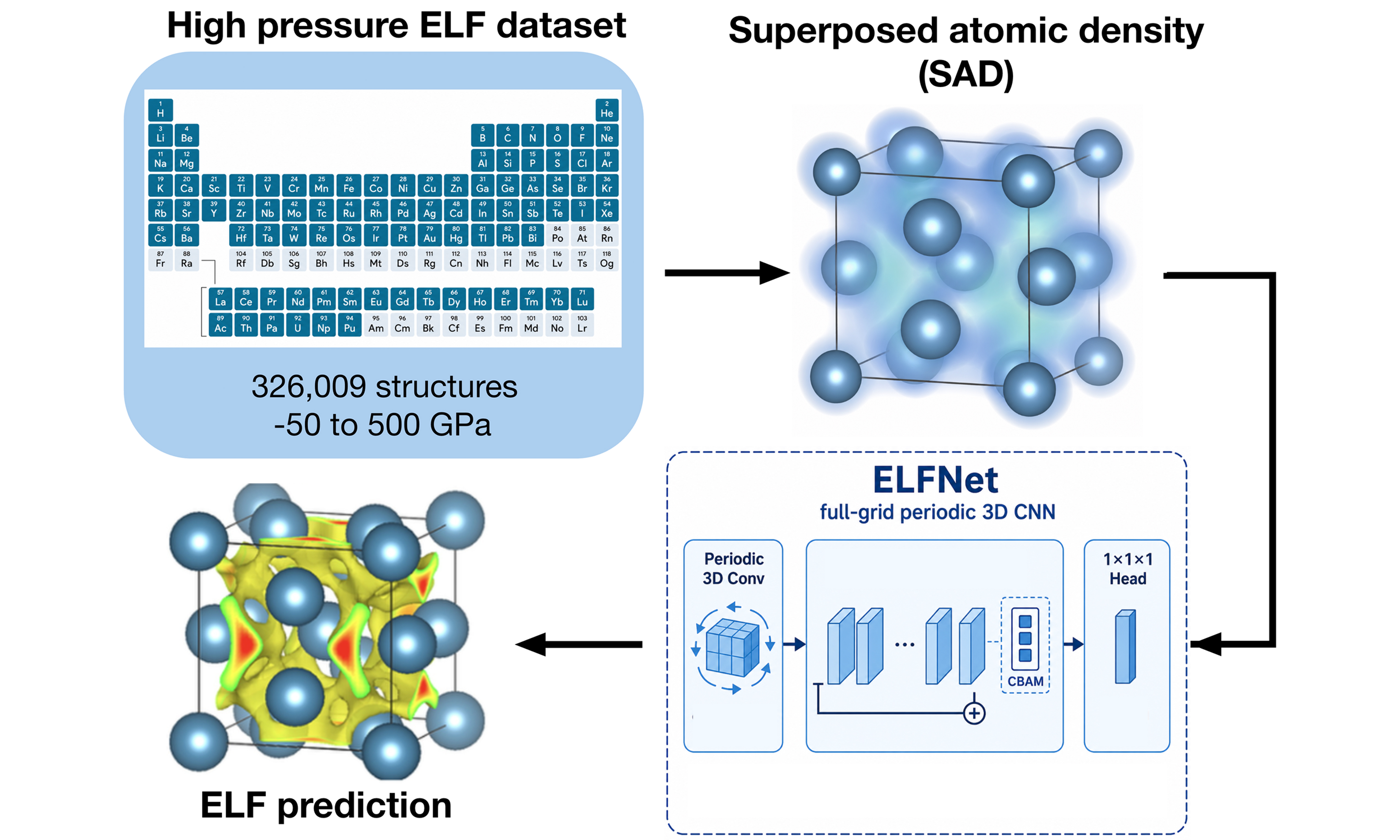
The electron localization function (ELF) provides a chemically interpretable representation of bonding and interstitial electron localization, but generating volumetric ELF fields with density functional theory (DFT) is computationally expensive for large candidate libraries. We present ELFNet, a structure-to-field model that predicts DFT-derived ELF grids from computationally inexpensive superposed atomic density (SAD) inputs for high-pressure chemical-template screening. To train the model, we constructed a pressure-targeted Perdew–Burke–Ernzerhof (PBE) ELF dataset containing 326,009 converged unary and binary prototype structures spanning 89 elements and covering pressures from approximately -50 to 500 GPa. ELFNet uses periodic full-grid convolutions and a composite objective designed to recover sparse high-ELF features. We evaluated the model on 50,000 metal-only templates derived from known high-pressure superhydride prototypes. Predicted fields captured chemically meaningful differences in the spatial topology of interstitial localization, while global maximum ELF values and maximum-location errors provided complementary measures of agreement with DFT references. On the reported hardware, the full inference-through-write workflow reduced summed per-structure elapsed time by approximately 350-fold relative to fixed-geometry Vienna Ab initio Simulation Package (VASP) ELF generation. These results establish SAD-to-ELF prediction as a low-cost front-end screening method for prioritizing candidate metal templates before downstream first-principles validation.
Keywords


 Download PDF
INTRODUCTION
Electronic-structure calculations reveal bonding and localization patterns that energies alone do not capture. The electron localization function (ELF) represents these patterns as chemically interpretable three-dimensional maps. Introduced by Becke and Edgecombe, ELF is a dimensionless real-space descriptor of electron localization based on the local behavior of same-spin electron pairs[1]. ELF is now widely used to identify chemically meaningful features such as bonding and lone-pair basins, atomic shell structure, and interstitial electron localization in molecules and solids[2,3]. For each spin component σ, ELF may be written schematically as
where Dσ measures the excess local kinetic-energy density associated with Pauli repulsion and Dσ0 is the corresponding reference for a homogeneous electron gas of the same spin density. ELF values range from 0 to 1, with values close to 1 indicating strongly localized electron-pair regions, values near 0.5 corresponding to behavior similar to a homogeneous electron gas, and values near 0 indicating suppressed localization. This representation is particularly valuable when conventional bonding descriptions are incomplete because it reveals localized regions that are not readily classified as two-center bonds, lone pairs, or formal valence assignments.
High-pressure chemistry is one such regime because compression can alter orbital ordering, bonding, reactivity, and the set of stable stoichiometries[4]. Hydrogen-rich compounds are a prominent example. Since Ashcroft’s proposal that hydrogen-dominant metallic alloys could host high-temperature superconductivity[5], experimental and theoretical studies have identified hydrides with exceptionally high superconducting transition temperatures, including sulfur hydrides and lanthanum hydrides at megabar pressures[6-11]. Recent work has broadened this landscape through calcium clathrate and superhydrides, alloy superhydrides, and molecular hydrides that retain high transition temperatures or reduce stabilization pressures[12-21]. Dense hydrogen networks can provide the high phonon frequencies and strong electron–phonon coupling required for such transition temperatures. Nevertheless, discovering new high-pressure hydrides remains challenging because many metal frameworks, hydrogen arrangements, compositions, and pressures must be evaluated before promising candidates can be identified.
The high-pressure hydride search space can be reduced through chemical template theory. In metal superhydrides, stability is not governed exclusively by direct metal–hydrogen bonding. Chemical template theory instead emphasizes the metal sublattice, which can host localized interstitial electronic states described as quasi-atom orbitals. The associated ELF maxima coincide spatially with interstitial sites that are subsequently occupied by hydrogen networks. Previous work has shown that these localization patterns can template hydrogen-network assembly and rationalize structural trends across high-pressure hydride families[22]. ELF therefore provides a descriptor of template strength and of the electronic topology that favors hydrogen clathrates and related motifs. Related work has also shown that ELF-derived bonding-network descriptors correlate with superconducting critical temperatures in hydrogen-based superconductors[23].
Chemical template theory has recently been combined with machine learning for superhydride discovery. Previous work integrated chemical-template features into an ML-guided screening workflow and reported the batch discovery of complex metal superhydrides, including non-integer hydrogen-to-metal ratios, new structural prototypes, and large primitive cells[24]. That study illustrates both the value and the computational bottleneck of ELF-based screening. Crystal-structure searches conventionally generate and relax large candidate pools[25,26], while recent machine-learning-guided, active-learning, and generative workflows can accelerate candidate generation, relaxation, and triage before first-principles validation[27-31]. As candidate cells grow, sometimes exceeding 50 atoms per primitive cell in non-stoichiometric superhydrides, direct density functional theory (DFT) calculations with ELF output remain expensive, and searches over thousands of hypothetical metal templates can devote substantial computational effort to generating ELFs for structures that are ultimately rejected.
These costs motivate a structure-to-field surrogate for ELF. The objective is to predict the ELF grid directly from structural information without performing a new electronic-structure calculation. In our workflow, the crystal structure and atomic species are converted into a computationally inexpensive superposed atomic density (SAD) grid, which ELFNet maps to the corresponding DFT-derived ELF grid. The model preserves periodicity, represents compression through the lattice geometry, and recovers the sparse high-value ELF maxima most relevant to template screening. Rather than replacing DFT, ELFNet supports a two-stage workflow in which predicted ELF fields rank many candidate metal templates before full DFT calculations are reserved for the most promising structures.
Recent machine-learning methods have predicted three-dimensional electron-density fields for molecules and periodic materials from atomic geometry or inexpensive initial electronic information, including grid-based and equivariant architectures that can accelerate or initialize electronic-structure calculations[32-36]. More directly related to ELF screening, machine-learning-predicted maximum ELF values have been used to discover ternary electrides from large hypothetical candidate libraries[37]. ELFNet differs by targeting complete periodic ELF fields across a broad, pressure-dependent 89-element dataset and evaluating them for high-pressure metal-template screening.
This study makes two contributions toward that goal. First, we introduce a Perdew–Burke–Ernzerhof (PBE) ELF dataset developed specifically for learning pressure-dependent localization fields. The dataset contains unary and binary prototype structures with broad element coverage, including noble gases and f-block elements that are often sparse or absent in general-purpose materials datasets. Although these elements may appear chemically inert under ambient conditions, high pressure can activate noble-gas chemistry and stabilize compounds with unusual stoichiometries and oxidation states[38,39]. Second, we present ELFNet, a full-grid residual three-dimensional convolutional network that maps SAD grids to ELF grids. The model uses a FlatResNet3D backbone, periodic circular-padding convolutions, and a peak-aware loss. In a case study involving 50,000 templates, the resulting workflow retained chemically meaningful localization features while reducing summed per-structure elapsed time by approximately 350-fold on the reported hardware relative to fixed-geometry Vienna Ab initio Simulation Package (VASP) ELF generation.
MATERIALS AND METHODS
High-pressure ELF dataset
Design goals
The dataset was designed to learn the pressure-dependent mapping from structure-derived SAD fields to DFT-derived ELF fields for compact high-pressure prototype cells. Recent general-purpose potential-energy-surface resources, including MatPES, MP-ALOE, the Materials Project trajectory dataset introduced with CHGNet, and OMat24, provide broad energy, force, and stress labels for training machine-learning interatomic potentials[40-43]. Universal and foundational interatomic-potential architectures trained across broad chemical spaces include M3GNet, CHGNet, DPA-2, NequIP, Allegro, MACE, the MACE foundation model, and GRACE[42,44-50]. In contrast, the dataset developed in this work was assembled around volumetric ELF output. Energies, forces, and stresses were retained for quality control and possible future use, but the learning task uses the SAD arrays as inputs and the ELF arrays as targets.
The dataset construction was guided by three requirements. First, the structures had to sample a broad range of pressures rather than only equilibrium or near-equilibrium volumes. Second, the enumeration had to include small prototype cells that could be systematically populated across many elements and element pairs. Third, the coverage had to include elements that may be underrepresented in common materials datasets but are chemically relevant under pressure, including noble gases and f-block elements.
Prototype families and element coverage
Unary structures were generated from six compact prototype families: simple cubic (SC, Pm
The final high-pressure subset contains the following 89 elements: H through Bi, the lanthanides La–Lu, and the actinides Ac, Th, Pa, U, Np, and Pu. The AB subset covers all 3,916 unordered canonical element pairs overall, with nearly complete coverage within each binary prototype. This element coverage was chosen to support exploratory high-pressure screening beyond the chemical space that is most common in ambient-pressure materials datasets. Under compression, noble gases and rare-earth or actinide elements can participate in unusual bonding, insertion, or charge-transfer behavior. For example, high pressure stabilizes xenon oxides with mixed oxidation states and the helium-containing compound Na2He[38,39]. Figure 1 summarizes the resulting element coverage and frequency.
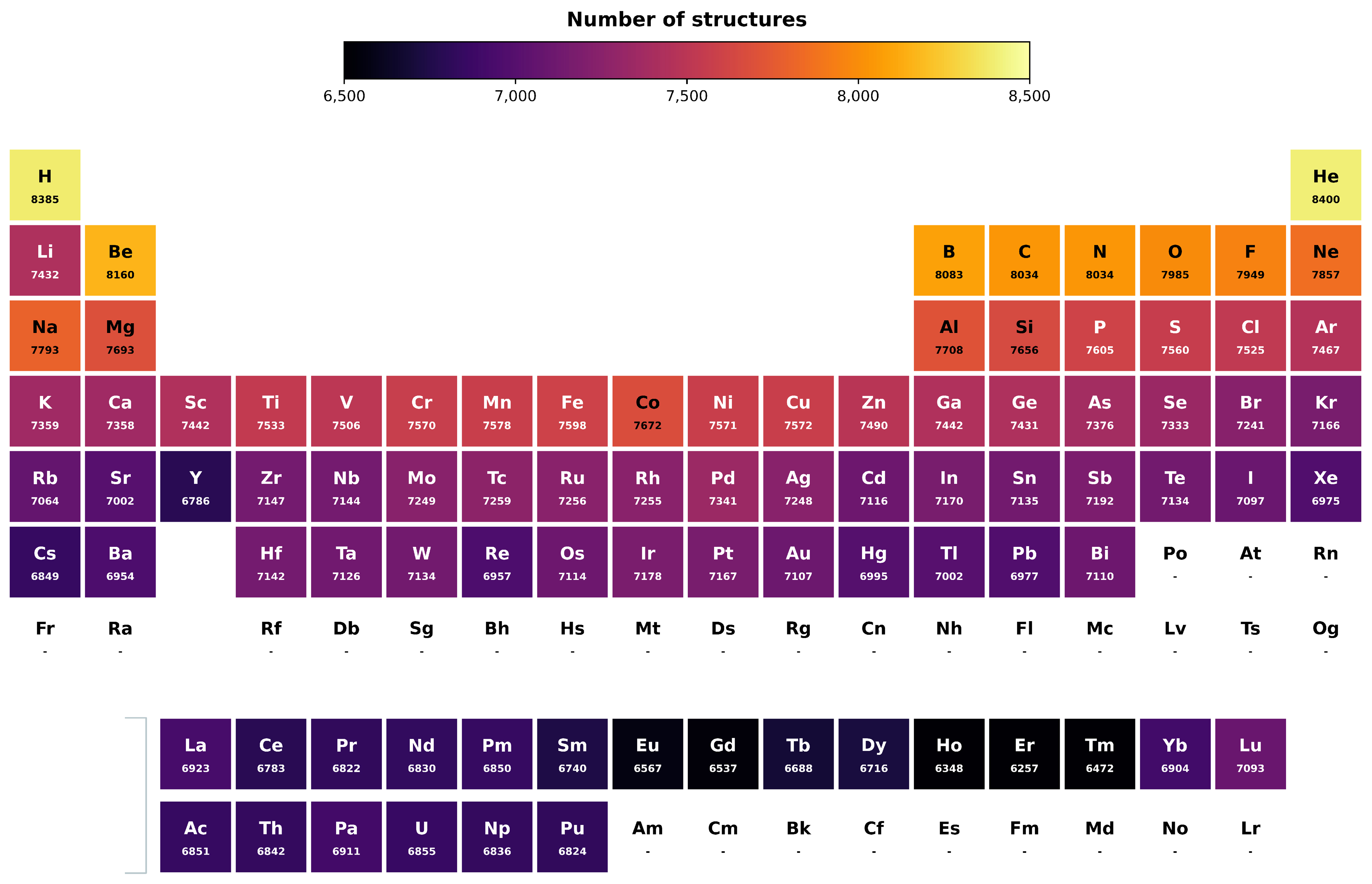
Figure 1. Element coverage in the final high-pressure PBE ELF dataset. Each periodic-table tile reports the number of structures containing that element; color encodes the same count on a logarithmic scale. The white color indicates zero coverage for that element. PBE: Perdew–Burke–Ernzerhof; ELF: electron localization function.
The full 89-element inventory is listed in Supplementary Table 1.
Pressure-targeted lattice expansion
To sample compression more systematically, we used the converged fixed-lattice prototype calculations to construct a pressure-targeted lattice-multiplier grid. Within each structure/prototype/chemical-system group, final DFT pressures from the original lattice-scale calculations were summarized by the median at each scale and used to fit a monotonic non-increasing pressure–scale relation using isotonic regression[51]. The fitted relation was then inverted to select additional lattice-scale multipliers within the usable 0-500 GPa pressure interval. This procedure produced 164,133 converged pressure-targeted multiplier structures in the final dataset; details of the fitting, interpolation, target-pressure selection, and multiplier accounting are provided in Supplementary Note 1 and Supplementary Table 2.
DFT settings and final selection
All final structures were obtained from PBE calculations[52,53]. MatPES-compatible PBE input settings and PAW potentials were used throughout[54-56]. PBE was selected instead of r2SCAN to maintain consistency with the MatPES-compatible high-throughput workflow and to make broad pressure sampling computationally tractable. Although r2SCAN can improve semilocal descriptions across diverse bonding environments[57], the objective was broad pressure coverage with ELF output rather than a high-fidelity equilibrium-energy benchmark. Functional sensitivity was therefore evaluated empirically using the pressure-balanced PBE–r2SCAN cross-check described below.
In a pressure-balanced 96-structure cross-check (16 per pressure bin), changing the reference from PBE to r2SCAN increased the median voxel mean absolute error (MAE) only from 0.09871 to 0.10493 and the median maximum-location distance from 1.109 to 1.183 Å. ELFNet–r2SCAN screening agreement was 92.71%, 78.13%, and 87.50% at ELF thresholds of 0.75, 0.80, and 0.90, respectively; PBE–r2SCAN agreement was at least 95.83% at every threshold. These results indicate that ELFNet retains useful screening information across the change in functionality. Supplementary Table 3 provides additional summary error metrics for this cross-check.
The final dataset contains 326,009 structures, including 7,423 unary and 318,586 binary structures. It is nearly balanced between the fixed absolute-lattice and pressure-targeted multiplier generation routes. The achieved pressures span -49.983 to 499.997 GPa, with a median of 83.26 GPa and a mean of 149.12 GPa. The median force magnitude is zero because many one-site and two-site high-symmetry prototypes have symmetry-cancelled forces; this does not imply zero stress or zero electronic response. Additional dataset statistics are provided in Supplementary Table 4, and the distributions of cohesive energy, force magnitude, and achieved pressure are summarized in Figure 2.
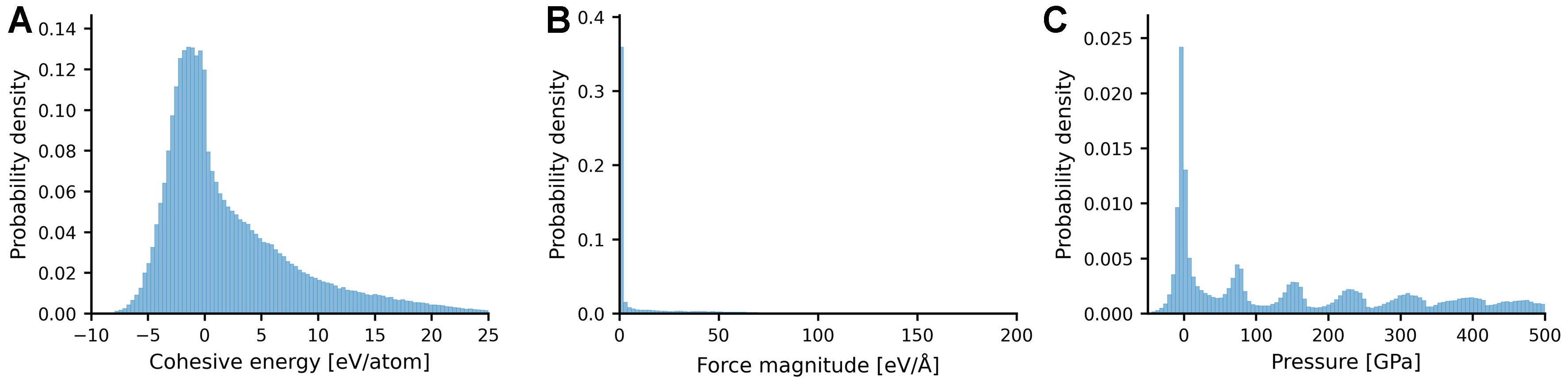
Figure 2. Distribution summary for the final high-pressure PBE ELF dataset. The panels report (A) cohesive energy per atom, (B) force magnitude, and (C) achieved density-functional-theory pressure. PBE: Perdew–Burke–Ernzerhof; ELF: electron localization function.
Negative achieved pressures arise only from expanded fixed-lattice configurations and represent DFT tensile-stress states.
SAD representation and learning target
The model input is an SAD field. SAD provides a computationally inexpensive, structure-derived representation of the crystal by summing tabulated neutral spherical atomic densities over all atoms in the periodic unit cell[58]. Consider a periodic crystal represented as
In continuous notation, the SAD field is
where
Pressure enters this representation implicitly through the lattice geometry. No pressure scalar is supplied to the neural network. Instead, the same fractional coordinates evaluated in a compressed lattice produce different real-space distances, different density overlaps, and different SAD values on the grid. This distinction matters for high-pressure screening because a candidate template at 200 GPa and the same idealized template at 0 GPa produce distinct inputs with different lattice geometries and SAD fields.
The supervised target is the DFT-derived ELF field on the same unit-cell grid. During training and inference, SAD and ELF arrays are handled as paired full-grid tensors with identical shapes. During inference from a starting structure, the model estimates the grid dimensions from the lattice, evaluates the tabulated neutral densities on that periodic grid, and predicts the corresponding ELF tensor.
ELFNet architecture
Full-grid FlatResNet3D
ELFNet is a full-grid neural operator
where
The production model uses one input SAD channel, one output ELF channel, a base width of 32, 16 same-resolution flat residual blocks, a kernel size of five, and three-dimensional convolutional block attention module (CBAM) after every four residual blocks. The stem applies a circularly padded 3 × 3 × 3 convolution, GroupNorm, and Gaussian error linear unit (GELU) activation. Each residual block contains two circularly padded 5 × 5 × 5 convolutions with GroupNorm, GELU, and squeeze-excitation (SE). A CBAM module follows blocks 4, 8, 12, and 16[59-63].
After the residual body, a further circularly padded 5 × 5 × 5 convolution and GroupNorm are combined with a long skip connection from the stem, followed by GELU activation. A 1 × 1 × 1 convolution and sigmoid activation then produce the one-channel ELF field. The bundled checkpoint contains 4,232,989 trainable parameters. This same-grid design preserves the image-to-image character of the SAD-to-ELF mapping while avoiding the memory overhead of multi-resolution feature maps and patch reconstruction. Figure 3 summarizes the implemented data flow.
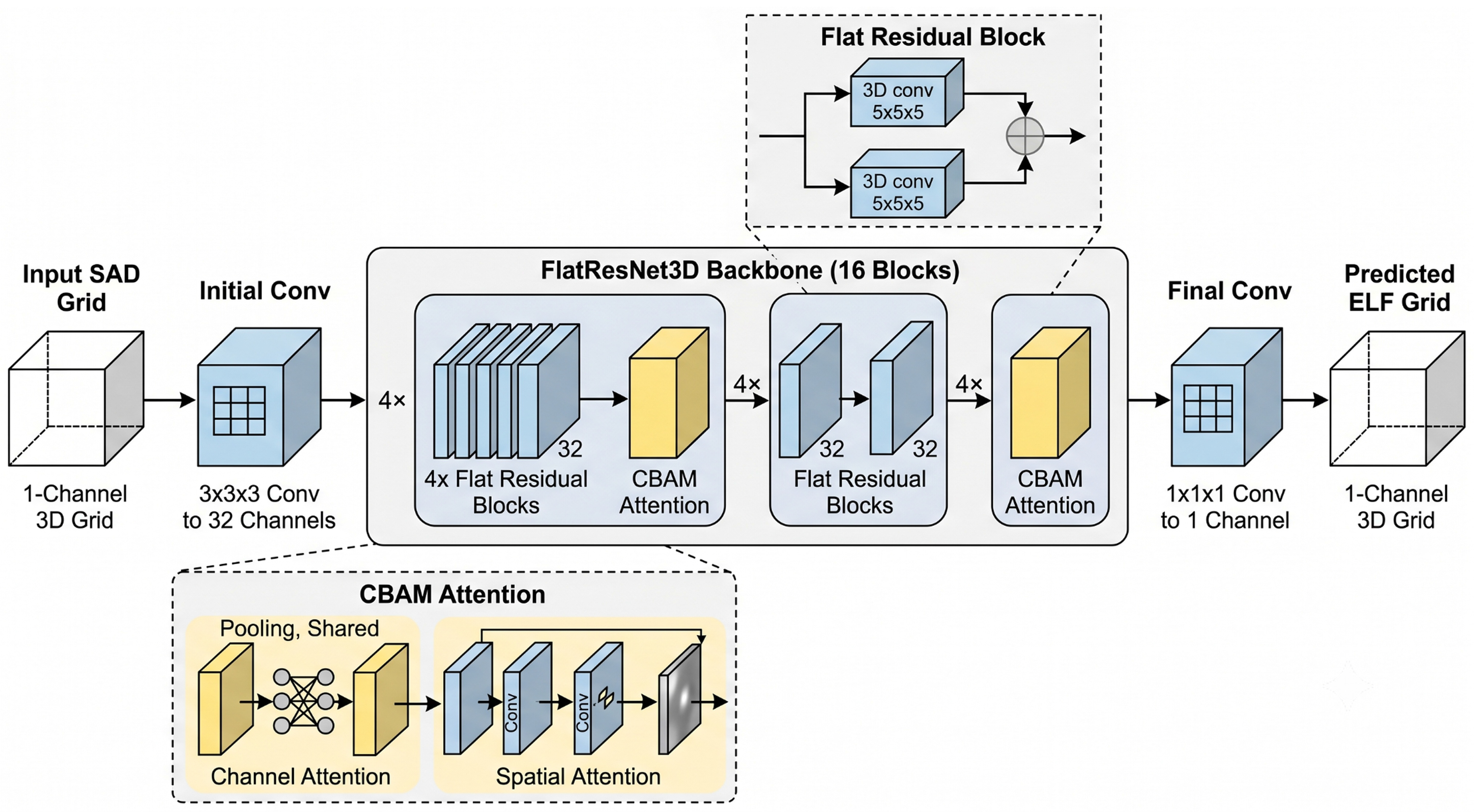
Figure 3. ELFNet architecture. A one-channel SAD grid is transformed at its native spatial resolution. The stem uses a periodic 3 × 3 × 3 convolution to produce 32 channels. Four stages, each containing four flat residual blocks followed by a three-dimensional CBAM, form the 16-block body. A post-body periodic 5 × 5 × 5 convolution is combined with a long stem skip connection, and a 1 × 1 × 1 head with sigmoid activation produces the ELF grid. Each residual block uses GroupNorm, GELU activation, and SE. SAD: Superposed atomic density; CBAM: convolutional block attention module; ELF: electron localization function; GELU: Gaussian error linear unit; SE: squeeze-excitation.
Training data loading
The training loader yields complete unit-cell SAD/ELF pairs. Samples are bucketed by grid shape to avoid unnecessary padding, so the production model trains on native full-grid arrays rather than extracted patches.
Training procedure
The 326,009 paired full-grid SAD/ELF samples were divided deterministically at the sample level into 309,709 training samples and 16,300 validation samples using a validation fraction of 0.05 and a random seed of 42. The independent 50,000-structure hydride-derived template set was not used for training, validation, checkpoint selection, or hyperparameter tuning.
The production model was trained for 80 epochs using the AdamW optimizer with a maximum learning rate of 1 × 10⁻⁴, a weight decay of 1 × 10⁻⁴, and a OneCycleLR learning-rate schedule. The batch size was 16 per distributed process, with two gradient-accumulation steps and gradient-norm clipping at 1.0. Training used mixed bfloat16 precision on eight distributed ranks across two compute nodes, each equipped with four NVIDIA A100 80 GB GPUs.
The full bfloat16 production run completed all epochs and optimizer steps with finite training and validation losses, no NaN or Inf events, and finite model and optimizer tensors in the final checkpoint.
Why explicit symmetry is not enforced
ELFNet does not explicitly enforce point-group or space-group symmetry beyond the periodic boundary conditions built into the convolutional layers. Recent equivariant atomistic and electronic-field models demonstrate how rotational covariance can be incorporated directly into learned three-dimensional representations[32,34,35,46]. In principle, crystallographic symmetry could also be incorporated by averaging predictions or intermediate feature fields over space-group operations written in Seitz form, g = {R|t}, where R is a rotation and t is a fractional translation. For a grid-based convolutional neural network (CNN), however, this would require resampling feature tensors under multiple symmetry operations and averaging the transformed copies. This would increase memory use and wall time, especially for full-grid ELF learning in high-symmetry cells.
This choice is consistent with the intended screening task. ELFNet is designed to identify candidate templates before more expensive DFT calculations, not to replace final electronic-structure analysis. Circular padding ensures that local neighborhoods wrap across unit-cell boundaries, preserving periodicity in the learned representation. For template screening, the most important requirement is to recover the presence, approximate magnitude, and spatial location of high-ELF maxima. A prediction with small symmetry-breaking artifacts can still be useful if it identifies the same interstitial localization basins that would motivate follow-up DFT calculations. Explicit symmetry averaging remains a useful future extension, but it is omitted here to prioritize memory efficiency and full-grid throughput.
Across 117 Fm
Training objective
ELF prediction is a strongly imbalanced field-regression problem. Most voxels in a unit cell have small or moderate ELF values, while a small fraction of localized basins or interstitial maxima carries much of the chemical information needed for template screening. A uniform voxel-reconstruction objective can therefore produce smooth fields with low average error while suppressing rare high-ELF features.
ELFNet uses a composite objective designed to balance global reconstruction quality with recovery of chemically relevant maxima. The voxel term,
The four components are combined with learned Kendall-style uncertainty weights[64].
For k ∈ {vox, grad, cdf, peak}, the model learns a scalar log-variance parameter ηk and minimizes
This objective is aligned with the template-screening metrics because it targets both the value and real-space location of high-ELF features. Training-loss curves for the production checkpoint are shown in Supplementary Figure 1.
RESULTS AND DISCUSSION
A plain 3D U-Net trained on the same split and compute budget contained 4.94% more parameters than ELFNet. Under the same non-peak objective, it achieved a 71.840% joint pass rate, whereas the FlatResNet3D backbone achieved 76.432% with lower median maximum-value, maximum-location, and voxel errors. The complete ELFNet model yielded the strongest peak-sensitive performance. Results are reported in Supplementary Table 6.
In otherwise matched ablations, the full composite loss increased the joint pass rate by 15.99 percentage points and reduced the median maximum-location error by 0.270 Å relative to the voxel plus gradient plus CDF objective. Individual voxel and gradient objectives could favor their corresponding fieldwise metrics but did not reproduce peak-sensitive acceptance. Removing CBAM degraded all primary metrics, and replacing circular padding with zero padding produced the largest architecture-related degradation. Results are reported in Supplementary Tables 6 and 7.
Qualitative template classification from predicted ELF fields
We first evaluated whether ELFNet preserves the spatial interstitial-localization patterns required for chemical-template screening before applying scalar metrics. Figure 4 compares predicted and DFT reference ELF fields for two representative templates. Although the reported global maximum for AuGa is numerically larger, that maximum does not form a pronounced basin in an open interstitial region and the field is instead fragmented or concentrated near atomic regions. Ca exhibits a clear ELF basin within an open interstitial region. The relevant screening signal is therefore the location and spatial topology of localization, not the scalar global maximum alone. Templates lacking a pronounced open-interstitial basin can be deprioritized, while those exhibiting such a basin can be retained for explicit hydrogen insertion and first-principles validation[22,24].
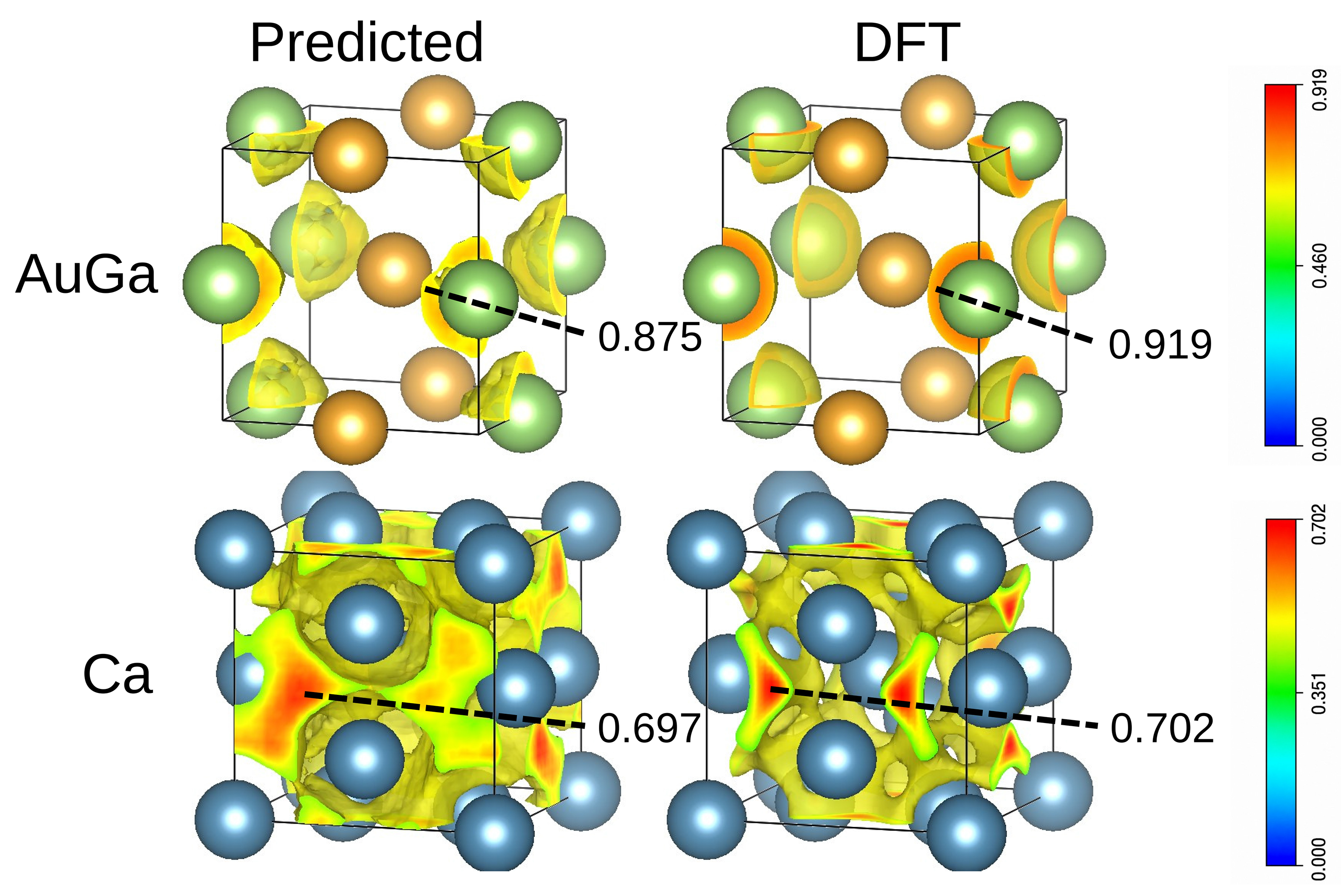
Figure 4. Predicted and DFT reference ELF fields for representative AuGa and Ca templates. Isosurfaces are rendered at ELF = 0.70 for AuGa and ELF = 0.55 for Ca. Surface color represents ELF values on the row-specific scales shown at right. Au, Ga, and Ca atoms are shown in gold, green, and blue, respectively. Although AuGa has the larger scalar global maximum, it does not form a pronounced basin in an open interstitial region; Ca exhibits a clear open-interstitial ELF basin. The dashed leaders identify the global ELF maxima and report their values. DFT: Density functional theory; ELF: electron localization function.
Hydride-derived template-screening case study
The screened structures were metal-only sublattices derived from known high-pressure superhydride prototypes. Construction began with parent hydride scaffolds. Hydrogen atoms were removed while the metal-site geometry was retained, and the metal sites were reassigned to mono-element or balanced binary element combinations. This procedure implements a chemical-template screening strategy in which the metal sublattice is evaluated for interstitial localization features that could template hydrogen networks before explicit hydrogen insertion.
Figure 5 summarizes 50,000 evaluated structures spanning 50 parent hydride formulas, 28 space groups, and pressure labels from 50 to 300 GPa. The 200 GPa parent-pressure bin contributes the largest number of structures. Additional information for this evaluation set is provided in Supplementary Table 8.
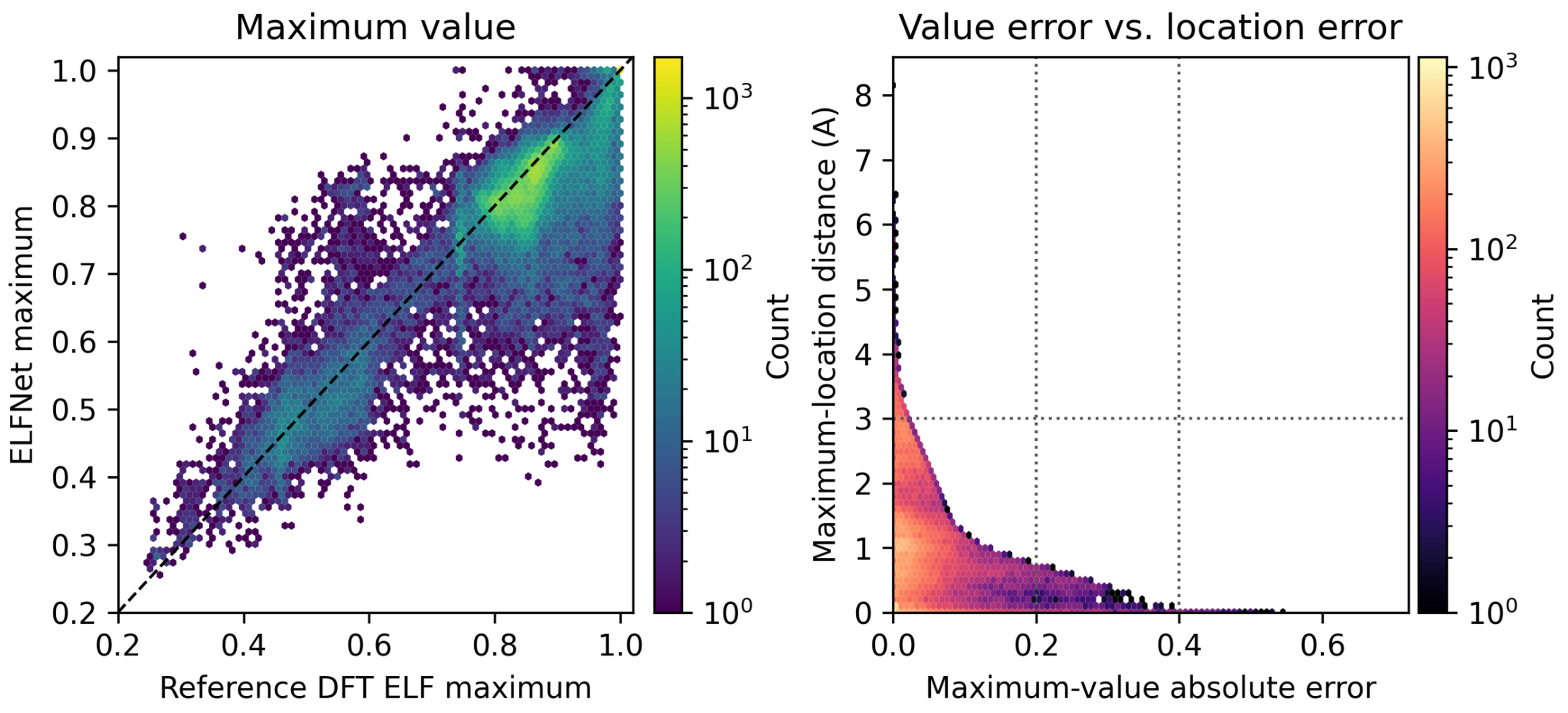
Figure 5. Maximum-value and maximum-location performance over the 50,000-structure hydride-derived template set. Left: parity plot comparing predicted and DFT reference global ELF maxima; the dashed line indicates perfect agreement. Right: absolute error in the maximum ELF value versus the real-space distance between predicted and DFT maximum locations. Both panels use logarithmic color density to indicate the number of structures in each bin. DFT: Density functional theory; ELF: electron localization function.
The mapping between the 50 parent hydride formulas and 55 prototype labels is listed in Supplementary Table 9.
Maximum-value and maximum-location performance
For each template, the DFT and ELFNet ELF grids were reduced to two screening metrics: the value of the global ELF maximum and the real-space distance between the predicted and DFT maximum locations. The maximum-value metric tests whether ELFNet recovers the amplitude of the strongest localization feature. The maximum-location metric tests whether that feature appears in the same region of the unit cell as the DFT reference. These metrics are complementary because a prediction can closely match the maximum ELF value while placing it in a different local basin, or it can place the maximum near the DFT reference location while under- or overestimating its value.
Figure 5 summarizes the template screening evaluation. The left panel compares the predicted and reference global ELF maxima, and the right panel compares maximum-value absolute error with maximum-location distance. The high density of structures with small value errors and small location distances shows that many templates are suitable for first-stage ranking, while the broader tails identify lower-confidence cases that should be prioritized for direct DFT validation if they appear chemically promising.
Across the 50,000-template set, the median absolute error in the global ELF maximum was 0.0268, and the median maximum-location distance was 0.895 Å. The corresponding 95th-percentile values were 0.1577 and 2.845 Å, respectively. At the thresholds shown in Figure 5, 93.57% of structures had both a maximum-value error no greater than 0.20 and a maximum-location distance no greater than 3 Å. These results show that the selected set is concentrated in the low-error region relevant to first-stage screening, while the remaining tail identifies lower-confidence cases for direct DFT validation. Large location errors should not necessarily be interpreted as complete field failures because the global maximum can shift between nearly equivalent localization basins. Additional percentile statistics and screening-threshold region counts are provided in Supplementary Table 10.
Pressure-stratified medians remained within the screening thresholds in every bin, with maximum-value errors no greater than 0.0361 and maximum-location distances no greater than 1.296 Å. The 160 GPa bin had the largest median location distance and the 300 GPa bin the largest median maximum-value error, but both remained within threshold; the aggregate result is therefore not solely a 200 GPa effect. Results are reported in Supplementary Table 11.
Among the 3,214 threshold failures, 1,515 exceeded only the maximum-value threshold, and 1,699 exceeded only the maximum-location threshold. No structure exceeded both thresholds. Pressure-stratified failure rates ranged from 2.36% at 100 GPa to 13.56% at 160 GPa. Failure rates also rose with structural and spatial complexity: from approximately 4% for one- or two-metal-site structures to 13.17% for eight-site structures and 26.57% for twelve-site structures, and from 3%-5% in the two smallest grid-volume quartiles to 9%-10% in the two largest. This pattern is consistent with increasing peak-location ambiguity. Element enrichments were confounded by pressure, scaffold, space group, and co-occurring elements and should not be interpreted as causal. Supplementary Tables 10 and 11 provide additional threshold-region counts and pressure-stratified summaries.
Cost of DFT ELF generation and model inference
To test whether ELFNet provides a practical timing advantage for screening, we compared fixed-geometry DFT ELF generation and ELFNet prediction for the same 50,000-structure evaluation set. For VASP, the final Total CPU time used (sec) and Elapsed time (sec) fields were parsed from each OUTCAR. The VASP calculations excluded ionic relaxation. Each calculation used eight MPI ranks, with up to six calculations running concurrently within a 48-task allocation on Intel Xeon Gold 6342 CPU nodes.
The ELFNet benchmark measured per-structure elapsed time from reading the benchmark input/reference ELFCAR through SAD construction, model inference, and writing the predicted ELFCAR. The input read supplied structure and grid metadata for the benchmark; a deployment workflow can instead begin from a structure file. Inference used one node containing four NVIDIA A100-SXM4-80GB GPUs and 32 CPU cores, with the evaluation set divided among four single-GPU processes. Because both workflows used concurrent execution, the reported totals are sums of per-structure timer values rather than the elapsed wall time of either complete campaign.
Summed over the evaluation set, the VASP Total CPU time used fields were 922.6 h and the VASP Elapsed time fields were 935.3 h. The 922.6 h quantity is a sum of VASP timer fields and is not scheduler-accounted core-hours. The full ELFNet inference-through-write pipeline required 2.67 h of summed per-structure elapsed time. Using elapsed time consistently, the mean per-structure values were 67.34 s for VASP ELF generation and 0.192 s for the complete ELFNet pipeline. Their ratio corresponds to an approximately 350-fold reduction in summed per-structure elapsed time on the specified CPU and GPU systems. This is a hardware-specific timing ratio rather than a hardware-normalized compute-efficiency metric or a measured full-campaign wall-clock speedup.
The model forward pass accounted for 18.5 min of aggregate processing time; much of the end-to-end pipeline time arose from input/output and preprocessing. In a production screening workflow, maxima could be evaluated directly from predicted tensors, with full ELFCAR files written only for selected candidates. Additional timing definitions and values are provided in Supplementary Table 12.
Discussion, limitations, and outlook
This work frames ELF generation as a structure-to-field learning problem for high-pressure chemical-template screening. In the chemical-template picture, interstitial ELF basins in the metal sublattice indicate where the lattice may support the formation of dense hydrogen networks. The results show that a periodic full-grid residual network can learn a useful SAD-to-ELF mapping and apply it to large template libraries. This shifts ELF analysis from a post-processing step after DFT toward a front-end screen for prioritizing candidate metal templates.
The dataset design helps explain this screening behavior. It was built for volumetric ELF learning, not only for energy and force prediction. Its pressure-targeted structures expose the model to changes in localization fields under compression, making the dataset more relevant than one limited to equilibrium or near-equilibrium cells. The broad element coverage also supports exploratory searches beyond conventional ambient-pressure chemistry, including elements such as noble gases, lanthanides, and actinides, whose bonding behavior can change substantially under compression.
The hydride-derived template-screening case study tests the intended use of the model directly. By applying ELFNet to metal-only sublattices derived from known superhydride prototypes, the workflow evaluates whether a candidate metal framework produces interstitial localization features before explicit hydrogen insertion. The qualitative AuGa and Ca examples show that the predicted fields can distinguish whether localization forms a pronounced basin in an open interstitial region. The maximum-value and maximum-location metrics provide complementary checks, but the scalar maximum alone does not determine template character.
This evaluation is aligned with the composite training objective, which combines full-field reconstruction with explicit sensitivity to sparse high-ELF basins through the adaptive peak term. Cases with large value or location errors should therefore be treated as lower-confidence candidates and prioritized for direct DFT validation if they remain chemically promising.
Several methodological choices should be interpreted in the context of this screening goal. The reference ELFs were generated with PBE, so the predicted fields represent a consistent PBE-level ELF topology rather than a functional-independent electronic descriptor. The 96-structure r2SCAN cross-check showed only modest changes in error and retained useful screening agreement across the change in functional. Templates near screening thresholds should nevertheless receive direct higher-level validation. In addition, ELFNet enforces periodicity through circular padding but does not explicitly enforce crystallographic point-group or space-group symmetry. For a front-end screening model, this is acceptable because the central requirement is to recover the presence, approximate magnitude, and location of high-ELF basins that motivate follow-up DFT calculations.
Other limitations are related to the scope of the training data and the target property. The model was trained on compact unary and binary high-pressure prototypes, while the screening case study applies it to hydride-derived metal scaffolds with larger and more varied metal sublattices. Further validation on complete hydrides and larger multicomponent systems is therefore needed. ELFNet also predicts only the ELF field. It does not determine thermodynamic stability, dynamical stability, metallicity, electron–phonon coupling, or superconducting critical temperature, so promising templates still require downstream first-principles validation.
ELFNet is intended as a first-stage electronic screening tool rather than a substitute for stability or superconductivity calculations. It ranks hydrogen-free metal templates by their predicted interstitial localization. For selected templates, candidate hydrogen arrangements can then be generated through targeted or active-learning-accelerated crystal-structure searches, generative crystal models, or conditional structure-inpainting methods[28,29,31,65]. The resulting complete hydrides require structural relaxation and evaluation of thermodynamic stability, dynamical stability, electronic structure, electron–phonon coupling, and superconducting critical temperature.
The timing comparison supports the practical value of ELFNet as a screening step. On the reported hardware, the complete workflow reduced summed per-structure elapsed time by approximately 350-fold relative to fixed-geometry VASP ELF generation while including benchmark-input reading, SAD construction, model inference, and predicted ELFCAR writing. This ratio is hardware-specific; the elapsed time of a complete screening campaign also depends on concurrency, load balancing, storage performance, and scheduler conditions. In a production workflow, ranking metrics could be evaluated directly from predicted tensors, with full ELFCAR files saved only for selected structures.
Future work should focus on improving candidate ranking and identifying cases outside the training domain. Uncertainty-aware screening and active learning could prioritize structures whose predicted ELF fields are most likely to require additional DFT data[29,30]. Optional symmetry averaging at inference time could reduce small symmetry-breaking artifacts when higher-fidelity fields are needed. Joint prediction of related electronic descriptors, such as charge density, could also provide a broader picture of the electronic structure used in high-pressure template screening. Future extensions could pair ELFNet with recent equivariant and grid-based electron-density models to combine ELF-based localization screening with complementary charge-density information[32-36].
CONCLUSIONS
We developed ELFNet, a structure-to-field framework for predicting DFT-derived ELF fields from computationally inexpensive SAD inputs. The work combines a pressure-targeted PBE ELF dataset containing 326,009 converged unary and binary prototype structures across 89 elements with a periodic full-grid residual network trained with a composite objective to recover high-ELF localization features relevant to chemical-template screening under pressure.
The hydride-derived template-screening case study demonstrates the practical value of this approach. Applied to 50,000 metal-only templates derived from known high-pressure superhydride prototypes, ELFNet retained chemically meaningful differences in the spatial topology of interstitial localization, including whether a pronounced basin forms in an open interstitial region. Performance was evaluated using global maximum ELF values and maximum-location errors against DFT reference ELFs. On the reported hardware, the full inference-through-write workflow reduced summed per-structure elapsed time by approximately 350-fold relative to fixed-geometry VASP ELF generation. These results establish ELF-based chemical-template analysis as a low-cost front-end screening method for prioritizing candidate metal templates before downstream first-principles validation.
DECLARATIONS
Authors’ contributions
Contributed to the conception and design of the study, data curation, formal analysis, investigation, methodology, software, validation, visualization, and manuscript drafting and revision: Ellis, A.
Contributed to data curation, formal analysis, investigation, and manuscript drafting and revision: Ellis, S.
Contributed to the conception and design of the study, funding acquisition, project administration, resources, supervision, and manuscript revision: Miao, M.
All authors reviewed and approved the final manuscript.
Availability of data and materials
The ELFNet source code, bundled checkpoint, model documentation, training and inference scripts, configuration files, and example POSCAR files are available at https://github.com/Austin243/ELFNet. The code version used for this study is the public repository state at the time of submission. Data supporting this article, including the pressure-targeted high-pressure PBE ELF training dataset, training-triplet files, and hydride-derived inference and screening data with provenance, are available from the public Zenodo record at https://zenodo.org/records/20481629. Supplementary Materials provide pressure-targeting, dataset, training-dynamics, template-set, Figure 5 performance, and timing summaries.
AI and AI-assisted tools statement
During preparation of this manuscript, generative AI tools, including ChatGPT (OpenAI), were used solely to assist with language editing, organization, and formatting. Figure 3 was created with the assistance of Gemini Nano Banana Pro. The authors reviewed and edited all AI-assisted content, verified Figure 3 for scientific accuracy, and accept full responsibility for the manuscript. No AI tool was used to generate primary scientific data, perform the reported analyses, or draw the scientific conclusions.
Financial support and sponsorship
This work was supported by the U.S. Department of Defense Research and Education Program for Historically Black Colleges and Universities and Minority-Serving Institutions Basic Research Funding (No. W911NF2310232); the National Science Foundation (DMR-1848141 and OAC-2117956); the Camille and Henry Dreyfus Foundation; and California State University Research, Scholarship and Creative Activity awards. The funding bodies had no role in the study design, data collection, analysis, interpretation, preparation of the manuscript, or decision to submit the work for publication.
Conflicts of interest
All authors declared that there are no conflicts of interest.
Ethical approval and consent to participate
Not applicable.
Consent for publication
Not applicable.
Copyright
© The Author(s) 2026.
Supplementary Materials
REFERENCES
1. Becke, A. D.; Edgecombe, K. E. A simple measure of electron localization in atomic and molecular systems. J. Chem. Phys. 1990, 92, 5397-403.
2. Silvi, B.; Savin, A. Classification of chemical bonds based on topological analysis of electron localization functions. Nature 1994, 371, 683-6.
3. Savin, A.; Nesper, R.; Wengert, S.; Fässler, T. F. ELF: the electron localization function. Angew. Chem. Int. Ed. Engl. 1997, 36, 1808-32.
4. Hilleke, K. P.; Bi, T.; Zurek, E. Materials under high pressure: a chemical perspective. Appl. Phys. A. 2022, 128, 441.
5. Ashcroft, N. W. Hydrogen dominant metallic alloys: high temperature superconductors? Phys. Rev. Lett. 2004, 92, 187002.
6. Drozdov, A. P.; Eremets, M. I.; Troyan, I. A.; Ksenofontov, V.; Shylin, S. I. Conventional superconductivity at 203 kelvin at high pressures in the sulfur hydride system. Nature 2015, 525, 73-6.
7. Duan, D.; Liu, Y.; Tian, F.; et al. Pressure-induced metallization of dense (H2S)2H2 with high-Tc superconductivity. Sci. Rep. 2014, 4, 6968.
8. Li, Y.; Hao, J.; Liu, H.; Li, Y.; Ma, Y. The metallization and superconductivity of dense hydrogen sulfide. J. Chem. Phys. 2014, 140, 174712.
9. Drozdov, A. P.; Kong, P. P.; Minkov, V. S.; et al. Superconductivity at 250 K in lanthanum hydride under high pressures. Nature 2019, 569, 528-31.
10. Somayazulu, M.; Ahart, M.; Mishra, A. K.; et al. Evidence for superconductivity above 260 K in lanthanum superhydride at megabar pressures. Phys. Rev. Lett. 2019, 122, 027001.
11. Errea, I.; Belli, F.; Monacelli, L.; et al. Quantum crystal structure in the 250-kelvin superconducting lanthanum hydride. Nature 2020, 578, 66-9.
12. Wang, H.; Tse, J. S.; Tanaka, K.; Iitaka, T.; Ma, Y. Superconductive sodalite-like clathrate calcium hydride at high pressures. Proc. Natl. Acad. Sci. U. S. A. 2012, 109, 6463-6.
13. Peng, F.; Sun, Y.; Pickard, C. J.; Needs, R. J.; Wu, Q.; Ma, Y. Hydrogen clathrate structures in rare earth hydrides at high pressures: possible route to room-temperature superconductivity. Phys. Rev. Lett. 2017, 119, 107001.
14. Ma, L.; Wang, K.; Xie, Y.; et al. High-temperature superconducting phase in clathrate calcium hydride CaH6 up to 215 K at a Pressure of 172 GPa. Phys. Rev. Lett. 2022, 128, 167001.
15. Li, Z.; He, X.; Zhang, C.; et al. Superconductivity above 200 K discovered in superhydrides of calcium. Nat. Commun. 2022, 13, 2863.
16. Bi, J.; Nakamoto, Y.; Zhang, P.; et al. Giant enhancement of superconducting critical temperature in substitutional alloy (La,Ce)H9. Nat. Commun. 2022, 13, 5952.
17. Chen, W.; Huang, X.; Semenok, D. V.; et al. Enhancement of superconducting properties in the La-Ce-H system at moderate pressures. Nat. Commun. 2023, 14, 2660.
18. Chen, L. C.; Luo, T.; Cao, Z. Y.; et al. Synthesis and superconductivity in yttrium-cerium hydrides at high pressures. Nat. Commun. 2024, 15, 1809.
19. Shan, P.; Ma, L.; Yang, X.; et al. Molecular hydride superconductor BiH4 with Tc up to 91 K at 170 GPa. J. Am. Chem. Soc. 2025, 147, 4375-81.
20. Liu, P.; Zhuang, Q.; Xu, Q.; Cui, T.; Liu, Z. Mechanism of high-temperature superconductivity in compressed H2-molecular-type hydride. Sci. Adv. 2025, 11, eadt9411.
21. Zhao, W.; Ellis, A.; Duan, D.; et al. Unlocking the origin of high‐temperature superconductivity in molecular hydrides at moderate pressures. Adv. Funct. Mater. 2025, 35, 2415910.
22. Sun, Y.; Miao, M. Chemical templates that assemble the metal superhydrides. Chem 2023, 9, 443-59.
23. Belli, F.; Novoa, T.; Contreras-García, J.; Errea, I. Strong correlation between electronic bonding network and critical temperature in hydrogen-based superconductors. Nat. Commun. 2021, 12, 5381.
24. Sun, Y.; Ellis, A.; Chen, X.; Miao, M. Batch discovery of complex metal superhydrides via an effective machine learning method structured by chemical template concept. J. Am. Chem. Soc. 2025, 147, 40407-19.
25. Glass, C. W.; Oganov, A. R.; Hansen, N. USPEX - evolutionary crystal structure prediction. Comput. Phys. Commun. 2006, 175, 713-20.
26. Wang, Y.; Lv, J.; Zhu, L.; Ma, Y. Crystal structure prediction via particle-swarm optimization. Phys. Rev. B. 2010, 82, 094116.
27. Merchant, A.; Batzner, S.; Schoenholz, S. S.; Aykol, M.; Cheon, G.; Cubuk, E. D. Scaling deep learning for materials discovery. Nature 2023, 624, 80-5.
28. Zeni, C.; Pinsler, R.; Zügner, D.; et al. A generative model for inorganic materials design. Nature 2025, 639, 624-32.
29. Hessmann, S. S. P.; Schütt, K. T.; Gebauer, N. W. A.; Gastegger, M.; Oguchi, T.; Yamashita, T. Accelerating crystal structure search through active learning with neural networks for rapid relaxations. npj. Comput. Mater. 2025, 11, 44.
30. Kulichenko, M.; Barros, K.; Lubbers, N.; et al. Uncertainty-driven dynamics for active learning of interatomic potentials. Nat. Comput. Sci. 2023, 3, 230-9.
31. Conway, L. J.; Pickard, C. J. Accelerating crystal structure prediction using data‐derived potentials: high‐pressure binary hydrides. Ann. Phys. 2026, 538, e00608.
32. Jørgensen, P. B.; Bhowmik, A. Equivariant graph neural networks for fast electron density estimation of molecules, liquids, and solids. npj. Comput. Mater. 2022, 8, 183.
33. Lv, T.; Zhong, Z.; Liang, Y.; Li, F.; Huang, J.; Zheng, R. Deep charge: deep learning model of electron density from a one-shot density functional theory calculation. Phys. Rev. B. 2023, 108, 235159.
34. Koker, T.; Quigley, K.; Taw, E.; Tibbetts, K.; Li, L. Higher-order equivariant neural networks for charge density prediction in materials. npj. Comput. Mater. 2024, 10, 161.
35. Qin, X.; Lv, T.; Zhong, Z. EAC-Net: predicting real-space charge density via equivariant atomic contributions. J. Chem. Theory. Comput. 2026, 22, 4813-21.
36. Li, C.; Sharir, O.; Yuan, S.; Chan, G. K. Image super-resolution inspired electron density prediction. Nat. Commun. 2025, 16, 4811.
37. Wang, Z.; Gong, Y.; Evans, M. L.; et al. Machine learning-accelerated discovery of A2BC2 ternary electrides with diverse anionic electron densities. J. Am. Chem. Soc. 2023, 145, 26412-24.
38. Dewaele, A.; Worth, N.; Pickard, C. J.; et al. Synthesis and stability of xenon oxides Xe2O5 and Xe3O2 under pressure. Nat. Chem. 2016, 8, 784-90.
39. Dong, X.; Oganov, A. R.; Goncharov, A. F.; et al. A stable compound of helium and sodium at high pressure. Nat. Chem. 2017, 9, 440-5.
40. Kaplan, A. D.; Liu, R.; Qi, J.; et al. A foundational potential energy surface dataset for materials. arXiv 2025, arXiv:2503.04070. Available online: https://doi.org/10.48550/arXiv.2503.04070. (accessed 2026-08-20).
41. Kuner, M. C.; Kaplan, A. D.; Persson, K. A.; Asta, M.; Chrzan, D. C. MP-ALOE: an r2SCAN dataset for universal machine learning interatomic potentials. npj. Comput. Mater. 2025, 11, 352.
42. Deng, B.; Zhong, P.; Jun, K.; et al. CHGNet as a pretrained universal neural network potential for charge-informed atomistic modelling. Nat. Mach. Intell. 2023, 5, 1031-41.
43. Barros-Luque, L.; Shuaibi, M.; Fu, X.; et al. The Open Materials 2024 (OMat24) inorganic materials dataset and models. Nat. Comput. Sci. 2026, 6, 642-52.
44. Chen, C.; Ong, S. P. A universal graph deep learning interatomic potential for the periodic table. Nat. Comput. Sci. 2022, 2, 718-28.
45. Zhang, D.; Liu, X.; Zhang, X.; et al. DPA-2: a large atomic model as a multi-task learner. NPJ. Comput. Mater. 2024, 10, 293.
46. Batzner, S.; Musaelian, A.; Sun, L.; et al. E(3)-equivariant graph neural networks for data-efficient and accurate interatomic potentials. Nat. Commun. 2022, 13, 2453.
47. Musaelian, A.; Batzner, S.; Johansson, A.; et al. Learning local equivariant representations for large-scale atomistic dynamics. Nat. Commun. 2023, 14, 579.
48. Batatia, I.; Kovács, D. P.; Simm, G. N. C.; Ortner, C.; Csányi, G. MACE: higher order equivariant message passing neural networks for fast and accurate force fields. arXiv 2022, arXiv:2206.07697. Available online: https://doi.org/10.48550/arXiv.2206.07697. (accessed 2026-08-20).
49. Batatia, I.; Benner, P.; Chiang, Y.; et al. A foundation model for atomistic materials chemistry. J. Chem. Phys. 2025, 163, 184110.
50. Lysogorskiy, Y.; Bochkarev, A.; Drautz, R. Graph atomic cluster expansion for foundational machine learning interatomic potentials. npj. Comput. Mater. 2026, 12, 114.
51. Barlow, R. E.; Bartholomew, D. J.; Bremner, J. M.; Brunk, H. D. Statistical inference under order restrictions. The theory and application of isotonic regression. John Wiley & Sons: London and New York, 1972. https://books.google.com/books/about/Statistical_Inference_Under_Order_Restri.html?id=DEamySUDBWcC&utm_source. (accessed 2026-08-20).
52. Kohn, W.; Sham, L. J. Self-consistent equations including exchange and correlation effects. Phys. Rev. 1965, 140, A1133.
53. Perdew, J. P.; Burke, K.; Ernzerhof, M. Generalized gradient approximation made simple. Phys. Rev. Lett. 1996, 77, 3865.
54. Kresse, G.; Furthmüller, J. Efficient iterative schemes for ab initio total-energy calculations using a plane-wave basis set. Phys. Rev. B. 1996, 54, 11169.
56. Kresse, G.; Joubert, D. From ultrasoft pseudopotentials to the projector augmented-wave method. Phys. Rev. B. 1999, 59, 1758.
57. Furness, J. W.; Kaplan, A. D.; Ning, J.; Perdew, J. P.; Sun, J. Accurate and numerically efficient r2SCAN meta-generalized gradient approximation. J. Phys. Chem. Lett. 2020, 11, 8208-15.
58. Hirshfeld, F. L. Bonded-atom fragments for describing molecular charge densities. Theoret. Chim. Acta. 1977, 44, 129-38.
59. He, K.; Zhang, X.; Ren, S.; Sun, J. Deep residual learning for image recognition. In 2016 IEEE Conference on Computer Vision and Pattern Recognition (CVPR), Las Vegas, USA. Jun 27-30, 2016. IEEE; 2016. pp 770-8.
60. Wu, Y.; He, K. Group normalization. In Ferrari, V.; Hebert, M.; Sminchisescu, C.; Weiss, Y.; editors. Computer Vision - ECCV 2018. Cham: Springer International Publishing; 2018. pp. 3-19.
61. Hendrycks, D.; Gimpel, K. Gaussian error linear units (GELUs). arXiv 2016, arXiv:1606.08415. Available online: https://doi.org/10.48550/arXiv.1606.08415. (accessed 2026-08-20).
62. Hu, J.; Shen, L.; Sun, G. Squeeze-and-excitation networks. In 2018 IEEE/CVF Conference on Computer Vision and Pattern Recognition, Salt Lake City, USA. Jun 18-23, 2018. IEEE; 2018. pp 7132-41.
63. Woo, S.; Park, J.; Lee, J. Y.; Kweon, I. S. CBAM: convolutional block attention Module. In: Ferrari, V.; Hebert, M.; Sminchisescu, C.; Weiss, Y.; editors. Computer Vision - ECCV 2018. Cham: Springer International Publishing; 2018. pp. 3-19.
64. Cipolla, R.; Gal, Y.; Kendall, A. Multi-task learning using uncertainty to weigh losses for scene geometry and semantics. In 2018 IEEE/CVF Conference on Computer Vision and Pattern Recognition, Salt Lake City, USA. Jun 18-23, 2018. IEEE; 2018. pp. 7482-91.
Cite This Article
 Open Access
How to Cite
Ellis, A.; Ellis, S.; Miao, M. Prediction of electron localization functions from superposed atomic densities for accelerated superhydride discovery. J. Mater. Inf. 2026, 6, 45. https://dx.doi.org/10.20517/jmi.2026.44
Download Citation
If you have the appropriate software installed, you can download article citation data to the citation manager of your choice. Simply select your manager software from the list below and click on download.
Export Citation File
Type of Import
Tips on Downloading Citation
Citation Manager File Format
Type of Import
Direct Import: When the Direct Import option is selected (the default state), a dialogue box will give you the option to Save or Open the downloaded citation data. Choosing Open will either launch your citation manager or give you a choice of applications with which to use the metadata. The Save option saves the file locally for later use.
Indirect Import: When the Indirect Import option is selected, the metadata is displayed and may be copied and pasted as needed.
About This Article
Copyright

Data & Comments
Data
0











Comments
Comments must be written in English. Spam, offensive content, impersonation, and private information will not be permitted. If any comment is reported and identified as inappropriate content by OAE staff, the comment will be removed without notice. If you have any queries or need any help, please contact us at [email protected].