

fig3
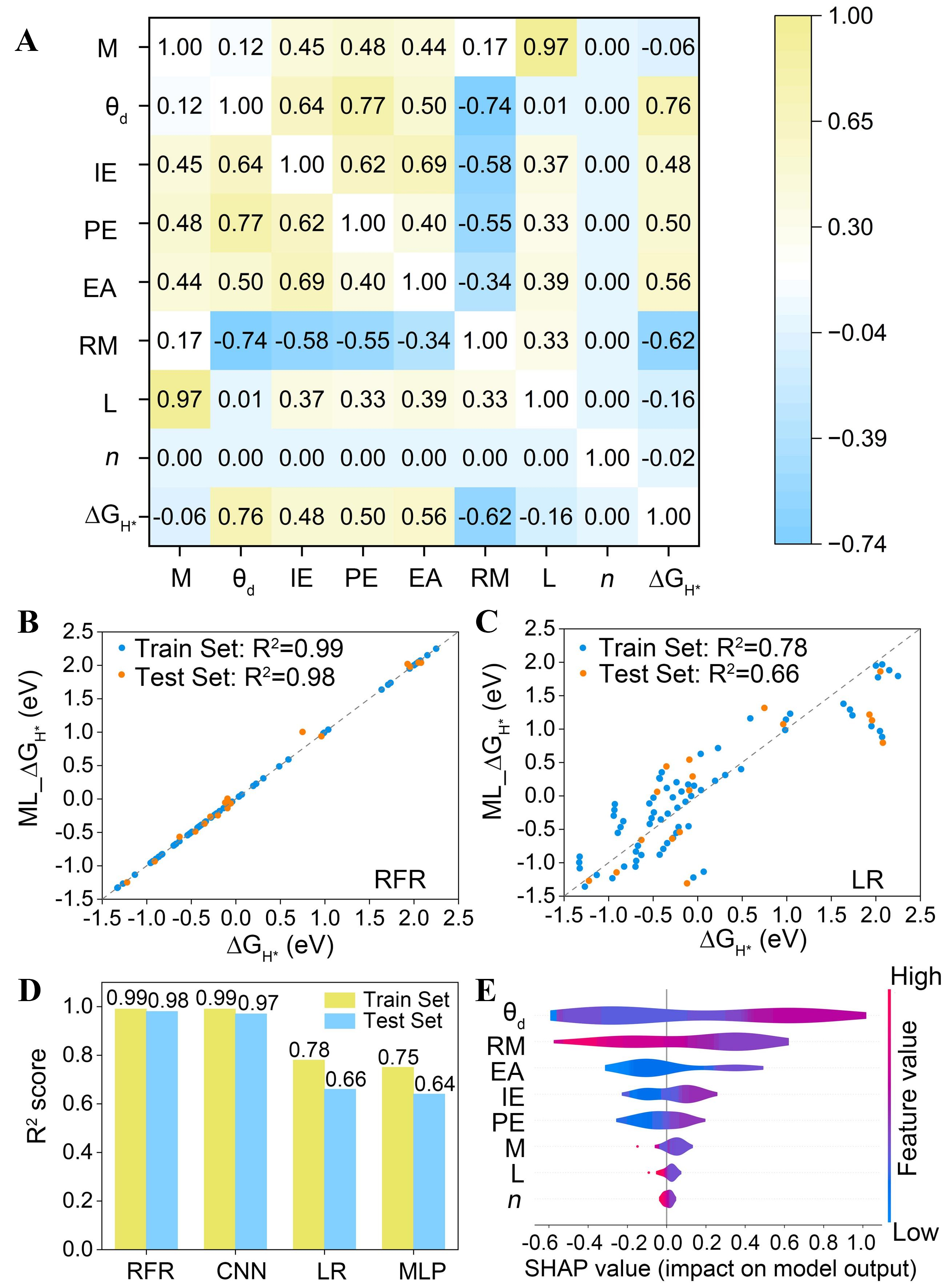
Figure 3. (A) Heatmap of Pearson correlation coefficients between the selected features and ∆GH*; (B) Comparison of the ∆GH* values predicted by the RFR model versus the DFT calculated values; (C) Comparison of the ∆GH* values predicted by the LR model versus the DFT calculated values; (D) R2 for different models; (E) Density map of SHAP values for all features. M: Atomic mass; θd: d-electron count; PE: Pauling electronegativity; IE: first ionization energy; EA: electron affinity; RM: covalent radius; L: period; n: carbon nanotube chirality index; ∆GH*: Gibbs free energy of hydrogen adsorption; R2: coefficient of determination; ML: machine learning; RFR: Random Forest Regression; LR: Linear Regression; SHAP: SHapley Additive exPlanations; CNN: Convolutional Neural Networks; MLP: Multilayer Perceptrons; DFT: density functional theory.