fig5
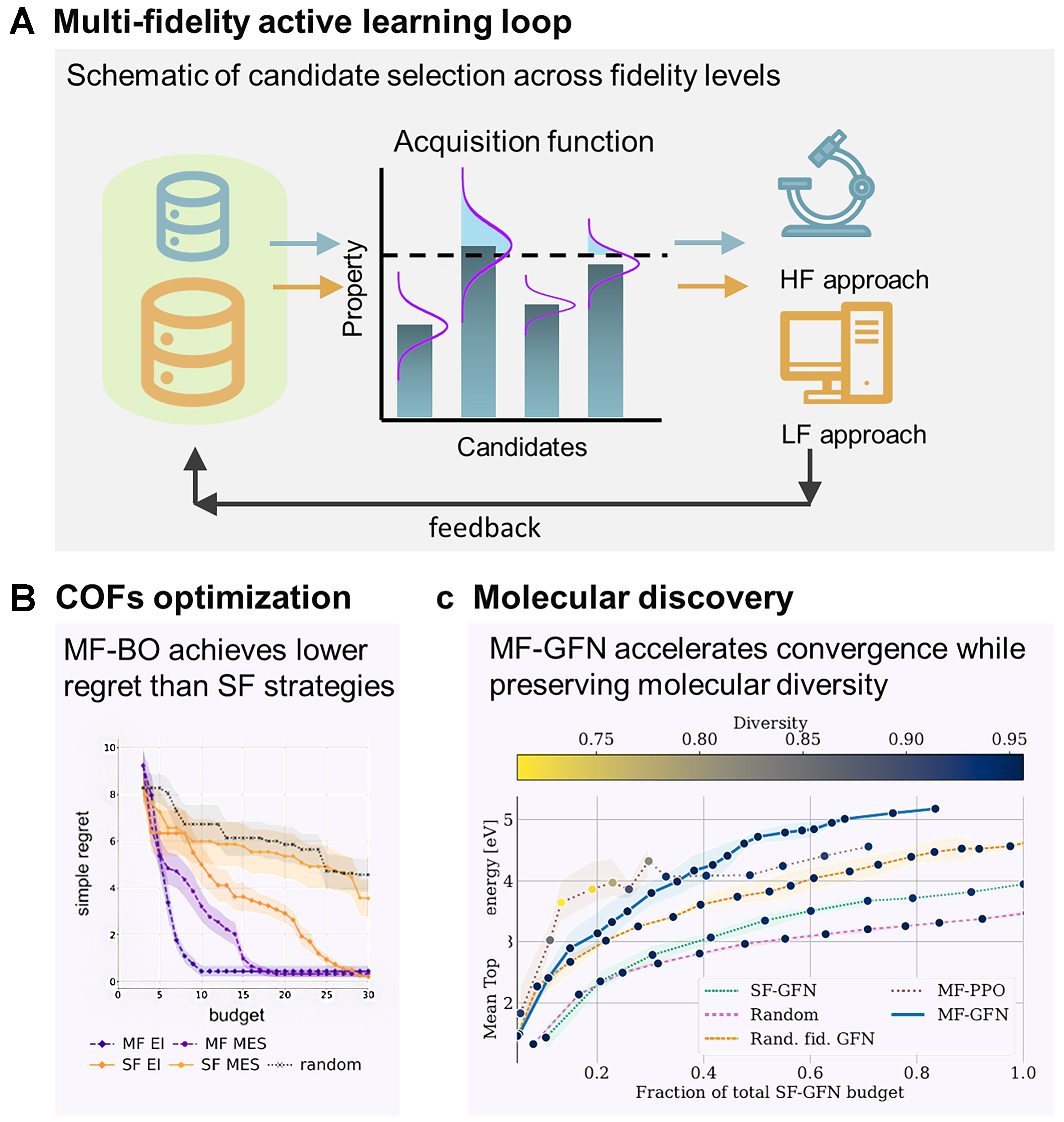
Figure 5. MF active learning and adaptive sampling in materials science. (A) Active-learning loop: schematic of candidate selection and fidelity allocation, where promising candidates are evaluated with costly HF methods and less valuable candidates with inexpensive LF approximations; (B) COF optimization: MF active learning achieves lower simple regret for xenon-krypton selectivity compared to SF and random baselines[60]; (C) Molecular discovery: MF-GFN accelerate convergence toward diverse molecules with desirable electron affinity compared with SF and random-fidelity approaches[96]. Together, these examples illustrate how MF active learning dynamically balances exploration, exploitation, and cost to accelerate discovery across molecular and porous materials. MF: Multi-fidelity; HF: high fidelity; LF: low fidelity; SF: single-fidelity; MF-BO: multi-fidelity Bayesian optimization; COF: covalent organic framework; GFN: generative flow network; MF-GFN: multi-fidelity generative flow network; SF-GFN: single-fidelity generative flow network; PPO: proximal policy optimization; MF-PPO: multi-fidelity proximal policy optimization; MES: max-value entropy search; MF-MES: multi-fidelity max-value entropy search; EI: expected improvement; SFEI: single-fidelity expected improvement.