
fig4
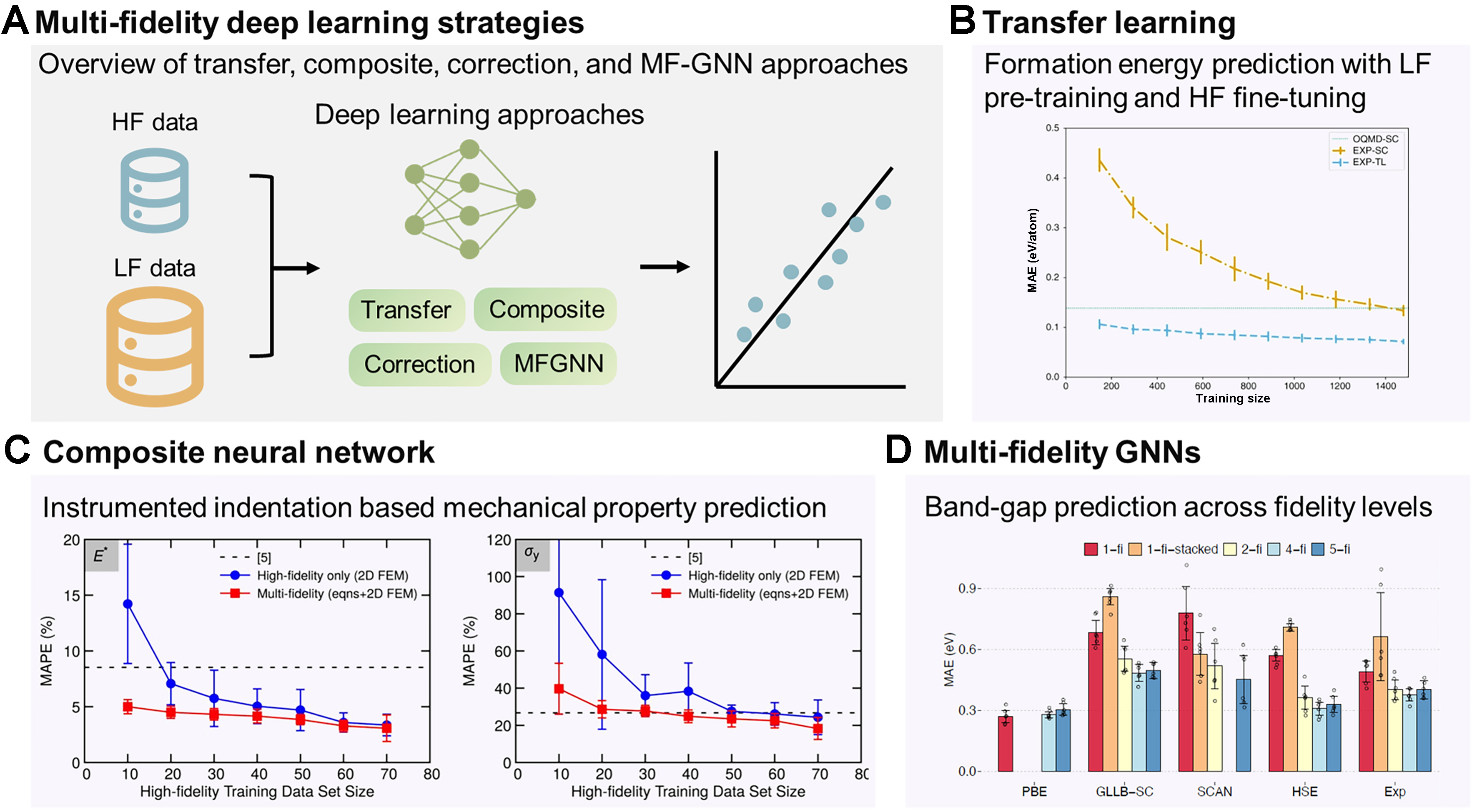
Figure 4. Deep learning-based MF frameworks for materials science. (A) Schematic overview of representative strategies: transfer learning, composite neural networks, correction learning, and MFGNN; (B) Transfer learning for formation energy prediction: performance comparison of SF models trained on the Open OQMD (LF, 341k entries) and EXP-TL. Incorporating LF knowledge reduces MAE across training sizes; results are obtained by 10-fold cross-validation, and error bars indicate the standard deviation (confidence interval) across folds[35]; (C) Composite neural network for extracting mechanical properties from indentation: MAPE as a function of training dataset size for the HF-only model and MF model, in comparison with the LF baseline (noted as [5])[30]. Reproduced from[30], © (2020) National Academy of Sciences. Distributed under the Creative Commons Attribution-NonCommercial-NoDerivatives 4.0 International (CC BY-NC-ND 4.0) license; image reused without modification; (D) MF graph neural network for band-gap prediction: comparison of MAE distributions across 1-fi, correction (1-fi-stacked), 2-fi, and MF (4-fi, 5-fi) models. LF data comprise PBE band gaps, while HF datasets include GLLB-SC, SCAN, HSE, and experimental values. Increasing fidelity integration systematically lowers prediction error[29]. Reproduced from[29] under the Creative Commons Attribution-ShareAlike (CC BY-SA 4.0) license. Together, these examples highlight the versatility of deep learning architectures in capturing nonlinear correlations and leveraging heterogeneous datasets for improved accuracy in MF learning. MF: Multi-fidelity; HF: high fidelity; LF: low fidelity; SF: single fidelity; GNN: graph neural network; MFGNN: multi-fidelity graph neural network; OQMD: Open Quantum Materials Database; TL: transfer learning; EXP-TL: experimental data (HF) with a transfer-learned model; MAE: mean absolute error; MAPE: mean absolute percentage error; PBE: Perdew-Burke-Ernzerhof (functional); GLLB-SC: Gritsenko-van Leeuwen-van Lenthe-Baerends solid-correlation (functional); SCAN: strongly constrained and appropriately normed (functional); HSE: Heyd-Scuseria-Ernzerhof (hybrid functional); 1-fi: single-fidelity; 2-fi: two-fidelity; 4-fi: four-fidelity; 5-fi: five-fidelity.