

Nonpersistent pesticide exposure and circulating sex hormones in postmenopausal women: evidence from NHANES 2013-2016
 0
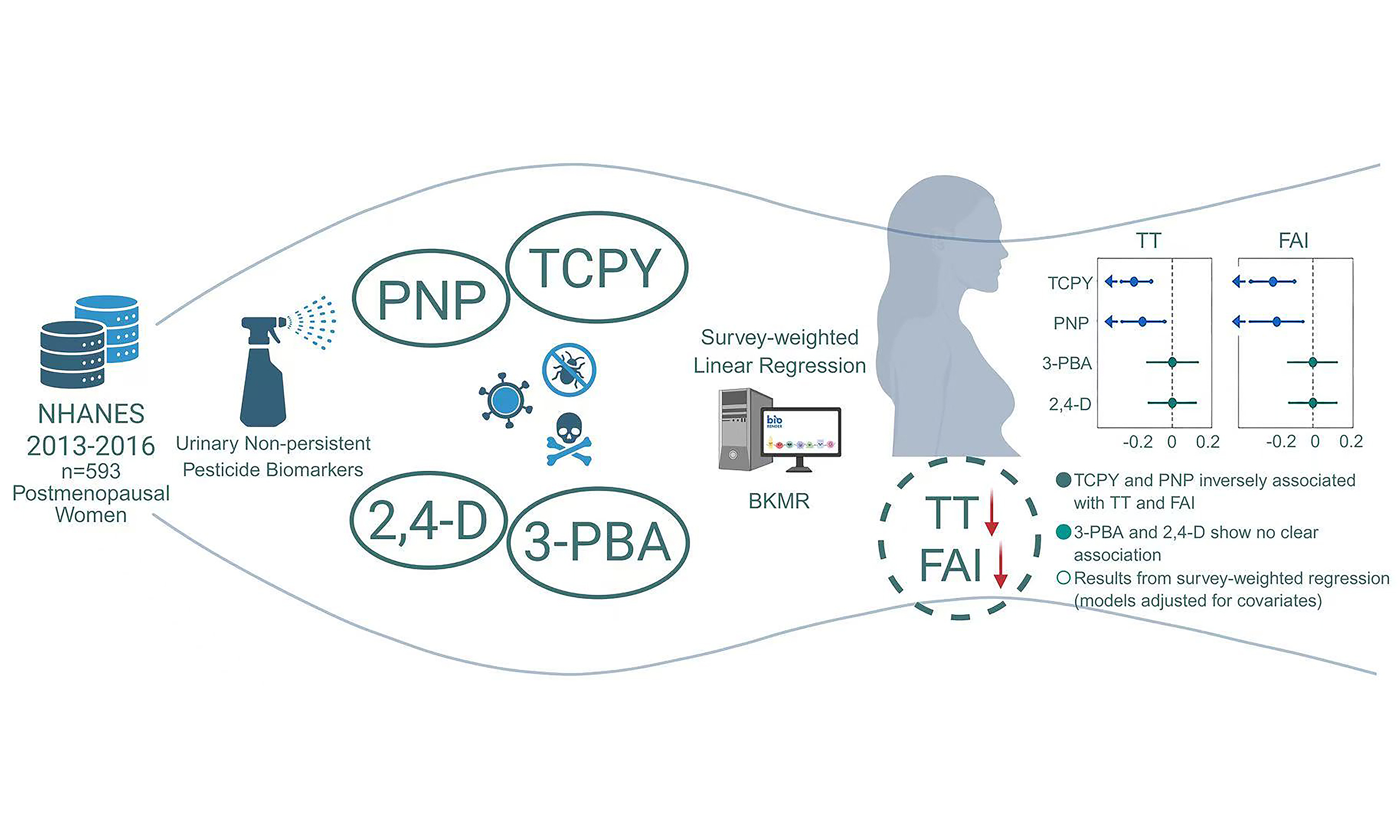
0 Graphical Abstract
Abstract
Non-persistent pesticides have been associated with altered sex-hormone profiles, but evidence among postmenopausal women remains limited. This cross-sectional study examined associations of individual urinary pesticide biomarkers and their mixture with circulating sex hormones among 593 postmenopausal women from the 2013-2016 National Health and Nutrition Examination Survey (NHANES). Survey-weighted linear regression evaluated individual biomarkers in a directed acyclic graph (DAG)-informed primary model and two progressively expanded sensitivity models incorporating lifestyle, clinical, and dietary covariates. Bayesian kernel machine regression (BKMR) evaluated overall mixture associations, biomarker-specific relative importance, and exploratory bivariate exposure-response patterns. In the primary weighted models, 3,5,6-trichloro-2-pyridinol (TCPY) and para-nitrophenol (PNP) were inversely associated with total testosterone (TT) and the free androgen index (FAI), and the directions were generally consistent across expanded models. No clear associations with estradiol (E2) or sex hormone-binding globulin (SHBG) were observed in the primary models. In BKMR, higher joint biomarker percentiles were associated with lower TT and FAI. PNP had the highest posterior inclusion probability (PIP) for TT (0.921), whereas PNP (0.607) and TCPY (0.523) had the highest PIPs for the FAI. These cross-sectional findings suggest inverse associations of the pesticide-biomarker mixture with androgen-related hormones, with PNP and TCPY showing the highest outcome-specific PIPs within the fitted BKMR models; however, causality cannot be established.
Keywords


 Download PDF
INTRODUCTION
Historically, persistent organochlorine pesticides (OCPs) were widely used for their effectiveness, but their persistence and bioaccumulation raised substantial environmental and health concerns. Modern pesticide use has shifted toward current-use compounds, including organophosphates, carbamates, pyrethroids, and phenoxy herbicides. Non-persistent pesticides are compounds with relatively short environmental and biological persistence that are generally metabolized and excreted more rapidly than persistent OCPs; however, lower persistence does not imply an absence of toxicity[1,2]. These pesticides are widely used in agricultural, residential, and occupational settings[3-7], and human exposure can occur through inhalation, ingestion, and dermal absorption[8-11]. Urinary biomarkers of several non-persistent pesticides are detectable in a large proportion of the general population[12,13].
Research has investigated associations between non-persistent pesticide exposure and alterations in sex-hormone profiles. For example, higher exposure to pyrethroid insecticides is significantly associated with alterations in adult levels of sex steroid hormones such as total testosterone (TT), sex hormone-binding globulin (SHBG), and free androgen index (FAI), suggesting potential endocrine-disrupting effects[14,15]; exposure to pyrethroid insecticides in rodent models is associated with impairment of the male reproductive system - including reduced serum TT, poorer sperm parameters, and damage to reproductive tissues, with oxidative stress proposed as a potential contributing pathway in experimental studies, suggesting endocrine-disrupting effects in animals[16]. However, in real-world scenarios, individuals are commonly exposed to complex mixtures of various pesticides. Consequently, the single-chemical approach may be limited by confounding from coexisting chemicals and may fail to capture potential interactive effects. Thus, our study focuses on the overall association of non-persistent pesticide mixtures with circulating sex hormones, an aspect that has received relatively little attention in prior research.
Exposure to non-persistent pesticides has also been associated with alterations in female reproductive endocrine development, including changes in pubertal timing[17]. Meanwhile, postmenopausal women with hormonal disturbances are more susceptible to environmental exposures and more prone to adverse outcomes[18]. However, the association between non-persistent pesticide exposure and sex hormone levels in this specific population remains understudied. Investigating this relationship is therefore of significant public health importance.
To address this gap, we conducted a cross-sectional analysis of postmenopausal women from the 2013-2016 National Health and Nutrition Examination Survey (NHANES) cycles with complete data on urinary pesticide biomarkers, circulating sex hormones, and relevant covariates. Survey-weighted linear regression estimated associations between individual urinary pesticide biomarkers and sex hormone outcomes, whereas Bayesian kernel machine regression (BKMR) evaluated overall mixture associations and relative biomarker importance. Covariate selection and the model hierarchy were informed by a study-specific directed acyclic graph (DAG), with additional adjustment for lifestyle, reproductive, hormone-use, and dietary factors.
EXPERIMENTAL
Study design and population
The NHANES is a survey program conducted by the National Center for Health Statistics (NCHS), which is part of the U.S. Centers for Disease Control and Prevention (CDC). It employs a stratified, multistage probability sampling design to recruit approximately 5,000 participants of all ages annually. Survey participants complete health interviews and physical examinations, and urine and blood samples are collected at the Mobile Examination Center (MEC). These data provide a crucial basis for understanding the health and nutritional status of the U.S. population. The study protocol of NHANES has been approved by the Institutional Review Board (IRB) of the NCHS, and all participants have signed an informed consent form. Detailed information about NHANES can be found on its official website (https://www.cdc.gov/nchs/nhanes/about_nhanes.htm).
This study utilized data from the 2013-2014 and 2015-2016 cycles of the NHANES, as they provided concurrent measurements of non-persistent pesticide exposure, serum sex hormone levels, and key covariates. Of the 19,357 NHANES participants, 1,077 were women aged 40 years or older with complete measurements of the four urinary pesticide biomarkers and four sex-hormone outcomes; 18,280 participants who did not meet these combined eligibility and data-completeness criteria were excluded. We then excluded 254 women who reported menstruation during the previous 12 months and were classified as not postmenopausal, leaving 823 women who met the postmenopausal criterion. An additional 230 participants with incomplete survey-design or covariate data were excluded, resulting in a final analytic sample of 593 postmenopausal women for the survey-weighted linear regression and BKMR analyses. The participant selection flowchart is presented in Supplementary Figure 1.
Exposure assessment
In the 2013-2016 NHANES cycles, we evaluated four urinary biomarkers with relatively high detection frequencies: 3-phenoxybenzoic acid (3-PBA), a common metabolite of pyrethroid insecticides; 3,5,6-trichloro-2-pyridinol (TCPY), a metabolite of chlorpyrifos; para-nitrophenol (PNP), a biomarker related to organophosphate pesticide exposure; and 2,4-dichlorophenoxyacetic acid (2,4-D), a phenoxy herbicide[19,20]. Detailed information on specimen collection, laboratory measurement procedures, detection limits, and quality-assurance and quality-control protocols is available in the corresponding cycle-specific NHANES laboratory documentation[21,22]; the key analytical parameters used in this study are summarized in Supplementary Note 1 and Supplementary Table 1.
Sex hormone assessment
Serum concentrations of TT, estradiol (E2), and SHBG were obtained from the publicly available NHANES laboratory datasets. The FAI was calculated as FAI = (TT in nmol/L) / (SHBG in nmol/L) × 100. Detailed laboratory measurement methods and quality-assurance and quality-control procedures are provided in the corresponding official NHANES documentation[23,24], with key analytical information summarized in Supplementary Note 1 and Supplementary Table 1.
Covariates
Potential covariates were selected on the basis of substantive knowledge and prior evidence that age, adiposity, smoking, alcohol intake, menopause type, and exogenous hormone use may be associated with circulating sex-hormone concentrations in postmenopausal women[25-28]. These variables were organized within a study-specific DAG developed to guide the revised adjustment strategy[29]. Specifically, the DAG was used to structure the primary adjustment set according to the presumed roles of measured variables in the exposure–outcome framework. Model 1 was specified as the primary DAG-informed model and included age, race/ethnicity, educational attainment, and family PIR. Urinary creatinine (UCRE) was additionally included to account for urine dilution rather than being treated as a back-door confounder. Dietary variables were additionally incorporated into expanded models because fruit and vegetable intake and related dietary choices may influence urinary pesticide biomarker concentrations, while reduced-calorie dietary and weight-loss interventions may alter circulating estrogens, free testosterone, and SHBG in postmenopausal women[30-32]. Total energy intake was included in the expanded dietary model, with its role interpreted according to contemporary guidance on energy adjustment in nutritional epidemiology[33]. Demographic and socioeconomic variables included age, self-reported race/ethnicity, educational attainment, and family poverty-income ratio (PIR). UCRE was included as a urine-dilution correction variable rather than as a back-door confounder. Alcohol intake over the previous 12 months was classified as none/rare, > 0 to 1 drink/day, or > 1 drink/day. Menopause classification was based on self-reported menstrual and surgical history and included natural menopause, hysterectomy with bilateral oophorectomy, hysterectomy without bilateral oophorectomy, and other or uncertain classifications. Ever use of female hormones was derived from the reproductive-health questionnaire, and current hormone therapy was identified from prescription-drug records for the previous 30 days. Day 1 total fruit and vegetable intakes were obtained from the Food Patterns Equivalents Database, total energy intake was obtained from the Day 1 dietary recall, and body mass index (BMI) was measured at the examination. Detailed variable definitions are provided in Supplementary Note 2.
The assumed temporal ordering and candidate adjustment sets were evaluated using the R package dagitty (version 0.3-4) [Supplementary Figure 2]. Model 2 was specified as an expanded sensitivity model and further included detectable serum cotinine, physical activity, alcohol intake, menopause classification, and previous and current exogenous hormone use to evaluate the robustness of the primary estimates to additional lifestyle, reproductive, and hormone-related characteristics. Model 3 was a further expanded sensitivity model that additionally included Day 1 total fruit and vegetable intake, total energy intake, and BMI to evaluate the robustness of the associations to broader dietary and anthropometric adjustment. Thus, Models 2 and 3 were intended as progressively expanded sensitivity models rather than progressively more definitive causal models. The DAG was used to structure covariate adjustment for the target exposure–outcome association; however, it does not overcome the lack of temporal information inherent in the cross-sectional design, and the estimates should not be interpreted causally.
Statistical analysis
Continuous variables are presented as mean (standard deviation, SD) or median [interquartile range, IQR], as appropriate, and categorical variables as n (%). Spearman’s rank correlation analysis was performed to assess the pairwise correlations among the four urinary non-persistent pesticide metabolites. Since the concentrations of pesticide metabolites and the levels of sex hormones were all right-skewed (as indicated by the Kolmogorov-Smirnov test, all P < 0.05), natural logarithm (ln) transformation was applied to these variables prior to regression modeling to reduce skewness and better meet the normality assumption of parametric tests.
Given that the data were derived from the complex sampling design of a large-scale survey, survey sample weights were incorporated into the primary and expanded weighted regression analyses to account for the NHANES complex survey design and improve population-level inference. Weighted linear regression was employed to analyze the independent association between the four non-persistent pesticide metabolites in urine samples and sex hormone indicators: for continuous sex hormone outcomes (actual concentrations of TT, E2, SHBG, and FAI), the effect estimates were expressed as a coefficient (β) and 95% confidence interval (CI). For the log–log models, β coefficients were converted to the estimated percentage difference in the outcome associated with a twofold higher exposure using [eβln(2) - 1] × 100. To provide an additional distribution-based interpretation of effect magnitude, we also estimated the percentage difference associated with an interquartile-range increase in each biomarker, defined as an increase from the 25th to the 75th percentile, using [eβln(Q3/Q1) - 1] × 100. Three prespecified models were fitted using a hierarchical adjustment strategy. Model 1 was the DAG-informed primary model and included age, race/ethnicity, educational attainment, family PIR, and UCRE, with UCRE included to account for urine dilution. Model 2 was an expanded sensitivity model that further included detectable serum cotinine, physical activity, alcohol intake, menopause classification, and previous and current exogenous hormone use. Model 3 was a further expanded sensitivity model that additionally included Day 1 total fruit and vegetable intake, total energy intake, and BMI. As a sensitivity analysis, the same three linear regression models were refitted without applying NHANES survey weights. The unweighted models used the same log-transformed exposure and outcome variables and the same covariate sets as the corresponding weighted Models 1-3. These analyses were conducted to evaluate the sensitivity of the estimates to survey weighting. The results of the unweighted sensitivity analyses are presented in Supplementary Figure 3.
The overall effect of the pesticide metabolite mixture on sex hormones, along with the contribution of each individual metabolite, was evaluated using BKMR, a semi-parametric method suitable for analyzing complex exposure-response relationships[34-36]. For each outcome, posterior summaries were based on retained iterations 5,001-20,000 from the selected chain (15,000 posterior draws; random seed 1176581367). Posterior inclusion probabilities (PIPs) were used to describe the conditional relative importance of the biomarkers within each mixture model; larger PIP values indicate greater conditional inclusion importance within the fitted mixture model but should not be interpreted as tests of statistical significance or as indicators of greater biological or causal importance. Additionally, BKMR was used to explore biomarker-specific exposure–response functions and descriptive bivariate patterns by evaluating whether the estimated function for one biomarker varied across selected levels of a second biomarker. These bivariate analyses were exploratory and were not interpreted as formal tests of statistical or biological interaction.
All statistical analyses were conducted using R software (Version 4.1.2). The weighted regression analysis was implemented using the “survey” package, and the mixture analysis was performed using the “bkmr” package. Statistical significance was defined as a two-sided P value < 0.05.
RESULTS AND DISCUSSION
Descriptive statistics of the study subjects
The characteristics of the 593 postmenopausal women are summarized in Table 1. The mean age was 63.0 (10.3) years, and the mean BMI was 30.4 (7.2) kg/m2. Median UCRE was 78.0 [45.0-122.0] mg/dL. Non-Hispanic White participants represented the largest racial/ethnic group, comprising 41.1% of the sample, and 77.9% were classified in the low income-to-poverty-ratio category. Regarding education, 33.6% had attended some college or obtained an associate degree, and 20.1% were college graduates or above. No physical activity was reported by 67.5%, and 55.5% reported no, rare, or occasional alcohol intake. Natural menopause accounted for 61.0% of participants, 15.5% had bilateral oophorectomy-related surgical menopause, 32.2% had ever used female hormones, and 5.7% were current hormone users. Median urinary pesticide biomarker concentrations were 0.620 [0.310-1.480] μg/L for 3-PBA, 0.950 [0.501-1.770] μg/L for TCPY, 0.530 [0.280-1.100] μg/L for PNP, and 0.267 [0.110-0.490] μg/L for 2,4-D.
Basic characteristics of participants
| Characteristics | Mean (SD), median [IQR] or n (%) |
| Age (years) | 63.0 (10.3) |
| BMI (kg/m2) | 30.4 (7.2) |
| UCRE (mg/dL) | 78.0 [45.0, 122.0] |
| Total fruit intake, cup equivalents/day | 0.57 [0.00, 1.34] |
| Total vegetable intake, cup equivalents/day | 1.14 [0.59, 1.95] |
| Total energy intake, 1,000 kcal/day | 1.69 (0.71) |
| 3-PBA (μg/L) | 0.620 [0.310, 1.480] |
| TCPY (μg/L) | 0.950 [0.501, 1.770] |
| PNP (μg/L) | 0.530 [0.280, 1.100] |
| 2,4-D (μg/L) | 0.267 [0.110, 0.490] |
| Ethnicity | |
| Mexican American | 87 (14.7) |
| Non-Hispanic Black | 128 (21.6) |
| Non-Hispanic White | 244 (41.1) |
| Other Hispanic | 74 (12.5) |
| Other Race - Including Multi-Racial | 60 (10.1) |
| Family poverty income ratio (%) | |
| Low | 462 (77.9) |
| High | 131 (22.1) |
| Education (%) | |
| 9-11th grade (includes 12th grade with no diploma) | 69 (11.6) |
| College graduate or above | 119 (20.1) |
| High school graduate/GED or equivalent | 141 (23.8) |
| Less than 9th grade | 65 (11.0) |
| Some college or associate degree | 199 (33.6) |
| Cotinine (%) | |
| At or above the detection limit | 353 (59.5) |
| Below lower detection limit | 240 (40.5) |
| Physical activity (%) | |
| Moderate | 127 (21.4) |
| No | 400 (67.5) |
| Vigorous | 66 (11.1) |
| Alcohol_category (%) | |
| None, rare, or occasional | 329 (55.5) |
| > 0 to 1 drink/day | 233 (39.3) |
| > 1 drink/day | 31 (5.2) |
| Menopause type, n (%) | |
| Natural menopause | 362 (61.0) |
| Bilateral oophorectomy-related surgical menopause | 92 (15.5) |
| Hysterectomy without bilateral oophorectomy | 110 (18.5) |
| Other or uncertain | 29 (4.9) |
| Ever female hormone use, n (%) | 191 (32.2) |
| Current hormone use, n (%) | 34 (5.7) |
Correlation analysis of urinary non-persistent pesticide biomarkers
The results of the Spearman correlation analysis on the four non-persistent pesticides showed that there were significant positive correlations between 3-PBA, PNP, TCPY, and 2,4-D (all P < 0.05), with low to moderate correlation coefficients (r) ranging from 0.22 to 0.50 [Figure 1]. Notably, the correlation between PNP and TCPY, as well as between TCPY and 2,4-D, was relatively strong, with correlation coefficients of 0.50 and 0.42, respectively. These consistent positive correlations suggest the likelihood of co-exposure to these pesticides in the study population.
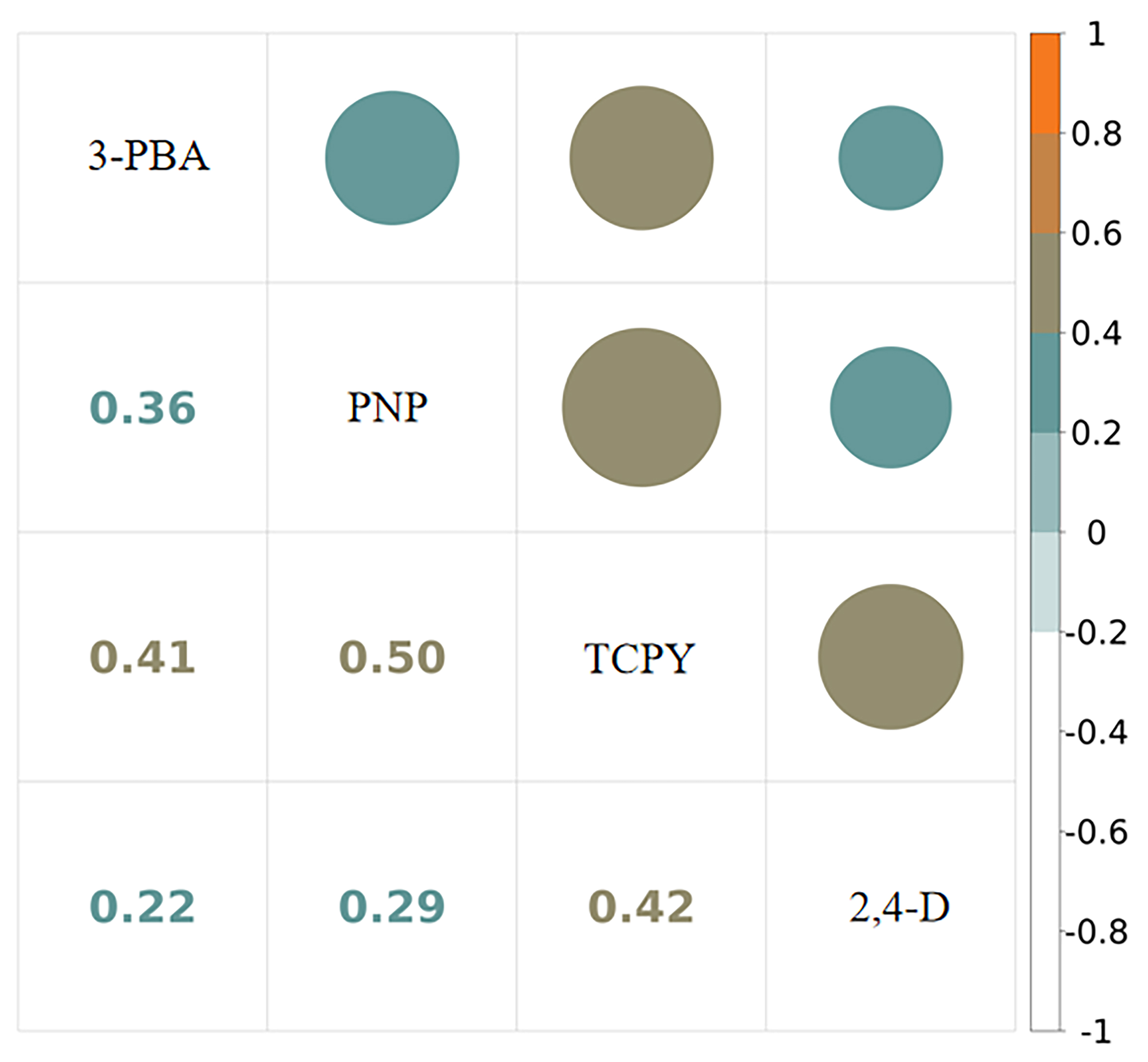
Figure 1. Spearman correlation analysis of urinary non-persistent pesticides in the included study participants. Lower-triangle cells show Spearman correlation coefficients; upper-triangle circle area is proportional to |r|, and circle color represents the direction and magnitude of the coefficient. 3-PBA: 3-Phenoxybenzoic acid; PNP: para-nitrophenol; TCPY: 3,5,6-trichloro-2-pyridinol; 2,4-D: 2,4-dichlorophenoxyacetic acid.
Independent association analysis between non-persistent pesticide biomarkers and sex hormones
In the DAG-informed primary survey-weighted model, TCPY was inversely associated with TT (β = -0.12; 95%CI, -0.21 to -0.03; P = 0.010) and FAI (β = -0.13; 95%CI, -0.22 to -0.05; P = 0.003). PNP was also inversely associated with TT (β = -0.09; 95%CI, -0.16 to -0.02; P = 0.019) and FAI (β = -0.12; 95%CI, -0.20 to -0.05; P = 0.003) [Figure 2A and B]. On the relative scale, a twofold higher TCPY concentration was associated with approximately 7.9% lower TT and 8.9% lower FAI, whereas a twofold higher PNP concentration was associated with approximately 6.0% lower TT and 8.2% lower FAI. Using an interquartile-range contrast, an increase in TCPY from the 25th to the 75th percentile was associated with 14.0% lower TT (95%CI, -23.1% to -3.8%) and 15.6% lower FAI (95%CI, -24.2% to -6.1%), whereas the corresponding increase in PNP was associated with 11.5% lower TT (95%CI, -20.0% to -2.2%) and 15.6% lower FAI (95%CI, -24.3% to -6.0%). Complete survey-weighted regression estimates and corresponding twofold- and IQR-based percentage differences are presented in Supplementary Table 2. The directions of these estimates remained consistent after expanded adjustment in Models 2 and 3. For E2, the PNP estimate was inverse but imprecise in Model 1 (β = -0.11; P = 0.066); the estimates remained inverse in Models 2 and 3 (β = -0.12 and -0.10; both P = 0.029; Figure 2C). No clear associations with SHBG were observed [Figure 2D], and neither 3-PBA nor 2,4-D was clearly associated with any hormone outcome in the primary weighted model. No statistically significant associations were observed for 3-PBA or 2,4-D across the fully adjusted models. The unweighted sensitivity models were directionally consistent for PNP–TT, PNP–FAI, and TCPY–FAI; the TCPY–TT estimate was weaker and reached P = 0.044 only in unweighted Model 3 [Supplementary Figure 3].
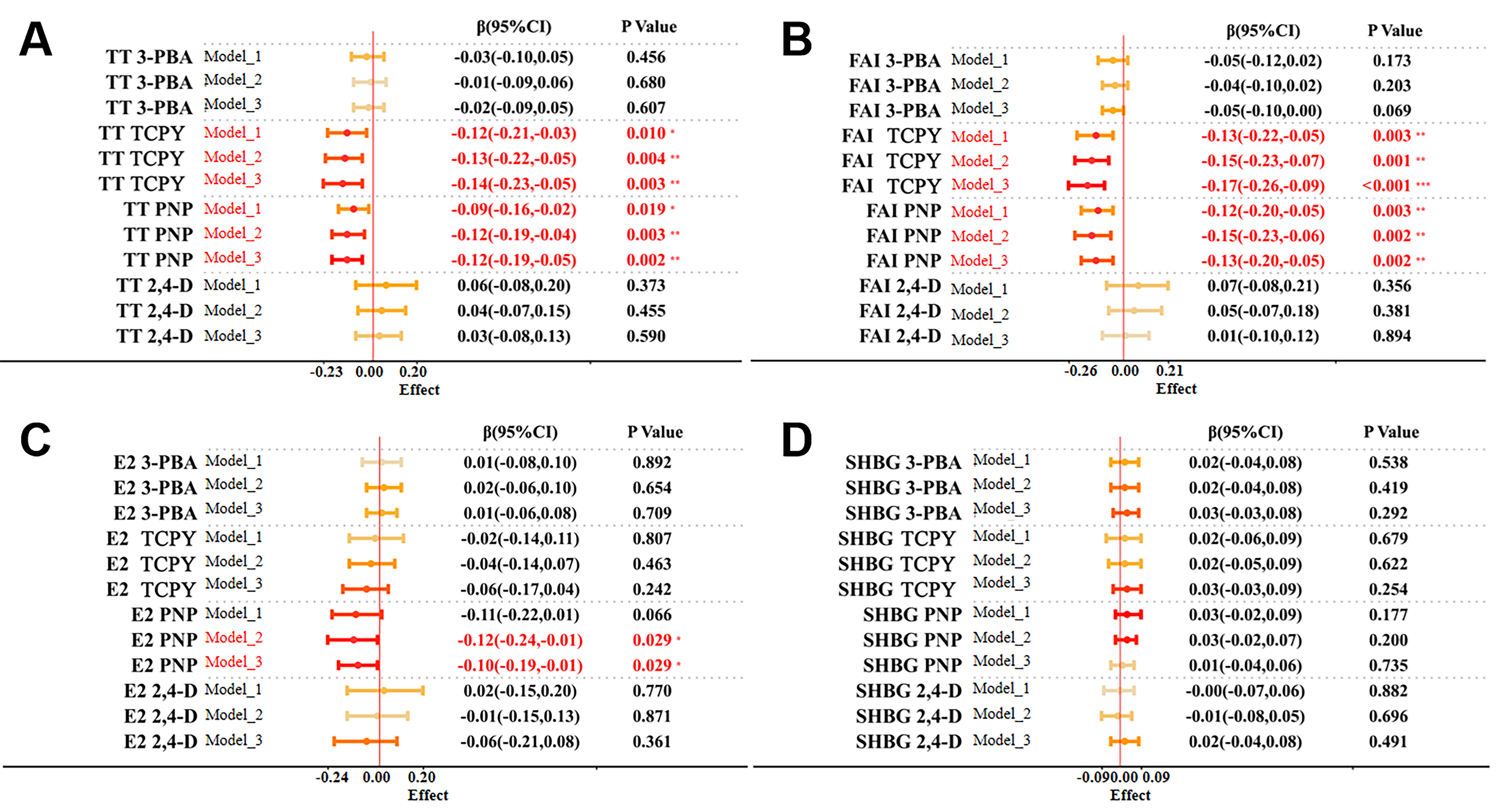
Figure 2. Survey-weighted associations between individual urinary pesticide biomarkers and circulating sex-hormone outcomes among postmenopausal women. (A) TT; (B) FAI; (C) E2; (D) SHBG. *P < 0.05, **P < 0.01, ***P < 0.001. TT: Total testosterone; FAI: free androgen index; E2: estradiol; SHBG: sex hormone-binding globulin; 3-PBA: 3-phenoxybenzoic acid; TCPY: 3,5,6-trichloro-2-pyridinol; PNP: para-nitrophenol; 2,4-D: 2,4-dichlorophenoxyacetic acid; CI: confidence interval.
BKMR analysis of non-persistent pesticide mixture exposure and sex hormones in postmenopausal women
In BKMR models adjusted for the Model 3 covariate set, the estimated overall mixture associations for TT and FAI generally became more negative as the four urinary pesticide biomarkers were jointly increased to higher percentiles relative to the 50th percentile; the 95% posterior credible intervals excluded zero at several higher evaluated percentiles [Figure 3A and B]. No clear overall mixture associations were observed for E2 or SHBG [Figure 3C and D]. Figure 3E-H presents biomarker-specific contrasts estimated while the remaining biomarkers were jointly fixed at the 25th, 50th, or 75th percentiles; The single-biomarker contrasts suggested the clearest inverse pattern for PNP in relation to TT and for PNP and TCPY in relation to FAI, whereas Figure 3G and H showed no clear associations for E2 or SHBG. PIPs differed substantially by outcome [Table 2]. For TT, PNP had the highest PIP (0.921), followed by TCPY (0.082). For FAI, PNP had the highest PIP (0.607), followed by TCPY (0.523). PIPs were uniformly lower for E2, with PNP having the highest value (0.210), and all PIPs were low for SHBG, with the highest value observed for PNP (0.084). Univariate functions showed generally inverse patterns for PNP and TCPY in relation to TT and FAI [Figure 4A and B], whereas the E2 and SHBG functions were imprecisely estimated and showed no consistent monotonic patterns [Figure 4C and D]. The selected percentiles were used solely as descriptive evaluation points and should not be interpreted as biological, toxicological, or clinical thresholds.
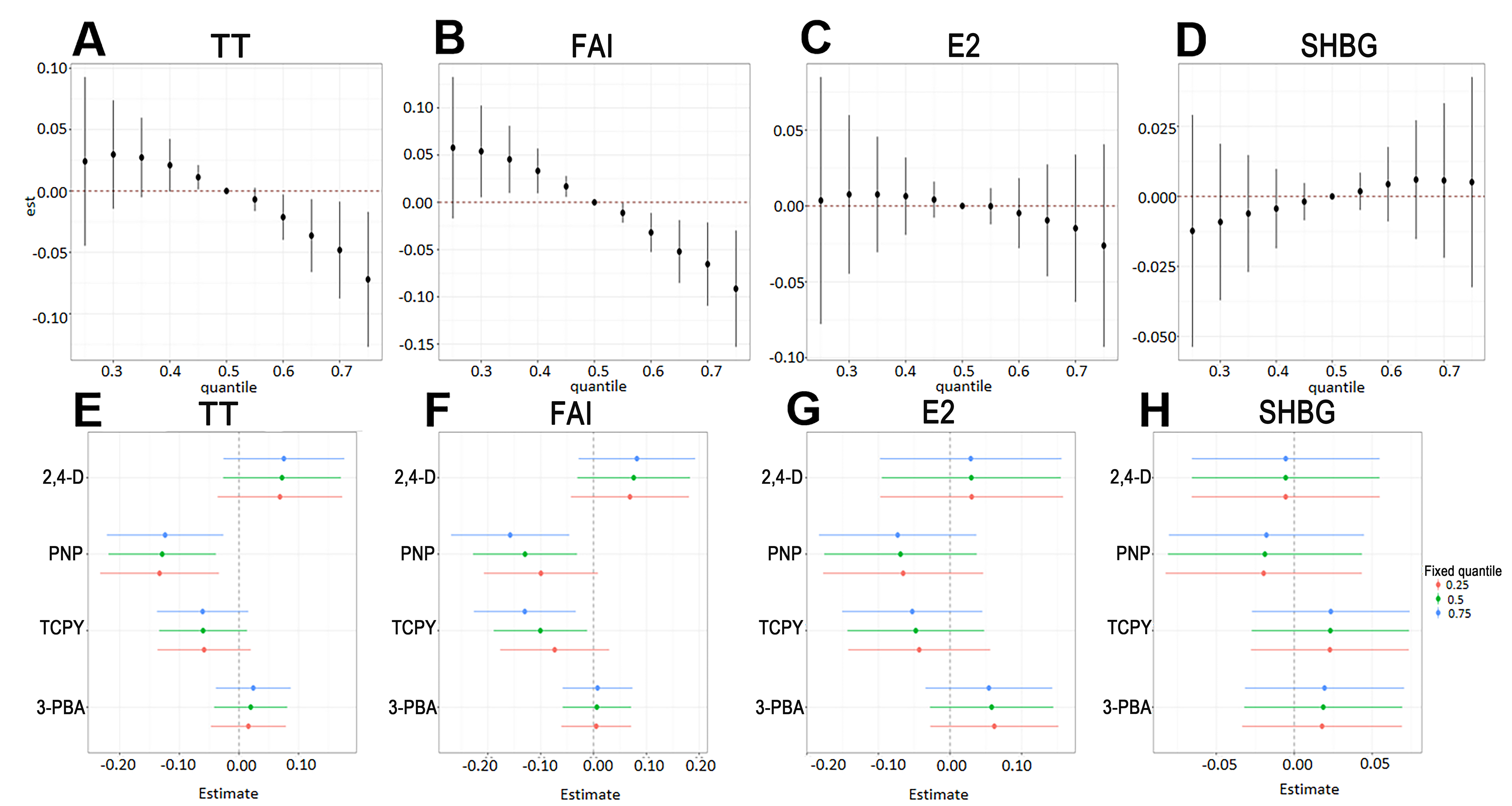
Figure 3. Association analysis between non-persistent pesticide mixtures and sex hormone levels in postmenopausal women based on the BKMR model. (A-D) Overall mixture associations with TT, FAI, E2, and SHBG, respectively. The y-axis represents the estimated overall association when all biomarker concentrations are set at selected percentiles (25th-75th) relative to the 50th percentile; (E-H) Single-biomarker estimates for TT, FAI, E2, and SHBG, respectively, with the other biomarkers fixed at the 25th, 50th, or 75th percentiles. Error bars represent 95% posterior credible intervals. BKMR: Bayesian kernel machine regression; TT: total testosterone; FAI: free androgen index; E2: estradiol; SHBG: sex hormone-binding globulin; 2,4-D: 2,4-dichlorophenoxyacetic acid; PNP: para-nitrophenol; TCPY: 3,5,6-trichloro-2-pyridinol; 3-PBA: 3-phenoxybenzoic acid.
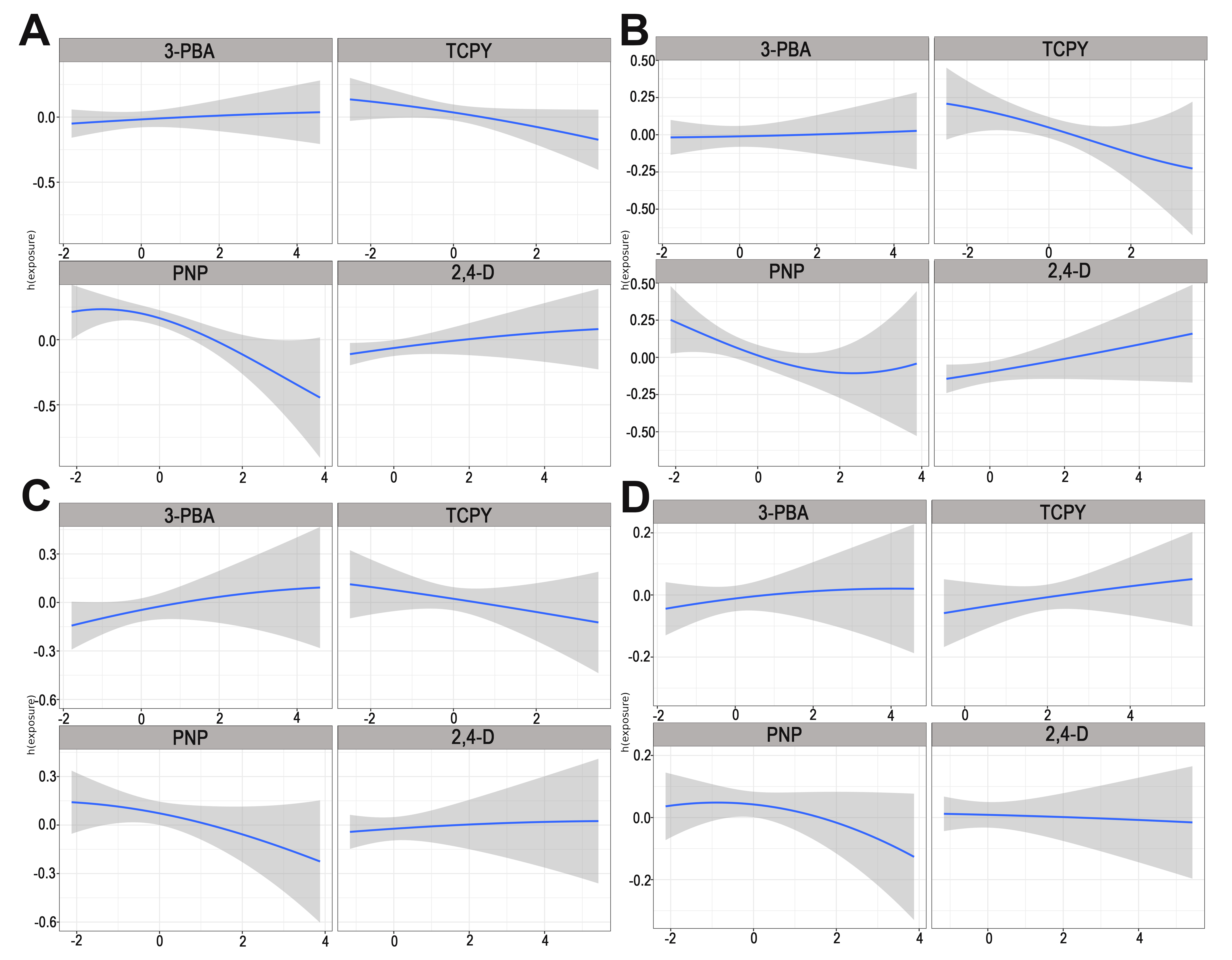
Figure 4. Univariate exposure-response functions of non-persistent pesticide mixtures and sex hormone levels in postmenopausal women based on the BKMR model. (A-D) Univariate exposure–outcome functions for TT, FAI, E2, and SHBG, respectively, with the other urinary pesticide biomarkers fixed at their median levels. Shaded areas represent 95% posterior credible intervals. BKMR: Bayesian kernel machine regression; TT: total testosterone; FAI: free androgen index; E2: estradiol; SHBG: sex hormone-binding globulin; 3-PBA: 3-phenoxybenzoic acid; TCPY: 3,5,6-trichloro-2-pyridinol; PNP: para-nitrophenol; 2,4-D: 2,4-dichlorophenoxyacetic acid.
PIPs of each pesticide in the BKMR model
| Pesticide biomarkers | Sex hormone indicators | |||
| TT | FAI | E2 | SHBG | |
| 3-PBA | 0.016 | 0.017 | 0.096 | 0.034 |
| TCPY | 0.082 | 0.523 | 0.098 | 0.010 |
| PNP | 0.921 | 0.607 | 0.210 | 0.084 |
| 2,4-D | 0.040 | 0.056 | 0.041 | 0.002 |
Pairwise BKMR functions from models adjusted for the expanded Model 3 covariate set were used to explore whether the estimated biomarker–outcome function for one urinary pesticide biomarker varied when a second biomarker was fixed at the 25th, 50th, or 75th percentile [Figure 5]. For TT, the pairwise functions were generally parallel, with no clear visual evidence of effect modification. Although minor vertical separations were observed in several panels, the slopes and overall shapes of the curves remained similar, providing no clear visual evidence that the TT function for one biomarker was meaningfully modified by the level of another biomarker. For FAI, the most noticeable departure from parallelism involved PNP and TCPY: the estimated TCPY function showed greater separation across the selected PNP percentiles, and the corresponding PNP function also varied modestly across TCPY percentiles. This pattern suggested possible model-scale effect modification between PNP and TCPY, although the evidence was exploratory. For E2, most percentile-specific curves were approximately parallel, with only small differences in their vertical positions or degrees of curvature in a few panels; therefore, no stable pairwise modification pattern could be identified. The SHBG functions were likewise largely overlapping or parallel across the evaluated percentiles, with no obvious visual evidence of effect modification. Because the bivariate plots did not display posterior uncertainty intervals and no formal interaction tests or interaction P values were generated, the observed curve patterns should be interpreted as exploratory graphical evidence rather than statistically confirmed, causal, or biological interactions. Visual inspection of the posterior diagnostic plots showed no obvious persistent drift in the scaled covariate-coefficient or residual-variance traces, although the sparse kernel-parameter traces warrant cautious interpretation [Supplementary Figures 4-7].
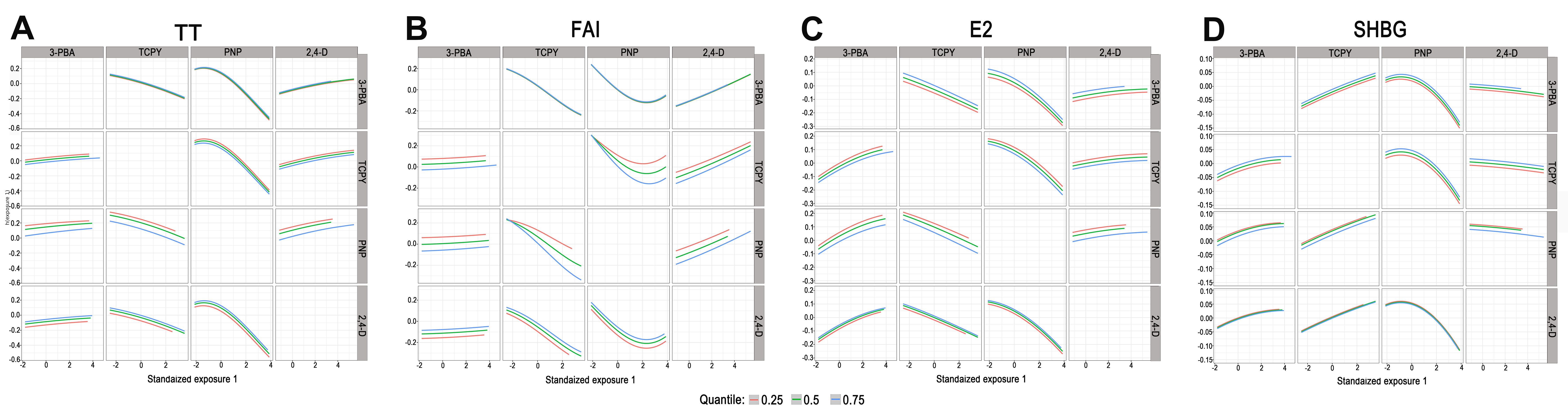
Figure 5. Bivariate exposure-response functions of non-persistent pesticide mixtures and sex hormone levels in postmenopausal women based on the BKMR model. (A-D) Bivariate functions for TT, FAI, E2, and SHBG, respectively. For each biomarker, the estimate was calculated with the second biomarker fixed at the 25th, 50th, and 75th percentiles. BKMR: Bayesian kernel machine regression; TT: total testosterone; FAI: free androgen index; E2: estradiol; SHBG: sex hormone-binding globulin; 3-PBA: 3-phenoxybenzoic acid; TCPY: 3,5,6-trichloro-2-pyridinol; PNP: para-nitrophenol; 2,4-D: 2,4-dichlorophenoxyacetic acid.
Discussion
In this reanalysis of 593 postmenopausal women, the DAG-informed primary survey-weighted models showed inverse associations of both TCPY and PNP with TT and FAI. The inverse directions were maintained after additional adjustment for lifestyle, menopause-related, hormone-use, dietary, and anthropometric covariates. BKMR showed an inverse overall-mixture pattern for TT and FAI. PNP had the highest PIP for TT, whereas PNP and TCPY had the two highest PIPs for FAI. In contrast, neither the primary weighted models nor BKMR provided clear evidence of associations with E2 or SHBG. The bivariate BKMR functions were largely parallel. A minor visual departure from parallelism was most apparent for PNP and TCPY in the FAI model; however, no uncertainty intervals or formal interaction tests were available, and the plots did not establish effect modification or biological interaction. These findings represent cross-sectional associations and do not establish temporal ordering or causality.
On the relative scale, a twofold higher TCPY concentration was associated with approximately 7.9% lower TT and 8.9% lower FAI, whereas a twofold higher PNP concentration was associated with approximately 6.0% lower TT and 8.2% lower FAI. When expressed using a distribution-based contrast, an increase in TCPY from the 25th to the 75th percentile was associated with approximately 14% lower TT and 16% lower FAI, whereas the corresponding IQR increase in PNP was associated with approximately 12% lower TT and 16% lower FAI. This IQR-based contrast complements the twofold-increase estimates by expressing the associations across a commonly observed range of biomarker concentrations in the study population. The inverse directions were maintained across the expanded weighted models and were also observed for PNP–TT, PNP–FAI, and TCPY–FAI in the unweighted sensitivity analyses. The attenuated unweighted TCPY–TT estimates suggest that this association was more sensitive to survey weighting and model specification. Experimental studies have reported findings suggesting that PNP may influence steroidogenic processes and androgen production; however, this experimental evidence provides only possible biological context for the present epidemiological associations and should not be interpreted as demonstrating a mechanism underlying our observations in postmenopausal women[37]. Previous epidemiological evidence has likewise suggested biomarker-specific associations between non-persistent pesticide biomarkers and androgen-related outcomes[38,39]. PIPs should not be interpreted as Bayesian analogs of regression P values or as indicators of biological or causal importance. Rather, they quantify outcome-specific conditional inclusion importance within the fitted correlated-mixture model, whereas regression coefficients quantify associations under separate single-biomarker model structures.
Several biological pathways proposed in the experimental literature may provide hypothesis-generating context for the observed epidemiological associations; however, none of these pathways or related mechanistic biomarkers were evaluated in the present study. Experimental studies have reported endocrine and reproductive effects of PNP and 2,4-D, although the relevance of these experimental findings to the hormonal profiles of postmenopausal women remains uncertain[37,40]. Experimental studies have reported that PNP exposure may affect gonadal development and hormonal profiles in animal models[37]. Experimental evidence also suggests that 2,4-D may disrupt cholesterol and testosterone homeostasis in Leydig cells through PPARα-dependent pathways[40]. These experimental observations are largely derived from animal models and male reproductive tissues and remain unverified in adrenal or peripheral steroidogenic tissues of postmenopausal women. They should therefore be regarded as hypothesis-generating biological explanations rather than mechanisms demonstrated by the present epidemiological findings.
After menopause, ovarian steroid production declines, and adrenal and peripheral metabolism account for a larger proportion of circulating sex steroids[41,42]. Although TT and FAI are related to bone and metabolic health, the clinical relevance of the modest cross-sectional differences observed here remains uncertain[43-46]. Recent studies of persistent endocrine-disrupting pollutants have also reported associations with sex-related hormones that varied according to menopausal status, further supporting the importance of considering the distinct hormonal context of postmenopausal women[47,48]. Independent of the causal interpretation of these findings, established pesticide-safety measures - including appropriate occupational protection, adherence to label instructions, avoidance of unnecessary residential applications, and integrated pest management - remain prudent. Repeated biomonitoring may also be useful in selected highly exposed occupational groups. However, this study cannot define a safe exposure threshold or demonstrate that reducing a specific pesticide will improve hormone levels.
The absence of clear primary associations with E2 and SHBG may reflect differences in hormone regulation, limited variability, exposure measurement error, or insufficient power. PNP showed an inverse association with E2 only in the expanded weighted models, whereas the primary estimate was imprecise and the corresponding BKMR evidence was weak (PIP = 0.210); this result should therefore be regarded as secondary and model-dependent. In postmenopausal women, E2 is produced largely through peripheral aromatization of adrenal androgen precursors, a process influenced by adiposity and genetic factors[49,50]. SHBG is synthesized in the liver and is affected by insulin, thyroid hormones, obesity, alcohol, medications, and other metabolic factors[46,51,52]. Residual confounding by dietary phytoestrogens, incompletely characterized medication use, occupational pesticide exposure, and co-exposure to other endocrine-disrupting chemicals may have contributed to the imprecision or attenuation of the E2 and SHBG estimates.
Strengths and limitations
Strengths of this study include accounting for the NHANES complex-survey design in the individual-biomarker analyses, using an explicit DAG-informed adjustment hierarchy, characterizing natural and surgical menopause and previous and current hormone use, incorporating alcohol and dietary variables in expanded models, and fitting outcome-specific BKMR models with posterior diagnostic plots.
Several limitations should be considered. First, the cross-sectional design precludes causal inference, does not establish temporal ordering, and cannot rule out reverse causation or residual confounding. Although several covariates were considered in the weighted multivariate linear regression models, some undetected or unnoticed confounders might also exist. Second, exposure was assessed using a single spot urine sample. For short-lived chemicals, substantial within-person variation can occur across days and meals; UCRE adjustment addresses dilution but does not convert a single measurement into an estimate of long-term exposure. This limitation may result in exposure misclassification and reduced precision. If the within-person variability is largely random and nondifferential with respect to the hormone outcomes, this type of measurement error would generally be expected to attenuate the observed exposure-outcome associations. However, departures from classical nondifferential measurement error could produce more complex patterns of bias. Because the underlying measurement-error structure cannot be determined from a single urine sample, the magnitude and direction of the resulting bias cannot be predicted with certainty. Third, mechanistic biomarkers such as StAR, cytochrome P450 family 17 subfamily A member 1 (CYP17A1), oxidative-stress markers, luteinizing hormone (LH), and follicle-stimulating hormone (FSH) were unavailable, so the mechanistic interpretation relies on external experimental evidence. Fourth, the relatively high mean BMI of the participants may affect hormone metabolism and may limit generalizability to leaner postmenopausal populations. Fifth, the sample size may have limited the power for subgroup and interaction analyses. Prospective studies with repeated urine samples, detailed dietary and medication information, and clinically relevant outcomes are needed.
CONCLUSIONS
In this cross-sectional NHANES analysis of 593 postmenopausal women, higher urinary TCPY and PNP concentrations were associated with lower TT and FAI in the primary survey-weighted models, and BKMR showed an inverse overall-mixture pattern for these androgen-related outcomes. PNP had the highest PIP for TT, whereas PNP and TCPY had the two highest PIPs for FAI; evidence for associations with E2 and SHBG was limited and less consistent. These findings are hypothesis-generating and require confirmation in prospective studies with repeated exposure measurements.
DECLARATIONS
Acknowledgments
We gratefully acknowledge all participants and personnel who contributed to the National Health and Nutrition Examination Survey (NHANES). We thank BioRender.com for providing the platform used to create the Graphical Abstract [Created in BioRender. (2026) https://BioRender.com/khtrm4x].
Authors’ contributions
Performed data acquisition and data analysis and interpretation: Kang, Y.; Xu, S.
Made substantial contributions to the conception and design of the study and provided administrative, technical, and material support: Deng, Y.; Yu, Y.
Availability of data and materials
The data used in this study are publicly available from the NHANES 2013-2014 and 2015-2016 cycles, maintained by the National Center for Health Statistics (NCHS), Centers for Disease Control and Prevention (CDC). The datasets are available at https://wwwn.cdc.gov/nchs/nhanes/continuousnhanes/default.aspx?BeginYear=2013 and https://wwwn.cdc.gov/nchs/nhanes/continuousnhanes/default.aspx?BeginYear=2015. The analytic code and derived datasets generated during the current study are available from the corresponding author upon reasonable request. Additional data supporting the findings of this study are provided in the article and its Supplementary Materials.
AI and AI-assisted tools statement
Not applicable.
Financial support and sponsorship
None.
Conflicts of interest
Deng, Y. is a Youth Editorial Board Member of the journal Journal of Environmental Exposure Assessment. Deng, Y. was not involved in any steps of editorial processing, notably including reviewers’ selection, manuscript handling, or decision-making. The other authors declare that there are no conflicts of interest.
Ethical approval and consent to participate
Not applicable.
Consent for publication
Not applicable.
Copyright
© The Author(s) 2026.
Supplementary Materials
REFERENCES
1. Pathak, V. M.; Verma, V. K.; Rawat, B. S.; et al. Current status of pesticide effects on environment, human health and it’s eco-friendly management as bioremediation: a comprehensive review. Front. Microbiol. 2022, 13, 962619.
2. Fernández, S. F.; Pardo, O.; Adam-Cervera, I.; et al.; BETTERMILK. Biomonitoring of non-persistent pesticides in urine from lactating mothers: exposure and risk assessment. Sci. Total. Environ. 2020, 699, 134385.
3. Yusà, V.; Fernández, S. F.; Dualde, P.; López, A.; Lacomba, I.; Coscollà, C. Exposure to non-persistent pesticides in the Spanish population using biomonitoring: a review. Environ. Res. 2022, 205, 112437.
4. Riedo, J.; Wächter, D.; Gubler, A.; Wettstein, F. E.; Meuli, R. G.; Bucheli, T. D. Pesticide residues in agricultural soils in light of their on-farm application history. Environ. Pollut. 2023, 331, 121892.
5. Sharma, A.; Shukla, A.; Attri, K.; et al. Global trends in pesticides: a looming threat and viable alternatives. Ecotoxicol. Environ. Saf. 2020, 201, 110812.
6. Tudi, M.; Daniel Ruan, H.; Wang, L.; et al. Agriculture development, pesticide application and its impact on the environment. Int. J. Environ. Res. Public. Health. 2021, 18, 1112.
7. García, M. G.; Sánchez, J. I. L.; Bravo, K. A. S.; Cabal, M. D. C.; Pérez-Santín, E. Review: Presence, distribution and current pesticides used in Spanish agricultural practices. Sci. Total. Environ. 2022, 845, 157291.
8. Oh, J.; Kim, K.; Kannan, K.; et al. Early childhood exposure to environmental phenols and parabens, phthalates, organophosphate pesticides, and trace elements in association with attention deficit hyperactivity disorder (ADHD) symptoms in the CHARGE study. Environ. Health. 2024, 23, 27.
9. Shu, S.; Li, Y.; Yu, X.; Chen, X.; Abdullah, U.; Yu, Y. Association between mixed exposure of non-persistent pesticides and liver fibrosis in the general US population: NHANES 2013-2016. Ecotoxicol. Environ. Saf. 2025, 290, 117776.
10. García-García, C. R.; Parrón, T.; Requena, M.; Alarcón, R.; Tsatsakis, A. M.; Hernández, A. F. Occupational pesticide exposure and adverse health effects at the clinical, hematological and biochemical level. Life. Sci. 2016, 145, 274-83.
11. Mostafalou, S.; Abdollahi, M. Pesticides: an update of human exposure and toxicity. Arch. Toxicol. 2017, 91, 549-99.
12. Kaur, R.; Choudhary, D.; Bali, S.; et al. Pesticides: an alarming detrimental to health and environment. Sci. Total. Environ. 2024, 915, 170113.
13. Dong, Y.; Yu, Y. Association between non-persistent pesticides and hypertension in adults: insights from NHANES. Int. J. Environ. Health. Res. 2025, 35, 2771-81.
14. Xu, H.; Bo, Y. Associations between pyrethroid exposure and serum sex steroid hormones in adults: findings from a nationally representative sample. Chemosphere 2022, 300, 134591.
15. Meeker, J. D.; Barr, D. B.; Hauser, R. Pyrethroid insecticide metabolites are associated with serum hormone levels in adult men. Reprod. Toxicol. 2009, 27, 155-60.
16. Zhang, X.; Zhang, T.; Ren, X.; Chen, X.; Wang, S.; Qin, C. Pyrethroids toxicity to male reproductive system and offspring as a function of oxidative stress induction: rodent studies. Front. Endocrinol. 2021, 12, 656106.
17. Castiello, F.; Freire, C. Exposure to non-persistent pesticides and puberty timing: a systematic review of the epidemiological evidence. Eur. J. Endocrinol. 2021, 184, 733-49.
18. Motlani, V.; Motlani, G.; Pamnani, S.; Sahu, A.; Acharya, N. Endocrine changes in postmenopausal women: a comprehensive view. Cureus 2023, 15, e51287.
19. Bravo, N.; Garí, M.; Grimalt, J. O. Occupational and residential exposures to organophosphate and pyrethroid pesticides in a rural setting. Environ. Res. 2022, 214, 114186.
20. Whitten, J.; Mahmood, T. H.; Jeannotte, T. L. Pesticide presence and distribution in a cold region agricultural basin. Sci. Total. Environ. 2025, 1000, 180477.
21. National Health and Nutrition Examination Survey 2013-2014 data documentation, codebook, and frequencies. Pyrethroids, herbicides, & organophosphorus metabolites - urine (UPHOPM_H). 2020. https://wwwn.cdc.gov/Nchs/Data/Nhanes/Public/2013/DataFiles/UPHOPM_H.htm. (accessed 2026-09-14).
22. National Health and Nutrition Examination Survey 2015-2016 data documentation, codebook, and frequencies. Pyrethroids, herbicides, & organophosphorus metabolites - urine (UPHOPM_I). 2023. https://wwwn.cdc.gov/Nchs/Data/Nhanes/Public/2015/DataFiles/UPHOPM_I.htm. (accessed 2026-09-14).
23. National Health and Nutrition Examination Survey 2013-2014 data documentation, codebook, and frequencies. Sex steroid hormone - serum (TST_H). 2018. https://wwwn.cdc.gov/Nchs/Data/Nhanes/Public/2013/DataFiles/TST_H.htm. (accessed 2026-09-14).
24. National Health and Nutrition Examination Survey 2015-2016 data documentation, codebook, and frequencies. Sex steroid hormone - serum (TST_I). 2018. https://wwwn.cdc.gov/Nchs/Data/Nhanes/Public/2015/DataFiles/TST_I.htm. (accessed 2026-09-14).
25. Key, T. J.; Appleby, P. N.; Reeves, G. K.; et al.; Endogenous Hormones and Breast Cancer Collaborative Group. Circulating sex hormones and breast cancer risk factors in postmenopausal women: reanalysis of 13 studies. Br. J. Cancer. 2011, 105, 709-22.
26. Tin Tin, S.; Smith-Byrne, K.; Ferrari, P.; et al. Alcohol intake and endogenous sex hormones in women: meta-analysis of cohort studies and Mendelian randomization. Cancer 2024, 130, 3375-86.
27. van Winden, L. J.; Vermeulen, R. F. M.; van den Noort, V.; et al. Changes in sex steroids and relation with menopausal complaints in women undergoing risk-reducing salpingo-oophorectomy. J. Endocr. Soc. 2022, 6, bvac069.
28. Shifren, J. L.; Desindes, S.; McIlwain, M.; Doros, G.; Mazer, N. A. A randomized, open-label, crossover study comparing the effects of oral versus transdermal estrogen therapy on serum androgens, thyroid hormones, and adrenal hormones in naturally menopausal women. Menopause 2007, 14, 985-94.
29. Tennant, P. W. G.; Murray, E. J.; Arnold, K. F.; et al. Use of directed acyclic graphs (DAGs) to identify confounders in applied health research: review and recommendations. Int. J. Epidemiol. 2021, 50, 620-32.
30. Chiu, Y. H.; Williams, P. L.; Mínguez-Alarcón, L.; et al. Comparison of questionnaire-based estimation of pesticide residue intake from fruits and vegetables with urinary concentrations of pesticide biomarkers. J. Expo. Sci. Environ. Epidemiol. 2018, 28, 31-9.
31. Jiang, B.; Pang, J.; Li, J.; et al. The effects of organic food on human health: a systematic review and meta-analysis of population-based studies. Nutr. Rev. 2024, 82, 1151-75.
32. de Roon, M.; May, A. M.; McTiernan, A.; et al. Effect of exercise and/or reduced calorie dietary interventions on breast cancer-related endogenous sex hormones in healthy postmenopausal women. Breast. Cancer. Res. 2018, 20, 81.
33. Tomova, G. D.; Arnold, K. F.; Gilthorpe, M. S.; Tennant, P. W. G. Adjustment for energy intake in nutritional research: a causal inference perspective. Am. J. Clin. Nutr. 2022, 115, 189-98.
34. Bobb, J. F.; Valeri, L.; Claus Henn, B.; et al. Bayesian kernel machine regression for estimating the health effects of multi-pollutant mixtures. Biostatistics 2015, 16, 493-508.
35. Bobb, J. F.; Claus Henn, B.; Valeri, L.; Coull, B. A. Statistical software for analyzing the health effects of multiple concurrent exposures via Bayesian kernel machine regression. Environ. Health. 2018, 17, 67.
36. Chiu, Y. H.; Bellavia, A.; James-Todd, T.; et al.; EARTH Study Team. Evaluating effects of prenatal exposure to phthalate mixtures on birth weight: a comparison of three statistical approaches. Environ. Int. 2018, 113, 231-9.
37. Ahmed, E.; Nagaoka, K.; Fayez, M.; Abdel-Daim, M. M.; Samir, H.; Watanabe, G. Suppressive effects of long-term exposure to P-nitrophenol on gonadal development, hormonal profile with disruption of tissue integrity, and activation of caspase-3 in male Japanese quail (Coturnix japonica). Environ. Sci. Pollut. Res. Int. 2015, 22, 10930-42.
38. Liang, H.; Wu, X.; Yao, H.; et al. Association of urinary metabolites of non-persistent pesticides with serum sex hormones among the US females: NHANES 2013-2014. Chemosphere 2022, 300, 134577.
39. Zheng, Y.; Wang, S.; Liu, H.; et al. Association of exposure to household pesticides with concentration of serum sex steroid hormones in general U.S. population: a cross-sectional study. Reprod. Toxicol. 2026, 144, 109305.
40. Harada, Y.; Tanaka, N.; Ichikawa, M.; et al. PPARα-dependent cholesterol/testosterone disruption in Leydig cells mediates 2,4-dichlorophenoxyacetic acid-induced testicular toxicity in mice. Arch. Toxicol. 2016, 90, 3061-71.
42. Torréns, J. I.; Sutton-Tyrrell, K.; Zhao, X.; et al. Relative androgen excess during the menopausal transition predicts incident metabolic syndrome in midlife women: study of Women’s Health Across the Nation. Menopause 2009, 16, 257-64.
43. Khosla, S.; Melton, L. J. 3rd; Riggs, B. L. Estrogens and bone health in men. Calcif. Tissue. Int. 2001, 69, 189-92.
44. Davis, S. R.; Bell, R. J.; Robinson, P. J.; et al.; ASPREE Investigator Group. Testosterone and estrone increase from the age of 70 years: findings from the sex hormones in older women study. J. Clin. Endocrinol. Metab. 2019, 104, 6291-300.
45. Sutton-Tyrrell, K.; Wildman, R. P.; Matthews, K. A.; et al.; SWAN Investigators. Sex-hormone-binding globulin and the free androgen index are related to cardiovascular risk factors in multiethnic premenopausal and perimenopausal women enrolled in the Study of Women Across the Nation (SWAN). Circulation 2005, 111, 1242-9.
46. Gambera, A.; Scagliola, P.; Falsetti, L.; Sartori, E.; Bianchi, U. Androgens, insulin-like growth factor-I (IGF-I), and carrier proteins (SHBG, IGFBP-3) in postmenopause. Menopause 2004, 11, 159-66.
47. Abasilim, C.; Persky, V.; Sargis, R. M.; et al. Persistent organic pollutants and endogenous sex-related hormones in Hispanic/Latino adults: The Hispanic Community health study/study of Latinos (HCHS/SOL). Environ. Res. 2025, 267, 120742.
48. Pérez-Díaz, C.; Echeverría, R.; Pérez-Carrascosa, F. M.; et al. Associations of internal persistent organic pollutant levels with sex hormones: an analysis by sex and menopausal status in a Spanish cohort. iScience 2025, 28, 112876.
49. Ahmed, F.; Hetty, S.; Laterveer, R.; et al. Altered expression of aromatase and estrogen receptors in adipose tissue from men with obesity or type 2 diabetes. J. Clin. Endocrinol. Metab. 2025, 110, e3410-24.
50. Dos Santos, B. R.; Casanova, G.; da Silva, T. R.; Oppermann, K.; Spritzer, P. M. Association between the aromatase (CYP19A1) gene variant rs10046 and cardiovascular risk in postmenopausal women. Arch. Endocrinol. Metab. 2024, 68, e240087.
51. Balogh, Z.; Csehely, S.; Orosz, M.; et al. Relations of insulin resistance, body weight, vitamin D deficiency, SHBG and androgen levels in PCOS patients. Biomedicines 2025, 13, 1803.
Cite This Article
 Open Access
How to Cite
Kang, Y.; Xu, S.; Deng, Y.; Yu, Y. Nonpersistent pesticide exposure and circulating sex hormones in postmenopausal women: evidence from NHANES 2013-2016. J. Environ. Expo. Assess. 2026, 5, 33. https://dx.doi.org/10.20517/jeea.2026.16
Download Citation
If you have the appropriate software installed, you can download article citation data to the citation manager of your choice. Simply select your manager software from the list below and click on download.
Export Citation File
Type of Import
Tips on Downloading Citation
Citation Manager File Format
Type of Import
Direct Import: When the Direct Import option is selected (the default state), a dialogue box will give you the option to Save or Open the downloaded citation data. Choosing Open will either launch your citation manager or give you a choice of applications with which to use the metadata. The Save option saves the file locally for later use.
Indirect Import: When the Indirect Import option is selected, the metadata is displayed and may be copied and pasted as needed.
About This Article
Copyright

Data & Comments
Data
0










Comments
Comments must be written in English. Spam, offensive content, impersonation, and private information will not be permitted. If any comment is reported and identified as inappropriate content by OAE staff, the comment will be removed without notice. If you have any queries or need any help, please contact us at [email protected].