
fig2
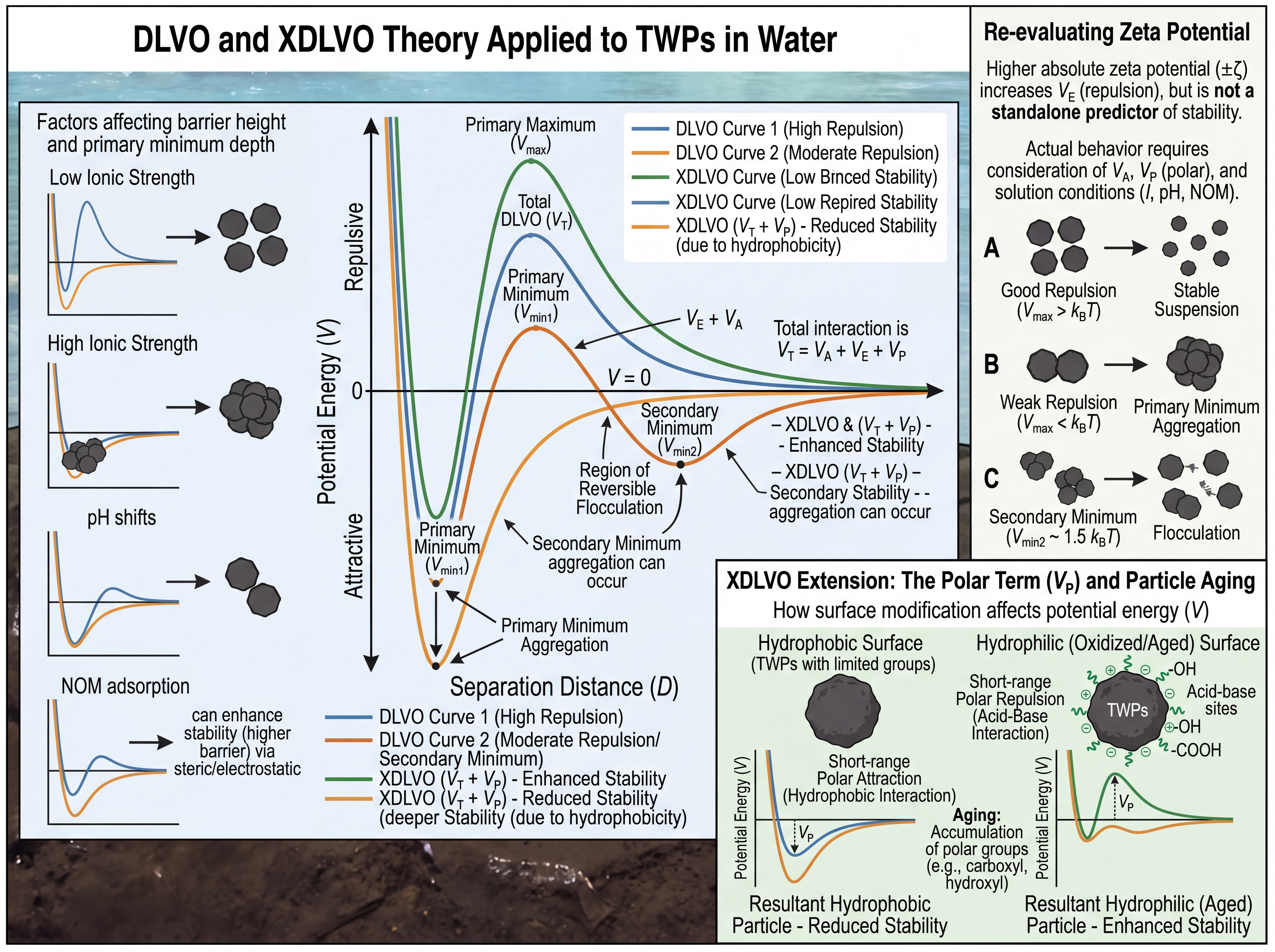
Figure 2. Schematic illustration of DLVO and XDLVO theory for TWP colloidal stability. The XDLVO total interaction energy (VT) comprises van der Waals attraction (VA), electrostatic double-layer repulsion (VE), and polar (acid-base) interaction (VP). The energy barrier (Vmax) and secondary minimum (Vmin2) determine dispersion vs. aggregation. Higher ionic strength compresses the double layer, lowering the barrier and promoting aggregation; NOM adsorption may introduce steric effects. Aging oxidizes TWP surfaces, increases hydrophilicity and polar repulsion (VP), raising the barrier and inhibiting aggregation. Zeta potential magnitude alone is not a universal predictor of stability; actual behavior requires XDLVO analysis under specific solution conditions (pH, ionic strength, NOM) [created by Nanobanana (Gemini 2.5 Flash Image)]. DLVO: Derjaguin-Landau-Verwey-Overbeek theory; XDLVO: extended DLVO; TWP: tire wear particle; NOM: natural organic matter.