



Review: Micro- and macro-scale transport of tire wear particles in aquatic environments and risk control
 0
0 Abstract
Since the introduction of the microplastics (MPs) concept, these contaminants have received sustained global attention. Tire wear particles (TWPs), as a dominant anthropogenic MP fraction, have been the subject of rapidly expanding research in recent years. Sedimentation is the key process controlling the environmental fate and ecological effects of TWPs in aquatic environments, which act as their primary sink, transport pathway, and exposure medium. Elucidating TWP sedimentation mechanisms, transport behavior, and risk mitigation strategies is therefore critical to addressing their associated environmental problems. This review systematically summarizes the microscale sedimentation mechanisms, influencing factors, transport pathways, and risk control measures for TWPs in aquatic environments, incorporating recent advances in flux estimation. It provides essential insights to guide future research on TWP environmental behavior.
Keywords
INTRODUCTION
Microplastics (MPs), as an emerging class of contaminants, have attracted global concern. Among these, tire wear particles (TWPs) are widely recognized as one of the primary sources of environmental MPs[1]. TWPs are mainly generated through the frictional wear between tire treads and road surfaces[2-5]. As of December 2025, China’s total number of motor vehicles in 2024 reached 453 million, with passenger vehicles accounting for 353 million. Notably, the number of new energy vehicles (NEVs) reached 31.4 million, representing a 53.8% increase compared to 2023. In addition, the sales penetration rate of NEVs reached 59.1%, indicating that the Chinese automotive market has entered a phase dominated by NEVs [Figure 1][6-11]. Particulate matter emissions from vehicle exhaust have been effectively controlled due to increasingly stringent emission standards[12]. NEVs, owing to their independence from fossil fuels, have gained widespread acceptance by reducing reliance on conventional fuels. However, the emerging pollutant TWPs are not mitigated by the transition from conventional fuel vehicles to NEVs. NEVs are typically heavier and have longer driving ranges, leading to more severe tire–road wear and greater generation of TWPs during operation compared with conventional vehicles. This implies that the widespread adoption of NEVs may, to a certain extent, exacerbate TWP pollution. Furthermore, TWPs are compositionally complex, and their size and number depend on factors such as climate (temperature), tire composition and structure, road surface texture, driving speed and style, and the nature of tire–road contact[1,2,13]. It is estimated that the global annual emission of TWPs exceeds 6 million tons, with per capita emissions ranging from 0.20 to 5.5 kg per year (average: 0.81 kg per year). Among these, approximately 128,000 tons of TWPs are transported annually via atmospheric transport to remote regions such as the Arctic and Antarctic[1,13-15]. Consequently, their transport pathways are relatively diverse, extending beyond migration from emission sources (e.g., roads) via runoff and street sweeping to various environmental compartments, such as freshwater systems, landfills, sediments, terrestrial environments, estuaries, and oceans. A portion of TWPs retained in wastewater treatment plants (WWTPs) settles in sludge, which is subsequently applied to soil as fertilizer. TWPs retained in soil may pose potential ecological health risks through possible plant uptake and trophic transfer of associated chemicals, although direct evidence for particle bioaccumulation and biomagnification along the food chain is currently lacking. This pathway has garnered increasing attention in recent years. Previous reviews on TWPs have primarily focused on aspects such as emission amounts, toxicological effects, and risk control. With the growing body of research on the sedimentation of TWPs in aquatic environments in recent years, the present review distinguishes itself by discussing the sedimentation mechanisms of TWPs at both microscale and macroscale, key influencing factors, transport pathways and studies related to the estimation of TWP flux into the ocean. Additionally, it summarizes technological research relevant to risk control. The sedimentation behavior of TWPs in aquatic environments is a key process that determines their environmental fate and ecological exposure; it also directly influences their potential pathways into the human body via drinking water sources and the food chain. Therefore, elucidating their sedimentation mechanisms and transport patterns is a crucial foundation for conducting environmental and human exposure assessments. This review aims to systematically synthesize the mechanisms, transport, flux estimation, and risk control technologies related to the sedimentation of TWPs in aquatic environments. On this basis, it identifies current knowledge gaps and outlines future interdisciplinary research frontiers, thereby providing critical insights to inform future research on TWPs in aquatic systems.
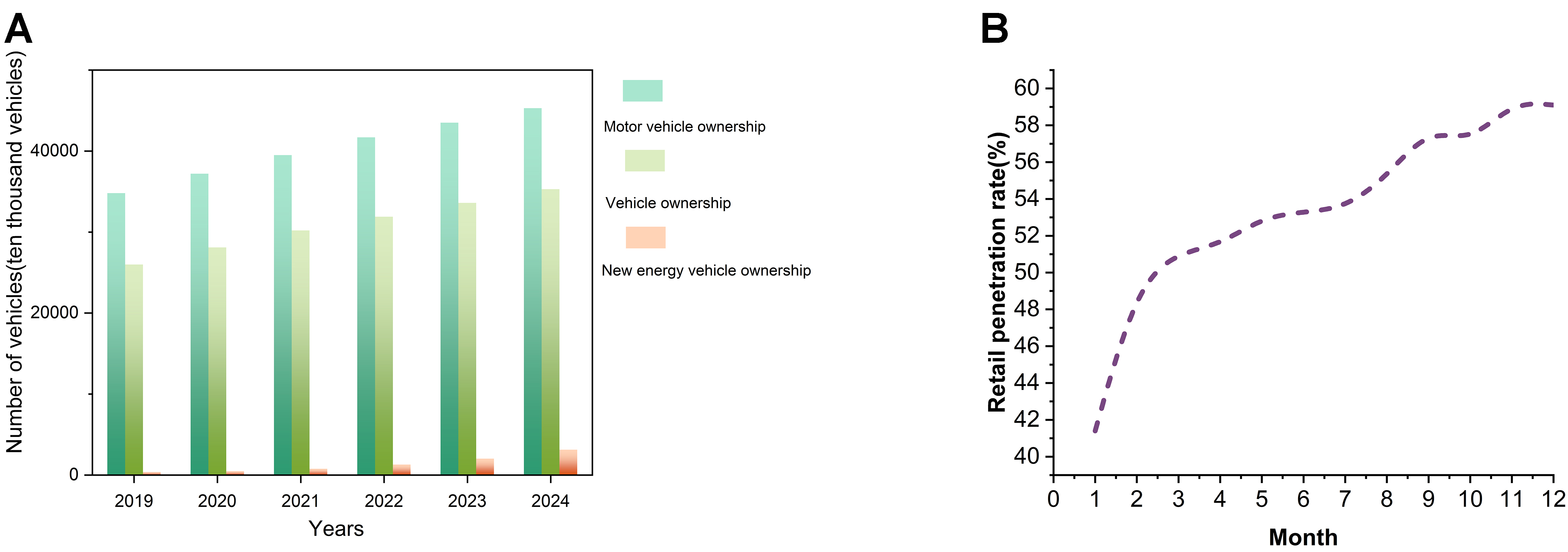
Figure 1. (A) China’s motor vehicle, automobile, and NEV ownership from 2019 to 2024; (B) China’s NEV sales penetration rate in 2025 chart. NEV: New energy vehicle.
MECHANISMS AND INFLUENCING FACTORS OF TWPS SEDIMENTATION IN AQUATIC ENVIRONMENTS
The fate of TWPs in aquatic environments is primarily determined by their sedimentation behavior. Sedimentation efficiency directly governs whether TWPs become buried in deep sediments or remain suspended and undergo long-term transport in surface waters. The sedimentation of TWPs is not a singular process but rather a complex outcome resulting from the coupled interactions among particle properties, water chemistry, and hydrodynamic conditions.
Fundamental principles of TWPs sedimentation
The particle size of TWPs ranges primarily from 1 μm to 1 mm, with the majority of particles being smaller than 100 μm; these can further degrade in the natural environment into nTWPs (1 nm - 1 μm). At the colloidal scale, the suspension and aggregation behavior of TWPs and their degradation products in aquatic environments is determined by the interparticle interaction potential[16-18]. In classical Derjaguin-Landau-Verwey-Overbeek theory (DLVO)[19-22], the total interaction energy per unit area, Utotal, is taken as the sum of the van der Waals attractive energy, UvdW, and the electrostatic double-layer repulsive energy, Uel:
with
where A is the Hamaker constant, H the interparticle separation, εr and ε0 the relative and vacuum permittivities, a the particle radius, ζ the zeta potential, and κ-1 the Debye length. This classical framework assumes ideal, spherical colloids with chemically homogeneous, smooth surfaces.
However, TWPs are non-spherical, surface-heterogeneous, and undergo progressive ageing. To capture these complexities, the extended DLVO (XDLVO) theory introduces a polar interaction energy[21], UAB, which accounts for hydrophobic and hydration forces:
UAB originates from the Lewis acid–base character of surface functional groups and the structure of the interfacial solvation layer; its effective range is typically 1-10 nm.
Importantly, the absolute value of the zeta potential - for instance, |30 mV| - is only an empirical benchmark [Figure 2][23-26]. It does not serve as a universal predictor of colloidal stability, particularly for TWP suspensions, where complex particle morphologies, steric hindrance, or bridging effects often dominate. Therefore, the aggregation and sedimentation behavior of TWPs in aquatic environments should be assessed quantitatively from XDLVO energy profiles - specifically, the height of the primary barrier and the depth of the secondary minimum - under relevant solution conditions [pH, ionic strength and composition, and the type and concentration of natural organic matter (NOM)], rather than by relying on a single zeta-potential threshold. In their study, Vlachos, Voutsa, and colleagues investigated the adsorption behavior of TWPs toward two common aquatic micropollutants - Bisphenol A (BPA) and 1H-Benzotriazole (BT) - in comparison with widely occurring polyethylene (PE) MPs. They further examined the effects of aging processes (photoaging, chemical aging, and biofouling) as well as environmental factors (pH and salinity) on adsorption behavior. Their study considered the influence of acid–base conditions on the surface functional groups of MPs. It was found that at higher pH values, the hydroxyl group of BPA undergoes dissociation, rendering BPA negatively charged and present as mono- or divalent anions (HBPA- or BPA2-)[27]. In contrast, BT undergoes deprotonation at higher pH values (BT-), whereas at low pH it exists in its protonated form (BTH+). The presence of these charged species suggests enhanced electrostatic interactions[27]. In natural aquatic environments, TWPs rarely settle in isolation. Instead, they are more commonly incorporated into heteroaggregates or flocs with other particles or macromolecules, forming larger aggregates that accelerate sedimentation[28,29]. Upon entering the environment, TWPs undergo aging processes such as oxidation, photodegradation, and hydrolysis, during which their interfacial properties evolve continuously. Aging alters the surface chemistry of TWPs, generating abundant polar functional groups and enhancing hydrophilicity, thereby facilitating interactions with water molecules. Moreover, aging promotes the fragmentation of TWPs into smaller particles, including nanoparticles. Vlachos et al. simulated photoaging, chemical aging, and biofouling of TWPs to investigate how aging modifies surface functional groups and, in turn, influences the adsorption of emerging contaminants onto TWPs[27]. Xu et al. demonstrated that environmental aging significantly alters the interactions between TWPs and antibiotics in natural waters, with pronounced compound-specific effects[30]. Upon entering water bodies, TWPs are rapidly coated with NOM such as proteins and polysaccharides, acting as an “artificial substratum” for microbial colonization, and are subsequently colonized by bacteria, algae, and other microorganisms, forming complex biofilms[31,32]. The role of biofilms is context-dependent. Specifically, on the one hand, EPS secreted by biofilms can alter the surface charge and hydrophobicity of the particles, increasing particle size, density, and aggregation tendency, thereby promoting sedimentation; on the other hand, at early stages of biofilm development or under specific environmental conditions, biofilms may reduce the effective density of particles (e.g., by entrapping gases or low-density substances) and increase adhesion strength and buoyancy, thereby inhibiting sedimentation or facilitating resuspension. Furthermore, biofilms confer active biological interfaces to TWPs, which may harbour pathogenic microorganisms and assist in their long-distance transport[30,33,34].
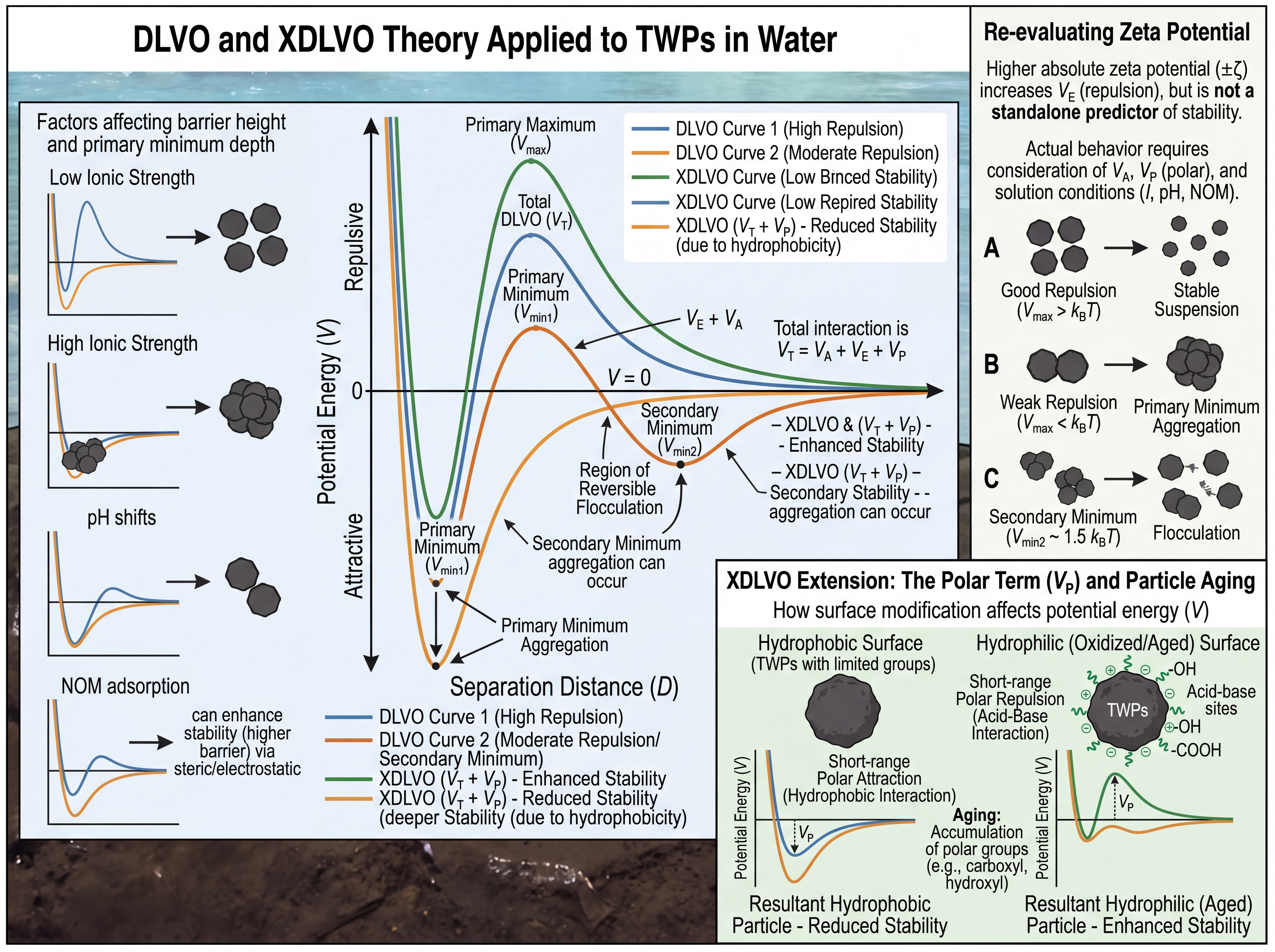
Figure 2. Schematic illustration of DLVO and XDLVO theory for TWP colloidal stability. The XDLVO total interaction energy (VT) comprises van der Waals attraction (VA), electrostatic double-layer repulsion (VE), and polar (acid-base) interaction (VP). The energy barrier (Vmax) and secondary minimum (Vmin2) determine dispersion vs. aggregation. Higher ionic strength compresses the double layer, lowering the barrier and promoting aggregation; NOM adsorption may introduce steric effects. Aging oxidizes TWP surfaces, increases hydrophilicity and polar repulsion (VP), raising the barrier and inhibiting aggregation. Zeta potential magnitude alone is not a universal predictor of stability; actual behavior requires XDLVO analysis under specific solution conditions (pH, ionic strength, NOM) [created by Nanobanana (Gemini 2.5 Flash Image)]. DLVO: Derjaguin-Landau-Verwey-Overbeek theory; XDLVO: extended DLVO; TWP: tire wear particle; NOM: natural organic matter.
Research on the microscale sedimentation of TWPs in aquatic environments represents a relatively underexplored yet critically important link in understanding their overall environmental fate. While the fundamental principle of sedimentation may appear to be a straightforward process of gravitational settling, the sedimentation behavior of TWPs is far more complex than can be described by classical sedimentation models such as Stokes’ law. This complexity arises from the extreme heterogeneity of TWPs themselves - including their diverse physical properties (size, shape, density), surface chemical characteristics, and aging-induced alterations - coupled with the dynamic and variable nature of environmental matrices. Moreover, TWP-related risks involve three distinct mechanisms: physical particle effects, leaching of intrinsic tire additives, and carrier-mediated transport of externally sorbed contaminants. Future research necessitates a paradigm shift from a “black-box model” to “transparent mechanisms”. To achieve this, it is essential to employ advanced characterization techniques, such as high-resolution cryo-electron microscopy and atomic force microscopy, as well as innovative tracing tools, including metal- or fluorescence-labeled TWPs and hyperspectral imaging. Furthermore, multiscale models should be developed by integrating particle properties (e.g., size, shape, density distribution), surface chemistry, heteroaggregation kinetics, and hydrodynamic modeling. Such models will enable the prediction of macroscopic environmental fate based on microscopic mechanisms. In parallel, research efforts must transition from static, closed laboratory systems to dynamic, open model ecosystem studies. Ultimately, this integrated approach will support the development of predictive models and decision-support tools that facilitate accurate environmental risk assessment and inform the design of pollution control technologies.
Factors influencing TWPs sedimentation
Influence of TWPs intrinsic properties
The physicochemical characteristics of TWPs serve as the intrinsic determinants of their environmental behavior, directly governing their modes of interaction with the surrounding environment. Owing to their complex compositional matrix, TWPs exhibit substantial heterogeneity in particle morphology, size, density, and specific surface area. Their sedimentation behavior in aquatic environments is predominantly governed by density and particle size [Table 1], while the factors influencing microscale transport can be categorized into three primary mechanisms: gravitational settling, hydrodynamic conditions, and particle aggregation effects. The density of TWPs typically exceeds that of water (approximately 1.0-1.8 g/cm3). According to Stokes’ law, sedimentation velocity is positively correlated with both particle size and density. In natural water bodies, flow velocity is not constant; in fluvial and coastal systems influenced by turbulent flow, shear forces can resuspend previously settled TWPs, leading to secondary suspension or transport. Furthermore, individual TWPs are micro- or nanoscale in size and readily undergo aggregation with other TWPs or suspended particulates (e.g., sediment, clay minerals, NOM). Such aggregation may either enhance sedimentation (in the case of heteroaggregation with natural particles) or retard it (in the case of homoaggregation with TWPs or other low-density MPs)[33,37,38].
Transportation methods for plastics based on their density and size
| Plastic type | Low density (< seawater density) | High density (> seawater density) |
| Macroplastic (> 25 mm) | Floating | Sinking |
| Mesoplastic (5-25 mm) | Floating | Sinking/suspension |
| MP (1 μm - 5 mm) | Floating/suspension | Sinking/suspension |
| Nanoplastic (< 1 μm) | Suspension/colloidally stable | Suspension/aggregation-sinking |
| TWPs* (10 nm - 300 µm) (dominant < 100 µm) | - | Suspension/rapid sinking/aggregation-sinking with road dust |
Micron-sized TWPs are transported primarily through gravitational settling. According to Stokes’ law, for a rigid spherical particle at low settling velocity (i.e., in the laminar regime), the settling velocity is proportional to the square of the particle diameter and to the density difference between the particle and the fluid[39,40]. In reality, however, the settling behavior of TWPs is far more complex than this ideal model predicts. First, the effective density of TWPs is considerably lower than the true material density owing to internal porosity and surface-adsorbed substances; it is therefore more appropriate to adopt the effective density, rather than the material density, in calculations. Second, TWPs often exhibit irregular, plate-like, fibrous, or branched morphologies, making it necessary to introduce a shape correction factor (e.g., the dynamic shape factor χ, typically > 1) to correct the actual drag. In general, the greater the deviation from a spherical shape, the slower the settling velocity, and the more readily the particles become entrained by turbulence. Furthermore, TWPs frequently undergo homo-aggregation or hetero-aggregation in aquatic environments, forming aggregates with a fractal structure (fractal dimension typically between 1.7 and 2.5). These aggregates possess high intra-aggregate porosity, which causes the effective density of the aggregate to decrease with increasing aggregate size; as a result, the settling velocity does not strictly follow the squared-diameter proportionality of Stokes’ law. Such fractal aggregates require the use of a fractal-modified settling model, such as the Winterwerp formula, for a proper description. By contrast, nano-sized TWPs (< 1 μm) have negligible mass, rendering gravitational settling unimportant and Brownian motion the dominant transport mechanism. Their fate in quiescent water therefore depends heavily on hetero-aggregation with suspended sediments, natural colloids, and similar entities, leading to the formation of larger, readily settling fractal flocs[5,40-43]. In a modeling study on the fate of nanoplastic particles in freshwater systems, Besseling et al. estimated the heteroaggregation attachment efficiencies of 70 and 1,050 nm polystyrene particles with kaolinite and bentonite[33]. However, another study investigating the influence of particle properties on the settling and rising velocities of MPs in freshwater revealed that conventional sedimentation formulas (e.g., Stokes, Dietrich) exhibit substantial predictive errors - particularly for fibers, where deviations ranged from 198% to 862% - indicating their inadequacy in capturing the diverse properties of MPs[44], comparable discrepancies may also apply to the sedimentation velocity estimation of TWPs.
TWPs do not represent a homogeneous or static class of “ideal particles”; rather, they constitute a dynamically evolving, highly heterogeneous, and complex particulate system. Current research frequently examines individual attributes - such as density, size, or surface chemistry - in isolation. However, the actual sedimentation behavior of TWPs results from synergistic or antagonistic interactions among these properties. Moreover, laboratory studies often employ synthetic TWPs or artificially processed samples; whether their properties (e.g., surface oxidation states) adequately reflect those of environmentally weathered and aged particles remains an open question. Existing research has predominantly focused on micrometer-scale TWPs, with some studies addressing nanoscale TWPs. However, the sedimentation behavior of larger-scale aggregates remains underexamined, revealing a potentially significant yet overlooked research gap. Future research should shift from conceptualizing TWPs as a “homogeneous pollutant” to recognizing them as a “diverse particulate population with life history traits”. This paradigm shift will require: (i) designing controlled experiments that is olate and quantify the contributions of individual attributes (e.g., modifying surface charge while maintaining invariant size and density) to sedimentation and aggregation; (ii) integrating computational fluid dynamics with the discrete element method to incorporate realistic particle morphology, deformability, and surface interaction forces, thereby enabling microscale simulation of TWP motion and collision dynamics in aqueous systems; and (iii) developing data-driven machine learning models trained on extensive experimental datasets to identify the most critical attribute combinations governing sedimentation, thereby elucidating the preferential environmental fate pathways of distinct TWP “phenotypes”.
Influence of water chemistry conditions
Beyond the intrinsic properties of TWPs, water chemistry fundamentally regulates their aggregation state by altering particle surface charge and interfacial forces, thereby affecting their effective size, settling velocity, and transport behavior. Tire rubber is composed predominantly of hydrophobic hydrocarbon polymers such as styrene–butadiene rubber (SBR) and natural rubber (NR) (water contact angle > 90°)[5,15]. However, upon environmental ageing - through oxidation, photodegradation, and hydrolysis - abundant polar functional groups are generated on the particle surface, enhancing hydrophilicity and promoting fragmentation into smaller particles, including nano-sized TWPs[27]. Surface chemical characteristics (functional groups, charge, and wettability) and processes occurring at solid–liquid, solid–solid, and solid–biological interfaces are the core mechanisms governing the micro-scale aggregation and sedimentation of TWPs. Below, we systematically discuss the influence of water chemistry factors on surface charge, aggregation, and settling behavior.
(1) Ionic strength and divalent cations. At high ionic strength (e.g., in seawater), cations - particularly Ca2+ and Mg2+ - compress the electrical double layer surrounding TWP surfaces, weakening electrostatic repulsion so that van der Waals attraction dominates. This promotes aggregation and accelerates settling. In freshwater, electrostatic repulsion is preserved, and TWPs tend to remain stably suspended, settling more slowly[17,45].
(2) pH. pH affects the ionization state of surface functional groups on TWPs through protonation/deprotonation, thereby modulating the ζ-potential. When the pH approaches the isoelectric point of TWPs, electrostatic repulsion is minimal and aggregation occurs most readily. In addition, pH influences the dissolution–precipitation equilibria of tire additives such as ZnO, altering their speciation and their capacity for bridging or charge neutralization[46].
(3) NOM (humic substances). NOM adsorbed onto TWP surfaces can form a hydration film, hindering particle aggregation through steric repulsion and thus enhancing the suspension stability of TWPs.
(4) Hetero-aggregation. Natural water bodies contain abundant clay minerals, iron/aluminium hydroxide colloids, bacteria, and other entities that can undergo hetero-aggregation with TWPs. Owing to the complementarity of their surface charge and hydrophobicity (e.g., positively charged iron hydroxides and negatively charged TWPs), hetero-aggregation is generally more efficient than homo-aggregation, forming larger and denser flocs that substantially accelerate settling[28,47,48].
(5) Biofilms. Upon entering water bodies, TWP surfaces are rapidly coated with organic substances such as proteins and polysaccharides, followed by microbial colonization and biofilm formation. The effect of biofilms on TWP sedimentation is context-dependent. While biofilms can increase particle size and aggregation tendency, they may also reduce effective density by entrapping gases or low-density substances, thereby inhibiting settling or facilitating resuspension[30,33,34].
The influence of water chemistry factors on the aggregation and sedimentation of TWPs ultimately determines their residence time, transport distance, and accumulation zones within the water column. Moreover, the high specific surface area and hydrophobicity of TWPs enable them to efficiently adsorb persistent organic pollutants (POPs), polycyclic aromatic hydrocarbons (PAHs), heavy metals, and pathogens from the surrounding water. When environmental conditions change (for instance, shifts in pH or salinity) or when TWPs are ingested by organisms, these adsorbed contaminants may be released, causing secondary pollution. In a comparative study on adsorption–desorption characteristics, researchers systematically evaluated the carrier effects of TWPs and polypropylene (PP) at different aging stages. Their findings indicated that TWPs exhibited superior vector effects for heavy metal ions compared to PP, and that aging enhanced the adsorption capacity of MPs. TWPs demonstrated higher adsorption capacity and greater desorption potential for heavy metal ions[34]. Similarly, Xu et al. investigated the adsorption behavior of four antibiotics onto three distinct types of TWPs. Their results revealed that environmental aging markedly altered the interactions between TWPs and antibiotics in natural waters, with pronounced compound-specific effects[30]. Understanding the aggregation and sedimentation behavior of TWPs under the control of water chemistry is therefore a prerequisite for assessing their risks as contaminant vectors and their ecological effects.
At present, most laboratory studies simulate ionic strength using single-salt solutions such as NaCl or CaCl2, or merely adjust pH[13,49]. However, the chemical composition of real freshwater, seawater, and estuarine environments is considerably more complex, containing multiple co-existing ions (Na+, K+, Ca2+, Mg2+, SO42-, etc.). These ions differ in their efficiency at compressing the electrical double layer and in their capacity for charge neutralization or bridging, and their synergistic or antagonistic effects also vary. At the same time, TWPs serve as highly effective contaminant vectors, and water chemistry conditions (such as pH)[50,51] can markedly regulate the adsorption–desorption equilibria of the heavy metals, PAHs, and other pollutants they carry. This process not only alters the surface properties of the TWPs themselves, but the released contaminants may also form new complexes with dissolved organic matter (DOM) and metal ions, further affecting the aggregation chemistry of the entire system. Existing studies remain largely at the level of qualitative correlation and lack quantitative models that can describe: By how many orders of magnitude does the hetero-aggregation rate constant increase when the abundance of surface oxygen-containing functional groups increases by a certain amount? Beyond what pH threshold does hetero-aggregation begin to deviate significantly from model predictions? Future research should progress from single-factor experiments to multi-factor coupling, establishing experimental systems that can simulate realistic water chemistry spectra. These systems should investigate the combined effects of ionic strength, ion valence, and DOM characteristics to adequately reproduce and deconvolute the complex regulatory network in real aquatic environments - where multiple chemical factors coexist, vary dynamically, and are deeply coupled with biological processes and contaminant behavior.
Influence of hydrodynamic conditions and biological factors
Current research on the sedimentation of TWPs in aquatic environments has largely been conducted under static, idealized conditions. Under static conditions, TWPs are subjected mainly to gravity, buoyancy, and viscous drag; their settling behavior can be approximately described by Stokes’ law, and the process is slow and predictable, with chemical aggregation serving as the principal pathway for altering their effective particle size[36,52]. In real water bodies, however, flow velocity varies considerably in both space and time. Turbulence in rivers and coastal zones generates shear forces that can resuspend previously settled TWPs or cause their secondary transport[24,53]. On the one hand, turbulence increases the collision frequency among particles, promoting both homo-aggregation of TWPs and hetero-aggregation between TWPs and suspended sediments, clay minerals, and natural colloids; the resulting larger flocs settle more readily. On the other hand, the upward components of turbulent eddies can hinder the settling of nano-sized TWPs and may even create a near-bed nepheloid layer. The efficiency of hetero-aggregation depends on the relative concentrations of TWPs and natural particles, particle size matching, surface charge, and the bridging or steric hindrance effects of NOM. In turbulent zones such as estuaries and coastal areas, the sedimentation of TWPs exhibits a dynamic balance, that is, turbulence accelerates settling by promoting hetero-aggregation, yet at the same time suppresses the settling of individual particles and small flocs. The net sedimentation flux is governed by the coupled effects of multiple factors, including turbulence intensity, floc strength, the concentration ratio of TWPs to natural suspended matter, and water chemistry conditions (ionic strength, NOM). Therefore, integrating the hetero-aggregation processes of TWPs into a hydrodynamic and sedimentological framework is essential for accurately predicting their environmental fate.Biologically driven processes - both natural and anthropogenic - also exert considerable influence on TWP sedimentation. Benthic organisms (e.g., crabs, shrimp, and bivalves) disturb sediment through bioturbation and feeding activities, leading to the resuspension of previously buried TWPs[54,55]. Furthermore, benthic suspension feeders may ingest suspended TWPs and subsequently egest them within fecal pellets, effectively packaging and depositing the particles back to the sediment bed[54,56].
Hydrodynamic and biological factors propel the issue of TWP microscale sedimentation from a controllable physicochemical problem to the forefront of complex Earth system science - one characterized by dynamism, heterogeneity, and biological interference. Current understanding remains at the level of identifying “influencing factors”, far from achieving quantitative mechanistic insight. Several critical questions remain unresolved: How do transient or extreme events - such as storm-induced sudden decreases in ionic strength, pulsed inputs of DOM and particulates via runoff, diurnal pH and DOM fluctuations during algal blooms, or rapid salinity front migration in estuaries - nonlinearly and sometimes irreversibly alter TWP aggregation status and sedimentation flux? Microbial community composition and extracellular polymeric substance (EPS) properties vary markedly across different water bodies (e.g., freshwater vs. marine, oligotrophic vs. eutrophic), leading to profound differences in biofilm adhesion strength and density. Are current studies adequately accounting for such variability? Moreover, TWPs may be directly ingested by filter-feeders (e.g., bivalves, zooplankton) or benthic organisms. Does passage through the digestive tract of these organisms modify the subsequent sedimentation behavior of TWPs? Future research should employ advanced hydrodynamic simulation tools - such as annular flumes, oscillating grid turbulence generators, and stratified shear flow devices - to replicate more realistic flow conditions ranging from laminar to turbulent regimes and from homogeneous shear to velocity gradients. Such systems will enable precise measurement of TWP settling velocity distributions and the aggregation–fragmentation balance under varied flow regimes. Multifactorial experiments conducted under controlled flow and biological conditions are essential. Ultimately, efforts should be directed toward the development of conceptual and numerical models that couple hydrodynamic modules (fluid dynamics), biological modules (biofilm growth, benthic activity), and particle dynamics modules (sedimentation, aggregation, resuspension).
TRANSPORT AND SEDIMENTATION PROCESSES OF TWPS IN AQUATIC ENVIRONMENTS
Sedimentation and transport processes of TWPs at the water–sediment interface
Upon generation, TWPs are initially deposited on road surfaces as a source and subsequently enter aquatic environments primarily through hydraulic transport pathways, including rainfall runoff, surface runoff, and wastewater treatment systems. Once introduced into aquatic systems, the transport and transformation of TWPs are codetermined by their intrinsic physicochemical properties and the prevailing water conditions [Figure 3]. The transport of TWPs in water bodies primarily involves sedimentation and resuspension - processes governed by a multitude of interacting factors: physical transport mechanisms (gravity, hydrodynamic conditions, aggregation effects); chemical processes (surface aging, pollutant adsorption/desorption, biofilm formation); and biologically driven processes (bioturbation, ingestion, egestion).
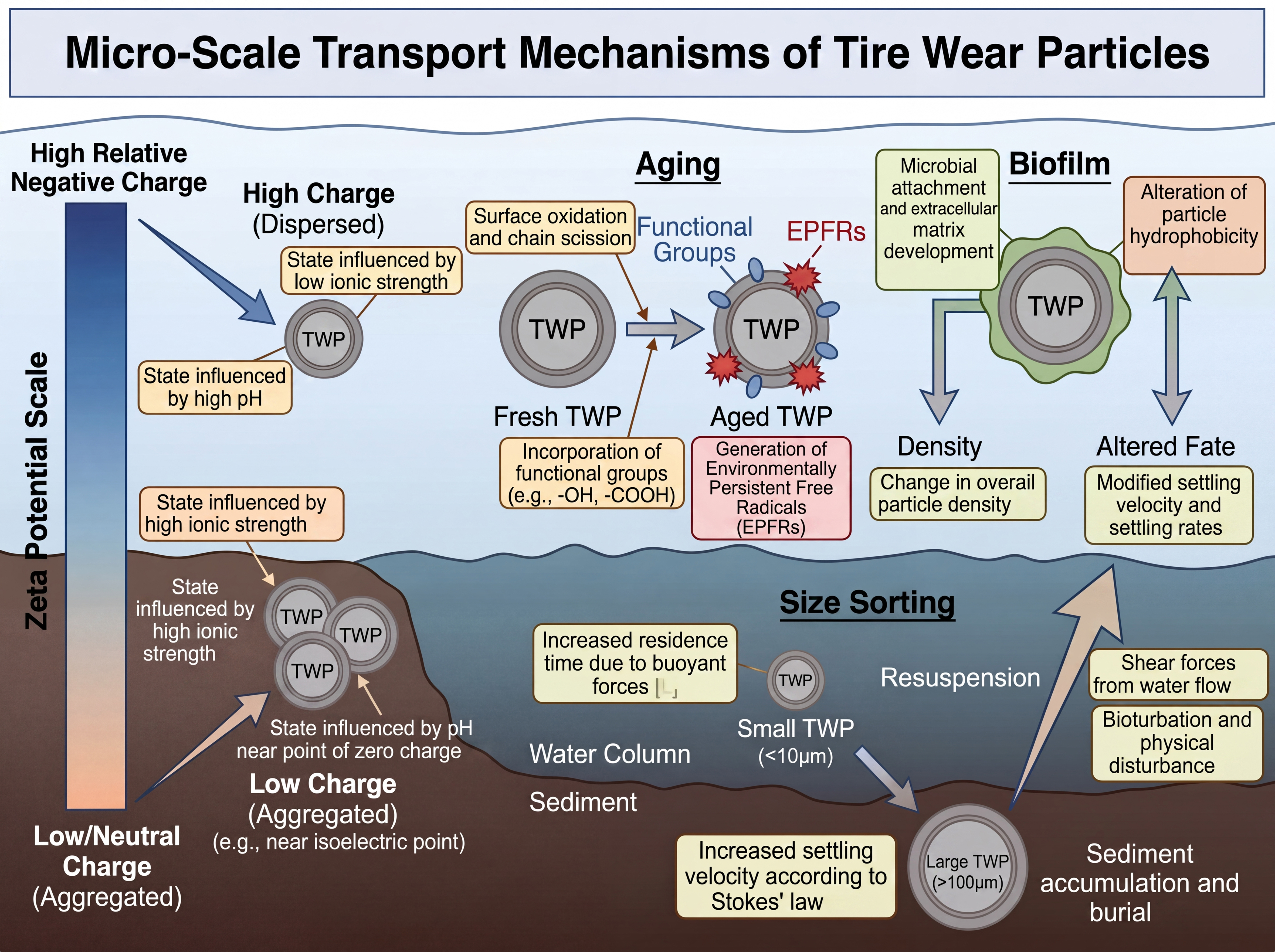
Figure 3. Micro-scale transport mechanisms of TWPs. The schematic illustrates the interplay between surface charge (dispersed vs. aggregated states), environmental ageing (surface oxidation, EPFR generation, biofilm formation, and density/hydrophobicity changes), and size sorting, which collectively govern the settling, resuspension, and fate of TWPs in the water column [created by Nanobanana (Gemini 2.5 Flash Image)]. TWPs: Tire wear particles; EPFR: environmentally persistent free radical.
Following complex microscale transport, TWPs ultimately partition into several major compartments: deposition in sediments, prolonged suspension in the water column, biological uptake, and further degradation. TWPs are inherently complex, dynamic, and heterogeneous “non-ideal particles”, characterized by variable composition, aging effects, and adsorption–desorption behaviors. They reside within “non-ideal systems” defined by multifactorial coupling (e.g., pH, salinity, turbulence intensity, organic matter content)[5,36]. Furthermore, technical limitations persist across detection, simulation, and modeling domains - including difficulties in quantification and identification, challenges in isolating nanoscale TWPs, an inability to fully replicate real environmental conditions, and complications in parameterizing predictive models[57-60]. Future research priorities should include: validating the applicability of conventional sediment transport formulas to TWPs and developing velocity prediction models tailored to diverse TWP types to support numerical simulations; quantifying the rates of key processes; elucidating the behavior of nanoscale TWPs; and assessing their long-term ecological risks in complex, real-world environments.
Transport processes at the watershed scale
The transport of TWPs is conventionally framed within a “source–pathway–sink” scheme. However, whether a given environmental compartment functions as a “source” or a “sink” for TWPs depends strongly on the specific environmental conditions, particularly the level of oxidant exposure, the redox conditions, and the physical setting (e.g., hydrodynamic intensity, sediment stability). For instance, under sustained disturbance or highly oxidative conditions - such as those encountered in road runoff or shallow turbulent zones - previously settled TWPs can be resuspended and re-enter the water column, turning that environment into a source. By contrast, low-energy, reducing, or burial-dominated environments (e.g., deep-water sediments, wetlands, polar ice) favour long-term retention and accumulation, thereby acting as a sink. The transport pathways of TWPs are therefore multi-route, cross-media, and dynamically reversible, that is, TWPs deposited in soil may be re-entrained by wind or surface runoff, and those sequestered in riverbank sediments can be resuspended during flood events [Figure 4]. This review focuses on the transport behavior of TWPs in aquatic environments and also incorporates recent advances in understanding the transport and fate of TWPs in specialized sink regions such as the deep sea and polar areas.
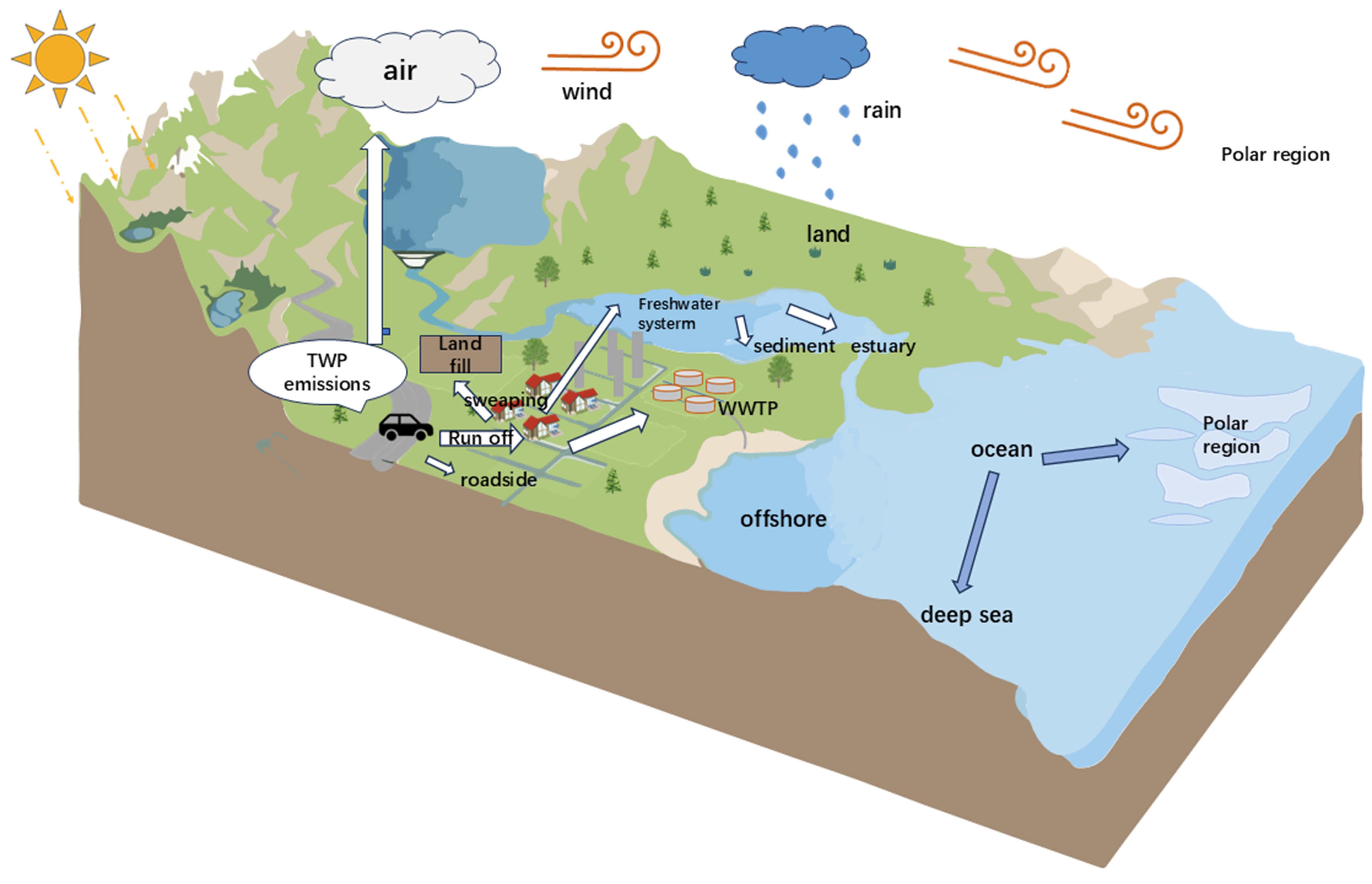
Figure 4. Schematic diagram of TWP environmental migration: the migration process of TWPs from emission sources (e.g., roads) through pathways such as runoff and sweeping into environmental media including freshwater systems, landfills, sediments, terrestrial environments, estuaries, oceans, and polar regions, while also encompassing atmospheric transport and deposition pathways. TWP: Tire wear particle; WWTP: wastewater treatment plant.
TWPs are readily conveyed via stormwater runoff, road runoff, and underground storm drainage systems into natural water bodies such as lakes, rivers, and oceans[61]. Within aquatic systems, the fate of TWPs manifests as either sedimentation or suspended transport. Particles with higher density - particularly those containing inorganic fillers - tend to settle rapidly and become incorporated into bottom sediments. In contrast, fine, low-density, or biofilm-colonized TWPs may remain suspended for extended periods, undergo long-range transport with water currents, and ultimately discharge into the ocean, thereby constituting a component of pelagic MP pollution[1,62,63]. During rainfall events, particle concentrations in stormwater runoff can reach 6.4-18 mg/L[64]. TWPs and their transformation products exhibit a pronounced propensity for accumulation in lacustrine and estuarine sediments. Wei et al. reported tire-derived additive concentrations as high as 3,500 ng/L, with severe exceedances observed in aquatic organisms (e.g., snails, shrimp, sea cucumbers, fish) - particularly for N,N′-Diphenyl-p-phenylenediamine (DPPD), N-(1,3-dimethylbutyl)-N′-phenyl-p-phenylenediamine (6PPD), and their transformation products[65]. Eisentraut and colleagues pioneered the analysis of tire wear content in environmental samples[66]. Wagner et al., using chemical markers to quantify tire wear, reported that tire-derived concentrations in sediments exceeded those in surface waters[2]. Another research group employed pyrolysis–gas chromatography–mass spectrometry to quantify tire wear emissions at major entry points to the marine environment, estimating that approximately 67%-89% of TWPs transported from land to ocean are retained as deposits in estuarine transition zones[67]. Liu et al. applied the Regional Ocean Modeling System coupled with a Lagrangian transport model to investigate the transport dynamics of MPs in Chinese seas under varying seasonal, climatic, and river discharge conditions. Their findings revealed pronounced seasonal variability in the transport pathways and spatial distribution of MPs, driven by the combined effects of regional ocean circulation patterns, riverine discharge, and intrinsic particle properties[68]. Furthermore, by simulating vertical flow velocities and extending the transit time of MPs to the open ocean, they demonstrated that MPs with higher density typically exhibit shorter transport distances. Notably, the transport distances of PE terephthalate and polystyrene were two orders of magnitude shorter than those of PE, providing scientific foundations for the management of coastal MP pollution. In a recent study, Deng et al. detected MPs in deep-sea sediments collected at depths of 4,900-7,016 m across the Western Pacific, Central Pacific, and Eastern Pacific[69]. Polyester fibers and rayon dominated the MP composition. The study further confirmed that deep-sea clay sediments, characterized by high specific surface area and low sedimentation velocity, serve as long-term reservoirs for MPs. Moreover, aggregation of MPs with marine snow and biological detritus was shown to accelerate their vertical settling[69]. Terminal settling velocity represents the most sensitive parameter governing both vertical and lateral transport of TWPs in aquatic environments. Despite the availability of numerous modeling studies, significant uncertainties persist due to the inherent complexity of TWPs and the scarcity of direct, systematic experimental data. These uncertainties may lead to either overestimation or underestimation of the influence of specific parameters[57,58]. In this context, Dittmar et al. recently provided the first critical empirical dataset on settling velocities, addressing the most substantial data gap in this field. However, the limited sample set in their study may not fully capture the global diversity of TWPs; thus, complementary data from different regions and road conditions worldwide are urgently needed to refine existing models[58,59]. While the work of Dittmar and colleagues represents a milestone advancement, several potential limitations remain. The study treated TWPs as homogeneous mixtures of tire and non-tire materials, which may oversimplify the structural complexity inherent to tires. Additionally, experiments were conducted under idealized conditions, whereas turbulence in natural water bodies substantially influences the actual sedimentation and resuspension behavior of TWPs, thereby introducing potential errors in model-based settling velocity estimates. Currently, empirical data on TWP transport in aquatic environments remain insufficient, constrained by both technical and environmental challenges. Processes such as biofouling, chemical flocculation, and hydrodynamic disturbances in real aquatic systems hinder our comprehensive understanding of the distribution, transport, and transformation of TWPs. Future research should adopt interdisciplinary approaches - building upon the methodological framework established by Dittmar et al. - that integrate physical transport data, simulation-based predictions, and toxicological assessments to address the challenges posed by particulate pollutants in complex environmental mixtures[59,70].
Current research methods and techniques
The complex composition and diffuse sources of TWPs, coupled with their rapid environmental aging, degradation, and mixing with MPs from other origins (e.g., textile fibers, plastic debris), render the precise source apportionment and quantification of their proportional contributions extremely challenging. Consequently, developing robust methodologies for accurate source tracing and applying them to estimate TWP emission fluxes in real-world environments has emerged as a central research priority. Driven by the need for precise source apportionment and flux estimation of TWPs, thermal-analysis-based hyphenated techniques and chemical marker methods have advanced rapidly in recent years. Pyrolysis–gas chromatography/mass spectrometry (Py-GC/MS) achieves quantitative analysis of TWPs in complex environmental matrices by detecting characteristic pyrolysis products of SBR, NR, and other elastomers[71,72]. Thermal extraction–desorption gas chromatography/mass spectrometry (TED-GC/MS) allows direct analysis of solid samples such as soil and sediment without sample pretreatment, making it suitable for high-throughput screening[73]. Thermogravimetric analysis–gas chromatography/mass spectrometry (TGA-GC/MS) enables simultaneous quantification of TWPs and their additives; its rapid-heating variant (PyroTGA-GC/MS) has demonstrated favourable sensitivity and efficiency in the analysis of road dust[74]. With respect to chemical markers, polymer markers (SBR, NR, BR) can directly indicate tire-derived constituents, although quantitative bias arising from compositional differences among tire types must be considered; molecular markers such as 6PPD-quinone (6PPD-Q), DPG, 2-Hydroxybenzothiazole (2-OHBT), and zinc can aid in identifying the TWPs contribution, but their differing environmental stability warrants careful evaluation[75,76]. Combining multiple markers with positive matrix factorization (PMF) can further distinguish traffic-related sources, including tire wear, brake wear, and exhaust emissions[26]. The refinement of these detection and source-tracing methods provides key technical support for estimating TWPs emission fluxes in real-world environments. To systematically elucidate the sedimentation mechanisms of TWPs in aquatic environments and quantitatively characterize their kinetic processes, the integrated application and continuous innovation of multidisciplinary research approaches are imperative. Under idealized laboratory conditions[2,13,39], sedimentation columns are commonly employed to simulate TWP settling in water. This method offers advantages including simple instrumentation and well-controlled conditions, enabling approximate simulations of quiescent aquatic environments. However, its limitations include extended experimental durations, difficulty in replicating the dynamic hydrodynamic conditions characteristic of natural waters, and insufficient sensitivity for monitoring colloidal-scale particles. Turbulent flumes provide a more realistic simulation of TWP sedimentation under environmentally relevant hydrodynamic regimes, yet their substantial spatial footprint and high equipment costs render them inaccessible to most domestic laboratories investigating TWP sedimentation. For monitoring TWP sedimentation rates in aquatic systems, turbidimeters or UV-Vis spectrophotometers are frequently employed to continuously track the attenuation of light transmittance through the water column. The temporal evolution of turbidity or absorbance serves as a real-time proxy for trends in bulk particle concentration, facilitating rapid screening and comparative assessment of macroscopic influences exerted by various environmental factors (e.g., salinity, NOM) on sedimentation processes. Nevertheless, these bulk optical methods cannot distinguish between turbidity variations arising from particle aggregation-induced size enlargement and those resulting from absorbance changes caused solely by particles settling out of the detection window. To overcome this limitation, researchers have increasingly adopted interdisciplinary approaches incorporating image analysis techniques. High-speed imaging coupled with automated image analysis of settling or suspended particles within sedimentation columns or flow cells - combined with computational vision scripts developed in Python or MATLAB - enables direct, in situ acquisition of multidimensional statistical data for individual particles or aggregates, including size, morphology, number concentration, and instantaneous settling velocity. However, this image-based technique exhibits limited resolution for submicron particles (< 10 μm) and is susceptible to analytical errors due to particle image overlap under high particle concentrations[44,70,77]. At the microscale, in addition to commonly employed techniques such as Fourier transform infrared spectroscopy, X-ray photoelectron spectroscopy, and Zeta potential analysis, atomic force microscopy represents a cutting-edge analytical tool. Atomic Force Microscope (AFM) not only enables three-dimensional topographical characterization and surface roughness quantification of TWPs at nanometer resolution but also, through chemical force microscopy and colloidal probe techniques, allows direct and quantitative measurement of microscopic interaction forces - both between TWPs themselves and between TWPs and mineral surfaces or biofilms. This capability provides robust experimental force-spectroscopic evidence supporting theoretical descriptions of van der Waals forces, electrostatic interactions, and polymer bridging.
Advances in predictive modeling and estimation approaches
DLVO theory elucidates colloidal stability through the equilibrium between van der Waals attraction and electrostatic double-layer repulsion. Its extension, XDLVO theory, further incorporates polar/hydrophobic interactions (e.g., Lewis acid–base forces), rendering the model more representative of realistic interfacial behavior. This mechanistic framework utilizes key parameters - including Zeta potential (ζ), particle radius (R), and solution ionic strength (I) - to compute the total interparticle interaction potential energy as a function of separation distance. The resultant energy barrier height and secondary minimum depth provide theoretical predictions of aggregation propensity under varying conditions, which are validated through comparison with aggregation rates measured by dynamic light scattering[38,78,79]. Population balance models employ population balance equations to describe particle collision dynamics driven by Brownian motion, fluid shear, and other mechanisms, along with aggregation and sedimentation-induced losses. These models dynamically simulate the temporal evolution of TWP particle size distributions and predict changes in supernatant particle concentrations, enabling direct fitting and validation against sedimentation column experimental data[80]. Environmental multimedia fate models leverage the fundamental mechanistic insights obtained from the aforementioned small-scale experimental and modeling approaches, scaling up through parameterization to regional or watershed-scale multimedia fate frameworks (e.g., fugacity models, QWASI models). Waldschläger et al. conducted approximately 500 physical experiments to further elucidate the influences of particle shape, size, and density on the rising and settling velocities of MPs[44]. Comparative evaluation against six classical sediment transport formulas revealed that none could accurately describe MP behavior. Consequently, a modified Stokes-based formula incorporating shape factors was developed, substantially improving prediction accuracy and markedly reducing relative errors[44,81,82]. Mancini et al. provided the first analysis of sediment-induced alterations in MP settling trajectories and inclination angles, refining the formula previously proposed by Francalanci et al. (2021) to enhance its applicability under turbid water conditions[77,81]. Computational fluid dynamics coupled with the discrete element method (CFD-DEM) represents the current state-of-the-art computational approach for simulating the sedimentation, aggregation, and resuspension behavior of TWP populations under flowing conditions. Within this coupled framework, the CFD module solves background fluid motion, while the DEM module tracks the translational and rotational movements of individual discrete particles - each assignable with realistic attributes including density, non-sphericity, and viscoelastic properties. Fluid–particle interactions (bidirectional coupling) and particle–particle/particle–boundary interactions (collision, adhesion, detachment) are explicitly considered. This enables simulation of the complete process of TWP aggregate growth, settling trajectories, and bed resuspension under complex hydrodynamic regimes including turbulent and shear flows. The approach offers flexible parameterization of diverse microscopic interaction force models and facilitates exploration of extreme conditions or large-scale watershed scenarios that are experimentally inaccessible. However, predictive accuracy remains critically dependent on the reliability of input parameters (e.g., surface energy, Hamaker constant, adhesion force models), and computational resource demands are substantial. Meng et al. pioneered the development of a semi-theoretical bedload transport rate model specifically targeting exposed MPs. Integrating CFD-DEM simulations with experimental validation, their results demonstrated that although dimensionless bedload transport rates of exposed MPs and natural sediments were comparable - indicating that density and particle diameter remain key factors governing sediment transport - detailed analysis revealed distinct transport rates between exposed MPs and native sediments. The model quantified these differential transport rates, providing metrics for assessing exposure-induced transport enhancement[83].Shi et al. investigated the interfacial interactions between polystyrene MPs and sulfamethoxazole as model pollutants under coupled aging and hydrodynamic conditions. CFD-DEM simulations further demonstrated that under low hydrodynamic energy regimes, PS-SMX complexes predominantly accumulated at the bottom and remained stable[84]. Lofty et al. experimentally investigated the three-dimensional settling behavior of environmental MPs, addressing critical knowledge gaps regarding lateral drift and settlement pathways that have been largely overlooked in existing research[85]. Chen et al. proposed a size probability distribution-based methodology for converting MP particle number concentrations to mass concentrations[48]. Comparative evaluation against volume–density methods (e.g., Isobe, Simon approaches) and coefficient conversion methods (e.g., Zhao, Weiss methods) was conducted [Table 2]. Application of this method to data from the middle and lower Yangtze River yielded a re-estimated annual mass flux of 1,950.00-12,655.58 tons (mean: 6,895.90 ± 3,763.24 tons), consistent with the model results of Chen et al. (7,020 tons) but substantially lower than global model estimates (85,440-1,469,481 tons). This discrepancy suggests potential overestimation by global models and highlights the necessity for future research to expand across diverse environmental compartments (e.g., beach sediments, extreme climatic conditions) and polymer types[86].
Comparison of different mass estimation methods for MPs
| Method | Key points | Advantages | Limitations |
| Balance method[87-89] | Directly measure mass using balances with an accuracy of 10-2 to 10-7 | Simple and precise; suitable for quantifying total plastic mass | May contain non-plastic debris if not properly separated; small particles require a high-precision balance |
| Mass spectrometry method[74,90,91] | Establishing first-order equations based on primary products to back-calculate MP mass | High specificity for accurate identification of polymer composition; capable of detecting chemical additives within plastics; detection limits ranging from 10-6 to 10-9 g | Expensive, requires specialized equipment; destructive method |
| Coefficient/equation conversion method[92,93] | Multiply the number of MPs by the average mass assumed for a specific sample or an established regression equation | Rapidly estimate mass from particle count; useful when direct weighing is impractical; requires no expensive equipment | Reliability of empirical coefficients is questionable; may introduce significant uncertainty |
| Volume-density method[74,94,95] | Estimating mass using particle volume and assumed density | Allows estimation of individual particle mass; more accurate than coefficient conversion method | Requires 2D or 3D measurement data for each particle; density variation within the same polymer introduces uncertainty |
| Size-probability distribution method[86] | Estimating total mass using statistical models based on size distribution | Accounts for size distribution variability; does not require individual particle shape parameters such as width or height; more accurate than coefficient conversion methods | Requires sample size distribution and fiber/fragment ratio; cannot obtain individual particle mass |
The goal of flux estimation is to answer the following question: within a given spatial and temporal domain, how many TWPs settle from the water column into the sediment? Current estimation efforts face a fundamental challenge - a pervasive lack of data, methods, and validation. To address this, we propose adopting a mass-balance framework to systematically quantify the fate of TWPs in aquatic environments[5,13,57,58]. For a control volume (e.g., a lake, river reach, or bay), the mass balance of TWPs can be expressed as:
The terms are defined as follows:
Runoff input (Qrunoff): the flux of road-derived TWPs entering the water body via surface runoff, influenced by rainfall intensity, road-surface particle loading,the proportion of impervious surfaces, and the interception efficiency of drainage systems.
Atmospheric deposition (Qatm): the flux of fine, airborne TWPs entering the water body through dry and wet deposition, originating mainly from tire-wear aerosols and road dust.
Wastewater discharge (Qwastewater): the flux of TWPs (especially nano-sized particles) remaining in treated effluent that is directly discharged into the receiving water body.
Sedimentation (Qsed): the net flux of TWPs removed from the water column to the sediment via gravitational settling, governed by the effective particle density, particle size distribution, aggregation state, and hydrodynamic conditions.
Resuspension (Qresus): the flux of previously settled TWPs re-entering the water column due to bed shear stress, bioturbation, or turbulent eddies - particularly pronounced in shallow waters and tidal estuaries.
Downstream export (Qout): the advective flux of TWPs transported out of the control volume by water flow, typically calculated as the product of water concentration and discharge.
Degradation/transformation (Qdeg): the flux associated with the conversion of TWPs into smaller particles or chemical products via photodegradation, mechanical fragmentation, and microbial degradation - currently quantified only to a very limited extent.
The primary problems with current flux estimates are as follows: high uncertainty in source inventories - estimates rely on vehicle-kilometer emission factors (g/vehicle·km), yet these factors vary substantially with tire type, road surface, and driving behavior, and they fail to capture non-exhaust emission pathways (e.g., atmospheric suspension and vehicle-induced dispersal); poorly constrained transport efficiency - the transfer efficiency from roads to water bodies depends on rainfall intensity, land-surface characteristics, drainage infrastructure, and distance, and is often parameterized with crude empirical values; oversimplified sedimentation parameters - settling velocities are frequently assigned fixed values, whereas in reality they undergo dynamic changes owing to particle ageing, aggregation, and biofilm coating; neglect of resuspension - in hydrodynamically active areas such as estuaries and coastal zones, deposited TWPs are readily resuspended and undergo multiple settling cycles, leading to overestimation of net sedimentation and permanent burial and underestimation of chronic exposure risk in the water column; and difficulty in closing the mass balance - within a catchment it is extremely challenging to obtain synchronized, accurate measurements of input, suspended, and deposition fluxes, making it impossible to construct a reliable mass balance for verifying the estimates.
Future research should prioritize the development of TWP-specific tracing and monitoring techniques, conduct “whole-chain” synchronized observations (road runoff → sewer networks → river transport → sediment burial), build interdisciplinary, multi-scale, and verifiable integrated modelling frameworks, and progressively quantify each term of the mass-balance equation given above, thereby providing a forward-looking basis for long-term environmental risk management.
RISK CONTROL STRATEGIES FOR TWPS
As one of the most widely distributed sources of MP pollution globally, TWPs have attracted increasing attention due to their potential toxic effects on terrestrial and aquatic biota. TWPs are also recognized as important carriers and sources of metal contaminants released into the environment[96], and the multiple threats associated with their generation and composition have become a growing environmental concern. Unlike conventional MPs, TWPs are not composed of a single polymer but rather constitute a complex composite system consisting of vulcanized rubber matrices, carbon black, zinc oxide, vulcanization residues, antioxidants such as 6PPD, and road-derived mineral particles. Their cross-linked elastic structure, relatively high density, and hydrophobic surface properties confer unique environmental behaviors. The generation of TWPs is closely associated with traffic activities, and these particles can migrate into soils, aquatic environments, and even remote polar regions through multiple transport pathways, including atmospheric deposition and road runoff, thereby achieving global-scale dispersal[97]. Furthermore, TWPs may pose threats to ecosystems and human health through trophic transfer and biomagnification within food webs[65]. Consequently, engineering control strategies for TWPs should be distinguished from conventional remediation approaches developed for general MPs. Given the ubiquity of their sources, there is an urgent need not only to establish an integrated management framework but also to develop targeted control strategies for TWP pollution across different environmental compartments[61]. More importantly, effective control strategies should integrate physical removal, biodegradation, and chemical remediation approaches, while rigorously distinguishing among phase transfer, structural transformation, true degradation, mineralization, and toxicity attenuation as distinct mechanistic processes.
TWPs exposure pathways
Existing studies on the health risks of TWPs have primarily focused on laboratory observations of toxic effects, while lacking a systematic understanding of the complete pathways through which pollutants migrate from environmental media into organisms and humans. Clarification of exposure pathways is a prerequisite for quantitative risk assessment and also provides the basis for developing targeted control strategies. The exposure pathways of TWPs can generally be categorized into ingestion by aquatic organisms, sediment exposure, trophic transfer, and multi-route human exposure, with substantial differences among these pathways in terms of exposure efficiency, bioavailability, and toxicological responses.
Suspended TWPs in the water column can be actively ingested by filter-feeding organisms, such as mussels and zooplankton, with uptake efficiency being strongly associated with particle size, surface properties, and the feeding selectivity of organisms[98]. Studies have demonstrated that zooplankton exhibit relatively high ingestion rates for particles in the size range of 1-20 μm, whereas nanoscale particles may penetrate biological membrane barriers and enter intracellular compartments[99,100]. Once TWPs enter the digestive tract, the stability of the vulcanized rubber matrix under intestinal pH and enzymatic conditions[101], together with the release kinetics of additives such as 6PPD, jointly determines the actual bioavailable dose. The toxic effects associated with ingestion exposure arise not only from the mechanical impacts of TWP particles themselves, such as intestinal blockage and pseudo-satiation leading to inhibited nutrient absorption, but also from the chemical additives associated with the particles.
TWPs contain a variety of chemical additives, among which 6PPD is one of the most commonly used antioxidants and antiozonants[102]. 6PPD itself is not persistent in the environment; rather, it is transformed under the action of ozone (O3) and, to a lesser extent, nitrogen oxides (NOx) or photooxidation. Its principal transformation product is 6PPD-Q. 6PPD-Q has attracted widespread attention owing to its high acute toxicity to certain fish species, such as coho salmon (Oncorhynchus kisutch), with a median lethal concentration (LC50) below 0.1 μg/L. The formation of 6PPD-Q proceeds via a two-step reaction: (i) the secondary amine group in 6PPD is cleaved by ozone to generate a nitroxide radical intermediate; (ii) further oxidation and rearrangement yield the quinone structure. This transformation occurs mainly on road surfaces, roadside soils, and atmospheric particles - environments where traffic emissions lead to elevated ozone concentrations. Key environmental drivers include ① ozone concentration, ② ultraviolet radiation, ③ temperature and humidity, and ④ road-surface residence time.
6PPD and its transformation products do not exist as free chemicals in isolation; rather, they are either embedded within TWPs or adsorbed onto particle surfaces. Consequently, the environmental behavior of 6PPD-Q is closely linked to the transport processes of TWPs. 6PPD-Q is generated predominantly on the particle surface after emission: fresh TWPs contain unreacted 6PPD, whereas aged TWPs, owing to surface oxidation, tend to release more 6PPD-Q. During rainfall, both dissolved and particle-bound 6PPD-Q can be transported by runoff, with the partition coefficient (Kd) depending on the organic carbon content of the TWPs and the water chemistry conditions. Furthermore, the sedimentation and resuspension of TWPs can influence the deposition of 6PPD-Q; resuspension may re-expose TWPs and their derivatives to oxic environments, thereby further altering their transformation states. The high lethality of 6PPD-Q to fish has been a major concern, yet species sensitivity to 6PPD-Q varies widely, and the overall ecological impact remains unclear. Current technologies cannot readily eliminate this challenge. The harm posed by 6PPD-Q is primarily mitigated through measures such as developing alternative antioxidants with lower toxicity (e.g., bio-based antioxidants, hindered amine light stabilizers), improving road materials to reduce tire wear and TWP generation, and constructing stormwater treatment systems capable of removing dissolved 6PPD-Q (e.g., biofiltration basins, constructed wetlands).
Sediments represent one of the major environmental sinks for TWPs in aquatic systems. Through atmospheric deposition and surface runoff transport, large quantities of TWPs ultimately accumulate in riverbeds, lake sediments, and coastal deposits, forming long-term pollution reservoirs. Benthic organisms, including polychaetes, bivalves, and demersal fish, interact with TWPs through sediment ingestion, body surface contact, and porewater exposure pathways. Exposure to TWPs in aquatic environments has been shown to alter bacterial community composition and affect nitrogen cycling in marine ecosystems, indicating exposure mechanisms fundamentally different from those associated with water-column ingestion[103]. Following aging processes in sediments, TWPs undergo enhanced surface oxidation, resulting in increased abundance of oxygen-containing functional groups, such as carboxyl and hydroxyl groups, which significantly enhance their adsorption capacity for heavy metals (e.g., Zn, Cd, and Pb) and hydrophobic organic pollutants. In addition, environmentally persistent free radicals generated during photoaging of TWPs may directly disrupt microbial processes involved in carbon metabolism and electron transfer, thereby inhibiting sediment denitrification rates[104]. During burrowing and foraging activities, benthic organisms can resuspend sediment-associated TWPs while simultaneously ingesting aged TWPs attached to sediment particles. Consequently, organisms are exposed not only to TWPs themselves but also to the complex pollutants enriched on their surfaces.
The transfer of TWPs and associated pollutants along food chains represents one of the most ecologically significant exposure pathways and serves as a crucial link connecting environmental concentrations with health risks in top predators. Trophic transfer involves two interrelated processes, that is, the movement of TWP particles across trophic levels and the bioaccumulation and biomagnification of associated chemical additives throughout the food web. Existing evidence suggests that TWPs can undergo cross-trophic transfer within food chains involving zooplankton, small fish, and larger predatory fish[105]. TWPs ingested by zooplankton may enter higher trophic levels through incompletely digested fecal pellets or via direct predation by small fish. However, substantial interspecies differences exist in the retention time, excretion efficiency, and tissue distribution of TWPs. Some studies have reported the accumulation of TWPs in fish liver, gill, and intestinal tissues[106], whereas data regarding their ability to cross intestinal barriers, enter systemic circulation, and subsequently migrate to muscle or brain tissues remain extremely limited. More importantly, the fate of TWPs within predator digestive systems - such as partial degradation by gastric acids or altered additive release kinetics under intestinal conditions - directly influences the actual exposure dose at higher trophic levels. Compounds such as 6PPD-Q, owing to their lipophilicity and metabolic stability, may possess significant biomagnification potential. Following exposure to TWPs containing 6PPD-Q, aquatic insects and small fish may accumulate the compound in adipose tissues, which can subsequently transfer to higher trophic levels when consumed by birds or mammals. At present, empirical data on the biomagnification factor (BMF) of 6PPD-Q remain extremely limited[65]. Most available studies are restricted to acute toxicity tests in single species, while chronic, multigenerational, and multi-trophic exposure studies are still lacking.
As terminal consumers in food webs, humans are exposed to TWPs through multiple pathways characterized by low-dose and long-term exposure. Dietary intake represents a major route, as the detection of TWPs in aquatic products such as fish and shellfish directly reflects contamination within aquatic food webs. Exposure through drinking water involves the transport and transformation of TWPs throughout source water, treatment processes, and distribution systems. The removal efficiency of conventional treatment technologies, surface chemical changes during disinfection, and the retention and re-release of TWPs within pipe biofilms all influence final exposure concentrations. Atmospheric inhalation is particularly important in traffic-dense areas, where TWPs are associated with inhalable particulate matter, and their deposition sites within the respiratory tract determine inhalation-related health risks. The ability of TWPs to penetrate the skin barrier depends on particle size, surface charge, and interactions with skin lipids, although dermal exposure pathways remain poorly understood. Toxicological studies, primarily conducted in model organisms, have demonstrated that 6PPD and 6PPD-Q can induce oxidative stress, cause DNA damage, and disrupt metabolic and neurological functions[107]. Adverse effects including intestinal toxicity, reproductive impairment, altered neurobehavior, and potential carcinogenicity have also been reported. However, direct evidence regarding their impacts on human health remains limited.
These exposure pathways do not occur independently but instead form a complex interconnected network at the ecosystem scale. TWPs accumulated in sediments can enter aquatic food webs through benthic organisms, thereby linking sediment exposure with trophic transfer. Likewise, atmospheric deposition can contaminate aquatic systems and subsequently enter humans through drinking water or seafood consumption. A major limitation of current risk assessment frameworks is the lack of integrated multi-media and multi-pathway exposure models, as well as insufficient toxicokinetic data linking environmental concentrations to internal doses. Source reduction measures can decrease atmospheric deposition and runoff loads; process interception approaches, such as stormwater management systems, can prevent the transport of TWPs into aquatic environments; and end-of-pipe treatments, including advanced drinking water purification, can reduce direct human exposure. Different control measures correspond to specific interruption points along exposure pathways, and their technical selection and performance evaluation should be integrated with quantitative analyses of exposure processes.
Physical separation and phase transfer in engineering systems
Road runoff represents the primary pathway through which TWPs enter aquatic environments; therefore, engineering control strategies mainly rely on physical separation processes within stormwater management systems and WWTPs. It should be emphasized that the “removal” achieved by these technologies essentially represents phase transfer, whereby TWPs are transferred from the aqueous phase to solid phases (e.g., sludge, sediments, or magnetic media) through gravitational settling, filtration, or magnetic separation, rather than molecular-level structural destruction. In stormwater management systems, sedimentation tanks and constructed wetlands exhibit relatively high retention efficiencies for particles larger than 20 μm[108,109], whereas their effectiveness for nanoscale wear particles remains limited. Liu et al. reported that constructed wetland systems achieved removal efficiencies of up to 99.7% for MPs larger than 20 μm[110]. However, this study was conducted using standard microspheres, while TWPs, due to their rough surfaces, higher density, and tendency to aggregate with road-derived mineral particles, may exhibit settling and filtration behaviors that deviate substantially from ideal spherical particle models. Although Rausch et al. investigated treatment technologies for TWPs and associated adsorbed pollutants in river systems[111], long-term data regarding the retention efficiency of sedimentation systems for nanoscale particles are still lacking. Within filtration systems, the incorporation of reactive media such as activated carbon and zeolites can improve particle retention efficiency. Nevertheless, breakthrough behavior and the risk of rerelease following adsorption saturation have not yet been systematically evaluated under realistic TWP exposure conditions.
WWTPs generally act as major sinks for TWPs. Primary treatment processes, including screening, grit removal, and primary sedimentation, together with secondary treatment processes such as activated sludge systems, mainly achieve 80%-95% removal of MPs through sedimentation and filtration[112]. However, this “removal” essentially represents phase transfer from the aqueous phase into sludge. Membrane bioreactors (MBRs) can further retain smaller particles, although membrane fouling and the disposal of residual sludge enriched with undegraded TWPs may generate secondary pollution. Barkmann et al. suggested that membrane treatment technologies, either alone or coupled with biological treatment processes in MBR systems, could enhance MP removal[113]. Zare et al. further proposed an integrated process combining electro-membrane bioreactors (EMBRs) with conventional bioreactors[114]. Nevertheless, for realistic TWPs containing carbon black and vulcanized rubber, the long-term operational stability and membrane fouling control mechanisms of these systems remain insufficiently validated.
Magnetic nanoseparation technologies, such as Fe3O4-based materials, have demonstrated high extraction efficiencies for simulated MPs at the laboratory scale. For example, magnetic extraction methods can separate plastics under external magnetic fields by magnetizing particles with Fe nanoparticles, showing particularly high efficiency for small-sized particles[115]. Synthetic ferrofluids have been reported to remove up to 99% of MPs from aqueous media[116], while Fe3O4–phosphotungstic acid (PWA)/amine nanotriplex composites have been applied for magnetic extraction in drinking water and seawater systems[117]. Mechanistic studies further indicate that the aggregation behavior of magnetic nanoparticles is strongly pH-dependent, with electrostatic attraction and charge neutralization dominating under acidic conditions, whereas electrostatic repulsion prevails under alkaline conditions[118]. The successful preparation of α-Fe2O3/Fe3O4 hybrid adsorbents has also confirmed their favorable adsorption performance[119]. However, most existing studies have employed pristine PS or PE microspheres, whose magnetization mechanisms primarily rely on electrostatic interactions between Fe nanoparticles and smooth hydrophobic surfaces. In contrast, real TWPs exhibit pronounced surface heterogeneity due to the presence of polar additives and road-derived mineral coatings, resulting in variable surface charge and hydrophobicity that may reduce magnetic separation efficiency. Furthermore, the recovery of magnetic materials, the release of metal ions, and nanoparticle aggregation behavior in complex aquatic environments remain insufficiently validated for realistic TWP systems. Exogenous adsorbents, such as activated carbon derived from poplar pruning waste, have also demonstrated effective capture of TWPs in seawater[120]; however, adsorption regeneration and long-term breakthrough behavior were not investigated. Overall, current treatment technologies can be broadly categorized as integrated systems combining physical retention, chemical transformation, and biological processes [Figure 5], although their applicability to realistic TWPs still requires systematic validation.
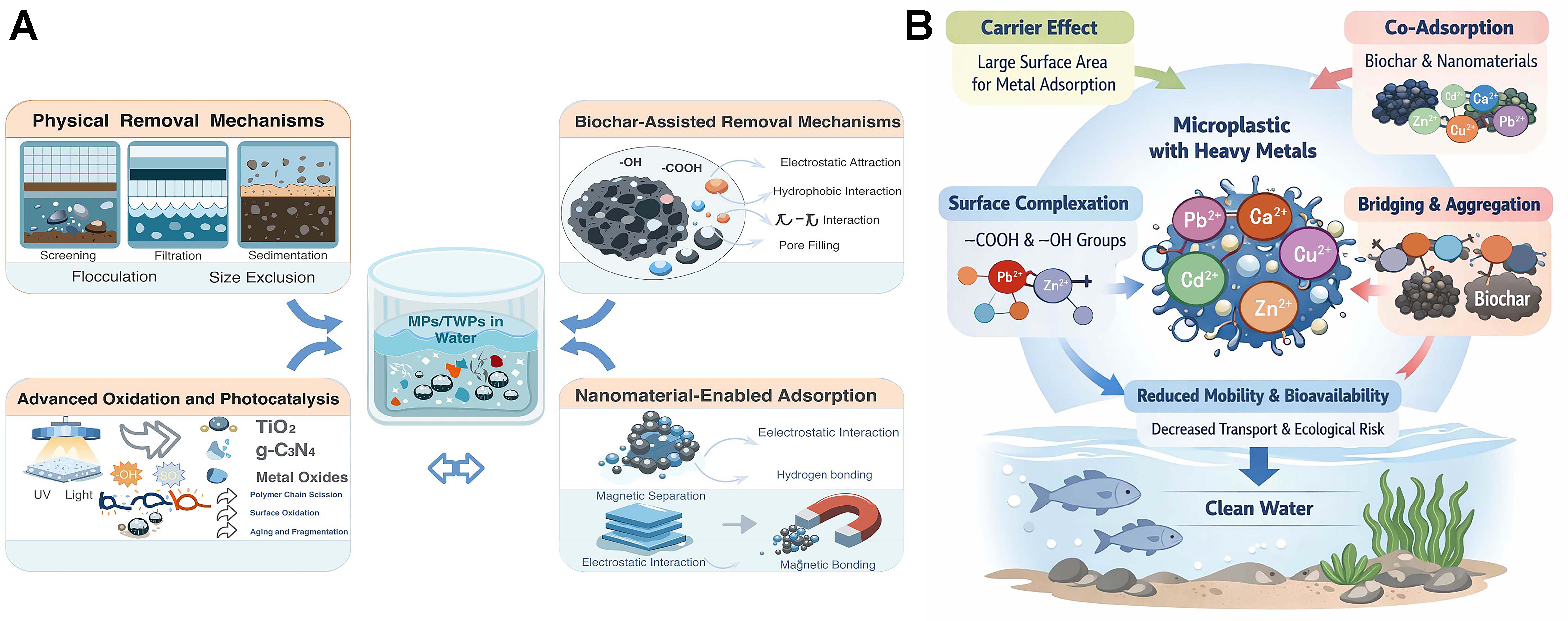
Figure 5. (A) Overall removal mechanisms of MPs and TWPs in aquatic environments; (B) Synergistic removal of MPs and heavy metals [(A) created by Nanobanana (Gemini 2.5 Flash Image)]. MPs: Microplastics; TWPs: tire wear particles; UV: ultraviolet.
Chemical transformation and structural degradation
Unlike physical separation approaches, chemical remediation aims to disrupt the polymeric network of TWPs or the molecular structure of associated additives. However, current literature often conflates structural transformation (e.g., surface oxidation and chain scission), degradation (e.g., polymer depolymerization), and mineralization (i.e., complete conversion into CO2 and inorganic salts), which should be rigorously distinguished.
Advanced oxidation processes (AOPs) and photocatalytic technologies degrade polymer structures through reactive radicals such as •OH and SO4-•. Photocatalysts including modified TiO2, BiOX, and ZnO[121], as well as composite catalysts such as BiOI/MIL-101[122], can induce surface oxidation and partial chain scission of MPs under ultraviolet or visible light irradiation. However, it should be emphasized that most studies have employed PS/PE particles or purified rubber substrates. For vulcanized and cross-linked TWPs, the three-dimensional network structure exhibits strong resistance to radical attack. Reported mass loss rates are generally below 10%, remaining far from true mineralization as evaluated by total organic carbon removal or CO2 release. Therefore, these processes should be classified as structural transformation or limited degradation rather than mineralization. Electrochemical advanced oxidation processes (EAOPs) can disrupt polymer backbones through the synergistic effects of direct anodic oxidation and indirect oxidation, and have been applied for MP removal in aquatic systems[123]. Physical retention and aggregation processes rely on mechanisms such as pore filling, hydrophobic interactions, and electrostatic attraction. Technologies including ultrafiltration, reverse osmosis, and MBRs can effectively separate small particles in the range of 1-5 μm. Surface-engineered materials, such as superhydrophobic wood membranes (water contact angle of 152.2° and sliding angle of 1.8°) and chitin nanofiber foams, further enhance adsorption and retention performance through surface modification[94,124]. Nevertheless, the coupled behavior of physical retention and chemical oxidation within engineering systems remains insufficiently understood. Key issues, including adsorption saturation cycles in reactive media beds and the relationship between oxidant dosage and TWP loading, have not yet been systematically investigated.
Notably, the carbon black present in TWPs is electrically conductive and may alter current distribution and radical generation efficiency within electrochemical systems. Inorganic fillers such as zinc oxide may further inhibit reaction efficiency through radical quenching or surface complexation effects. These engineering challenges arising from TWP-specific components have received little attention in the existing literature. In addition, incomplete oxidation may fragment polymers into smaller nanoscale particles or promote the release and transformation of additives, such as the conversion of 6PPD to 6PPD-Q, thereby potentially increasing ecological toxicity. Therefore, toxicity reduction cannot be inferred solely from mass loss or apparent morphological changes, but should instead be independently validated using biological toxicity endpoints, including acute fish toxicity and cellular viability assays.
In recent years, all-biomass fiber framework materials, such as chitin-based fibrous scaffolds derived from discarded seafood waste or natural fibers, have demonstrated the ability to remove MPs from complex aquatic environments without chemical crosslinking through hydrogen-bond-induced rearrangement and multilevel structural exposure[124-126]. Adsorbed materials can not only be regenerated and recycled to achieve waste-to-waste utilization, but can also be converted into value-added products through compression and electrospinning processes. Although these materials exhibit considerable potential for green remediation, their long-term adsorption capacity and mechanical stability in realistic TWP-contaminated systems still require engineering-scale validation.
Biological processes and toxicity attenuation
Bioremediation involves mechanisms such as biosorption, biofilm encapsulation, and enzymatic degradation, which differ substantially in both timescale and chemical nature. Biodegradation refers to the process by which microorganisms cleave polymer backbones or side chains through extracellular enzymes, such as oxygenase and esterases, resulting in a continuous reduction in molecular weight. In contrast, biosorption only involves the immobilization of particles by cell walls or EPSs and therefore represents a phase-transfer process rather than true degradation.
Strains such as Pseudomonas spp. can degrade components of TWPs through the secretion of extracellular enzymes[127], while algae such as green algae may remove MPs via biofilm formation and heterogeneous aggregation mechanisms[128]. However, most current biodegradation studies have focused on low-crosslinked NR or synthetic polyisoprene rather than tire rubber produced through high-temperature vulcanization and containing large amounts of carbon black and antioxidants. The chemical stability of vulcanized crosslink bonds (C–Sx–C) significantly inhibits microbial attack, and the biodegradation half-life of realistic TWPs in the environment is estimated to range from decades to centuries, far exceeding the timescales represented by short-term laboratory incubations. Regarding toxicity attenuation, Gu et al. isolated an Mn2+-resistant strain, Bacillus sp. A260, which enhanced MP adsorption and immobilized heavy metals through biofilm formation[129]. However, this process mainly reduces the bioavailability of heavy metals rather than degrading TWPs themselves. Furthermore, microbial transformation of organic additives associated with TWPs, such as 6PPD, may generate more toxic derivatives, including 6PPD-Q, leading to a divergence between pollutant removal and detoxification. Therefore, comprehensive evaluation of biological treatment systems should simultaneously monitor particle residues, additive transformation products, and toxicity endpoints in order to avoid misinterpreting biological accumulation or immobilization as true detoxification.
Existing studies have demonstrated that 6PPD-Q can undergo structural transformation in specific oxidation systems, accompanied by a certain degree of toxicity attenuation. For example, solar-activated periodate systems have been reported to promote the degradation of 6PPD-Q at environmentally relevant concentrations, while zebrafish embryo toxicity assays revealed reduced toxicity following treatment[130]. Similarly, UV/PMS systems have been shown to degrade 6PPD-Q and generate multiple transformation products, and both toxicity prediction analyses and sediment microbial exposure experiments indicated an overall decrease in toxicity after treatment[131]. However, these studies are primarily based on abiotic AOPs, the underlying mechanisms of which fundamentally involve chemical oxidation rather than biologically mediated enzymatic degradation. Within biological systems, several studies have attempted to employ the white-rot fungus Phanerochaete chrysosporium for the transformation and detoxification of 6PPD-Q[132]. In addition, soil microbial communities, soil nematodes, and earthworm gut host–microbiome systems have also been suggested to participate in the biotransformation of 6PPD-Q[133,134]. Nevertheless, these studies remain preliminary, and systematic understanding of the actual degradation pathways, key metabolites, and long-term ecological consequences is still lacking. In particular, whether these transformation processes can achieve complete mineralization and stable detoxification has yet to be conclusively demonstrated.
Overall, direct evidence for the degradation and detoxification of 6PPD-Q in environmental biological systems remains limited. Current studies mainly focus on oxidative transformation, microbial enrichment, or partial structural degradation rather than true mineralization. Although some treatment processes may reduce the concentration of parent compounds, the resulting intermediates may retain or even enhance ecological toxicity. Therefore, evaluations of biological treatment strategies for TWPs and their associated additives should clearly distinguish particle removal, chemical transformation, mineralization, and toxicity attenuation as independent processes, and should integrate metabolite identification, total organic carbon removal, and biological toxicity endpoints into comprehensive assessments.
Coordinated control of long-term behavior and composite pollution in engineering systems
At present, most of the research on TWPs risk control is limited to laboratory batch experiments, and there is a lack of investigation of the long-term operation behavior of engineering systems. In actual filtration or reactive media systems, the initial removal rate of TWPs by adsorbents [such as activated carbon, biochar, metal–organic framework (MOFs)] tends to be high, but with the saturation of the surface site, the penetration curve rises rapidly, and the adsorbed particles may be desorbed due to water shear or ionic strength changes.
MOF-based materials, such as ZnCo-ZIF and ZIF-8, provide abundant adsorption sites owing to their high specific surface areas and porous structures, enabling the capture of MP particles through physical retention and surface adsorption[135,136]. These materials possess high porosity, structural stability, and abundant active sites. Following hydrophobic modification with agents such as hexadecyltrimethoxysilane (HDTMS), their adsorption performance toward MPs in oil–water systems can be further enhanced through hydrophobic–hydrophobic interactions. Layered double hydroxide (LDH) materials, such as Zn–Al LDH, exhibit interfacial regulation capabilities for nanoscale plastic particles through interlayer ion exchange and electrostatic adsorption mechanisms. Magnetic core–shell structures, including Fe3O4@SiO2 and Fe3O4–PWA/amine composites, integrate adsorption and magnetic separation into a single process[137]. Hierarchically porous carbon nitride-supported single-atom iron catalysts and three-dimensional bimetallic nanosheets further improve MP removal efficiency and extend functional performance[25,138], such as hydrogen evolution, through synergistic catalytic–adsorptive mechanisms. However, most existing studies have been conducted in idealized aqueous systems and have not considered the competitive inhibition effects of high concentrations of suspended solids, oils, and road salts (e.g., NaCl and CaCl2)[5,139] commonly present in real road runoff. The long-term stability, metal ion release risks, and ecological toxicity of MOFs and magnetic nanomaterials also remain insufficiently evaluated for realistic TWP systems. In reactive media systems, such as zero-valent iron-filled reactors, the chemical transformation efficiency of TWPs is jointly controlled by hydraulic retention time, oxidant dosage, and media scaling conditions. During long-term operation, Zn2+, additives, and road-derived mineral particles released from TWPs may induce media passivation or pore blockage, thereby altering hydraulic conductivity and reaction kinetics. These engineering-scale issues have rarely been addressed in the current literature.
The synergistic control of TWPs and heavy metals represents another critical issue in risk management processes. Aging significantly increases the abundance of oxygen-containing functional groups, such as carboxyl and hydroxyl groups, on TWP surfaces, thereby enhancing their capacity for surface complexation and electrostatic adsorption of Cd2+, Pb2+, and Zn2+, and enabling TWPs to act as carriers for heavy metal transport[140]. Aged particles generally possess more oxygen-containing functional groups and therefore exhibit stronger heavy metal adsorption capacities. Tang et al. demonstrated that divalent metal ions, including Ni2+, Cu2+, and Zn2+, can interact with carboxylate anions on MP surfaces through electrostatic attraction[141]. The interactions between TWPs and heavy metals are also influenced by surface charge properties, while the accumulation of heavy metals on some particles may additionally involve coprecipitation and adsorption onto hydrated iron or manganese oxides. In constructed wetlands and bioretention systems, plant root networks and microbial biofilms can simultaneously retain TWPs and immobilize heavy metals. Yin et al. reported that water hyacinth, a rapidly growing floating aquatic plant, achieved removal efficiencies exceeding 55% for small-sized MPs in contaminated water bodies[142]. However, issues including long-term saturation within treatment systems, disposal pathways following plant harvesting, and the resuspension behavior of TWPs under alternating anaerobic and aerobic conditions still require clarification through long-term column experiments and pilot-scale studies.
Furthermore, sorption behavior not only determines the enrichment capacity of TWPs for contaminants, but also directly influences their effective mobility and long-term environmental fate[143]. A higher sediment–water Kd indicates preferential partitioning of contaminants into the particulate phase, thereby reducing instantaneous transport fluxes in the aqueous phase while enhancing retention within sediment reservoirs. Degaffe and Turner reported sediment–water partition coefficients for Zn2+ released from TWPs under simulated estuarine conditions of approximately 550 mL/g in river water and 270 mL/g in seawater, indicating that TWPs entering sedimentary environments can rapidly redistribute associated metals into the solid phase[144]. When TWPs exhibit high partition coefficients for heavy metals or hydrophobic organic contaminants, these pollutants preferentially associate with particle surfaces, reducing their immediate mobility in water while promoting long-term retention in sediments. However, such “immobilization” is not permanently stable. Changes in environmental conditions, including pH, ionic strength, redox status, and fluctuations in NOM concentrations, may induce the desorption of previously adsorbed contaminants and their rerelease into the aqueous phase, thereby enabling secondary transport. Particularly under stormwater runoff events or sediment resuspension conditions, TWPs may act as mobile carriers that facilitate the redistribution of contaminants among different environmental compartments. NOM plays a dual role in this process. On the one hand, humic and fulvic acids can inhibit the adsorption of heavy metals onto TWP surfaces through competition for active sorption sites[145]. On the other hand, NOM may stabilize the colloidal dispersion of TWPs via Ca2+ bridging or hydrophobic association, thereby enhancing their mobility and suspension stability in aquatic environments[146]. For nanoscale TWPs, this colloidal stabilization effect may further prolong particle residence time in water bodies and reduce the removal efficiency of sedimentation and filtration systems. Therefore, sorption processes are not only critical mechanisms governing contaminant “removal”, but also key factors controlling the environmental fate and long-term risk evolution of TWPs.
Biochar is considered a promising adsorptive material for the control of TWP-associated complex pollution systems. Derived from a wide range of feedstocks, including agricultural and forestry residues, wood chips, and sewage sludge, biochar can be engineered through pyrolysis temperature regulation to tailor its surface chemistry and pore structure[147]. In TWP remediation, biochar mainly functions through two mechanisms: (i) capturing TWP particles via pore filling and hydrophobic interactions; and (ii) adsorbing TWP-associated organic additives, such as 6PPD and its quinone derivative (6PPD-Q), as well as heavy metal ions (e.g., Zn2+ and Cd2+), through surface functional groups including carboxyl, hydroxyl, and aromatic moieties[148]. Biochar produced at high pyrolysis temperatures (> 600 °C) generally exhibits larger specific surface areas and abundant microporous structures, favoring the physical retention of small TWP particles. In contrast, biochar generated at intermediate and low temperatures (300-500 °C) retains more oxygen-containing functional groups, thereby enhancing the chemical adsorption of polar additives and metal ions through hydrogen bonding, π–π interactions, and electrostatic attraction[149]. The adsorption of heavy metals onto TWPs involves multiple mechanisms, including surface complexation, electrostatic attraction, coprecipitation, and cation–π interactions.
Some studies have combined biochar with magnetic materials, such as Fe3O4, to impart magnetic separation capability and facilitate recovery from aquatic environments[150]. Recent studies have also demonstrated significant progress in applying modified biochar to remediation systems targeting co-contamination by the tire antioxidant transformation product 6PPD-Q and heavy metals. Biochar modification strategies have been investigated to mitigate the impacts of TWP pollution on soil health, antimony speciation, and pollutant behavior under different soil moisture conditions[148,151]. In heavy metal–TWP co-contamination systems, biochar can immobilize metal ions through surface complexation and ion exchange processes, while simultaneously promoting redox transformations that reduce metal bioavailability. At the same time, hydrophobic interactions enable the adsorption of TWPs, thereby facilitating the synergistic removal of composite pollutants. However, the long-term stability of biochar after environmental application, regeneration methods following adsorption saturation, and breakthrough behavior under engineering conditions have not yet been sufficiently validated. In addition, the production cost of biochar, quality consistency during large-scale manufacturing, and the risk of secondary pollution during disposal - such as residual PAHs and heavy metal leaching - remain key constraints limiting its practical application.
Research gaps and prospects
The engineering implementation of TWP risk control faces three major constraints. First, laboratory studies commonly use conventional MPs or purified rubber as substitutes for realistic TWPs, leading to systematic biases in technology validation. Second, removal processes dominated by physical separation essentially represent phase transfer, while the ultimate fate of TWPs accumulated in sludge, spent media, and concentrated residues remains unresolved. Third, chemical and biological transformation technologies exhibit limited efficiency in disrupting vulcanized rubber matrices, remaining far from true mineralization, whereas the ecological risks associated with transformation intermediates are still poorly understood.
Physical separation remains the primary approach for TWP removal in current stormwater management systems and wastewater treatment processes. Technologies such as sedimentation, filtration, adsorption, and magnetic separation reduce aqueous-phase TWP concentrations by transferring particles into sludge, spent media, or magnetic recovery residues. However, these processes fundamentally represent phase transfer rather than true pollutant elimination. During sludge incineration, landfilling, or land application, TWPs may be re-released into atmospheric or soil environments. Similarly, improperly managed spent adsorbents may generate secondary solid-waste pollution. Therefore, engineering evaluations should simultaneously consider both removal efficiency and the ultimate fate of TWPs, rather than relying solely on effluent concentrations as the primary performance indicator.
Chemical and biological transformation technologies exhibit limited efficiency in disrupting the three-dimensional network structure of vulcanized rubber. Photocatalysis, advanced oxidation, and enzymatic reactions may introduce oxygen-containing functional groups onto polymer surfaces, cleave partial side chains, or reduce molecular weight; however, the mass loss rates reported in current studies are generally below 10%. More importantly, incomplete transformation may promote the conversion of additives such as 6PPD into more toxic derivatives, including 6PPD-Q, or fragment micrometer-sized TWPs into more mobile nanoscale particles. In such cases, structural transformation is accompanied not by toxicity attenuation, but by a shift in risk form. Therefore, technologies claiming degradation or removal should be independently validated using biological toxicity endpoints rather than being evaluated solely based on apparent mass loss or morphological changes.
Biochar has demonstrated considerable engineering potential for the remediation of TWP-associated composite pollution systems, although its practical effectiveness still requires validation under realistic environmental conditions. Biochar can be produced from a wide range of feedstocks, including agricultural residues, wood waste, and sewage sludge. By regulating pyrolysis conditions, biochars with distinct pore structures and surface chemical properties can be obtained. Laboratory batch experiments have shown that biochar exhibits favorable adsorption performance toward standard MPs and single heavy metal solutions through mechanisms including pore filling, hydrophobic interactions, hydrogen bonding, and surface complexation.
However, under realistic road runoff conditions, biochar is subjected to substantially greater competitive constraints. High concentrations of suspended solids may block surface pores, while DOM can compete for hydrophobic adsorption sites. In addition, the release of inorganic fillers such as zinc oxide may alter local pH conditions and consequently affect surface charge distributions. Carbon black particles attached to TWPs may also occupy active adsorption sites on biochar surfaces. The long-term operational behavior of biochar in dynamic filtration systems - including breakthrough curve characteristics, regeneration methods after adsorption saturation, and performance deterioration during repeated cycles - has not yet been systematically evaluated through column experiments or pilot-scale studies. From an engineering and economic perspective, large-scale biochar production must address challenges related to feedstock consistency, pyrolysis energy consumption, and product stability. Potential risks associated with residual PAHs and heavy metal leaching during final disposal should also be incorporated into life-cycle assessments. If these limitations can be overcome, biochar may serve as an effective permeable filler in stormwater management systems, a supplementary substrate in constructed wetlands, or a pretreatment adsorption unit in wastewater treatment processes, thereby contributing to the source interception of TWPs and associated pollutants.
Therefore, for engineering applications, it is necessary to establish performance evaluation standards based on realistic TWPs containing carbon black, zinc oxide, vulcanization systems, and road-derived mineral particles. Pilot-scale studies integrating stormwater control facilities, such as bioretention systems and filtration swales, with wastewater treatment processes should be conducted to systematically monitor the long-term behavior of particle retention, media breakthrough, and additive release. At the same time, four independent indicators - phase-transfer efficiency, degree of structural transformation, mineralization rate, and toxicity attenuation index - should be clearly distinguished to avoid mechanistic misinterpretation caused by inconsistent terminology. Only by integrating material development with engineering-scale validation can TWP management shift from simple concentration reduction toward comprehensive risk control.
CONCLUSIONS AND PERSPECTIVES
Despite recent progress in research on the aquatic behavior of TWPs, fundamental gaps in understanding remain in this emerging and complex field. Specifically, current studies primarily focus on short-term, single-factor experiments, and there is a lack of understanding regarding the long-term, multi-factor coupled mechanisms governing sedimentation dynamics. Second, the primary challenge lies in the fact that simplified laboratory systems struggle to reveal the coupled sedimentation mechanisms involving water chemistry, hydrodynamics, and biological processes in real-world environments; meanwhile, natural water bodies - which are governed by dynamic heterogeneity such as seasonal hydrology, extreme events, and tides - are difficult to use for validation. This results in unclear sedimentation mechanisms, a scarcity of monitoring data, and difficulties in estimating sedimentation fluxes; consequently, individual toxicity cannot be reliably extrapolated to population-level risks, ultimately leading to a lack of predictability and precision in end-of-pipe regulation.
However, as an emerging environmental pollutant, the sedimentation behavior of TWPs in aquatic environments is a key process that determines their environmental fate, ecological risks, and human exposure. Clarifying their microscopic sedimentation mechanisms and macroscopic transport patterns not only provides a theoretical basis for predicting the spatial distribution of pollutants and identifying high-deposition zones, but also lays the foundation for formulating prevention and control strategies, such as runoff management, optimization of water treatment processes, and restoration of receiving water bodies. Furthermore, by assessing potential exposure pathways through drinking water and the food chain, this body of research provides critical support for evaluating human health risks associated with TWPs. Achieving these objectives hinges precisely on bridging current gaps in our understanding.
Future research must delve deeper into the transformation of TWPs at the sediment-water interface following sedimentation to clarify their long-term ecological exposure potential. In addition to employing vegetation barriers, magnetic materials, modified biochar, and synergistic remediation technologies, it is essential to promote methodological innovation and interdisciplinary integration. By leveraging machine learning and artificial intelligence to integrate multi-source heterogeneous data (field observations, experimental parameters, and satellite remote sensing), constructing trend prediction models from watershed to global scales through targeted monitoring, and developing a “tire-to-water” full life-cycle management system, we can establish a scientific paradigm for the remediation of complex pollutants.
DECLARATIONS
Authors’ contributions
Responsible for the overall conception and design of the manuscript; drafted the abstract, Introduction, Sections “Mechanisms and Influencing Factors of TWPs Sedimentation in Aquatic Environments” “Transport and Sedimentation Processes of TWPs in Aquatic Environments”, and the “Conclusions and Perspectives”; and created Figures 1-4 and Tables 1 and 2: Zhang, J.
Responsible for drafting Section “Risk Control Strategies for TWPs” and creating Figure 5: Wang, J.
Responsible for guiding the research framework, providing methodological support, reviewing and revising the entire manuscript, and managing the project and funding: Luo, Z.
All authors have reached consensus on the final version and agree to submit it.
Availability of data and materials
Not applicable.
AI and AI-assisted tools statement
During the preparation of this manuscript, the AI tool Nanobanana (Gemini 2.5 Flash Image) was used solely for the editing of Figures 2, 3, and 5. The tool did not influence the study design, data collection, analysis, interpretation, or the scientific content of the work. All authors take full responsibility for the accuracy, integrity, and final content of the manuscript.
Financial support and sponsorship
This study was supported by the Nature Science Foundation of China (42377407).
Conflicts of interest
All authors declared that there are no conflicts of interest.
Ethical approval and consent to participate
Not applicable.
Consent for publication
Not applicable.
Copyright
© The Author(s) 2026.
REFERENCES
1. Kole, P. J.; Löhr, A. J.; Van Belleghem, F. G. A. J.; Ragas, A. M. J. Wear and tear of tyres: a stealthy source of microplastics in the environment. Int. J. Environ. Res. Public. Health. 2017, 14, 1265.
2. Wagner, S.; Hüffer, T.; Klöckner, P.; Wehrhahn, M.; Hofmann, T.; Reemtsma, T. Tire wear particles in the aquatic environment - a review on generation, analysis, occurrence, fate and effects. Water. Res. 2018, 139, 83-100.
3. Thorpe, A.; Harrison, R. M. Sources and properties of non-exhaust particulate matter from road traffic: a review. Sci. Total. Environ. 2008, 400, 270-82.
4. Chen, Y.; Liu, J.; Zhang, Y. X.; Li, J. Y.; Li, G. J. Black microplastics in the environment: origin, transport and risk of tire wear particles. Chin. J. Appl. Ecol. 2022, 33, 2260-70.
5. Mayer, P. M.; Moran, K. D.; Miller, E. L.; et al. Where the rubber meets the road: emerging environmental impacts of tire wear particles and their chemical cocktails. Sci. Total. Environ. 2024, 927, 171153.
6. China Automobile Dealers Association. Analysis of the national passenger car market in December 2025 (in Chinese). https://cada.cn/Trends/info_91_10424.html. (accessed 2026-06-17).
7. Ministry of Ecology and Environment of the People’s Republic of China. China mobile environmental management annual report (2021). https://www.mee.gov.cn/hjzl/sthjzk/ydyhjgl/202109/t20210910_920787.shtml. (accessed 2026-06-17).
8. Ministry of Ecology and Environment of the People’s Republic of China. China mobile environmental management annual report (2022). https://www.mee.gov.cn/hjzl/sthjzk/ydyhjgl/202212/t20221207_1007111.shtml. (accessed 2026-06-17).
9. Ministry of Ecology and Environment of the People’s Republic of China. China mobile environmental management annual report (2023). https://www.mee.gov.cn/hjzl/sthjzk/ydyhjgl/202312/t20231207_1058460.shtml. (accessed 2026-06-17).
10. Ministry of Ecology and Environment of the People’s Republic of China. China mobile environmental management annual report (2024). https://www.mee.gov.cn/hjzl/sthjzk/ydyhjgl/202503/t20250326_1104757.shtml. (accessed 2026-06-17).
11. Ministry of Ecology and Environment of the People’s Republic of China. China mobile environmental management annual report (2025). https://www.mee.gov.cn/hjzl/sthjzk/ydyhjgl/202512/t20251203_1137022.shtml. (accessed 2026-06-17).
12. Han, Q. K.; Chen, H. F.; Zu, L.; et al. Emission characteristics and influencing factors of tire wear particles from light-duty vehicles. China. Environ. Sci. 2024, 44, 6018-24.
13. Baensch-Baltruschat, B.; Kocher, B.; Stock, F.; Reifferscheid, G. Tyre and road wear particles (TRWP) - a review of generation, properties, emissions, human health risk, ecotoxicity, and fate in the environment. Sci. Total. Environ. 2020, 733, 137823.
14. Evangeliou, N.; Grythe, H.; Klimont, Z.; et al. Atmospheric transport is a major pathway of microplastics to remote regions. Nat. Commun. 2020, 11, 3381.
15. Knight, L. J.; Parker-Jurd, F. N. F.; Al-Sid-Cheikh, M.; Thompson, R. C. Tyre wear particles: an abundant yet widely unreported microplastic? Environ. Sci. Pollut. Res. Int. 2020, 27, 18345-54.
16. Kushwaha, M.; Shankar, S.; Goel, D.; et al. Microplastics pollution in the marine environment: a review of sources, impacts and mitigation. Mar. Pollut. Bull. 2024, 209, 117109.
17. Sharma, V. K.; Ma, X.; Guo, B.; Zhang, K. Environmental factors-mediated behavior of microplastics and nanoplastics in water: a review. Chemosphere 2021, 271, 129597.
18. Xu, Y.; Ou, Q.; Li, X.; Wang, X.; van der Hoek, J. P.; Liu, G. Combined effects of photoaging and natural organic matter on the colloidal stability of nanoplastics in aquatic environments. Water. Res. 2022, 226, 119313.
19. Churaev, N. V. Surface forces in wetting films. Adv. Colloid. Interface. Sci. 2003, 103, 197-218.
20. Perni, S.; Preedy, E. C.; Prokopovich, P. Success and failure of colloidal approaches in adhesion of microorganisms to surfaces. Adv. Colloid. Interface. Sci. 2014, 206, 265-74.
21. Zhang, J.; Zeng, H. Intermolecular and surface interactions in engineering processes. Engineering 2021, 7, 63-83.
23. Yu, S.; Shen, M.; Li, S.; et al. Aggregation kinetics of different surface-modified polystyrene nanoparticles in monovalent and divalent electrolytes. Environ. Pollut. 2019, 255, 113302.
24. Zhang, H. Transport of microplastics in coastal seas. Estuar. Coast. Shelf. Sci. 2017, 199, 74-86.
25. Wu, N.; Wang, J.; Zheng, B.; et al. Insights into the adsorption performance and mechanism of novel 3D bimetallic MOF nanosheets for the high-efficient removal of 6PPD and 6PPD-quinone. Sep. Purif. Technol. 2025, 354, 128904.
26. Sun, W.; Wang, B.; Ouyang, W.; Liu, Z.; Zhang, H. Tire wear particles in aquatic environments: a systematic review of sources, detection, distribution, and toxicological impacts. Ecotoxicol. Environ. Saf. 2025, 305, 119236.
27. Vlachos, D.; Voutsa, D. Adsorption of emerging micropollutants on tire wear particles. Sci. Total. Environ. 2025, 971, 179068.
28. Wang, Y.; Tang, Z.; Liu, Y.; et al. Heterogeneous aggregation of microplastics and mineral particles in aquatic environments: effects of surface functional groups, pH, and electrolytes. Environ. Chem. Ecotoxicol. 2025, 7, 848-58.
29. Li, K.; Kong, D.; Chen, X.; et al. Influencing mechanisms of humic acid and pH on the migration behavior of typical tire wear particles. Acta. Pedol. Sin. 2024, 61, 456-68.
30. Xu, J. Y.; Ding, J.; Du, S.; Zhu, D. Tire particles and its leachates: impact on antibiotic resistance genes in coastal sediments. J. Hazard. Mater. 2024, 465, 133333.
31. Rødland, E. S.; Heier, L. S.; Lind, O. C.; Meland, S. High levels of tire wear particles in soils along low traffic roads. Sci. Total. Environ. 2023, 903, 166470.
32. Li, R.; Sun, Q.; Xue, Y.; Liu, C.; Sun, H.; Wang, L. Estimation of tire wear particle emissions from civilian vehicles. Environ. Sci. Technol. 2026, 60, 10211-20.
33. Besseling, E.; Quik, J. T. K.; Sun, M.; Koelmans, A. A. Fate of nano- and microplastic in freshwater systems: a modeling study. Environ. Pollut. 2017, 220, 540-8.
34. Fan, X.; Ma, Z.; Zou, Y.; Liu, J.; Hou, J. Investigation on the adsorption and desorption behaviors of heavy metals by tire wear particles with or without UV ageing processes. Environ. Res. 2021, 195, 110858.
35. Cai, C.; Zhu, L.; Hong, B. A review of methods for modeling microplastic transport in the marine environments. Mar. Pollut. Bull. 2023, 193, 115136.
36. Thompson, R. C.; Courtene-Jones, W.; Boucher, J.; Pahl, S.; Raubenheimer, K.; Koelmans, A. A. Twenty years of microplastic pollution research-what have we learned? Science 2024, 386, eadl2746.
37. Bradford, S. A.; Yates, S. R.; Bettahar, M.; Simunek, J. Physical factors affecting the transport and fate of colloids in saturated porous media. Water. Resour. Res. 2002, 38, 1327.
38. Ding, Z.; Wang, H.; Chen, S.; Chen, Y.; Liu, Y.; Zhao, X. Sedimentation behavior of aggregated microplastics: influence of particle size and water constituents in environmental waters. Sci. Total. Environ. 2025, 1006, 180931.
39. Wik, A.; Dave, G. Occurrence and effects of tire wear particles in the environment - a critical review and an initial risk assessment. Environ. Pollut. 2009, 157, 1-11.
40. Kreider, M. L.; Panko, J. M.; McAtee, B. L.; Sweet, L. I.; Finley, B. L. Physical and chemical characterization of tire-related particles: comparison of particles generated using different methodologies. Sci. Total. Environ. 2010, 408, 652-9.
41. Lai, H.; Liu, X.; Qu, M. Nanoplastics and human health: hazard identification and biointerface. Nanomaterials 2022, 12, 1298.
42. Fussell, J. C.; Franklin, M.; Green, D. C.; et al. A review of road traffic-derived non-exhaust particles: emissions, physicochemical characteristics, health risks, and mitigation measures. Environ. Sci. Technol. 2022, 56, 6813-35.
43. Zheng, L.; Wu, D.; Chen, X.; et al. Chemical profiles of particulate matter emitted from anthropogenic sources in selected regions of China. Sci. Data. 2024, 11, 1206.
44. Waldschläger, K.; Schüttrumpf, H. Effects of particle properties on the settling and rise velocities of microplastics in freshwater under laboratory conditions. Environ. Sci. Technol. 2019, 53, 1958-66.
45. Amobonye, A.; Bhagwat, P.; Raveendran, S.; Singh, S.; Pillai, S. Environmental impacts of microplastics and nanoplastics: a current overview. Front. Microbiol. 2021, 12, 768297.
46. Thio, B. J.; Zhou, D.; Keller, A. A. Influence of natural organic matter on the aggregation and deposition of titanium dioxide nanoparticles. J. Hazard. Mater. 2011, 189, 556-63.
47. Li, F.; Huang, D.; Wang, G.; et al. Microplastics/nanoplastics in porous media: key factors controlling their transport and retention behaviors. Sci. Total. Environ. 2024, 926, 171658.
48. Chen, Y.; Tang, H.; Li, H.; et al. Molecular-level insight into the behavior of metal cations and organic matter during the aggregation of polystyrene nanoplastics. J. Hazard. Mater. 2024, 473, 134665.
49. V, G.; Shanmugavel, S. P.; Tyagi, V. K.; Banu, J. R. Microplastics as emergent contaminants in landfill leachate: source, potential impact and remediation technologies. J. Environ. Manag. 2023, 343, 118240.
50. Liu, H.; Yuan, Y.; Cao, T.; Zhang, T.; Chen, W. Key environmental behaviors of tire wear particles and their influencing mechanisms. Prog. Chem. 2025, 37, 103-111.
51. Zou, Y.; Zhang, Y.; Feng, H.; et al. Occurrence, fate, and ecological impacts of microplastics in soil: a comparative analysis of conventional, biodegradable microplastics, and tire wear particles. Environ. Pollut. 2025, 386, 127151.
52. Burns, E. E.; Boxall, A. B. A. Microplastics in the aquatic environment: evidence for or against adverse impacts and major knowledge gaps. Environ. Toxicol. Chem. 2018, 37, 2776-96.
53. Browne, M. A.; Crump, P.; Niven, S. J.; et al. Accumulation of microplastic on shorelines woldwide: sources and sinks. Environ. Sci. Technol. 2011, 45, 9175-9.
54. Ni, X.; Zhou, H.; Liu, Y.; et al. Toxic effects of tire wear particles and the leachate on the Chinese mitten crab (Eriocheir sinensis). Environ. Pollut. 2023, 335, 122354.
55. Rist, S.; Le Du-Carrée, J.; Ugwu, K.; et al. Toxicity of tire particle leachates on early life stages of keystone sea urchin species. Environ. Pollut. 2023, 336, 122453.
56. Tallec, K.; Gabriele, M.; Paul-Pont, I.; Alunno-Bruscia, M.; Huvet, A. Tire rubber chemicals reduce juvenile oyster (Crassostrea gigas) filtration and respiration under experimental conditions. Mar. Pollut. Bull. 2022, 181, 113936.
57. Unice, K. M.; Weeber, M. P.; Abramson, M. M.; et al. Characterizing export of land-based microplastics to the estuary - Part I: Application of integrated geospatial microplastic transport models to assess tire and road wear particles in the Seine watershed. Sci. Total. Environ. 2019, 646, 1639-49.
58. Unice, K. M.; Weeber, M. P.; Abramson, M. M.; et al. Characterizing export of land-based microplastics to the estuary - Part II: Sensitivity analysis of an integrated geospatial microplastic transport modeling assessment of tire and road wear particles. Sci. Total. Environ. 2019, 646, 1650-9.
59. Dittmar, S.; Weyrauch, S.; Reemtsma, T.; et al. Settling velocities of tire and road wear particles: analyzing finely graded density fractions of samples from a road simulator and a highway tunnel. Environ. Sci. Technol. 2025, 59, 13434-46.
60. Bigdeli, M. Physical and numerical modeling of large marine microplastics transport and deposition. 2025. http://hdl.handle.net/10393/50521. (accessed 2026-06-17).
61. Gehrke, I.; Schläfle, S.; Bertling, R.; Öz, M.; Gregory, K. Review: Mitigation measures to reduce tire and road wear particles. Sci. Total. Environ. 2023, 904, 166537.
62. Ren, Y.; Li, W.; Zhou, P.; et al. Occurrence, emission, and transport of tire and road wear particles across four environmental compartments along ring road networks in Beijing. Environ. Sci. Technol. 2024, 58, 23160-8.
63. Siegfried, M.; Koelmans, A. A.; Besseling, E.; Kroeze, C. Export of microplastics from land to sea. A modelling approach. Water. Res. 2017, 127, 249-57.
64. Rauert, C.; Charlton, N.; Okoffo, E. D.; et al. Concentrations of tire additive chemicals and tire road wear particles in an Australian urban tributary. Environ. Sci. Technol. 2022, 56, 2421-31.
65. Wei, L. N.; Wu, N. N.; Xu, R.; et al. First evidence of the bioaccumulation and trophic transfer of tire additives and their transformation products in an Estuarine Food Web. Environ. Sci. Technol. 2024, 58, 6370-80.
66. Eisentraut, P.; Dümichen, E.; Ruhl, A. S.; et al. Two birds with one stone - fast and simultaneous analysis of microplastics: microparticles derived from thermoplastics and tire wear. Environ. Sci. Technol. Lett. 2018, 5, 608-13.
67. Parker-Jurd, F. N. F.; Napper, I. E.; Abbott, G. D.; Hann, S.; Thompson, R. C. Quantifying the release of tyre wear particles to the marine environment via multiple pathways. Mar. Pollut. Bull. 2021, 172, 112897.
68. Liu, R.; Wang, T.; Li, J.; Liu, X.; Zhu, Q. Simulation of seasonal transport of microplastics and influencing factors in the China Seas based on the ROMS model. Water. Res. 2023, 244, 120493.
69. Deng, H.; Fu, Y.; Su, L.; et al. Unveiling the deep-sea microplastic Odyssey: characteristics, distribution, and ecological implications in Pacific Ocean sediments. J. Hazard. Mater. 2025, 489, 137537.
70. Dittmar, S.; Ruhl, A. S.; Altmann, K.; Jekel, M. Settling velocities of small microplastic fragments and fibers. Environ. Sci. Technol. 2024, 58, 6359-69.
71. Paterson, K.; Beckingham, B.; Momplaisir, G. M.; Varner, K. Adapting methods for isolation and enumeration of microplastics to quantify tire road wear particles with confirmation by pyrolysis GC-MS. Environ. Sci. Technol. 2025, 59, 1769-79.
72. Goßmann, I.; Halbach, M.; Scholz-Böttcher, B. M. Car and truck tire wear particles in complex environmental samples - a quantitative comparison with “traditional” microplastic polymer mass loads. Sci. Total. Environ. 2021, 773, 145667.
73. Müller, A.; Kocher, B.; Altmann, K.; Braun, U. Determination of tire wear markers in soil samples and their distribution in a roadside soil. Chemosphere 2022, 294, 133653.
74. Evans, K. S.; Baqer, D.; Mafina, M. K.; Al-Sid-Cheikh, M. Qualitative and quantitative analysis of tire wear particles (TWPs) in road dust using a novel mode of operation of TGA-GC/MS. Environ. Sci. Technol. Lett. 2025, 12, 79-84.
75. Tumwet, F. C.; Fester, K.; Vrchovecká, S.; Scheytt, T. Characterisation of tire wear particles and their chemical markers: a case study along a German highway. Case. Stud. Chem. Environm. Eng. 2025, 11, 101163.
76. Kung, H.; Uyen, T. P.; Huang, B.; Mutuku, J. K.; Chang-Chien, G. Evaluation of tire wear particle concentrations in TSP and PM10 using polymeric and molecular markers. Process. Saf. Environ. Prot. 2024, 184, 342-54.
77. Mancini, M.; Francalanci, S.; Serra, T.; Colomer, J.; Solari, L. Settling velocities of microplastics with different shapes in sediment-water mixtures. Environ. Pollut. 2025, 372, 126071.
78. Nam, H.; Gomez-Flores, A.; Kim, H. Combining size distribution and shape of plastic and oxide particles to evaluate physicochemical interactions: aggregation and attachment. J. Hazard. Mater. 2025, 488, 137385.
79. Yang, X.; Tang, D. W. S. Modeling microplastic transport through porous media: challenges arising from dynamic transport behavior. J. Hazard. Mater. 2025, 484, 136728.
80. Gauer, C.; Jia, Z.; Wu, H.; Morbidelli, M. Aggregation kinetics of coalescing polymer colloids. Langmuir 2009, 25, 9703-13.
81. Francalanci, S.; Paris, E.; Solari, L. On the prediction of settling velocity for plastic particles of different shapes. Environ. Pollut. 2021, 290, 118068.
82. Khatmullina, L.; Isachenko, I. Settling velocity of microplastic particles of regular shapes. Mar. Pollut. Bull. 2017, 114, 871-80.
83. Meng, D.; Li, Y. P. Bedload transport rates of microplastics on natural sediments under open channel flow: the role of exposure in acceleration. J. Hazard. Mater. 2025, 498, 139867.
84. Shi, C.; Yang, J.; Yang, L.; et al. Micro and macro interaction behaviors analysis between microplastics and antibiotics in complex hydrodynamic environment. J. Environ. Chem. Eng. 2025, 13, 120341.
85. Lofty, J.; Hapich, H.; Gray, A.; et al. Three-dimensional settling dynamics of environmental microplastics. Environ. Sci. Technol. 2026, 60, 2112-21.
86. Chen, H.; Tao, J.; Wang, T.; et al. An accurate size-probability distribution method for converting microplastic counts to mass. Environ. Sci. Technol. 2026, 60, 1263-74.
87. Yonkos, L. T.; Friedel, E. A.; Perez-Reyes, A. C.; Ghosal, S.; Arthur, C. D. Microplastics in four estuarine rivers in the Chesapeake Bay, U.S.A. Environ. Sci. Technol. 2014, 48, 14195-202.
88. Kataoka, T.; Nihei, Y.; Kudou, K.; Hinata, H. Assessment of the sources and inflow processes of microplastics in the river environments of Japan. Environ. Pollut. 2019, 244, 958-65.
89. Esiukova, E.; Lobchuk, O.; Fetisov, S.; Bocherikova, I.; Kantakov, G.; Chubarenko, I. Baltic plastic soup recipe: presence of paraffin increases micro- and mesoplastic contamination. Reg. Stud. Mar. Sci. 2024, 74, 103554.
90. Sefiloglu, FÖ.; Stratmann, C. N.; Brits, M.; et al. Comparative microplastic analysis in urban waters using μ-FTIR and Py-GC-MS: a case study in Amsterdam. Environ. Pollut. 2024, 351, 124088.
91. Lee, J. H.; Kim, M. J.; Kim, C. S.; et al. Detection of microplastic traces in four different types of municipal wastewater treatment plants through FT-IR and TED-GC-MS. Environ. Pollut. 2023, 333, 122017.
92. Zhao, S.; Wang, T.; Zhu, L.; et al. Analysis of suspended microplastics in the Changjiang Estuary: implications for riverine plastic load to the ocean. Water. Res. 2019, 161, 560-9.
93. Weiss, L.; Ludwig, W.; Heussner, S.; et al. The missing ocean plastic sink: gone with the rivers. Science 2021, 373, 107-11.
94. Wu, M.; Liu, W.; Zhang, M.; et al. Rapid removal of small particle-sized microplastics utilizing superhydrophobic wood membranes. J. Environ. Manage. 2025, 392, 126787.
95. Barchiesi, M.; Kooi, M.; Koelmans, A. A. Adding depth to microplastics. Environ. Sci. Technol. 2023, 57, 14015-23.
96. Councell, T. B.; Duckenfield, K. U.; Landa, E. R.; Callender, E. Tire-wear particles as a source of zinc to the environment. Environ. Sci. Technol. 2004, 38, 4206-14.
97. Kang, J.; Liu, X.; Dai, B.; et al. Tyre wear particles in the environment: sources, toxicity, and remediation approaches. Sustainability 2025, 17, 5433.
98. Song, Q.; Meng, Q.; Meng, X.; Chen, J.; Cong, J. Comparative toxicological impacts of tire wear and latex particle leachates on zebrafish embryos: chemical characterization, oxidative stress, and transcriptomic disruption. Comp. Biochem. Physiol. C. Toxicol. Pharmacol. 2025, 298, 110323.
99. Calle, L.; Le Du-Carrée, J.; Martínez, I.; et al. Toxicity of tire rubber-derived pollutants 6PPD-quinone and 4-tert-octylphenol on marine plankton. J. Hazard. Mater. 2025, 484, 136694.
100. Parker, B. W.; Beckingham, B. A.; Ingram, B. C.; Ballenger, J. C.; Weinstein, J. E.; Sancho, G. Microplastic and tire wear particle occurrence in fishes from an urban estuary: influence of feeding characteristics on exposure risk. Mar. Pollut. Bull. 2020, 160, 111539.
101. Masset, T.; Ferrari, B. J. D.; Dudefoi, W.; et al. Bioaccessibility of organic compounds associated with tire particles using a fish in vitro digestive model: solubilization kinetics and effects of food coingestion. Environ. Sci. Technol. 2022, 56, 15607-16.
102. Tian, Z.; Zhao, H.; Peter, K. T.; et al. A ubiquitous tire rubber-derived chemical induces acute mortality in coho salmon. Science 2021, 371, 185-9.
103. Liu, Y.; Zhou, H.; Yan, M.; et al. Toxicity of tire wear particles and the leachates to microorganisms in marine sediments. Environ. Pollut. 2022, 309, 119744.
104. Ye, J.; Zhang, Y.; Gao, Y.; et al. Impacts of environmentally persistent free radicals on the denitrification toxicity of photoaged tire wear particles in estuarine sediments. SSRN 2025.
105. Chai, Y.; Wang, H.; Lv, M.; Yang, J. Carryover effects of tire wear particle leachate threaten the reproduction of a model zooplankton across multiple generations. Ecotoxicology 2025, 34, 52-60.
106. Meng, X.; Wang, F.; Liang, Q.; Meng, Q.; Song, Q.; Cong, J. Weathering-modulated gut-liver toxicity of tire wear particles in zebrafish: source-specific effects and multi-omics insights. Environ. Chem. Ecotoxicol. 2026, 8, 1057-68.
107. Wik, A.; Dave, G. Environmental labeling of car tires - toxicity to Daphnia magna can be used as a screening method. Chemosphere 2005, 58, 645-51.
108. Ziajahromi, S.; Lu, H. C.; Drapper, D.; Hornbuckle, A.; Leusch, F. D. L. Microplastics and tire wear particles in urban stormwater: abundance, characteristics, and potential mitigation strategies. Environ. Sci. Technol. 2023, 57, 12829-37.
109. Rasmussen, L. A.; Liu, F.; Klemmensen, N. D. R.; Lykkemark, J.; Vollertsen, J. Retention of microplastics and tyre wear particles in stormwater ponds. Water Res. 2024, 248, 120835.
110. Liu, F.; Olesen, K. B.; Borregaard, A. R.; Vollertsen, J. Microplastics in urban and highway stormwater retention ponds. Sci. Total. Environ. 2019, 671, 992-1000.
111. Rausch, J.; Jaramillo-Vogel, D.; Perseguers, S.; Schnidrig, N.; Grobéty, B.; Yajan, P. Automated identification and quantification of tire wear particles (TWP) in airborne dust: SEM/EDX single particle analysis coupled to a machine learning classifier. Sci. Total. Environ. 2022, 803, 149832.
112. Ormaniec, P.; Mikosz, J. Circulation of microplastics in a municipal wastewater treatment plant with multiphase activated sludge. Desal. Water. Treat. 2024, 317, 100265.
113. Barkmann, L.; Weber, F.; Raber, W.; et al. Industrielle mikroplastikemissionen - handlungsempfehlungen. 2022. https://nbn-resolving.org/urn:nbn:de:tuda-tuprints-202304. (accessed 2026-06-17).
114. Zare, M. R.; Farsani, M. H.; Rahmani, A.; Mengelizadeh, N. Application of electro-membrane bioreactor in the treatment of pharmaceutical wastewater. Desal. Water. Treat. 2024, 320, 100866.
115. Divya, V.; Deivayanai, V. C.; Anbarasu, K.; Saravanan, A.; Vickram, A. S. A review on advances in hybrid magnetic nanoparticles for microplastics removal: mechanistic insights and emerging prospects. Environ. Res. 2025, 285, 122554.
116. Hamzah, S.; Ying, L. Y.; Azmi, A. A. A. R.; et al. Synthesis, characterisation and evaluation on the performance of ferrofluid for microplastic removal from synthetic and actual wastewater. J. Environ. Chem. Eng. 2021, 9, 105894.
117. Bhore, R. K.; Kamble, S. B. Nano adsorptive extraction of diverse microplastics from the potable and seawater using organo-polyoxometalate magnetic nanotricomposites. J. Environ. Chem. Eng. 2022, 10, 108720.
118. Yan, R.; Lin, S.; Jiang, W.; et al. Effect of aggregation behavior on microplastic removal by magnetic Fe3O4 nanoparticles. Sci. Total. Environ. 2023, 898, 165431.
119. Han, C.; Wang, Y.; Liu, J.; et al. Facile synthesis of α-Fe2O3/Fe3O4 hybrid adsorbent with tailored affinity sites for high-efficiency microplastics capture. J. Environ. Chem. Eng. 2025, 13, 119019.
120. Wang, Y.; Xu, J.; Zhao, Y.; et al. Tire wear particles in the marine environment: sources, migration, ecological risk and control strategy. Front. Mar. Sci. 2025, 12, 1668826.
121. Ebrahimi, S. M.; Dehghanzadeh, R.; Taghipour, H.; Sarbakhsh, P.; Aslani, H. Mitigating microplastic pollution in surface waters: removal of PET and PP using potassium ferrate and metal-based coagulation. J. Environ. Chem. Eng. 2025, 13, 119737.
122. Ren, A.; Rius-Ayra, O.; Kang, M.; Llorca-Isern, N. Durably superhydrophobic magnetic cobalt ferrites for highly efficient oil-water separation and fast microplastic removal. Langmuir 2024, 40, 21533-46.
123. Rim, T.; Xing, Y.; Kang, M.; et al. Microplastic pollution remediation: a comprehensive review on electrochemical advanced oxidation processes (EAOPs) for degradation in wastewater. Environ. Sci. Water. Res. Technol. 2025, 11, 2881-905.
124. Wu, Y.; Ye, C.; Liu, F.; et al. Highly efficient, recyclable microplastic adsorption enabled by chitin hydrogen bond network rearrangement. Adv. Funct. Mater. 2024, 34, 2311075.
125. Liu, F.; Wu, Y.; Long, M.; et al. Activating adsorption sites of waste crayfish shells via chemical decalcification for efficient capturing of nanoplastics. ACS. Nano. 2024, 18, 15779-89.
126. Wu, Y.; Chen, S.; Wu, J.; et al. Revivable self-assembled supramolecular biomass fibrous framework for efficient microplastic removal. Sci. Adv. 2024, 10, eadn8662.
127. Bhatt, P.; Pathak, V. M.; Bagheri, A. R.; Bilal, M. Microplastic contaminants in the aqueous environment, fate, toxicity consequences, and remediation strategies. Environ. Res. 2021, 200, 111762.
128. Feisal, N. A. S.; Tengku Ibrahim, T. N. B.; Ahmad, M. A.; Cheah, W. Y.; Kamaludin, N. H. The potential of using microalgae for microplastic degradation in aquatic ecosystem. Algal. Res. 2025, 85, 103825.
129. Gu, Z.; Zheng, R.; Sun, C.; Wu, S. Resistance and removal mechanisms of deep-sea Bacillus sp. A260 in mitigating Mn2+ and microplastic pollution. J. Hazard. Mater. 2025, 496, 139429.
130. Chen, L.; Hu, J.; Borthwick, A. G. L.; et al. Solar-light-activated periodate for degradation and detoxification of highly toxic 6PPD-quinone at environmental levels. Nat. Water. 2024, 2, 453-63.
131. Zhou, S.; Wang, L.; Cao, Y.; Zhang, Z.; Zhu, X.; Luo, Y. Multi-omics elucidates how humic acid-biochar composite empowers sulfate-reducing bacteria for efficient biomineralization of cadmium and lead. J. Hazard. Mater. 2026, 511, 142208.
132. Yu, H.; Luo, L.; Wu, B.; et al. Efficient catalytic degradation and detoxification of 6PPD-quinone by the multifunctional enzyme system of phanerochaete chrysosporium. J. Hazard. Mater. 2025, 494, 138634.
133. Wang, W.; Huang, G.; Miao, F.; Zhao, Z.; Cai, Z. Biotransformation of tire-derived 6PPD and 6PPD-Q in soil nematode caenorhabditis elegans: unraveling novel phosphorylation products and distinct kinetic profiles. Environ. Sci. Technol. 2025, 59, 14625-36.
134. Shi, R.; Liu, W.; Shi, X.; et al. Earthworm intestine orchestrates dual host-microbiome detoxification of 6PPD-quinone. J. Hazard. Mater. 2025, 500, 140527.
135. Zhu, A.; Zheng, J.; Zhu, Z.; Hu, C.; Liu, B. Enhanced superhydrophobic melamine sponge with bimetal organic framework for simultaneous oil-water separation and microplastic removal. Colloids. Surf. A. Physicochem. Eng. Asp. 2024, 696, 134295.
136. Yan, Y.; Liu, X.; Wang, X.; et al. Multifunctional MOF-based superhydrophobic quartz sand: interfacial interactions for durable and efficient microplastic removal in stormwater. Chem. Eng. J. 2025, 522, 167692.
137. Li, W.; Liu, S.; Huang, K.; Qin, S.; Liang, B.; Wang, J. Preparation of magnetic Janus microparticles for the rapid removal of microplastics from water. Sci. Total. Environ. 2023, 903, 166627.
138. Lin, J.; Hu, K.; Wang, Y.; et al. Tandem microplastic degradation and hydrogen production by hierarchical carbon nitride-supported single-atom iron catalysts. Nat. Commun. 2024, 15, 8769.
139. Weyrauch, S.; Seiwert, B.; Voll, M.; Reemtsma, T. Environmental aging of tire and road wear particles and tire additives: a long-term field study. Environ. Sci. Process. Impacts 2025, 27, 3498-505.
140. Liu, S.; Huang, J.; Zhang, W.; et al. Microplastics as a vehicle of heavy metals in aquatic environments: a review of adsorption factors, mechanisms, and biological effects. J. Environ. Manage. 2022, 302, 113995.
141. Tang, S.; Lin, L.; Wang, X.; Yu, A.; Sun, X. Interfacial interactions between collected nylon microplastics and three divalent metal ions (Cu(II), Ni(II), Zn(II)) in aqueous solutions. J. Hazard. Mater. 2021, 403, 123548.
142. Yin, J.; Zhu, T.; Li, X.; Wang, F.; Xu, G. Phytoremediation of microplastics by water hyacinth. Environ. Sci. Ecotechnol. 2025, 24, 100540.
143. Koelmans, A. A.; Besseling, E.; Wegner, A.; Foekema, E. M. Plastic as a carrier of POPs to aquatic organisms: a model analysis. Environ. Sci. Technol. 2013, 47, 7812-20.
144. Degaffe, F. S.; Turner, A. Leaching of zinc from tire wear particles under simulated estuarine conditions. Chemosphere 2011, 85, 738-43.
145. Tourinho, P. S.; Kočí, V.; Loureiro, S.; van Gestel, C. A. M. Partitioning of chemical contaminants to microplastics: sorption mechanisms, environmental distribution and effects on toxicity and bioaccumulation. Environ. Pollut. 2019, 252, 1246-56.
146. Hüffer, T.; Wagner, S.; Reemtsma, T.; Hofmann, T. Sorption of organic substances to tire wear materials: similarities and differences with other types of microplastic. TrAC. Trends. Anal. Chem. 2019, 113, 392-401.
147. Ahmad, M.; Rajapaksha, A. U.; Lim, J. E.; et al. Biochar as a sorbent for contaminant management in soil and water: a review. Chemosphere 2014, 99, 19-33.
148. Ihenetu, S. C.; Hao, Y.; Li, J.; Guo, X.; Xu, Q.; Li, G. Effects of biochar on the mobility and bioavailability of 6PPD, 6PPD-Q, and antimony in tire wear-impacted rhizosphere soil. J. Hazard. Mater. 2026, 501, 140833.
149. Guo, D.; Wu, J.; Feng, D.; et al. Mechanism of efficient magnetic biochar for typical aqueous organic contaminant combined-adsorption removal. Fuel. Process. Technol. 2023, 247, 107795.
150. Chin, J. F.; Heng, Z. W.; Teoh, H. C.; Chong, W. C.; Pang, Y. L. Recent development of magnetic biochar crosslinked chitosan on heavy metal removal from wastewater - modification, application and mechanism. Chemosphere 2022, 291, 133035.
Cite This Article
 Open Access
How to Cite
Download Citation
Export Citation File:
Type of Import
Tips on Downloading Citation
Citation Manager File Format
Type of Import
Direct Import: When the Direct Import option is selected (the default state), a dialogue box will give you the option to Save or Open the downloaded citation data. Choosing Open will either launch your citation manager or give you a choice of applications with which to use the metadata. The Save option saves the file locally for later use.
Indirect Import: When the Indirect Import option is selected, the metadata is displayed and may be copied and pasted as needed.
About This Article
Copyright

Data & Comments
Data
0










Comments
Comments must be written in English. Spam, offensive content, impersonation, and private information will not be permitted. If any comment is reported and identified as inappropriate content by OAE staff, the comment will be removed without notice. If you have any queries or need any help, please contact us at [email protected].