

When genetics meets destiny: rethinking hypertrophic cardiomyopathy through the lens of genotype
 0
0 

 Download PDF
Hypertrophic cardiomyopathy (HCM) has long resisted a one-size-fits-all clinical framework. The landmark study by Vissing and colleagues[1], published in Circulation in 2026, now delivers the most granular longitudinal portrait to date of two biologically distinct HCM subtypes - sarcomeric and nonsarcomeric - and the findings compel a fundamental reorientation of how we surveil, stratify, and treat patients across their lifespan[1].
Using the multicenter SHaRe registry (n = 6,120 genotyped patients; median follow-up 5.3 years), the authors demonstrate that sarcomeric HCM, defined by pathogenic or likely pathogenic variants in core sarcomere genes (MYBPC3, MYH7, TNNT2, TNNI3, TPM1, MYL2, MYL3, and ACTC1), presents nearly 16 years earlier, carries a 28%-37% higher age-standardized burden of atrial fibrillation (AF), left ventricular systolic dysfunction (LVSD), and ventricular arrhythmias (VAs), and costs patients an estimated 3.5 life-years expectancy between ages 44 and 85 compared to their non-sarcomeric counterparts[1]. Perhaps most striking are the cause-specific mortality data: while overall death rates are statistically indistinguishable (10.4% vs. 9.4%), cardiovascular death accounts for 51% of sarcomeric versus only 24% of nonsarcomeric fatalities - a near inversion that makes the raw mortality figures deeply misleading. Despite community-based and general cardiology cohorts have consistently shown lower overall HCM mortality than tertiary referral series such as the ShaRE Registry[2], such a cause-specific pattern may still be generalisable, as it reflects a biological difference in disease substrate rather than a severity-selection bias.
The amplifying role of AF deserves particular attention. In the temporal Cox hazard analyses, AF emerges as the single most consequential disease modifier in the entire cohort, increasing the downstream hazard of LVSD 2.54-fold, VAs 3.13-fold, and all-cause mortality 1.94-fold. This would be clinically important on its own, but the genotype-interaction analyses reveal a further layer of complexity: the impact of AF is significantly greater in sarcomeric than non-sarcomeric HCM (effect ratios 1.89 for LVSD, 1.86 for death). In practical terms, AF in a patient with a MYBPC3 variant is a different biological event than AF in a genetically elusive patient. Whether this reflects greater myocardial vulnerability to the hemodynamic and tachycardic consequences of AF[3] or an acceleration of an already more aggressive underlying cardiomyopathic substrate remains to be determined. This question has direct therapeutic implications: it raises the possibility that early rhythm control strategies, already supported by emerging evidence in general HCM populations, may be disproportionately beneficial in sarcomeric disease[4].
The non-sarcomeric phenotype reframes comorbidities as causal rather than merely coincidental. The near-doubling in hypertension prevalence (44% vs. 20%) and significantly higher rates of obesity in non-sarcomeric HCM are consistent with Mendelian randomization data implicating elevated diastolic blood pressure in disease pathogenesis[5]. This opens a provocative therapeutic window: if hypertension and obesity are not simply bystanders but active contributors to phenotypic expression, in combination with polygenic background risk, then aggressive cardiometabolic management in these patients may functionally “lower the dose” of disease. This shifts the non-sarcomeric visit from a surveillance exercise to an active disease-modification opportunity, an important conceptual shift for both clinicians and patients. As an example, the benefit of aggressive weight management in nonsarcomeric HCM is further supported by older observations that bariatric surgery can substantially reduce or abolish resting Left Ventricular Outflow Tract (LVOT) gradients in obese patients with obstructive HCM[6]. This finding raises the hypothesis that Glucagon like Peptide (GLP-1) receptor agonists, now widely used in this comorbidity profile, may potentially represent an emerging disease-modifying pharmacological strategy in this subgroup, despite dedicated evidence being lacking. Moreover, the management of sarcomere (SARC)-negative family members presents a distinct and clinically underappreciated challenge. As demonstrated by Harper et al.[5], nonsarcomeric HCM is underpinned by polygenic susceptibility interacting with environmental and metabolic factors, a risk architecture that is currently not assessable through commercially available testing. In the absence of a pathogenic variant to track, the guidelines-recommended approach of continued periodic clinical screening in at-risk relatives remains the only available tool. Vissing et al.’s data[1] reinforce the importance of this recommendation: a proportion of nonsarcomeric cases are likely to represent phenotypic expression of polygenic burden, and relatives may share both the genetic background and the environmental exposures that drive it. The question of how to conduct prospective studies in this population, given the methodological challenges of long follow-up and heterogeneous endpoints, is unresolved but urgent.
From an aging perspective, this study is especially salient. Sarcomeric HCM does not “burn out” with age. On the contrary, the largest relative excess in HCM-related mortality between groups occurs between ages 46 and 55 (> 3-fold higher in sarcomeric), and the relative excess in VAs actually peaks after age 65, a period when Implantable Cardioverter Defibrillator (ICD) implantation decisions are frequently revisited. Current European and American sudden cardiac death risk algorithms do not incorporate genetic substrate[7,8]. Vissing et al.[1] show a standardized incidence ratio of 1.3 for composite VA events in sarcomere variant carriers, with the highest absolute and relative differences in older patients, precisely when clinicians are most likely to reason that “the risk has passed”. Inclusion of genotype in future risk models is not just desirable; the data suggest it is necessary to capture a phenotypically distinct late-life risk stratum.
Several limitations warrant acknowledgment. The SHaRe cohort is predominantly White and assembled at high-volume referral centers, which may inflate event rates compared to community-followed patients. The absence of comprehensive medication data precludes assessment of whether treatment intensity, particularly Renin Angiotensin Aldosterone System (RAAS) inhibition and weight-loss pharmacotherapy in non-sarcomeric patients, or early rhythm control in sarcomeric disease, may modify these trajectories.
Nevertheless, the clinical roadmap is coherent and actionable. For sarcomeric HCM, the data support not only a lower threshold for advanced therapies and genotype-informed sudden cardiac death (SCD) prediction, but also a structured and lifelong surveillance strategy: more frequent echocardiographic and Holter monitoring to detect early AF and subclinical LVSD, and, critically, systematic expansion of cascade genetic testing to first-degree relatives [Figure 1]. For nonsarcomeric HCM, surveillance shifts its focus toward modifiable cardiometabolic risk factors, with regular blood pressure assessment, body weight monitoring, and metabolic profiling at each visit. An aging population living longer with HCM makes this genotype-stratified framework not a future aspiration, but an immediate clinical need[9].
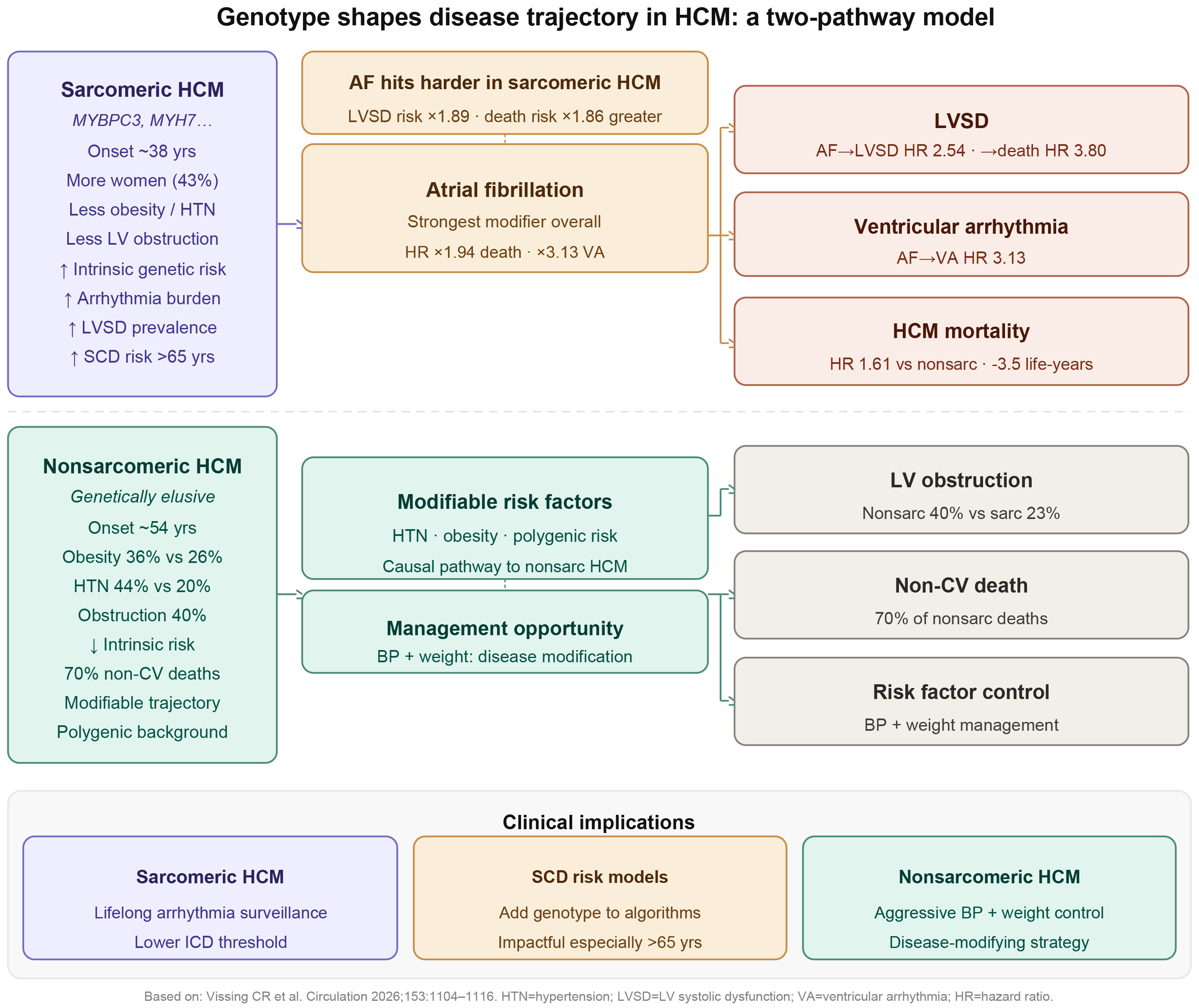
Figure 1. Two-pathway model of disease trajectory in hypertrophic cardiomyopathy according to genetic subtype. Sarcomeric HCM (top, driven by pathogenic sarcomere variants) is characterized by earlier disease onset, a higher intrinsic burden of arrhythmias and left ventricular systolic dysfunction, and a greater susceptibility to the downstream consequences of atrial fibrillation, which amplifies the risk of LVSD, ventricular arrhythmia, and HCM-related death to a significantly greater extent than in nonsarcomeric disease. Nonsarcomeric HCM (bottom, genetically elusive) is shaped predominantly by modifiable cardiovascular comorbidities - hypertension, obesity, and polygenic background risk - with a higher prevalence of LV obstruction and a greater proportion of noncardiovascular deaths. Clinical implications differ accordingly: sarcomeric HCM warrants intensified lifelong arrhythmia surveillance and a lower ICD threshold, incorporation of genotype into SCD risk prediction models would improve their performance, particularly in patients over 65, and nonsarcomeric HCM represents an opportunity for disease modification through aggressive blood pressure and weight management. HCM: Hypertrophic cardiomyopathy; LVSD: left ventricular systolic dysfunction; AF: atrial fibrillation; ICD: implantable cardioverter defibrillator; LV: left ventricle; SCD: sudden cardiac death; CV: cardiovascular.
DECLARATIONS
Authors’ contributions
Prepared the first draft: Maurizi N
Supervised the work and approved the manuscript: Pieroni M
Availability of data and materials
Not applicable.
AI and AI-assisted tools statement
Not applicable.
Financial support and sponsorship
Dr. Maurizi N has received grants from Bristol Meier Squibb, Amicus, Foundation CVCL, Bangarter-Rhyner Foundation and fees (honoraria or consulting) from Bristol Meier Squibb, Academic CME, Atheneum and Guidepoint.
Conflicts of interest
All authors declared that there are no conflicts of interest.
Ethical approval and consent to participate
Not applicable.
Consent for publication
Not applicable.
Copyright
© The Author(s) 2026.
REFERENCES
1. Vissing CR, Axelsson Raja A, Helms AS, et al. Differences in disease trajectory, comorbidities, and mortality in sarcomeric and nonsarcomeric hypertrophic cardiomyopathy. Circulation. 2026;153:1104-16.
2. Maron BJ, Rowin EJ, Casey SA, Maron MS. How hypertrophic cardiomyopathy became a contemporary treatable genetic disease with low mortality: shaped by 50 years of clinical research and practice. JAMA Cardiol. 2016;1:98-105.
3. Fumagalli C, Bonanni F, Beltrami M, et al. Incidence of stroke in patients with hypertrophic cardiomyopathy in stable sinus rhythm during long-term monitoring. Int J Cardiol. 2023;381:70-5.
4. Kirchhof P, Camm AJ, Goette A, et al. Early rhythm-control therapy in patients with atrial fibrillation. N Engl J Med. 2020;383:1305-16.
5. Harper AR, Goel A, Grace C, et al. Common genetic variants and modifiable risk factors underpin hypertrophic cardiomyopathy susceptibility and expressivity. Nat Genet. 2021;53:135-42.
6. Mahmoud AK, Awad K, Sheashaa H, et al. Cardiovascular outcomes following bariatric surgery in obese patients with hypertrophic cardiomyopathy: a multicenter propensity-matched analysis. Am Heart J Plus. 2026;64:100756.
7. O'Mahony C, Jichi F, Pavlou M, et al. A novel clinical risk prediction model for sudden cardiac death in hypertrophic cardiomyopathy (HCM risk-SCD). Eur Heart J. 2014;35:2010-20.
8. Ommen SR, Ho CY, Asif IM, et al. 2024 AHA/ACC/AMSSM/HRS/PACES/SCMR guideline for the management of hypertrophic cardiomyopathy: a report of the American Heart Association/American College of Cardiology Joint Committee on Clinical Practice Guidelines. Circulation. 2024;149:e1239-311.
Cite This Article
 Open Access
How to Cite
Maurizi N, Pieroni M. When genetics meets destiny: rethinking hypertrophic cardiomyopathy through the lens of genotype. J Cardiovasc Aging. 2026;6:46. https://dx.doi.org/10.20517/jca.2026.72
Download Citation
If you have the appropriate software installed, you can download article citation data to the citation manager of your choice. Simply select your manager software from the list below and click on download.
Export Citation File
Type of Import
Tips on Downloading Citation
Citation Manager File Format
Type of Import
Direct Import: When the Direct Import option is selected (the default state), a dialogue box will give you the option to Save or Open the downloaded citation data. Choosing Open will either launch your citation manager or give you a choice of applications with which to use the metadata. The Save option saves the file locally for later use.
Indirect Import: When the Indirect Import option is selected, the metadata is displayed and may be copied and pasted as needed.
About This Article
Special Topic
Copyright

Data & Comments
Data
0











Comments
Comments must be written in English. Spam, offensive content, impersonation, and private information will not be permitted. If any comment is reported and identified as inappropriate content by OAE staff, the comment will be removed without notice. If you have any queries or need any help, please contact us at [email protected].