
fig4
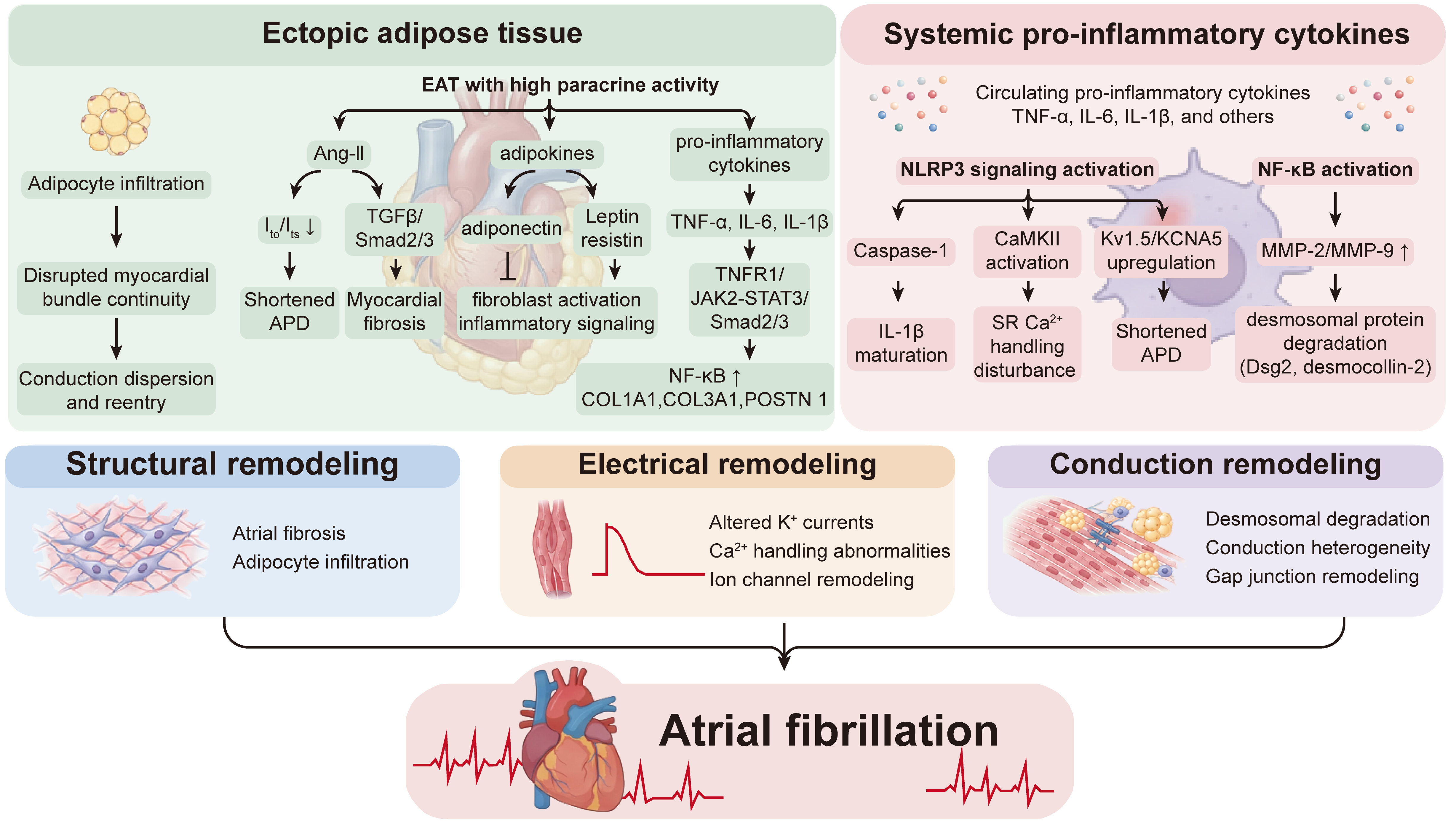
Figure 4. Mechanisms of obesity-related atrial fibrillation. Ectopic adipose tissue and systemic pro-inflammatory cytokines promote atrial fibrillation through coordinated structural, electrical, and conduction remodeling. Adipocyte infiltration disrupts the continuity of atrial myocardial bundles, thereby increasing conduction heterogeneity and susceptibility to reentry. EAT with enhanced paracrine activity further contributes to atrial remodeling through the local release of Ang-II, adipokines, and pro-inflammatory cytokines. Ang-II reduces cardiomyocyte K+ currents, thereby shortening action potential duration, while simultaneously activating TGF-β/Smad2/3 signaling in cardiac fibroblasts to promote fibrotic remodeling. In parallel, EAT-derived TNF-α, IL-6, IL-1β, leptin, and TGF-β activate TNFR1-, JAK2/STAT3-, NF-κB-, and TGFβR/Smad2/3-dependent signaling pathways, enhancing inflammatory responses and upregulating fibrosis-associated genes, including COL1A1, COL3A1, and POSTN. Systemic pro-inflammatory cytokines further activate the NLRP3/caspase-1/IL-1β axis and CaMKII signaling, resulting in abnormal sarcoplasmic reticulum Ca2+ handling and electrical instability. Concurrent upregulation of Kv1.5/KCNA5-mediated IKur contributes to action potential shortening. In addition, NF-κB-dependent induction of MMP-2 and MMP-9 promotes degradation of desmosomal proteins, including Dsg2 and Dsc2, thereby impairing intercellular coupling and increasing conduction heterogeneity and effective refractory period dispersion. Collectively, these structural, electrical, and conduction abnormalities establish a pro-arrhythmic substrate that facilitates the initiation and maintenance of atrial fibrillation. EAT: Epicardial adipose tissue; Ang-II: angiotensin II; APD: action potential duration; ERP: effective refractory period; TNF-α: tumor necrosis factor-α; IL: interleukin; TNFR1: tumor necrosis factor receptor 1; JAK2: Janus kinase 2; STAT3: signal transducer and activator of transcription 3; TGF-β: transforming growth factor-β; TGFβR: transforming growth factor-β receptor; NF-κB: nuclear factor κB; COL1A1: collagen type I alpha 1 chain; COL3A1: collagen type III alpha 1 chain; POSTN: periostin; NLRP3: NOD-like receptor family pyrin domain-containing 3; CaMKII: Ca2+/calmodulin-dependent protein kinase II; IKur: ultra-rapid delayed rectifier potassium current; Kv1.5: voltage-gated potassium channel Kv1.5; KCNA5: potassium voltage-gated channel subfamily A member 5; MMP: matrix metalloproteinase; Dsg2: desmoglein-2; Dsc2: desmocollin-2.