

fig3
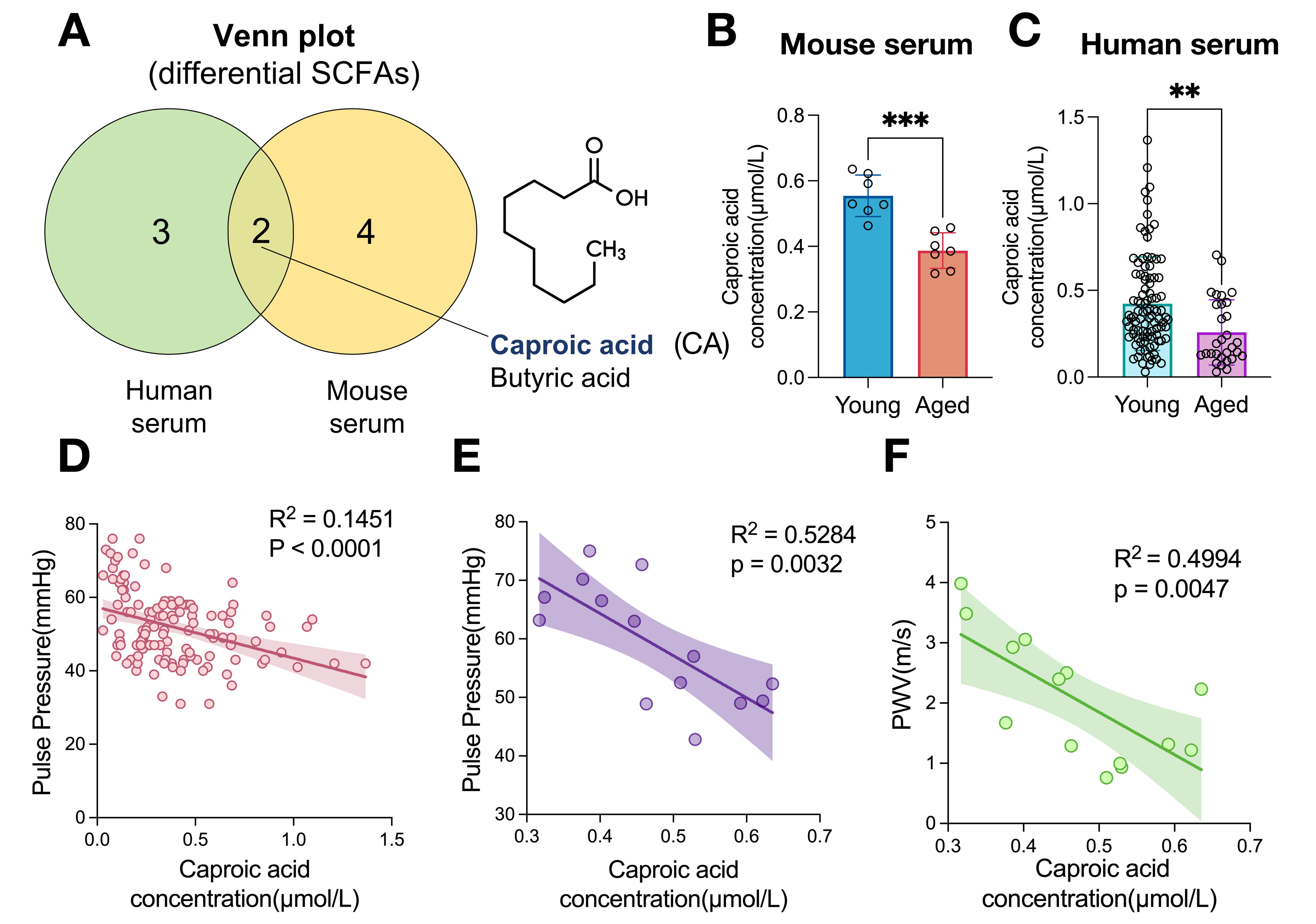
Figure 3. Caproic acid is an age-associated SCFA linked to vascular aging and arteriosclerosis in mice and humans. (A) Venn diagram of overlapping age-related differential SCFAs in human and mouse serum, with the chemical structure of caproic acid shown. (B) Serum caproic acid concentrations in young (n = 7) and aged (n = 7) mice. (C) Serum caproic acid concentrations in young (n = 97) and aged (n = 30) human subjects. (D) Correlation between serum caproic acid and pulse pressure in humans (n = 127). (E) Correlation between serum caproic acid and pulse pressure in mice (n = 14). (F) Correlation between serum caproic acid and aortic arch PWV in mice (n = 14). Data are mean ± SD. **P < 0.01, ***P < 0.001 vs. young group (unpaired student’s t-test). Linear regression analyses are shown with R2 and P values; shaded areas represent 95% confidence intervals.