

fig1
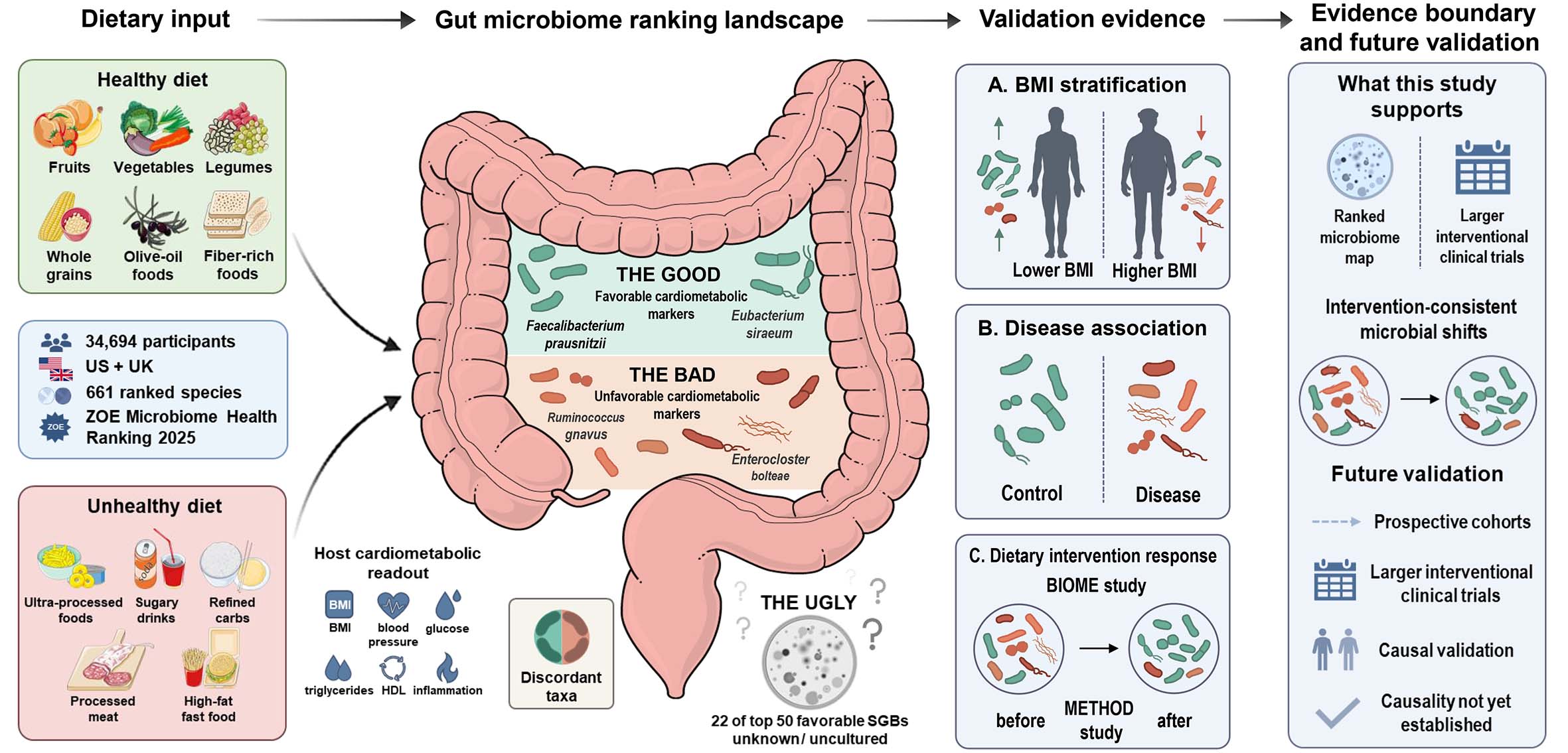
Figure 1. Conceptual summary of the gut microbiome ranking framework for cardiometabolic health. In the original study, 661 gut microbial species were ranked in 34,694 participants from the US and UK according to their associations with dietary patterns and cardiometabolic markers. This schematic summarizes the proposed framework, highlighting favorably ranked taxa (“the good”), unfavorably ranked taxa (“the bad”), and unknown or uncultured candidates (“the ugly”). The right-hand validation section summarizes three lines of supporting evidence: (A) BMI stratification, in which lower BMI is associated with a greater representation of favorably ranked microbes and higher BMI with a greater representation of unfavorably ranked microbes; (B) disease association, in which control or healthier states show relatively more favorable microbial signatures, whereas disease states show relatively more unfavorable signatures; and (C) dietary intervention response, in which the BIOME and METHOD intervention studies suggest that diet-related interventions can shift the gut microbiome toward a more favorable configuration. Together, these findings support the reproducibility and potential actionability of the microbiome ranking landscape. Further prospective studies, larger interventional trials, and causal validation will likely be needed. Selected graphical elements were adapted from Servier Medical Art (https://smart.servier.com), licensed under CC BY 4.0 (https://creativecommons.org/licenses/by/4.0/), and from Bioicons elements identified as public domain/no restrictions in the accompanying attribution/license table. Graphical elements were modified in color, size, orientation, and layout.