fig1
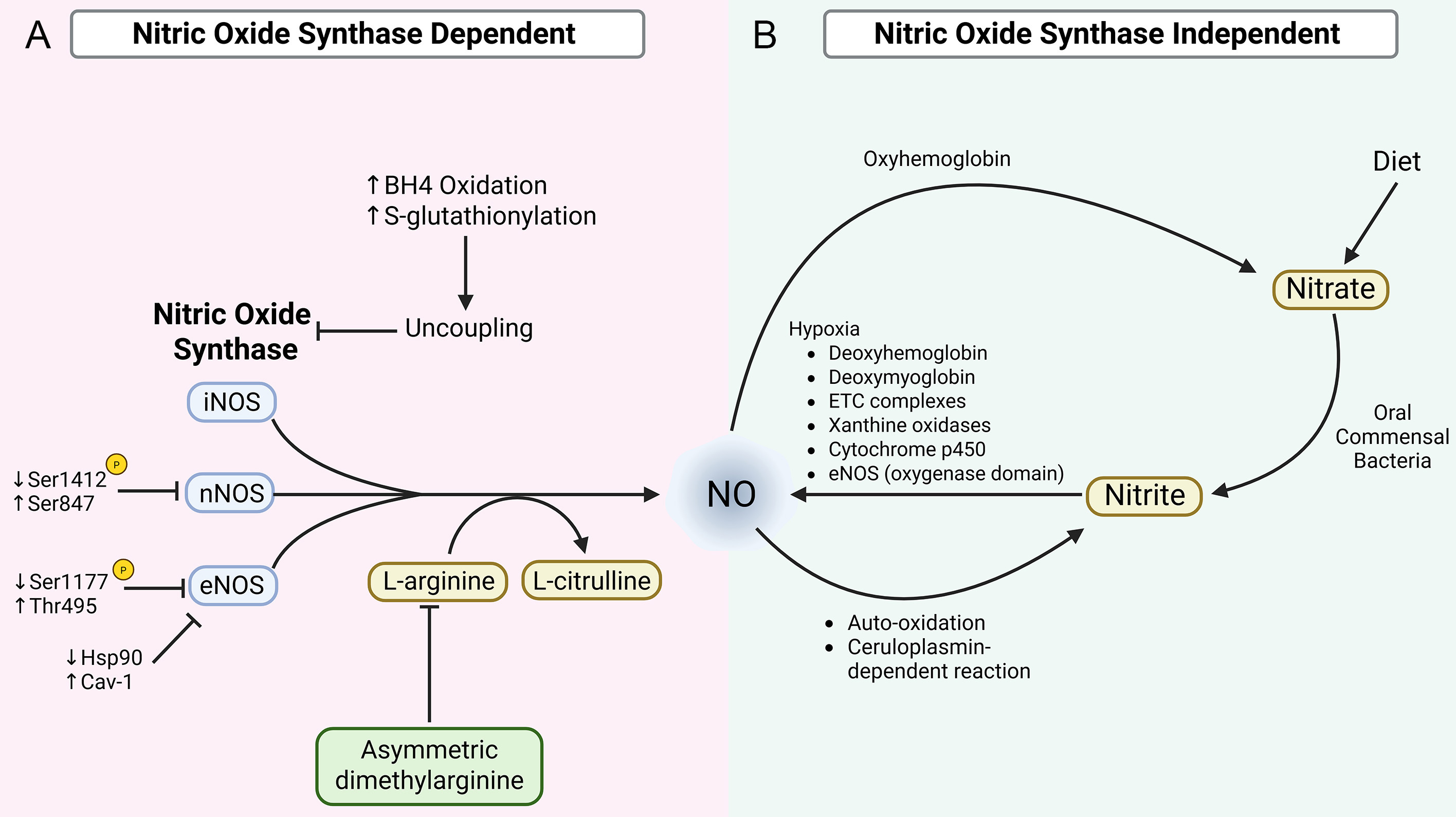
Figure 1. Synthesis and Regulation of NO. [(A) NOS-dependent NO production] NO is enzymatically synthesized through the conversion of L-arginine to L-citrulline by iNOS, nNOS, and eNOS. Each of these NOS isoforms is regulated by distinct phosphorylation sites, with phosphorylation of Ser1412 and dephosphorylation at Ser847 driving nNOS activity, and phosphorylation at Ser1177 and dephosphorylation at Thr495 driving eNOS activity. Age-related alterations of these phosphorylation states (as represented by the indicated arrows) reduce NOS activity in the cardiovascular system. Additionally, age-associated inhibitory NOS modulation by increased ADMA reduces L-arginine availability, further impairing NOS-mediated NO production. Moreover, age-associated depletion of BH4 levels and increased S-glutathionylation promote NOS uncoupling and further downregulate NO bioavailability. [(B) NOS-independent NO production] Alternatively, NO can also be produced by the reduction of nitrate and nitrite, derived from dietary sources or from the oxidation of NOS-derived NO. Circulating nitrate and nitrite act as storage forms of NO and can be reduced back to NO under hypoxic conditions. Reduction of nitrate/nitrite to NO is mediated by mechanisms involving deoxyhemoglobin, deoxymyoglobin, mitochondrial ETC complexes, xanthine oxidases, cytochrome 450, and the oxygenase domain of eNOS. Created in BioRender. Patel, P. (2025) https://BioRender.com/v5hq0f8.