

Contact-electro-chemistry: an emerging paradigm for interfacial chemical reactions
 0
0 


 Download PDF
Contact electrification (CE) is a ubiquitous interfacial phenomenon that occurs when two materials come into contact and subsequently separate[1-3]. Traditionally, CE has been understood mainly as a physical process associated with electrostatic charge accumulation, surface potential generation, and mechanical energy conversion[4-6]. This understanding has enabled broad advances in electrostatic control, triboelectric nanogenerators, self-powered sensing, and interfacial charge manipulation[7,8]. However, the role of CE in driving chemical transformations has remained largely underexplored[9-11]. At contacting interfaces, charge transfer can generate localized electric fields, reorganize interfacial molecules and ions, and create non-equilibrium microenvironments that are intrinsically relevant to chemical reactivity[12]. At solid-liquid interfaces, these processes are further coupled with electrical double layer (EDL) formation, solvent polarization, and ion redistribution[13,14]. Interfacial electron transfer and ion redistribution reshape the local reaction microenvironment and enable chemical activation[15]. We define chemical transformations directly driven by these CE-induced interfacial processes as Contact-electro-chemistry (CE-Chemistry)[16].
CE-Chemistry differs from conventional electrochemistry, photochemistry, and thermochemistry in the origin, spatial localization, and dynamic evolution of its chemical driving force[17,18]. Rather than relying primarily on external electrodes, applied bias, photon excitation, or bulk heating, CE-Chemistry harnesses CE-induced interfacial charge transfer to establish localized interfacial electric fields, whose magnitude and spatiotemporal evolution are further shaped by the EDL[16,19]. These localized fields can polarize water and organic molecules, reorganize hydrogen-bond networks, redistribute ions within the EDL, lower activation barriers, facilitate electron transfer, and stabilize reactive intermediates[13,20]. By coupling CE, EDL-mediated field regulation, radical chemistry, and redox transformations, this paradigm offers opportunities for mild, spatially confined, and potentially sustainable chemical processes without conventional electrodes or external bias[14,21].
In this Perspective, the conceptual foundations, regulatory strategies, key challenges, and future opportunities of CE-Chemistry are examined. Rather than providing a comprehensive catalog of reported reactions, emphasis is placed on the mechanistic framework linking CE-induced interfacial charge transfer to EDL-mediated electric field generation, the spatiotemporal evolution of localized interfacial fields, and their influence on reaction kinetics and selectivity. Strategies for enhancing CE performance are first discussed, including the rational design of materials, surface chemistry, interfacial morphology, reactor architectures, and contact dynamics. Approaches for regulating chemically operative interfacial electric fields through EDL engineering are then considered, with particular attention given to the control of ionic and molecular environments, field strength and fluctuations, EDL screening, and local reactant accessibility. Finally, the major challenges associated with establishing quantitative charge-field-reaction relationships, resolving dynamic EDL structures under operando conditions, controlling reaction pathways and selectivity, and developing standardized performance metrics for scalable implementation are outlined. Through continued advances in these areas, CE-Chemistry is anticipated to evolve into a predictive, scalable, and sustainable platform for interfacial chemical transformations, operating either independently or in concert with established electrochemical and photochemical technologies.
STRATEGIES FOR ADVANCING CONTACT-ELECTRO-CHEMISTRY
Strategies for enhancing CE performance
A central prerequisite for advancing programmable CE-Chemistry is the ability to amplify and regulate CE performance, as interfacial charge transfer defines the strength of localized electric fields and the extent of chemical activation[12]. This requires coordinated regulation from both material and engineering perspectives [Figure 1A]: the former determines intrinsic charge-transfer capability, whereas the latter governs effective interfacial contact, contact-separation dynamics, and scalable operation.
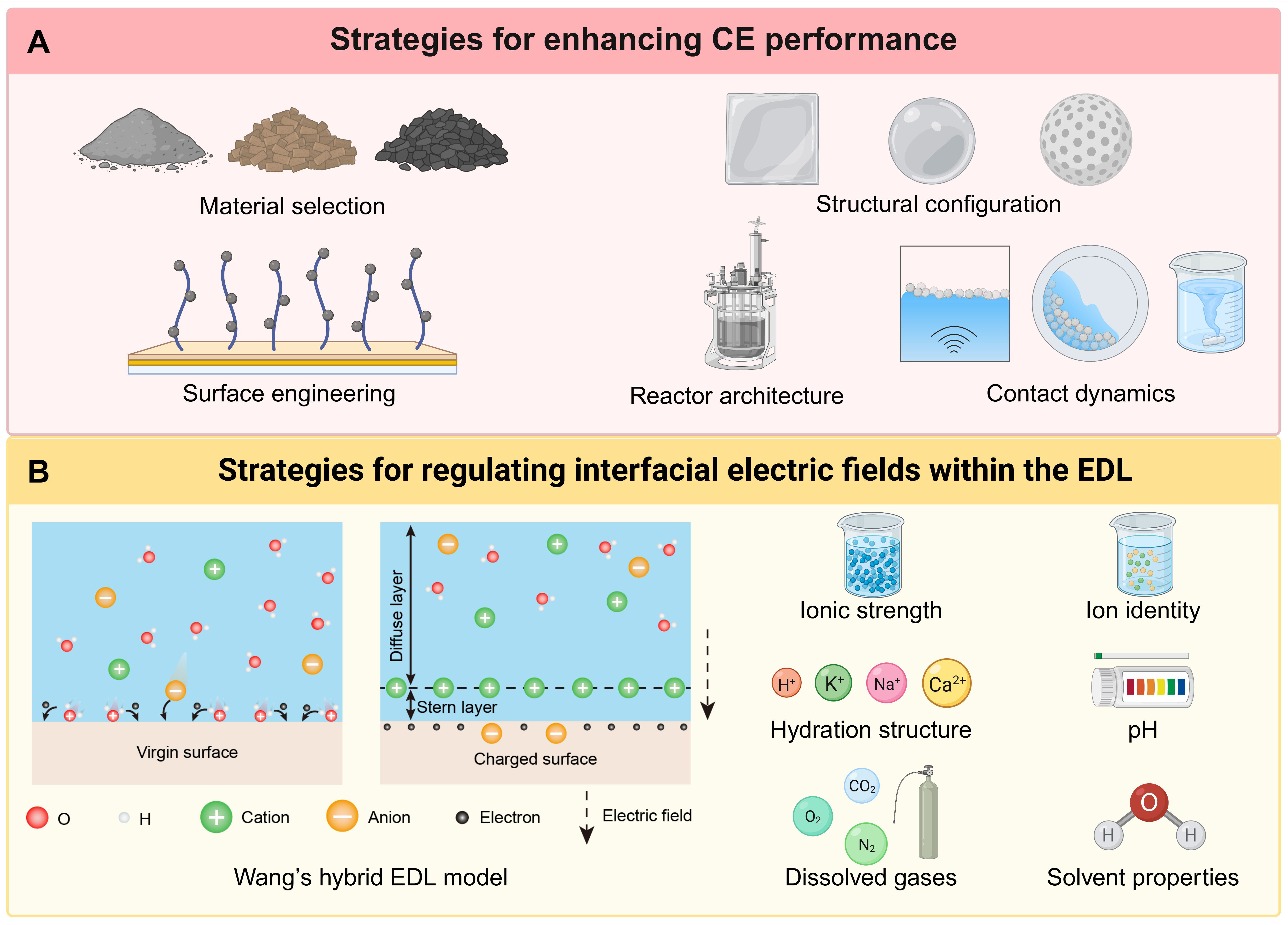
Figure 1. Strategies for advancing contact-electro-chemistry through enhanced CE and EDL engineering. (A) Strategies for enhancing CE performance: material selection, surface engineering, structural configuration, reactor architecture, and contact dynamics. (B) Strategies for regulating interfacial electric fields within the EDL: Wang’s hybrid EDL model[2] Ionic strength, ion identity, hydration structure, pH, dissolved gases, and solvent properties. CE: Contact electrification; EDL: electrical double layer.
In CE-Chemistry, enhancing CE performance is the fundamental basis for strengthening interfacial charge transfer and accumulation, which in turn governs the formation of interfacial electric fields and the efficiency of chemical activation[22]. This performance is largely dictated by material properties, particularly electronegativity, which determines whether a material can efficiently accept or donate electrons during CE with liquids[9]. Accordingly, rational material selection and surface modification are central to enhancing the reactivity of CE-Chemistry. Depending on the targeted reaction system, CE-active platforms can be selected or developed from polymers, inorganic oxides, semiconductors, carbon-based materials, and hybrid composites, with their surface functionality, wettability, chemical and thermal stability, and recyclability tailored for specific interfacial environments[23]. Surface engineering provides a versatile route for modulating CE activity by tailoring the density, distribution, and electronic properties of surface functional groups. In particular, fluorination plays a pivotal role in solid-liquid CE, as fluorinated moieties enhance electron affinity and facilitate interfacial electron transfer from liquid molecules to the solid surface, thereby increasing charge generation[24]. Additional control can be achieved through defect engineering, electret polarization, work-function modulation, and metal-dielectric hybridization, which collectively influence charge transfer kinetics, charge retention, and interfacial charge density[19,20]. Through these approaches, the generation and localization of interfacial charges can be systematically regulated, advancing CE-Chemistry from empirical material optimization toward the predictive design of interfacial charge-transfer pathways and localized electrostatic reaction environments.
Interface morphology, reactor architecture, and contact dynamics play pivotal roles in translating intrinsic material properties into sustained chemical performance in CE-Chemistry[12]. Because CE-driven reactions are initiated at continuously regenerated solid-liquid interfaces, overall reactivity is governed not by material loading alone, but by the accessible interfacial area, the frequency and effectiveness of contact-separation events, and the efficiency of interfacial renewal[25]. Accordingly, morphological engineering strategies, including surface roughening, chemical etching, templating, electrospinning, porous-structure fabrication, and micro/nanopatterning, have been widely employed to increase the effective contact area and amplify localized interfacial electric fields[26,27]. By promoting interfacial interactions, charge generation, and electric-field concentration, these approaches enhance charge-transfer efficiency and the magnitude of chemically operative interfacial fields, thereby improving CE-driven chemical activity[26,28,29]. At the architecture level, nanoscale powders and microscale particles provide high specific surface areas and frequent collision opportunities[25,30]; fibrous membranes, porous scaffolds, coated textiles, and immobilized particles improve recyclability and long-term stability[27,31]; magnetic composite designs further enable rapid material separation and reuse under an external magnetic field, reducing secondary contamination from dispersed micro/nano materials[32]; and planar films provide model or immobilized interfaces, whereas tubes, microfluidic chips, and packed-bed flow reactors enable spatially controlled and continuously renewed solid-liquid interfaces for continuous CE-Chemistry[23,33]. In parallel, contact dynamics provide another key route for enhancing CE performance. Mechanical inputs, including ultrasonication, liquid flow, ball milling, stirring, and macroscopic droplet motion, modulate CE by regulating frequency, time, energy, rotation speed, and flow rate[9]. Notably, because these mechanical inputs may also introduce additional effects, such as cavitation, mass-transfer enhancement, or local heating, appropriate control experiments are needed to distinguish genuine CE-driven mechanisms from other mechanically induced contributions. Moreover, morphology and contact dynamics should be regarded not as auxiliary engineering parameters, but as core determinants of interfacial charge transfer and accumulation, EDL evolution, reactive species generation, and reaction efficiency[13]. Future progress requires coordinated design principles that correlate effective interfacial area, surface charge density, mechanical input parameters, interfacial electric field strength, and reaction kinetic parameters, enabling CE-Chemistry to advance from proof-of-concept reactions toward predictable, efficient, and scalable interfacial chemical platforms.
Strategies for regulating interfacial electric fields within the EDL
Once interfacial charge transfer occurs, the key challenge shifts from charge generation to the regulation of chemically active interfacial electric fields[14]. Within CE-Chemistry, the EDL should be viewed not simply as a charge-screening layer, but as a dynamic electrochemical microenvironment that controls local field strength, ion distribution, reactant accessibility, reactive-species formation, and reaction pathway evolution[1,2]. As such, EDL engineering provides the mechanistic bridge between CE and chemical reactivity [Figure 1B]. Whereas materials selection and interfacial engineering govern how charges are generated and accumulated, EDL regulation determines how these charges are spatially distributed, temporally sustained, and ultimately converted into chemically operative electric fields capable of directing interfacial reactions.
According to Wang’s hybrid EDL model, EDL formation at the solid-liquid interfaces follows a two-step process[1,2]. In the first step, when a liquid contacts a virgin solid surface, liquid molecules and ions, including H2O molecules, cations, and anions, impact the solid surface owing to thermal motion or fluid pressure. During these interfacial impacts, the electron clouds of liquid molecules and solid-surface atoms overlap, enabling interfacial electron transfer across the solid-liquid interface[12]. Meanwhile, ion adsorption and surface ionization reactions may also occur simultaneously[2]. This step generates initial surface charges and determines the origin and composition of initial charges on solid surfaces. In the second step, oppositely charged free ions in the liquid are attracted toward the charged surface by electrostatic interactions, leading to EDL formation[1,9]. This model provides a mechanistic basis for EDL formation at solid-liquid interfaces, especially for understanding how CE-induced electron transfer and subsequent counter-ion migration establish localized interfacial electric fields in CE-Chemistry.
Regulation of the ionic and molecular environment within the EDL provides a direct route for controlling interfacial electric fields and reaction microenvironments[21]. Ionic strength, ion identity, hydration structure, valence state, mobility, and specific adsorption collectively determine EDL organization, electrostatic screening, and local reactant distributions[34]. While excessive ionic strength may attenuate interfacial fields through enhanced screening, appropriate ionic regulation can strengthen field localization and promote reactant enrichment near electrified interfaces[35]. Ion hydration is particularly important[36], as weakly hydrated ions can form more compact Stern layers and generate stronger localized electric fields[37]. In addition, pH, solvent properties, and dissolved gases influence EDL structure by regulating proton activity, surface ionization, solvation environments, radical reactivity, and competing charge-transfer pathways[38,39]. EDL engineering should therefore be regarded not merely as electrolyte optimization, but as a means of programming chemically active interfacial microenvironments that govern charge transfer, field distribution, and reaction selectivity.
The temporal evolution of the EDL is equally critical in CE-Chemistry[14]. CE-driven reactions are often initiated under transient, non-equilibrium conditions, where interfacial charge transfer, triboelectric charge accumulation, ion redistribution, and electric-field formation are dynamically coupled[16]. The resulting spatiotemporally heterogeneous electric fields can create transient high-field microenvironments that promote electron transfer, radical generation, and bond activation[13]. As the EDL evolves toward equilibrium, increasing ionic screening attenuates field gradients[9] and limits further interfacial charge transfer, leading to diminished reactivity[40]. EDL engineering should therefore focus on balancing charge generation, field localization, dynamic field fluctuations, ionic screening, and reactant accessibility, rather than maximizing any single parameter[16,40]. Developing quantitative relationships between interfacial charge density, EDL structure, field dynamics, and reaction kinetics will be essential for transforming CE-Chemistry from an empirical phenomenon into a predictive framework for interfacial chemical reactivity.
CHALLENGES AND OPPORTUNITIES
Key challenges
Despite rapid progress, CE-Chemistry remains at an early stage of mechanistic development. A central challenge is to establish quantitative charge-field-reaction relationships that link CE-induced interfacial charge transfer with EDL-mediated electric field formation and downstream chemical kinetics. In most reported systems, key descriptors, including surface charge density, surface potential, charge-transfer kinetics, ion distributions, EDL evolution, interfacial electric-field dynamics, and reaction rates, are still measured independently or inferred indirectly[19,41-43]. Extensive experimental evidence indicates that hydrophobic solid-liquid interfaces often exhibit enhanced electron transfer efficiency and higher CE-Chemistry reactivity[44]. The strong interfacial electrostatic potential and associated electric fields may originate from differences in electronegativity between contacting phases, as well as from polarity reorganization and orientation of interfacial water at hydrophobic surfaces[45]. However, this fragmented understanding obscures the direct coupling between CE processes, interfacial electric-field formation, and reaction kinetics. Dynamic solid-liquid contact, transient charge accumulation, EDL screening, and radical generation are typically investigated separately across different spatial and temporal scales. As a consequence, it remains difficult to quantitatively resolve how CE-induced charge transfer governs the magnitude, spatiotemporal fluctuations, and relaxation dynamics of interfacial electric fields, and how these evolving fields ultimately regulate reaction rates and selectivity.
A second challenge lies in resolving and controlling the dynamic EDL under realistic reaction conditions. In CE-Chemistry, the EDL is not a static screening structure but an evolving interfacial microenvironment in which charge accumulation, counter-ion migration, solvent polarization, and chemical reactions occur simultaneously. During the initial stages of CE, non-equilibrium interfacial electric fields may promote electron transfer, radical generation, and bond activation[9]. As ion migration proceeds, however, the EDL may enter a more stabilized screening regime that suppresses further interfacial electron transfer[2,13]. Disentangling these two regimes requires operando methods capable of probing interfacial electric fields, ion distributions, hydration structures, and reaction intermediates with high spatial and temporal resolution, such as Kelvin probe measurements, Raman spectroscopy, and infrared spectroscopy[1,14]. At present, the lack of such direct measurements limits the ability to resolve the spatiotemporal evolution of the EDL and to delineate how its distinct dynamic stages differentially regulate interfacial reaction pathways and kinetics.
Reaction selectivity represents another major challenge. CE-Chemistry often proceeds through coupled charge transfer, radical-mediated, and proton-involved pathways, which can be highly sensitive to local pH, ionic strength, solvent identity, dissolved gases, and surface chemistry[9]. While such sensitivity provides opportunities for pathway programming, it also complicates mechanistic interpretation and product control[16]. Radical intermediates and hydrated electrons are short-lived and can undergo secondary reactions, recombination, scavenging, or cross-coupling with other species in the interfacial region[12]. Therefore, achieving selective CE-driven transformations requires not only enhancing charge generation, but also controlling where and when reactive intermediates are produced, how long they persist, and which reactants they encounter.
Scalability and benchmarking also remain unresolved. Reported CE-Chemistry systems differ widely in material form, contact mode, mechanical input, liquid volume, reaction time, interfacial area, and product quantification method[12]. These differences make it difficult to compare intrinsic activity across systems[9]. For practical deployment, standardized metrics should be established to correlate chemical output with effective interfacial area, material loading, surface charge density, mechanical energy input, and reaction volume. In addition, dispersed micro/nano materials may provide high contact areas but raise concerns regarding recyclability and secondary contamination. Therefore, future systems must balance high interfacial activity with material durability, operational stability, and scalable reactor design.
Future opportunities
At the material level, rational control of electronegativity, surface functional groups, defect states, electret polarization, work function, wettability, and chemical stability can enable more predictable interfacial charge transfer and accumulation. Hybrid materials, magnetic composites, immobilized particles, porous scaffolds, and coated architectures may further combine high charge-generating capability with improved recyclability and long-term operation. Such material strategies will be essential for moving beyond empirical screening toward surface-charge-engineered reaction platforms.
EDL engineering offers a second major opportunity. By regulating ionic strength, ion identity, hydration structure, pH, solvent properties, and dissolved gases, it should become possible to tune the balance between field amplification, field fluctuation, reactant enrichment, and EDL screening. In this context, the goal is not simply to maximize interfacial electric field strength, but to maintain a productive non-equilibrium interfacial microenvironment in which electron transfer, ion migration, and chemical activation are temporally coordinated. This perspective opens opportunities to design ion-programmed and solvent-programmed CE-Chemistry systems for selective radical generation, redox conversion, proton-coupled pathways, and interfacial molecular activation.
Reactor and process engineering will be equally important for practical implementation. Flow-through tubes, microfluidic chips, packed-bed reactors, immobilized membranes, and modular solid-liquid contactors can provide spatially controlled and continuously renewed interfaces for scalable CE-Chemistry. Mechanical inputs such as ultrasonication, stirring, flow, ball milling, and droplet motion can be optimized not only to increase contact frequency, but also to regulate contact time, mechanical energy input, residence time, and interfacial renewal. Integrating these engineering parameters with material and EDL design will enable CE-Chemistry to evolve from batch proof-of-concept reactions toward continuous, controllable, and energy-efficient reaction systems.
More broadly, CE-Chemistry may offer a new paradigm for distributed and sustainable chemical production. Emerging applications include water disinfection, pollutant degradation, in situ generation of reactive oxidants, hydrogen peroxide synthesis, resource recovery, seawater transformation, nitrogen and carbon conversion, and interfacial organic synthesis. Rather than competing with conventional electrochemical or photochemical approaches, CE-Chemistry is expected to complement these established technologies by enabling localized interfacial electric fields without the need for external bias, engineered electrodes, or noble-metal catalysts. With continued advances in mechanistic understanding, material design, and reaction design, CE-Chemistry could evolve into a general platform for harvesting ambient mechanical energy to drive selective, scalable, and sustainable interfacial reactions. In addition, its unique ability to generate transient, spatially confined electrostatic environments may allow seamless integration with electrochemical and photochemical systems, opening opportunities for synergistic reaction pathways and enhanced overall catalytic performance.
DECLARATIONS
Authors’ contributions
Conceptualized the idea and led the project: Wei, D.; Sun, B.; Kvarnström, C.
Made substantial contributions to writing the paper: Wei, D.; Qian, H.; Huo, X.
Availability of data and materials
Not applicable.
Financial support and sponsorship
This work was supported by the National Natural Science Foundation (grant number 22479016).
Conflicts of interest
Wei, D., Editor-in-Chief of the journal Iontronics, and Kvarnström, C., Associate Editor of the journal Iontronics, were not involved in any steps of the editorial process, including reviewer selection, manuscript handling, or decision-making. The other authors declare that there are no conflicts of interest.
Ethical approval and consent to participate
Not applicable.
Consent for publication
Not applicable.
AI and AI-assisted tools statement
Not applicable.
Copyright
© The Author(s) 2026.
REFERENCES
1. Wang, Z. L.; Wang, A. C. On the origin of contact-electrification. Mater. Today. 2019, 30, 34-51.
2. Lin, S.; Xu, L.; Chi Wang, A.; Wang, Z. L. Quantifying electron-transfer in liquid-solid contact electrification and the formation of electric double-layer. Nat. Commun. 2020, 11, 399.
3. Zhou, B.; Zhou, Q.; Liu, Z.; Zhou, X.; Bao, L. Engineering artificial spider silk from biomimetic synthesis to advanced applications. SmartSys. 2025, 1, e70005.
4. Zhang, C.; Hao, Y.; Lu, X.; et al. Advances in TENGs for marine energy harvesting and in situ electrochemistry. Nano-Micro. Letters. 2025, 17, 124.
5. Chen, P.; Zhang, Z.; Ye, C.; et al. A self-sustainable, ultrarobust and high-power-density triboelectric nanogenerator for in situ powering of marine internet of things. Adv. Mater. 2025, 37, e11283.
6. Ding, X.; Zhou, Y.; Wang, W.; et al. Smart bearings enabled by the tribovoltaic effect and machine learning. Chem. Eng. J. 2026, 537, 176308.
7. Wei, Y.; Li, X.; Gu, Y.; et al. Probing electrical double layer via triboelectric charge transfer. Nat. Commun, 2026, 17, 402.
9. Qian, H.; Wang, Z. L.; Wei, D. From contact electrification to chemical reactions: The emergence of contact-electro-catalysis. Nano. Energy. 2026, 153, 111944.
10. Shen, Z.; Zhu, D.; Zhang, M. Synergy of smart materials and structures toward intelligent metamaterials. SmartSys. 2025, 1, e70007.
11. Sun, Z.; He, T.; Ren, Z.; et al. Moving toward human-like perception and sensation systems - from integrated intelligent systems to decentralized smart devices. SmartSys. 2025, 1, e4.
12. Wang, Z.; Dong, X.; Tang, W.; Wang, Z. L. Contact-electro-catalysis (CEC). Chem. Soc. Rev. 2024, 53, 4349-73.
13. Li, S.; Wang, Z. L.; Wei, D. Chemical reactions at electrified interfaces. Acc. Chem. Res. 2026, 59, 285-97.
14. Li, S.; Wang, Z. L.; Wei, D. Hidden interfacial electric fields in chemistry: contact electrification and beyond. Chem. Soc. Rev. 2026, 55, 4756-82.
15. Lin, S.; Chen, X.; Wang, Z. L. Contact electrification at the liquid-solid interface. Chem. Rev. 2022, 122, 5209-32.
16. Li, S.; Zhang, Z. Peng ,P.; et al. A green approach to induce and steer chemical reactions using inert solid dielectrics. Nano. Energy. 2024, 122, 109286.
17. Gao, R.; Gao, Z.; Nguyen, N. T.; et al. Photoelectrochemical production of disinfectants from seawater. Nat. Sustain. 2025, 8, 672-81.
18. Moreno-Hernandez, I. A.; Brunschwig, B. S.; Lewis, N. S. Crystalline nickel, cobalt, and manganese antimonates as electrocatalysts for the chlorine evolution reaction. Energy Environ. Sci. 2019, 12, 1241-8.
19. Liu, J.; Yang, Z.; Li, S.; et al. Modular contact-electro-chemistry based on dielectrics with work function-tunable metal coatings. Nano. Energy. 2025, 144, 111389.
20. Dong, X.; Wang, Z.; Hou, Y.; et al. Regulating contact-electro-catalysis using polymer/metal janus composite catalysts. J. Am. Chem. Soc. 2024, 146, 28110-8.
21. Chen, C.; Jin, H.; Wang, P.; et al. Local reaction environment in electrocatalysis. Chem Soc Rev, 2024, 53, 2022-55.
22. Gan, T.; Yang, Z.; Li, S.; et al. Unveiling Janus chemical processes in contact-electro-chemistry through oxygen reduction reactions. J. Am. Chem. Soc. 2025, 147, 25407-16.
23. Xu, C.; Li, S.; Zhang, Y.; et al. Contact-electro-chemistry induced by flow electrification in dielectric tubes. Nano. Energy. 2025, 134, 110526.
24. Wang, Z.; Dong, X.; Wu, N.; et al. A generalized approach for enhancing contact-electro-catalysis of oxides in a broad temperature range by fluorination. Nat. Commun. 2025, 16, 11035.
25. Li, H.; Berbille, A.; Zhao, X.; et al. A contact-electro-catalytic cathode recycling method for spent lithium-ion batteries. Nat. Energy. 2023, 8, 1137-44.
26. Lee, K.; Mehrgardi, M. A.; Zare, R. N. Interfacial curvature, not simply size, controls spontaneous hydrogen peroxide formation in water microdroplets. J. Am. Chem. Soc. 2025, 147, 33240-7.
27. Lee, K.; Bose, S.; Song, X.; Choi, S. Q.; Zare, R. N. Continuous flow contact electrocatalysis for hydrogen peroxide production. J. Phys. Chem. C. 2025, 129, 6254-61.
28. Wang, Y.; Wang, Y.; Hu, B.; et al. Catalyst-free contact-electro-catalytic H2O2 synthesis via simple combination of a poly(tetrafluoroethylene) stir bar and ultrasound. Chem. Commun. 2024, 60, 7331-4.
29. Liu, Z.; Jiang, X.; Cheng, X.; et al. Catalytic effect of gray gallium nitride for hydrogen peroxide generation: insights into mechanical stimuli-driven semiconductor-liquid interface alteration. ACS. Nano. 2025, 19, 33361-71.
30. Gan, T.; Li, Z.; Li, S.; et al. Sustainable fluorinated silicon dielectric design for enhanced contact-electro-chemistry. Angew. Chem. Int. Ed. 2025, 64, e202517059.
31. Cao, D.-Q.; Fang, R.-K.; Song, Y.-X.; et al. Contact-electro-catalysis for degradation of trace antibiotics in wastewater. Chem. Eng. J. 2024, 487, 150531.
32. Chen, Z.; Lu, Y.; Liu, X.; Li, J.; Liu, Q. Novel magnetic catalysts for organic pollutant degradation via contact electro-catalysis. Nano. Energy. 2023, 108, 108198.
33. Chen, B.; Xia, Y.; He, R.; et al. Water-solid contact electrification causes hydrogen peroxide production from hydroxyl radical recombination in sprayed microdroplets. P. Natl. Acad. Sci. USA. 2022, 119, e2209056119.
34. Ringe, S.; Clark, E. L.; Resasco, J.; et al. Understanding cation effects in electrochemical CO2 reduction. Energy Environ. Sci. 2019, 12, 3001-14.
35. Malkani, A. S.; Li, J.; Oliveira, N. J.; et al. Understanding the electric and nonelectric field components of the cation effect on the electrochemical CO reduction reaction. Sci. Adv. 2020, 6, eabd2569.
36. Nightingale, E. R. Phenomenological theory of ion solvation. Effective radii of hydrated ions. J. Phys. Chem. 1959, 63, 1381-7.
37. McGregor, J.-M.; Bender, J. T.; Petersen, A. S.; et al. Organic electrolyte cations promote non-aqueous CO2 reduction by mediating interfacial electric fields. Nat. Catal. 2025, 8, 79-91.
38. Liu, M.; Pang, Y.; Zhang, B.; et al. Enhanced electrocatalytic CO2 reduction via field-induced reagent concentration. Nature 2016, 537, 382-6.
39. Ge, Q.; Liu, Y.; You, W.; et al. Substantially improved efficiency and selectivity of carbon dioxide reduction by superior hydrated electron in microdroplet. Sci. Adv, 2025, 11, eadx5714.[DOI: 10.1126/sciadv.adx5714].
40. Liu, J.; Yang, Z.; Li, S.; et al. Nonaqueous contact-electro-chemistry via triboelectric charge. J. Am. Chem. Soc. 2024, 146, 31574-84.
41. Li, W.; Sun, J.; Wang, M.; et al. Contact-electro-catalysis for direct oxidation of methane under ambient conditions. Angew. Chem. Int. Ed. 2024, 63, e202403114.
42. Zhang, B.; Hu, X.; Zhang, R.; et al. Recycling spent lithium iron phosphate via contact-electro-catalysis. Adv. Energy. Mater. 2025, 15, e03508.
43. Berbille, A.; Li, X.; Su, Y.; et al. Mechanism for generating H2O2 at water-solid interface by contact-electrification. Adv. Mater. 2023, 35, 2304387.
44. Muntaha, S. T.; Xu, T.; Li, S.; et al. Triboelectricity-driven chemistry at oppositely charged triboelectric interfaces with ionic dyes. Nanoscale. Horiz. 2026, 11, 1426-34.
Cite This Article
 Open Access
How to Cite
Download Citation
If you have the appropriate software installed, you can download article citation data to the citation manager of your choice. Simply select your manager software from the list below and click on download.
Export Citation File
Type of Import
Tips on Downloading Citation
Citation Manager File Format
Type of Import
Direct Import: When the Direct Import option is selected (the default state), a dialogue box will give you the option to Save or Open the downloaded citation data. Choosing Open will either launch your citation manager or give you a choice of applications with which to use the metadata. The Save option saves the file locally for later use.
Indirect Import: When the Indirect Import option is selected, the metadata is displayed and may be copied and pasted as needed.
About This Article
Special Topic
Copyright

Data & Comments
Data
0








Comments
Comments must be written in English. Spam, offensive content, impersonation, and private information will not be permitted. If any comment is reported and identified as inappropriate content by OAE staff, the comment will be removed without notice. If you have any queries or need any help, please contact us at [email protected].