

fig3
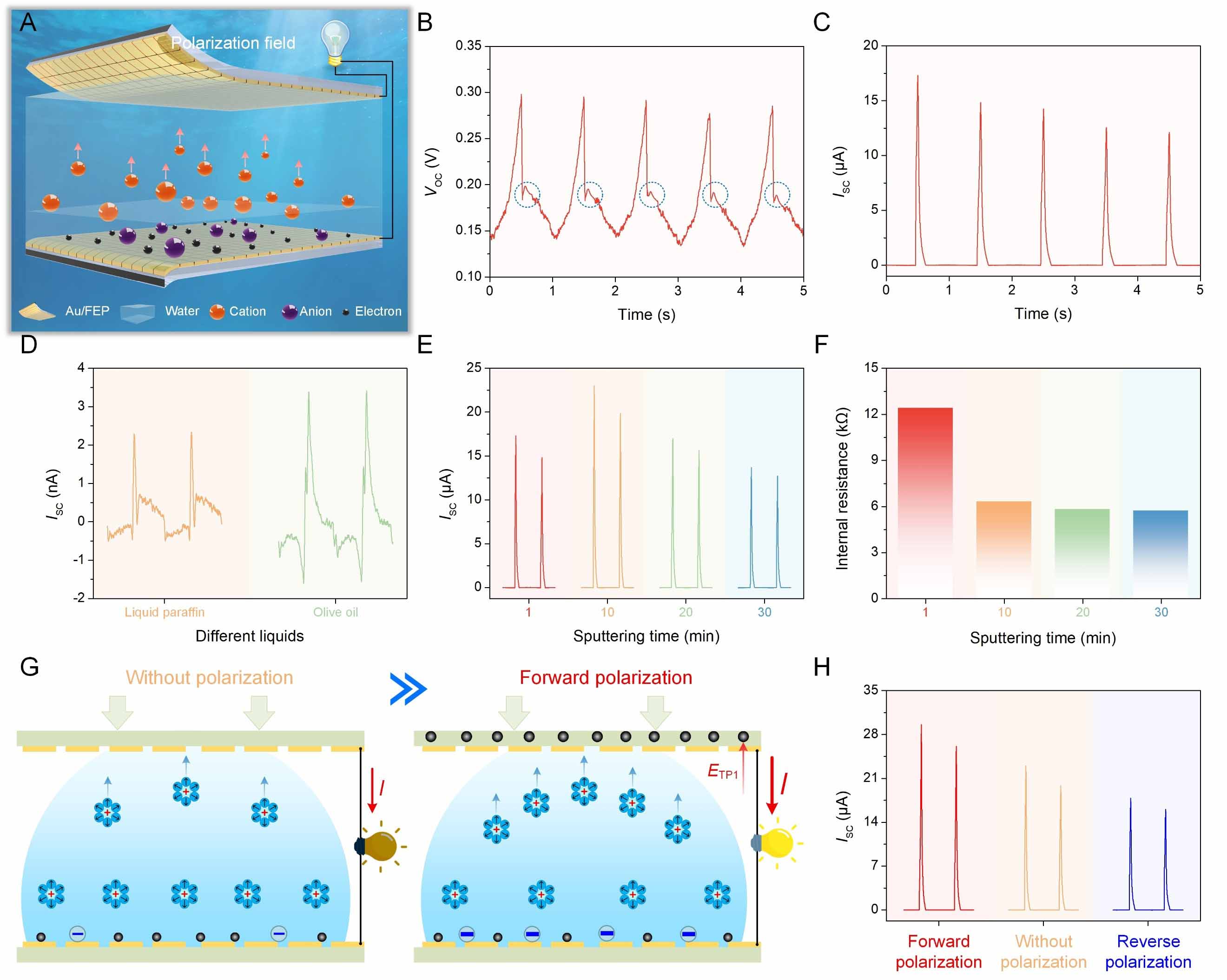
Figure 3. Dynamic regulation of TING performance via triboelectrically induced ion polarization. (A) Schematic illustration of the TING working mechanism based on directional ionic migration driven by ionic concentration gradients between dynamically coupled asymmetric EDLs; (B and C) VOC and ISC generated by the TING constructed using Au/FEP hybrid films with an Au sputtering time of 1 min; (D) Electrical output of the TING after replacing the aqueous phase with ion-free insulating liquids, demonstrating the dominant role of ionic migration in device operation; (E) Influence of Au sputtering time in Au/FEP hybrid films on the ISC generated by the TING; (F) Influence of Au sputtering time in metal/dielectric hybrid materials on the internal resistance of the TING; (G) Schematic illustration of the forward triboelectrically induced ion polarization mechanism for enhancing ionic migration and ionic-electronic coupling within the TING; (H) Influence of forward and reverse triboelectrically induced ion polarization on the ISC generated by the TING, respectively. FEP: Fluorinated ethylene propylene; ETP: electrostatic polarization field; TING: triboiontronic nanogenerator; EDL: electrical double layer; ISC: short-circuit current.

