

fig3
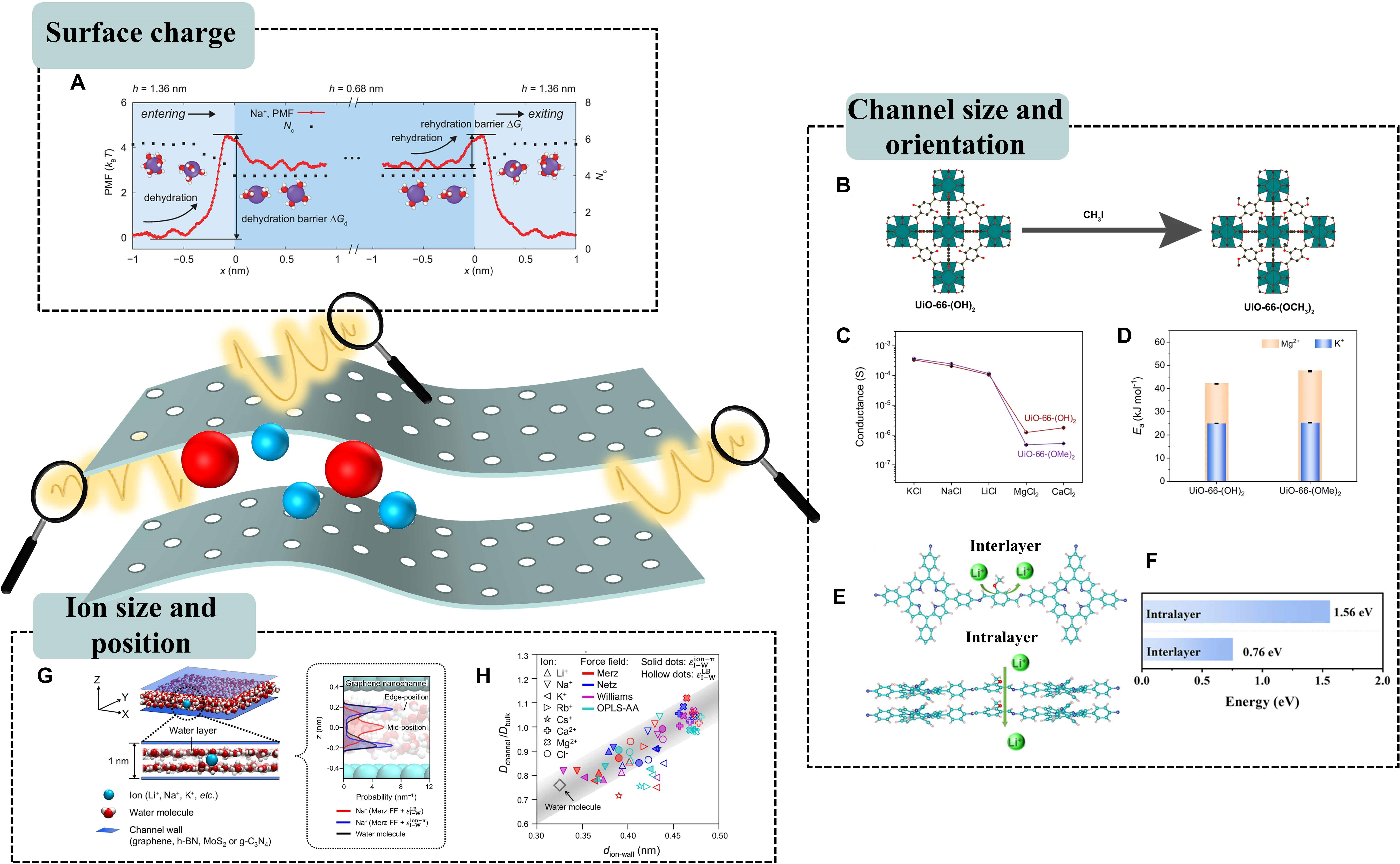
Figure 3. Ion transport mechanism in bionic nanofluidic channel. (A) Potential of mean force (PMF) and hydration number (Nc) for Na+ entering/exiting a nanochannel. (A) Ref.[67] Copyright © 2020 American Chemical Society; (B) Structures of UiO-66-(OH)2 and UiO-66-(OCH3)2; (C) Ionic conductance of UiO-66-(OH)2 and UiO-66-(OCH3)2 membranes in 100 mM electrolyte solutions; (D) Activation energies governing K+/Mg2+ transport across UiO-66-(OH)2 and UiO-66-(OMe)2 frameworks. (B-D) Ref.[81] Copyright © 2024, The Author(s); Schematic Li+ migration along (E) parallel and vertical pathways with (F) corresponding energy barriers. (E and F) Ref.[85] Copyright © 2025 Wiley-VCH GmbH; (G) Simulation of hydrated ions in 2D nanofluidic channels; (H) The simulation of Dchannel/Dbulk with dion-wall for various ions and force fields. (G and H) Ref.[93] Copyright © 2025, The Author(s). FF: Force fields; OPLS: optimized potentials for liquid simulations; AA: all-atom BN:boron nitride; Dchannel/Dbulk: the ion self-diffusivity ratio of 2D nanochannels to bulk water; dion-wall: the distance of ion-wall.