

fig3
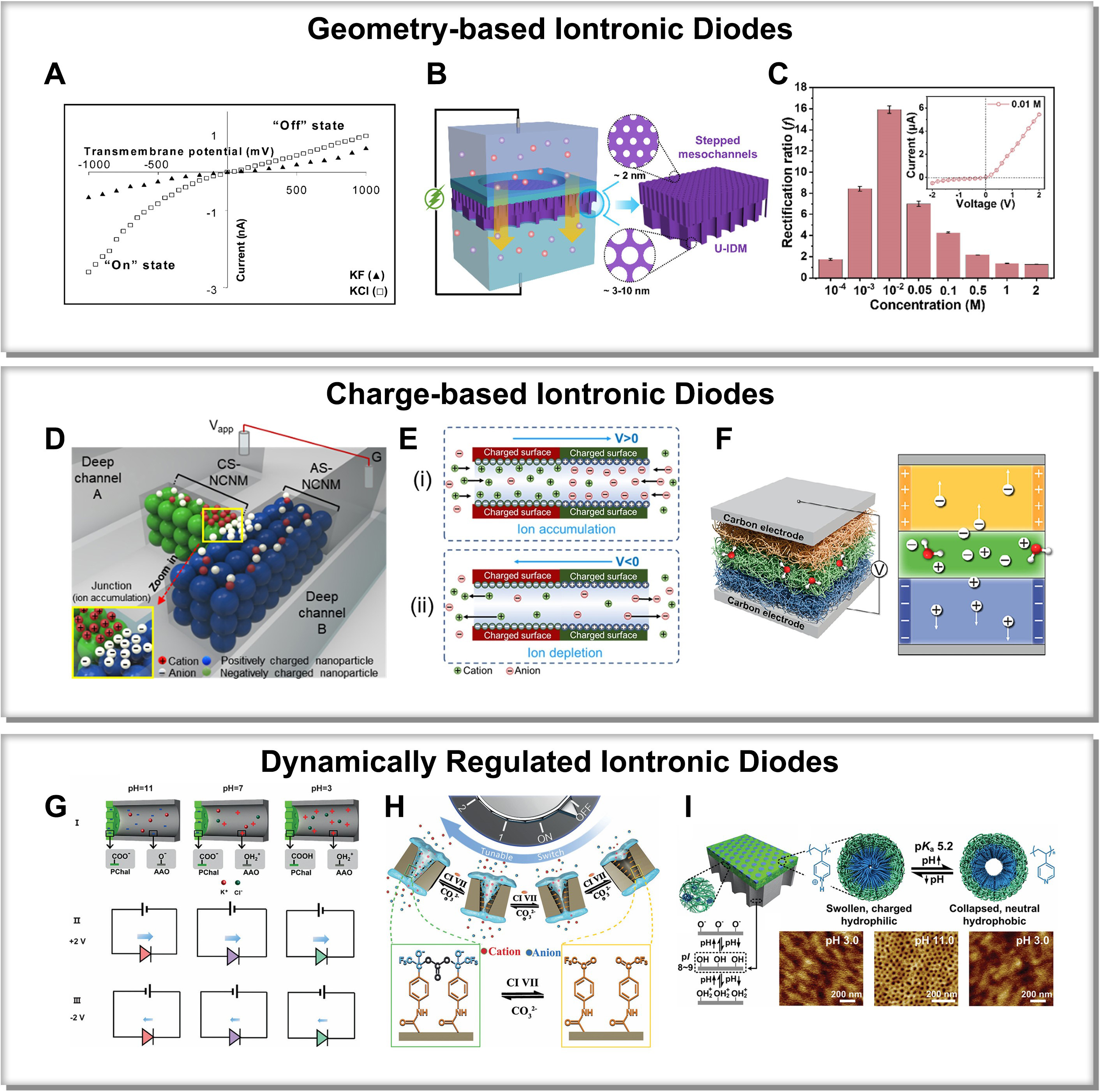
Figure 3. Iontronic diodes based on nanoconfined materials. (A) A geometry-based iontronic diode in a conical Au nanotube exhibits rectification in KCl but ohmic transport in KF. This figure is quoted with permission from American Chemical Society[52]; (B) A unipolar iontronic diode membrane is enabled by stepped mesochannels. This figure is quoted with permission from American Chemical Society[54]; (C) Rectification ratios of the U-IDM at different KCl concentrations are shown. The inset displays the I-V curve in 0.01 M KCl. This figure is quoted with permission from American Chemical Society[54]; (D) A charge-based bipolar iontronic diode is constructed from oppositely charged nanochannel networks. This figure is quoted with permission from the American Chemical Society[55]; (E) A MXene-based p-n iontronic diode operates through bias-dependent ion accumulation and depletion. This figure is quoted with permission from Wiley-VCH GmbH[49]; (F) A trilayer p-i-n nanofluidic diode enables ion-selective transport, moisture-enabled energy harvesting, and ionic logic. This figure is quoted with permission from Wiley-VCH GmbH[56]; (G) A dual amphoteric nanochannel diode maintains a stable rectification direction over a wide pH range. This figure is quoted with permission from Wiley-VCH GmbH[16]; (H) A carbonate-activated nanofluidic diode enables reversible switching between rectification and gating states. This figure is quoted with permission from Wiley-VCH GmbH[17]; (I) A heterogeneous membrane enables pH-responsive rectification and selective anion/cation gating. This figure is quoted with permission from Wiley-VCH GmbH[47]. U-IDM: unipolar iontronic diode membrane; MXene: Ti3C2Tx; p-n: positive-negative charge junction; p-i-n: positive-intrinsic-negative; PAA: porous anodic alumina. NCNM: nanochannel network membrane.