

fig6
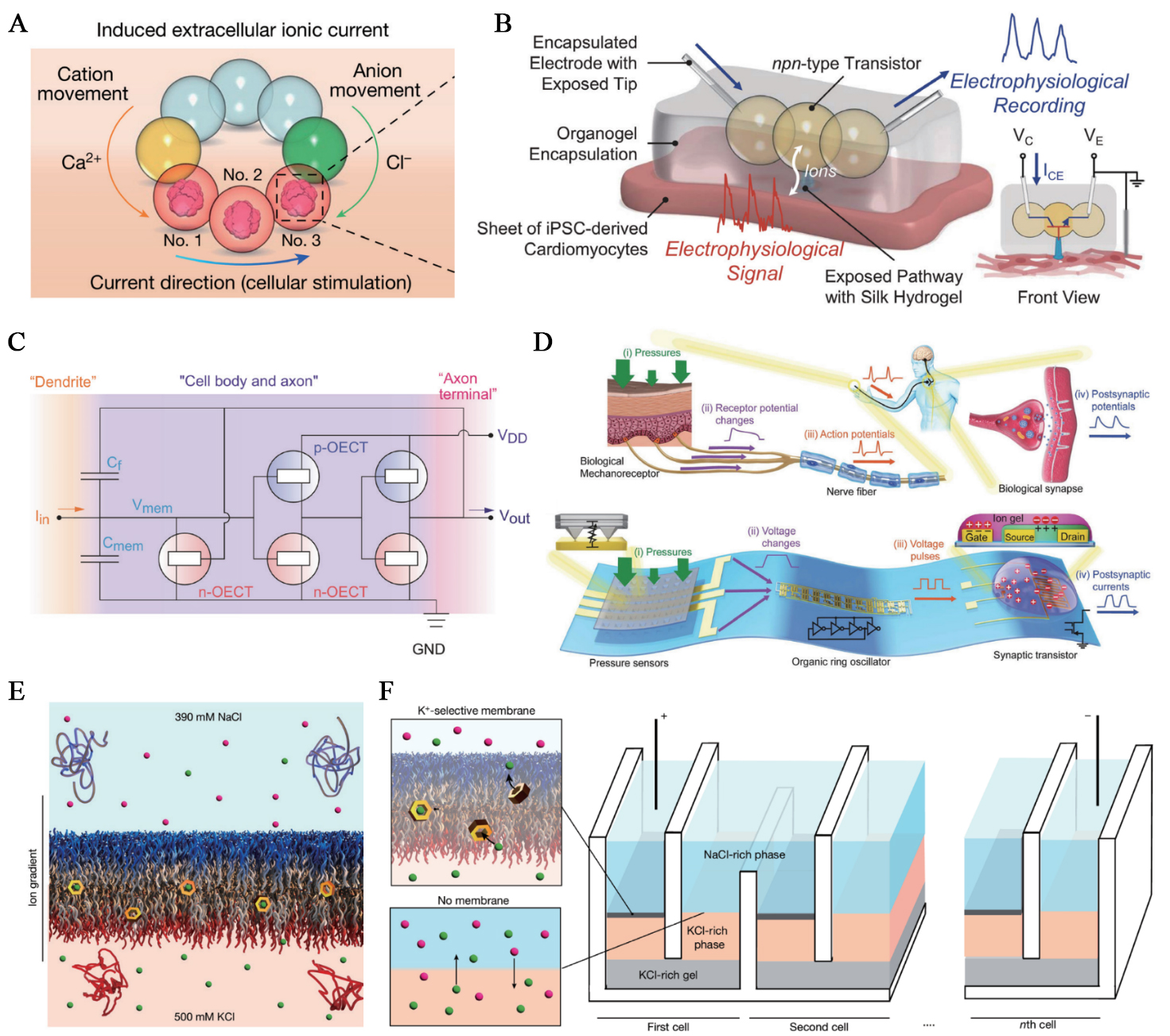
Figure 6. Bioinspired bioiontronics. (A) Dropletronic power source for the modulation of neuronal activities. This figure is quoted with permission from Zhang et al.[27]; (B) Organogel-encapsulated npn-type dropletronic transistor interfaced with living cardiac tissue for ionic signal recording. This figure is quoted with permission from Zhang et al.[29]; (C) The OECN based on Axon Hillock circuit. This figure is quoted with permission from Harikesh et al.[111]; (D) Bioinspired artificial afferent nerve: top, biological tactile pathway with mechanoreceptors, spike initiation, and synaptic relay; bottom, flexible organic counterpart integrating pressure-sensor arrays, an organic ring oscillator that encodes pressure into spike frequency, and a synaptic transistor that sums inputs. This figure is quoted with permission from Kim et al.[112]; (E) Valinomycin-doped block-copolymer bilayer shuttles K⁺ across the membrane under a NaCl/KCl gradient, producing an ionic output power. This figure is quoted with permission from Sproncken et al.[113]; (F) A bioinspired power unit comprising serial stacks of ion-selective membranes and conductive bridges; each cell contributes an incremental potential, so total voltage scales with the number of cells. This figure is quoted with permission from Sproncken et al.[113]. VC: Collector voltage; VE: emitter voltage; ICE: collector-emitter anion transport; OECT: organic electrochemical transistor; VDD: drain voltage; OECN: organic electrochemical neuron.