

fig3
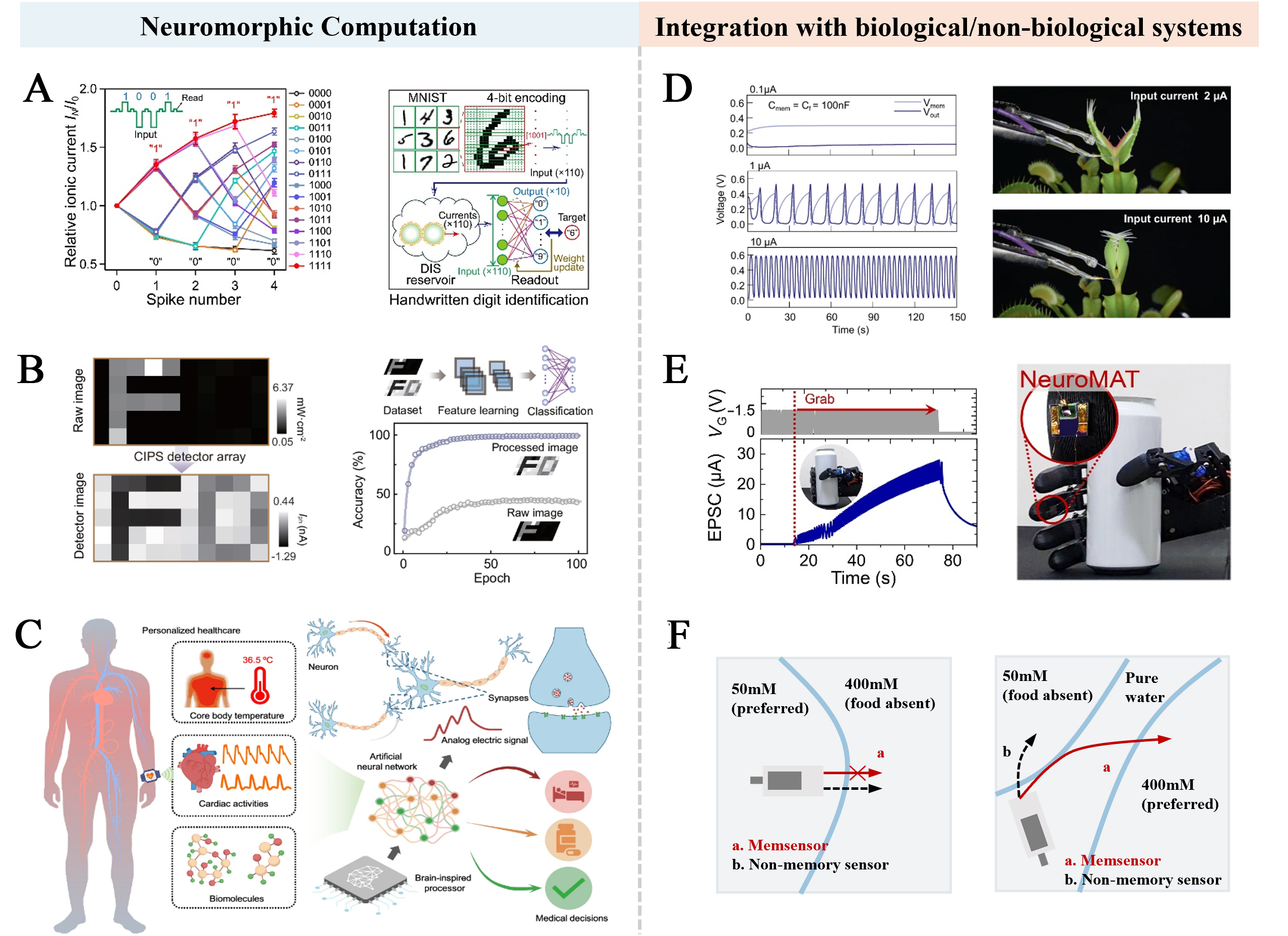
Figure 3. Applications of artificial neurons in neuromorphic computation and biological/non-biological interfaces. (A) Handwritten digit identification. Reproduced with permission from ref.[34]. Copyright 2025, The American Association for the Advancement of Science under CC BY 4.0 license http://creativecommons.org/licenses/by/4.0/; (B) Optical neuromorphic computing for high recognition accuracy of image processing. Reproduced with permission from ref.[35]. Copyright 2025, Springer Nature under CC BY 4.0 license http://creativecommons.org/licenses/by/4.0/; (C) Schematic illustrations of the wearable CSPINS, designed to collect, process, and analyze multimodal physicochemical data for real-time medical decision-making. Reproduced with permission from ref.[36]. Copyright 2025, Springer Nature under CC BY 4.0 license http://creativecommons.org/licenses/by/4.0/; (D) Modulation of Venus flytrap using the artificial neuron in different spiking patterns. Reproduced with permission from ref.[37]. Copyright 2022, Springer Nature under CC BY 4.0 license http://creativecommons.org/licenses/by/4.0/; (E) Programming process of pressure required by artificial tactile neuron integrated robotic hand to grip target object. Reproduced with permission from ref.[39]. Copyright 2023, The American Association for the Advancement of Science under CC BY 4.0 license http://creativecommons.org/licenses/by/4.0/; (F) Steering control of the miniature boat via chemical environment monitoring with memsensors[40]. MNIST: Modified National Institute of Standards and Technology; DIS: droplet interface synapses; CIPS: CuInP2S6; EPSC: excitatory postsynaptic current.