

fig3
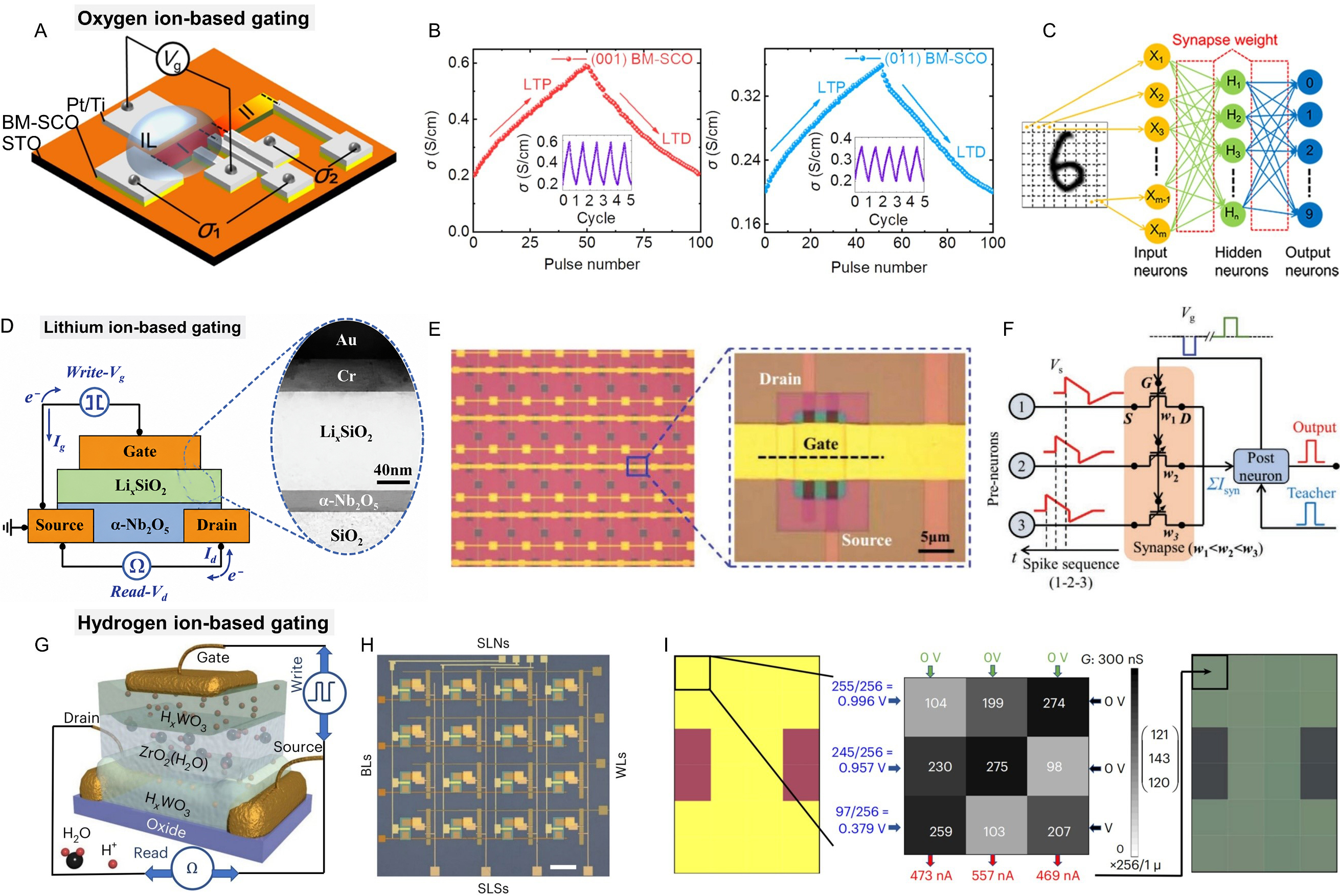
Figure 3. Examples of oxide-based electrochemical EGTs for neuromorphic computing. (A-C) Oxygen-ion-based gating in SrxCoO3, including the device schematic (A), long-term potentiation and long-term depression (B), and ANN for image recognition (C). Reprinted with permission. Copyright 2023, WILEY-VCH[33]; (D-F) Lithium-ion-based gating in Nb2O5: device schematic (D), EGT arrays (E), and a simple 3 × 1 SNN (F). Reprinted with permission. Copyright 2020, WILEY-VCH[38]; (G-I) Hydrogen ion-based gating in HxWO3, showing a device schematic (G), device arrays (H), and the color transformation of a letter “I” by the arrays (I). Reprinted with permission. Copyright 2023, Springer Nature[43]. BM-SCO: brownmillerite SrCoO2.5; STO: SrTiO3; LTP: long-term potentiation; LTD: long-term depression; BL: bit line; SLN: source line for weight update; WL: word line; SLS: source line for weight sum; EGT: electrolyte-gated transistor; ANN: artificial neural network; SNN: spiking neural network.