

fig2
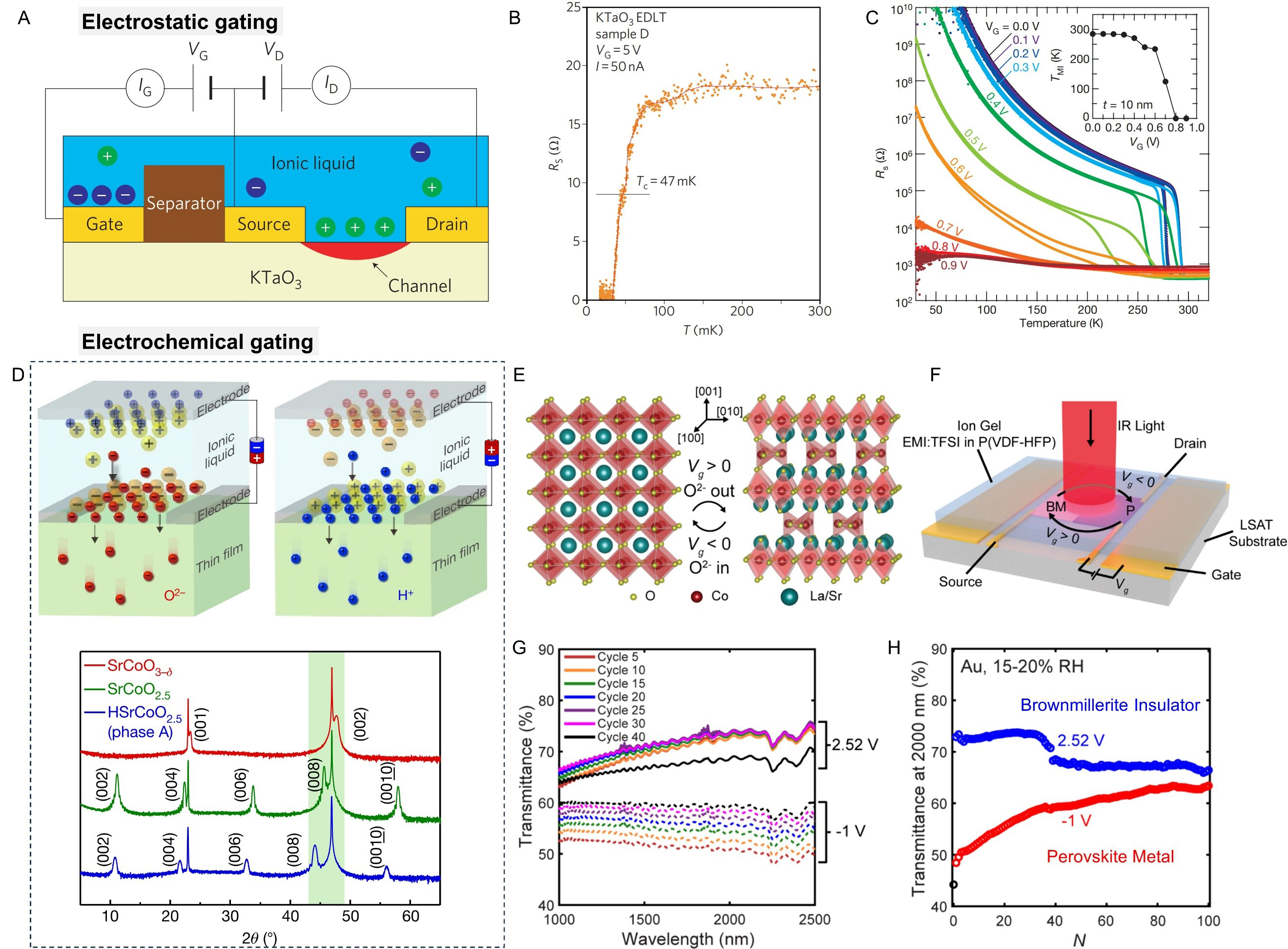
Figure 2. Examples of the electrostatic and electrochemical gating of oxides. (A and B) Ionic-liquid-gated KTaO3 device designed to achieve superconductivity. Reprinted with permission. Copyright 2011, Springer Nature[6]; (C) Electrostatic-gating-induced insulator-metal transition in VO2. Reprinted with permission. Copyright 2012, Springer Nature[8]; (D) Electrochemical-gating-induced phase transitions between SrCoO3, SrCoO2.5, and HSrCoO2.5, as indicated by the peak shift in the X-ray diffraction results. Reprinted with permission. Copyright 2017, Springer Nature[12]; (E-H) Gated phase transitions between La0.5Sr0.5CoO3 and La0.5Sr0.5CoO2.5, including the structural schematic (E), in situ Fourier transform infrared spectroscopy setup (F), repeating cycles of phase transitions (G), and ON/OFF ratios of the transmittance (H). Reprinted with permission. Copyright 2025, ACS[16]. EDLT: electric double-layer transistor; EMI:TFSI: 1-ethyl-3-methylimidazolium bis(trifluoromethylsulfonyl)amide; P(VDF-HEP): poly(vinylidene fluoride-co-hexafluoropropylene); IR: infrared; RH: relative humidity.