

fig1
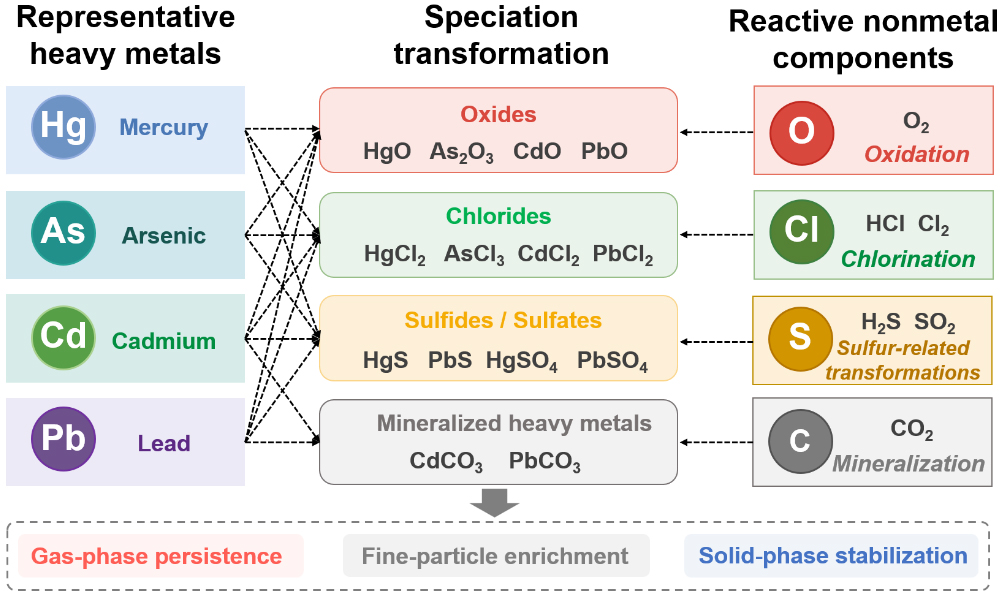
Figure 1. Interaction network between heavy metals and reactive nonmetal components in flue gas. The figure illustrates representative components and processes; additional effects of H2O and NOx are discussed in Section Interactions between heavy metals and reactive flue-gas components. Representative metals including Hg, As, Cd, and Pb interact with O-, Cl-, S-, and C-containing components to form oxides, chlorides, sulfides, sulfates, and particle-associated species. O2 promotes oxidation; HCl, Cl2, and Cl-containing species drive chlorination; SO2 in oxidizing gas contributes to surface sulfation and sulfate formation, whereas H2S and other reduced sulfur sources can drive sulfide formation at sufficiently low oxygen potential; and CO2 contributes indirectly through mineralization and carbonate-related capture. These transformations determine three major fates: gas-phase persistence, fine-particle enrichment, and solid-phase stabilization.

