

fig6
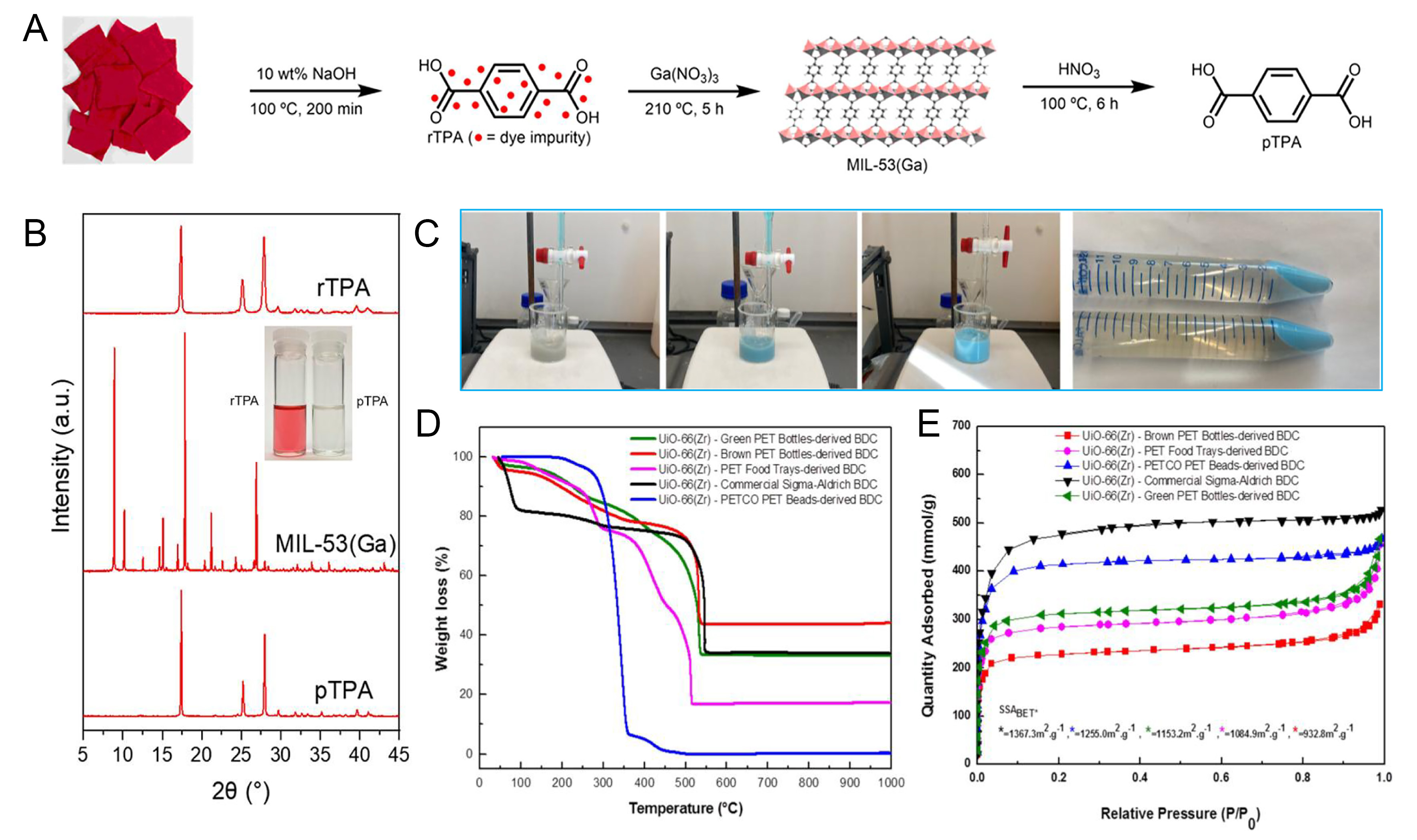
Figure 6. (A) Schematic illustration of the steps used to recover TPA from complex PET-rich waste. rTPA and pTPA denote recycled terephthalic acid and purified terephthalic acid, respectively; (B) Powder X-ray diffraction patterns of rTPA recovered from a red mixed PET/non-PET feedstock, MIL-53(Ga) synthesized from rTPA, and pTPA obtained from MOF disassembly. Inset: photographs of rTPA and pTPA in DMSO. (A and B) are adapted with permission from reference[192]. Copyright 2023, American Chemical Society; (C) Photographs of the room-temperature synthesis of CuBDC MOFs using Na2BDC obtained from depolymerized blue-dye polyester. (C) is adapted with permission from reference[132]. Copyright 2023, American Chemical Society; (D) Thermogravimetric analysis curves and (E) N2 sorption isotherms of UiO-66(Zr) samples prepared from different BDC sources. (D and E) are adapted with permission from reference[34]. Copyright 2019, American Chemical Society. TPA: Terephthalic acid; rTPA: recycled TPA; pTPA: purified TPA; PET: polyethylene terephthalate; MOFs: metal-organic frameworks; DMSO: dimethyl sulfoxide.