

fig1
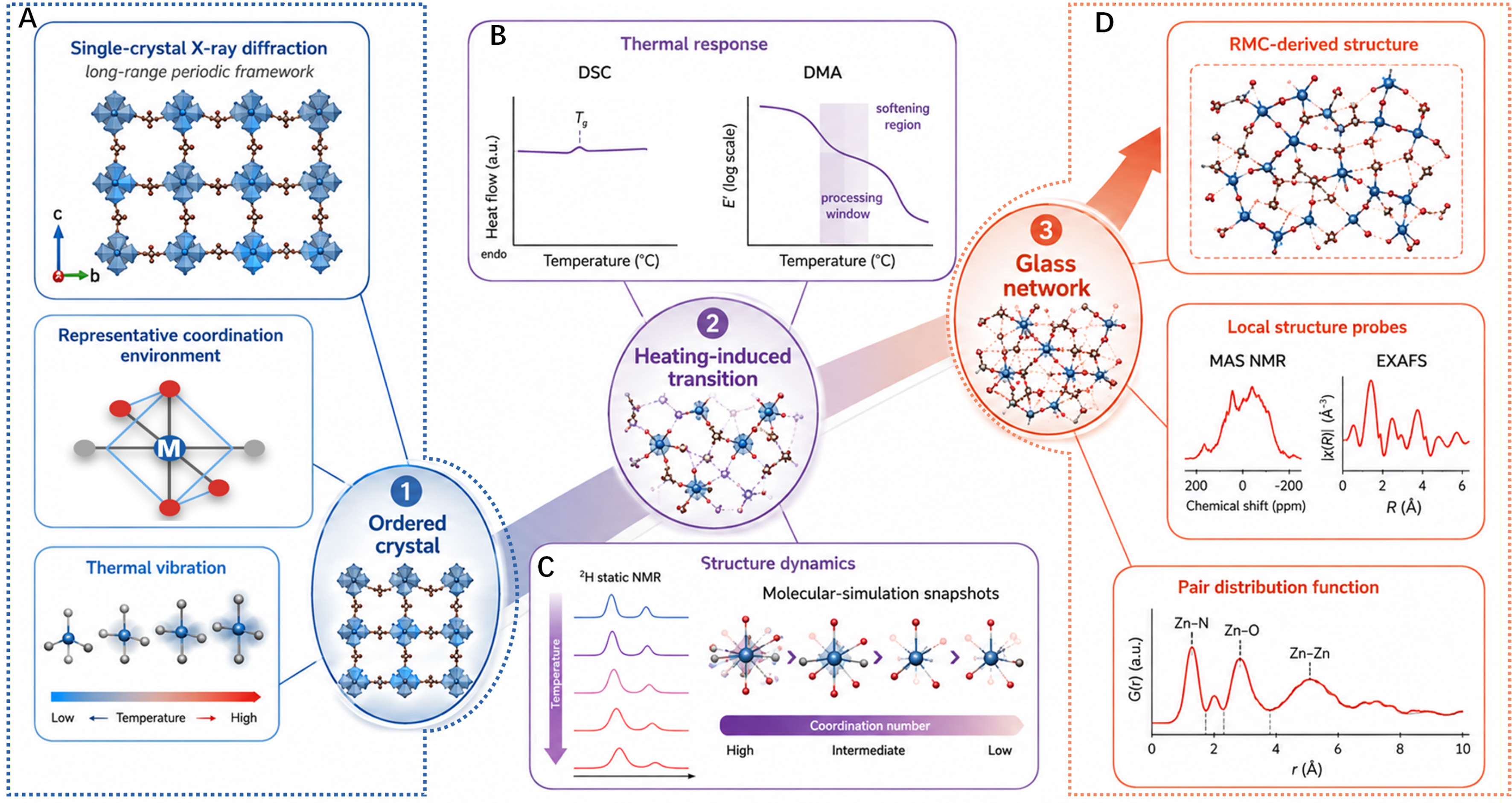
Figure 1. Selected characterizations of structures and phase transitions in MOFs. (A) Single-crystal XRD can determine the crystal structure, where mean atomic displacement retrieved from variable temperature measurements helps clarify the melting mechanism through Lindemann’s rule; (B) Frequency-dependent dynamic mechanical analysis and DSC are used to determine thermal behavior, such as Tg; (C) Variable-temperature solid-state NMR and molecular simulation are examples of characterization methods that provide insight into structural dynamics; (D) RMC can provide atomistic modeling of the glass structure through the fitting of experimental data from PDF, EXAFS, and MAS NMR. DSC: Differential scanning calorimetry; DMA: dynamic mechanical analysis; MAS NMR: magic-angle spinning nuclear magnetic resonance; EXAFS: extended X-ray absorption fine structure; MOFs: metal-organic frameworks; XRD: X-ray diffraction; Tg: glass transition temperature; RMC: reverse Monte Carlo; PDF: pair distribution function.

