

fig1
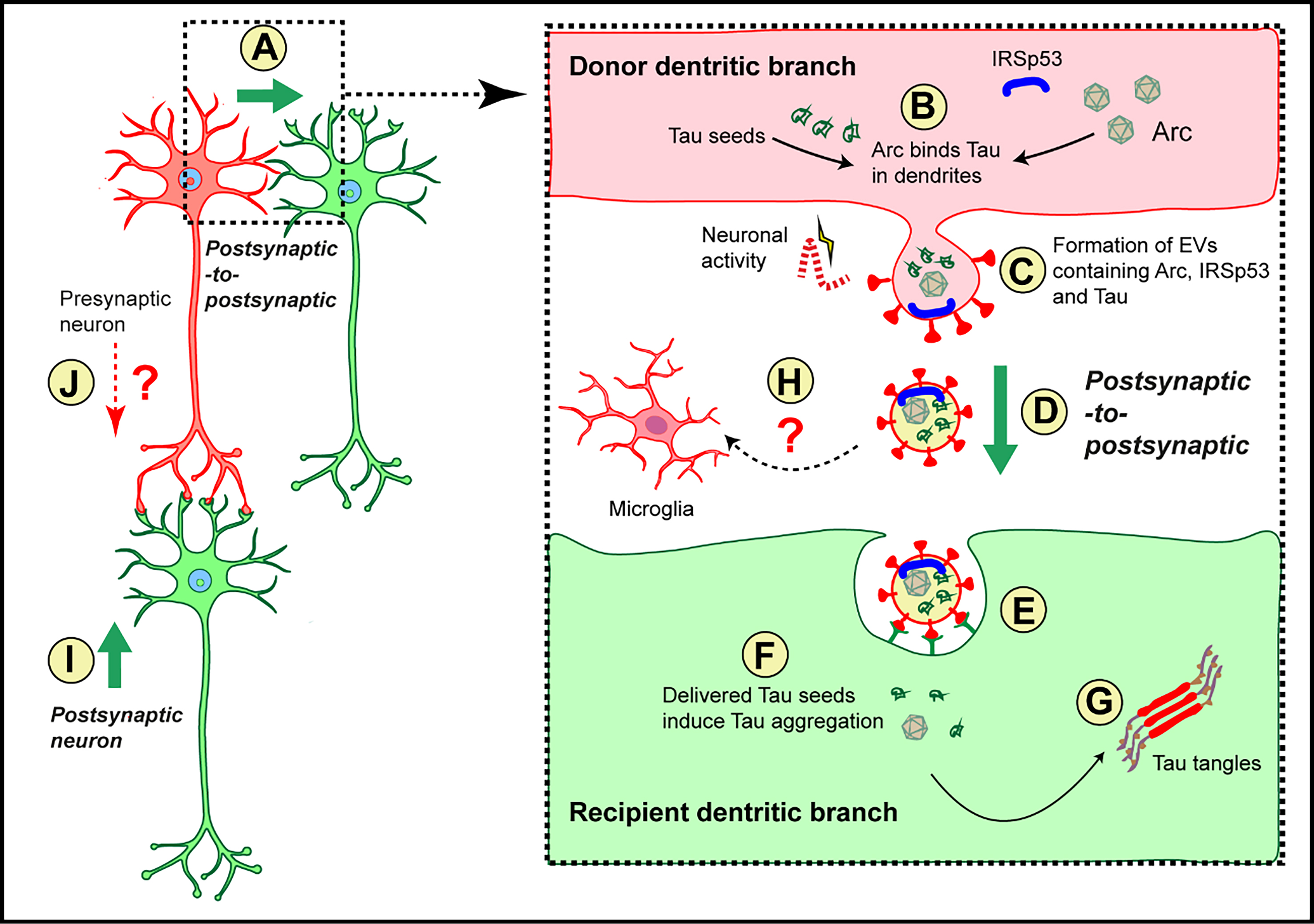
Figure 1. Potential model of Arc-facilitated Tau packaging into EVs and their propagation in the initiation of Tau pathology. (A) The model of dendrite-to-dendrite (postsynaptic-to-postsynaptic) transmission of EVs containing Tau. This mode of transmission is illustrated in greater detail in the right panel; (B) Under pathological conditions, Tau becomes enriched in dendrites, where it interacts with Arc, a protein that is predominantly localized in this compartment[12]; (C) In dendrites, neuronal activity can potentiate the interaction between Arc and IRSp53 with the plasma membrane within actin-rich extrasynaptic microdomains, promoting the formation of EVs that bud from the cell surface[13]; (D) Tau-containing EVs are released and transferred to neighboring dendrites, thereby enabling postsynaptic-to-postsynaptic transmission; (E) These Arc-IRSp53 EVs are subsequently internalized by dendrites of neighboring neurons; (F) Following internalization, Tau and Arc should be delivered to the cytosol; (G) Tau seeds then template the conversion of endogenous soluble Tau into oligomeric species and, ultimately, into fibrillar Tau aggregates characteristic of Tau pathology[20]; (H) Potential uptake of Arc-IRSp53-Tau-containing EVs by microglia (dotted arrow) may further promote Tau propagation and disease progression, consistent with the established EV-mediated role of microglia in driving tauopathy progression in other mouse models[21]; (I) An alternative model of EV-mediated Tau transmission from dendrites to axons (postsynaptic-to-presynaptic) is also depicted; (J) Because Arc can also be released in small EVs generated via the classical exosome pathway involving multivesicular bodies[19], axon-to-dendrite (presynaptic-to-postsynaptic) transmission cannot be ruled out. EVs: Extracellular vesicles; IRSp53: insulin receptor substrate protein of 53 kDa; Arc: activity-regulated cytoskeleton-associated protein.