

fig4
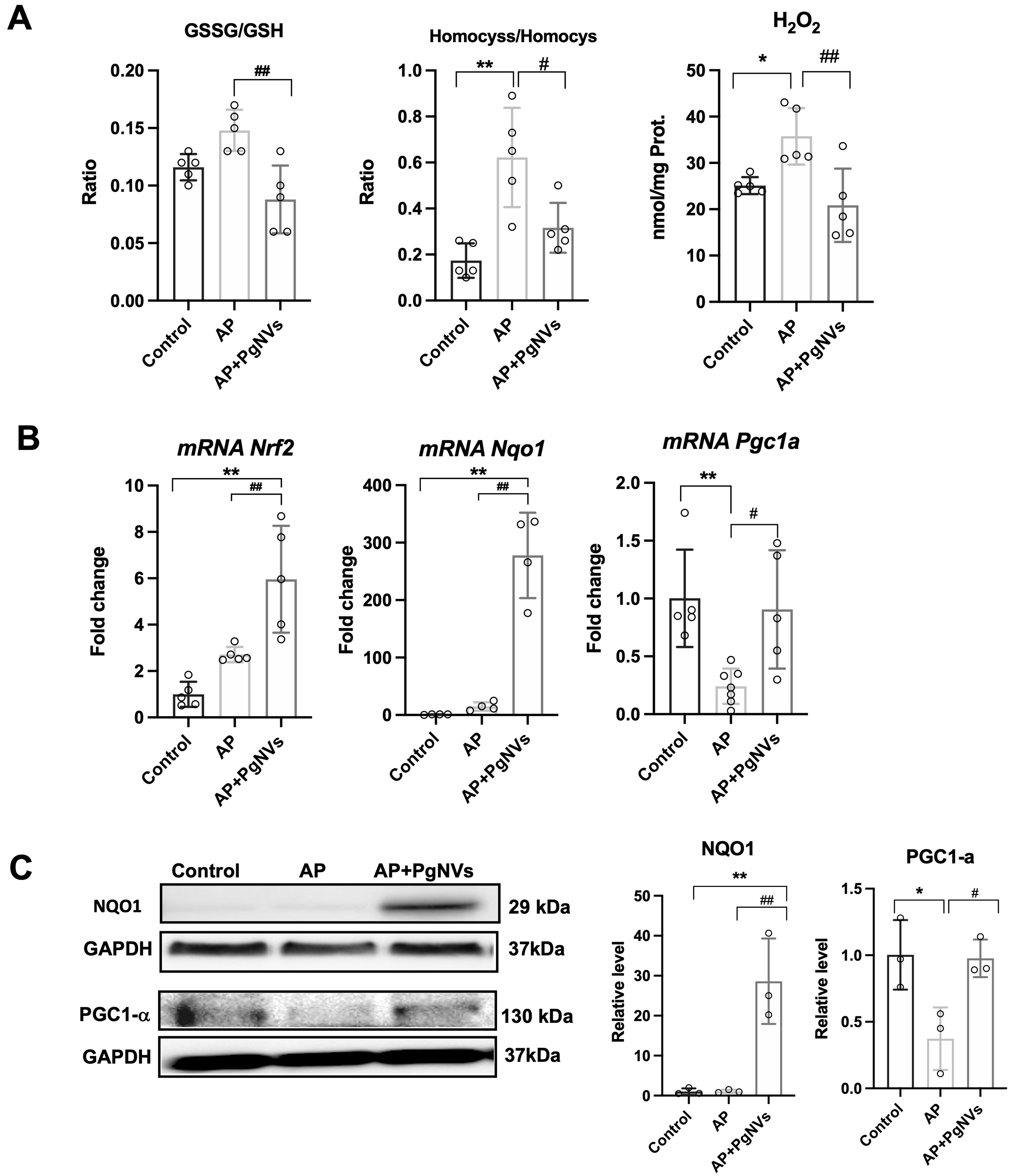
Figure 4. PgNVs treatment enhances antioxidant defense in acute pancreatitis. (A) Ratio of GSSG/GSH, ratio of Homocystine/Homocysteine, and hydrogen peroxide levels in pancreas of mice after 3 days in control, AP, and AP + PgNVs groups (n = 5); (B) Relative mRNA levels of Nrf2, Nqo1 and Pgc-1α in pancreas from mice after 3-days of pancreatitis in control, AP, and AP + PgNVs groups. Expression was determined by RT-qPCR analysis, using Tbp as housekeeping gene (n = 5); (C) Representative western blot of NQO1 and PGC-1α and densitometry, using GAPDH as a loading control (n = 3). Measurements expressed as mean ± SD. *Significantly different from control group, P < 0.05; **significantly different from control group, P < 0.01; #significantly different from AP group, P < 0.05; ##significantly different from AP group, P < 0.01. AP: Acute pancreatitis; PgNVs: pomegranate-derived nanovesicles; GSSG: oxidized glutathione; GSH: reduced glutathione; mRNA: messenger RNA; Nrf2: nuclear factor erythroid 2-related factor 2; Nqo1: NAD(P)H quinone dehydrogenase 1 (NQO1); Pgc-1α: peroxisome proliferator-activated receptor gamma coactivator 1 alpha (PGC-1α); RT-qPCR: reverse transcription-quantitative polymerase chain reaction; Tbp: TATA-box binding protein; GAPDH: glyceraldehyde-3-phosphate dehydrogenase; SD: standard deviation.