

Mesoscale regulation of ordered membrane electrode assemblies for hydrogen-electric energy interconversion systems
 0

Graphical Abstract
Abstract
Hydrogen-electric energy interconversion systems represented by proton exchange membrane fuel cells and PEM water electrolyzers are key technologies for clean energy conversion. However, their widespread commercialization is hindered by challenges such as high cost and limited durability, largely attributed to inefficient catalyst utilization and multiphase transport limitations in conventional membrane electrode assemblies (MEAs). In recent years, ordered MEAs have emerged as a promising strategy to rationally structure the catalyst layer (CL), proton exchange membrane, and gas diffusion layer (GDL) at the mesoscale, thereby enabling ordered pathways for proton, electron, gas, and water transport. This paper reviews the design and regulation strategies of ordered membrane electrodes from the mesoscale perspective, focusing on the ordered structures of the CL, PEM, GDL and their effects on cell performance. The optimization of the reaction interface, the construction of long-range ordered proton transport channels and the design of hierarchical porous GDLs have resulted in significant advancements in the field. The paper concludes with a discussion of the current challenges in research and offers a perspective on future directions, including scale-up preparation, long-term stability assessment and multi-scale coupling mechanism research.
Keywords


 Download PDF
INTRODUCTION
Amid global carbon emission reduction initiatives, hydrogen energy systems have emerged as highly promising alternatives to fossil fuels[1-3]. At the core of hydrogen technologies lie fuel cells and water electrolyzers, among which proton exchange membrane (PEM) hydrogen-electric interconversion systems - including PEM fuel cells (PEMFCs) and PEM water electrolyzers (PEMWEs) now play a pivotal role in the national energy strategies of countries worldwide[4-6]. Leading countries including Japan, the United States, and China have set targets to increase the power density of fuel cell stacks; notably, Japan aims for 9 kW/L by 2040, nearly triple the current maximum of 3.1 kW/L[7]. Nevertheless, the widespread commercialization of hydrogen-electric energy conversion systems is currently impeded by two critical challenges: exorbitant manufacturing costs and limited operational lifespan[8-10]. The membrane electrode assembly (MEA) serves as the core of PEM hydrogen-electric energy conversion systems, with its sandwich structure functioning as the site for electrochemical reactions and mass transfer during energy conversion[11]. The MEA comprises a proton exchange membrane, anode/cathode gas diffusion layers (GDLs), and anode/cathode catalyst layers (CLs)[12,13]. Positioned between the cathode and anode, the PEM acts as an electrolyte, conducting protons while isolating reaction gases and electrons[14]. CLs are the centers of electrocatalytic reactions, largely determining PEM hydrogen-electric energy conversion system reaction efficiency and rate[15], whereas GDLs distribute reactant gases to CLs and remove excess water, ensuring stable electrochemical reactions[16-18]. At present, significant progress has been made in improving the performance of MEA components through morphological modification or compositional adjustment [Figure 1], with mature materials successfully implemented in industrial applications. However, integrating these materials into MEAs often results in substantial performance losses[19,20]. For instance, various oxygen reduction reaction (ORR) and oxygen evolution reaction (OER) catalyst materials, such as bimetallic and shape-controlled nanoparticles, have been developed, exhibiting record-breaking activity in rotating disk electrode (RDE) experiments, but underperforming in MEA measurements[21-23]. This discrepancy stems from the spatial multi-scale characteristics of MEAs: nanoscale catalysts and proton conductors, microscale CLs, tens-of-micrometers-scale GDLs, and centimeter-to-decimeter-scale porous electrodes. The efficiency of electrochemical catalysis relies on effective matching and coupling between material structures and reaction-transport response times across these scales - optimal reaction kinetics are only achieved when microscale active sites, mesoscale mass transfer channels, and macroscale structural integrity synergize[24,25]. Notably, the mesoscale, defined as an intermediate domain between the microscopic (unit scale) and macroscopic (system scale) dimensions[26-28], plays a pivotal bridging role. Unlike the nanoscale, which governs intrinsic catalytic activity through electronic structure and surface chemistry, or the macroscale, which determines system-level engineering constraints, the mesoscale regulates the spatial organization of transport pathways for electrons, protons, reactant gases, product water, and heat[29]. Specifically, for PEM hydrogen-electric energy conversion systems, the mesoscale encompasses structural features ranging from approximately 10 nm to 100 μm[30]. It is crucial to distinguish mesoscale regulation from nanoscale catalyst design: while the nanoscale governs intrinsic properties such as electronic structure, surface binding energies, and crystal facet activity through quantum mechanical effects, the mesoscale regulates extrinsic, collective phenomena including percolation transport, interfacial contact resistance, and multiphase flow dynamics[31]. For instance, the percolation threshold of proton conduction in the catalyst layer emerges only when ionomer domains achieve mesoscale connectivity[30], while the anisotropic gas diffusion in ordered GDLs arises from the collective alignment of fiber networks rather than individual fiber properties[32]. Furthermore, mesoscale structures critically influence interfacial chemistry: the CL/PEM interface determines proton transfer resistance and mechanical adhesion, while the CL/GDL interface governs electron contact resistance and two-phase mass transport[15]. Inheriting quantum mechanical properties from the microscale while retaining measurable, tunable dimensions linked to the macroscale, mesoscale structures regulate catalyst distribution, optimize proton/electron transfer paths, and mitigate mass transfer limitations - addressing the key challenge of coordinating multi-scale structural compatibility[12,27,33]. Thus, understanding mesoscale behavior between disparate structures and exploring MEA regulation and design from a mesoscale perspective offer a promising approach to overcome electrochemical system efficiency bottlenecks.
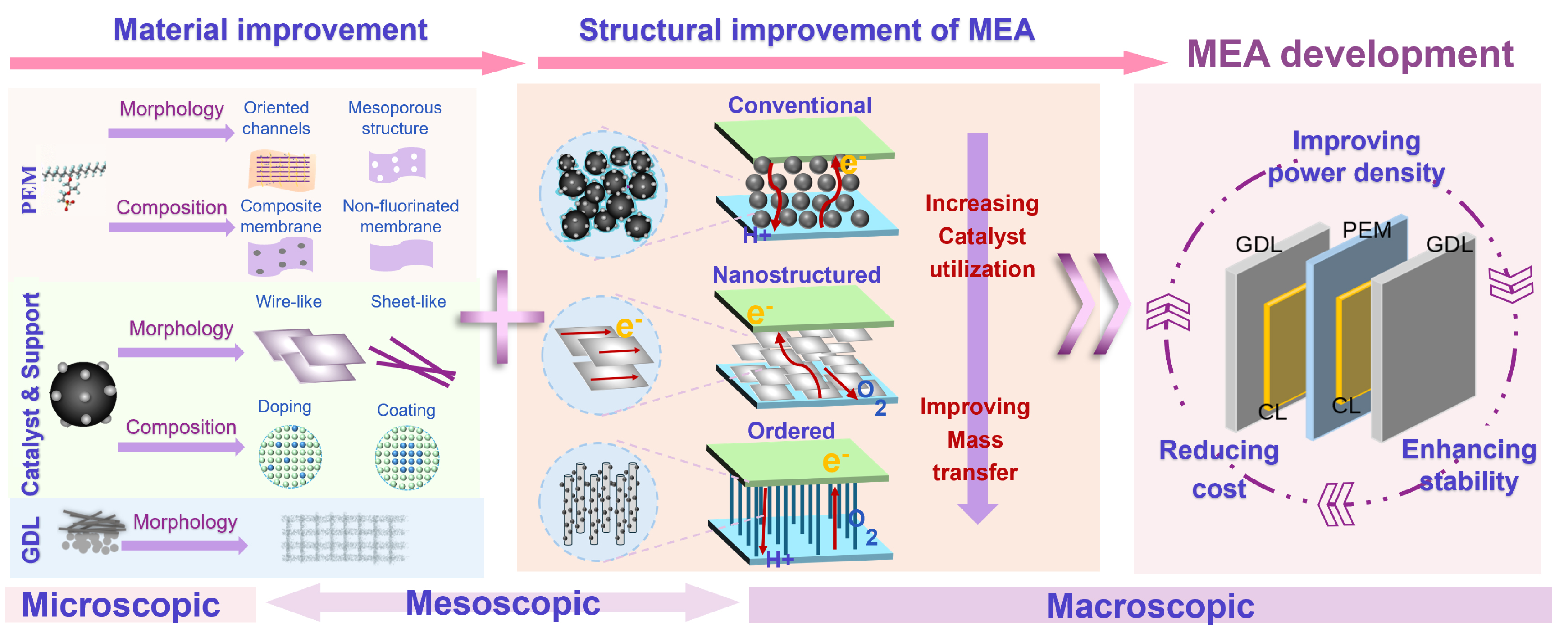
Figure 1. Trend of the development of MEA. PEM: Proton exchange membrane; MEA: membrane electrode assembly; GDL: gas diffusion layer.
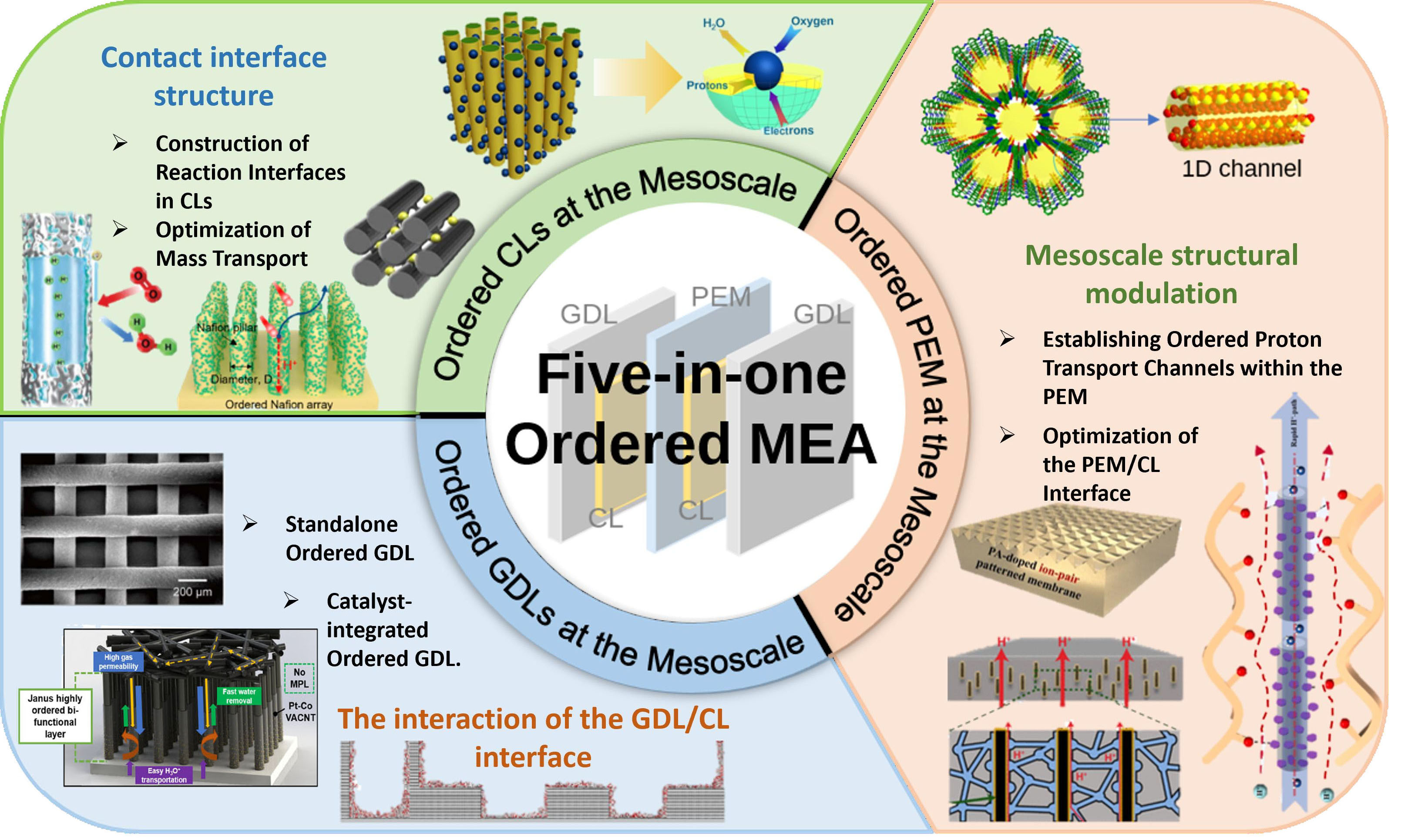
The MEA governs PEM hydrogen-electric energy conversion systems’ dynamic response and degradation rates[34], with catalyst materials and electrode fabrication processes accounting for over 50% of total fuel cell system costs[35]. Therefore, developing high-performance PEM hydrogen-electric energy conversion systems requires designing high-activity catalysts and stable MEA structures to extend lifespan and reduce costs. Traditional MEA preparation methods include catalyst-coated substrates (CCSs) and catalyst-coated membranes (CCMs). The CCS method, suitable for large-scale production, suffers from poor heterogeneous catalyst dispersion and inadequate mass transport[36,37], while CCM-MEAs exhibit superior electrochemical kinetics and reduced resistive losses[38]. However, CCM preparation via direct spraying or decal transfer faces challenges such as ink loss, membrane swelling, complex processes, and high costs[39]. Current MEA development struggles to balance ultralow Pt/Ir loading and high performance, primarily due to randomly distributed catalysts and disordered pore structures in conventional MEAs. Catalyst agglomeration reduces active site density and blocks proton/electron transport pathways, leading to low conductivity. Disordered pore sizes and tortuous channels impair mass transport and water removal, causing electrode corrosion and CL microstructural degradation[40,41]. To overcome the aforementioned limitations, MEA structures have undergone a revolutionary evolution from traditional disordered composites to mesoscopically ordered architectures[42]. and have gradually become an important means to achieve mesoscale regulation. Ordered MEAs are constructed with ordered structures within the MEA, including nano-array structures or other shapes of ordered structures. These ordered structures can provide ordered channels for proton, electron, and mass transport, reducing resistance, increasing active sites, improving performance at low precious metal loadings, and enhancing structural stability - prolonging cell lifespan[43-46]. Notably, existing reviews on ordered electrodes focus predominantly on CLs, with insufficient attention to PEMs and GDLs. Although PEMs (≈ 9%) and GDLs (≈ 3%) account for lower proportions of fuel cell stack costs compared to CLs[45], their significance is substantial. The membrane directly determines the fuel cell’s usability, lifespan, and performance, with failures posing safety hazards and resource waste, while GDLs critically influence mass transport. Moreover, the matched design of ordered CLs and GDLs optimizes mass transfer pathways and enhances interfacial structural compatibility, laying the foundation for overall ordered MEA performance improvement. Their impact on costs is more reflected in performance than in proportional cost contributions. This review focuses on the five-in-one ordered MEA, incorporating the ordered proton membrane, anode/cathode ordered CLs, and anode/cathode ordered GDLs. The design of these three MEA components is unified by the principle of creating abundant channels for electrons and mass transfer, despite being manufactured in divergent ways.
Herein, we focus on the regulation of the five-in-one ordered MEA from a mesoscale perspective, with a logical emphasis on the core components and their interconnections. Specifically, we elaborate on the optimization of reaction interfaces and mass transport within ordered catalyst layers, the mesoscale structural regulation of ordered PEM, and the controllable fabrication strategies for mesoscale structures in ordered GDLs - all of which are interconnected as key elements of mesoscale design that collectively determine MEA performance. Building on these component-level regulatory approaches, we further summarize integrated strategies for the overall design and regulation of ordered MEAs based on mesoscale principles. Additionally, we delve into the critical role of interfaces between MEA components in modulating fuel cell performance, as these interfaces serve as the link between individual mesoscale-structured components and directly influence the synergistic functionality of the entire MEA. This comprehensive analysis aims to inspire the development of efficient regulation and synthesis strategies for ordered MEAs. Finally, we propose targeted recommendations to address current challenges in mesoscale regulation and component synergy, with the goal of further advancing research and development in the field of MEA design for PEM hydrogen-electric energy conversion systems.
ORDERED CATALYST LAYERS AT THE MESOSCALE
In PEM hydrogen-electric energy conversion systems, the multi-level mesoscale from microscopic nanoparticles to macroscopic MEA can be attributed to catalyst particles and CL. This includes the phase distribution between catalyst particles and their supports and the interfacial structures between them, the contact interface structures between catalyst particles and ionomers, and the effect of inhomogeneous particle and ionomer structures on mass transport properties. Their disorder directly leads to mesoscale performance bottlenecks, while their ordered regulation is the key to mesoscale construction. Specifically, the random phase distribution of catalyst/support destroys the continuity of mesoscale electron transport channels; the disordered catalyst/ionomer interface fragments mesoscale proton transport pathways; and the inhomogeneity of particles/ionomers forms a tortuous, blocked mesoscale mass transport network. Constructing ordered CL structures based on mesoscale principles represents an effective approach to optimizing the probability density of active sites and enhancing energy conversion efficiency - essentially by reordering these three structural units to build continuous mesoscale electron/proton channels and unobstructed mass transport networks. The core principles guiding this construction are twofold: (a) engineering reaction interfaces within the CL to improve catalyst utilization, and (b) enhancing the transport capabilities of reaction gases and water while minimizing mass transfer resistance.
Construction of reaction interfaces in CLs
As the rate-limiting steps with sluggish kinetics, the ORR (at the cathode of PEMFCs) and OER (at the anode of PEMWEs) are the key factors determining the performance of PEMFCs and PEMWEs, respectively[47,48]. The ORR and OER occur at the three-phase boundary[49], which is defined as a catalyst-electrolyte interface where electrons, protons, and gases come into contact with each other. This interface involves a proton-conducting ionomer, an electron-conducting catalyst, and a gas-permeable pore structure. Figure 2 illustrates the mass transport processes in the cathode of PEMFCs and the anode of PEMWEs. Taking PEMFCs as an example, oxygen is first transported to the catalytically active sites, where it undergoes adsorption and activation. Anode-generated protons are transported to the active sites via the PEM, whereas electrons are conducted via the external circuit[50,51]. The construction of efficient triple-phase interface regions to improve the utilization of electrocatalysts has emerged as a viable strategy to reduce noble metal catalyst loading while maintaining cell performance[52,53].
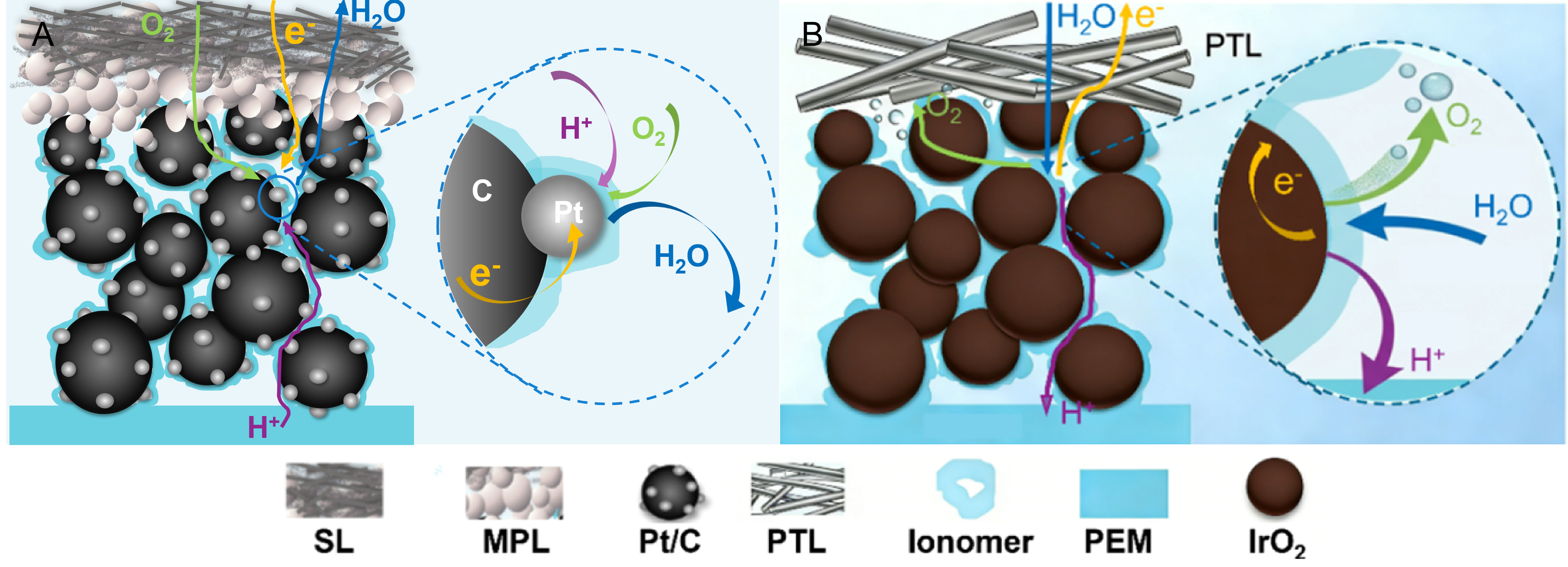
Figure 2. Mass transfer processes: (A) in the Pt-based cathode catalyst layer of PEMFCs; (B) in the Ir-based anode catalyst layer of PEMWEs. SL: Support layer; MPL: microporous layer; PTL: porous transport layer; PEM: proton exchange membrane; PEMFC: PEM fuel cell; PEMWE: PEM water electrolyzer.
In a typical catalyst layer, the ionomer completely covers the catalytic surface of the TPB[54]. During the reaction, protons are conducted via the vehicle mechanism and the Grotthuss mechanism[55]. To enhance proton conductivity, numerous researchers have attempted to modify the molecular structure[56] and composition[57] of the ionomer. However, due to the irregular distribution of catalyst particles in conventional CLs, proton transport pathways are inevitably disrupted, leading to the formation of inactive sites. Therefore, the optimization of the ionomer distribution and the construction of well-defined ionomer/catalyst particle interfaces are crucial. Ordered proton conductors can improve catalyst layer proton conductivity through fast, oriented transport channels. Ning et al.[58]. fabricated nanoscale Nafion arrays and subsequently deposited Pt nanoparticle catalysts by magnetron sputtering, resulting in a proton-ordered MEA [Figure 3A]. Its ultra-high specific surface area provides a large number of active sites for catalyst loading, while its well-ordered nanostructure forms abundant proton transport channels, effectively reducing the proton transport resistance of the catalyst. In the catalyst layer, the catalyst skeleton can form continuous electron transport channels[59]. However, some catalyst particles may be completely electronically isolated by the ionomer, resulting in the formation of “dead zones”[60]. During the disordered electron transport process, electrons encounter increased interfacial resistance and scattering effects, which leads to a rise in ohmic losses. In contrast, ordered electron channels can provide continuous and efficient electron conduction pathways, thereby significantly reducing electron transport losses. Tian et al.[59] used physical sputtering to deposit Pt particles on vertically aligned carbon nanotubes (VACNTs), creating a CL with an ordered electronic conductor array. The ACNTs form oriented, continuous channels within the electrode, extending from the proton exchange membrane to the gas diffusion layer, thereby precisely controlling the transport pathways of electrons, protons, and reactants at the mesoscale. This ordered structure eliminates the tortuous, random transport networks commonly found in traditional disordered catalyst layers, achieving synergistic optimization of the three-phase interface, charge conduction, and mass supply at the mesoscale. [Figure 3B and C]. Consequently, this electrode exhibits performance comparable to that of commercial electrodes with a platinum loading one order of magnitude higher even at a loading of only 35 μg cm-2 [Figure 3D].
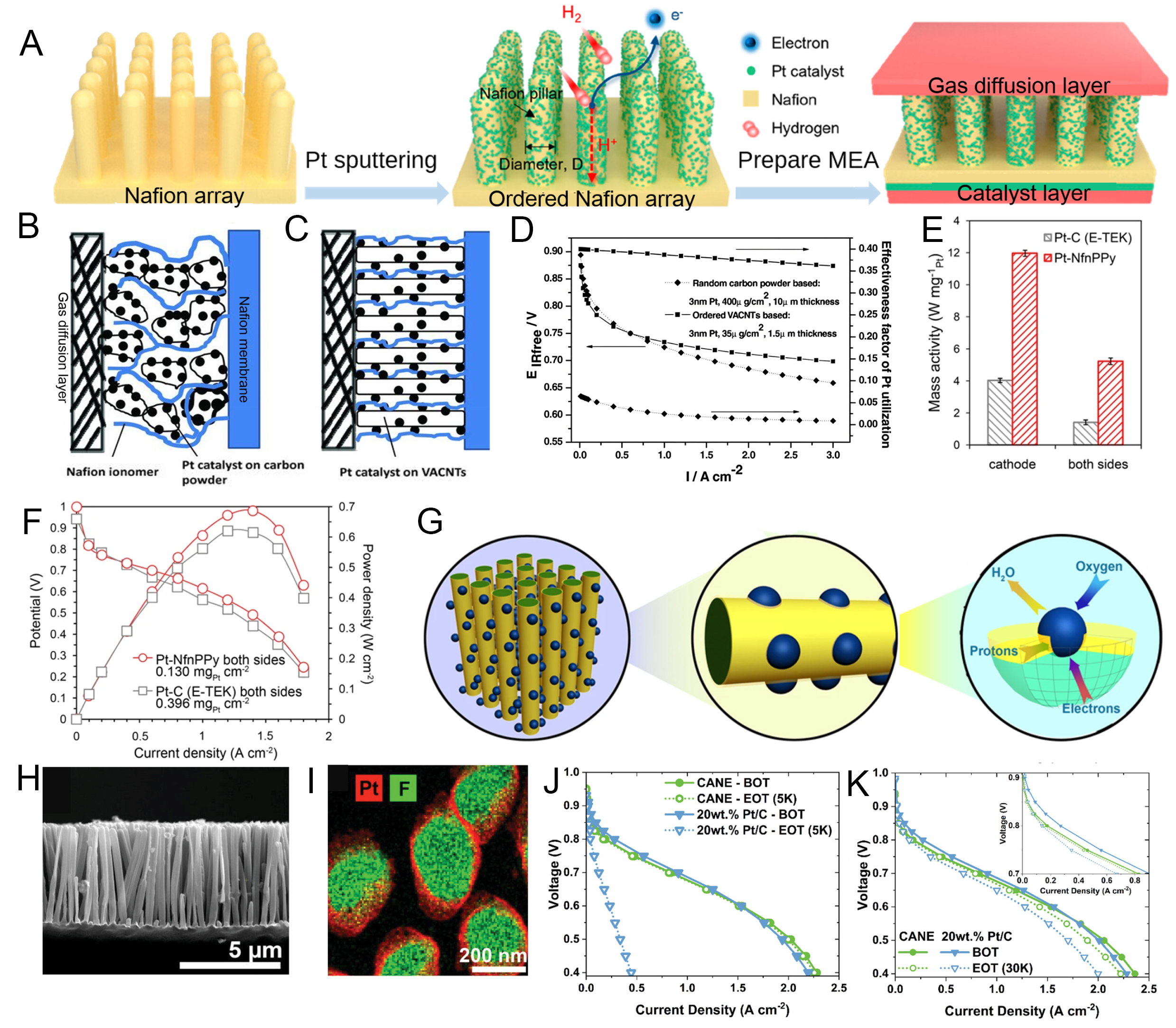
Figure 3. (A) Preparation of ordered nanosized Nafion arrays. (A) Adapted in part with permission from[58]. Copyright 2023, American Chemical Society; (B) CLs geometry made of Pt /C; (C) CLs geometry made of Pt catalyst on VACNTs film; (D) Simulated polarization curves and platinum utilization efficiency of random carbon-based and VACNTs-supported catalyst coatings; (B-D) Reprinted in part with permission from[59]. Copyright 2011, Wiley; (E) Mass power density comparison between fuel cells with Pt-NfnPPy electrodes and conventional Pt/C electrodes; (F) Polarization data of MEAs using Pt-NfnPPy and common Pt/C electrodes, operated at 70 °C with fully humidified H2/air reactants; (G) Structural diagram of the Pt-NfnPPy electrode; (E-G) Adapted in part with permission from[68]. Copyright 2022, Springer Nature. (H) SEM images of a CANE-7.5 sample; (I) The corresponding STEM-EDS map; (J and K) Polarization curves at the initial and final testing stages under support AST (J) and catalyst AST (K). (H-K) Reprinted in part with permission from[69] Copyright 2023, Wiley. MEA: Membrane electrode assembly; E-TEK: a commercial catalyst brand; CL: catalyst layer; VACNT: vertically aligned carbon nanotube; STEM-EDS: scanning transmission electron microscopy - energy dispersive X-ray spectroscopy; SEM: scanning electron microscopy; CANE: coaxial nanowire electrode; PPy: polypyrrole; AST: accelerated stress test.
Improving catalyst utilization and high ORR or OER activity is highly desirable for high-performance CLs[61]. Catalyst utilization and ORR or OER activity are directly related to the interfacial structure of the support and mass transport properties[62,63]: higher dispersion[64], greater ionomer coverage[51] and improved mass transport properties will lead to better CL performance. From the mesoscale perspective, these key performance-influencing factors are essentially determined by the spatial arrangement of CL components at the mesoscale. Therefore, to design and fabricate high-performance cathode CLs with low precious metals loading and high catalyst utilization, it is essential not only to select superior catalysts but also to optimize the mesoscale structure of the CL by regulating the mesoscale distribution of components to bridge the gap between microscale active sites and macroscale transport efficiency[65,66]. Wang et al.[67] precisely regulated the mesoscale spatial configuration of Pt catalysts by employing a self-assembly strategy with PS-b-P4VP block copolymers to prepare metal-containing nanocomposites with ordered honeycomb-like (OHC) mesopores. This mesoscale OHC structure serves as a "nanoscale template" that constrains the growth and distribution of Pt nanoparticles: the metal can be precisely positioned on the surfaces and inner walls of the mesopores, avoiding random aggregation of Pt nanoparticles at the microscale. Xia et al.[68] fabricated a hierarchical nanoarray-ordered CL. When used as both cathode and anode in a PEMFC, this electrode achieves a high mass-specific power density of 5.23 W mg-1 Pt and exhibits excellent durability [Figure 3E and F]. As shown in Figure 3G, its inner layer consists of an ordered electronic conductor, polypyrrole (PPy), and the outer layer is an ordered proton conductor, Nafion ionomer. Platinum nanoparticles are distributed at the dual-functional interface, anchoring and stabilizing the active sites within an environment constructed by proton/electron transport pathways. This spatial arrangement at the mesoscale greatly enhances Pt utilization, resulting in impressive ORR activity and stability.
Furthermore, catalyst film electrodes, composed of smooth or nanostructured catalyst layers at the nanoscale, represent a promising candidate material for bridging microscale catalyst activity and macroscale MEA performance[69]. Unlike traditional CLs, these film electrodes achieve mesoscale structural integration. Their ultrathin, continuous structures allow the catalyst to come into direct contact with the electrolyte membrane, thereby eliminating the carbon support and ionomer binder that would otherwise obstruct transport pathways at the mesoscale[70,71]. This breakthrough design overcomes a key limitation of traditional catalyst layers. By replacing supported nanoparticles with a continuous catalyst film, it eliminates carrier corrosion and particle degradation. At the same time, the absence of polymer agglomeration and the shortened electron transport pathways directly enhance the kinetics of the ORR[46,72,73]. For instance, Zeng et al.[74] designed a 3D-ordered MEA using Pt-skin@PdCo nanotube arrays (NTAs) - the open-walled, aligned NTA structure constructs continuous mesoscale pathways for mass transport, boosting Pt utilization via dual-sided accessible sites and eliminating ionomer reliance, ultimately achieving high power densities (222.5 kW/gPt for cathode, 330.4 kW/gPt for anode). The proton conduction mechanisms on ionomer-free Pt electrode surfaces are as follows: (i) adsorbed H surface diffusion and (ii) water film-facilitated surface migration on the catalyst surface[75-77]. It is particularly critical to provide effective proton conduction in ionomer-free catalyst film electrodes due to limited surface roughness and insufficient proton transport. Strategies aimed at enhancing proton conduction may need to balance the transport requirements of protons and oxygen, which could ultimately constrain electrode performance[78-80]. In an effort to address these limitations, Yang et al.[69] fabricated coaxial nanowire electrodes (CANEs) by encapsulating ionomers within Pt nanofilms [Figure 3H and I]. In this core-shell architecture, the traditional triple-phase boundary gives way to dual-phase boundaries, in which the ionomer core is responsible for proton conduction, while the Pt shell ensures rapid O2 diffusion. This functional separation at the mesoscale decouples the transport pathways for protons and O2, thereby achieving higher platinum utilization and durability even at low platinum loading. During the durability testing process, the CANE demonstrated remarkable resilience as depicted in Figure 3J and K. Nevertheless, it is noteworthy that the water production rate per unit thickness in catalyst film cathodes is 20-30 times higher than that of thinner Pt/C electrodes[81]. This poses a significant challenge for water management strategies, indicating that further efforts are required to bring this promising catalyst film electrode technology into practical applications.
Optimization of mass transport
The mass transport overpotential in the CL accounts for 20%-50% of the total mass transport overpotential[82]. The core cause of the mass transfer overpotential in the catalyst layer is the hindrance to the transport of reactants to the active sites and the discharge of the product from the active sites, which results in the reaction rate being limited by mass transfer rather than the electrochemical reaction itself; such mass transport relies on the pores within the CL. Typically, catalyst particles are dispersed into Nafion solution and then sprayed onto the PEM, followed by heat treatment to produce a porous CL[83,84]. The carbon particles contain primary pores measuring 5-20 nm in size, while secondary pores measuring 20-100 nm exist between the particles. The pore structure not only enhances electrochemical activity at the microscale but also promotes effective mass transport within the CL at the macroscale[85,86]. O2 transport within the CL plays a crucial role in the superior performance of hydrogen-electric energy conversion systems. Figure 4A illustrates the O2 transport pathways in the CCL of PEMFCs. After O2 enters the CL from the flow channel through the GDL, molecular diffusion dominates in the porous medium, while Knudsen diffusion dominates in ionomer films[87]. The pore-scale method is an efficient approach for studying oxygen reactive transport processes in CLs[88,89]. Micropores (< 2 nm) are unfavorable for ionomer penetration, preventing protons from reaching internal active sites, while excessive macropores (> 20 nm) significantly hinder proton conduction through the ionomer network. Mesopores (2-20 nm) enable an ideal distribution of catalyst and ionomer[90]. Therefore, the porous structure of the CL should be designed with a considerable proportion of mesopores. Yarlagadda et al.[91] demonstrated that particles forming accessible pores in the range of 4-7 nm can minimize oxygen transport resistance. Wang et al.[92] systematically compared the effect of carbon support pore size on Pt/ionomer interactions using three model catalysts with well-defined pore structures. The HOMC support with ordered mesopores achieved the optimal configuration, wherein Pt nanoparticles were positioned at the mesopore mouths while the ionomer resided on the external surface. This design avoids ionomer poisoning of Pt, ensures rapid O2 diffusion through the open mesopores, and allows effective proton conduction from the external ionomer to the Pt sites at the pore mouths. In contrast, the Vulcan support exposed Pt on the external surface, leading to direct ionomer adsorption on Pt[92]. Although this configuration maintains proton transport, it suppresses catalytic activity and adds oxygen diffusion resistance. The high-surface-area Ketjenblack support confined Pt deep within its pore channels, where the ionomer cannot reach, making the Pt sites largely inaccessible to protons [Figure 4B]. Song et al.[93] reported that ordered mesoporous carbon outperformed disordered wormhole-like mesoporous carbon in fuel cell reactivity, even though both carbon materials have similar pore size distributions. This is because the ordered structure has better three-dimensional connectivity, which improves mass transport and makes it easier for platinum particles to reach the electrolyte [Figure 4C].
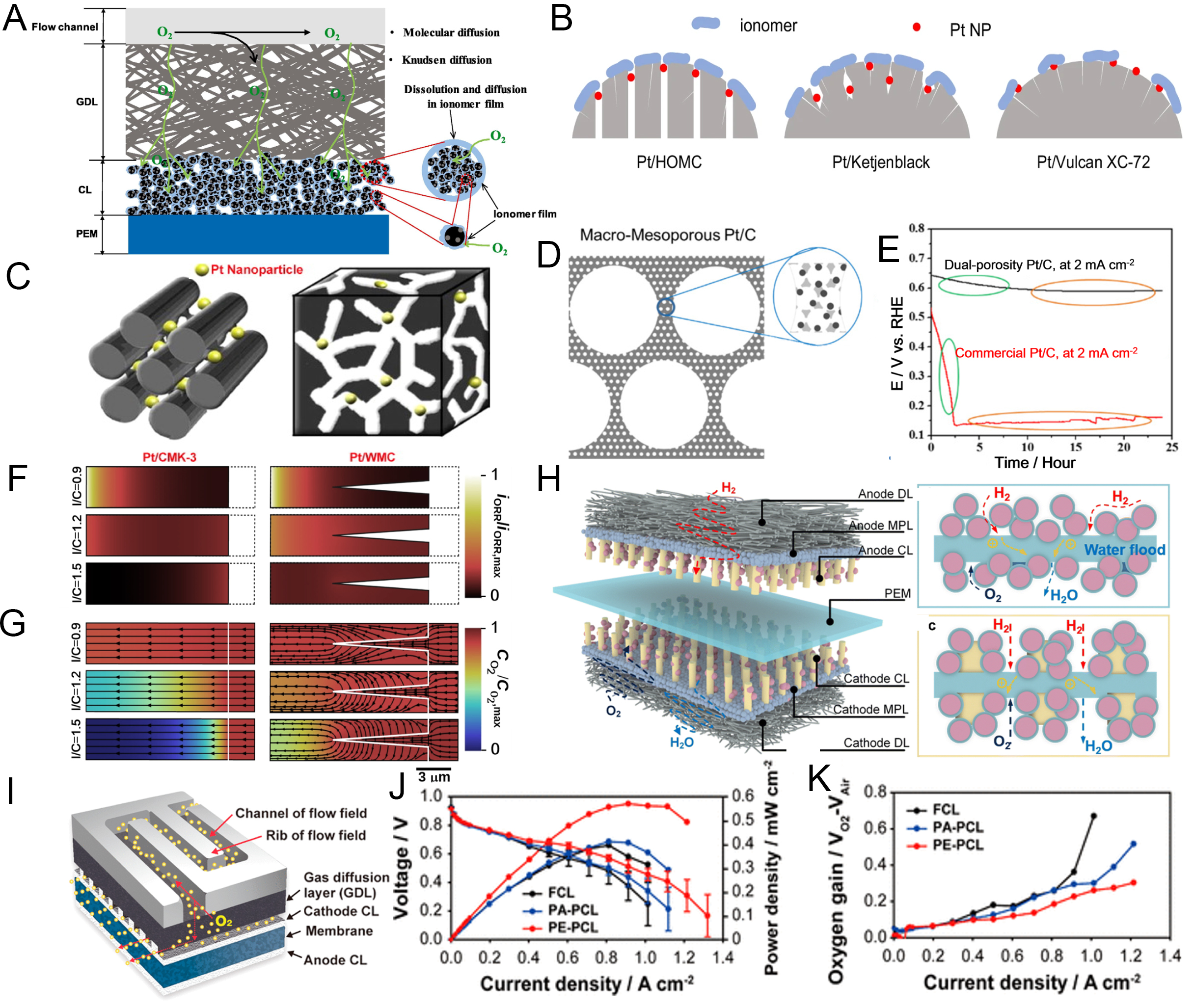
Figure 4. (A) Sketch of oxygen delivery paths from flow channels to CLs. (A) Reprinted in part with permission from[87]. Copyright 2024, Elsevier; (B) Model diagrams of ionomer-carbon-platinum interactions. (B) Reprinted in part with permission from[92]. Copyright 2024, Springer Nature; (C) Schematic of carbon pore geometry impacts on platinum catalytic performance. (C) Reprinted in part with permission from[93]. Copyright 2010, Elsevier; (D) Schematic diagram of ordered macro-mesoporous Pt/C. (E) Chronopotential curves measured in O2-saturated 0.1 M HClO4 at 2 mA cm-2. (D and E) Reprinted in part with permission from[101] Copyright 2018, Wiley; (F and G) 2D multiphysics simulation results of planar and channeled electrodes: (F) ORR current contour at 0.7 V; (G) normalized oxygen concentration field at 1.0 A cm-2, arrows represent O2 diffusion routes. (F and G) Adapted in part with permission from[102]. Copyright 2023, Springer Nature; (H) Diagram of dual-sided structured MEA configuration, plus operation principles of standard and ordered MEAs. (H) Reprinted in part with permission from[103]. Copyright 2024, Royal Society of Chemistry; (I) Illustration of CLs with horizontal through-pores and lateral reactant transport inside these planar channels; (J) I-V polarization curves and power density curves for FCL, PA-PCL, and PE-PCL at 100% RH (error bars indicate a voltage fluctuation during galvanostatic measurements at each current density); (K) Total O2 transport resistances. (I-K) Reprinted in part with permission from[105]. Copyright 2018, American Chemical Society. GDL: Gas diffusion layer; CL: catalyst layer; PEM: proton exchange membrane; NP: nanoparticle; HOMC: hollow ordered mesoporous carbon; RHE: reversible hydrogen electrode; CMK: carbon mesostructured from KAIST; WMC: wormhole-like mesoporous carbon; DL: diffusion layer; MPL: microporous layer; FCL: flat catalyst layer.
In the practical operation of PEMFCs, in addition to ensuring the continuous transport of reactant gases and the rapid transfer of electrons and protons, it is also essential to facilitate the rapid removal of water. When flooding occurs, the accumulation of water in the porous channels directly compresses the O2 mass transport pathways, preventing O2 molecules from reaching the active sites in a timely manner, thereby slowing down or even halting the ORR[94,95]. The design and synthesis of hierarchically porous materials have become a research hotspot in the field of electrocatalysis. Hierarchically porous structures are three-dimensional multiscale architectures formed by the interconnection of pores with different pore sizes (typically including at least two or more types of pores)[96]. Such structures are beneficial for improving the mass transport efficiency and anti-flooding capability of gas porous electrodes, thereby accelerating the ORR[97]. By constructing MEAs with hierarchically porous structures, carbon corrosion is significantly mitigated, mass transport is enhanced, and material stability is greatly improved[98-100]. Wang et al.[101] fabricated an anti-flooding gas porous electrode with an ordered macroporous-mesoporous interpenetrating network using a soft-hard template method. Both macropores and mesopores exhibited a regular and ordered arrangement, while Pt nanoparticles were uniformly distributed on the porous carbon support [Figure 4D]. The mass transport efficiency and antiflooding efficiency of the ordered porous electrode were four times that of commercial Pt/C [Figure 4E]. MEA testing demonstrated that the output power of the porous electrode consistently surpassed that of commercial Pt/C catalysts, with a 45% improvement in power output even under highly humidified conditions compared to traditional electrodes.
The tortuous and random structure of traditional electrodes limits the transport of O2 and water[72]. In addition to the design of ordered pores, the ordered shape design of catalyst layers, including ridges, pillars, and channels, is also a method to reduce mass transport resistance and enhance the transport capabilities of reactant gases and water. Lee et al.[102] proposed a multifunctional electrode with a highly ordered ridge and groove structure. The grooved electrode consists of catalyst ridges with high ionomer content, separated by empty grooves, providing effective pathways for H+ and O2 transport. This design simultaneously enhances H+ and O2 transport, achieving significant improvements in performance and durability. They used multiphysics simulation to analyze the local transport behavior of reactants and products within the electrode and calculated the spatial distribution of the oxygen reduction reaction rate (iORR). At an I/C (ionomer-to-carbon ratio) of 0.9, the introduction of grooves had a limited impact on performance due to the high H+ transport resistance in the electrode; however, as the I/C ratio increased, the grooves significantly influenced iORR, leading to notable performance improvements [Figure 4F]. The iORR distribution in the grooved electrode was more uniform, directly demonstrating improved oxygen and proton transport. Additionally, the oxygen concentration distribution within the grooved electrode was also more uniform [Figure 4G], further corroborating the above conclusion. Xuan et al.[103] synthesized a novel double-sided ordered membrane electrode for PEMFC using a TiN nanorod array [Figure 4H]. Due to its low mass transfer resistance, this ordered structure significantly enhances gas diffusion efficiency. Additionally, the uniformly arranged channel structure in the double-sided ordered membrane electrode generates radial capillary forces. Combined with its low surface tension, this significantly increases the water drainage rate, thereby preventing water accumulation and channel blockage. The prepared ordered membrane electrode exhibited an almost linear change in output voltage as the current density increased, with no noticeable sudden voltage drop observed. After 200 h of accelerated stress test (AST) at 90 °C and 30/30% relative humidity, the peak performance only dropped by 4.8%. In contrast to the introduction of TiO2 arrays, Wang et al.[104] directly grew TiO2 nanoarrays on the surface of the gas diffusion layer, thereby developing a novel self-humidifying membrane electrode. This catalytic layer structure effectively maintains humidity in the anode region and promptly replenishes moisture in the proton exchange membrane, thereby ensuring smooth proton conduction under low-humidity conditions. Lee et al.[105] invented an in-plane channel-structured CL [Figure 4I]. A comparison between patterned CLs with structures parallel and perpendicular to the rib/channel configuration demonstrated that in-plane channels traversing both the channel and rib regions improved overall gas and water transport. The enhanced performance in the direction perpendicular to the channels was attributed to the higher utilization of the CL segments under the rib regions due to gas transport from the channel regions [Figure 4J]. Oxygen gain measurements provided additional evidence for the improved oxygen transport [Figure 4K]. Measurements of the limiting current oxygen transport resistance revealed that the observed performance increase stemmed from shorter effective diffusion distances, which promoted both molecular and Knudsen diffusion.
Degradation mechanisms of ordered CLs under realistic operating conditions
Ordered CLs provide short and directional transport paths at the beginning of life, but their advantage can diminish if the ordered architecture reconstructs under realistic operation. Understanding these end-of-life (EOL) degradation pathways is essential for assessing the practical durability of ordered MEA technologies[106,107]. In PEMFC cathodes, Pt dissolution/redeposition, Ostwald ripening, carbon corrosion at high potentials, ionomer chemical attack, and repeated hydration-dehydration cycles can redistribute catalyst particles and ionomer domains, increasing local oxygen resistance and reducing electrochemically active surface area[108-111]. Ordered arrays and ultrathin films may be especially sensitive because their high surface energy, small feature size, and limited mechanical redundancy can accelerate coarsening, detachment, or collapse under compression. In PEMWE anodes, Ir dissolution, Ti oxidation/passivation, ionomer degradation, oxygen-bubble blockage, and porous transport layer (PTL)/CL interfacial fatigue can change the true contact area and convert initially continuous pathways into isolated reaction zones[112-114].
Ordered CLs, particularly those with high surface-area-to-volume ratios such as nanowires and nanoporous architectures, are susceptible to significant electrochemical active surface area (ECSA) losses during AST[115]. Recent modeling studies have established that Pt degradation in the cathode catalyst layer follows a complex sequence involving Ostwald ripening, mass loss, and precipitation within the PEM, ultimately leading to Pt band formation[116]. For ordered nanowire arrays, a unique dissolution-redeposition mechanism has been identified: during potential cycling, material dissolves from regions of high positive curvature and is redeposited along the surface during cathodic sweeps, leading to coarsening of the porous structure and eventual transformation into dense nanoparticle-like morphologies. This mechanism is accentuated by the high tortuosity of nanostructured architectures, which increases the probability of dissolved cations contacting the surface prior to elution into the bulk electrolyte[117,118]. The stability of the ionomer phase in ordered CLs is equally critical. In ordered CLs where the ionomer/catalyst interface is precisely engineered, any degradation of the ionomer distribution directly disrupts the designed proton transport pathways, potentially causing more severe performance loss than in random CLs where alternative pathways may exist[119]. Ordered carbon-based structures in CLs and GDLs face severe corrosion under long-term operation, particularly at high potentials and under start-stop conditions[54]. The corrosion of carbon supports leads to catalyst detachment, collapse of ordered pore structures, and loss of electrical connectivity. For vertically aligned carbon nanotube arrays, while the ordered structure provides excellent initial transport properties[120], the high surface energy and mechanical stress concentration sites may accelerate carbon oxidation compared to randomly distributed carbon powders[54,115]. The most critical EOL challenge for ordered structures is the loss of orderedness itself. As degradation proceeds, the initially ordered transport channels may become blocked by Pt precipitation, ionomer redistribution, or carbon corrosion products[121]. Unlike random porous networks that possess inherent fault tolerance through tortuous alternative pathways, ordered channel architectures may suffer catastrophic transport blockage if critical pathways are compromised. This ‘all-or-nothing’ degradation mode represents a fundamental durability risk that must be addressed through the design of hierarchical ordered structures with built-in redundancy[118]. For instance, Huang et al.[122] designed an orderly interlocking membrane electrode assembly to prevent damage to the array structure during assembly. In the 300-h stability test of this electrode, the attenuation rate was only 18.9 μV/h @ 2 A/cm2.
Mesoscale regulation of the CL focuses on optimizing reaction interfaces and mass transport pathways to improve catalyst utilization and reduce transport resistance. Through the design of ordered pore/shape structures and the construction of ordered proton/electron transport channels, the accessibility of active sites, mass transport efficiency, and flooding resistance are enhanced. These mesoscale design strategies enable the catalyst layer to achieve high performance at a low platinum loading. To facilitate the rational selection of fabrication strategies for ordered catalyst layers, Table 1 systematically compares the representative methods discussed above, providing a practical reference for researchers navigating the diverse landscape of ordered CL fabrication.
Comparison of fabrication strategies for ordered catalyst layers in PEM hydrogen-electric energy conversion systems
| Fabrication strategy | Typical ordered structure | References | Scale-up potential | Main advantages | Main limitations |
| AAO template-directed growth | Vertically aligned nanowires/nanotubes, ordered nanochannels CVP | [42] | Low to medium | Highest structural order; tunable pore diameter, density | AAO cost, template removal, limited area, and poor compatibility with hot pressing / large-area roll processing |
| Hard-template / soft-template self-assembly | Ordered mesoporous or honeycomb-like CLs | [67] | Medium | Better control over mesopore connectivity and catalyst distribution; more flexible than AAO | Template removal, pore blockage by ionomer, batch-to-batch variability, and cost |
| CVD-grown aligned arrays | VACNTs, TiO2 nanorods, WOx nanorods, aligned conductive scaffolds | [123] | Low to medium | Continuous electron pathways, straight transport channels, and good catalyst exposure | High-temperature or vacuum growth, expensive equipment, and difficulty in large-area uniformity |
| Sputtering/ALD/PVD thin-film deposition | Ultrathin catalyst films on ordered supports or patterned interfaces | [124] | Medium | Precise thickness control, short electron paths, and high utilization | Vacuum cost, scale-up difficulty, and interfacial adhesion / water-management issues |
| Electrodeposition / electrochemical deposition | Ordered catalyst nanowires, nanorods, or conformal catalyst layers | [125] | Medium | Simple chemistry, controllable loading, compatible with structured substrates | Requires conductive substrates; uniformity in deep 3D structures is challenging |
ORDERED PROTON EXCHANGE MEMBRANES AT THE MESOSCALE
The PEM plays a critical role in hydrogen-electric energy interconversion systems, as it blocks reactant gases and electrons between the cathode and anode while facilitating proton conduction as an ionic conductor[126,127]. The primary goal and most pressing challenge in current research is to construct a reliable and efficient proton transport network within the PEM, thereby facilitating the development of high-performance proton exchange membranes[128]. At the microscale, the membrane is distant from the electrochemical reaction interface, while at the macroscale, it is in close contact with the electrodes. Therefore, the mesoscale structural regulation of the PEM is key to enhancing its performance. Table 2 summarizes the main fabrication strategies for ordered proton exchange membranes, which are critical for translating ordered PEM concepts from laboratory to industrial production.
Comparison of fabrication strategies for ordered proton exchange membranes in PEM hydrogen-electric energy conversion systems
| Fabrication strategy | Typical ordered structure | References | Scale-up potential | Main advantages | Main limitations | |
| AAO template-directed membrane structuring | Vertically aligned nanochannels, cone-shaped or pore-ordered ionomer domains | [129] | Low to medium | Highest structural order; tunable pore diameter, density | Template cost, demolding difficulty, structural damage during hot pressing | |
| Nanoimprinting/pattern replication | Micro- and nanoscale surface patterns, inverted pyramids, pillars, grooves | [130] | Medium to high | Highly relevant to MEA integration; compatible with embossing or replication routes | Pattern collapse, swelling-induced distortion, and local stress concentration | |
| Hard-template/soft-template induced phase separation | Ordered proton/water channels formed by filler or block-copolymer templating | [121] | Medium to high | Strong tuning flexibility; compatible with solution casting | Filler aggregation, leaching, swelling, and mechanical embrittlement | |
| Electric-field alignment | Oriented nanofillers, ion clusters, or block-copolymer domains | [131] | Medium | Precise thickness control, short electron paths, and high utilization | Vacuum cost, scale-up difficulty, and interfacial adhesion/water-management issues | |
| Magnetic-field alignment | Magnetically aligned filler chains or nanotube networks | [132] | Medium | Simple alignment principle; effective for through-plane channel construction | Dependence on magnetic fillers; aggregation and compatibility issues | |
Establishing ordered proton transport channels within the PEM
Constructing ordered proton transport channels within the membrane can improve the entangled structure of the PEM and create uninterrupted pathways for water molecules and protons[133-136]. Ordered PEMs stand in stark contrast to the random and less controlled environment of traditional PEMs as shown in Figure 5A, where proton transfer channels in PEMs suffer from inefficient proton transport due to the amorphous nature of polymer segments[136]. However, achieving sufficient proton conductivity requires maintaining a high ion exchange capacity, which inevitably leads to excessive swelling under high humidity, thereby compromising mechanical properties[137]. In other words, the development of polymeric proton exchange membranes is constrained by the trade-off between proton conductivity and mechanical performance[138]. These challenges have prompted researchers to explore novel proton exchange membranes with long-range ordered proton transfer channels and stable membrane structures[139]. Introducing suitable fillers into Nafion or other sulfonated polymers can phase-separate the matrix, raise the density of acid-base pairs, and improve hydrogen-bond network connectivity, thereby optimizing proton transport channels[133,140].
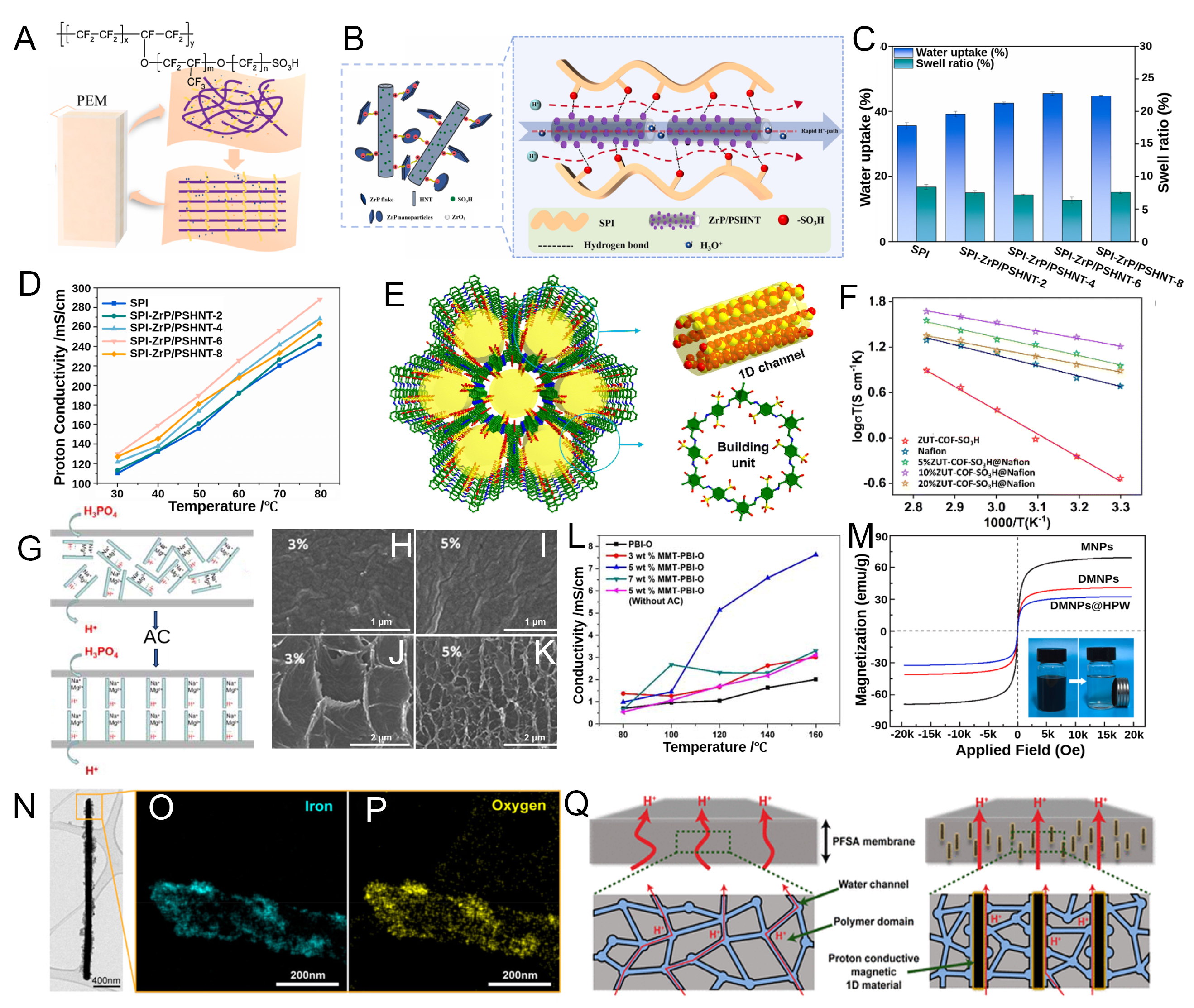
Figure 5. (A) Ordered and amorphous PEM. (A) Reprinted in part with permission from[135]. Copyright 2024, Elsevier; (B) Schematic representation of the proton transport process in the prepared ZrP/PSHNT composites and composite membranes; (C) Water uptake, and swelling ratio of SPI and SPI-ZrP/PSHNT composite membranes; (D) Temperature-dependent in-plane proton conductivity at 100% RH for SPI-based composites (B-D) Reprinted in part with permission from[141]. Copyright 2025, Elsevier; (E) Crystal structure of ZUT-COF-SO3H with porous channels functionalized by sulfonic acid groups in ZUT-COF-SO3H and building blocks in ZUT-COF-SO3H. (F) Arrhenius curves of proton conductivity tested at 80% RH. (E and F) Reprinted in part with permission from[142]. Copyright 2023, Royal Society of Chemistry; (G) Sketch of electric field-driven alignment of MMT nanosheets in mixed solutions; (H-K) SEM images of composite membranes; (L) Proton conductivity of composite membranes. (G-L) Reprinted in part with permission from[152]. Copyright 2018, Taylor and Francis Ltd; (M) Magnetic hysteresis curves of MNPs, DMNPs and PWA-DMNPs; inset image shows aqueous DMNPs@HPW captured by magnet. m Reprinted in part with permission from[132]. Copyright 2024, Elsevier; (N) TEM image of pm-WS2 nanotube; STEM-EDS image of Fe(O) and O (P); (Q) Contrast diagram: disordered water channels in conventional PFSA membranes vs. TP-oriented 1D water pathways in composite electrolytes. (N-Q) Reprinted in part with permission from[155]. Copyright 2020, American Chemical Society. PEM: Proton exchange membrane; HNT: halloysite nanotube; SPI: sulfonated polyimide; PSHNT: PDDA-modified sulfonated halloysite nanotube; ZUT-COF-SO3H: sulfonated covalent organic framework; AC: alternating current; PFSA: perfluorosulfonic acid; STEM-EDS: scanning transmission electron microscopy-energy dispersive X-ray spectroscopy; TP: through-plane; SEM: scanning electron microscopy; MNP: magnetic nanoparticle; DMNPs@HPW: polydopamine-coated magnetic nanoparticles loaded with phosphotungstic acid; MMT: montmorillonite.
Li et al.[141] prepared zirconium phosphate (ZrP) poly (diallyldimethylammonium chloride)-modified sulfonated halloysite nanotube (PSHNT) composites via electrostatic self-assembly, and incorporated them into a sulfonated polyimide (SPI) matrix to obtain a novel composite proton exchange membrane. The synergy between the high acidity of ZrP and the excellent water absorption of HNTs provided more proton transfer sites within the membrane and created long-range ordered conduction pathways as shown in Figure 5B. The SPI-ZrP/PSHNT-6 composite membrane exhibited a water uptake of 45.5% [Figure 5C], and a proton conductivity of 288.2 mS·cm-1 at 100% relative humidity and 80 °C [Figure 5D]. The peak power density of a single cell based on this membrane was 230.2 mW·cm-2. Shao et al.[142] employed a sulfonation strategy to synthesize a two-dimensional hydrophilic covalent organic framework (ZUT-COF-SO3H) rich in sulfonic groups. They incorporated this framework as a nanofiller into a Nafion matrix to prepare a composite proton exchange membrane [Figure 5E]. The well-ordered one-dimensional channels of ZUT-COF-SO3H provide space for the formation of long-range ordered hydration pathways, while its high density of sulfonic acid sites significantly promotes proton conduction. Following the formation of such ordered pathways, proton migration becomes more direct and unimpeded, adhering to the Grotthuss hopping mechanism, resulting in a marked reduction in the activation energy for proton transport [Figure 5F]. At 80 °C and 80% relative humidity, the COF-Nafion membrane doped with 10% ZUT-COF-SO3H exhibited proton conductivity 2.4 times that of the pure Nafion membrane. When assembled into a fuel cell as a proton exchange membrane, the composite membrane demonstrated excellent performance, achieving a maximum power density of 304.056 mW·cm-2 at a current density of 640.179 mA·cm-2.
Ion channels in conventional PEMs typically adopt a tortuous morphology, and their proton conduction behavior is often isotropic, or even exhibits undesirable anisotropy in which in-plane conduction exceeds out-of-plane conduction. In order to address this challenge, researchers have explored electric-field alignment and magnetic-field alignment techniques to orient conductivity in the through-plane direction[143,144]. In PEMs, protons are bound within the negatively charged -SO3H groups[145]. When subjected to a uniform external electric field, these charged components can form dipoles and undergo rotation[146,147]. As described below[148], the energy generated by this rotation can force the molecules to align in a specific direction:
where U denotes dipole rotation energy; n stands for the total amount of involved molecules; E refers to the intensity of the externally applied uniform electric field; q represents the charge magnitude of polarized units; d is the spacing separating paired opposite-charge species; and θ characterizes the included angle between the dipole axis and the direction of the applied electric field.
Dielectric polarization is the primary driving force behind the morphological reorganization of block copolymer nanostructures under the influence of an external electric field. Studies have shown that even after the removal of an external magnetic field, the aligned ionic clusters can remain stable, indicating that the formation of ion-conducting channels does not rely on the external magnetic force[149]. Based on this characteristic, the introduction of an external electric field can effectively regulate the positioning and distribution of ion-conducting nanochannels within the membrane[150,151]. By applying an electric field during the membrane casting process, Ryu et al.[131] obtained recast Nafion with more ordered microstructures and reduced ion cluster sizes. Wang et al.[152] incorporated proton-exchange montmorillonite (MMT) nanosheets into a polybenzimidazole (PBI-O) matrix containing ether linkages. Throughout the solvent evaporation process, an alternating electric field was used to align the MMT fillers in situ within the initial cast film solution [Figure 5G]. SEM images verified the generation of continuous proton-conduction pathways inside hybrid films, among which the composite filled with 5 wt.% MMT delivered the most regular and complete conductive channel network. These morphological observations solidified the positive contribution of the external alternating electric field to constructing ordered ion migration pathways and thus boosting the through-plane proton conduction of PBI-O-based high-temperature membranes [Figure 5H-K]. The 5% aligned MMT nanosheets increased the conductivity of the pure PBI-O membrane by 400% without sacrificing other properties [Figure 5L].
Magnetic field-induced alignment offers unique advantages in regulating material structures, as it only requires magnetic materials to possess sufficient saturation magnetization to respond to the field. By introducing magnetizable materials and aligning them under a magnetic field, the orientation of channels can be conveniently controlled to optimize material performance. Although most metals exhibit some degree of magnetism, only a few, such as Fe, Co, and Ni, display ferromagnetism. Among these, Fe ranks first in magnetic strength, with Co coming second, while other magnetic metals are typically paramagnetic with relatively weak magnetism. Therefore, Fe3O4 is often chosen as a prevalent doping candidate to realize directional filler arrangement under external magnetic fields due to its excellent magnetic properties[153,154]. Han et al.[132] prepared poly-dopamine-coated, phosphotungstic acid-loaded magnetic ferrite nanoparticles (DMNPs@HPW) with excellent magnetic responsiveness [Figure 5M]. By incorporating this functional filler into a sulfonated poly(ether ether ketone) matrix and utilizing a magnetic field to induce the oriented alignment of the filler, an ordered proton conduction pathway spanning the entire membrane thickness was established within the membrane. Hyun et al.[155] synthesized one-dimensional magnetic WS2 nanotubes by dispersing a surface-modified polystyrene sulfonic acid layer within a Nafion matrix and loading them with Fe3O4 nanoparticles [Figure 5N-P]. By applying a weak magnetic field of 0.035 T during the casting process, they successfully achieved the perpendicular alignment of proton conduction channels along the thickness of the membrane [Figure 5Q]. Molecular dynamics simulations indicate that the high density of sulfonic acid groups on the nanotube surface induces the formation of a continuous hydration layer at the Nafion/nanotube interface, providing a high-speed pathway for protons. Compared to recast Nafion membranes of the same thickness, the vertically aligned composite membrane exhibited a 69% increase in out-of-plane proton conductivity at 30% relative humidity, and fuel cells based on this membrane demonstrated a 51% increase in peak power density under the same humidity conditions.
Optimization of the PEM/CL interface
For hydrogen‑electric energy interconversion systems, the interfacial configurations between components are as decisive as the intrinsic material properties of each part in determining overall performance and operational stability. Therefore, in addition to the intrinsic design of the PEM, the interface between the PEM and the CL must also be considered. The PEM/CL interface structure significantly influences the mass transport and charge transfer processes in the MEA[154,156]. With technological advancements, the initial two-dimensional interface structure achieved by the CCM method has evolved into three-dimensional engineered interfaces between the PEM and CL, including engineered surface-patterned PEMs and porous membrane designs [Figure 6A][19,60]. Among these, surface-patterned PEMs enable precise control over the PEM surface structure, allowing the fabrication of the PEM with ordered patterns. This effectively optimizes the contact interface between the PEM and the CL, shortens the proton transport path, and reduces the proton transport resistance[157]. Lee et al.[158] constructed an ion-pair membrane with an inverted pyramid microstructure pattern using a solvent-assisted patterning technique. This design demonstrated higher transfer efficiency, enhanced capillary penetration of phosphoric acid (PA) into the catalyst layer, and reduced PA loss due to compression [Figure 6B]. Furthermore, compared to traditional CCS and flat CCM, the three-dimensional interlocking membrane/catalyst layer structure exhibited significant improvements in interfacial bonding strength and electrochemical active surface area [Figure 6C]. This indicates a uniform distribution of PA along the proton transport pathways, increasing the number of active sites. The patterned CCM also exhibited the lowest oxygen transport resistance [Figure 6D], attributed to changes in the morphology and porosity of the catalyst layer induced by the patterned membrane. Benefiting from these improvements, the patterned CCM, composed of an ion-pair membrane and protonated PA ionomer, achieved a high power output of 680 mW cm-2 under dry H2/ air conditions at 160 °C with a loading of 0.5 mgPt cm-2 [Figure 6E].
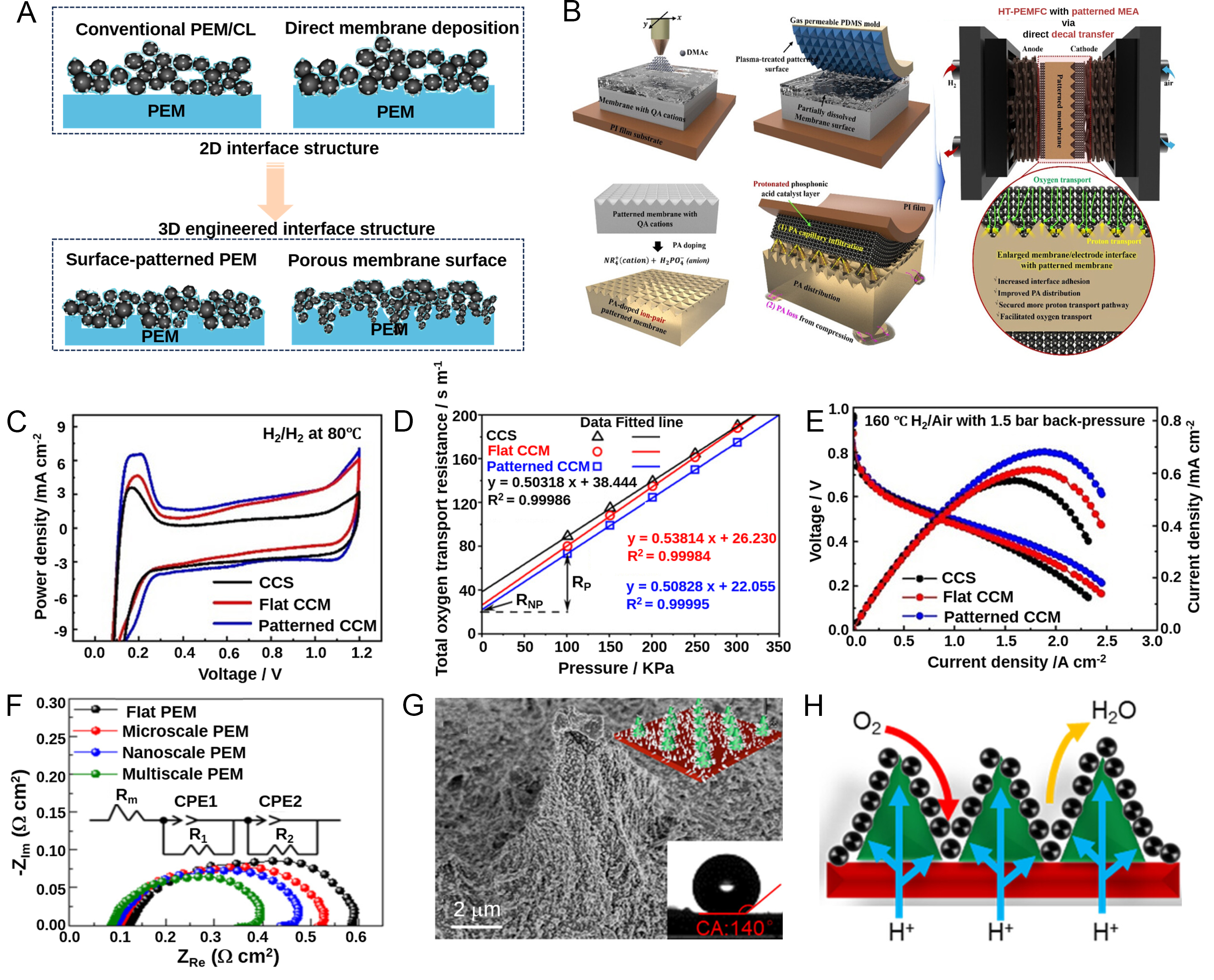
Figure 6. (A) Diagram showing the transformation from 2D flat contact interfaces to customized 3D interfacial structures; (B) Schematic diagram of the process and application of the inverted pyramid structure patterned film; (C) CV curves used for calculating the electrochemically active surface area; (D) Total oxygen-transport resistance for the flat CCM, the patterned CCM, and the CCS; (E) Polarization curves at 160 °C obtained by supplying dry H2/air with a back pressure of 1.5 bar. (B-E) Reprinted in part with permission from[158]. Copyright 2024, Wiley; (F) Nyquist plots derived from EIS tests of structured PEM-based MEAs under 0.6 V operation; the inset exhibits the corresponding equivalent circuit; (G) The SEM image of multiscale structure on PEM with insets presenting contact angle data; (H) Structural sketch of multiscale PEM coated with catalyst. (F-H) Reprinted in part with permission from[160]. Copyright 2023, American Chemical Society. PEM: Proton exchange membrane; QA: quaternary ammonium; DMAc: dimethylacetamide; PI: polyimide; PDMS: polydimethylsiloxane; HT-PEMFC: high-temperature proton exchange membrane fuel cell; MEA: membrane electrode assembly; PA: phosphoric acid; CCS: catalyst-coated substrate; CCM: catalyst-coated membrane; CA: contact angle; CV: cyclic voltammetry; EIS: electrochemical impedance spectroscopy; SEM: scanning electron microscopy.
The employment of patterned membranes has been demonstrated to enhance the reaction rate by means of two principal mechanisms. Firstly, it leads to an expansion of the membrane-electrode interface, and secondly, it results in a reduction of the thickness of the CL. In addition to fabricating single-scale patterns, multiscale patterns with various micro- and nanoscale morphological features can also be designed on the membrane surface[159]. Li et al.[160] fabricated a multi-scale structured PEM by replicating the hierarchical architecture of natural lotus leaves. The assembled MEA equipped with this biomimetic multi-layered PEM achieves an ohmic resistance of only 84 mΩ cm2, outperforming single-scale patterned counterparts [Figure 6F]. It features microscale columnar structures and nanoscale needle-like protrusions. This multi-scale structured PEM combines dual advantages: enhanced surface area from nanoscale features and reduced thickness through optimized microscale architecture [Figure 6G]. The distinctive hierarchical surface structure facilitates enhanced water management. The loose contact region full of voids is constructed between the textured membrane and catalytic layer, enabling unobstructed oxygen transport and fast drainage of cathodic liquid water [Figure 6H]. Single-cell testing demonstrates that the MEA equipped with this multiscale membrane enhanced discharge performance by a factor of 1.96 in comparison with a MEA with a flat PEM. Mesoscale regulation of PEM focuses on constructing ordered proton transport channels and optimizing the PEM/CL interface. Through filler modification, external field-induced alignment, and surface patterning (including multiscale patterns), the proton conductivity of PEMs is improved while maintaining mechanical stability, and the interfacial mass transport and charge transfer efficiency are enhanced.
ORDERED GAS DIFFUSION LAYERS AT THE MESOSCALE
Gas diffusion layers are core porous functional media sandwiched between catalyst layers and bipolar plates in the membrane electrode assemblies of both PEMFCs and PEMWEs[161,162]. GDLs fulfill multiple transport functions: they conduct electrons between catalytic active regions and current collectors, uniformly deliver reaction feedstocks to catalytic sites, remove liquid products or electrolytically generated gas bubbles, and dissipate heat produced by electrochemical reactions[163]. The hydrophilic pores within the microporous layers work synergistically to regulate the balance of water retention and drainage inside the membrane, prevent pore flooding, and ensure stable operation of hydrogen-electric bidirectional conversion devices[164-166].
Similar to the PEM, the GDL is distant from the electrochemical reaction interface at the microscale but closely contacts the electrode at the macroscale. This multi-level mesoscale behavior can be attributed to the mutual influence at the GDL/CL interface. Poor contact between the GDL and the CL can lead to additional electrical contact resistance at the interface. Additionally, during the ORR process, liquid water tends to accumulate within the gaps between the GDL and the CL, hindering mass transfer[38,167]. Ordered GDLs are essential for regulating two-phase fluid delivery and lowering ohmic polarization and mass transfer overpotentials[168]. Conventional GDLs feature random porous structures, which bring several drawbacks including non-uniform distribution of reaction species, insufficient water supply capacity and sluggish bubble detachment[169,170]. On the contrary, ordered GDLs feature precisely designed, uniformly arranged pore structures that form smooth, continuous channels for transporting reaction media and removing electrolytic byproducts[171]. This regular geometric arrangement eliminates dead zones and reduces mass transfer losses, thereby improving the overall reaction efficiency of the electrolytic devices[172]. Additionally, structural parameters like pore dimension and void fraction can be flexibly tuned for ordered GDLs, optimizing the bonding state between catalytic films and porous substrates between the CL and GDL. The CL is intricately linked to the GDL, as the GDL can serve as a substrate for catalyst coating, deposition, or growth. In this section, we will discuss two types of ordered GDLs: standalone ordered GDL and catalyst-integrated ordered GDL.
Standalone ordered GDL
A range of advanced manufacturing methods, including 3D additive manufacturing, laser etching, and mask lithography, enable researchers to precisely control pore size, geometric profile, spatial distribution, and total porosity, thereby fabricating ordered GDLs with uniform microstructures and customizable properties[123]. Table 3 presents a comparative overview of ordered gas diffusion layer fabrication methods. Huang et al.[173] utilized 3D printing technology to fabricate a nickel-based gas diffusion layer with straight-through pores and a three-dimensional periodic structure [Figure 7A]. They further characterized the bubble escape behavior, wettability, ohmic resistance, and mass transport resistance of the two GDLs using an in-situ observation system, contact angle measurements, and electrochemical impedance spectroscopy. As shown in Figure 7B-D, in the anion exchange membrane water electrolyzer (AEMWE), the GDL3D print exhibits excellent electrolytic performance. This advantage stems from three structural benefits: a periodic grid arrangement, surface properties that balance gas-affinity and gas-repulsion, and lower internal ohmic resistance. This customized porous structure suppresses excessive bubble growth and shortens gas residence time, while simultaneously enhancing electron conduction between the layer and the flow plate, thereby synergistically reducing ohmic polarization losses and concentration polarization losses. In a 1 mol/L KOH solution, the NiFe/ GDL3D print. only requires 240 mV overpotential to sustain 10 mA cm-2 OER activity. Furthermore, the AEMWE with the GDL3D print. under pure water supply achieved an industrial current density of 1A cm-2 at 1.8 V. Lu et al.[174] modified the GDL using laser perforation technology to control pore size and pattern. The perforation pattern consisted of a square array of 100 μm diameter holes spaced 1 mm apart, applied only to the microporous layer (MPL) [Figure 7E]. The single cell with the perforated GDL demonstrated high performance under conditions of 90 ℃/30% relative humidity and 40 ℃/100% relative humidity. To elucidate the impact of perforation, ex-situ water migration was analyzed using neutron imaging [Figure 7F]. In the reference cell, the water thickness fluctuated within a range of 0.2-1.3 mm, whereas in the cell with the perforated GDL, the water thickness remained relatively uniform. Additionally, the breakthrough pressures for the reference GDL and the perforated GDL were 25.0 kPa and 9.5 kPa, respectively. These findings were corroborated by an ex-situ water transport experiment, which demonstrated that localized perforation of the porous layer effectively achieved uniform water distribution and improved water transport in the GDL [Figure 7G]. Wang et al.[175] fabricated an MPL with basket-weave patterned grooves approximately 80 µm wide [Figure 7H and I]. Research has found that the grooves formed between the CL and the ordered GDL do not increase contact resistance and actually promote water retention. Molecular dynamics simulation results [Figure 7J] validated this strengthened water-retaining characteristic of structured MPLs. Under low-humidity operating environments, the extra retained moisture lowers internal ohmic loss and boosts proton conduction within electrodes, so MEAs equipped with grooved microporous layers deliver much better electrochemical output compared to flat counterparts. Zhu et al.[176] fabricated ordered PTLs by directionally stacking titanium fibers, which effectively eliminated dead zones and improved permeability.
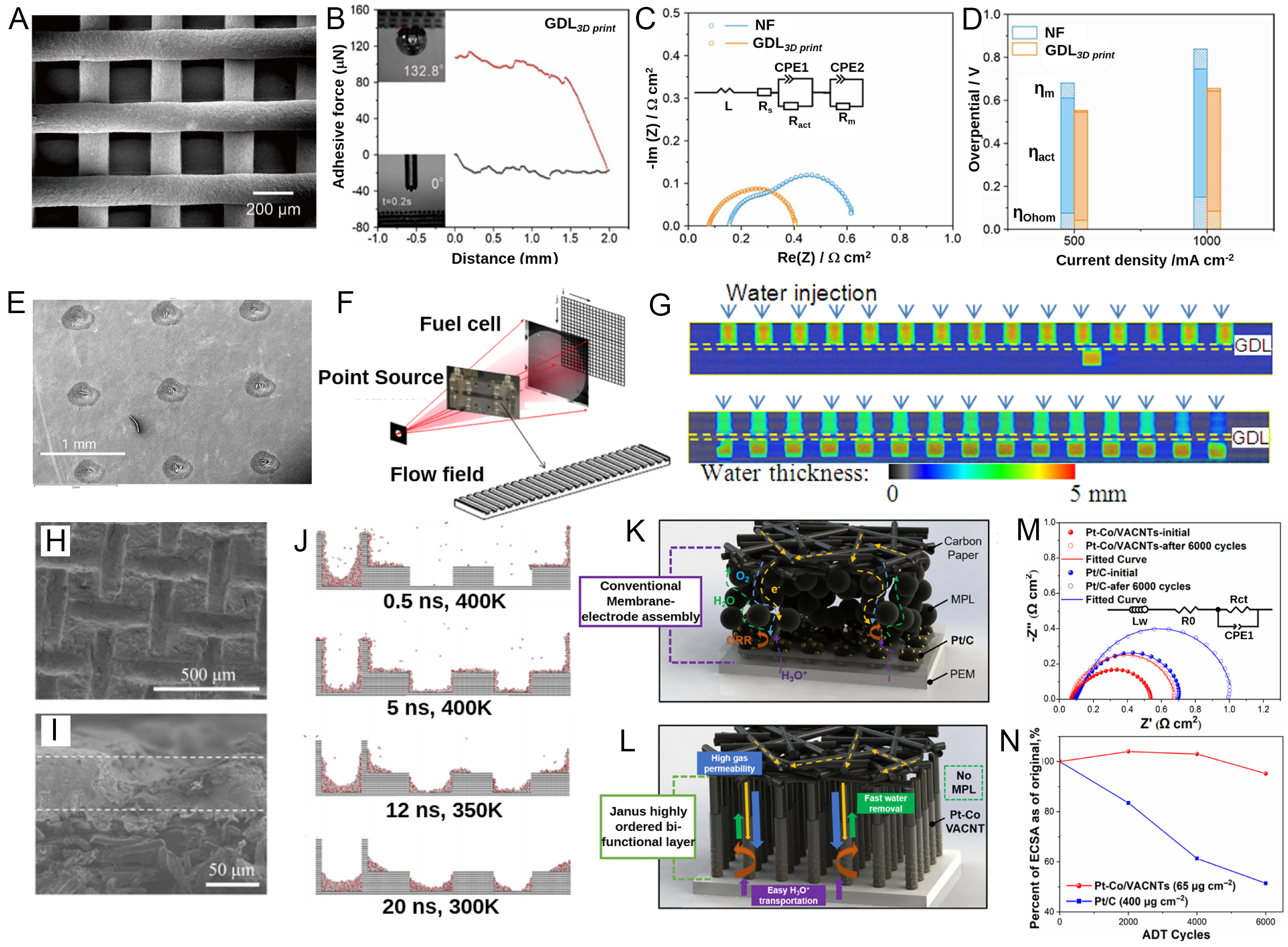
Figure 7. (A) Optical microscope images of GDL3D print; (B) Adhesive force measurement of the O2 bubbles on GDL3D print; (C) Electrochemical impedance spectra of various porous transport layers recorded under AEMWE at 0.2 A cm-2, with the matched equivalent circuit model displayed in the inset panel; (D) Comparison of split polarization components for pure-water-fed AEMWE operated at 500 mA cm-2 and 1,000 mA cm-2. (A-D) Reprinted in part with permission from[173]. Copyright 2023, Elsevier; (E) SEM image of perforated GDL; (F) NIST neutron imaging setup and fuel cell hardware; (G) Neutron radiographs of water breakthrough in the baseline GDL (upper image) and the laser-perforated GDL (lower image). (E-G) Reprinted in part with permission from[174]. Copyright 2013, Electrochemical Society Inc; (H and I) SEM images of the patterned MPL: top-view morphology (H) and cross-sectional profiles (I); (J) Sequential snapshots tracking water condensation processes on patterned MPL surfaces at different reaction phases. (H-J) Reprinted in part with permission from[175]. Copyright 2024, Tsinghua University Press; (K and L) Structural sketches: standard MEA configuration (K); Janus ordered dual-functional interlayer with outstanding gas-water transfer capacity (L); (M) In-situ EIS data recorded on single cells pre- and post-ADT aging cycles; (N) ECSA retention curve after multiple accelerated test cycles. (K-N) Reprinted in part with permission from[123]. Copyright 2021, Wiley. GDL: Gas diffusion layer; NF: nickel foam; VACNT: vertically aligned carbon nanotube; MPL: microporous layer; PEM: proton exchange membrane; SEM: scanning electron microscopy; MEA: membrane electrode assembly; EIS: electrochemical impedance spectroscopy; ADT: accelerated degradation test; ECSA: electrochemical active surface area.
Comparison of fabrication strategies for ordered gas diffusion layers in PEM hydrogen-electric energy conversion systems
| Fabrication strategy | Typical ordered structure | References | Scale-up potential | Main advantages | Main limitations | |
| Laser perforation/laser micro-patterning | Periodic through-holes, micropores, or channel arrays | [174] | High | Post-processing friendly; precise control of hole size and spacing | Thermal damage, local defects, and processing cost | |
| Patterned MPL/coating- based structuring | Grooves, basket-weave patterns, ordered MPL textures | [175] | High | Compatible with existing GDL coating methods | Pattern collapse under compression and possible contact resistance changes | |
| 3D printing / additive manufacturing | Periodic porous metal or polymer transport layers with designed channel geometry | [173] | Medium | Highly designable pore topology; useful for model and prototype devices | Printing throughput, resolution, and surface chemistry control | |
| Surface roughening / chemical etching | Roughened Ti fibers or carbon-based porous supports | [177] | High | Simple process; easy to integrate with commercial substrates | Over-etching can weaken mechanics and increase contact resistance | |
Catalyst-integrated ordered GDL
A good interfacial contact at the transport layer and CL interface enables high catalyst utilization[177]. To maximize this contact and eliminate discrete interfaces, researchers have explored using the porous transport layer directly as the supporting skeleton for catalysts. In such architectures, the porous material not only acts as a structural framework but also serves as an intrinsic electrocatalytic medium. Meng et al.[123] proposed a method for fabricating ordered membrane electrodes for PEMFCs using a highly ordered Pt-Co/VACNTs bifunctional layer. The highly ordered hydrophobic VACNTs served as the microporous layer, and Pt-Co alloy catalysts were deposited on the VACNTs via dual-target magnetron sputtering. Finally, a pure carbon paper without a MPL was hot-pressed to form the complete membrane electrode structure. In traditional membrane electrodes [Figure 7K], the random distribution of particles in the MPL and CL makes it challenging to precisely control the microstructure[123]. In addition, the highly tortuous pore pathways within the MPL, combined with the insulating and hydrophobic nature of polytetrafluoroethylene (PTFE), hinder the transport of oxygen, electrons, and liquid water around the oxygen reduction active sites[178]; moreover, these mass transfer limitations are further exacerbated under high-current conditions[179]. As shown in Figure 7L, vertically aligned carbon nanotube arrays feature a straight, continuous pore structure; this ordered framework can significantly accelerate multiphase mass transfer processes within the electrode assembly, thereby enhancing reaction rates and stability. Both the ohmic polarization and charge transfer polarization measured in single cells were reduced. This result confirms that the Janus bifunctional catalytic film optimizes the interface between the proton exchange membrane and the diffusion anode, ensuring uniform dispersion of the Nafion-doped catalyst particles and accelerating the diffusion rate of oxygen into the TPB [Figure 7M]. This membrane electrode exhibits high electrochemical stability [Figure 7N] and Pt utilization, achieving a maximum power density of 1.41 W cm-2, outperforming membrane electrodes prepared using the CCM method and traditional carbon paper with an MPL.
Mesoscale regulation of GDLs mainly involves precise control of pore structure and interface properties through advanced manufacturing technologies and catalyst integration strategies. Standalone ordered GDLs with controlled pore size, shape, and distribution improve gas diffusion and water management efficiency. Catalyst-integrated ordered GDLs achieve synergistic optimization of catalyst utilization and mass transport, enhancing the overall performance and stability of the MEA.
CONCLUSION AND OUTLOOK
This paper systematically reviews the mesoscale regulation strategies and research progress of ordered MEA in hydrogen-electric energy interconversion systems, focusing on the structural design and optimization of the CL, PEM, and GDL. The goal is to integrate the design of the CL, GDL, and PEM to explore next-generation MEA structures. From a mesoscale perspective, the matching of interfacial properties (e.g., charge transfer, mass transport pathways) between the CL, PEM, and GDL with intrinsic material properties (e.g., porosity, conductivity) is critical for enhancing MEA performance. Mesoscale regulation governs the coupled transport of multiple species: (i) electron transport depends on the continuity of carbon/catalyst conductive networks; (ii) proton transport requires percolated ionomer pathways above the connectivity threshold; (iii) gas transport is limited by pore tortuosity and Knudsen diffusion in narrow channels; (iv) water transport involves capillary-driven two-phase flow and interfacial phase change; (v) heat transport is influenced by the anisotropic thermal conductivity of ordered structures. The optimization of ordered MEAs thus necessitates simultaneous engineering of these coupled transport processes - a multiphysics challenge that lies at the heart of mesoscale regulation. Through systematic regulation from a mesoscale perspective, ordered membrane electrodes hold promise for advancing hydrogen-electric energy interconversion systems toward low platinum loading, high power density, and extended lifespan, laying the foundation for the commercial application of hydrogen energy technologies. However, the practical application of ordered membrane electrodes still faces the following challenges:
1. Scalable fabrication and manufacturing compatibility: Current mesoscale ordered structures rely on processes such as high-temperature deposition (400-750 °C), vacuum processing[124,154,180], and template-assisted array formation[181]. These methods can produce well-defined model architectures, but their large-area uniformity, membrane swelling tolerance, catalyst loss, defect density, and cost must be benchmarked against industrial CCM, CCS, PTE, slot-die coating, decal transfer, spraying, tape casting, calendering, and roll-to-roll embossing. Future work should report active area, yield, processing time, catalyst utilization after assembly, and performance dispersion across repeated cells. For PEMWEs, scalable ordered PTLs are particularly important because the PTL/CL contact controls low-Ir utilization and oxygen removal at high current density[182-184].
2. Complex Influencing Factors in External Field Orientation: The use of external field orientation for ordered PEM preparation processes is a promising route with many advantages, but it still faces multiple challenges during implementation. Magnetic field orientation is an accessible method but consumes lengthy processing time. Follow-up research should focus on simplifying operational workflows and improving the economics of practical applications. Throughout the entire preparation process, it is essential to ensure precise angular alignment between the membrane substrate and the magnetic flux; even a slight angular deviation can cause the vertical proton transport channels to bend, hindering proton transport across the membrane. In some experiments, the application of an electric current to generate a magnetic field results in significant heat accumulation, triggering side reactions[150]. Other influencing factors include thermodynamic and kinetic properties, the stacking structure and loading ratio of the fillers, solvent viscosity, and preparation process parameters[185]. Electric field modulation allows for flexible and convenient control of the nanoscale structural arrangement within the film; this advantage facilitates the fabrication of structurally precise functional films for high-end electrochemical energy conversion devices. Nevertheless, a series of mutually coupled parameters - including the geometric morphology of the fillers, the volumetric loading of the fillers, the viscosity and melting point of the solvent, the strength of the applied electric field, and the dielectric mismatch between the various components of the composite material - collectively determine the final formation of the oriented microstructure. In addition, the presence of the filler itself can have some detrimental effects on the membrane, such as aggregation of the filler and reaction of the filler with the substrate[185]. Therefore, all these factors need to be taken into account to optimize the microstructure and improve the performance when using external field-directed channels.
3. Advances in Diagnostic Tools and Simulations: MEA performance is influenced by numerous factors, and the processes involved in the entire system are both numerous and complex. Combining in-situ characterization techniques (e.g., X-ray tomography, neutron imaging) with multiphysics models can reveal the dynamic impact of mesoscale structures (e.g., pore alignment, ionomer coverage) on macroscopic cell performance. Advanced in-situ imaging equipment, including techniques that combine soft X-ray tomography with X-ray absorption near-edge structure tomography, helps to analyze and optimize the catalyst/polymer interface under dynamic operating conditions. Conducting extensive trial-and-error experiments in traditional laboratories not only wastes significant time but also consumes excessive resources. With the gradual maturation of machine learning algorithms and the rapid development of computational resources[186,187], applying machine learning and high-throughput screening to the design of MEA in fuel cells will significantly advance research and development in energy conversion by enabling high-throughput screening and performance prediction.
4. Long-Term Stability Assessment: The mechanical strength, corrosion resistance, and durability of ordered structures under high-temperature and high-humidity conditions require systematic investigation. For example, ordered carbon-based structures in CL and GDL may suffer from corrosion under long-term operation, and ordered arrays may experience structural collapse or catalyst detachment. Future research should establish a comprehensive stability evaluation system for the five-in-one ordered MEA, including accelerated durability testing under various operating conditions. Additionally, developing modification strategies (e.g., surface coating, alloying, cross-linking) to enhance the stability of mesoscale ordered structures, and exploring the degradation mechanism of ordered structures at the mesoscale to guide the design of more durable ordered MEAs are important research directions.
5. Direction of Synergistic Optimization for MEA: At present, the mesoscale regulation of each component (CL, PEM, GDL) is mostly carried out independently, and the synergistic effect between components is not fully considered. Future research should focus on the synergistic optimization of the five-in-one ordered MEA, such as matching the mesoscale pore structure of CL and GDL to improve mass transport efficiency, and optimizing the PEM/CL interface structure to enhance proton transport continuity. Yang et al.[188] proposed a 3D-printed all-in-one bipolar electrode structure, which integrates the cathode-side catalyst layer, liquid/gas diffusion layer, bipolar plate, current distributor and gasket of proton exchange membrane electrolyzer cells into a single component. It can be fabricated through only three procedures: 3D printing, polishing and sputter coating, drastically reducing the number of parts, manufacturing steps and multi-layer interfacial contact resistance. Additionally, exploring the multi-scale coupling mechanism between microscale material properties, mesoscale structure regulation, and macroscale MEA performance will provide a theoretical basis for the integrated design of high-performance five-in-one ordered MEAs[189,190].
6. Applicability of the Mesoscale Regulation Concept: The principles of mesoscale regulation developed for hydrogen-electric energy conversion systems share fundamental commonalities with other electrochemical energy devices, where dynamic interfaces and transport pathways critically determine performance. In sodium-ion batteries, for example, Fu et al.[191] introduced selenium vacancies in VSe2-x via physical vapor transport to create additional active sites and efficient channels for Na+ diffusion, resulting in exceptional rate performance and remarkable stability. This vacancy engineering strategy exemplifies how atomic-scale defects, when organized into mesoscale transport networks, can fundamentally alter ion storage behavior - paralleling the manner in which ordered ionomer channels in PEMs enhance proton transport. Similarly, in lithium-ion batteries and supercapacitors, the design of nano/mesoscale composite electrode materials and hierarchical porous structures has proven essential for improving rate capability and cycling stability. The fabrication of 3D-printed sodium-ion batteries via ternary anode design demonstrates that ordered architectural control can enable hybrid ion storage mechanisms and enhanced electrode-electrolyte interfaces[192]. In metal-air batteries, ordered cathode structures with vertically aligned nanorod arrays and Z-scheme heterojunctions facilitate directional charge separation and improved redox performance under operational conditions[193]. These cross-disciplinary examples highlight that the core concept of mesoscale regulation - engineering the spatial organization of active sites, transport channels, and interfaces to achieve emergent device-level properties - transcends specific chemistries and represents a universal design paradigm for advanced electrochemical energy systems.
In summary, although remarkable progress has been made in the research of ordered MEA for hydrogen-electric energy interconversion systems, there is still significant room for improvement. Clearly, addressing the current challenges of ordered MEA through mesoscale regulation will not only significantly enhance the performance and reliability of hydrogen-electric energy interconversion systems but also provide valuable insights for the development of other electrochemical energy conversion devices, promoting the widespread application of hydrogen energy technologies.
DECLARATIONS
Acknowledgments
We gratefully acknowledge that all graphical fragments integrated into the Graphical Abstract were reproduced with formal copyright permissions granted by the corresponding publishers. Copyright attributions are listed as follows: Copyright © 2023, Wiley-VCH Verlag GmbH & Co. KGaA, Weinheim (Figure 1 used in Ordered CLs at the Mesoscale); Copyright © 2023, American Chemical Society (Figure 1A used in Ordered CLs at the Mesoscale); Copyright © 2010, Elsevier (Figure 7 used in Ordered CLs at the Mesoscale); Copyright © 2022, Springer Nature (Figure 1B and C used in Ordered CLs at the Mesoscale); Copyright © 2023, Royal Society of Chemistry (Figure 2B and C used in Ordered PEM at the Mesoscale); Copyright © 2025, Elsevier (Figure 9 used in Ordered PEM at the Mesoscale); Copyright © 2020, American Chemical Society (Figure 1B used in Ordered PEM at the Mesoscale); Copyright © 2024, Wiley-VCH Verlag GmbH & Co. KGaA, Weinheim (Figure 1C used in Ordered PEM at the Mesoscale); Copyright ©2024, Tsinghua University Press. (Figure 7B used in Ordered GDLs at the Mesoscale); Copyright © 2021, Wiley-VCH Verlag GmbH & Co. KGaA, Weinheim (Figure 5B used in Ordered GDLs at the Mesoscale); Copyright ©2023, Elsevier (Figure 2B used in Ordered GDLs at the Mesoscale).
Authors’ contributions
Original draft writing: Bai, J.
Literature summary: Bai, J.
Literature collection: Jin, T.
Figure/table organization: Jin, T.
Manuscript revision: Chen, Z.
Reference verification: Chen, Z.
Conceptual discussion and editing: Deng, Z.; Zheng, J.
Review scope supervision: Deng, C.
Manuscript revision: Deng, C.; Shu, C.; Tang, W.
Scientific framework supervision: Shu, C.
Conceptualization of the review: Tang, W.
Supervised the project supervision: Tang, W.
Availability of data and materials
Not applicable.
AI and AI-assisted tools statement
During the preparation of this manuscript, ChatGPT (OpenAI, GPT-5.6, released 2026-07-09) was used solely for language editing and polishing. The tool did not influence the study design, data collection, data analysis, interpretation of the results, or the scientific content of the work. All authors take full responsibility for the accuracy, integrity, and final content of the manuscript.
Financial support and sponsorship
We gratefully acknowledge the financial support from the National Natural Science Foundation of China (Grant Nos. 22409157 and 22379120), the Higher Education Institution Academic Discipline Innovation and Talent Introduction Plan (“111 Plan”) (No. B23025), the Fundamental Research Funds for the “Young Talent Support Plan” of Xi’an Jiaotong University (HG6J003), and the “1000-Plan program” of Shaanxi Province.
Conflicts of interest
Tang, W. serves as an Associate Editor of Energy Z and was not involved in any stage of the editorial processing of this manuscript, including reviewer selection, manuscript handling, or decision-making. Zheng, J. is affiliated with Jiangxi Natural New Energy Technology Co. The other authors declare that they have no conflicts of interest.
Ethical approval and consent to participate
Not applicable.
Consent for publication
Not applicable.
Copyright
© The Author(s) 2026.
REFERENCES
1. Yin, S.; Chen, L.; Yang, J.; et al. A Fe-NC electrocatalyst boosted by trace bromide ions with high performance in proton exchange membrane fuel cells. Nat. Commun. 2024, 15, 7489.
2. Shao, R.; Xu, X.; Zhou, Z.; et al. Promoting ordering degree of intermetallic fuel cell catalysts by low-melting-point metal doping. Nat. Commun. 2023, 14, 5896.
3. Ji, Y.; Kwon, O.; Jeon, O. S.; Yim, S.; Jeon, Y.; Shul, Y. Effective single web-structured electrode for high membrane electrode assembly performance in polymer electrolyte membrane fuel cell. Sci. Adv. 2023, 9, eadf4863.
4. Khedekar, K.; Zaffora, A.; Santamaria, M.; et al. Revealing in-plane movement of platinum in polymer electrolyte fuel cells after heavy-duty vehicle lifetime. Nat. Catal. 2023, 6, 676-86.
5. Liu, F.; Kim, I. S.; Miyatake, K. Proton-conductive aromatic membranes reinforced with poly(vinylidene fluoride) nanofibers for high-performance durable fuel cells. Sci. Adv. 2023, 9, eadg9057.
6. Li, M.; Ding, H.; Song, J.; et al. Transport-friendly microstructure in SSC-MEA: unveiling the SSC ionomer-based membrane electrode assemblies for enhanced fuel cell performance. Adv. Sci. 2024, 11, 2403647.
7. You, S.; Jung, S.; Park, J.; et al. Enhancing durability of automotive fuel cells via selective electrical conductivity induced by tungsten oxide layer coated directly on membrane electrode assembly. Sci. Adv. 2023, 9, eadi5696.
8. Sun, Y.; Mao, L.; Hu, Z.; Zhang, X.; Peng, R. Magnetic Array-Aided Visualizing PEMFC Degradation Heterogeneity. Adv. Sci. 2024, 11, 2403631.
9. Sharma, R.; Morgen, P.; Chiriaev, S.; et al. Insights into degradation of the membrane-electrode assembly performance in low-temperature PEMFC: the catalyst, the ionomer, or the interface? ACS. Appl. Mater. Interfaces. 2022, 14, 49658-71.
10. Yao, J.; Yang, Y.; Hou, X.; et al. Fast design of catalyst layer with optimal electrical-thermal-water performance for proton exchange membrane fuel cells. J. Energy. Chem. 2023, 81, 642-55.
11. Yu, W.; Yang, X.; Liang, X.; et al. All sprayed fluorine-free membrane electrode assembly for low-platinum and low-humidity proton exchange membrane fuel cells. J. Mater. Chem. A. 2023, 11, 9002-8.
12. Podbevšek, D.; Modestino, M. A. A multiscale fluid dynamics perspective on bubble management in water electrolysis. Joule. 2026, 10, 102429.
13. Li, G.; Shen, R.; Hu, S.; Wang, B.; Algadi, H.; Wang, C. Norbornene-based acid-base blended polymer membranes with low ion exchange capacity for proton exchange membrane fuel cell. Adv. Compos. Hybrid. Mater. 2022, 5, 2131-7.
14. Pei, Y.; Zhu, W.; Yue, R.; et al. Controllable construction of Pt/CNT catalyst layers to improve Pt utilization in PEMFCs. J. Mater. Chem. A. 2024, 12, 739-47.
15. Zhao, J.; Liu, H.; Li, X. Structure, property, and performance of catalyst layers in proton exchange membrane fuel cells. Electrochem. Energy. Rev. 2023, 6, 13.
16. Zhang, G.; Qu, Z.; Tao, W.; et al. Porous flow field for next-generation proton exchange membrane fuel cells: materials, characterization, design, and challenges. Chem. Rev. 2023, 123, 989-1039.
17. Ahmed, S.; Beauger, C.; Zada, A.; et al. Recent advancements in designing high-performance proton exchange membrane fuel cells: a comprehensive review. Appl. Energy. 2025, 390, 125753.
18. Mo, S.; Du, L.; Huang, Z.; et al. Recent advances on PEM fuel cells: from key materials to membrane electrode assembly. Electrochem. Energy. Rev. 2023, 6, 28.
19. Yang, B.; Xiang, Z. Nanostructure engineering of cathode layers in proton exchange membrane fuel cells: from catalysts to membrane electrode assembly. ACS. Nano. 2024, 18, 11598-630.
20. Lazaridis, T.; Stühmeier, B. M.; Gasteiger, H. A.; El-sayed, H. A. Capabilities and limitations of rotating disk electrodes versus membrane electrode assemblies in the investigation of electrocatalysts. Nat. Catal. 2022, 5, 363-73.
21. Riasse, R.; Lafforgue, C.; Vandenberghe, F.; et al. Benchmarking proton exchange membrane fuel cell cathode catalyst at high current density: a comparison between the rotating disk electrode, the gas diffusion electrode and differential cell. J. Power. Sources. 2023, 556, 232491.
22. Ehelebe, K.; Schmitt, N.; Sievers, G.; et al. Benchmarking fuel cell electrocatalysts using gas diffusion electrodes: inter-lab comparison and best practices. ACS. Energy. Lett. 2022, 7, 816-26.
23. Long, X.; Mao, Z.; He, Y.; et al. Comprehensive analysis of advanced stable anode electrocatalysts for proton exchange membrane water electrolyzer. Coord. Chem. Rev. 2026, 556, 217657.
24. Huang, W.; Li, J.; Edwards, P. P. Mesoscience: exploring the common principle at mesoscales. Natl. Sci. Rev. 2017, 5, 321-6.
25. Wei, Y.; Zhao, D.; Wang, D. Mesoscience in hollow multi-shelled structures. Adv. Sci. 2024, 11, 2305408.
26. Sun, F.; Yang, C.; Zhang, Y.; et al. Multiscale mass transfer at carbonaceous catalyst-mediated electrocatalytic interface. Joule. 2025, 9, 102170.
27. Buot, F. A. Mesoscopic physics and nanoelectronics: nanoscience and nanotechnology. Phys. Rep. 1993, 234, 73-174.
28. Ryan, E. M.; Mukherjee, P. P. Mesoscale modeling in electrochemical devices - a critical perspective. Progr. Energy. Combust. Sci. 2019, 71, 118-42.
29. Deng, Z.; Kumar, V.; Bölle, F. T.; et al. Towards autonomous high-throughput multiscale modelling of battery interfaces. Energy. Environ. Sci. 2022, 15, 579-94.
30. Olbrich, W.; Kadyk, T.; Sauter, U.; Eikerling, M.; Gostick, J. Structure and conductivity of ionomer in PEM fuel cell catalyst layers: a model-based analysis. Sci. Rep. 2023, 13, 14127.
31. Ren, H.; Teng, Y.; Meng, X.; et al. Ionomer network of catalyst layers for proton exchange membrane fuel cell. J. Power. Sources. 2021, 506, 230186.
32. Sun, J.; Lin, P.; Zeng, L.; et al. Artificial-intelligence-guided design of ordered gas diffusion layers for high-performing fuel cells via Bayesian machine learning. Nat. Commun. 2025, 16, 6528.
33. Lim, B. H.; Majlan, E. H.; Tajuddin, A.; et al. Comparison of catalyst-coated membranes and catalyst-coated substrate for PEMFC membrane electrode assembly: a review. Chin. J. Chem. Eng. 2021, 33, 1-16.
34. Xing, Y.; Li, H.; Avgouropoulos, G. Research progress of proton exchange membrane failure and mitigation strategies. Materials. 2021, 14, 2591.
35. Wang, J.; Wang, H.; Fan, Y. Techno-economic challenges of fuel cell commercialization. Engineering. 2018, 4, 352-60.
36. Cho, S.; Oh, S.; Kim, M.; et al. Mass-transport-engineered CCM architecture employing MPL-free carbon paper and graphene-coated Ni foam channels for high-temperature PEM fuel cells. Adv. Sci. 2026, 13, e75250.
37. Gao, Y.; Yu, H.; Wang, W.; et al. Roadmap toward next-generation proton exchange membrane water electrolyzers. Joule. 2026, 10, 102337.
38. Chen, M.; Zhao, C.; Sun, F.; Fan, J.; Li, H.; Wang, H. Research progress of catalyst layer and interlayer interface structures in membrane electrode assembly (MEA) for proton exchange membrane fuel cell (PEMFC) system. eTransportation. 2020, 5, 100075.
39. Koch, S.; Metzler, L.; Kilian, S. K.; et al. Toward scalable production: catalyst-coated membranes (CCMs) for anion-exchange membrane water electrolysis via direct bar coating. Adv. Sustainable. Syst. 2023, 7, 2200332.
40. Pan, S.; Wen, Q.; Dan, X.; et al. Enhanced triple-phase interface in PEMFC by proton conductor absorption on the Pt catalyst. ACS. Appl. Energy. Mater. 2023, 6, 763-72.
41. Yu, L.; Tian, B.; Huang, W.; Zhou, X.; Li, W. Advancements in ordered membrane electrode assembly (MEA) for water electrolysis. Curr. Opin. Electrochem. 2024, 48, 101595.
42. Li, Y.; Wen, Q.; Qin, J.; et al. A high-efficient and low-consumption nanoimprint method to prepare large-area and high-quality Nafion array for the ordered MEA of fuel cell. Chem. Eng. J. 2023, 451, 138722.
43. Pan, S.; Qin, J.; Ning, F.; et al. Well-dispersed Nafion array prepared by the freeze-drying method to effectively improve the performance of proton exchange membrane fuel cells. ACS. Sustainable. Chem. Eng. 2021, 9, 16770-7.
44. Tan, M.; Zhang, W.; Liu, H.; et al. Revolutionizing high-temperature polymer electrolyte membrane fuel cells: unleashing superior performance with vertically aligned TiO2 nanorods supporting ordered catalyst layer featuring Pt nanowires. Fuel. 2024, 357, 130084.
45. Wang, M.; Peng, F.; Zou, J.; et al. Manufacturing-induced irregularities of membrane electrode assemblies: Impacts on proton exchange membrane fuel cells’ performance and diagnosis. Renew. Sust. Energ. Rev. 2025, 216, 115707.
46. Wang, G.; Zou, L.; Huang, Q.; Zou, Z.; Yang, H. Multidimensional nanostructured membrane electrode assemblies for proton exchange membrane fuel cell applications. J. Mater. Chem. A. 2019, 7, 9447-77.
47. Zhao, W.; Xu, G.; Dong, W.; et al. Progress and perspective for in situ studies of oxygen reduction reaction in proton exchange membrane fuel cells. Adv. Sci. 2023, 10, 2300550.
48. Chen, Z.; Guo, L.; Pan, L.; et al. Advances in oxygen evolution electrocatalysts for proton exchange membrane water electrolyzers. Adv. Energy. Mater. 2022, 12, 2103670.
49. Zhao, Z.; Hossain, M. D.; Xu, C.; et al. Tailoring a three-phase microenvironment for high-performance oxygen reduction reaction in proton exchange membrane fuel cells. Matter. 2020, 3, 1774-90.
50. Li, H.; You, J.; Feng, Y.; et al. Comprehensive understanding of oxygen transport at Gas/ionomer/electrocatalyst triple phase boundary in PEMFCs. Chem. Eng. J. 2023, 478, 147454.
51. Li, C.; Yu, K.; Bird, A.; et al. Unraveling the core of fuel cell performance: engineering the ionomer/catalyst interface. Energy. Environ. Sci. 2023, 16, 2977-90.
52. Sun, R.; Xia, Z.; Xu, X.; Deng, R.; Wang, S.; Sun, G. Periodic evolution of the ionomer/catalyst interfacial structures towards proton conductance and oxygen transport in polymer electrolyte membrane fuel cells. Nano. Energy. 2020, 75, 104919.
53. Li, Y.; Wu, Z.; Wang, C.; et al. Engineering triple-phase boundary in Pt catalyst layers for proton exchange membrane fuel cells. Adv. Funct. Mater. 2024, 34, 2310428.
54. Xu, S.; Liu, H.; Zheng, N.; Tao, H. B. Physical degradation of anode catalyst layer in proton exchange membrane water electrolysis. Adv. Mater. Interfaces. 2025, 12, 2400549.
56. Eskandari, H.; Paul, D. K.; Young, A. P.; Karan, K. Humidity-dependent hydration and proton conductivity of PFSA ionomer thin films at fuel-cell-relevant temperatures: effect of ionomer equivalent weight and side-chain characteristics. ACS. Appl. Mater. Interfaces. 2022, 14, 50762-72.
57. Kim, B.; Park, J.; Park, J. Effect of blended perfluorinated sulfonic acid ionomer binder on the performance of catalyst layers in polymer electrolyte membrane fuel cells. Membranes. 2023, 13, 794.
58. Ning, F.; Qin, J.; Dan, X.; et al. Nanosized proton conductor array with high specific surface area improves fuel cell performance at low Pt loading. ACS. Nano. 2023, 17, 9487-500.
59. Tian, Z. Q.; Lim, S. H.; Poh, C. K.; et al. A highly order-structured membrane electrode assembly with vertically aligned carbon nanotubes for ultra-low Pt loading PEM fuel cells. Adv. Energy. Mater. 2011, 1, 1205-14.
60. Fan, J.; Chen, M.; Zhao, Z.; et al. Bridging the gap between highly active oxygen reduction reaction catalysts and effective catalyst layers for proton exchange membrane fuel cells. Nat. Energy. 2021, 6, 475-86.
61. Wen, G.; Sun, L.; Qin, Y.; et al. COF-assisted construction of steric mass-charge channels to boost activity for high-performance fuel cells. Angew. Chem. Int. Ed. 2025, 64, e202424179.
62. Islam, M. N.; Mansoor, Basha. A. B.; Kollath, V. O.; Soleymani, A. P.; Jankovic, J.; Karan, K. Designing fuel cell catalyst support for superior catalytic activity and low mass-transport resistance. Nat. Commun. 2022, 13, 6157.
63. Lee, Y. J.; Kim, H.; Oh, H.; et al. Lens-shaped carbon particles with perpendicularly-oriented channels for high-performance proton exchange membrane fuel cells. ACS. Nano. 2022, 16, 2988-96.
64. Owejan, J. P.; Owejan, J. E.; Gu, W. Impact of platinum loading and catalyst layer structure on PEMFC performance. J. Electrochem. Soc. 2013, 160, F824-33.
65. Zhang, R.; Min, T.; Liu, Y.; Chen, L.; Tao, W. Pore-scale study of effects of different Pt loading reduction schemes on reactive transport processes in catalyst layers of proton exchange membrane fuel cells. Int. J. Hydrogen. Energy. 2021, 46, 20037-53.
66. Zhang, G.; Qu, Z.; Tao, W.; et al. Advancing next-generation proton-exchange membrane fuel cell development in multi-physics transfer. Joule. 2024, 8, 45-63.
67. Wang, Z.; Yang, Y.; Mo, J.; Zhao, C.; Yan, C. Control on Pt-containing ordered honeycomb mesoporous nanostructures via self-assembly of block copolymer. Colloid. Surface. A. 2023, 656, 130392.
68. Xia, Z.; Wang, S.; Jiang, L.; et al. Bio-inspired construction of advanced fuel cell cathode with Pt anchored in ordered hybrid polymer matrix. Sci. Rep. 2015, 5, 16100.
69. Yang, G.; Komini, Babu. S.; Liyanage, W. P. R.; et al. Coaxial nanowire electrodes enable exceptional fuel cell durability. Adv. Mater. 2023, 35, 2301264.
70. Marconot, O.; Pauc, N.; Buttard, D.; Morin, A. Vertically aligned platinum copper nanotubes as PEM fuel cell cathode: elaboration and fuel cell test. Fuel. Cells. 2018, 18, 723-30.
71. Zeng, Y.; Shao, Z.; Zhang, H.; et al. Nanostructured ultrathin catalyst layer based on open-walled PtCo bimetallic nanotube arrays for proton exchange membrane fuel cells. Nano. Energy. 2017, 34, 344-55.
72. Yang, G.; Lee, C.; Qiao, X.; Babu, S. K.; Martinez, U.; Spendelow, J. S. Advanced electrode structures for proton exchange membrane fuel cells: current status and path forward. Electrochem. Energy. Rev. 2024, 7, 9.
73. Bai, J.; Ke, S.; Song, J.; et al. Surface engineering of carbon-supported platinum as a route to electrocatalysts with superior durability and activity for PEMFC cathodes. ACS. Appl. Mater. Interfaces. 2022, 14, 5287-97.
74. Zeng, Y.; Zhang, H.; Wang, Z.; et al. Nano-engineering of a 3D-ordered membrane electrode assembly with ultrathin Pt skin on open-walled PdCo nanotube arrays for fuel cells. J. Mater. Chem. A. 2018, 6, 6521-33.
75. Wang, K.; Zhou, T.; Cao, Z.; et al. Advanced 3D ordered electrodes for PEMFC applications: From structural features and fabrication methods to the controllable design of catalyst layers. Colloid. Surface. A. 2024, 9, 1336-65.
76. Huang, J.; Zhang, J.; Eikerling, M. Unifying theoretical framework for deciphering the oxygen reduction reaction on platinum. Phys. Chem. Chem. Phys. 2018, 20, 11776-86.
77. Martínez-Hincapié, R.; Climent, V.; Feliu, J. M. Peroxodisulfate reduction as a probe to interfacial charge. Electrochem. Commun. 2018, 88, 43-6.
78. Sinha, P. K.; Gu, W.; Kongkanand, A.; Thompson, E. Performance of nano structured thin film (NSTF) electrodes under partially-humidified conditions. J. Electrochem. Soc. 2011, 158, B831.
79. Inaba, M.; Suzuki, T.; Hatanaka, T.; Morimoto, Y. Fabrication and cell analysis of a Pt/SiO2 platinum thin film electrode. J. Electrochem. Soc. 2015, 162, F634-8.
80. Hu, L.; Zhang, M.; Komini babu, S.; Kongkanand, A.; Litster, S. Ionic conductivity over metal/water interfaces in ionomer-free fuel cell electrodes. ChemElectroChem. 2019, 6, 2659-66.
81. Liu, Y.; Cai, X.; Lu, J.; Du, A.; Lin, R. Pt active site density optimization of the catalyst layer for an ultralow-Pt-loading PEMFC. Energy. Fuels. 2024, 38, 21423-31.
82. Murata, S.; Imanishi, M.; Hasegawa, S.; Namba, R. Vertically aligned carbon nanotube electrodes for high current density operating proton exchange membrane fuel cells. J. Power. Sources. 2014, 253, 104-13.
83. Wu, J.; Liu, H.; Song, Y.; Wang, Y. A modeling study of PEM fuel cells with novel catalyst monolayers under low platinum loading. J. Mater. Chem. A. 2022, 10, 4076-86.
84. Seselj, N.; Alfaro, S. M.; Bompolaki, E.; Cleemann, L. N.; Torres, T.; Azizi, K. Catalyst development for high-temperature polymer electrolyte membrane fuel cell (HT-PEMFC) applications. Adv. Mater. 2023, 35, 2302207.
85. Balogun, E.; Cassegrain, S.; Mardle, P.; Adamski, M.; Saatkamp, T.; Holdcroft, S. Nonconformal particles of hyperbranched sulfonated phenylated poly(phenylene) ionomers as proton-conducting pathways in proton exchange membrane fuel cell catalyst layers. ACS. Energy. Lett. 2022, 7, 2070-8.
86. Lee, Y. J.; Kim, H. E.; Lee, E.; et al. Ultra-low Pt loaded porous carbon microparticles with controlled channel structure for high-performance fuel cell catalysts. Adv. Energy. Mater. 2021, 11, 2102970.
87. Chen, Y.; Lin, H.; Huo, J.; et al. Multi-scale revealing how real catalyst layer interfaces dominate the local oxygen transport resistance in ultra-low platinum PEMFC. J. Colloid. Interface. Sci. 2024, 671, 344-53.
88. Deng, H.; Hou, Y.; Chen, W.; Pan, F.; Jiao, K. Lattice Boltzmann simulation of oxygen diffusion and electrochemical reaction inside catalyst layer of PEM fuel cells. Int. J. Heat. Mass. Transfer. 2019, 143, 118538.
89. Jiao, L.; Arman, T. A.; Hwang, S.; et al. Self-sacrificial template synthesis of Fe-N-C catalysts with dense active sites deposited on a porous carbon network for high performance in PEMFC. Adv. Energy. Mater. 2024, 14, 2303952.
90. Ramaswamy, N.; Kumaraguru, S. Materials and design selection to improve high current density performance in PEMFC. ECS. Trans. 2018, 85, 835-42.
91. Yarlagadda, V.; Carpenter, M. K.; Moylan, T. E.; et al. Boosting fuel cell performance with accessible carbon mesopores. ACS. Energy. Lett. 2018, 3, 618-21.
92. Wang, M.; Zhang, J.; Favero, S.; et al. Resolving optimal ionomer interaction in fuel cell electrodes via operando X-ray absorption spectroscopy. Nat. Commun. 2024, 15, 9390.
93. Song, S.; Liang, Y.; Li, Z.; et al. Effect of pore morphology of mesoporous carbons on the electrocatalytic activity of Pt nanoparticles for fuel cell reactions. Appl. Catal. B-Environ. 2010, 98, 132-7.
94. Choi, J.; Yang, L.; Kishimoto, T.; et al. Is the rapid initial performance loss of Fe/N/C non precious metal catalysts due to micropore flooding? Energy. Environ. Sci. 2017, 10, 296-305.
95. Chen, H.; Zhang, R.; Xia, Z.; Weng, Q.; Zhang, T.; Pei, P. Experimental investigation on PEM fuel cell flooding mitigation under heavy loading condition. Appl. Energy. 2023, 349, 121632.
96. Chen, L.; Zhang, R.; Min, T.; Kang, Q.; Tao, W. Pore-scale study of effects of macroscopic pores and their distributions on reactive transport in hierarchical porous media. Chem. Eng. J. 2018, 349, 428-37.
97. Manna, N.; Singh, M.; Kurungot, S. Microporous 3D-structured hierarchically entangled graphene-supported Pt3Co alloy catalyst for PEMFC application with process-friendly features. ACS. Appl. Mater. Interfaces. 2023, 15, 28023-35.
98. Trogadas, P.; Ramani, V.; Strasser, P.; Fuller, T. F.; Coppens, M. O. Hierarchically structured nanomaterials for electrochemical energy conversion. Angew. Chem. Int. Ed. 2016, 55, 122-48.
99. Pan, S.; Ye, Y.; Zhang, C.; et al. A review of designing hierarchical structure within membrane electrode assembly for water electrolyzer. Adv. Sci. 2025, 12, e10546.
100. Baek, J.; Son, H.; Lee, E.; Yoo, S. J.; Kim, M.; Lee, G. Hierarchically porous Co-N-C electrocatalysts with enhanced mass transport and cobalt utilization efficiency for oxygen reduction reaction in high-performance PEMFCs. J. Mater. Chem. A. 2025, 13, 11445-57.
101. Wang, M. J.; Zhao, T.; Luo, W.; et al. Quantified mass transfer and superior antiflooding performance of ordered macro-mesoporous electrocatalysts. AIChE. J. 2018, 64, 2881-9.
102. Lee, C.; Kort-kamp, W. J. M.; Yu, H.; et al. Grooved electrodes for high-power-density fuel cells. Nat. Energy. 2023, 8, 685-94.
103. Xuan, L.; Mei, D.; Zhou, C.; Mao, W.; Wang, Y. Development of a double-side ordered membrane electrode assembly based on titanium nitride nanoarrays. Ind. Chem. Mater. 2024, 2, 622-33.
104. Wang, Y.; Zhang, W.; Liu, H.; et al. Cultivating titanium dioxide nanoarrays on gas diffusion layer for advancing self-humidifying proton exchange membrane fuel cell. Fuel. 2024, 366, 131322.
105. Lee, D.; Jo, W.; Yuk, S.; et al. In-Plane Channel-structured catalyst layer for polymer electrolyte membrane fuel cells. ACS. Appl. Mater. Interfaces. 2018, 10, 4682-8.
106. Tian, B.; Li, Y.; Liu, Y.; et al. Ordered membrane electrode assembly with drastically enhanced proton and mass transport for proton exchange membrane water electrolysis. Nano. Lett. 2023, 23, 6474-81.
107. Ahluwalia, R. K.; Peng, J.; Wang, X.; Cullen, D. A.; Steinbach, A. J. Long-term stability of nanostructured thin film electrodes at operating potentials. J. Electrochem. Soc. 2017, 164, F306-20.
108. Schneider, P.; Scherzer, A.; Ney, L.; et al. In-situ characterization of cathode catalyst degradation in PEM fuel cells. Sci. Data. 2024, 11, 828.
109. Roiron, C.; Cosenza, A.; Ferro, G.; Chen, J. L.; Wang, H.; Atanassov, P. Carbon catalyst supports for Pt-based polymer electrolyte membrane fuel cells: porosity, graphitization, and chemical modifications. Adv. Sci. 2025, 12, e08841.
110. Luo, W.; Feng, A.; Xie, H.; et al. A review of coupled degradation mechanisms in PEMFCs: thermal management, hydrogen crossover and mitigation strategies. Batteries. 2026, 12, 275.
111. Ni, W.; Liu, Z.; Li, J.; Zhang, L.; Chen, Q.; Zhao, D. Multiple synergistic degradation parameter identification of PEM fuel cells utilizing threat response adaptive differential evolution algorithm. Energies. 2026, 19, 894.
112. Bernhardt, A.; Lange, K.; Göckeritz, R.; et al. Degradation mechanisms in PEM water electrolysis: diagnosis and impact. Adv. Mater. Technol. 2026, 11, e02419.
113. Kim, S.; Hyun, K.; Kwon, Y. Effects of voltage stress conditions on degradation of iridium-based catalysts occurring during high-frequency operation of PEM water electrolysis. Chem. Eng. J. 2024, 496, 154288.
114. Li, P.; Zhou, Z.; Qiu, D.; Peng, L. Insight into oxygen transport in proton exchange membrane water electrolyzers by in situ X-ray characterization. Adv. Sci. 2024, 11, 2405658.
115. Ai, L.; Xu, Z.; Holmes, S. M.; Zhai, H. Improving interlayer interactions in proton exchange membrane fuel cell through carbon nanotube-based catalyst design. Adv. Sci. 2025, 12, e14404.
116. Okonkwo, P. C. Proton exchange membrane fuel cell catalyst layer degradation mechanisms: a succinct review. Catalysts. 2025, 15, 97.
117. Zhu, Y.; Qu, Z.; Zhang, G.; Yu, B. A one-dimensional model for Pt degradation and precipitation in proton exchange membrane fuel cell considering Pt nucleation, particle size growth, and band formation. Electrochim. Acta. 2024, 475, 143590.
118. Li, Y.; Hart, J. L.; Gawas, R.; et al. Unveiling the origin of morphological instability in topologically complex electrocatalytic nanostructures. J. Am. Chem. Soc. 2025, 147, 33482-94.
119. Liu, H.; Yang, Y.; Liu, J.; et al. Constructing robust 3D ionomer networks in the catalyst layer to achieve stable water electrolysis for green hydrogen production. ACS. Appl. Mater. Interfaces. 2024, 16, 16408-17.
120. Zasypkina, A. A.; Ivanova, N. A.; Spasov, D. D.; Mensharapov, R. M.; Sinyakov, M. V.; Grigoriev, S. A. Recent advances in the development of nanocarbon-based electrocatalytic/electrode materials for proton exchange membrane fuel cells: a review. Catalysts. 2024, 14, 303.
121. Ren, Y.; Liu, L.; Hwang, D. K.; Lee, C. Template-based structured electrodes for high power and durable proton exchange membrane fuel cells. SusMat. 2026, 6, e70081.
122. Huang, W.; Jiang, Y.; Ning, F.; et al. Occlusal ordered membrane electrode assembly (MEA) with conformal array structure and superior performance by constructing nested interface. Adv. Funct. Mater. 2025, 36, e08864.
123. Meng, X.; Deng, X.; Zhou, L.; et al. A highly ordered hydrophilic-hydrophobic Janus Bi-functional layer with ultralow Pt loading and fast gas/water transport for fuel cells. Energy. Environ. Mater. 2020, 4, 126-33.
124. Deng, R.; Xia, Z.; Sun, R.; Wang, S.; Sun, G. Nanostructured ultrathin catalyst layer with ordered platinum nanotube arrays for polymer electrolyte membrane fuel cells. J. Energy. Chem. 2020, 43, 33-9.
125. Wang, Z.; Yu, H.; Na, J.; et al. A low Ir loading Inverse opal self-supporting electrode for efficient and durable PEM water electrolysis. Int. J. Hydrogen. Energy. 2025, 114, 97-105.
126. Ma, H.; Tong, Y.; Hung, Y. M.; Wang, X. Progress on the durability of catalyst layer interfaces in proton-exchange membrane fuel cells. Process. Saf. Environ. Prot. 2024, 192, 358-77.
127. Zhang, F.; Zu, B.; Wang, B.; et al. Developing long-durability proton-exchange membrane fuel cells. Joule. 2025, 9, 101853.
128. Wei, P.; Sui, Y.; Meng, X.; Zhou, Q. The advances development of proton exchange membrane with high proton conductivity and balanced stability in fuel cells. J. Appl. Polym. Sci. 2023, 140, e53919.
129. Huang, Y.; Liu, Y.; Que, L.; et al. Ordered Nafion composite membranes doped with Ce-UiO-66: improved performance and decreased H2 crossover in PEM water electrolysis. J. Phys. Chem. Lett. 2026, 17, 4870-8.
130. Dong, S.; Zhang, C.; Yue, Z.; et al. Overall design of anode with gradient ordered structure with low iridium loading for proton exchange membrane water electrolysis. Nano. Lett. 2022, 22, 9434-40.
131. Ryu, S.; Kim, J.; Lee, J.; Moon, S. Investigation of the effects of electric fields on the nanostructure of Nafion and its proton conductivity. J. Mater. Chem. A. 2018, 6, 20836-43.
132. Han, D.; Sun, J.; Ge, J.; et al. Magnetically aligned composite membranes based on sulfonated poly(ether ether ketone) and phosphotungstic acid-loaded magnetic nanoparticles for fuel cell. Int. J. Hydrogen. Energy. 2024, 57, 301-14.
133. Kugarajah, V.; Dharmalingam, S. Sulphonated polyhedral oligomeric silsesquioxane/sulphonated poly ether ether ketone nanocomposite membranes for microbial fuel cell: insights to the miniatures involved. Chemosphere. 2020, 260, 127593.
134. Cai, Y. Y.; Yang, Q.; Sun, L. X.; et al. Bioinspired layered proton-exchange membranes with high strength and proton conductivity. Int. J. Hydrogen. Energy. 2021, 46, 4087-99.
135. Ren, K.; Liu, X.; Rao, Z. Effect of temperature and external electric field on proton transport in ordered and amorphous proton exchange membranes: a molecular dynamics study. Int. J. Hydrogen. Energy. 2024, 54, 1422-35.
136. Zhu, L.; Li, Y.; Ye, P.; et al. Ultra-stable, highly proton conductive, and self-healing proton exchange membranes based on molecule intercalation technique and noncovalent assembly nanostructure. Adv. Funct. Mater. 2023, 33, 2210453.
137. Fan, C.; Peng, Q.; Wu, H.; et al. A quantum dot intercalated robust covalent organic framework membrane for ultrafast proton conduction. J. Mater. Chem. A. 2022, 10, 6616-22.
138. Zhang, L.; Lyu, B.; Gao, Z.; et al. Emerging covalent organic frameworks for efficient proton conductors. Ind. Eng. Chem. Res. 2023, 62, 16545-68.
139. Gao, Z.; Yin, Z.; Kong, Y.; et al. Robust and highly proton conductive COF composite membranes for fuel cell and electrochemical hydrogen compression. Chem. Eng. J. 2024, 490, 151368.
140. Kutter, M.; Hilgert, A.; Maier, M.; et al. LiF@PFSA-based composite membranes for PEM fuel cells at intermediate temperature conditions. ACS. Appl. Polym. Mater. 2025, 7, 599-610.
141. Li, L.; Zhao, J.; Zhang, Y.; et al. Construction of proton exchange membrane with high proton conductivity based on 3D self-assembly structures as multiple proton transport channels. Int. J. Hydrogen. Energy. 2025, 97, 419-30.
142. Shao, Z.; Xue, X.; Gao, K.; et al. Sulfonated covalent organic framework packed Nafion membrane with high proton conductivity for H2/O2 fuel cell applications. J. Mater. Chem. A. 2023, 11, 3446-53.
143. Park, M. J.; Balsara, N. P. Anisotropic proton conduction in aligned block copolymer electrolyte membranes at equilibrium with humid air. Macromolecules. 2009, 43, 292-8.
144. Yun, S.; Shin, S.; Lee, J.; et al. Effect of pressure on through-plane proton conductivity of polymer electrolyte membranes. J. Membr. Sci. 2012, 417-418, 210-6.
145. Sahu, A. K.; Pitchumani, S.; Sridhar, P.; Shukla, A. K. Nafion and modified-Nafion membranes for polymer electrolyte fuel cells: An overview. Bull. Mater. Sci. 2009, 32, 285-94.
146. Oikawa, H.; Fujita, S.; Kasai, H.; Okada, S.; Tripathy, S. K.; Nakanishi, H. Electric field-induced orientation of organic microcrystals with large dipole moment in dispersion liquid. Colloid. Surface. A. 2000, 169, 251-8.
147. Besharat, F.; Manteghian, M.; Gallone, G.; Lazzeri, A. Electric field induced alignment of graphene oxide nanoplatelets in polyethersulfone matrix. Nanotechnology. 2020, 31, 155701.
148. Gahlot, S.; Kulshrestha, V. Dramatic improvement in water retention and proton conductivity in electrically aligned functionalized CNT/SPEEK nanohybrid PEM. ACS. Appl. Mater. Interfaces. 2015, 7, 264-72.
149. Liu, X.; Li, Y.; Xue, J.; et al. Magnetic field alignment of stable proton-conducting channels in an electrolyte membrane. Nat. Commun. 2019, 10, 842.
150. Sun, J.; Han, D.; Mohideen, M. M.; et al. Constructing vertical proton transport channels in proton exchange membranes of fuel cells. Int. J. Hydrogen. Energy. 2024, 50, 1456-80.
151. Allahyarov, E.; Taylor, P. L. Predicted electric-field-induced hexatic structure in an ionomer membrane. Phys. Rev. E. 2009, 80, 020801.
152. Wang, F.; Wang, D.; Zhu, H. Montmorillonite-polybenzimidazole inorganic-organic composite membrane with electric field-aligned proton transport channel for high temperature proton exchange membranes. Polym. Plast. Technol. Eng. 2018, 57, 1752-9.
153. Xie, T.; Feng, S.; Yan, Z.; Yang, T. Tribo-magnetization of the PTFE composites containing ferromagnetic fillers of Fe, Co, or Ni. Wear. 2019, 424-425, 233-45.
154. Huang, L.; Qi, R. A comprehensive review on assembly design strategies on proton exchange membrane applications. Int. J. Hydrogen. Energy. 2022, 47, 33903-18.
155. Hyun, J.; Doo, G.; Yuk, S.; et al. Magnetic field-induced through-plane alignment of the proton highway in a proton exchange membrane. ACS. Appl. Energy. Mater. 2020, 3, 4619-28.
156. Breitwieser, M.; Klingele, M.; Vierrath, S.; Zengerle, R.; Thiele, S. Tailoring the membrane-electrode interface in PEM fuel cells: a review and perspective on novel engineering approaches. Adv. Energy. Mater. 2018, 8, 1701257.
157. Zhang, Y.; Liu, F.; Shan, J.; Zhang, X.; Wu, X.; Hou, Z. Advances of high-performance and stable finely-ordered patterned membrane for proton exchange membrane fuel cell applications. J. Power. Sources. 2024, 595, 234053.
158. Lee, S.; Oh, S.; Kim, S.; et al. Patterned ion-pair membrane for high-temperature proton-exchange membrane fuel cells. Small. Struct. 2024, 6, 2400430.
159. Jang, S.; Kang, Y. S.; Kim, D.; et al. Multiscale architectured membranes, electrodes, and transport layers for next-generation polymer electrolyte membrane fuel cells. Adv. Mater. 2023, 35, 2204902.
160. Li, Y.; Wen, Q.; Zou, S.; et al. Multiscale architectured Nafion membrane derived from lotus leaf for fuel cell applications. ACS. Appl. Mater. Interfaces. 2023, 15, 29084-93.
161. Zhang, Z.; He, P.; Dai, Y.; Jin, P.; Tao, W. Study of the mechanical behavior of paper-type GDL in PEMFC based on microstructure morphology. Int. J. Hydrogen. Energy. 2020, 45, 29379-94.
162. Xu, K.; Di, Q.; Sun, F.; Chen, M.; Wang, H. Degradation mechanism analysis of substrate and microporous layer of gas diffusion layer in proton exchange membrane fuel cell. Fuel. 2024, 358, 130198.
163. Kang, Y.; Lee, S.; Lee, J.; et al. Anisotropically wettable porous transport layers for gas management in water electrolyzers. Adv. Sci. 2026, 13, e08569.
164. Shrestha, P.; Ouellette, D.; Lee, J.; et al. Graded microporous layers for enhanced capillary-driven liquid water removal in polymer electrolyte membrane fuel cells. Adv. . Mater. Interfaces. 2019, 6, 1901157.
165. Yin, B.; Xu, S.; Yang, S.; Dong, F. Influence of microelliptical groove gas diffusion layer (GDL) on transport behavior of proton exchange membrane fuel cell (PEMFC). Int. J. Heat. Mass. Transfer. 2021, 180, 121793.
166. Wen, Q.; Pan, S.; Li, Y.; et al. Janus gas diffusion layer for enhanced water management in proton exchange membrane fuel cells (PEMFCs). ACS. Energy. Lett. 2022, 7, 3900-9.
167. Zhang, Q.; Gu, T.; Shi, R.; et al. Chemically engineered microporous layer with superhydrophobicity for high-performance proton exchange membrane fuel cells. Energy. Fuels. 2024, 38, 1477-86.
168. Zhang, T.; Meng, L.; Chen, C.; et al. Similarities and differences between gas diffusion layers used in proton exchange membrane fuel cell and water electrolysis for material and mass transport. Adv. Sci. 2024, 11, 2309440.
169. Wang, W.; Yu, S.; Li, K.; et al. Insights into the rapid two-phase transport dynamics in different structured porous transport layers of water electrolyzers through high-speed visualization. J. Power. Sources. 2021, 516, 230641.
170. Niblett, D.; Niasar, V.; Holmes, S. Enhancing the performance of fuel cell gas diffusion layers using ordered microstructural design. J. Electrochem. Soc. 2020, 167, 013520.
171. He, C.; Wen, Q.; Ning, F.; et al. A new integrated GDL with wavy channel and tunneled rib for high power density PEMFC at low back pressure and wide humidity. Adv. Sci. 2023, 10, 2302928.
172. Chen, L.; Lin, R.; Dong, M.; Yu, X.; Lou, M.; Hao, Z. Optimizing the mass-transfer efficiency of a microporous layer for high-performance proton exchange membrane fuel cells. J. Phys. Chem. C. 2021, 125, 14122-33.
173. Huang, B.; Lei, C.; Sun, X.; et al. Improving mass transfer in anion exchange membrane water electrolysis by ordered gas diffusion layer. Int. J. Hydrogen. Energy. 2023, 48, 35453-62.
174. Lu, Z.; Waldecker, J.; Xie, X.; Lai, M.; Hussey, D. S.; Jacobson, D. L. Investigation of water transport in perforated gas diffusion layer by neutron radiography. ECS. Trans. 2013, 58, 315-24.
175. Wang, S.; Hu, K.; Chen, W.; et al. The influence of patterned microporous layer on the proton exchange membrane fuel cell performances. Nano. Res. 2024, 17, 6095-101.
176. Zhu, Z.; Liu, X.; Gao, R.; et al. Enhancing mass transport efficiency in high-current density PEMECs by constructing Ti-fiber oriented porous transport layers. Small. 2025, 21, 2411817.
177. Liu, C.; Padgett, E.; Arregui-Mena, J. D.; et al. Performance improvement of proton exchange membrane water electrolysis by surface modification of porous transport layers. J. Power. Sources. 2025, 652, 237624.
178. Bozzetti, M.; Berger, A.; Cuadrado, Collados. C.; Thommes, M.; Gasteiger, H. A.; Tileli, V. On tortuosity and water management in hydrophobic and hydrophilic microporous layers with different carbon structures. J. Electrochem. Soc. 2025, 172, 036505.
179. Zhukovsky, K.; Pozio, A. Maximum current limitations of the PEM fuel cell with serpentine gas supply channels. J. Power. Sources. 2004, 130, 95-105.
180. Saha, M. S.; Li, R.; Sun, X. High loading and monodispersed Pt nanoparticles on multiwalled carbon nanotubes for high performance proton exchange membrane fuel cells. J. Power. Sources. 2008, 177, 314-22.
181. Ning, F.; Bai, C.; Qin, J.; et al. Great improvement in the performance and lifetime of a fuel cell using a highly dense, well-ordered, and cone-shaped Nafion array. J. Mater. Chem. A. 2020, 8, 5489-500.
182. Zaman, S.; Moradizadeh, L.; Murugaiah, D. K.; Khalid, M.; Roohan, Farooq. Lala. S.; Shahgaldi, S. Exploring the degradation of catalyst layer and porous transport layer in proton exchange membrane water electrolyzers. EES. Catal. 2026, 4, 11-30.
183. Weber, C. C.; Wrubel, J. A.; Gubler, L.; Bender, G.; De, Angelis. S.; Büchi, F. N. How the porous transport layer interface affects catalyst utilization and performance in polymer electrolyte water electrolysis. ACS. Appl. Mater. Interfaces. 2023, 15, 34750-63.
184. Park, S. H.; Park, Y. J.; Jang, S.; et al. Triple-layer porous transport layers with ultra-high porosity for enhanced oxygen transport and catalyst utilization in water electrolysis. Nano-Micro. Lett. 2025, 17, 316.
185. Lei, C.; Xie, Z.; Wu, K.; Fu, Q. Controlled vertically aligned structures in polymer composites: natural inspiration, structural processing, and functional application. Adv. Mater. 2021, 33, 2103495.
186. Ding, R.; Ding, Y.; Zhang, H.; et al. Applying machine learning to boost the development of high-performance membrane electrode assembly for proton exchange membrane fuel cells. J. Mater. Chem. A. 2021, 9, 6841-50.
187. Rui, Z.; Ding, R.; Hua, K.; et al. Design of proton exchange membranes with high durability for fuel cells: From the perspective of machine learning. J. Membr. Sci. 2023, 683, 121831.
188. Yang, G.; Xie, Z.; Yu, S.; et al. All-in-one bipolar electrode: a new concept for compact and efficient water electrolyzers. Nano. Energy. 2021, 90, 106551.
189. Zeng, Z.; Ouimet, R.; Bonville, L.; et al. Innovative duo-recombination layer design for effective hydrogen crossover mitigation in advanced MEAs for PEM water electrolyzers. Int. J. Hydrogen. Energy. 2025, 114, 534-44.
190. Wan, L.; Xu, Z.; Xu, Q.; Wang, P.; Wang, B. Overall design of novel 3D-ordered MEA with drastically enhanced mass transport for alkaline electrolyzers. Energy. Environ. Sci. 2022, 15, 1882-92.
191. Fu, X.; Yang, M.; Zhai, M.; Zhang, C.; Niu, H.; Li, Y. Precision anode vacancy engineering for long-lasting and fast-charging Na-Ion batteries. Energy. Storage. Mater. 2024, 70, 103450.
192. He, Z.; Han, T.; Liu, W.; et al. 3D printed sodium-ion batteries via ternary anode design affording hybrid ion storage mechanism. Adv. Energy. Mater. 2025, 14, 2303296.
Cite This Article
 Open Access
How to Cite
Bai, J.; Jin, T.; Chen, Z.; Deng, Z.; Zheng, J.; Deng, C.; Shu, C.; Tang, W. Mesoscale regulation of ordered membrane electrode assemblies for hydrogen-electric energy interconversion systems. Energy Z 2026, 2, 200023. https://dx.doi.org/10.20517/energyz.2026.30
Download Citation
If you have the appropriate software installed, you can download article citation data to the citation manager of your choice. Simply select your manager software from the list below and click on download.
Export Citation File
Type of Import
Tips on Downloading Citation
Citation Manager File Format
Type of Import
Direct Import: When the Direct Import option is selected (the default state), a dialogue box will give you the option to Save or Open the downloaded citation data. Choosing Open will either launch your citation manager or give you a choice of applications with which to use the metadata. The Save option saves the file locally for later use.
Indirect Import: When the Indirect Import option is selected, the metadata is displayed and may be copied and pasted as needed.
About This Article
Special Topic
Copyright

Data & Comments
Data
0










Comments
Comments must be written in English. Spam, offensive content, impersonation, and private information will not be permitted. If any comment is reported and identified as inappropriate content by OAE staff, the comment will be removed without notice. If you have any queries or need any help, please contact us at [email protected].