

fig5
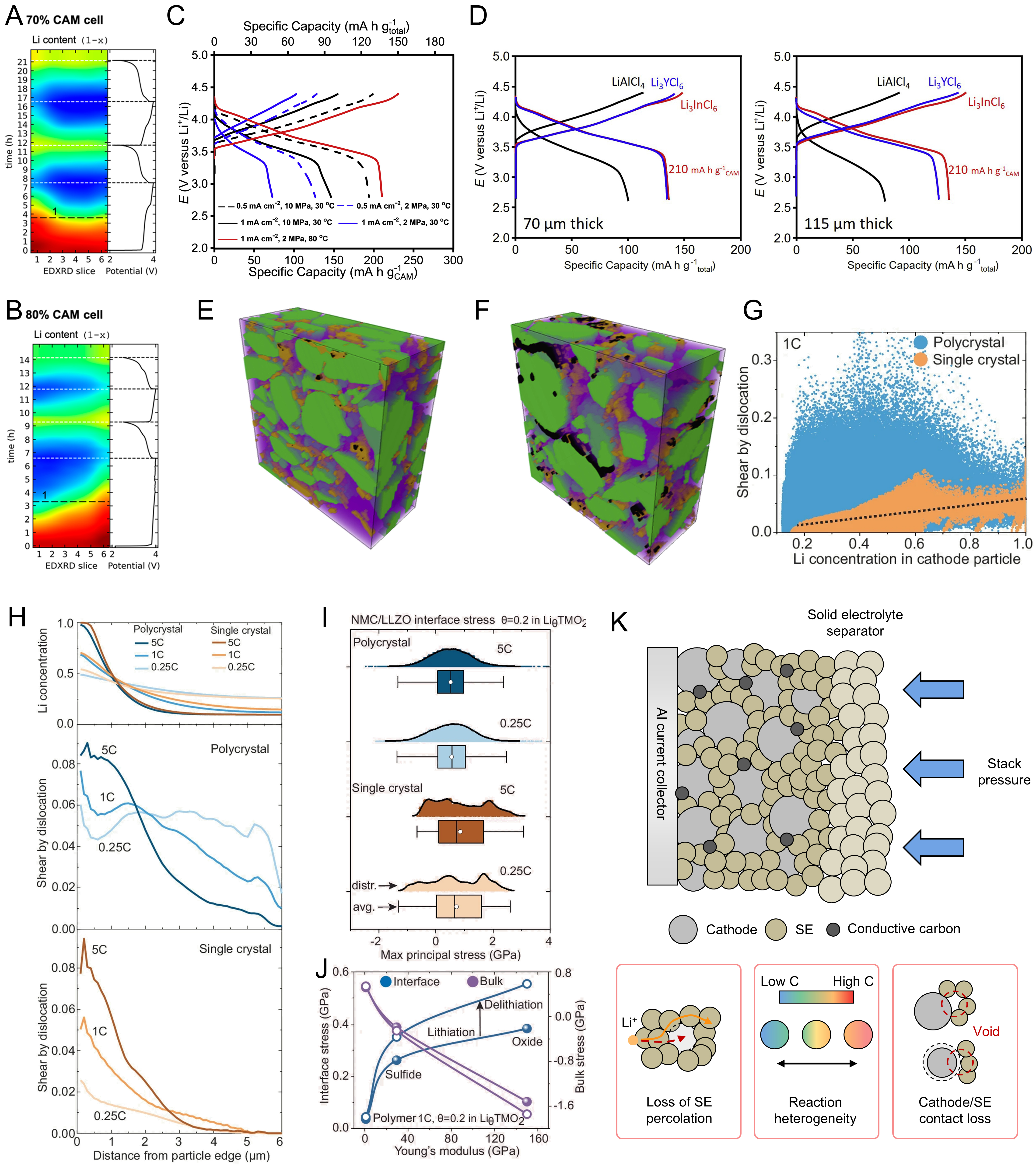
Figure 5. (A and B) Depth-dependent lithiation profiles of NMC111/Li6PS5Cl composite cathodes containing (A) 70 wt.% and (B) 80 wt.% CAM, obtained by high-energy depth-profiling XRD; (A and B) are reprinted with permission from Ref.[55] under a CC BY 4.0 license; (C) first-cycle capacity response of NMC83-based composite cathodes under different current-density, temperature, and stack-pressure conditions; (D) first-cycle specific-capacity profiles of 70 µm (left) and 115 µm (right) composite cathodes employing solid electrolytes with different ionic conductivities; (E) reconstructed 3D microstructure of the composite cathode before cycling; (F) reconstructed 3D microstructure of the composite cathode after 50 cycles; (C-F) are reprinted from Ref.[96] under a CC BY 4.0 license; (G and H) calculated distributions of (G) Li concentration and (H) dislocation-induced plastic shear in Ni-rich NCM composite cathodes; (I) CAM/SE interfacial stress during Li (de)intercalation; (J) dependence of interfacial stress on the mechanical properties of the SE; (G-J) are reprinted with permission from Ref.[97] under a CC BY 4.0 license; (K) schematic illustration of coupled transport, reaction, and chemo-mechanical degradation in thick ASSB composite cathodes. CAM: Cathode active material; NMC: nickel-manganese-cobalt; XRD: X-ray diffraction; SE: solid electrolyte; ASSB: all-solid-state battery.