

Uncertainty-aware physics-guided digital twins for lithium-ion batteries: toward integrated health, safety, and fast-charging management
 0
0 Abstract
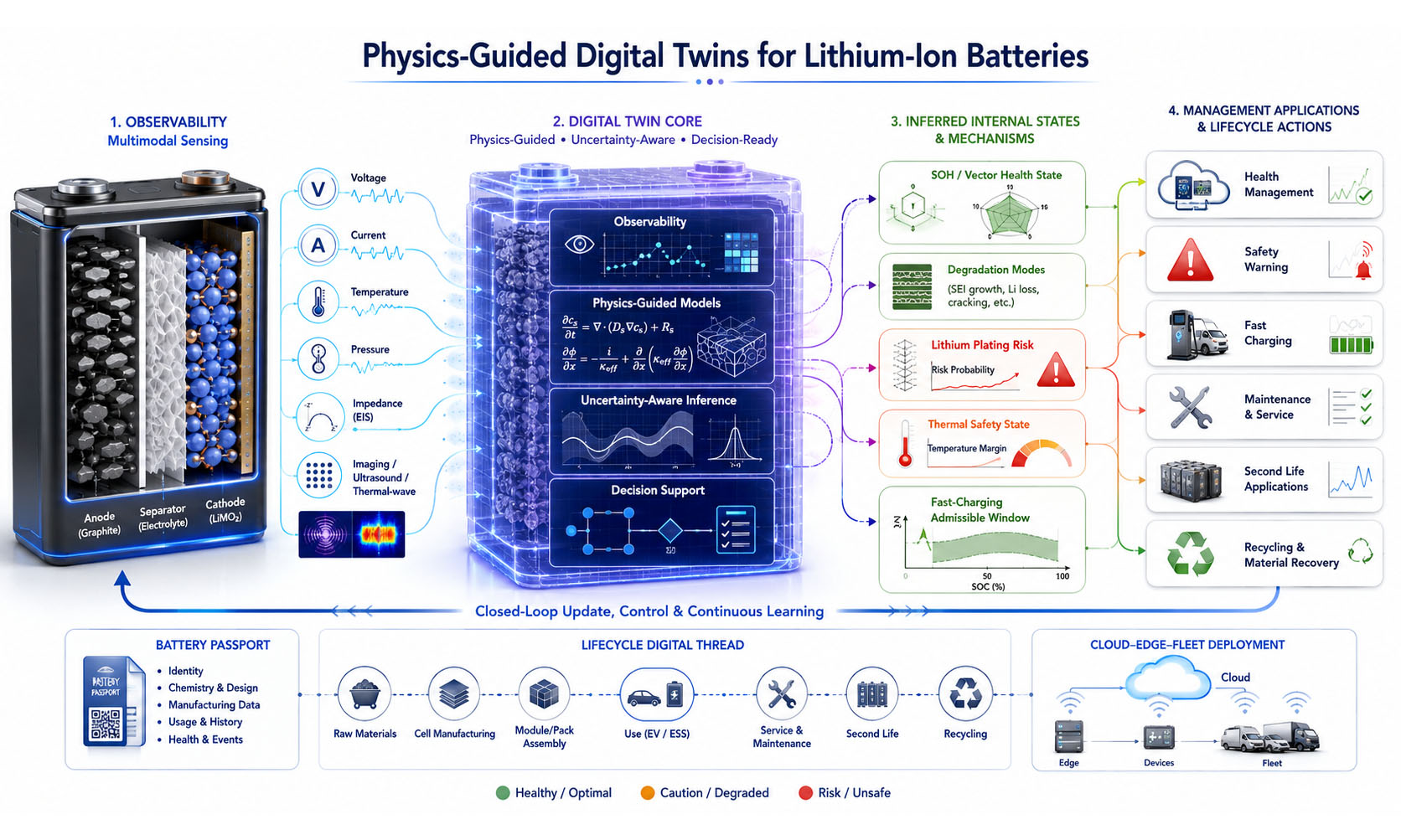
Lithium-ion battery management is shifting from scalar state estimation to integrated supervision of health, safety, and fast-charging capability. Existing reviews have addressed battery informatics, probabilistic prognostics, physics-guided learning, or digital-twin concepts as largely separate topics, but the connections among observability, mechanistic state representation, uncertainty quantification, and decision-oriented control remains underdeveloped. This Review reorganizes the field around uncertainty-aware physics-guided digital twins and argues that health loss, safety risk, and fast-charge limitations originate from coupled electrochemical, thermal, mechanical, and interfacial processes rather than from independent objectives. The discussion first identifies the shared physicochemical basis of degradation, with fast charging treated as a stringent validation case for a useful twin. The literature is then structured around four coupled layers: observability and data, physics-based and hybrid models, uncertainty-aware inference, and decision-facing control. On this basis, the Review examines health management beyond scalar state of health, plating-aware safety diagnosis, risk-constrained fast charging, and deployment from cell to pack and fleet levels. Finally, benchmarking, standardization, semantic data governance, and battery-passport requirements are discussed together with future opportunities in multimodal sensing, knowledge-enhanced twins, and autonomous closed-loop optimization. The central conclusion is that a deployable battery digital twin must be physics-grounded, uncertainty-calibrated, and explicitly designed to support decisions.
Keywords
INTRODUCTION
Lithium-ion batteries underpin electrified transportation, grid buffering, and portable electronics, yet large-scale deployment remains constrained by the coupled requirements of high energy density, short charging time, long lifetime, low cost, and safety. Recent reviews in Advanced Materials and npj Computational Materials show that machine learning (ML) has accelerated the transition from empirical trial-and-error workflows toward data-centric battery science, while also exposing the limitations of purely empirical optimization when data coverage, task relevance, and experimental validation are inadequate[1-3]. For electric vehicles and stationary storage, the central challenge is therefore no longer limited to discovering better materials; it is to manage each battery system safely and efficiently as it ages under heterogeneous real-world use.
Materials-level and lifecycle evidence further show why battery digital twins should be framed as materials-to-systems representations rather than as battery management system (BMS) software alone. Transport, interfacial stability, manufacturability, safety tolerance, and recycling constraints all influence which hidden states can be observed, which models remain valid, and which lifecycle decisions can be justified.
This systems-level challenge creates a natural role for digital twins. In the battery context, a digital twin should be understood as a continuously updated representation that integrates measurements, mechanistic priors, and inference to estimate internal states, predict degradation, quantify risk, and support operational decisions[4,5]. Such a representation is valuable only if it links hidden electrochemical and thermal states to actionable outcomes: health estimation, safety warning, fast-charging supervision, maintenance, and lifecycle decisions.
Fast charging illustrates the promise and difficulty of this framework. Closed-loop learning has shown that high-dimensional charging protocols can be searched efficiently[6]. Plating-aware pressure sensing[7], thermal-wave diagnostics[8], ultrasound imaging[9], and MHz-band electromagnetic measurements[10] further indicate that the practical limits of fast charging are controlled by latent electrochemical, thermal, and mechanical states rather than by voltage-current thresholds alone. Fast charging should therefore be treated as a state- and risk-dependent control problem, not as a fixed protocol-design problem.
The main barrier is the gap between laboratory observability and field deployment. Vehicle batteries rarely experience ideal full cycles; instead, they operate through fragmented charging, partial-discharge windows, thermal variability, cell-to-cell inconsistency, and sparse labels for true health states. A Communications Engineering study demonstrates that large electric vehicle (EV) datasets can support more realistic state-of-health estimation[11], while a Nature Communications analysis of open-source EV data further reveals persistent ambiguity in state of health (SOH) definition, pack-level heterogeneity, and operational domain shift[12].
Existing reviews often cover only one part of this landscape - battery informatics[2], application-oriented battery ML[3], physics-guided ML[4], or probabilistic health prognostics[5] - and therefore stop short of a unified account of how sensing, modeling, inference, and decision-making should be connected. This revised review adopts a different organizing principle. Instead of cataloging algorithms, it focuses on uncertainty-aware physics-guided digital twins as decision systems for integrated health, safety, and fast-charging management.
What is still missing is a framework that is sufficiently mechanistic to remain meaningful under distribution shift, yet sufficiently adaptive to remain useful under fragmented operating data and evolving battery conditions. This missing middle is precisely where battery digital twins become relevant. In this context, a digital twin should not be reduced to a high-fidelity simulator, a software dashboard, or a machine-learning predictor. It should instead be understood as a decision-oriented representation of the battery that is continuously updated by measurements, informed by mechanistic priors, and evaluated against uncertainty. Such a definition is especially important in electrochemical systems because degradation-mode analysis shows that multiple internal pathways can generate similar terminal voltage and capacity trajectories[13], while spatially resolved plating simulations further illustrate why internal-state representation is needed beyond scalar terminal signals[14].
A second unresolved issue concerns scale. Much of the literature on battery diagnostics is still framed around single cells under well-controlled laboratory protocols, whereas practical battery management must operate at the level of packs, fleets, and lifecycle decision chains. Thermal gradients, current maldistribution, module imbalance, charging-station heterogeneity, and incomplete ground truth all alter the meaning of state estimation once deployment moves from the cell cycler to the vehicle or storage system[11-13]. Consequently, a review focused only on cell-level inference or only on algorithm families risks missing the system's problem that motivates digital twins in the first place.
A third unresolved issue concerns interpretation. A growing body of recent work argues that the central variables for battery management are not single scalar labels, but latent representations that connect what can be observed to what must be controlled. For health, this means degradation modes rather than capacity alone[13]. For charging, it means internal plating dynamics and a risk-conditioned action set rather than a universally optimal protocol[14,15]. For safety, it means a latent state of safety rather than post hoc threshold alarms[16]. These developments suggest that the most useful future battery-management frameworks will be structured around hidden states, uncertainty, and control relevance instead of around isolated prediction tasks[5].
This review therefore aims to provide a more closed analytical narrative than is typical in existing battery-ML surveys. Rather than treating health estimation, safety diagnosis, fast charging, sensing, uncertainty quantification, and deployment as parallel themes, the article argues that they are different expressions of the same multi-layered problem. The central thesis is that a deployable battery digital twin must be simultaneously physics-grounded, uncertainty-aware, and decision-oriented. The discussion is organized accordingly: Section SHARED PHYSICOCHEMICAL ORIGINS OF HEALTH, SAFETY, AND FAST CHARGING identifies the shared physicochemical basis of health loss, safety escalation, and fast-charging limitation; Section ARCHITECTURE OF UNCERTAINTY-AWARE PHYSICS-GUIDED DIGITAL TWINS defines the architecture of uncertainty-aware physics-guided digital twins; Section DIGITAL-TWIN-ENABLED HEALTH MANAGEMENT examines digital-twin-enabled health management beyond scalar SOH; Section SAFETY DIAGNOSIS AND RISK-CONSTRAINED FAST CHARGING turns to safety diagnosis and risk-constrained fast charging; Section DEPLOYMENT REALISM, BENCHMARKING, AND DATA GOVERNANCE addresses deployment, benchmarking, and data governance; and Sections OUTLOOK: TOWARD TRUSTWORTHY AND AUTONOMOUS BATTERY TWINS and CONCLUSION synthesize future directions and the main conclusion.
Table 1 positions representative prior work according to the role it plays in this Review: data-centric battery science, probabilistic prognostics, physics-guided modeling, operando observability, field-data deployment, and lifecycle data governance.
Representative prior studies grouped by conceptual role in the present review
| Conceptual strand | Representative article | Role in the present review |
| Data-centric battery research | Lv et al., “Machine learning for materials development and state prediction in lithium-ion batteries” (Adv. Mater. 2022)[1] | Establishes the broader AI landscape and motivates the shift from empirical workflows to data-centric battery science |
| Battery informatics | Ling, “A review of the recent progress in battery informatics” (npj Comput. Mater. 2022)[2] | Clarifies the main data sources, bottlenecks, and machine-learning task families in battery research |
| Application-oriented ML | Wang, “Application-oriented design of machine learning paradigms for battery science” (npj Comput. Mater. 2025)[3] | Reframes battery ML in terms of task relevance, data adequacy, and experimental validation |
| Physics + ML for management | Borah et al., “Synergizing physics and machine learning for advanced battery management” (Commun. Eng. 2024)[4] | Provides the conceptual backbone for internal/external integration and battery digital twins |
| Probabilistic battery prognostics | Thelen et al., “Probabilistic machine learning for battery health diagnostics and prognostics” (npj Mater. Sustain. 2024)[5] | Defines uncertainty types, task taxonomy, and calibration-focused evaluation |
| Fast-charging optimization | Attia et al., “Closed-loop optimization of fast-charging protocols” (Nature 2020)[6] | Demonstrates learning-in-the-loop charging-policy optimization |
| Plating-aware operando sensing | Huang et al. (pressure)[7], Zeng et al. (thermal-wave)[8], Wasylowski et al. (ultrasound)[9], Ishigaki et al. (MHz electromagnetics)[10] | Shows that plating and related side reactions are becoming partially observable during operation |
| Automotive field data | von Bülow et al. (Commun. Eng. 2024)[11]; Liu et al. (Nat. Commun. 2025)[12] | Shows both the promise and the limitations of real-world data for pack-level health estimation |
| Degradation-mode interpretation | Li et al., “The importance of degradation mode analysis ...” (Nat. Commun. 2025)[13] | Explains why capacity-only fitting is insufficient and why degradation modes should be explicit state targets |
| Hybrid and physics-informed learning | Wang et al. (PINN, Nat. Commun. 2024)[17]; Che et al. (mechanistic residual learning, Nat. Commun. 2026)[18] | Representative routes for embedding mechanism into learnable battery twins |
| Digital-twin-enabled diagnosis | Guo et al., “Digital twin-assisted degradation diagnosis during fast charging” (Adv. Energy Mater. 2024)[15] | Links fast-charging actions directly to aging modes and mechanistic interpretation |
| Data semantics and governance | Clark et al., “Toward a unified description of battery data” (Adv. Energy Mater. 2022)[19]; EU Battery Regulation 2023/1542[20] | Shows why ontology, standardization, and battery passports are central to deployable battery twins |
SHARED PHYSICOCHEMICAL ORIGINS OF HEALTH, SAFETY, AND FAST CHARGING
Health estimation, safety protection, and fast charging are often treated as separate engineering problems, yet in practice they are different manifestations of one coupled degradation landscape. Mechanism-aware analyses show that capacity fade, power fade, plating propensity, and safety escalation are linked through shared electrochemical and mechanical pathways, including solid electrolyte interphase (SEI) growth, electrolyte depletion, lithium plating, active-material loss, and particle cracking[5,13]. This observation matters because very different internal states can produce similar external capacity-loss trajectories, especially when only voltage or resistance are used as labels[13]. A useful digital twin must therefore explain not only how much performance has been lost, but why it has been lost.
This is why degradation modes are more informative than scalar health labels. The now common decomposition into lithium inventory loss (LLI), positive-electrode loss of active material (LAMPE), and negative-electrode loss of active material (LAMNE) offers a physically meaningful middle layer between latent mechanisms and measurable performance[5,13]. Once health is expressed in this intermediate form, state estimation, remaining-life prediction, and charging control can be connected more naturally because the twin can reason over the mechanism space instead of over a single capacity number.
Fast charging is the harshest validation case for such reasoning. Under low-temperature, high-current, heterogeneous internal transport conditions, local overpotentials rise, and lithium plating becomes more likely, while thermal and structural nonuniformity amplifies the damage[6,7]. Operando pressure measurements[7], thermal-wave sensing[8], ultrasound visualization[9], and MHz electromagnetic diagnostics[10] further show that plating and related side reactions are spatially distributed, time-varying phenomena rather than discrete threshold events. As a result, the limiting quantity for fast charging is not current alone but the joint evolution of latent electrochemical, thermal, and risk states.
The same logic extends from cell to pack scale. In practical EV systems, the relevant state space includes not only cell-level state of change (SOC) and degradation modes, but also pack-level thermal gradients, current maldistribution, worst-cell margin, and evolving operational context[11,12]. The lab-to-field gap therefore changes the task definition of a digital twin: the objective is no longer the accurate fitting of curated cycling data, but robust state reconstruction and decision support under partial observability, domain shift, and sparse ground truth.
Two analytical consequences follow from this observation. The first is that identifiability becomes a central issue. If different combinations of LLI, LAMNE, interfacial impedance growth, electrolyte depletion, and structural heterogeneity can reproduce similar external degradation curves, then capacity-only model fitting is intrinsically underdetermined. A management framework built only on terminal variables may therefore remain blind to whether the limiting factor is lithium inventory, active-material accessibility, transport resistance, or plating risk. This is not a semantic nuance. It directly affects whether a battery should be charged more conservatively, thermally conditioned, derated, repurposed, or retired[10,13].
The second consequence is that health, safety, and fast charging cannot be separated by time scale as cleanly as they often are in engineering practice. Slow interphase growth, transition-metal dissolution, and active-material isolation reshape local transport pathways[13,21]; those transport limitations alter overpotential distributions during fast charging[6,7]. Elevated local overpotentials, in turn, increase the likelihood of plating, gas generation, or localized heat release[9,22]. In this sense, fast charging is not an independent objective layered on top of a healthy battery. It is an operational regime that exposes the evolving internal state of the battery more aggressively than mild cycling does. Recent work on air-exposure failure of single-crystal high-nickel cathodes further illustrates that storage history can alter interfacial chemistry before apparent capacity loss becomes severe[23].
This coupling is particularly visible when degradation is viewed through the lens of propagation. At the cell level, the relevant progression may be from interfacial growth to transport limitation, then to plating or self-heating. At the pack level, the same progression is amplified by nonuniform cooling, electrical interconnection, and balancing constraints. A cell that is only moderately aged in isolation can become the worst cell in a series-connected string, limiting both pack power and safe charging current. The cell-to-pack transition is therefore not a mere scaling problem; it changes which latent variables become safety-critical and which observables retain diagnostic value[11,12].
Recent safety-focused studies have begun to articulate this bridge more explicitly. Degradation-mode analysis and spatially resolved plating models connect ageing to mechanism evolution[13,14], while pack diagnostics and fault-diagnosis frameworks link local faults to system-level risk[24,25]. That viewpoint is highly relevant here because battery digital twins must eventually operate across the same continuum. A useful twin should therefore not be designed only to estimate gradual ageing or only to detect rare events. It should instead be able to represent how long-term ageing modifies near-term hazard thresholds and how abnormal operation reshapes future degradation trajectories. Similar scale coupling is evident in abnormal-thermal studies of all-solid-state batteries, where cracking and lithium-dendrite growth remain coupled to local thermal and mechanical states[26].
Figure 1 summarizes this coupled landscape from application need to latent mechanism. The application map in Figure 1A sets the management requirements. Figure 1B and C then show that capacity fade and power fade arise from interacting degradation submodels and degradation modes rather than from a single ageing coordinate[13]. Figure 1D adds spatially resolved plating dynamics[14], and Figure 1E adds electrothermal nonuniformity under spatial thermal gradients[22]. Figure 1F-H show how these mechanisms become difficult to infer in EV field data[12]. Figure 1I therefore frames the digital twin as a systems-level response to a many-to-one inverse problem: multiple latent degradation pathways can project onto similar terminal signals, so management requires an internal-state representation rather than a scalar label alone.
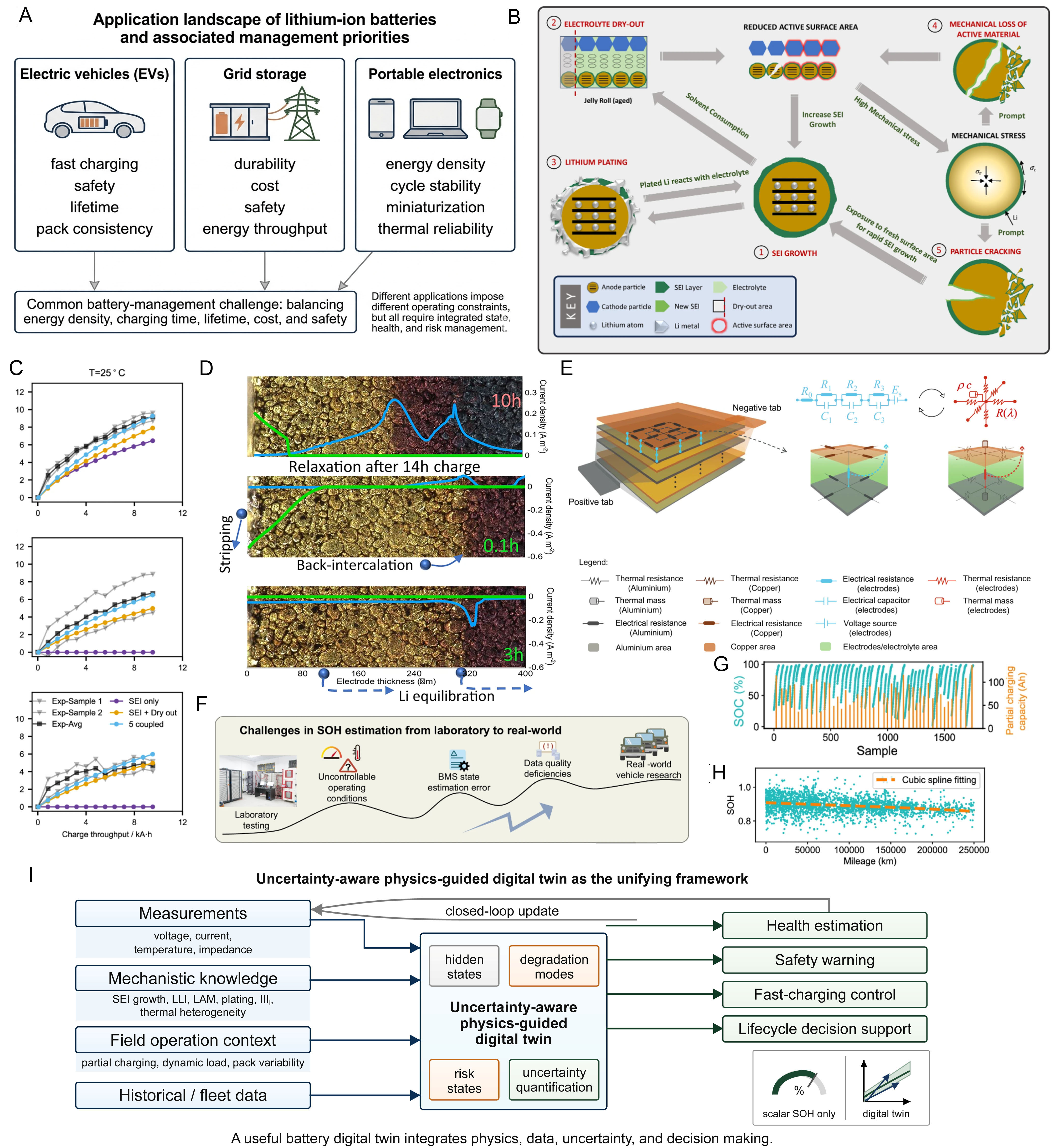
Figure 1. Shared physicochemical origins of health, safety, and fast charging. (A) Application landscape and management priorities for lithium-ion batteries; (B) Coupled degradation submodels, including SEI growth, electrolyte dry-out, lithium plating, active-material loss, and particle cracking; (C) Degradation-mode trajectories involving LLI, LAMNE, and LAMPE. Figure 1B and C are reprinted from Ref.[13], under the CC BY 4.0 license; (D) Phase-field prediction of lithiation/delithiation and plating/stripping current distributions during charge and relaxation. Figure 1D is reprinted from Ref.[14], under the CC BY 4.0 license; (E) Electrothermal network representation of a pouch cell under spatially resolved thermal gradients. Figure 1E is reprinted from Ref.[22], under the CC BY 4.0 license; (F) Real-world EV SOH estimation challenges; (G) Fragmented EV charging behavior; (H) Fleet-level SOH variability. Figure 1F-H is reprinted with permission from Ref.[12]. Copyright © 2025 Springer Nature; (I) Uncertainty-aware physics-guided digital twin as the unifying framework. SEI: Solid electrolyte interphase; LLI: lithium inventory loss; LAM: loss of active material; SOC: state of change; SOH: state of health; LAMNE: negative-electrode loss of active material; LAMPE: positive-electrode loss of active material; EV: electric vehicle.
A useful way to make this coupling more concrete is to separate the latent failure landscape from its observable manifestations. At the latent level, the primary actors are interphase growth, active-material isolation, electrolyte consumption, plating, crack nucleation, oxygen release, and heat generation. At the observable level, the quantities seen by the BMS are far more compressed: voltage trajectory, apparent capacity, impedance rise, relaxation behavior, pressure, temperature, and, occasionally, gas emission. The mapping from the first set to the second is many-to-one. The same terminal voltage depression can arise from lithium loss, transport limitation, thermal imbalance, or contact degradation. Conversely, a small change in one observable, such as dP/dQ, may carry disproportionate information about plating-sensitive mechanics[7], field-data ambiguity[12], degradation-mode/plating non-uniqueness[13,14], thermal-gradient effects[22], or early-trajectory uncertainty[27]. The digital-twin problem is therefore fundamentally an inverse problem under structural non-uniqueness.
Recent degradation-and-safety studies further suggest that ageing modifies not only the mean performance trajectory but also the shape of the hazard landscape[13,28-30]. Aged cells may exhibit lower tolerance to mechanical abuse[31,32], altered separator resilience, earlier self-heating onset[28,29], modified gas-evolution chemistry[33], and different thermal-runaway heat release[34,35]. This means that degradation cannot be treated as a neutral background trend that simply lowers capacity. It actively changes the triggering conditions, escalation pathways, and observability of extreme events[30,36]. Put differently, ageing does not merely precede safety failure; it conditions the entire fault-to-hazard transition. For a digital twin, this implies that safety states should be conditioned on health states, and health states should be updated with awareness of safety-relevant operating history.
A related point is that fast charging should be understood as an information-rich perturbation. Under mild cycling, many harmful mechanisms evolve slowly and remain partly latent[13,21]. Under fast charging, closed-loop high-rate operation amplifies kinetic and thermal sensitivity[6]; pressure, thermal-wave, ultrasound, and electromagnetic measurements then make otherwise subtle local reactions more observable[7-10]. This is one reason why fast charging is a stringent validation scenario for battery twins: it magnifies both the opportunity for state discrimination[15] and the penalty for model misspecification under thermal and electrochemical heterogeneity[22,37]. A twin that remains well calibrated under fast charging is likely to be informative under gentler conditions; the converse is not necessarily true.
The coupling among degradation, fault development, and catastrophic failure can also be viewed through a timescale hierarchy. Slow processes such as SEI growth[13,38], lithium inventory loss[13], and contact degradation[21] reshape the baseline electrochemical state over weeks to months. Intermediate processes, such as localized lithium deposition[7,10], gas generation[33], or thermal imbalance under repeated high-rate operation[22], evolve over cycles or hours. Very fast processes, such as internal short circuits[31,32], violent gas release[33,35], or thermal runaway[39,40], can unfold in minutes or seconds. A battery digital twin that aims to be decision-useful must therefore preserve continuity across these timescales. It is not enough to estimate long-term health without relating it to short-term hazard, nor to detect short-term anomalies without situating them within the ageing state that conditioned them[13,14].
This continuity matters because interventions also operate on different timescales. Design changes, electrolyte choices, and formation protocols act before the battery is deployed[41]. Thermal conditioning, charging control, and balancing operate during use. Maintenance, warranty, repurposing, and recycling decisions act later in the lifecycle[42]. The same hidden state may influence all of them, but in different ways. For example, a pack with modest average capacity fade, but a strongly degraded worst-cell may still be acceptable for some use scenarios while being inappropriate for extreme fast charging or second-life deployment. An integrated digital twin is attractive precisely because it can preserve this causal continuity across lifecycle stages rather than allow the battery to be reinterpreted independently at each stage[19,20].
The degradation-to-safety bridge can also be interpreted in terms of progressive versus abrupt failure regimes. In a progressive regime, latent damage accumulates through repeated cycling, thermal gradients, local plating, gas accumulation, or contact degradation[13,21], until the battery enters a state in which even routine operation becomes hazardous. In an abrupt regime, an acute trigger such as severe short-circuiting or mechanical damage drives the battery into failure on a short timescale[24,39]. Yet the severity of that event is still conditioned by the pre-existing degradation state[40,43]. This distinction is useful because it shows that battery safety is neither wholly slow nor wholly sudden. It is conditioned by ageing but revealed by events. A practical digital twin must therefore represent both the gradual movement of the battery toward risk and the acute transitions by which that risk becomes visible[14].
A remaining scientific gap is to translate degradation modes into risk thresholds that are both physically identifiable and operationally actionable. Studies on localized high-temperature instability show that similar capacity loss may correspond to different thermal-stability envelopes[21,44,45]. Work on side-reaction amplification[46] and thermal-runaway onset[35,47] further indicates that heat release and self-heating pathways depend strongly on interfacial chemistry and abuse history. Reports on aged-cell risk asymmetry[28,29] and sudden-death failure[30] show that the same nominal SOH can conceal very different escalation routes. In other words, the relevant state is not merely how much the battery has degraded, but how that degradation reshapes the latent pathways by which faults escalate. This is precisely the level of closure a useful digital twin must achieve: it must connect LLI/LAM-type degradation coordinates to transport limitation, self-heating propensity, short-circuit susceptibility, and thermal-runaway severity rather than treating these as independent labels.
ARCHITECTURE OF UNCERTAINTY-AWARE PHYSICS-GUIDED DIGITAL TWINS
Definition and scope
In this review, an uncertainty-aware physics-guided digital twin is defined as a continuously updated digital representation of a battery system that couples measurement streams, mechanistic priors, and data-driven adaptation to estimate hidden states, predict degradation, quantify risk, and support control[4,5]. This definition deliberately distinguishes a digital twin from both a standalone simulator and a standalone machine-learning model. A simulator may provide mechanistic consistency without sufficient adaptability, while a black-box predictor may interpolate well without clarifying what is physically happening inside the cell.
The qualifier uncertainty-aware is essential. Battery behavior varies across cells, across usage histories, and across operational domains, so any practically useful twin must represent what is known and what remains ambiguous. Following recent probabilistic battery reviews, uncertainty should be carried through the full stack: from noisy or missing observations, to imperfect model form and drifting parameters, to predictive risk under unseen conditions[5]. This is especially important when twin outputs are used to determine charging aggressiveness or safety margins, where overconfidence can be more harmful than modest point-prediction error.
In practice, this definition implies that the twin must sit between measurement and action, rather than at either end of the pipeline. If it is reduced to an offline model, it cannot adapt. If it is reduced to a direct control policy, it cannot explain or calibrate. If it is reduced to a static dashboard of measured signals, it cannot infer latent states. The distinctive value of a digital twin therefore lies in preserving a mechanistically meaningful internal state[13], while remaining open to data-driven correction[4,48] and uncertainty-aware updating[5].
A second implication is that the twin should be evaluated by the quality of the decisions it enables, not only by the error of the intermediate variables it predicts. Accurate SOH estimation is important, but the engineering question is whether that estimate leads to more appropriate charging limits, thermal interventions, maintenance recommendations, or second-life decisions. Likewise, a physically elegant model is not automatically a useful twin if it cannot be synchronized with measurements or if its uncertainty is not interpretable to downstream control layers. This decision-facing perspective is what differentiates a battery digital twin from an advanced battery model[4,5,49].
Figure 2 should be read as the architectural bridge between the conceptual definition of a battery digital twin and the observability layer discussed below. Figure 2A defines the minimum closed loop in which observations are translated into a mechanistic state representation, uncertainty is carried through inference, and the estimated state constrains action[50,51]. Figure 2B extends this loop into a cloud BMS and cloud-side-end collaboration architecture for data sensing, storage, analytics, visualization, and coordinated updating[50,52]. Figure 2C shows how field data are converted into multimodal health features rather than treated as unstructured telemetry[12]. Figure 2D and E introduce privacy-preserving retired-battery sorting, where data contributors train local models and share parameters rather than raw data[49]. Figure 2F moves the same logic to fleet-scale fault warning through a central hyper-model and owner-specific local models[48]. Figure 2G and H then show how mechanistic priors and residual learning can keep SOC/SOH estimates synchronized as cells age[18]. Figure 2I abstracts these elements into a cloud-edge-fleet personalization loop. The figure, therefore, does not merely collect management platforms; it defines the information pathway by which a twin remains synchronized, individualized, and decision-relevant under field conditions.
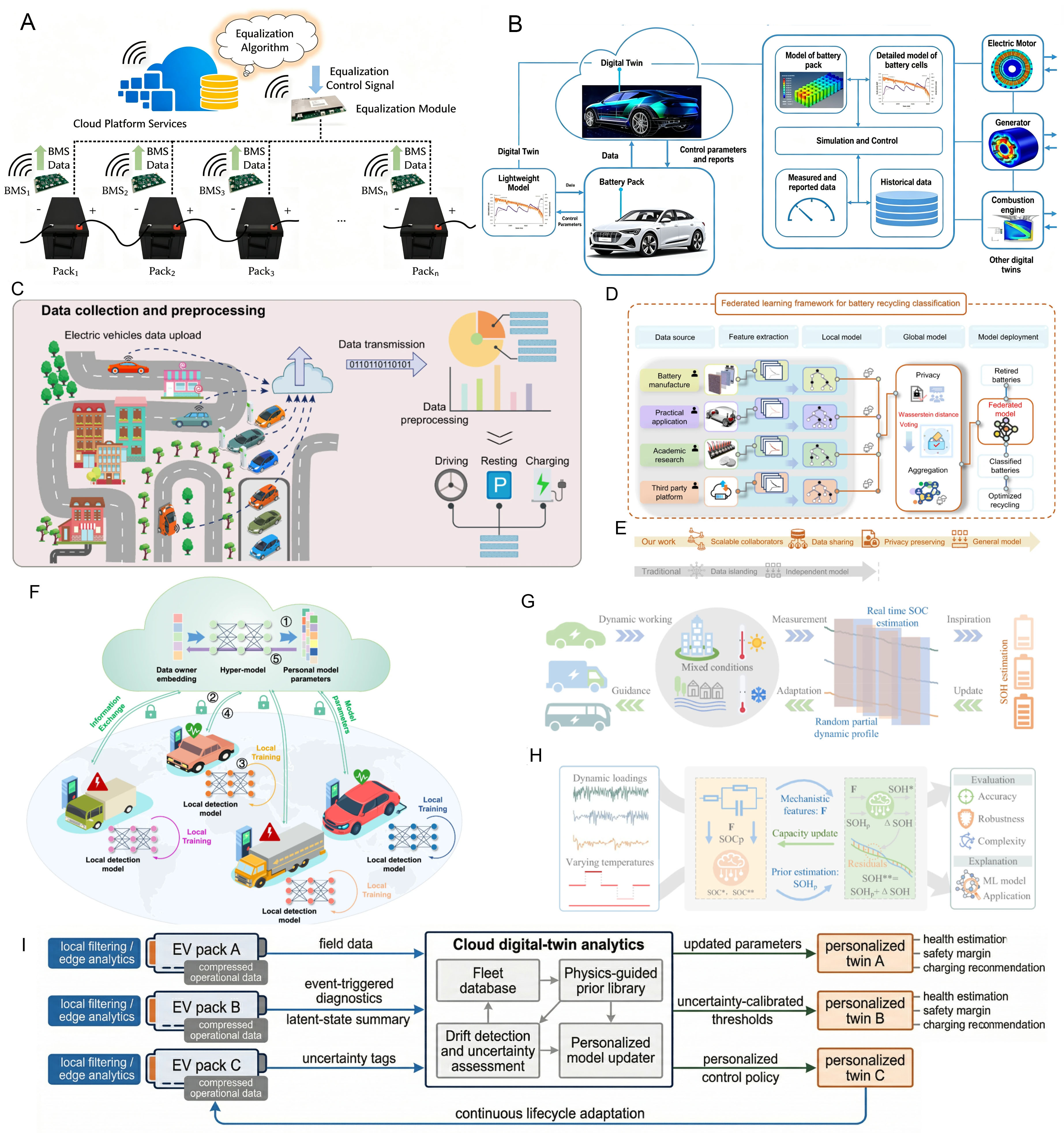
Figure 2. Closed-loop architecture of uncertainty-aware physics-guided digital twins. (A) Digital twins-assisted equalization strategy of the batteries; (B) Battery Digital twins concept in COMSOL Multiphysics®. Figure 2A and B is reprinted from Ref.[50], under the CC BY 4.0 license; (C) Multimodal field-data feature construction for EV SOH estimation, including voltage maps, charge-capacity and temperature sequences, and point features. Figure 2C is reprinted with permission from Ref.[12]. Copyright © 2025 Springer Nature; (D) Multi-contributor federated learning framework for retired-battery sorting without raw-data exchange; (E) Privacy-preserving collaboration compared with the conventional data-islanding paradigm. Figure 2D and E is reprinted from Ref.[49], under the CC BY 4.0 license; (F) Personalized federated fault-warning architecture using a central hyper-model and local owner-specific models for massive EV fleets. Figure 2F is reprinted with permission from Ref.[48]. Copyright © 2025 Springer Nature; (G) Closed-loop residual-learning demonstration for battery monitoring; (H) Mechanistically inspired SOC/SOH monitoring pipeline for lifelong state correction. Figure 2G and H is reprinted with permission from Ref.[18]. Copyright © 2026 Springer Nature; (I) Cloud-edge-fleet updating and personalization loop for battery digital twins. BMS: Battery management system; SOC: state of change; SOH: state of health; EV: electric vehicle.
Observability, data sources, and the lab-to-field gap
The first architectural pillar is observability. Conventional voltage, current, and surface temperature signals remain indispensable because they are inexpensive, continuous, and already available in most BMS hardware[11]. Yet recent work makes clear that these channels alone are not sufficient for many of the most consequential hidden variables. Online impedance concepts[53], data ontologies for battery semantics[19], and multiscale characterization frameworks spanning electrochemical, thermal, and microstructural measurements[41] together suggest that digital twins should be built from a hierarchy of data modalities rather than from one monolithic timeseries.
This hierarchy should combine at least four sources of information: battery informatics and laboratory data resources[2], operational field data from real use[11], structured knowledge and data semantics[19], and high-fidelity characterization or virtual experiments across the battery lifecycle[41]. The practical implication is that data engineering becomes part of model design. What the vehicle stores, what the cloud aggregates, and what the twin treats as a label or latent state all shape the eventual notion of battery health and risk.
From the standpoint of observability, the key challenge is not only that the most consequential variables are hidden, but that the available observables have unequal diagnostic value across conditions. Voltage and current remain essential for SOC tracking and pack-level consistency, but they lose specificity during dynamic load transients[11,51]. Temperature can indicate thermal imbalance but often lags internal reactions[22]. Pressure and strain sensing are sensitive to plating, gas generation, and swelling[7,25]. Ultrasound and MHz-band electromagnetic diagnostics can probe spatial heterogeneity and Li-metal signatures[9,10], whereas impedance captures interfacial and transport evolution[53,54]. A deployable twin therefore requires modality selection rather than modality accumulation: each signal should be judged by the hidden states it makes more identifiable, the conditions under which it remains informative, and the cost of acquiring it at scale.
This is one reason why the lab-to-field gap should be treated as an observability problem rather than merely as a data-volume problem. In the laboratory, one can impose full cycles, control temperature, and measure reference quantities with high fidelity[39]. In the field, the twin instead receives fragmented charging windows, irregular driving loads, varying ambient conditions, missing metadata, and pack-level interactions[11,12]. The question is therefore not simply whether a laboratory-trained model generalizes, but whether the field data contain enough information to reconstruct the variables that the model was built to estimate[18,55].
The answer may differ by task. For capacity-oriented health tracking, partial-charge or fragmented-charge features may suffice[7,56]. For degradation-mode diagnosis, richer signatures such as impedance, relaxation, or controlled perturbations may be required[18,54]. For safety and fast charging, pressure sensing[7], thermal-wave measurements[8], ultrasound imaging[9], electromagnetic diagnostics[10], cross-scale spatial models[37], and internal thermal/pressure evidence[57] can become decisive because the relevant precursors are spatial, local, and strongly condition-dependent. The design of a digital twin therefore begins not with architecture diagrams but with a rigorous statement of which hidden variables are needed for which decisions, and which measurements make those variables recoverable.
This point also implies that observability is partly an experimental-design problem. If the relevant latent states are weakly expressed in passive field trajectories, then the twin must either exploit naturally informative events, including thermal propagation or pressure-sensitive transients[58-60], ageing-mode and fault-evolution signatures[61,62], and overcharge/thermal-runaway responses[63], or call on lightweight active probing through impedance excitation, controlled balancing perturbations, or fault-residual monitoring[53,54,64]. Safety-oriented estimation studies similarly show that early fault detection depends on whether the selected evidence stream is sensitive to the target latent state: onboard degradation prediction and early-trajectory models provide one route[54,65-67], while impedance and lab-on-fiber diagnostics provide another[55,68]. Recycling-oriented and impedance-relaxation studies add further validation routes under incomplete evidence[69-71]. Thus, the quality of a battery twin depends not only on the model class employed but also on whether the available evidence is sufficiently informative for the variables being estimated.
An equally important principle is identifiability under limited stimulation. In laboratory diagnostics, one can deliberately impose informative experiments such as full Constant Current - Constant Voltage (CC-CV) cycles, relaxation sequences, impedance sweeps, or controlled thermal perturbations[53-55]. In real operation, the battery often experiences whatever the user or the application demands. This means that the twin must infer as much as possible from passively observed trajectories while also recognizing when passive observation is insufficient. The most useful architectures may therefore combine passive monitoring with occasional active probing, for example through controlled charging segments[21,46,47], balancing-resistor perturbations[53], or opportunistic impedance measurements[54,64].
Table 2 maps these observability trade-offs by relating each modality to the hidden states it makes more identifiable, its strengths, its deployment limits, and its present maturity.
Observability modalities for deployable battery digital twins
| Modality | Hidden states informed | Advantages | Deployment limits | Maturity |
| Voltage, current, temperature | SOC; ohmic trend; pack imbalance; coarse thermal state[11,12] | Low cost; continuous; already in BMS[51] | Limited specificity for local interfacial events[7,10] | High |
| Impedance/EIS | Charge-transfer resistance; diffusion limit; interfacial evolution[53,54] | Mechanism-rich; supports probabilistic forecasting[54] | Excitation/synchronization burden; limited field deployment[53] | Medium |
| Pressure/strain | Plating; gas generation; swelling; mechanical integrity[7,57] | Early sensitivity to local side reactions[7] | Packaging dependence; difficult pack integration[7] | Medium |
| Thermal-wave / internal sensing | Effective thermal conductivity; degradation pathway; self-heating precursor[8,57] | Pathway-sensitive thermal signatures[8] | Additional hardware and contact design required[8] | Medium |
| Ultrasound / magnetic diagnostics | Internal heterogeneity; plating morphology; current maldistribution[9,10] | Non-destructive access to spatially distributed states[9,10] | High instrumentation complexity; limited automotive maturity[9,10] | Low-Medium |
| Field/fleet metadata | Usage context; transfer regime; owner-specific risk; lifecycle traceability[11,12,48] | Critical for deployment realism and personalization[48,49] | Incomplete, heterogeneous, and weakly standardized[19,20,42] | High collection / low semantic integration |
Together, Figure 3A-C show why mechanical pressure can expose lithium plating earlier than voltage-only monitoring[7]. Figure 3D-F extend observability to thermal-contact and degradation-pathway information[8]. Figure 3G and H add spatially resolved ultrasound imaging[9], whereas Figure 3I-K show that high-frequency electromagnetic response can encode metallic-lithium signatures[10]. These examples support the central point that deployable twins require state-targeted observability rather than indiscriminate sensor accumulation.
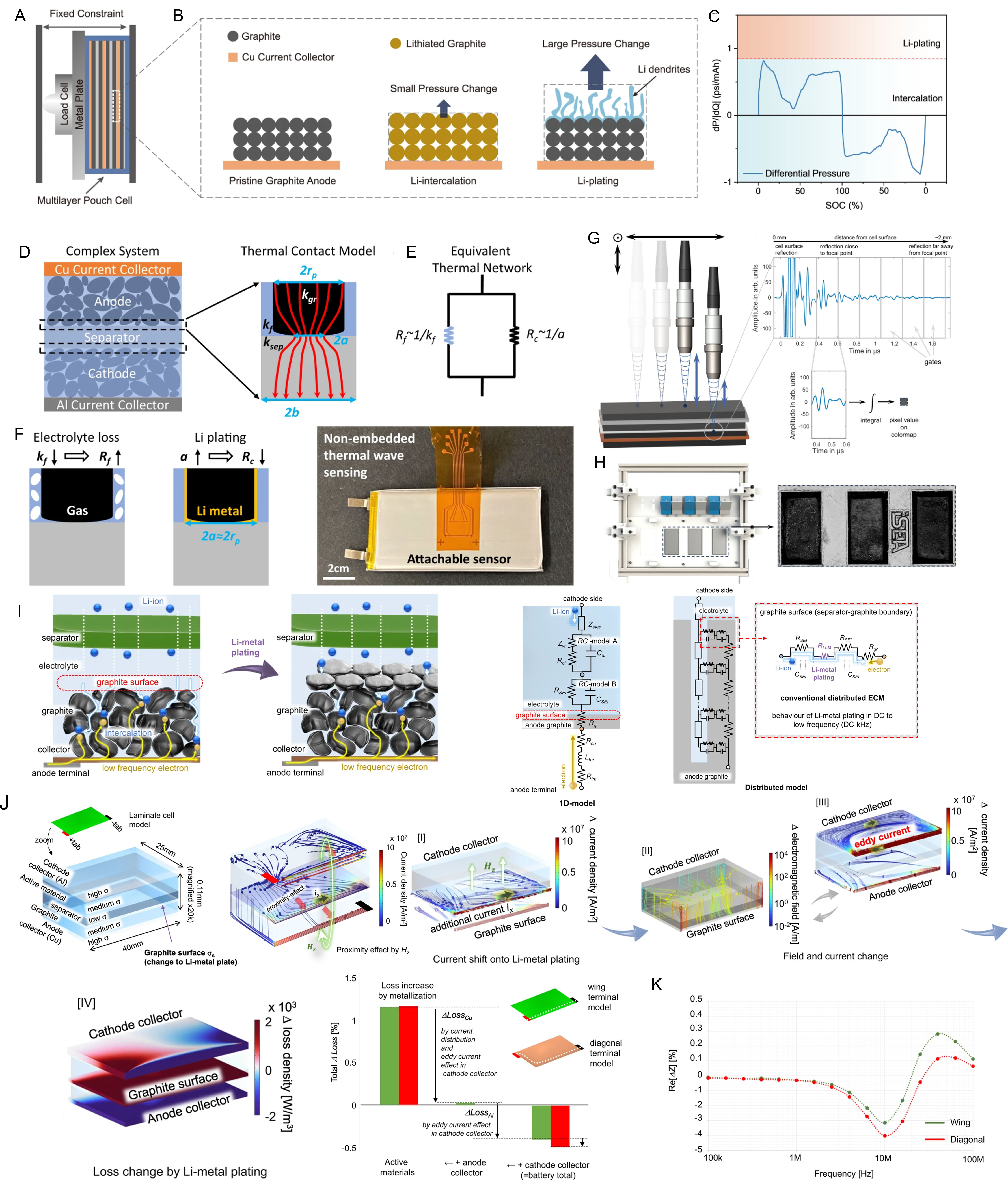
Figure 3. Multimodal observability for hidden electrochemical, thermal, and mechanical states. (A) Operando differential-pressure sensing configuration for pouch cells; (B) Pressure-change mechanism distinguishing lithium plating from intercalation; (C) Pressure-derived lithium-plating threshold from the dP/dQ profile. Figure 3A-C is reprinted from Ref.[7], under the CC BY 4.0 license; (D) Thermal-wave unit-cell and contact model for porous electrodes; (E) Equivalent thermal network for separator-electrode contact; (F) Attachable thermal-wave sensing for pathway-resolved degradation interpretation. Figure 3D-F is reprinted from Ref.[8], under the CC BY 4.0 license; (G) Ultrasound scanning and gated signal acquisition for operando plating visualization; (H) Signal-to-image reconstruction for ultrasound imaging. Figure 3G and H is reprinted from Ref.[9], under the CC BY 4.0 license; (I) Low-frequency electromagnetic and equivalent-circuit interpretation of Li-metal plating; (J) High-frequency finite element method (FEM) analysis of current-density and electromagnetic-field response to plating; (K) Terminal-impedance response over a wide frequency range. Figure 3I-K is reprinted from Ref.[10], under the CC BY 4.0 license. SOC: State of change; AI: artificial intelligence; RC: resistance-capacitance; SEI: solid electrolyte interphase; DC: direct current.
Physics-based models and hybrid learning
The second architectural pillar is a task-matched model hierarchy. For high-frequency onboard tasks, such as SOC updates or power limitation, low-order equivalent circuit models remain attractive because they are lightweight and interpretable. For root-cause analysis, plating prediction, or lifetime extrapolation, higher-fidelity electrochemical-thermal-degradation models are more appropriate because they explicitly represent concentration gradients, overpotentials, transport bottlenecks, and mechanism-specific aging[4,13]. The key point is not that one model class is universally superior, but that different time scales and decisions require different levels of mechanistic detail.
Physics-guided ML is especially valuable at this interface. Internal integration approaches embed physical relations into the architecture or loss function, as illustrated by physics-informed SOH modeling[17]. External integration approaches use mechanistic models as priors, feature generators, simulators, or residual backbones, as seen in digital-twin-assisted degradation diagnosis under fast charging[15] and mechanistically guided residual learning for lifelong state monitoring[18]. In both cases, the goal is not to decorate a neural network with physical terminology but to improve sample efficiency, extrapolation, and state interpretability by constraining learning within a physically meaningful representation.
A useful way to interpret this hierarchy is through task allocation. Equivalent-circuit models remain attractive when computational parsimony and real-time execution dominate, for example during onboard SOC estimation, online filtering, or control-oriented state tracking[4]. Reduced-order electrochemical models become valuable when concentration gradients, overpotentials, or plating thresholds must be represented explicitly, yet full P2D fidelity is still unaffordable[13]. High-fidelity electrochemical-thermal-degradation models become necessary when the management task itself depends on mechanism attribution, such as understanding how charging protocols redistribute ageing modes[15] or why a local hotspot appears under a given cooling topology[49].
For large-format cells, this hierarchy must also retain spatial information because through-plane concentration gradients, in-plane current-collector drops, tab-position effects, and nonuniform cooling can create three-dimensional temperature and current distributions even when terminal voltage appears normal. Current physics-guided twins usually address this problem through spatially reduced representations rather than full cell-resolved simulation at every control step: pseudo-two-dimensional electrochemical states may be coupled to two- or three-dimensional thermal/current-collector networks, while modal reduction, subdomain lumping, or surrogate electrothermal maps preserve the dominant hot-spot and current-crowding modes at tractable computational cost. In this sense, reduced-order models should not be interpreted as spatially uniform models; their value lies in retaining the few spatial modes that control plating margin, local heat generation, and pack-level derating decisions[22,37,57].
The practical deployment implication is that spatial reduction should be state-aware rather than geometry-blind. For onboard control, the twin may keep only a small set of spatial coordinates, such as tab-near versus tab-far temperature[22,37], surface-to-core thermal lag and local heat-generation modes[57], large-format overcharge/thermal-risk descriptors[72], or pack-level thermal-fault coordinates[73]. For cloud diagnosis, the same coordinates can be recalibrated against richer electrochemical-thermal simulations or service-bench measurements. This hierarchy allows large-format cells to be represented by a small number of decision-relevant spatial modes, while still preserving the ability to identify when a local hot spot, local plating margin, or current-crowding mode - not the pack-average state - should control fast-charging derating or safety intervention.
This also explains why model simplicity and model usefulness are not the same thing. A model can be numerically stable but semantically poor if it suppresses the very states that matter for decision-making. Conversely, a high-fidelity model can be scientifically valuable yet operationally irrelevant if it cannot be synchronized with available measurements or updated online. The key design question is therefore not whether a model is simple or complex, but whether its state variables are aligned with the management objective. In battery digital twins, state-space design is therefore a central scientific act rather than an implementation detail[4,13,55]. From the electrode-manufacturing side, dry-processed graphite electrodes further demonstrate that mechanical robustness and processing history can become model-relevant state variables rather than external fabrication details[74].
Hybrid learning becomes meaningful in this context because it allows the twin to inherit the state semantics of physical models while using data-driven components to absorb unresolved heterogeneity, missing physics, or field-induced drift. Physics-informed neural networks embed governing relations or degradation dynamics into the learning process[17]. Residual learners use mechanistic priors as baselines and learn only the mismatch between prior and observation[18]. Reduced-order surrogates and impedance-based models preserve state semantics while improving computational tractability[22,54], and domain-adaptive mappings address source-target shifts across cells or operating conditions[49]. Their value is greatest when the physical prior remains informative but incomplete, which is precisely the regime encountered in real battery systems[8,15]. Interface-engineering studies in solid-state lithium batteries also show that physically meaningful interfacial descriptors are necessary if learned models are to remain transferable across architectures[75].
Figure 4 links the physical model hierarchy to hybrid and probabilistic learning in sequential order. Figure 4A introduces a cross-scale electrochemical-mechanical model that connects particle-scale strain, electrode-scale deformation, and cell-level voltage-strain response, providing a mechanistic backbone distinct from the electrothermal heterogeneity shown in Figure 1E[37]. Figure 4B identifies the chemistry and usage heterogeneity that any transferable model must accommodate[17]. Figure 4C shows the short-window feature extraction used for physics-informed SOH estimation, and Figure 4D gives the physics-informed neural network (PINN) architecture that constrains degradation learning[17]. Figure 4E-G then show training, deep neural network (DNN)-swarm structure, and estimation in a domain-adaptive workflow for SOH inference without additional degradation experiments[76]. Figure 4H and Figure 4I move to impedance-based state-action forecasting under variable future protocols[55], while Figure 4J links this impedance-informed forecasting framework with multi-step ageing-prediction evidence under uneven usage[54,55]. The resulting hierarchy should be read as a mapping between physical fidelity, state semantics, and decision relevance, not as a simple ranking of model complexity.
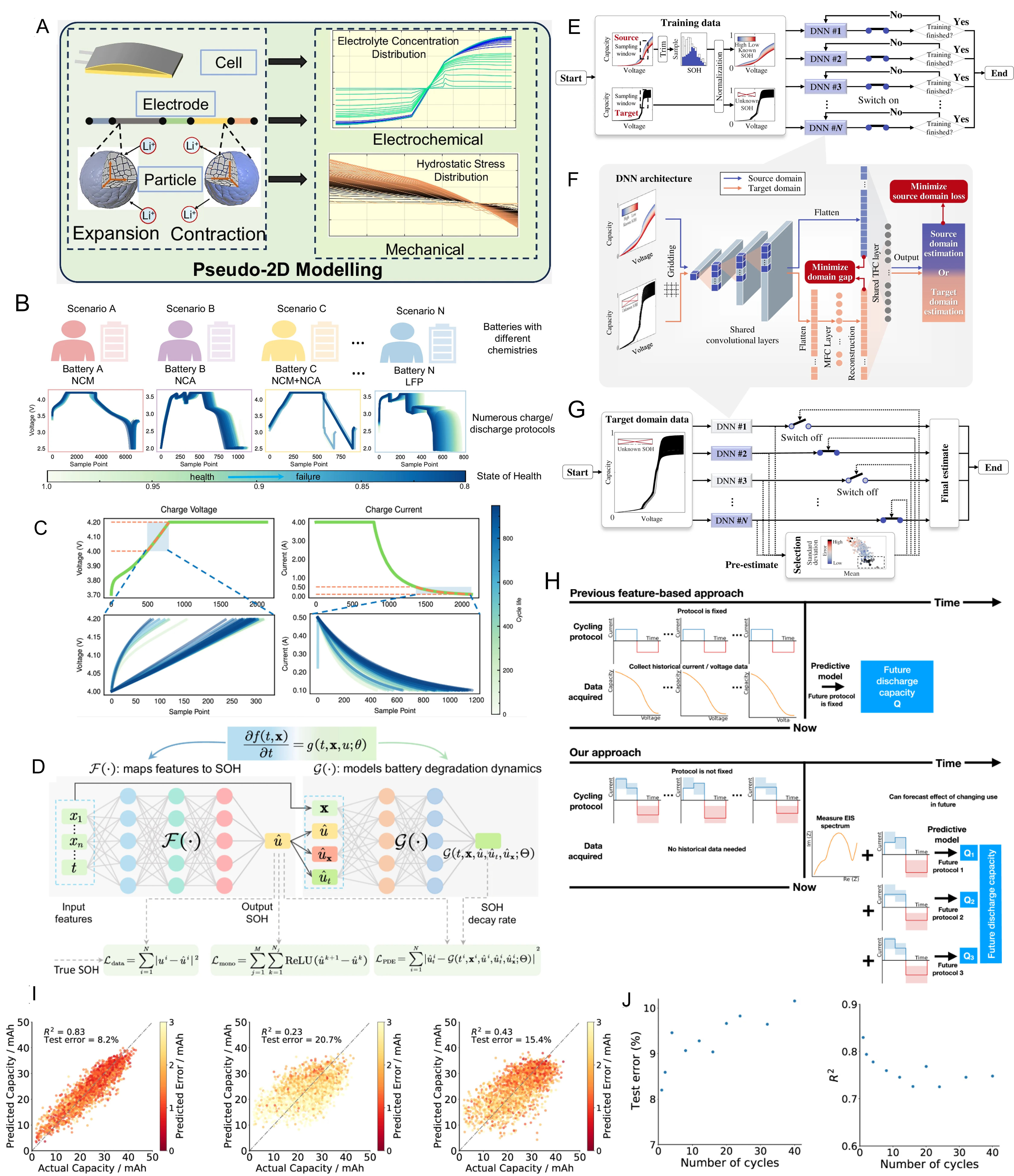
Figure 4. Physics-based models, hybrid learning, and uncertainty-aware inference. (A) Cross-scale electrochemical-mechanical modeling framework linking particle-scale strain, electrode-scale displacement, and cell-level voltage-strain response for high-fidelity battery twins. Figure 4A is reprinted with permission from Ref.[37]. Copyright © 2025 Springer Nature; (B) Chemistry and user-dependent degradation heterogeneity motivating physics-informed learning; (C) Short charging-window feature extraction for SOH estimation; (D) Physics-informed neural-network architecture for stable degradation modeling and SOH prognosis. Figure 4B-D is reprinted from Ref.[17], under the CC BY 4.0 license; (E) Training procedure for domain-adaptive SOH estimation; (F) DNN-swarm architecture for source-target transfer; (G) Estimation procedure without additional degradation experiments. Figure 4E-G is reprinted from Ref.[76], under the CC BY 4.0 license; (H) Impedance-based forecasting framework under variable future protocols; (I) State-action forecasting evidence showing the joint need for electrochemical impedance spectroscopy (EIS)-derived state and protocol action; (J) Multi-step forecasting performance under uneven usage. Figure 4H-J is reprinted from Ref.[55], under the CC BY 4.0 license. NCM: Lithium nickel-cobalt-manganate; NCA: lithium nickel-cobalt-aluminate; LFP: lithium iron phosphate; SOH: state of health; DNN: deep neural network; MFC: middle fully connected; TFC: terminal fully connected; EIS: electrochemical impedance spectroscopy.
This suggests an additional design principle: battery digital twins should be built around state variables that are operationally sufficient rather than merely physically exhaustive. An exhaustive state description of a lithium-ion cell would be intractable for most deployment contexts. By contrast, an operationally sufficient description preserves the latent variables needed to support the decisions of interest. For health management, this may be a vector of capacity, resistance, LLI, LAM, and uncertainty[13]. For safety management, it may be a latent hazard state coupled to internal temperature, pressure, and escalation likelihood[48]. For fast charging, it may be the admissible action set conditioned on plating risk and thermal margin[15,49]. The architecture should therefore be judged by its sufficiency for intervention rather than by formal fidelity alone[4,5].
A second design principle is synchronization. A digital twin that cannot remain synchronized with real measurements is not a twin in any useful sense. Synchronization is difficult in batteries because the information content of incoming data is highly nonuniform across time. A full CC-CV charge may be highly informative; a brief partial charge may not be[55]. A thermal transient may be diagnostic under one condition and uninformative under another[57]. Real systems therefore require event-aware updating rules that weight incoming measurements by their state informativeness rather than simply by their recency. This is one reason why cloud-assisted and edge-assisted battery twins are attractive: they allow asynchronous data aggregation[12], event-triggered diagnostics[18,34], and model updates at timescales that match the underlying physics[48,49,51].
Uncertainty-aware inference and decision layers
The third architectural pillar is uncertainty-aware inference. Rather than returning a single SOH value, the twin should estimate a probability distribution over current states, degradation modes, and future risk, ideally with calibrated measures of epistemic and aleatory uncertainty[5]. Impedance-based probabilistic forecasting illustrates the value of this view: battery condition is better described as a multidimensional state vector than a single scalar health index, and predictive uncertainty becomes part of the state itself when future usage is variable or partially unknown[54].
The fourth pillar is decision and deployment. A useful twin must map estimated states and uncertainties onto actions such as charging-rate selection, thermal intervention, power derating, maintenance recommendation, or fleet-level model update[4,5]. This naturally motivates a cloud-edge-fleet architecture: the vehicle handles real-time filtering and safety execution, while cloud resources perform heavier health diagnosis, cross-vehicle learning, drift detection, and personalized model adaptation. Seen this way, the digital twin is less a single model than a layered decision system built around observability, mechanism, inference, and control.
In battery systems, uncertainty has at least four operationally distinct origins. Measurement uncertainty arises from sensor noise, drift, limited resolution, and missing data[11,12]. Parametric uncertainty arises because latent electrochemical and degradation parameters are not directly measured and may drift with age or environment[39]. Structural uncertainty arises because all models suppress part of the underlying physics. Finally, deployment uncertainty arises because the operating domain itself shifts across users, climates, battery types, charging infrastructures, and lifecycle stages[49,55]. A digital twin that collapses these sources into a single deterministic estimate may still interpolate well on familiar data, but it cannot support trustworthy management when conditions change[5].
The practical consequence is that uncertainty must be propagated to the decision layer rather than reported only at the estimator output. A charging controller should not only know the inferred plating threshold, but also how uncertain that threshold currently is. A maintenance decision should not only use the estimated health state, but also the uncertainty around whether the limiting mechanism is LLI, LAM, impedance rise, or a pack-level imbalance effect. In this sense, calibration is not an optional reporting metric; it is part of the physical usefulness of the twin[5,16,54].
The relation between uncertainty and deployment is particularly strong in battery applications because many operational choices are inherently asymmetric. A slightly over-conservative charging limit may cost time; an overconfident charging limit may trigger plating or self-heating[16]. A slightly conservative fault alarm may cause service interruption; an overconfident miss may allow hazard escalation[17,77]. This asymmetry is why battery digital twins should be regarded as risk-mediating systems. Their purpose is not to eliminate uncertainty, which is impossible, but to structure it in a form that can inform action[5].
Edge deployment imposes a practical trade-off between uncertainty fidelity and computational latency. Full Bayesian neural networks, particle filtering with high-dimensional electrochemical states, and large ensembles can represent epistemic uncertainty more richly[5], but they are usually better suited to cloud-side recalibration, offline diagnosis, or event-triggered analysis because repeated sampling increases memory use, inference latency, and energy consumption[18]. By contrast, deterministic models with calibrated output layers, quantile or conformal prediction intervals, lightweight residual ensembles, and reduced-order Bayesian filters offer lower computational cost and are more compatible with embedded BMS controllers[48,49,51]. Impedance-aware and field-diagnosis models can then support edge or cloud recalibration when additional evidence is available[53-55], although these lighter methods may underrepresent model-form uncertainty under severe domain shift[77]. A deployable twin should therefore allocate UQ by time scale: fast onboard protection uses conservative intervals and low-order filters; edge devices execute limited ensembles or residual uncertainty checks during informative events; and cloud/fleet layers perform heavier posterior recalibration, drift detection, and model updating when communication and latency constraints are relaxed.
This allocation also changes how UQ should be evaluated in practice. For an edge BMS, the relevant question is not whether the estimator recovers a full posterior distribution, but whether it provides a calibrated and conservative uncertainty bound within the sampling period required for protection or control. Therefore, UQ methods should be compared by latency, memory footprint, update frequency, calibration error, and safety-margin violation rate rather than only by point-estimation accuracy. A lightweight interval that reliably identifies out-of-distribution operation can be more useful for current derating than a more expressive posterior that is too slow for real-time execution. Conversely, high-fidelity posterior sampling remains valuable when the task is offline diagnosis, cloud-side personalization, or fleet-level recalibration. This separation makes uncertainty awareness deployable instead of treating it as an algorithmic add-on.
A third design principle is semantic continuity. Battery models are often built for one lifecycle phase at a time: formation, first use, ageing, second life, or recycling. However, deployment increasingly requires continuity across these phases. Manufacturing genealogy affects initial heterogeneity; operating history affects second-life value; safety incidents affect recycling logistics; regulatory descriptors affect what can be audited[42]. A battery twin that fragments across lifecycle stages loses much of its practical value. Ontology provides the semantic layer[19], battery passports define a traceability requirement[20], and digital-thread concepts connect these descriptors into the architecture of deployable twin systems[41].
The same task-matched logic applies to model selection: the appropriate model depends on which hidden states must be recovered and which decisions must ultimately be supported. In practice, model hierarchy should therefore be interpreted as a mapping between physical fidelity, state semantics, and decision relevance rather than as a simple ladder from low to high complexity.
This view also clarifies the role of ML in battery twins. ML is not most useful when it replaces the mechanistic model entirely, but when it learns which parts of the state are identifiable under current data conditions[4,5], how uncertainty should be recalibrated after domain shift[48,49], and where mechanistic priors systematically fail[57]. In other words, the strongest digital-twin use cases are not those in which artificial intelligence (AI) suppresses physics, but those in which AI helps determine when physics, measurement, and decision constraints are jointly informative enough to act[16,43].
For this reason, calibration should be treated as a design objective from the outset rather than as a post hoc evaluation metric. A twin that is slightly less accurate in mean estimation but reliably calibrated may be more useful than a sharper but overconfident alternative, especially in charging and safety applications[5]. This is because battery-management decisions are almost always asymmetric under uncertainty. The cost of an unnecessary warning or moderate derating is often much smaller than the cost of missing a true escalation[16]. The architecture should therefore preserve not only state semantics but also calibration semantics, so that downstream control layers can interpret what level of confidence is being reported and act accordingly[49,54].
A related requirement is fault tolerance in the architecture itself. Practical twins must continue to function under partial sensor loss, missing metadata, asynchronous uploads, or occasional drift in the underlying models[11,12]. This argues for modular architectures in which sensing, state estimation, hazard assessment, and decision support can degrade gracefully rather than fail monolithically. In that respect, the most valuable future twins may be those that are not only accurate when fully informed, but also robustly useful when partially informed, a condition that better reflects deployment reality[48,49,51].
Under commercial BMS constraints, inferred internal states cannot be validated by assuming continuous access to laboratory ground truth. A practical validation loop should instead combine three evidence levels. First, field-data studies define the deployment limits and pack heterogeneity that the validation loop must respect[11,12]. Second, state-of-safety and online impedance concepts provide observable anchors for hidden thermal, electrical, and interfacial states[16,53,54]. Third, random charging segments, pack thermal-fault detection, and open thermal-failure benchmarks provide event-based checks against future observable responses[64,73,78]. In practice, the twin should be initialized and periodically audited against laboratory or service-bench diagnostics such as reference capacity tests, impedance measurements, pulse responses, teardown-informed degradation modes, or thermal-abuse datasets. During operation, latent states should be checked by cross-consistency constraints: SOC, heat generation, impedance growth, pressure/strain response, and voltage relaxation should not contradict mass balance, energy balance, or pack topology. When passive telemetry is insufficient, event-triggered validation can use naturally occurring charge segments, balancing transients, brief diagnostic pulses, or opportunistic impedance measurements to test whether the inferred state predicts the next observable response within its uncertainty interval.
For this reason, validation should be prospective as well as retrospective. A plating-risk state, for example, should not only correlate with a later capacity-loss label; it should also predict the direction of pressure change, impedance evolution, voltage relaxation, thermal response, or charging-current sensitivity when an informative event occurs. Similarly, an inferred local thermal state should predict subsequent pack-temperature residuals, coolant-side response, or imbalance growth within its confidence interval. If these prospective checks fail, the twin should widen the uncertainty bound, trigger a diagnostic event, or transfer the case to cloud-side recalibration. This mechanism closes the loop between hidden-state inference and commercial operation because the inferred state is continuously tested against future observables that are available to the BMS, even when the true internal variable is never directly measured.
Table 3 organizes the model layer by state variables, strengths, limitations, and best-fit tasks, emphasizing that model choice in a digital twin is task-matched rather than universal.
Model classes and their deployment roles in battery digital twins
| Model class | State variables | Advantages | Limits | Best-fit tasks |
| Equivalent-circuit models | SOC; polarization; lumped resistance/capacitance[4] | Fast; interpretable; control-oriented[4] | Weak mechanism resolution; limited extrapolation for plating/safety[13,15] | Onboard filtering; SOC; power limitation[4] |
| Reduced-order electrochemical models | Concentration gradients; overpotentials; effective transport states[4,15] | Better mechanism fidelity at manageable cost[4,15] | Still requires calibration and simplification[37] | Fast charging; diagnostic supervision; adaptive control[15] |
| Electrochemical-thermal-degradation models | Electrode potentials; heat generation; plating tendency; degradation modes[13,14,22,37] | Strong physical interpretability; causal structure[13,14,37] | Heavy parameterization; computational burden[4,37] | Root-cause analysis; safety; cloud diagnosis[14,15,37] |
| Physics-informed learning | Learned health trajectories constrained by physics[17] | Improved sample efficiency; state consistency[17] | Depends on adequacy of embedded physics[17] | SOH/SOP/SOS under partial data[17] |
| Residual / hybrid learning | Mechanistic priors + data-driven corrections[18,77] | Good deployment compromise; adapts to drift[18,77] | Requires stable prior model and calibration loop[18,49] | Lifelong monitoring; personalization; cloud-edge updates[18,49,77] |
| Probabilistic models | Distributions over states, parameters, and risk[5,16,54] | Explicit uncertainty; supports risk-aware decisions[5] | Calibration and dataset realism are critical[5,54] | Safety; charging; maintenance; decision support[5,16,54] |
DIGITAL-TWIN-ENABLED HEALTH MANAGEMENT
One of the clearest consequences of this framework is that health management can no longer be organized around a single scalar SOH definition. Vehicle-oriented discussions of SOH emphasize that capacity-based, energy-based, and resistance-based definitions each capture only part of the future usefulness of a battery[11]. A twin that is meant to support charging, safety, second-life grading, or warranty decisions therefore needs a vector-like health representation that can simultaneously encode capacity loss, power limitation, degradation-mode composition, and risk margins[54].
Practical health management begins with deployable health indicators. Early machine-learning pipelines demonstrated that carefully engineered features extracted from partial charge curves can estimate SOH with usable confidence intervals[79]. More recent domain-knowledge-guided work moves this idea closer to the field by constructing indicators that remain meaningful under fragmented charge windows and real driving discharges[56]. This is an important conceptual shift: useful health indicators are not simply statistically predictive; they must also remain computable under realistic operating constraints.
A second shift is from capacity estimation to degradation diagnostics. If multiple internal pathways can produce similar capacity-loss curves, then maintenance and charging decisions require more than a scalar estimate. Mechanism-aware studies now argue that LLI, LAMNE, and LAMPE should be treated as explicit diagnostic targets, not merely as post hoc explanations[5,13]. In this context, information-rich measurements such as electrochemical impedance can act as compressed fingerprints of hidden electrochemical processes and support probabilistic forecasting even when detailed usage history is unavailable[54].
The third shift concerns generalization. Health models trained on single chemistries or narrow laboratory protocols often fail when transferred to new manufacturers, broader operating conditions, or field data. Domain-adaptive deep learning has shown that usable SOH estimation can be obtained without repeating full degradation experiments for every target battery[77], while inter-cell deep learning has demonstrated improved lifetime prediction across diverse ageing conditions and even across chemistries[80]. These results suggest that the right question is no longer whether transfer is possible, but how much mechanistic and statistical structure is needed to make transfer trustworthy.
Field data are now sufficiently rich to make this transition concrete. Open-source EV datasets have enabled multimodal SOH estimation from large numbers of vehicles, exposing both the opportunity and the complexity of pack-level health assessment[12]. At the same time, the historical lesson from early-life prediction is still important: deliberately designed datasets and informative early-cycle features remain powerful when paired with physically meaningful targets[55]. For digital twins, the implication is that cell-level diagnosis, pack-level heterogeneity management, and fleet-level learning should be treated as a single service continuum rather than as isolated modeling problems.
This is also where hybrid digital twins show practical strength. Fast-charging-specific twins can translate observed aging into mechanism-level interpretations[15], while mechanistically guided residual learning offers a route to continuous monitoring throughout life without repeated offline recalibration[18]. Taken together, these developments point to a health-management architecture in which lightweight onboard monitoring is periodically corrected by richer cloud-level inference, and both are anchored to mechanism-aware latent states rather than to a single empirical health score.
The notion of vector health is useful precisely because it resolves several ambiguities that have historically been hidden inside scalar SOH. Capacity loss does not distinguish between loss of lithium inventory and loss of active material[13]. Resistance increase does not by itself identify whether the limiting process lies in charge transfer, ionic transport, contact loss, or heterogeneous utilization[54]. Even the same numerical SOH can imply very different remaining safe charging windows, thermal sensitivities, and second-life values depending on how that SOH was reached[72]. A digital twin can only support lifecycle decisions if its health representation preserves some of this mechanism-level structure[10].
This is why early-cycle information has regained importance. The value of early-cycle features is not merely that they allow earlier forecasting, but that they can encode intrinsic tendencies of a cell before heavy ageing obscures them. Mechanistically guided residual learning supports continual state correction[18], while chemistry-enabled and early-trajectory studies show how early signals can shape future ageing paths[43,55]. Generative and foundation-model approaches further suggest that these early signals can be embedded into richer trajectory models[72,81]. In practice, this would move health management from static diagnosis toward continual prognosis.
Generalization remains the decisive bottleneck. A model that performs well only on a single chemistry, protocol, or fleet is not a digital-twin solution but a local regression model. Real deployment requires transfer across manufacturers, climates, pack topologies, and charging habits. Generative degradation models and ageing/safety analyses reveal why extrapolation is difficult[27,39,40]. Fleet-level collaborative learning and impedance-aware field diagnosis provide routes to personalization under heterogeneous data[48,54-56]. Fragmented-capacity estimation and domain-adaptive learning show how partial evidence can still support transfer[64,77], while inter-cell prediction and additional transfer studies extend this logic across ageing conditions[80,82]. A mature health twin should not merely survive domain shift; it should indicate when a new operating regime lies outside the reliable envelope of its prior experience.
The health-management literature is therefore converging toward a representation in which observables, latent states, and future trajectories are learned jointly rather than sequentially. Fragmented-charge capacity and partial-window features support health estimation under incomplete field data[76,83-85]. Multimodel fusion and personalized health prediction connect terminal signals to mechanism-aware health states[86,87]. Voltage-anomaly and short-circuit diagnostics then extend this state representation toward fault-sensitive health tracking[88-90]. Early-trajectory prediction and cloud-assisted health updating extend the representation toward prognosis[91-93], while realistic fault detection and relaxation-voltage diagnosis support fleet deployment[94-96]. This perspective also clarifies why health estimation, prognostics, and second-life grading should not be developed as isolated subfields, but as connected inference tasks sharing a common state representation.
Figure 5 translates this argument into health-management workflows in the order from observable feature construction to lifelong prognosis. Figure 5A shows multimodal feature engineering from EV field data, and Figure 5B embeds these features into a deep-learning SOH-estimation framework[12]. Figure 5C and D connect a deployable power-autocorrelation indicator to capacity loss under realistic operating conditions[67]. Figure 5E addresses available-capacity estimation under fragmented charging, where complete laboratory cycles are unavailable[82]. Figure 5F and G emphasize that lifetime prediction must be evaluated across diverse ageing factors and capacity-fade trajectories[86]. Figure 2G-H extends health inference toward mechanistically guided residual learning for lifelong SOC/SOH correction[18], whereas Figure 5H illustrates early full-lifecycle prediction through BatteryGPT[27]. The figure therefore supports a vector-health view in which observables, latent mechanisms, transfer regime, and uncertainty are jointly relevant to decisions.
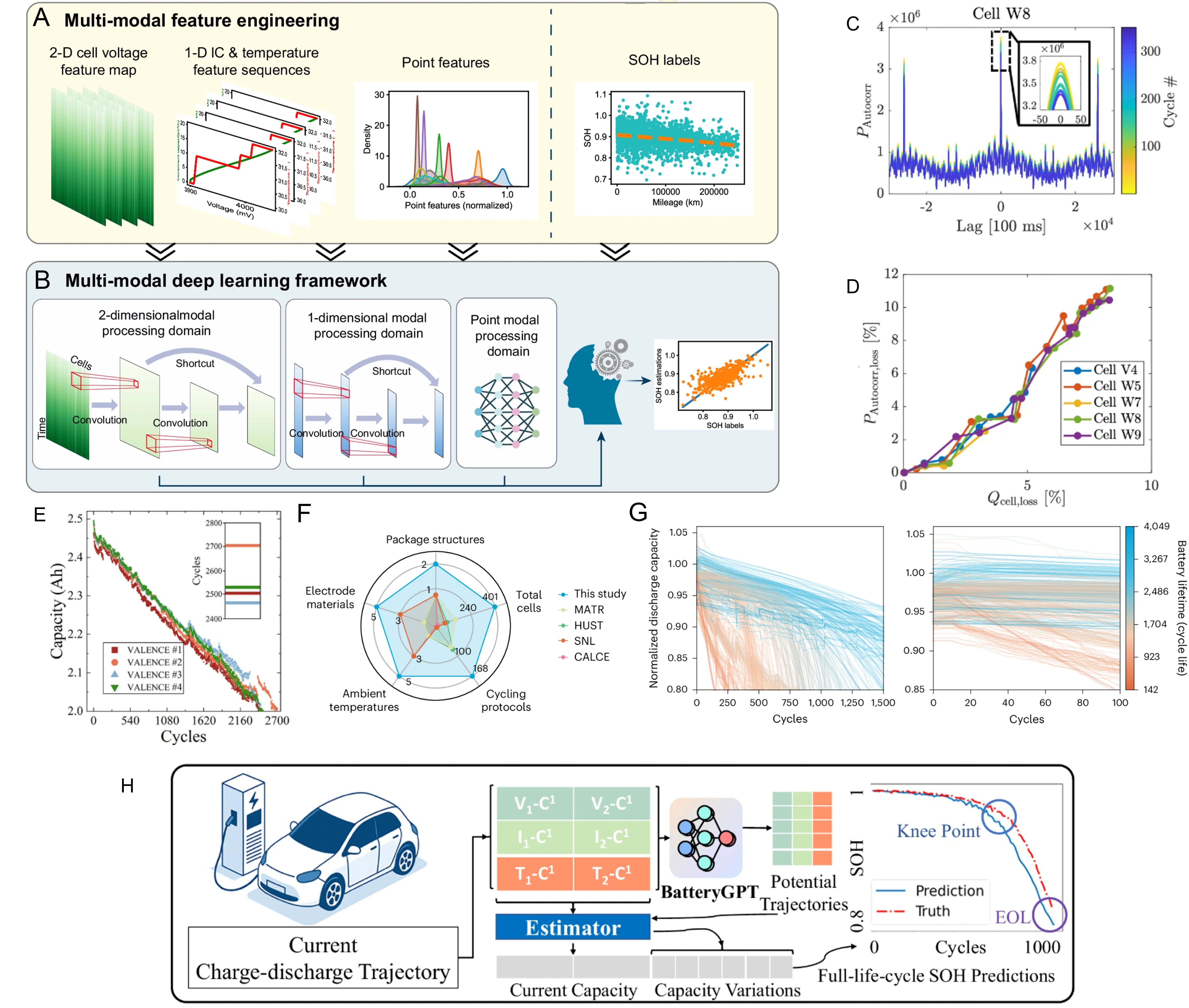
Figure 5. Digital-twin-enabled health management beyond scalar SOH. (A) Multimodal feature engineering from EV field data; (B) Deep-learning SOH-estimation framework using 2D voltage, 1D sequence, and point-feature domains. Figure 5A and B are reprinted with permission from Ref.[12]. Copyright © 2025 Springer Nature; (C) Power-autocorrelation profiles calculated from discharge data; (D) Relation between power-autocorrelation loss and capacity loss. Figure 5C and D is reprinted with permission from Ref.[67]. Copyright © 2024 Springer Nature; (E) Available-capacity degradation under fragmented charging windows. Figure 5E is reprinted with permission from Ref.[82]. Copyright © 2025 Springer Nature; (F) Diverse ageing-factor coverage for inter-cell lifetime prediction; (G) Long- and short-term degradation behaviors across ageing conditions. Figure 5F and G are reprinted from Ref.[86], under the CC BY 4.0 license; (H) BatteryGPT pipeline linking early-cycle data to full-lifecycle SOH, knee point, and EOL prediction. Figure 5H is reprinted with permission from Ref.[27]. Copyright © 2025 Springer Nature. SOH: state of health; MATR: MIT-Accelerated Technology Readiness; HUST: Huazhong University of Science and Technology; SNL: Sandia National Laboratories; CALCE: Center for Advanced Life Cycle Engineering; EOL: end-of-life; EV: electric vehicle.
The shift from scalar SOH to vector health also changes how one should think about interpretability. In much of the battery literature, interpretability is treated as an attribute of the algorithm[5]. In practice, the more consequential notion is interpretability of the state representation: a transparent algorithm is of limited value if it estimates a quantity that is not aligned with the maintenance or charging decision[13]. Conversely, a moderately complex model may still be useful if it yields a health representation that can be decomposed into physically meaningful limiting factors[54,72]. For battery twins, interpretability therefore begins with what is estimated, not only with how it is estimated.
This has immediate implications for pack management. A battery pack does not fail gracefully according to the average cell; it is constrained by the least healthy cell, the hottest region, the most resistive connection, or the most uncertain safety margin[11,12]. A twin that estimates only fleet-average or pack-average health may therefore underestimate operational risk. In contrast, a vector-health formulation can preserve pack dispersion, worst-cell margin, and uncertainty around both[18,48]. This is essential when health outputs feed into balancing, charging derating, warranty assessment, or second-life grading[55].
Another underappreciated issue is that health estimation and prognosis operate on different evidence regimes. Current-state estimation can rely on short windows and local indicators[55], whereas long-horizon prognosis requires assumptions about future operating conditions. The most credible health twins will therefore usually combine mechanistic current-state estimation with scenario-conditioned prognosis rather than extrapolate a single trend line indefinitely[18,43]. Generative sequence models and multimodal latent representations may improve this transition[27,72,81], but only if such models remain anchored to physically interpretable targets and calibrated uncertainty estimates[97-99].
Second-life management makes these issues even sharper. A battery entering repurposing does not arrive with a clean, uniformly sampled health trajectory; it arrives with missing context, uneven stress history, unknown micro-fault burden, and heterogeneous cell dispersion[48,51]. A practical twin for second-life decisions, therefore, cannot rely solely on nominal SOH labels. It must infer residual capability, uncertainty, and risk under incomplete information[100], ideally using representations that remain meaningful across the transition from first-life to second-life applications[10].
This is also why cloud assistance is likely to remain central to high-quality health management. Fleet-scale data provide the diversity needed to learn which features remain stable across vehicles, climates, and charging infrastructures[11,12]. Onboard systems provide the immediacy required for real-time adaptation. Neither alone is sufficient. The most useful health-management architectures are therefore likely to remain hybrid not only in the model sense, but also in the deployment sense: lightweight local monitoring[18], event-triggered uplink[48], and cloud-side inference that returns updated priors, thresholds, and control suggestions to the edge[49,51].
There is also a methodological lesson here for benchmark construction. Health models should not be compared exclusively at equal levels of target observability. Some methods assume complete charge curves; some assume only partial windows; some rely on impedance or pulse data; some infer trajectory from early cycles[7,12]. A review that compares only endpoint RMSE without declaring these observability assumptions can mislead readers about what is actually deployable. In digital twins, the operational question is whether the assumed evidence stream exists in the intended application[48,54], and whether it can be acquired repeatedly without unacceptable cost or disruption[55,56].
Safety diagnosis and risk-constrained fast charging
Safety diagnosis and fast-charging control are the most stringent tests of whether a digital twin is truly decision-ready. Conventional BMS strategies rely heavily on threshold-based protection using voltage, current, and surface temperature. This is necessary but increasingly insufficient because the most dangerous transitions - lithium plating onset, local heat accumulation, gas evolution, or the approach to thermal runaway - develop internally and can remain weakly visible at the surface until late in the process[7,57].
Recent sensing studies show how a twin can move beyond this limitation. Differential pressure monitoring detects plating during fast charging[7], thermal-wave sensing differentiates degradation pathways in commercial cells[8], ultrasound visualizes plating evolution within multilayer pouch cells[9], and MHz-band electromagnetics reveals cycle-by-cycle changes associated with metallic lithium deposition[10]. In parallel, lab-on-fiber measurements demonstrate that internal temperature and pressure signals can provide early-warning signatures of thermal runaway before traditional external indicators become decisive[57]. These results do not eliminate the need for modeling; instead, they create the observability needed for more informative latent safety states.
This motivates a transition from threshold alarms to state-of-safety estimation. A safety-oriented twin should infer a time-varying hazard state that integrates thermal, electrochemical, and mechanical evidence rather than issuing binary warnings only after thresholds are crossed. Recent state-of-safety formulations move in this direction by combining multiple observables into a unified early-warning indicator and quantifying warning lead time under abuse conditions[16]. The practical value of such a formulation is that uncertainty can be translated into conservative control before irreversible failure develops.
In fast charging, this latent-state perspective becomes unavoidable. The fundamental control problem is not to force the battery through a fixed current profile as quickly as possible[6], but to exploit whatever fast-charging freedom remains after the current health state, temperature field, and risk margin are taken into account[7,9,10]. Put differently, the safe charging envelope is not static. It contracts or expands with age, heterogeneity, environment, and model confidence[13,15]. The role of a digital twin is to infer this envelope online and update it continuously, rather than treat it as a fixed engineering constant[37,57].
Fast charging should be interpreted within the same framework. Closed-loop protocol optimization proved that data-driven exploration can identify better charging policies more efficiently than brute-force experimentation[6]. However, a digital-twin perspective pushes the objective further: the output should not be a universally optimal protocol, but a safe and context-specific action set conditioned on present health, temperature, heterogeneity, and predictive confidence. Digital-twin-assisted fast-charging studies show that this is feasible because charging actions can be linked directly to changes in dominant aging modes rather than only to terminal capacity retention[15].
A useful way to express this distinction is through the difference between protocol optimization and action-space regulation. Protocol optimization seeks a globally good charging schedule under assumed conditions[6]. Digital-twin charging instead seeks the set of locally admissible actions under current inferred conditions[15,37]. This shift matters because a protocol that is safe for a fresh cell at 25 °C may not be safe for an aged cell[44,45], a pack with a strong thermal gradient[101,102], or a vehicle after repeated high-rate operation[103]. Risk-constrained fast charging is therefore inseparable from state estimation[57], uncertainty quantification[104,105], and pack-level supervision[106].
Fast-charging safety is also inseparable from chemistry. The charging window is not only determined by current, temperature, and state of charge, but by the interphase chemistry that governs charge transfer, lithium transport, gas evolution, and plating reversibility. This is why recent fast-charging advances increasingly couple control with pressure, thermal-wave, ultrasound, and electromagnetic evidence[7-10]. Cross-scale electrochemical models and thermal-safety analyses further show how potential, heat release, and electrolyte stability reshape the admissible action space[37,45,47]. Interfacial degradation studies and lifetime prognostics explain why the same nominal charging policy can age differently across chemistries and use histories[101-103]. A battery digital twin that ignores this chemistry layer may still regulate current successfully in the short term, but it will remain blind to why the safe envelope changes over repeated cycling. Recent electrolyte studies using hierarchical ionic networks and quasi-localized high-concentration designs show that interfacial stability and ion-transport kinetics can shift the accessible fast-charging envelope[107,108]. Low-temperature lithium-metal electrolyte design further shows that solvent-cosolvent interactions can modify risk margins under cold operation[109].
For safety diagnosis more broadly, the most important conceptual shift is from event detection to state-of-safety estimation. Batteries do not move from “safe” to “unsafe” in a single physical step; they transition through latent precursor states characterized by subtle changes in internal temperature, pressure, stress, gas evolution, impedance, and local current distribution[13,14]. A warning framework that only reacts after voltage collapse or sharp temperature rise has already surrendered much of its intervention window[16,17]. A state-of-safety framework instead asks how evidence should be fused before catastrophic failure is visible at the pack surface[24,25]. At this management level, degradation history[57,97,98], sensor evidence[99,100], and intervention timing must be evaluated jointly. Laboratory-to-field fault diagnosis clarifies the first part of this timing problem[110-112], while digital-twin and field-learning studies clarify how the intervention logic should remain deployable[113,114].
This transition is especially important at pack and fleet scales. The same local cell event may remain weakly visible in aggregate pack telemetry until it is amplified by thermal propagation or balancing constraints[12,16,17]. Conversely, fleet-level monitoring can reveal rare-event signatures and owner-specific risk patterns that are invisible in single-vehicle analysis[77]. A complete safety twin therefore spans cell-level precursors, pack-level escalation, and fleet-level collaborative learning. Its output is not merely a warning flag, but a graded hazard state that can support derating, charging reconfiguration, thermal conditioning, or shutdown.
At larger scales, safety intelligence also becomes a distributed learning problem. Privacy-preserving collaborative fault warning demonstrates that fleet-level safety models can be trained from heterogeneous charging-station data without centralizing raw records[48]. Meanwhile, fragmented charge-capacity estimation shows that useful capacity-related information can still be recovered even when full charge traces are unavailable[64]. Together, these studies imply that safety and fast-charging twins must be designed for limited onboard observability, fragmented data access, and privacy constraints from the outset, not retrofitted to them after laboratory success.
A second unresolved issue in this section concerns how safety-relevant information should be prioritized when multiple sensing modalities are available. The emerging battery-safety literature increasingly shows that current, voltage, temperature, pressure, gas, strain, and embedded thermal signals are not interchangeable; rather, they resolve different precursors at different stages of hazard escalation. This is especially important for pack applications, where aggregate telemetry can mask local precursor states. Recent work on internal short-circuit and abuse mechanisms clarifies the physical origin of hazardous precursors[31,32]. Battery digital-twin and degradation-safety studies then connect those precursors to pack-scale diagnosis and decision logic[115-118]. Wide-temperature operation and ageing chemistry show why the same warning signal can have different meaning across environments[119-122]. Electrolyte/interfacial studies further connect chemistry to warning thresholds[123-125]. Model-based fault diagnosis and failure-mode analysis define how such evidence should be interpreted[126-129], while online SOH/fault estimation links the evidence streams to derating, reconfiguration, isolation, or shutdown decisions[130-132].
Figures 6 and 7 distinguish the charging and safety aspects of the same latent-state problem. Figure 6A and B illustrate how negative-electrode potential and Ti-O covalency can expand the materials window for fast charging[83]. Figure 6C-F show pressure-triggered dynamic current regulation and graphite-anode evidence for suppressing lithium plating[7]. Figure 6G and H show post-plating manipulation through electric-field relaxation[84], while Figure 6I and J connect chemistry-enabled fast charging to CC/CV-stage behavior and cycling retention[43]. Figure 7 then shifts from charging control to hazard-state estimation. Figure 7A and B define the lab-on-fiber measurement platform, Figure 7C and D show internal temperature/pressure traces and thermal-runaway event sequence, and Figure 7E links these measurements to mechanism decoding and derivative-based warning before venting[68]. Figure 7F-H introduce strain-temperature-voltage evidence, electrode-level damage, and state-of-safety trajectories[16], while Figure 7I adds heat and mass-output variability under thermal runaway[34]. Together, Figures 6 and 7 show why fast charging and safety should be treated as coupled control problems rather than as separate threshold rules.
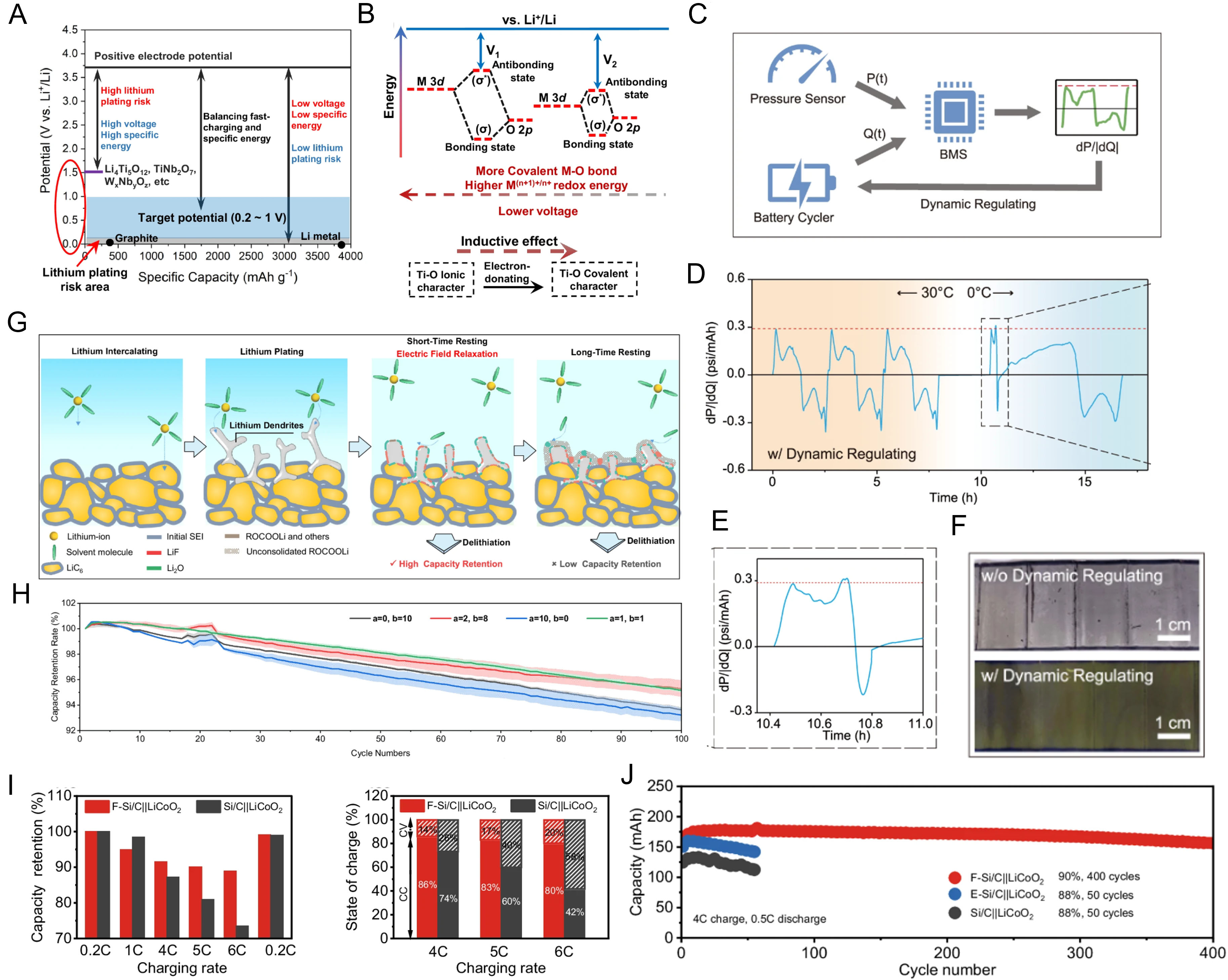
Figure 6. Fast-charging supervision as risk-constrained control. (A) Materials-level potential window for balancing fast charging and specific energy; (B) Ti-O covalency strategy for regulating lithium-insertion potential. Figure 6A and B is reprinted with permission from Ref.[83]. Copyright © 2025 Springer Nature. (C) Pressure-triggered self-regulated charging scheme; (D) Dynamic current regulation at 30 °C; (E) Dynamic current regulation at 0 °C; (F) Graphite-anode optical evidence showing suppression of lithium plating. Figure 6C-F is reprinted from Ref.[7], under the CC BY 4.0 license; (G) Electric-field-relaxation mechanism for lithium-dendrite manipulation; (H) Degradation response of commercial Gr||LFP cells under 3 C plating-prone fast charging and different manipulation protocols. Figure 6G and H are reprinted with permission from Ref.[84]. Copyright © 2025 Springer Nature; (I) Capacity retention and CC/CV-stage segmentation under chemistry-enabled fast charging; (J) Pouch-cell cycling stability under 4 C charging. Figure 6I and J are reprinted from Ref.[43], under the CC BY 4.0 license. BMS: Battery management system; SEI: solid electrolyte interphase; LFP: lithium iron phosphate; CC: constant current; CV: constant voltage.
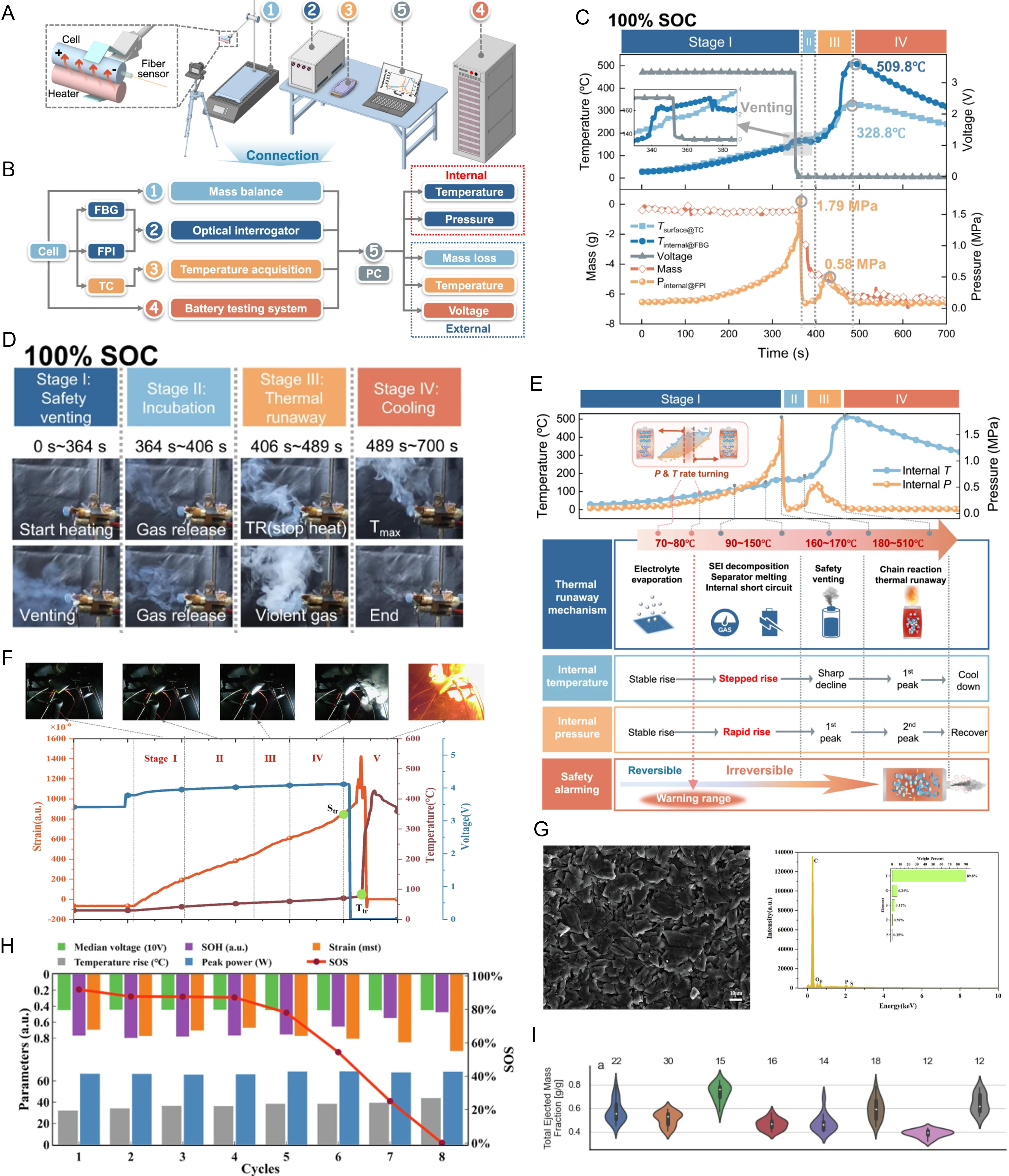
Figure 7. Safety diagnosis, early warning, and state-of-safety estimation. (A) Lab-on-fiber experimental platform for internal temperature and pressure monitoring; (B) Measurement logic and functions of the experimental setup; (C) Internal temperature/pressure traces, surface temperature, voltage, and mass evolution during thermal runaway; (D) Thermal-runaway event sequence in 18650 cells; (E) Mechanistic decoding of thermal runaway and derivative-based early warning before venting. Figure 7A-E is reprinted from Ref.[68], under the CC BY 4.0 license; (F) Strain, temperature, and voltage evolution under abuse; (G) Negative-electrode morphology and composition after runaway; (H) State-of-safety quantitative assessment and trajectory. Figure 7F-H is reprinted with permission from Ref.[16]. Copyright © 2025 Springer Nature; (I) Distribution of heat and mass-output variability under thermal runaway. Figure 7I is reprinted with permission from Ref.[34]. Copyright © 2024 Springer Nature. FBG: Fiber Bragg Grating; FPI: Fabry-Perot interferometer; TR: thermal runaway; TC: thermocouple; PC: personal computer; SOH: state of health; SOS: state of safety.
From a sensing perspective, the central safety challenge is that many precursors are local, whereas most deployed signals are aggregate. Internal pressure can rise before surface temperature. A local hotspot can form before pack-level temperature appears abnormal. Lithium plating can begin in a limited region before mean voltage or current reveals anything unusual. This mismatch is one reason why a purely threshold-based BMS frequently detects late. It also explains the growing interest in richer evidence streams. State-of-safety, mechanical, and abuse-oriented measurements help connect local deformation, strain, and fault initiation to hazard evolution[16,21,24,25]. Cross-scale modeling and side-reaction-aware safety studies add chemical and thermal context[37,46,47,57]. Industrial-scale twin and foundation-model studies indicate how such evidence can be embedded in deployable monitoring architectures[113,114]. Current-sensor and field-health estimation studies provide one hardware/data pathway for field implementation[133-135], while rapid health estimation and physics-informed degradation decoupling extend the corresponding inference layer[136,137]. Shunt and fluxgate devices support pack-level current acquisition[138-141], whereas fluxgate magnetometry provides additional magnetic-current sensing options[142,143]. Physics-informed, deep-learning, and feature-based SOH methods provide complementary inference layers[144-147], while integral pack health, multimodal analytics, and large language models extend the same logic toward battery intelligence[148-150]. A digital twin does not replace these modalities; it provides the latent-state framework in which their signals become collectively interpretable.
To bridge this macro-to-micro mismatch, a battery digital twin should be organized as a hierarchical inference system rather than a single pack-mean estimator. Aggregate pack telemetry, including pack voltage, pack current, coolant and surface temperature, balancing records, and charging history, should first constrain a physics-based pack model; topology information, cell inconsistency priors, and electrothermal coupling can then be used to disaggregate the pack response into cell- and module-level latent states. In this setting, pack measurements are not treated as direct surrogates for mean health; they are interpreted as compressed projections of heterogeneous cell behavior. Recent vehicle-scale SOH studies using open EV data confirm that cell inconsistency and operating heterogeneity materially change the meaning of pack signals[12], whereas transfer of differential-voltage and incremental-capacity diagnostics from cell to vehicle level shows that cell-level electrochemical fingerprints can still be partially recovered at pack scale when the pack topology and charging context are explicitly modeled[24]. Standardized pack-level SOH procedures further reinforce the point that observability at vehicle scale depends on how measurements are anchored to comparable test conditions rather than on pack averages alone[42].
Once cell- and module-level posteriors are reconstructed, the twin can map them upward into a pack risk vector that preserves worst-cell dominance, spatial clustering, and propagation potential. In practice, the relevant outputs are not only mean pack SOH or temperature, but the probability that a specific cell is approaching plating, the probability that a module contains a local hotspot, the confidence interval on imbalance growth, and the likelihood that a local thermal fault will escalate under the current load. This representation makes later control actions physically interpretable: a high worst-cell plating probability justifies current derating or a temporary charging-rate reduction; a localized thermal-fault posterior can trigger targeted cooling, balancing intervention, or module isolation; and fleet-level collaborative learning can update these thresholds when heterogeneous vehicles exhibit rare but repeatable warning patterns[48]. Recent pack-level thermal fault detection based on integrated physics and deep neural networks further illustrates that safety supervision becomes more actionable when measured pack temperatures are interpreted through internal fault states rather than through threshold exceedance alone[73].
Battery safety also unfolds across multiple timescales. Some hazards develop over months through progressive degradation and fault accumulation[13,14]. Others, such as sudden short-circuit-triggered escalation, evolve within seconds or minutes[24,25]. A mature digital twin should therefore separate long-horizon hazard conditioning from short-horizon hazard monitoring. The former depends on degradation state, interfacial chemistry, and cumulative stress[40]; the latter depends on real-time evidence such as internal temperature, pressure, voltage collapse, gas evolution, and strain[81].
For fast charging, the analogous distinction is between feasibility and aggressiveness. A charge action can be electrochemically feasible yet operationally unwise if its uncertainty margin is too small: protocol optimization defines the outer search space[6], while plating-sensitive pressure, thermal-wave, ultrasound, and electromagnetic diagnostics constrain it by hidden-state evidence[7-10]. Thermal nonuniformity can further shrink the admissible window[44,45], and an outlier cell approaching a plating boundary can dominate the pack limit[101-103]. Conversely, a conservative charge action can still be suboptimal if the twin underestimates the available thermal and kinetic margin[15,37]. Risk-constrained fast charging should therefore be framed as a constrained action-selection problem in which the admissible current trajectory is recalculated from health state[57], safety state[104], and confidence level[105,106].
The broader safety-detection literature reinforces this conclusion. Recent high-level reviews emphasize that large battery packs introduce a distinct safety regime relative to single cells because degradation and plating mechanisms[13,14], interfacial high-temperature stability[21], and fault propagation all become first-order variables. The practical difficulty is that the signals available to the BMS are often aggregate measurements, whereas the triggering event may originate from a single cell, a local current pathway, or a small gas pocket[24,25]. This mismatch explains why cell-level side-reaction mechanisms[46,47], industrial-scale twin deployment and foundation-model monitoring[113,114], field-data health learning[133-135], rapid pack health estimation[136,137], and current-sensor electronics[138-141] should be treated as linked scales rather than separate literatures. Magnetic-current sensing further expands the pack-level evidence stream for this scale bridge[142,143].
Recent work also underscores that safety monitoring is expanding beyond voltage-current-temperature triplets. Mechanical stress and swelling provide evidence of plating, gas generation, or mechanical deformation[16,21]. Gas, acoustic, ultrasonic, and optical-fiber measurements provide complementary early-warning channels under different installation constraints[24,37]. Field-health and data-driven monitoring studies show how such signals can be interpreted at scale[133-135], and rapid health/degradation-decoupling studies extend that interpretation under limited labels[136,137]. Current-sensing and shunt/fluxgate electronics can improve pack-level observability where direct internal sensing is impractical[138-141], while magnetometer-based sensors add further options for non-contact current evidence[142,143]. X-ray or tomography-derived structural information, EIS-based thermal/interfacial signatures, and multimodal analytics offer richer state evidence[46,47,57]. Physics-informed and deep-learning methods connect these evidence streams to deployable SOH inference[144-147], while integral pack health, multimodal battery analytics, and foundation models broaden the corresponding decision layer[148-150]. The scientific question is therefore not which sensor is universally best, but which signal makes the target hazard state identifiable in the intended deployment environment.
From this perspective, safety and fast charging become two coupled supervision problems. Fast charging asks how aggressively one may act under current hidden-state uncertainty. Safety asks how early a hazard state can be inferred from imperfect evidence. In both cases, the most relevant outputs are not raw measurements but decision variables: maximum admissible current, preheating request, fault-severity class, safety margin, or shutdown trigger. Battery twins matter because they allow these outputs to be conditioned simultaneously on mechanism, measurement, and uncertainty rather than on fixed thresholds alone.
Pack propagation warrants particular attention. Much of the safety literature focuses on how single-cell abnormalities trigger local runaway[13,14], but practical electrification increasingly depends on whether such events remain local, propagate to neighboring cells, or are amplified by module enclosure, gas pathways, and pack topology[24,25,77]. The digital twin therefore needs a state representation that can move from cell-level precursors to module-level propagation variables[80,97,98] and then to pack-level intervention actions or audit-ready decision records[99,100]. Without this scale bridge, the same warning metric may have different operational meanings in a single-cell test[110,111], a module[112], and a vehicle pack[113].
There is a complementary issue on the control side. A warning that a hazard state is rising does not specify what intervention should be taken. Depending on the time scale, the appropriate response may be current reduction, thermal conditioning, balancing, charging interruption, derating, cell isolation, or shutdown[16]. An effective safety twin should map inferred hazard states to intervention classes[24,25] and update this mapping as confidence, lead time, and hazard severity change[37].
Table 4 aligns health estimation, prognosis, fast-charging supervision, safety diagnosis, and lifecycle governance by their outputs, dominant sources of uncertainty, decision relevance, and evaluation metrics.
Task classes, outputs, uncertainty sources, and decision metrics
| Task | Primary outputs | Dominant uncertainty sources | Decision relevance | Recommended metrics |
| Health estimation | SOH, vector health state, degradation modes[11-13,54] | Partial cycles, temperature variation, pack heterogeneity[11,12] | Maintenance, warranty, second life, charging limits[11,13] | RMSE/MAE + calibration + robustness[5,54] |
| Health prognosis | Future SOH, knee point, EOL, RUL[27,55,80] | Future usage uncertainty, model-form uncertainty[5,80] | Maintenance planning, lifecycle value[27,55] | Trajectory error, NLL, prediction-interval quality[5] |
| Fast-charging supervision | Admissible charging current, plating margin, thermal margin[6,7,15] | Latent plating threshold, thermal nonuniformity, state-estimation error[7,22,37] | Charging control, preheating, derating[6,15] | Time-to-target + safety-margin violation rate + calibration[5,7,15] |
| Safety diagnosis | State of safety, warning lead time, escalation class[16,57] | Rare events, incomplete observability, pack propagation[14,24,78] | Alarm, shutdown, isolation, emergency response[16,57] | Lead time, false-alarm rate, missed-event rate, robustness[16,78] |
| Deployment and governance | Personalized twin update, battery passport fields, lifecycle traceability[19,20,42,49] | Semantic inconsistency, missing metadata, domain shift[12,19,42] | Auditability, compliance, repurposing, recycling[20,42,49] | Latency, interoperability, reproducibility, auditability[19,20,42] |
DEPLOYMENT REALISM, BENCHMARKING, AND DATA GOVERNANCE
The deployment challenge is often underestimated. In practice, a battery digital twin is not deployed once; it is sustained across sensing, logging, synchronization, update, and decision layers. Vehicle batteries differ in initial grading, cooling conditions, aging history, and operational patterns, so a deployable twin must explicitly manage cell inconsistency, worst-cell limitation, and pack-level thermal heterogeneity[11,12]. This favors a layered architecture in which the pack is not collapsed into a single lumped state unless the information loss is acceptable for the intended decision.
Deployment changes the criteria by which a battery digital twin should be judged. In laboratory studies, the implicit objective is often predictive fidelity under controlled conditions. In field operation, the objective is narrower and more consequential: maintain safe operation, preserve useful life, and keep the model synchronized with incomplete, noisy, and partially labeled data[11,12]. This is why deployment should be viewed as an architecture problem rather than a post-model implementation step. The useful twin is the one that can be maintained under imperfect information, not merely the one that performs well offline[48,49,51].
This, in turn, reframes the value of cloud-edge-fleet architectures. Their purpose is not simply to centralize data, but to distribute intelligence across time scales and decision types[12,16]. Local filtering and immediate protection remain naturally onboard. Heavy health diagnosis can be cloud-mediated when standardized pack procedures define comparable labels[42], while drift detection, personalization, and fleet-level anomaly learning are more naturally handled by collaborative or cloud-based architectures[48,49,51]. The edge layer becomes important when latency, communication cost, or privacy prevents full cloud dependence[55,57].
Benchmarking must follow the same realism. Many current datasets and evaluations still emphasize narrow laboratory cycling, whereas digital twins are meant to operate across protocol changes, temperature shifts, pack configurations, and field data with scarce labels[5,12,80]. Benchmark design should therefore separate interpolation from extrapolation, laboratory from field transfer, cell from pack configuration shift, and health prediction from safety warning. Without this separation, apparently strong headline accuracy can hide weak deployment robustness.
Evaluation metrics should also move beyond point-error reporting. Probabilistic battery reviews argue that calibration-oriented metrics such as negative log-likelihood, expected calibration error, and sparsification-based measures are necessary whenever predictions are used to guide control[5]. For safety tasks, warning lead time, false-alarm rate, and missed-event rate are as important as classification accuracy[16]. Open-access resources such as the Battery Failure Databank can play an important role here because they offer a common basis for benchmarking rare but consequential thermal-runaway behaviors[78].
A second prerequisite for reproducible evaluation is improved semantic and regulatory infrastructure. Vehicle-level health measurement is not yet standardized, and recent work has argued for repeatable onboard procedures for energy- and capacity-based SOH at the pack level[42]. At the same time, the earlier data-centric lesson from battery research still holds: broad and diverse datasets become much more useful when organized around meaningful early descriptors and clearly defined targets[55]. A robust benchmark therefore needs both shared data and shared measurement definitions.
These concerns now extend into lifecycle governance. Unified battery data descriptions[19] and multiscale digital modeling across the full lifecycle[41] provide the semantic backbone needed to connect manufacturing genealogy, testing history, operational data, and end-of-life decisions. This is increasingly important under the EU Battery Regulation, which requires battery passports for EV batteries, light means of transport batteries, and industrial batteries above 2 kWh from 18 February 2027[20]. In that context, the digital twin becomes more than an internal engineering asset; it becomes part of the auditable digital thread that links performance, safety, value retention, repurposing, and recycling. Strategic lithium-ion battery recycling studies further indicate that pack-level records and material provenance are necessary to connect digital-twin outputs with resource-risk management and circular value chains[151].
Benchmark design deserves separate emphasis because the field remains too tolerant of accuracy numbers generated under unrealistically narrow conditions. A battery digital twin should be benchmarked along at least four dimensions: uncertainty quality[5], deployment realism from cell to field[12], mechanism-level transfer[13,14], and system scale. Deployment realism asks whether the data originate from controlled cycling, semi-realistic duty cycles, or field operation[54,55]. System scale asks whether the model is evaluated at the material/interface, cell, pack, or fleet level[16,17,42]. Task type separates health estimation, safety warning, fast charging, and lifecycle decision support; uncertainty quality asks whether the prediction is calibrated rather than merely accurate[77,80].
Data governance is not an administrative afterthought to this problem; it is part of the scientific architecture. Once the digital twin is deployed beyond a single-cell test stand, battery identity, provenance, manufacturing history, beginning-of-life characterization, field usage, maintenance events, second-life grading, and end-of-life processing all become causally relevant[19,20]. Without a semantic layer linking these descriptors, apparent prediction errors may reflect hidden differences in labels[41], measurement protocols[42], or battery genealogy. Governance therefore determines whether data remain comparable[104], auditable[105], and reusable across the lifecycle[139].
The governance problem also has a scientific dimension. Standardization, pack-level measurement procedures, and semantic continuity determine which deployment claims are testable across institutions, fleets, and lifecycle stages[33]. A benchmark that ignores privacy constraints, owner heterogeneity, measurement protocols, or regulatory fields may still be publishable, but it is not deployable. Equalization, magnetic, and optical monitoring hardware provide one layer of deployability[152-154]. Flexible microsensors and battery-monitoring front ends define how those signals enter pack electronics[155-158]. Self-heating and embedded temperature measurements define another layer of safety-relevant observability[159-161]. Heat-generation, radial-temperature, and thin-film thermocouple measurements extend this observability into spatial thermal characterization[162-164]. Gas detection and failure sensing expand the evidence base for early warning[165], while federated estimation under privacy constraints reinforces the need to treat deployment realism, auditability, and semantic interoperability as first-class scientific requirements rather than downstream engineering details.
Figures 8 and 9 close the deployment and benchmarking argument in sequential order. Figure 2D and E show privacy-preserving collaboration for retired-battery sorting without raw-data exchange[49]. Figure 8A and B expose battery-type heterogeneity across charging-station owners, and Figure 2F shows how a personalized federated fault-warning architecture handles that heterogeneity[48]. Figure 8C illustrates second-life SOH estimation under random retirement conditions and deployment without extra SOC conditioning[69]. Figure 8D adds the lifecycle digital-thread layer that connects battery identity, provenance, health, compliance, repurposing, and recycling. Figure 9 then shifts to benchmark realism: Figure 9A and B show real-world direct current (DC) fast-charging capacity distribution and temperature-dependent charging-profile heterogeneity[166]; Figure 9C and D address standardized pack-level SOH measurement and differential-voltage transfer from cell to vehicle level[24,42]; Figure 9E and F show that evaluation should include realistic data flow, data-frame heterogeneity, ROC curves, and reconstruction error rather than point accuracy alone[117]; Figure 9G adds pack-voltage variability under fixed voltage windows[42]; and Figure 9H summarizes the benchmark matrix and roadmap for deployable twins. Together, Figures 8 and 9 show that deployment and benchmarking are not external to the digital-twin problem; they define its engineering meaning.
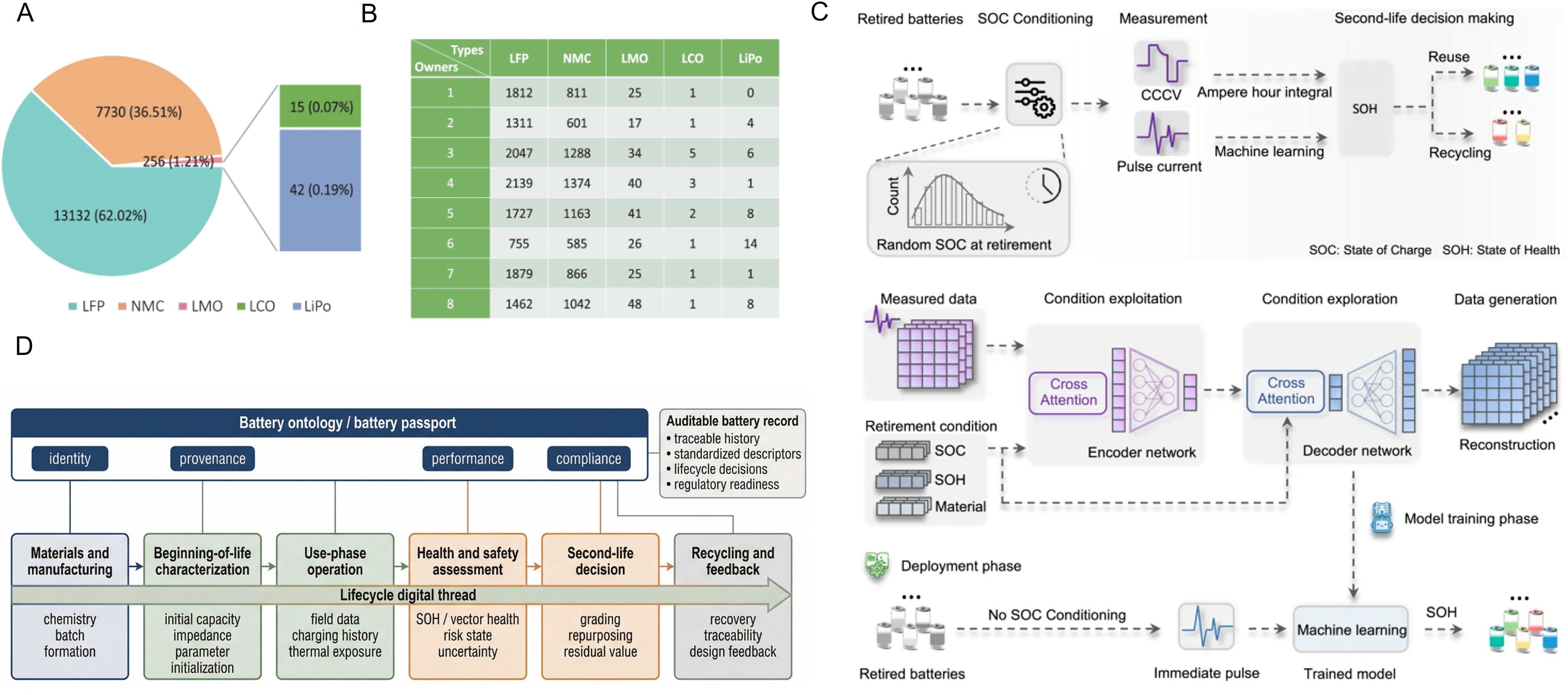
Figure 8. Deployment, privacy-preserving collaboration, and lifecycle digital thread. (A) Overall battery-type distribution in heterogeneous charging-station data; (B) Owner-specific battery-type distribution. Figure 8A and B is reprinted with permission from Ref.[48]. Copyright © 2025 Springer Nature; (C) Generative-learning-assisted retired-battery SOH estimation under random retirement conditions, including pretreatment, pulse-response generation, and deployment without additional SOC conditioning. Figure 8C is reprinted with permission from Ref.[69]. Copyright © 2024 Springer Nature; (D) Battery-passport, ontology, and lifecycle digital-thread layer connecting identity, provenance, performance, compliance, second-life use, and recycling. LFP: lithium iron phosphate; NMC: lithium nickel manganese cobalt oxide; LCO: lithium cobalt oxide; CCCV: constant current constant voltage; SOH: state of health; SOC: state of change.

Figure 9. Benchmarking, standardization, and future directions. (A) Real-world DC fast-charging capacity distribution across connector power ratings; (B) Temperature-dependent real-world charging-profile heterogeneity. Figure 9A and B is reprinted from Ref.[166], under the CC BY 4.0 license. (C) Vehicle-level SOH standardization based on scalable and reproducible measurement procedures; (D) Differential-voltage transfer from cell-level diagnostics to pack-level EV measurement. Figure 9C and D is reprinted from Ref.[42], under the CC BY 4.0 license; (E) Online fault-diagnosis data flow and field dataset structure under stochastic operating conditions; (F) ROC and RMSE-based evaluation of fault detection and prediction accuracy. Figure 9E and F are reprinted with permission from Ref.[117]. Copyright © 2025 Springer Nature; (G) Pack-voltage variability under fixed voltage windows, illustrating limits of nonstandardized SOH comparison. Figure 9G is reprinted from Ref.[42], under the CC BY 4.0 license; (H) Benchmark matrix and roadmap for deployable battery twins, spanning deployment realism, system scale, calibration, robustness, latency, and auditability. SOC: State of change; TCP: transmission control protocol; IP: internet protocol; TSP: telematics service provider; SOH: state of health; EV: electric vehicle; RMSE: root mean square error.
Dataset design is central to this transition. A dataset suitable for academic model comparison is not automatically suitable for battery-twin deployment[12,13]. Deployment-oriented datasets must preserve context: battery identity, chemistry, pack topology, environment, sampling cadence, control history, maintenance events, and the provenance of labels[17,48]. Otherwise, two apparently identical voltage segments may correspond to different degradation modes[54], thermal histories[55], or control constraints. Safety datasets also need explicit rare-event metadata[77,140] and abuse-condition descriptors if they are to support state-of-safety benchmarking[78].
The notion of benchmark realism should therefore be broadened beyond data source. Realism also concerns the perturbations that the benchmark allows. A useful benchmark should test adaptation to temperature shift[5], pack scaling[13,14], partial charging[42], rare-event imbalance[55], missing labels[77], and changing decision cost[80]. In battery digital twins, a benchmark that does not expose the model to these distortions may be a test of interpolation, but not a test of deployability.
Regulation further sharpens these requirements. Battery passports and traceability mandates make standardized data descriptors part of the deployment problem[19,20], while lifecycle reporting obligations require the twin to support explainable and auditable decisions[41,42]. This is particularly relevant for health-based warranty[12], second-life valuation[14], and recycling readiness, where the decision must remain traceable to measurement history, model assumptions, and uncertainty estimates[51]. Recent graphite-anode recycling analysis similarly shows that degradation understanding should be retained into targeted regeneration and recycling decisions[167].
Another practical issue is that large-scale deployment requires explicit coexistence of model diversity. The same fleet may contain different chemistries, form factors, pack topologies, software versions, and sensor layouts[12]. A digital-twin architecture that assumes one model per fleet or one metric per chemistry will quickly become brittle. More realistic architectures will likely require shared state semantics[19,20], model personalization[51,55], and uncertainty-aware switching among local, cloud, and fleet-level models[41,42].
A final deployment consideration concerns auditability. If the twin is used only for internal analysis, modest opacity may be tolerable. If it influences warranty decisions, insurance risk, second-life valuation, charging limits, or safety interventions, then the rationale for its outputs must be inspectable[20,42]. This does not mean that every subsystem must be fully transparent, but it does mean that inputs[12], model version[14], uncertainty estimate[51], and action recommendation should remain traceable. Auditability is therefore a deployment constraint, not only a regulatory preference[104,105].
Data resources are likely to determine the pace of progress as much as any individual algorithm. The field now has access to open EV datasets[12], retired-battery datasets[51], battery-failure databases[78], and increasingly rich laboratory datasets with impedance, imaging, and operando sensing[13,14,42]. Yet these resources are rarely aligned semantically. Different datasets define health differently, record metadata unevenly, and provide safety labels at different levels of granularity[54,55]. This is why benchmark design must be coupled to data standardization, not treated as a separate post-processing exercise[140].
This is also why future benchmark initiatives should not separate data quality from governance. A benchmark that is impossible to reproduce, impossible to interpret semantically, or incompatible with lifecycle traceability will not support industrial translation even if it produces informative machine-learning leaderboards[20,42]. Strong benchmark design in this field therefore requires defined test regimes[54], clear labels[55], uncertainty metrics, metadata standards, and auditable provenance[77].
Finally, the maturation of battery digital twins will depend on whether the community can align scientific rigor with industrial traceability. A high-performing health model is insufficient if its labels are not portable across platforms, its uncertainty is uncalibrated, or its outputs cannot be audited at the pack, fleet, or regulatory level. Conversely, a robust digital thread without mechanism-aware inference will still fail to deliver actionable intelligence. The next phase of progress therefore lies at the intersection of electrochemical understanding, reliable data semantics, lifecycle governance, and computational decision theory. Only by treating these as coupled requirements, rather than as separate research tracks, can battery digital twins become a stable technical foundation for fast charging, predictive safety, warranty management, repurposing, and circular battery value chains.
An equally important open issue concerns the coupling between management decisions and information acquisition. Most battery studies still assume that sensing is passive and fixed, but practical digital twins should also decide when to probe the system more aggressively. A short rest period, a diagnostic pulse, a low-amplitude impedance measurement, or a temporary charging-rate modulation may all be interpreted as information-seeking actions, because they improve the observability of hidden states such as plating tendency, resistance growth, or pack imbalance. In this sense, battery management is not only an optimization problem over energy and power, but also an optimization problem over uncertainty reduction. Future twins will likely combine passive monitoring with selective active interrogation, thereby coupling estimation, control, and diagnostic experiment design within the same closed-loop framework. This shift from passive prediction to active state clarification is particularly relevant for safety-critical operation, where uncertainty itself is often the variable that must be managed.
A further conceptual challenge is that the twin must remain identifiable under changing evidence regimes. In early life, electrochemical signatures are information-rich, yet the damage state is small. In mid-life, degradation modes become separable, however, operating histories diverge; late in life, pack constraints, thermal asymmetry, and cell dispersion dominate the practical risk picture. A deployable twin should therefore not be calibrated once and then only updated numerically. It should adapt its own reliance on model classes, latent states, and observables as the battery ages. For example, a newly commissioned pack may benefit from impedance-informed initialization and formation-aware priors, whereas an aged field pack may rely more on uncertainty-aware residual learning, abnormality scoring, and conservative control thresholds. This age-dependent reweighting of evidence is rarely made explicit in current literature, yet it is essential if digital twins are to remain scientifically interpretable and operationally useful across the full battery lifecycle.
OUTLOOK: TOWARD TRUSTWORTHY AND AUTONOMOUS BATTERY TWINS
The preceding sections suggest that progress in battery digital twins will be limited less by isolated algorithmic accuracy than by whether the field can construct state representations that are observable, identifiable, calibrated, and useful for intervention. Three questions should therefore be addressed together: what the twin can see, what physical state it represents, and how uncertainty is converted into action. Treating sensing, modeling, control, and governance as separate topics is no longer sufficient for deployable battery intelligence.
The first priority is active and economical observability. Future twins will not reliably infer plating, thermal-runaway precursors, degradation-mode evolution, or pack imbalance from voltage, current, and surface temperature alone. Pressure sensing[7], thermal-wave measurements[8], ultrasound imaging[9], and MHz-band electromagnetic diagnostics[10] each make different hidden states more identifiable. Interfacial stability and fault-mechanism studies define which safety signals are physically meaningful[21,25], while side-reaction and online impedance analyses refine that mapping[46,47,53]. Industrial-scale twin architectures and field-learning frameworks then determine whether these signals can be deployed at scale[113,114]. Current-sensor and field-health electronics define one part of the hardware cost of that deployment[133-135], and rapid pack health/degradation models define another[136,137]. Shunt and fluxgate devices define additional pack-monitoring options[138-141], while magnetometer-based sensing further extends current-measurement capability[142,143]. The key problem is therefore not maximal sensing but value-of-information design: what is the cheapest evidence stream that makes a decision-relevant hidden state identifiable?
The second priority is state-sufficient multiphysics modeling. A useful twin does not need to reproduce every microscopic detail of a cell; it must retain the internal variables needed for the intended decision. Physics-plus-machine-learning frameworks define the general management architecture[4], while fast-charging degradation diagnosis provides a decision-specific example[15]. Physics-informed neural networks and mechanistically guided residual learners show how learnable models can remain state-aware[17,18]. Cross-scale electrochemical-mechanical modeling and lifecycle digital modeling extend this state representation across physical scales[37,41], and impedance-based forecasting illustrates how reduced evidence streams can still support probabilistic state prediction[54]. The open problem is to define, for each task, which latent coordinates are sufficient: degradation modes for health management, plating and thermal margins for charging, state of safety for hazard mitigation, and traceable descriptors for lifecycle governance.
The third priority is calibrated uncertainty under distribution shift. Field operations continuously change the evidence regime. Early-life data are information-rich but weakly degraded[27], mid-life trajectories are mechanism-separating, but user-dependent[11,12], and late-life operation is dominated by pack dispersion, thermal asymmetry, and risk concentration[18]. A deployable twin should therefore adapt not only its state estimate but also its confidence estimate. This is the difference between a predictor that extrapolates and a twin that knows when it is leaving its validated domain[5,80].
Figure 10 illustrates this age-dependent rebalancing. In beginning-of-life operation, the physical model can be weighted more strongly because geometry, material properties, formation history, and initial parameters remain close to the calibrated design space. During mid-life operation, the evidence regime becomes mixed: degradation modes become more separable, but user-dependent histories and partial observations increase the need for data-driven residual correction. Near end-of-life, cell-to-cell dispersion, thermal asymmetry, and localized ageing increasingly reduce the reliability of a purely nominal physics model; the twin should therefore increase the contribution of data-driven anomaly scores, residual learners, and uncertainty-calibrated thresholds while retaining physical constraints to prevent nonphysical extrapolation. The practical rule is not to replace physics with ML but to update the fusion weights according to model residuals, uncertainty calibration, and the information content of incoming measurements.
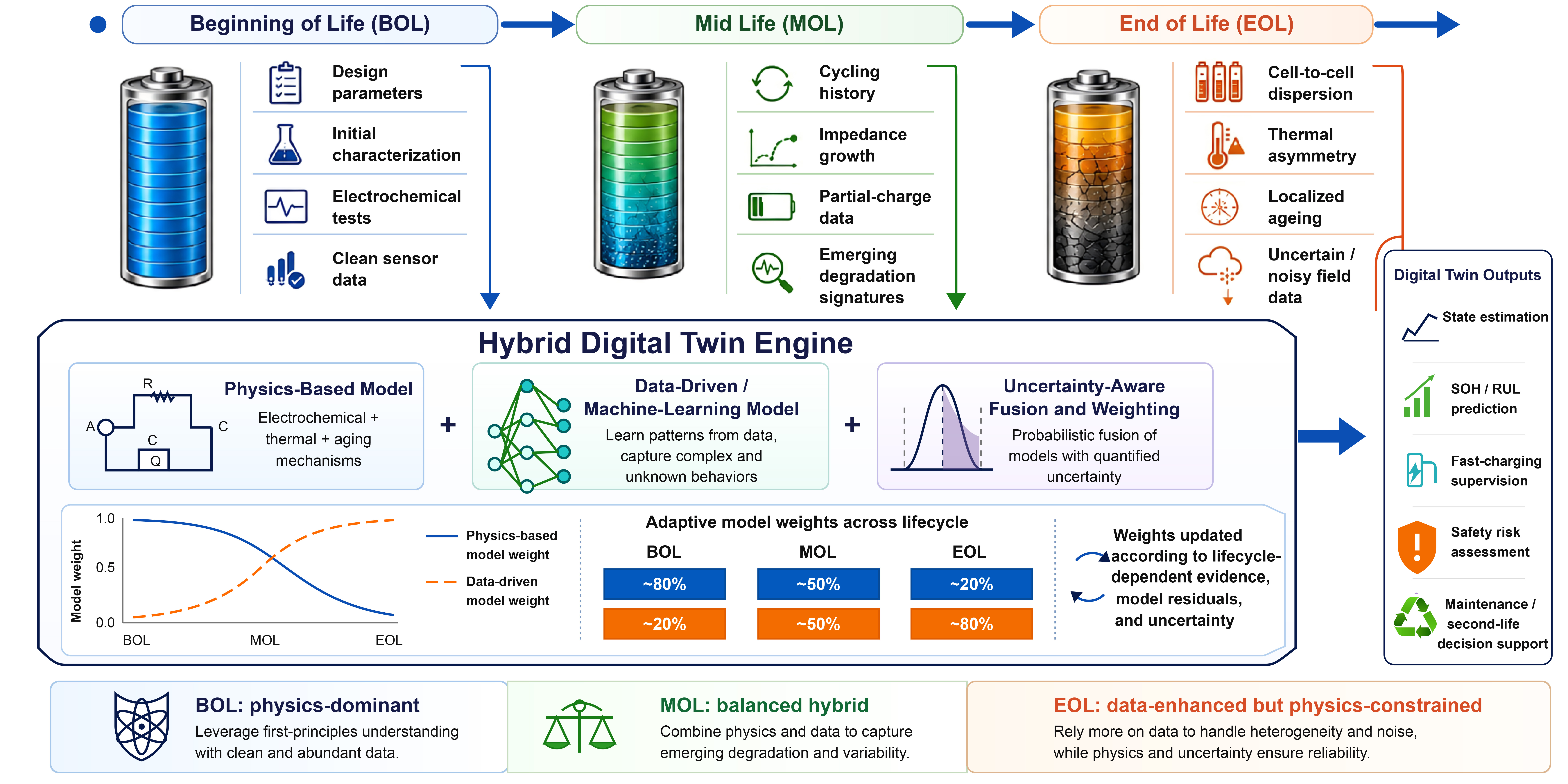
Figure 10. Conceptual workflow for lifecycle-dependent rebalancing between physics-based and data-driven models in battery digital twins. At the beginning-of-life, the digital twin is physics-dominant because the fresh cell remains close to design assumptions and is supported by relatively clean characterization data. During mid-life, the model becomes a balanced hybrid as degradation modes become more separable, but usage histories diverge. At end-of-life, the twin becomes data-enhanced but physics-constrained because cell-to-cell dispersion, localized ageing, and uncertainty dominate management risk. Throughout the lifecycle, the uncertainty-aware fusion layer updates model weights according to incoming evidence, model residuals, and calibration quality. SOH: State of health; RUL:
The fourth priority is benchmark realism. Battery twins should be tested across distinct regimes: interpolation within known laboratory distributions[5], extrapolation across controlled but unseen operating conditions[13,14], transfer across chemistry or configuration[42], and in-the-wild operation under fragmented data and uncertain labels[78,80]. Reporting a single point-error metric across these regimes is not informative enough. Future benchmark reports should separate mean accuracy, calibration, robustness, warning lead time, latency, and auditability.
The fifth priority is semantic and regulatory continuity. Battery identity, manufacturing genealogy, beginning-of-life characterization, field operation, maintenance events, safety incidents, second-life grading, and recycling decisions are not peripheral metadata once a twin is deployed beyond the laboratory[19,20]. They determine whether health labels are portable, whether uncertainty is interpretable, and whether lifecycle decisions can be audited[41,42].
A final direction is cautious autonomy. Closed-loop optimization can move battery management from monitoring to supervisory action[6], but autonomy is credible only when the action policy remains constrained by physical state, calibrated uncertainty, and traceable decision logic. The objective is not to replace electrochemical understanding with end-to-end automation. It is to use learning to determine when measurements, mechanisms, and uncertainty are sufficient for a safe action[168], when additional probing is required, and when conservative intervention is necessary under reinforcement-learning or safe-control settings[169,170]. Abnormal-thermal solid-state battery analysis illustrates why autonomous decisions must remain constrained by failure-mechanism awareness[26]. Recycling-oriented studies likewise show that digital-twin outputs should remain connected to material recovery and resource-risk decisions rather than end at first-life operation[151,167].
From this perspective, the long-term value of digital twins lies in reorganizing battery management around state sufficiency, uncertainty calibration, and lifecycle accountability. If this reorganization succeeds, apparently separate functions - state estimation, degradation diagnosis, fast-charging supervision, fault warning, second-life grading, and regulatory traceability - become different queries to the same evolving representation of the battery system.
CONCLUSION
This Review argues that lithium-ion battery health management, safety diagnosis, and fast-charging control should not be treated as independent software functions. They are different decision aspects of the same coupled electrochemical, thermal, mechanical, and interfacial degradation system. A digital twin that only predicts scalar SOH or reproduces terminal voltage is therefore insufficient for modern battery management because it does not preserve the mechanism-to-action link required for safe operation.
A deployable battery digital twin must be physics-grounded, uncertainty-calibrated, and decision-oriented. It should fuse multimodal observability with task-matched mechanistic models, infer hidden degradation and hazard states with calibrated uncertainty, and translate those states into control-relevant quantities such as charging margins, safety warnings, maintenance priorities, and lifecycle decisions. This is a stricter requirement than high prediction accuracy under laboratory cycling; it requires robustness under fragmented field data, pack heterogeneity, privacy constraints, and evolving evidence regimes.
The most consequential advances will therefore stem from the explicit coupling of observability, mechanism, uncertainty, and action across the battery lifecycle. When benchmarking, data semantics, and governance mature alongside model development, the digital twin can move from an attractive concept to an auditable battery-intelligence layer for safe fast charging, predictive safety, durable operation, repurposing, and circular battery value management.
DECLARATIONS
Authors’ contributions
Drafted and organized the manuscript: Wu, H.
Contributed to conceptualization, supervision, critical revision, and correspondence: Zhang, Y.; Mu, D.
All authors reviewed and approved the final manuscript.
Availability of data and materials
Not applicable.
AI and AI-assisted tools Statement
During the preparation of this manuscript, the AI tool DeepSeek (V3.1, released 2025-08-21) was utilized solely for language editing, and Doubao-Seedream 5.0 Lite (released 2026-02-13) was used exclusively to polish the Graphical Abstract. The tool did not influence the study design, literature selection, figure-source selection, data interpretation, analysis, conclusions, or the scientific content of the work. All authors have reviewed and approved the final manuscript and take full responsibility for the accuracy, integrity, and final content of the manuscript.
Financial support and sponsorship
This work was financially supported by the National Key Research and Development Program of China (2024YFF0505900), Shandong Provincial Natural Science Foundation (ZR2026LGY006), the China Postdoctoral Science Foundation General Fund (2025M774198), and the Postdoctoral Fellowship Program of CPSF under Grant Number GZC20252688.
Conflicts of interest
All authors declared that there are no conflicts of interest.
Ethical approval and consent to participate
Not applicable.
Consent for publication
Not applicable.
Copyright
© The Author(s) 2026.
REFERENCES
1. Lv, C.; Zhou, X.; Zhong, L.; et al. Machine learning: an advanced platform for materials development and state prediction in lithium-ion batteries. Adv. Mater. 2022, 34, 2101474.
2. Ling, C. A review of the recent progress in battery informatics. npj. Comput. Mater. 2022, 8, 33.
3. Wang, Y. Application-oriented design of machine learning paradigms for battery science. npj. Comput. Mater. 2025, 11, 89.
4. Borah, M.; Wang, Q.; Moura, S.; Sauer, D. U.; Li, W. Synergizing physics and machine learning for advanced battery management. Commun. Eng. 2024, 3, 134.
5. Thelen, A.; Huan, X.; Paulson, N.; Onori, S.; Hu, Z.; Hu, C. Probabilistic machine learning for battery health diagnostics and prognostics - review and perspectives. npj. Mater. Sustain. 2024, 2, 14.
6. Attia, P. M.; Grover, A.; Jin, N.; et al. Closed-loop optimization of fast-charging protocols for batteries with machine learning. Nature 2020, 578, 397-402.
7. Huang, W.; Ye, Y.; Chen, H.; et al. Onboard early detection and mitigation of lithium plating in fast-charging batteries. Nat. Commun. 2022, 13, 7091.
8. Zeng, Y.; Shen, F.; Zhang, B.; et al. Nonintrusive thermal-wave sensor for operando quantification of degradation in commercial batteries. Nat. Commun. 2023, 14, 8203.
9. Wasylowski, D.; Ditler, H.; Sonnet, M.; et al. Operando visualisation of lithium plating by ultrasound imaging of battery cells. Nat. Commun. 2024, 15, 10237.
10. Ishigaki, M.; Ishikawa, K.; Usuki, T.; Kondo, H.; Komagata, S.; Sasaki, T. Operando Li metal plating diagnostics via MHz band electromagnetics. Nat. Commun. 2023, 14, 7275.
11. Von Bülow, F.; Heinrich, F.; Paxton, W. A. The future of battery data and the state of health of lithium-ion batteries in automotive applications. Commun. Eng. 2024, 3, 173.
12. Liu, H.; Li, C.; Hu, X.; et al. Multi-modal framework for battery state of health evaluation using open-source electric vehicle data. Nat. Commun. 2025, 16, 1137.
13. Li, R.; Kirkaldy, N. D.; Oehler, F. F.; Marinescu, M.; Offer, G. J.; O’Kane, S. E. J. The importance of degradation mode analysis in parameterising lifetime prediction models of lithium-ion battery degradation. Nat. Commun. 2025, 16, 2776.
14. Lu, X.; Lagnoni, M.; Bertei, A.; et al. Multiscale dynamics of charging and plating in graphite electrodes coupling operando microscopy and phase-field modelling. Nat. Commun. 2023, 14, 5127.
15. Guo, W.; Sun, Z.; Guo, J.; Li, Y.; Vilsen, S. B.; Stroe, D. I. Digital twin-assisted degradation diagnosis and quantification of NMC battery aging effects during fast charging. Adv. Energy. Mater. 2024, 14, 2401644.
16. Gu, X.; Shang, Y.; Li, J.; et al. Early warning of thermal runaway based on state of safety for lithium-ion batteries. Commun. Eng. 2025, 4, 106.
17. Wang, F.; Zhai, Z.; Zhao, Z.; Di, Y.; Chen, X. Physics-informed neural network for lithium-ion battery degradation stable modeling and prognosis. Nat. Commun. 2024, 15, 4332.
18. Che, Y.; Zheng, Y.; Rhyu, J.; et al. Mechanistically guided residual learning for battery state monitoring throughout life. Nat. Commun. 2026, 17, 855.
19. Clark, S.; Bleken, F. L.; Stier, S.; et al. Toward a unified description of battery data. Adv. Energy. Mater. 2022, 12, 2102702.
20. Regulation (EU) 2023/1542 of the European Parliament and of the Council of 12 July 2023 concerning batteries and waste batteries, Off. J. Eur. Union 2023, L 191, 1. Available from: https://eur-lex.europa.eu/eli/reg/2023/1542/oj.
21. Zhang, X.; Jia, H.; Xu, Y.; et al. Unravelling high-temperature stability of lithium-ion battery with lithium-rich oxide cathode in localized high-concentration electrolyte. J. Power. Source. Adv. 2020, 5, 100024.
22. Li, S.; Zhang, C.; Zhao, Y.; Offer, G. J.; Marinescu, M. Effect of thermal gradients on inhomogeneous degradation in lithium-ion batteries. Commun. Eng. 2023, 2, 74.
23. An, R.; Su, Y.; Wang, Y.; et al. Unveiling long-term storage failure mechanisms of single-crystal high-nickel cathodes during air exposure. Carbon. Neutral. 2025, 4, e70008.
24. Bilfinger, P.; Rosner, P.; Schreiber, M.; et al. Battery pack diagnostics for electric vehicles: transfer of differential voltage and incremental capacity analysis from cell to vehicle level. eTransportation 2024, 22, 100356.
25. Hu, X.; Zhang, K.; Liu, K.; Lin, X.; Dey, S.; Onori, S. Advanced fault diagnosis for lithium-ion battery systems: a review of fault mechanisms, fault features, and diagnosis procedures. EEE. Ind. Electron. Mag. 2020, 14, 65-91.
26. Pei, J.; Bai, X.; Xue, P.; et al. All-solid-state battery safety in abnormal thermal situations: crack propagation and lithium dendrite growth. Nano. Res. Energy. 2025, 4, e9120155.
27. Hu, J.; Fu, P.; Wei, Z.; et al. Early prediction of lithium-ion battery degradation with a generative pre-trained transformer. Nat. Commun. 2025, 17, 126.
28. Gao, T.; Bai, J.; Ouyang, D.; et al. Effect of aging temperature on thermal stability of lithium-ion batteries: part A - high-temperature aging. Renewable. Energy. 2023, 203, 592-600.
29. Zhang, L.; Liu, L.; Terekhov, A.; Warnberg, D.; Zhao, P. Thermal runaway of Li-ion battery with different aging histories. Process. Saf. Environ. Prot. 2024, 185, 910-7.
30. Zhang, G.; Wei, X.; Wang, X.; et al. Lithium-ion battery sudden death: Safety degradation and failure mechanism. eTransportation 2024, 20, 100333.
31. Duan, X.; Wang, H.; Jia, Y.; Wang, L.; Liu, B.; Xu, J. A multiphysics understanding of internal short circuit mechanisms in lithium-ion batteries upon mechanical stress abuse. Energy. Storage. Mater. 2022, 45, 667-79.
32. Yang, S.; Wang, W.; Lin, C.; Shen, W.; Li, Y. Investigation of internal short circuits of lithium-ion batteries under mechanical abusive conditions. Energies 2019, 12, 1885.
33. Liu, P.; Yang, L.; Xiao, B.; et al. Revealing lithium battery gas generation for safer practical applications. Adv. Funct. Mater. 2022, 32, 2208586.
34. Masalkovaitė, K.; Gasper, P.; Finegan, D. P. Predicting the heat release variability of Li-ion cells under thermal runaway with few or no calorimetry data. Nat. Commun. 2024, 15, 8399.
35. Zhang, Y.; Cheng, S.; Mei, W.; et al. Understanding of thermal runaway mechanism of LiFePO4 battery in-depth by three-level analysis. Appl. Energy. 2023, 336, 120695.
36. Yang, C.; Singh, A.; Pu, X.; et al. Addressing the safety of next-generation batteries. Nature 2025, 645, 603-13.
37. Li, X.; Zhao, S.; Gwan, C.; Wang, Z.; Jiao, S.; Zhu, Y. High-fidelity hierarchical modeling of lithium-ion batteries: a cross-scale electrochemical-mechanical framework. Commun. Eng. 2026, 5, 10.
38. Tang, S.; Liang, Y.; Zhong, C.; et al. Revisiting the overdischarge process as a novel accelerated aging method for LiFePO4/Graphite batteries through the unveiling of SEI evolution mechanism. Energy. Storage. Mater. 2025, 74, 103916.
39. Preger, Y.; Barkholtz, H. M.; Fresquez, A.; et al. Degradation of commercial lithium-ion cells as a function of chemistry and cycling conditions. J. Electrochem. Soc. 2020, 167, 120532.
40. He, W.; Williard, N.; Osterman, M.; Pecht, M. Prognostics of lithium-ion batteries based on Dempster-Shafer theory and the Bayesian Monte Carlo method. J. Power. Sources. 2011, 196, 10314-21.
41. Liu, X.; Zhang, L.; Yu, H.; et al. Bridging multiscale characterization technologies and digital modeling to evaluate lithium battery full lifecycle. Adv. Energy. Mater. 2022, 12, 2200889.
42. Bilfinger, P.; Schreiber, M.; Rosner, P.; et al. Why we need a standardized state of health measurement procedure for electric vehicle battery packs - a proposal for energy- and capacity-based metrics. npj. Clean. Energy. 2025, 1, 10.
43. Ou, Y.; Zhang, B.; Zhan, R.; et al. A salt-free medium facilitating electrode prelithiation towards fast-charging and high-energy lithium-ion batteries. Nat. Commun. 2025, 16, 7956.
44. Zhou, Y.; Zhu, X.; Wang, Z.; Shan, T.; Zhang, J.; Sun, Z. Safety assessment of thermal runaway behavior of lithium-ion cells with actual installed state. Appl. Therm. Eng. 2023, 229, 120617.
45. Lyu, P.; Liu, X.; Qu, J.; et al. Recent advances of thermal safety of lithium ion battery for energy storage. Energy. Storage. Mater. 2020, 31, 195-220.
46. Du, H.; Wang, Y.; Kang, Y.; et al. Side reactions/changes in lithium-ion batteries: mechanisms and strategies for creating safer and better batteries. Adv. Mater. 2024, 36, 2401482.
47. Hou, J.; Lu, L.; Wang, L.; et al. Thermal runaway of Lithium-ion batteries employing LiN(SO2F)2-based concentrated electrolytes. Nat. Commun. 2020, 11, 5100.
48. Yang, H.; Tian, J.; Mai, W.; et al. Privacy-preserving collaborative battery fault warning for massive electric vehicles by heterogeneous data from charging stations. Nat. Commun. 2025, 17, 974.
49. Tao, S.; Liu, H.; Sun, C.; et al. Collaborative and privacy-preserving retired battery sorting for profitable direct recycling via federated machine learning. Nat. Commun. 2023, 14, 8032.
50. Naseri, F.; Gil, S.; Barbu, C.; et al. Digital twin of electric vehicle battery systems: comprehensive review of the use cases, requirements, and platforms. Renew. Sustain. Energy. Rev. 2023, 179, 113280.
51. Li, W.; Rentemeister, M.; Badeda, J.; Jöst, D.; Schulte, D.; Sauer, D. U. Digital twin for battery systems: cloud battery management system with online state-of-charge and state-of-health estimation. J. Energy. Storage. 2020, 30, 101557.
52. Wang, Y.; Xu, R.; Zhou, C.; Kang, X.; Chen, Z. Digital twin and cloud-side-end collaboration for intelligent battery management system. J. Manuf. Syst. 2022, 62, 124-34.
53. Blömeke, A.; Zappen, H.; Ringbeck, F.; Frie, F.; Wasylowski, D.; Sauer, D. U. Balancing resistor-based online electrochemical impedance spectroscopy in battery systems: opportunities and limitations. Commun. Eng. 2024, 3, 62.
54. Severson, K. A.; Attia, P. M.; Jin, N.; et al. Data-driven prediction of battery cycle life before capacity degradation. Nat. Energy. 2019, 4, 383-91.
55. Jones, P. K.; Stimming, U.; Lee, A. A. Impedance-based forecasting of lithium-ion battery performance amid uneven usage. Nat. Commun. 2022, 13, 4806.
56. Hu, X.; Gao, F.; Xiao, Y.; et al. Advancements in the safety of lithium-ion battery: the trigger, consequence and mitigation method of thermal runaway. Chem. Eng. J. 2024, 481, 148450.
57. Ding, Y.; Lu, L.; Zhang, H. Multi-physics simulation and risk analysis of internal thermal runaway propagation in lithium-ion batteries. eTransportation 2025, 24, 100427.
58. Wang, G.; Gao, W.; He, X.; et al. Numerical investigation on thermal runaway propagation and prevention in cell-to-chassis lithium-ion battery system. Appl. Therm. Eng. 2024, 236, 121528.
59. Feng, X.; Ouyang, M.; Liu, X.; Lu, L.; Xia, Y.; He, X. Thermal runaway mechanism of lithium ion battery for electric vehicles: a review. Energy. Storage. Mater. 2018, 10, 246-67.
60. Ding, S.; Wang, L.; Dai, H.; He, X. Prognosticating nonlinear degradation in lithium-ion batteries: operando pressure as an early indicator preceding other signals of capacity fade and safety risks. Energy. Storage. Mater. 2025, 75, 103998.
61. Che, Y.; Hu, X.; Teodorescu, R. Opportunities for battery aging mode diagnosis of renewable energy storage. Joule 2023, 7, 1405-7.
62. Song, S.; Tang, X.; Sun, Y.; et al. Fault evolution mechanism for lithium-ion battery energy storage system under multi-levels and multi-factors. J. Energy. Storage. 2024, 80, 110226.
63. Wang, Z.; Yuan, J.; Zhu, X.; et al. Overcharge-to-thermal-runaway behavior and safety assessment of commercial lithium-ion cells with different cathode materials: a comparison study. J. Energy. Chem. 2021, 55, 484-98.
64. Zhou, P.; Liang, J.; Liu, Y.; Wu, J.; Song, Q.; Li, X. Capacity estimation of retired lithium-ion batteries using random charging segments from massive real-world data. Cell. Rep. Phys. Sci. 2025, 6, 102444.
65. Sudarshan, M.; Serov, A.; Jones, C.; Ayalasomayajula, S. M.; García, R. E.; Tomar, V. Data-driven autoencoder neural network for onboard BMS Lithium-ion battery degradation prediction. J. Energy. Storage. 2024, 82, 110575.
66. Yang, X.; Xie, H.; Zhang, L.; et al. Early-stage degradation trajectory prediction for lithium-ion batteries: a generalized method across diverse operational conditions. J. Power. Sources. 2024, 612, 234808.
67. Lanubile, A.; Bosoni, P.; Pozzato, G.; Allam, A.; Acquarone, M.; Onori, S. Domain knowledge-guided machine learning framework for state of health estimation in Lithium-ion batteries. Commun. Eng. 2024, 3, 168.
68. Mei, W.; Liu, Z.; Wang, C.; et al. Operando monitoring of thermal runaway in commercial lithium-ion cells via advanced lab-on-fiber technologies. Nat. Commun. 2023, 14, 5251.
69. Tao, S.; Ma, R.; Zhao, Z.; et al. Generative learning assisted state-of-health estimation for sustainable battery recycling with random retirement conditions. Nat. Commun. 2024, 15, 10154.
70. Maradesa, A.; Py, B.; Huang, J.; et al. Advancing electrochemical impedance analysis through innovations in the distribution of relaxation times method. Joule 2024, 8, 1958-81.
71. Messing, M.; Shoa, T.; Habibi, S. Estimating battery state of health using electrochemical impedance spectroscopy and the relaxation effect. J. Energy. Storage. 2021, 43, 103210.
72. Zhu, X.; Wang, Z.; Wang, Y.; et al. Overcharge investigation of large format lithium-ion pouch cells with Li(Ni0.6Co0.2Mn0.2)O2 cathode for electric vehicles: thermal runaway features and safety management method. Energy 2019, 169, 868-80.
73. Naguib, M.; Chen, J.; Kollmeyer, P.; Emadi, A. Thermal fault detection of lithium-ion battery packs through an integrated physics and deep neural network based model. Commun. Eng. 2025, 4, 79.
74. Lim, J.; Kang, K.; Choi, S.; et al. In-situ crosslinkable graphite for mechanically robust dry-processed lithium-ion battery electrodes. Carbon. Neutral. 2025, 4, e70050.
75. Yang, J.; Zhang, X.; Hou, M.; et al. Research advances in interface engineering of solid-state lithium batteries. Carbon. Neutral. 2025, 4, e188.
76. Lu, J.; Xiong, R.; Tian, J.; Wang, C.; Sun, F. Deep learning to estimate lithium-ion battery state of health without additional degradation experiments. Nat. Commun. 2023, 14, 2760.
77. Wu, C.; Zhu, C.; Ge, Y.; Zhao, Y. A review on fault mechanism and diagnosis approach for Li-ion batteries. J. Nanomater. 2015, 2015, 631263.
78. Finegan, D. P.; Billman, J.; Darst, J.; et al. The battery failure databank: insights from an open-access database of thermal runaway behaviors of Li-ion cells and a resource for benchmarking risks. J. Power. Sources. 2024, 597, 234106.
79. Chen, Z.; Xiong, R.; Tian, J.; Shang, X.; Lu, J. Model-based fault diagnosis approach on external short circuit of lithium-ion battery used in electric vehicles. Appl. Energy. 2016, 184, 365-74.
80. Gao, W.; Zheng, Y.; Ouyang, M.; Li, J.; Lai, X.; Hu, X. Micro-short-circuit diagnosis for series-connected lithium-ion battery packs using mean-difference model. IEEE. Trans. Ind. Electron. 2019, 66, 2132-42.
81. Chen, W.; Chen, W.; Saif, M.; Li, M.; Wu, H. Simultaneous fault isolation and estimation of lithium-ion batteries via synthesized design of Luenberger and learning observers. IEEE. Trans. Contr. Syst. Technol. 2014, 22, 290-8.
82. Zhang, Z.; Gu, X.; Zhu, Y.; Wang, T.; Gong, Y.; Shang, Y. Data-driven available capacity estimation of lithium-ion batteries based on fragmented charge capacity. Commun. Eng. 2025, 4, 32.
83. Huang, J.; Yang, Q.; Hu, A.; et al. Enhanced specific energy in fast-charging lithium-ion batteries negative electrodes via Ti-O covalency-mediated low potential. Nat. Commun. 2025, 16, 6243.
84. Han, X.; Mao, S.; Wang, Y.; et al. Manipulation of lithium dendrites based on electric field relaxation enabling safe and long-life lithium-ion batteries. Nat. Commun. 2025, 16, 3699.
85. Roman, D.; Saxena, S.; Robu, V.; Pecht, M.; Flynn, D. Machine learning pipeline for battery state-of-health estimation. Nat. Mach. Intell. 2021, 3, 447-56.
86. Zhang, H.; Li, Y.; Zheng, S.; et al. Battery lifetime prediction across diverse ageing conditions with inter-cell deep learning. Nat. Mach. Intell. 2025, 7, 270-7.
87. Ma, G.; Xu, S.; Jiang, B.; et al. Real-time personalized health status prediction of lithium-ion batteries using deep transfer learning. Energy. Environ. Sci. 2022, 15, 4083-94.
88. Cao, R.; Zhang, Z.; Lin, J.; et al. Reliable online internal short circuit diagnosis on lithium-ion battery packs via voltage anomaly detection based on the mean-difference model and the adaptive prediction algorithm. Batteries 2022, 8, 224.
89. Wu, X.; Wei, Z.; Wen, T.; Du, J.; Sun, J.; Shtang, A. Research on short-circuit fault-diagnosis strategy of lithium-ion battery in an energy-storage system based on voltage cosine similarity. J. Energy. Storage. 2023, 71, 108012.
90. Li, X.; Dai, K.; Wang, Z.; Han, W. Lithium-ion batteries fault diagnostic for electric vehicles using sample entropy analysis method. J. Energy. Storage. 2020, 27, 101121.
91. Xia, B.; Shang, Y.; Nguyen, T.; Mi, C. A correlation based fault detection method for short circuits in battery packs. J. Power. Sources. 2017, 337, 1-10.
92. Sun, Z.; Han, Y.; Wang, Z.; et al. Detection of voltage fault in the battery system of electric vehicles using statistical analysis. Appl. Energy. 2022, 307, 118172.
93. Zhao, J.; Ling, H.; Wang, J.; Burke, A. F.; Lian, Y. Data-driven prediction of battery failure for electric vehicles. iScience 2022, 25, 104172.
94. Zhang, X.; Yang, W.; Yan, L.; Kaleem, M. B.; Liu, W. Adaptive internal short-circuit fault detection for lithium-ion batteries of electric vehicles. J. Energy. Storage. 2024, 84, 110874.
95. Zhang, J.; Wang, Y.; Jiang, B.; et al. Realistic fault detection of Li-ion battery via dynamical deep learning. Nat. Commun. 2023, 14, 5940.
96. Qiao, D.; Wei, X.; Jiang, B.; et al. Quantitative diagnosis of internal short circuit for lithium-ion batteries using relaxation voltage. IEEE. Trans. Ind. Electron. 2024, 71, 13201-10.
97. Zhao, Y.; Deng, J.; Liu, P.; et al. Enhancing battery durable operation: Multi-fault diagnosis and safety evaluation in series-connected lithium-ion battery systems. Appl. Energy. 2025, 377, 124632.
98. Cai, L.; Wang, H.; Dong, Z.; He, Z.; Gao, M.; Song, Y. A multi-fault diagnostic method based on category-reinforced domain adaptation network for series-connected battery packs. J. Energy. Storage. 2023, 60, 106690.
99. Tian, E.; Chen, H.; Wang, C.; Wang, L. Security-ensured state of charge estimation of lithium-ion batteries subject to malicious attacks. IEEE. Trans. Smart. Grid. 2023, 14, 2250-61.
100. Liu, K.; Wei, Z.; Zhang, C.; Shang, Y.; Teodorescu, R.; Han, Q. Towards long lifetime battery: AI-based manufacturing and management. IEEE/CAA. J. Autom. Sinica. 2022, 9, 1139-65.
101. Björklund, E.; Xu, C.; Dose, W. M.; et al. Cycle-induced interfacial degradation and transition-metal cross-over in LiNi0.8Mn0.1Co0.1O2-graphite cells. Chem. Mater. 2022, 34, 2034-48.
102. Edge, J. S.; O’kane, S.; Prosser, R.; et al. Lithium ion battery degradation: what you need to know. Phys. Chem. Chem. Phys. 2021, 23, 8200-21.
104. Zhang, Y.; Wik, T.; Bergström, J.; Zou, C. State of health estimation for lithium-ion batteries under arbitrary usage using data-driven multimodel fusion. IEEE. Trans. Transp. Electrific. 2024, 10, 1494-507.
105. Zhao, J.; Feng, X.; Pang, Q.; et al. Battery safety: machine learning-based prognostics. Progr. Energy. Combust. Sci. 2024, 102, 101142.
106. Wei, Y.; Wang, M.; Zhang, M.; Cai, T.; Huang, Y.; Xu, M. Advancements, challenges, and future trajectories in advanced battery safety detection. Electrochem. Energy. Rev. 2025, 8, 10.
107. Xia, K.; Yao, Z.; Liu, Z.; et al. Hierarchical ionic networks in polymer electrolyte boost high-voltage solid-state Li batteries with stable interfaces and long cycling. Nano. Res. Energy. 2026, 5, e9120181.
108. Yin, X.; Wu, J.; Zhou, M.; et al. Functionalized carboxylate molecule-enabled quasi-localized high concentration electrolyte for high-stability lithium-ion batteries. Nano. Res. Energy. 2026, 5, e9120200.
109. Yan, C.; Li, H.; Zhao, X.; et al. Electrolyte design via hydrogen bonding between solvent and non-solvating cosolvent enabling stable lithium metal batteries at -20°C. Carbon. Neutral. 2025, 4, e70015.
110. Zhao, J.; Feng, X.; Tran, M.; Fowler, M.; Ouyang, M.; Burke, A. F. Battery safety: fault diagnosis from laboratory to real world. J. Power. Sources. 2024, 598, 234111.
111. Li, W.; Chen, J.; Quade, K.; Luder, D.; Gong, J.; Sauer, D. U. Battery degradation diagnosis with field data, impedance-based modeling and artificial intelligence. Energy. Storage. Mater. 2022, 53, 391-403.
112. Xu, Y.; Ge, X.; Guo, R.; Shen, W. Recent advances in model-based fault diagnosis for lithium-ion batteries: a comprehensive review. Renew. Sustain. Energy. Rev. 2025, 207, 114922.
113. Dubarry, M.; Howey, D.; Wu, B. Enabling battery digital twins at the industrial scale. Joule 2023, 7, 1134-44.
114. Sun, W.; Wu, C.; Xie, C.; et al. Fine-tuning enables state of health estimation for lithium-ion batteries via a time series foundation model. Energy 2025, 318, 134177.
115. Qasem, M.; Stubblefield, J.; Qandil, M.; Yassin, Y.; Haddadin, M.; Krishnamurthy, M. Real-time AI-enabled digital twin for battery health estimation and fast charging using partial-discharge data. eTransportation 2026, 27, 100528.
116. Kim, S.; Lee, H.; Lim, J.; Park, J.; Lee, Y. M. Digital twin battery modeling and simulations: a new analysis and design tool for rechargeable batteries. ACS. Energy. Lett. 2024, 9, 5225-39.
117. Cao, R.; Zhang, Z.; Shi, R.; et al. Model-constrained deep learning for online fault diagnosis in Li-ion batteries over stochastic conditions. Nat. Commun. 2025, 16, 1651.
118. Zhao, Y.; Wang, Z.; Yan, L.; et al. Bridging battery degradation and safety: challenges and opportunities. eTransportation 2025, 26, 100497.
119. Feng, Y.; Zhou, L.; Ma, H.; et al. Challenges and advances in wide-temperature rechargeable lithium batteries. Energy. Environ. Sci. 2022, 15, 1711-59.
120. Du, Y.; Fujita, K.; Shironita, S.; et al. Capacity fade characteristics of nickel-based lithium-ion secondary battery after calendar deterioration at 80 °C. J. Power. Sources. 2021, 501, 230005.
121. Hu, A.; Li, F.; Chen, W.; et al. Ion Transport kinetics in low-temperature lithium metal batteries. Adv. Energy. Mater. 2022, 12, 2202432.
122. Byun, S.; Park, J.; Appiah, W. A.; Ryou, M.; Lee, Y. M. The effects of humidity on the self-discharge properties of Li(Ni1/3Co1/3Mn1/3)O2/graphite and LiCoO2/graphite lithium-ion batteries during storage. RSC. Adv. 2017, 7, 10915-21.
123. Sun, Z.; Zhao, J.; Zhu, M.; Liu, J. Critical problems and modification strategies of eealizing high-voltage LiCoO2 cathode from electrolyte engineering. Adv. Energy. Mater. 2024, 14, 2303498.
124. Etacheri, V.; Marom, R.; Elazari, R.; Salitra, G.; Aurbach, D. Challenges in the development of advanced Li-ion batteries: a review. Energy. Environ. Sci. 2011, 4, 3243.
125. Klein, S.; Van Wickeren, S.; Röser, S.; et al. Understanding the outstanding high-voltage performance of NCM523||graphite lithium ion cells after elimination of ethylene carbonate solvent from conventional electrolyte. Adv. Energy. Mater. 2021, 11, 2003738.
126. Deshpande, R.; Verbrugge, M.; Cheng, Y.; Wang, J.; Liu, P. Battery cycle life prediction with coupled chemical degradation and fatigue mechanics. J. Electrochem. Soc. 2012, 159, A1730-8.
127. Birkl, C. R.; Roberts, M. R.; Mcturk, E.; Bruce, P. G.; Howey, D. A. Degradation diagnostics for lithium ion cells. J. Power. Sources. 2017, 341, 373-86.
128. Liu, Y.; Liao, C.; Zhang, W.; Hu, G.; Zhang, C.; Wang, L. Internal short circuit diagnosis of lithium-ion battery based on mechanism model and deep learning. J. Electrochem. Soc. 2022, 169, 100514.
129. Xu, J.; Ma, J.; Zhao, X.; Chen, H.; Xu, B.; Wu, X. Detection technology for battery safety in electric vehicles: a review. Energies 2020, 13, 4636.
130. Ren, D.; Feng, X.; Liu, L.; et al. Investigating the relationship between internal short circuit and thermal runaway of lithium-ion batteries under thermal abuse condition. Energy. Storage. Mater. 2021, 34, 563-73.
131. Hendricks, C.; Williard, N.; Mathew, S.; Pecht, M. A failure modes, mechanisms, and effects analysis (FMMEA) of lithium-ion batteries. J. Power. Sources. 2015, 297, 113-20.
132. Zhang, S.; Guo, X.; Dou, X.; Zhang, X. A rapid online calculation method for state of health of lithium-ion battery based on coulomb counting method and differential voltage analysis. J. Power. Sources. 2020, 479, 228740.
133. Fan, K.; Wan, Y.; Wang, Z.; Jiang, K. Time-efficient identification of lithium-ion battery temperature-dependent OCV-SOC curve using multi-output Gaussian process. Energy 2023, 268, 126724.
134. Gou, B.; Xu, Y.; Feng, X. An ensemble learning-based data-driven method for online state-of-health estimation of lithium-ion batteries. IEEE. Trans. Transp. Electrific. 2021, 7, 422-36.
135. Wang, Q.; Wang, Z.; Liu, P.; Zhang, L.; Sauer, D. U.; Li, W. Large-scale field data-based battery aging prediction driven by statistical features and machine learning. Cell. Rep. Phys. Sci. 2023, 4, 101720.
136. Deng, Z.; Xu, L.; Liu, H.; Hu, X.; Wang, B.; Zhou, J. Rapid health estimation of in-service battery packs based on limited labels and domain adaptation. J. Energy. Chem. 2024, 89, 345-54.
137. Tao, S.; Zhang, M.; Zhao, Z.; et al. Non-destructive degradation pattern decoupling for early battery trajectory prediction via physics-informed learning. Energy. Environ. Sci. 2025, 18, 1544-59.
138. Yan, L.; Peng, J.; Gao, D.; et al. A hybrid method with cascaded structure for early-stage remaining useful life prediction of lithium-ion battery. Energy 2022, 243, 123038.
139. Uy, O.; Maurer, R. Fault tree safety analysis of a large Li/SOCl2 spacecraft battery. J. Power. Sources. 1987, 21, 207-25.
140. Lee, S.; Hong, S.; Park, W.; et al. High accuracy open-type current sensor with a differential planar hall resistive sensor. Sensors 2018, 18, 2231.
141. Baorda, R. P.; Rosa, T.; Angelini, P.; Bosisio, G.; Cattani, A. Integrated metal shunt with matched sensing resistor for high-side current sensing. In ESSCIRC 2023- IEEE 49th European Solid State Circuits Conference (ESSCIRC), Lisbon, Portugal, September 11-14, 2023; IEEE, 2023, pp 241-4.
142. Li, J.; Ren, W.; Luo, Y.; Zhang, X.; Liu, X.; Zhang, X. Design of fluxgate current sensor based on magnetization residence times and neural networks. Sensors 2024, 24, 3752.
143. Garcha, P.; Schaffer, V.; Haroun, B.; et al. A duty-cycled integrated-fluxgate magnetometer for current sensing. IEEE. J. Solid-State. Circuits. 2022, 57, 2741-51.
144. Ye, J.; Xie, Q.; Lin, M.; Wu, J. A method for estimating the state of health of lithium-ion batteries based on physics-informed neural network. Energy 2024, 294, 130828.
145. Fan, Y.; Xiao, F.; Li, C.; Yang, G.; Tang, X. A novel deep learning framework for state of health estimation of lithium-ion battery. J. Energy. Storage. 2020, 32, 101741.
146. Ospina Agudelo, B.; Zamboni, W.; Postiglione, F.; Monmasson, E. Battery state-of-health estimation based on multiple charge and discharge features. Energy 2023, 263, 125637.
147. Wang, J.; Xiang, Y. Fast modeling of the capacity degradation of lithium-ion batteries via a conditional temporal convolutional encoder-decoder. IEEE. Trans. Transp. Electrific. 2022, 8, 1695-709.
148. Hu, J.; Fu, P.; Hu, X.; et al. Toward advanced estimation of state of health for integral lithium-ion battery pack. Cell. Rep. Phys. Sci. 2025, 6, 102363.
149. Ning, Y.; Yang, F.; Zhang, Y.; et al. Bridging multimodal data and battery science with machine learning. Matter 2024, 7, 2011-32.
151. Suh, J. H.; Lee, H.; Kim, J.; et al. Strategic lithium-ion battery recycling for global resource challenges. Carbon. Neutral. 2025, 4, e70018.
152. Kim, C.; Kim, M.; Moon, G. A modularized charge equalizer using a battery monitoring IC for series-connected li-ion battery strings in electric vehicles. IEEE. Trans. Power. Electron. 2013, 28, 3779-87.
153. Nugroho, B.; Yahya, A.; Rahim, A.; Andromeda, T. Magnetic field relationship between distance and induced voltage generated by electromagnetic pulse (EMP). In 2018 5th International Conference on Information Technology, Computer, and Electrical Engineering (ICITACEE), Semarang, Indonesia, September 27-28, 2018; IEEE, 2018, pp 7-10.
154. Hongxing, W.; Kexin, L.; Haojie, D.; Kai, M.; Shanqiang, F. Research on improvement of temperature stability of optical voltage transducer. In 2014 7th International Conference on Intelligent Computation Technology and Automation (ICICTA), Changsha, China, October 25-26, 2014; IEEE, 2014, pp 534-8.
155. Lee, C.; Weng, F.; Huang, Y.; Chang, C.; Cheng, C. Real-time monitoring of internal temperature and voltage of high-temperature fuel cell stack. Electrochim. Acta. 2015, 161, 413-9.
156. Lee, C.; Peng, H.; Lee, S.; et al. A flexible three-in-one microsensor for real-time monitoring of internal temperature, voltage and current of lithium batteries. Sensors 2015, 15, 11485-98.
157. You, Y.; Zhu, G.; Li, Y.; Guo, W.; Zhu, Z. 17-Cell battery monitoring analog front end with high sampling accuracy for battery pack applications. Microelectron. J. 2024, 151, 106327.
158. Shi, Q.; Tang, W.; Lv, Q. A high precision voltage detection circuit for multiple lithium batteries. In 2022 7th International Conference on Integrated Circuits and Microsystems (ICICM), Xi'an, China, October 28-31, 2022; IEEE, 2022, pp 60-6. DOI: 10.1109/ICICM56102.2022.10011305.
159. Mao, B.; Huang, P.; Chen, H.; Wang, Q.; Sun, J. Self-heating reaction and thermal runaway criticality of the lithium ion battery. Int. J. Heat. Mass. Transfer. 2020, 149, 119178.
160. Fleming, J.; Amietszajew, T.; Charmet, J.; Roberts, A. J.; Greenwood, D.; Bhagat, R. The design and impact of in-situ and operando thermal sensing for smart energy storage. J. Energy. Storage. 2019, 22, 36-43.
161. Zhu, S.; Han, J.; An, H.; et al. A novel embedded method for in-situ measuring internal multi-point temperatures of lithium ion batteries. J. Power. Sources. 2020, 456, 227981.
162. Drake, S.; Martin, M.; Wetz, D.; et al. Heat generation rate measurement in a Li-ion cell at large C-rates through temperature and heat flux measurements. J. Power. Sources. 2015, 285, 266-73.
163. Zhang, G.; Cao, L.; Ge, S.; Wang, C.; Shaffer, C. E.; Rahn, C. D. In situ measurement of radial temperature distributions in cylindrical Li-ion cells. J. Electrochem. Soc. 2014, 161, A1499-507.
164. Mutyala, M. S. K.; Zhao, J.; Li, J.; Pan, H.; Yuan, C.; Li, X. In-situ temperature measurement in lithium ion battery by transferable flexible thin film thermocouples. J. Power. Sources. 2014, 260, 43-9.
165. Cai, T.; Valecha, P.; Tran, V.; Engle, B.; Stefanopoulou, A.; Siegel, J. Detection of Li-ion battery failure and venting with carbon dioxide sensors. eTransportation 2021, 7, 100100.
166. Li, S.; Zhang, M.; Doel, R.; Ross, B.; Piggott, M. D. Deep learning predicts real-world electric vehicle direct current charging profiles and durations. Nat. Commun. 2025, 16, 10921.
167. Shan, M.; Wei, K.; Cheng, L.; et al. Toward sustainable graphite anode recycling: from degradation understanding to targeted regeneration. Nano. Res. Energy. 2026, 5, e9120230.
168. Bin Faheem, A.; Han, Z.; Wu, D.; Li, H. AI-driven big data frameworks for electrode-electrolyte interphases in batteries. Adv. Mater. 2026, 38, e21975.
169. He, Z.; Wang, Z.; Dong, Y.; et al. Coupling data-driven and reinforcement learning for material development and device management in batteries. Adv. Mater. 2026, 38, e72332.
Cite This Article
 Open Access
How to Cite
Download Citation
Export Citation File:
Type of Import
Tips on Downloading Citation
Citation Manager File Format
Type of Import
Direct Import: When the Direct Import option is selected (the default state), a dialogue box will give you the option to Save or Open the downloaded citation data. Choosing Open will either launch your citation manager or give you a choice of applications with which to use the metadata. The Save option saves the file locally for later use.
Indirect Import: When the Indirect Import option is selected, the metadata is displayed and may be copied and pasted as needed.
About This Article
Copyright

Data & Comments
Data
0





Comments
Comments must be written in English. Spam, offensive content, impersonation, and private information will not be permitted. If any comment is reported and identified as inappropriate content by OAE staff, the comment will be removed without notice. If you have any queries or need any help, please contact us at [email protected].