

fig6
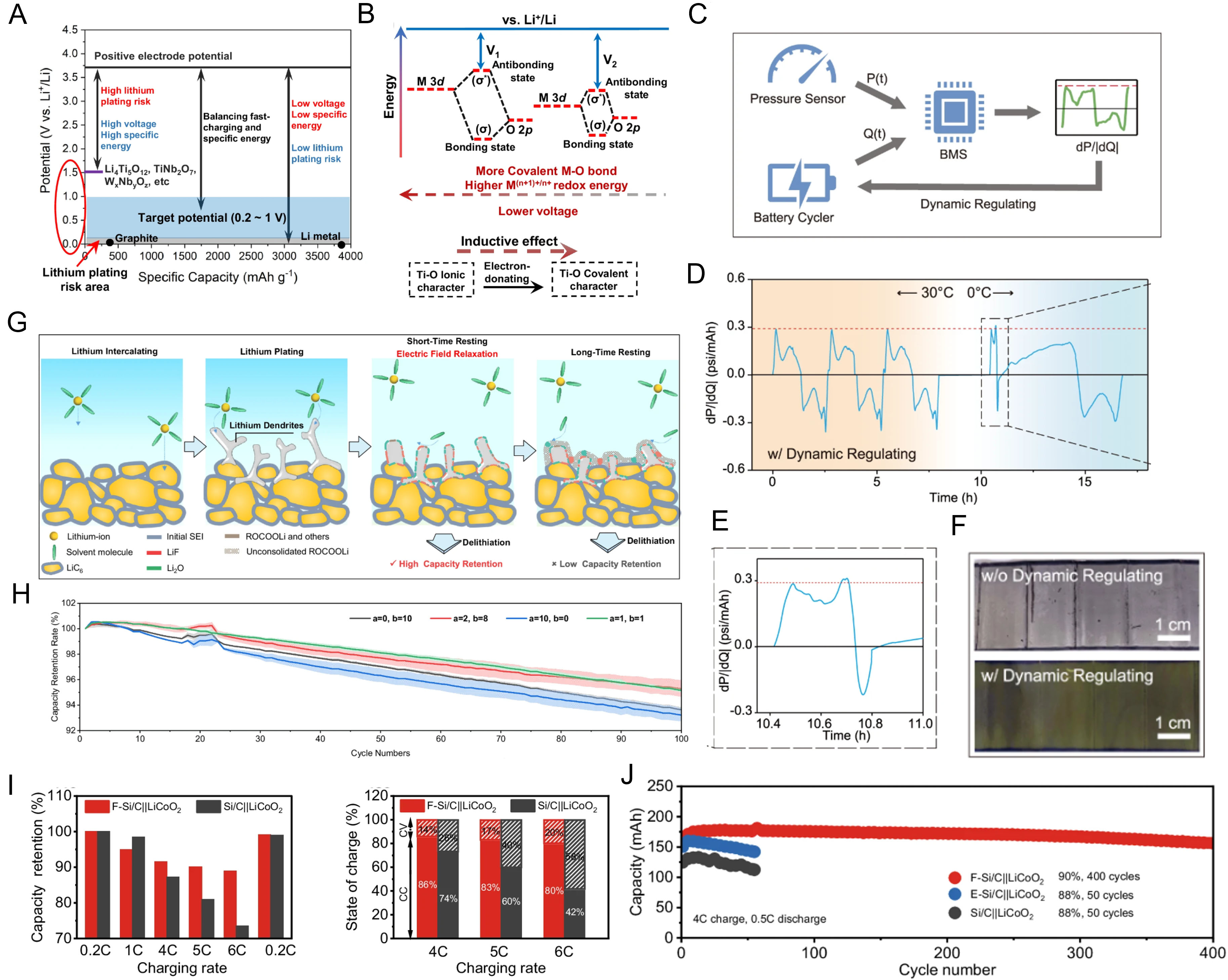
Figure 6. Fast-charging supervision as risk-constrained control. (A) Materials-level potential window for balancing fast charging and specific energy; (B) Ti-O covalency strategy for regulating lithium-insertion potential. Figure 6A and B is reprinted with permission from Ref.[83]. Copyright © 2025 Springer Nature. (C) Pressure-triggered self-regulated charging scheme; (D) Dynamic current regulation at 30 °C; (E) Dynamic current regulation at 0 °C; (F) Graphite-anode optical evidence showing suppression of lithium plating. Figure 6C-F is reprinted from Ref.[7], under the CC BY 4.0 license; (G) Electric-field-relaxation mechanism for lithium-dendrite manipulation; (H) Degradation response of commercial Gr||LFP cells under 3 C plating-prone fast charging and different manipulation protocols. Figure 6G and H are reprinted with permission from Ref.[84]. Copyright © 2025 Springer Nature; (I) Capacity retention and CC/CV-stage segmentation under chemistry-enabled fast charging; (J) Pouch-cell cycling stability under 4 C charging. Figure 6I and J are reprinted from Ref.[43], under the CC BY 4.0 license. BMS: Battery management system; SEI: solid electrolyte interphase; LFP: lithium iron phosphate; CC: constant current; CV: constant voltage.