



Bilateral coordination interfaces enable long-term stable organic solar cells under multiple stress conditions
 0
0 Abstract
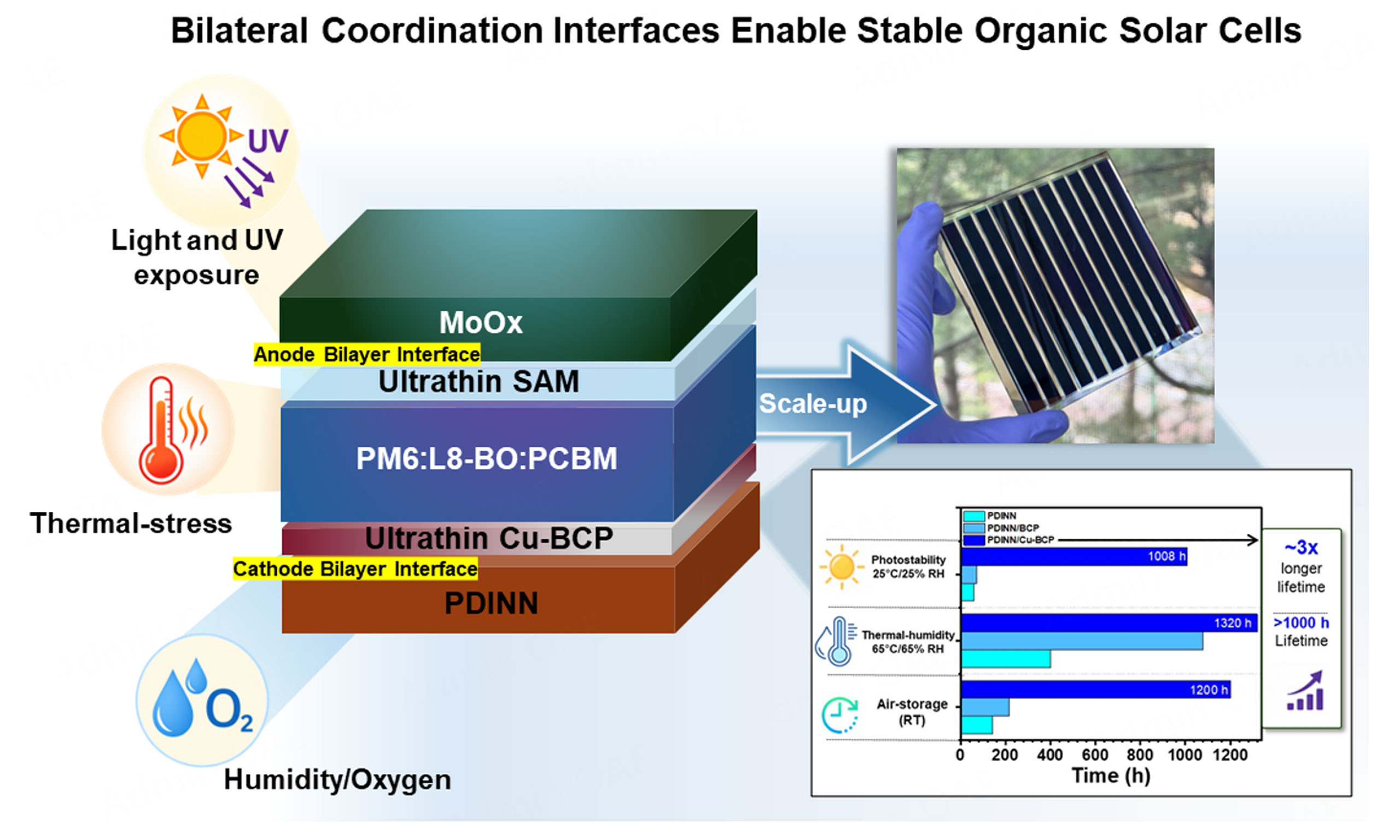
Achieving long-term operational stability alongside high power conversion efficiency remains one of the most critical challenges for organic solar cells (OSCs), as interfacial degradation under heat, humidity, and continuous illumination severely limits device lifetime. Although many studies report improved stability under individual stress conditions, few OSC studies have demonstrated extended durability across multiple stress conditions. Here, we report a bilateral bilayer interface engineering strategy centered on a novel coordination-engineered cathode stabilization material, Cu-bathocuproine (BCP), formed by coordinating Cu with conventional BCP. Introduced as an overlayer on aliphatic amine-functionalized perylene-diimide (PDINN), Cu-BCP serves as an efficient electron-extraction interlayer and a chemically stabilized buffer that suppresses detrimental interfacial reactions with the non-fullerene acceptor. Combined with a self-assembled monolayer/metal oxide anode bilayer, [2-(9H-carbazol-9-yl)ethyl]phosphonic acid (2PACz)/MoOx, OSCs with the structure of indium tin oxide (ITO)/PDINN/Cu-BCP/PM6:L8-BO:PC71BM/2PACz/MoOx/Ag achieve a power conversion efficiency of 16.70%, surpassing the reference devices based on PDINN (14.58%) and PDINN/BCP (15.05%). Importantly, the bilateral bilayer devices exhibit substantially enhanced durability under multiple independent stress conditions, retaining 80% of their initial efficiency after 1,200 h in air storage, 1,320 h at 65 °C/65% relative humidity, and 1,008 h under continuous 1-sun illumination, corresponding to the longest T80 lifetime among PDINN-based devices. The improved stability is associated with suppressed trap-assisted recombination, reduced leakage current, and lower charge-transfer resistance. Moreover, large-area modules deliver an efficiency of 14.57% with a 54 cm2 active area, indicating an 87% cell-to-module ratio. These results demonstrate that ultrathin stabilization-layer design within bilateral bilayer interfaces is an effective route toward efficient, stable, and scalable OSCs.
Keywords
INTRODUCTION
In recent years, organic solar cells (OSCs) have been rapidly developed, exhibiting power conversion efficiencies (PCEs) that exceed 19%. This improvement is mainly due to the development of non-fullerene acceptors (NFAs), improved control over bulk-heterojunction (BHJ) morphology, and the emergence of self-assembled monolayer (SAM)-based hole-selective contacts[1-6]. Despite these remarkable gains in efficiency, long-term operational stability remains a major obstacle to practical deployment, particularly under realistic stress conditions involving heat, moisture, and continuous illumination[7-9]. Moreover, while many previous studies have achieved strong stability under one specific stress condition, and in some cases under three, it remains uncommon for a single OSC study to clearly demonstrate extended durability across all major independent stress modes relevant to practical operation[10-12]. Because interfacial degradation is often one of the earliest and most severe failure pathways in OSCs, developing robust interfacial materials is currently as important as improving the photoactive layer itself.
In inverted OSC architectures, the electron-collecting interface is especially critical because it governs both charge-selective extraction and interfacial chemical stability. ZnO has been widely used as an electron transport layer (ETL), yet its surface defects and photocatalytic activity are well known to accelerate interfacial degradation and compromise photostability[13-15]. These limitations have stimulated growing interest in alternative cathode interlayers (CILs) that can maintain efficient electron extraction while minimizing interfacial instability. Among them, water/alcohol-processable organic cathode interlayer materials (CIMs), such as poly[(9,9-bis(3′-((N,N-dimethyl)-N-ethylammonium)-propyl)-2,7-fluorene)-alt-2,7-(9,9-dioctylfluorene)] (PFN-Br), polyethyleneimineethoxylated (PEIE), and related amine-containing materials, offer several advantages, including effective defect passivation, low-temperature processing, and improved compatibility with NFA-based active layers[16-18]. In particular, aliphatic amine-functionalized perylene-diimide (PDINN) has emerged as a highly effective cathode interlayer, providing favorable energy-level alignment and enabling high initial efficiencies across a wide range of OSC systems[19-21]. However, PDINN primarily addresses electronic contact formation and does not inherently provide sufficient chemical protection against prolonged thermal, humid, or photo-induced interfacial degradation. As a result, the cathode-side interface remains vulnerable under extended operation.
A promising route to address this issue is to move beyond the conventional role of bilayer interfacial contacts. In most OSC bilayers, the additional layer is mainly introduced to tune the work function (WF), improve energy alignment, or facilitate charge extraction. Alternatively, an ultrathin constituent layer may be incorporated within the bilayer to specifically function as a stabilization layer. Such a design would enable the bilayer to combine electronic selectivity with chemical protection, thereby simultaneously addressing efficiency and durability concerns. In this context, bathocuproine (BCP) and related phenanthroline-derived molecules are attractive starting materials because they are established cathode-side buffer materials in optoelectronic devices and possess favorable electron-transporting and hole/exciton-blocking properties[22,23]. However, pristine BCP can interact unfavorably with NFA-based active layers, leading to interfacial instability[22]. This highlights the need for a new material design approach in which a conventional interlayer is transformed into a more chemically robust functional component rather than simply using it in its original form[24]. In this context, metal-ligand coordination is particularly attractive because it can modulate the ligand electronic structure, reduce chemical reactivity, stabilize interfacial energetics, and promote denser molecular packing[25-27]. Previous studies have shown that coordination-based cathode modification can effectively improve cathode contact properties. For example, phenanthroline coordination on ZnO has been used to tune the work function of metal-oxide cathode buffer layers, while Ag/phenanthroline coordination has been reported to promote coordination-assisted n-doping and improve electron injection in organic electronics[28,29]. Nevertheless, these approaches mainly focus on work-function modulation, electron injection, or doping behavior, and comparatively fewer studies have targeted cathode-side chemical stabilization at the CIL/NFA-containing active-layer interface under multiple operational stress conditions. Based on this concept, Cu-coordinated BCP (Cu-BCP) is a coordination-engineered interfacial material derived from conventional BCP, designed to act as an ultrathin chemically stabilized overlayer for ETLs while preserving efficient electron extraction.
Anode-side interlayers are also critical for achieving efficient and stable inverted OSCs. Among various hole-selective interlayers, SAMs, particularly [2-(9H-carbazol-9-yl)ethyl]phosphonic acid (2PACz), have been shown to improve energy-level alignment, suppress interfacial recombination, and simplify device fabrication[30,31]. In this study, we develop a bilateral bilayer interface engineering strategy that combines a coordination-engineered cathode bilayer (PDINN/Cu-BCP) with a SAM/metal oxide anode bilayer (2PACz/MoOx). In contrast to previous studies that mainly focused on either cathode-side or anode-side interlayers separately, the present study integrates both interfaces into a bilateral bilayer design. Importantly, the cathode bilayer is not designed merely as a conventional dual-interlayer contact; rather, one of its constituent layers is an ultrathin coordination-engineered stabilization sublayer. PDINN functions as the primary electron-selective contact, while the ultrathin Cu-BCP overlayer acts as a coordination-engineered stabilization layer. Through Cu-N coordination, Cu-BCP modifies the nitrogen electronic environment of BCP, reduces unfavorable cathode-side interfacial reactivity, and helps preserve efficient electron extraction during device operation. At the anode side, the 2PACz/MoOx bilayer provides a controlled and stable hole-collecting contact. Through the simultaneous engineering of both charge-extraction interfaces, the resulting OSCs achieve a high PCE of 16.70% and show markedly improved operational stability under multiple independent stress conditions, retaining 80% of their initial efficiency after 1,200 h in air storage, 1,320 h at 65 °C/65% relative humidity (RH), and 1,008 h under continuous 1-sun illumination. Moreover, large-area modules deliver 14.57% efficiency over a 54 cm2 active area with an 87% cell-to-module (CTM) ratio. To the best of our knowledge, no single previous OSC study has clearly established more than 1,000 h of durability under air/ambient storage, humidity-containing thermal aging, and continuous illumination. Taken together, these results identify Cu-BCP as a promising coordination-engineered stabilization material for CILs and demonstrate that ultrathin stabilization-layer design within bilateral bilayer interfaces is an effective strategy for simultaneously advancing the efficiency, stability, and scalability of OSCs.
EXPERIMENTAL
Materials
The donor polymers PBDBT-2F (also referred to as PM6) and the NFA (L8-BO) were purchased from 1-Materials. The fullerene acceptor PC71BM was supplied by Sigma-Aldrich. PDINN (1-Materials) and 2PACz (TCI), as well as copper(II) chloride (CuCl2, Sigma-Aldrich) and BCP (Sigma-Aldrich), were purchased commercially.
Device fabrication
For the CIL preparation, PDINN was dissolved in methanol at a concentration of 1 mg/mL and stirred at
Measurement and characterization
The optical properties, including the transmittance and absorbance, were measured using an ultraviolet-visible (UV-Vis) spectrometer (Cary 5000, Varian, USA). The surface morphology was investigated using atomic force microscopy (AFM; Park NX10, Park Systems, Republic of Korea). Water contact angle measurements were performed using a contact angle analyzer (Phoenix-300, SEO, Republic of Korea) to evaluate surface wettability. The WFs of the CILs were determined from the onset of the secondary electron cutoff region using ultraviolet photoelectron spectroscopy (UPS; MultiLab 2000, Thermo Scientific, UK). Current density-voltage (J-V) characteristics were measured in ambient air using a source meter (Keithley 2400A) under calibrated AM 1.5G illumination at 100 mW/cm2. The illumination intensity was calibrated using a standard Si photodiode detector equipped with a KG-5 filter (Oriel 91150V, Newport, USA). External quantum efficiency (EQE) spectra were collected over the wavelength range of 300-1,000 nm using an EQE measurement system (Oriel IQE-200, Newport Co., USA). Electrochemical impedance spectroscopy (EIS) was carried out using an electrochemical impedance analyzer (CompactStat, Ivium Technologies, Netherlands) over the frequency range of 1 kHz to 1 MHz under dark conditions, with the applied bias set close to the open-circuit voltage (VOC) of each device. The time-resolved photoluminescence (TRPL) decay transients were recorded at 635 nm under pulsed excitation at 405 nm.
RESULTS AND DISCUSSION
To enhance interfacial stability and charge extraction in inverted-structure OSCs, a coordination-engineered CIL comprising PDINN/Cu-BCP was developed. Figure 1A presents the molecular structures of the active-layer components and the design concept of the coordination-engineered CIL. In this strategy, pristine BCP is converted into Cu-BCP through coordination with copper, forming a coordination-locked overlayer on PDINN. As illustrated in Figure 1A, BCP coordinates with copper species to form a Cu-N coordination complex, denoted as Cu-BCP, thereby generating a coordination-locked interlayer on top of PDINN. This coordination interaction effectively suppresses the reactivity of nitrogen lone pairs in pristine BCP and promotes the formation of a denser, chemically stabilized interfacial layer, in agreement with a previous study showing that strong coordination between air-stable metal species and chelating organic ligands drives complex formation and facilitates electron donation[32]. The corresponding device architecture is shown in Figure 1B, which consists of ITO/PDINN/Cu-BCP/PM6:L8-BO:PC71BM/2PACz/MoOx/Ag. To enhance hole extraction and reduce interfacial recombination, the 2PACz layer was used as an ultra-thin hole-selective interlayer that was coated on top of the active layer before MoOx. Previous research demonstrated that hybrid SAM/MoOx contacts in inverted devices can increase interfacial stability, minimize unfavorable direct interactions between MoOx and the bulk heterojunction, and facilitate charge transport[33,34]. Thermally evaporated MoOx is sensitive to temperature and deteriorates with increasing annealing temperature, and it can also spontaneously diffuse into underlying organic layers, leading to performance degradation over time[35]. Supplementary Figure 1 shows that introducing 2PACz onto the PM6:L8-BO:PC71BM film results in negligible changes in the absorption profile, suggesting that the optical characteristics of the active layer are well preserved. No noticeable spectral shift was observed following the introduction of 2PACz, indicating that the intrinsic optical properties of the active layer were preserved. The interfacial electronic characteristics of the modified ITO electrodes were further evaluated using UPS. As shown in Figure 1C, the WF of the modified ITO electrode is determined from the onset of the secondary-electron cutoff region in the UPS spectra. The calculated WFs are listed in
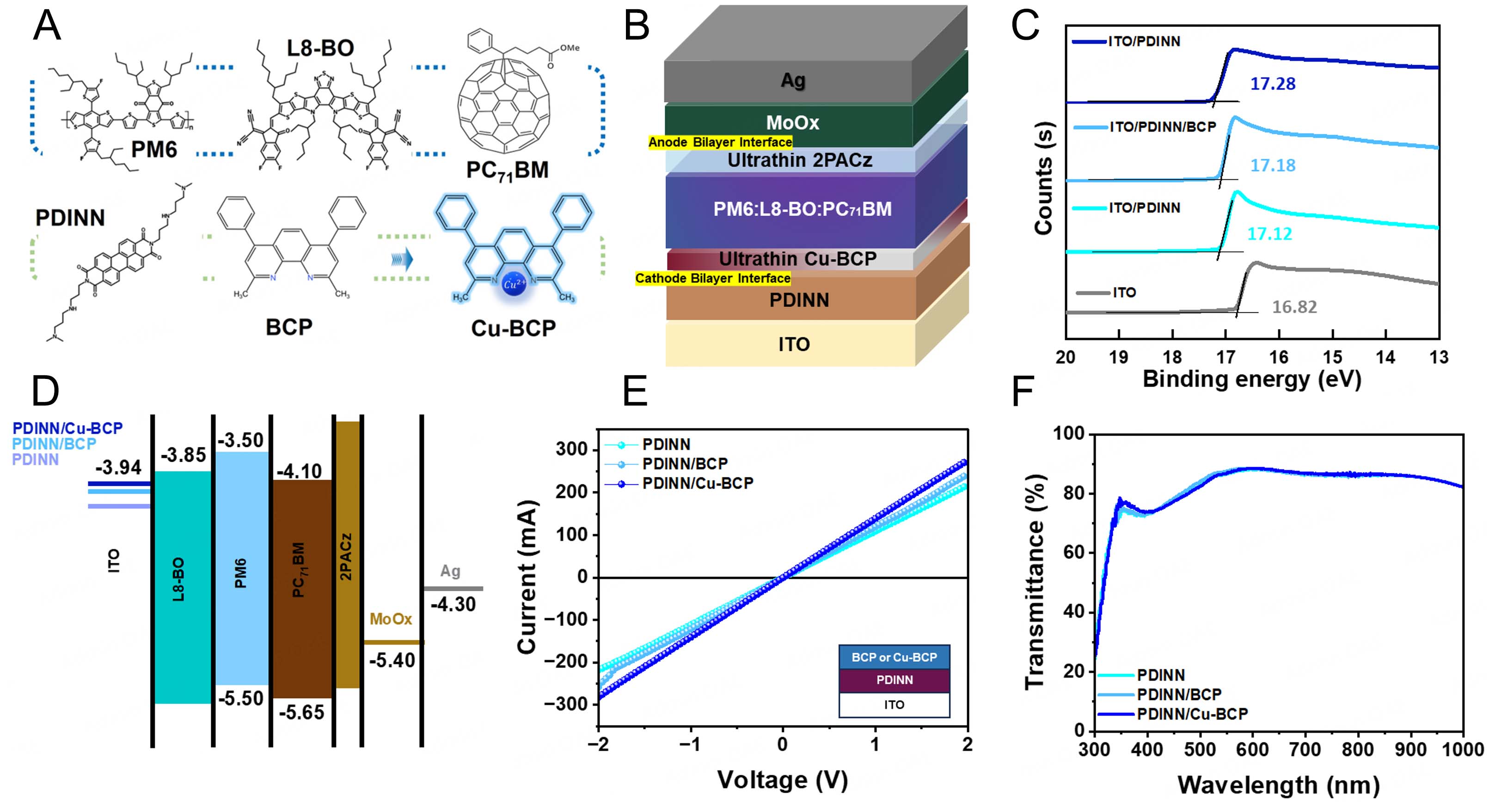
Figure 1. (A) Chemical structures of the photoactive materials (PM6:L8-BO:PC71BM) and cathode interlayers components (PDINN, BCP and Cu-BCP); (B) inverted OSC device structure incorporating PDINN/Cu-BCP as bilayer ETLs and ultrathin 2PACz/MoOx as a bilayer HTL; (C) UPS spectra of ITO, ITO/PDINN, ITO/PDINN/BCP, and ITO/PDINN/Cu-BCP; (D) energy level alignment of the inverted OSC device structure; (E) I-V characteristics of the ITO/PDINN-based interfacial stacks with BCP or Cu-BCP; (F) optical transmittance spectra of ITO substrates modified with PDINN, PDINN/BCP, and PDINN/Cu-BCP interlayers.
The chemical compatibility between the L8-BO acceptor and the interlayer components was first examined using the absorption spectra to clarify the role of Cu-BCP in suppressing interfacial degradation. As shown in Figure 2A, mixing PDINN with L8-BO leads to a clear spectral perturbation in the visible region together with a visible color change, indicating a relatively strong chemical/electronic interaction between the acceptor and PDINN. This trend aligns with a previous study demonstrating that a CIL with amines can chemically react with NFAs, altering their original electronic structure[24]. While PDINN is a known efficient dipolar CIL, its amine-containing side chains can also create strong interfacial interactions with the active layer, which is beneficial electronically yet can become chemically problematic for reactive NFA systems[38]. By contrast, the spectra of L8-BO (dissolved in chloroform) mixed with BCP or Cu-BCP remain much closer to the spectrum of pristine L8-BO, suggesting that the BCP-based upper layer effectively mitigates direct perturbation of the acceptor. Conversely, phenanthroline-based interlayers with lower interfacial reactivity can prevent these chemical interactions at the cathode and thereby stabilize the system[39]. X-ray photoelectron spectroscopy (XPS) was conducted to understand the formation of the coordination-engineered Cu-containing cathode layer and the interfacial interactions between PDINN. The corresponding full survey spectra are provided in Supplementary Figure 2. As shown in
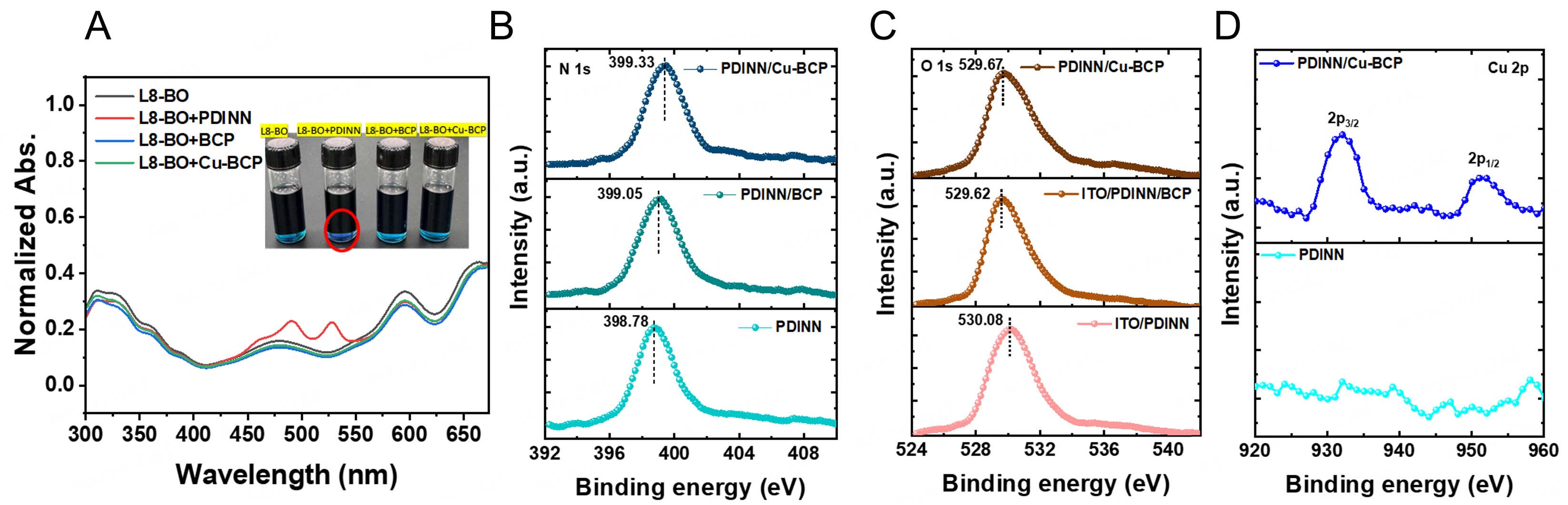
Figure 2. Optical and chemical interaction analysis of PDINN-based CILs. (A) Normalized UV-vis absorption profiles for neat L8-BO solution and L8-BO blended with PDINN, BCP, or Cu-BCP, with a photograph of the corresponding solution shown in the inset. XPS spectra of (B) N 1s element; (C) O 1s element of PDINN, PDINN/BCP, PDINN/Cu-BCP; and (D) Cu 2p element of PDINN vs. PDINN/Cu-BCP.
The morphology and wettability of the modified substrates were systematically examined because the surface characteristics of CIL-modified ITO can affect interfacial adhesion and electron-collection behavior. AFM analysis was performed to assess the morphological changes induced by the BCP overlayer and Cu-BCP coordination layer before and after coating the photoactive blend. As shown in Supplementary Figure 6, PDINN/BCP displays a slightly increased roughness (Rq = 1.115 nm) compared to PDINN, whereas PDINN/Cu-BCP exhibits marginally lower roughness (Rq = 0.962 nm). While these differences are modest, the consistently lower roughness of PDINN/Cu-BCP across both bare interlayer and BHJ-coated films suggests improved interfacial uniformity, which may contribute to reduced contact resistance and more stable device operation, as supported by the lower charge-transfer resistance and improved stability observed in the corresponding devices[41]. After photoactive layer coating, all films remain smooth, with Rq values of 1.584, 1.644, and 1.582 nm for PDINN, PDINN/BCP, and PDINN/Cu-BCP, respectively, indicating that none of the interlayers induces severe topographic instability during BHJ coating. Because the interfacial layers in OSCs are known to affect film morphology and recombination, as well as interfacial energetics, these AFM results indicate that Cu-BCP provides a more physically uniform cathode-side contact than BCP alone[41,42]. Water contact-angle measurements [Supplementary Figure 7] further reveal the systematic tuning of the surface wettability for various CILs, increasing from 41.4° for PDINN to 53.7° for PDINN/BCP and 57.9° for PDINN/Cu-BCP. The increased contact angle of PDINN/Cu-BCP indicates moderate surface polarity compared to PDINN. This change in wettability may influence BHJ deposition dynamics and interfacial contact quality. Combined with the AFM results showing uniform film formation, these data suggest that Cu-BCP provides balanced interfacial compatibility with the active layer, consistent with its beneficial effects on charge extraction and device stability. In particular, previous studies have shown that adjusting the surface free energy of interfacial layers can alter donor/acceptor distribution and active-layer morphology, while PDINN-type polar interlayers must balance the WF reduction against the risk of overly high surface energy and inadequate physical contact with the active layer[21,43,44]. Therefore, the higher contact angle of PDINN/Cu-BCP suggests that Cu incorporation moderates the strong polarity of the PDINN-based cathode surface and provides a more balanced interface for PM6:L8-BO:PC71BM deposition. Based on this interfacial modification, the CuCl2 mixing ratio was first optimized by comparing different volume ratios, including 1:0.5, 1:3, 1:5, and 1:7, using MoOx alone as the HTL. Supplementary Table 4 summarizes the photovoltaic parameters obtained under different interlayer volume-ratio conditions. Among these devices, the 1:5 (v/v) ratio yielded the highest PCE of 15.24%, primarily due to improved VOC and fill factor (FF) values. Therefore, the 1:5 (v/v) CuCl2 ratio was selected as the optimized condition because it provides the best balance between Cu-N coordination-induced stabilization and efficient charge extraction. Using this optimized Cu-BCP condition, the intrinsic role of cathode-side bilayer engineering was then examined by comparing devices employing PDINN, PDINN/BCP, and PDINN/Cu-BCP CILs, as summarized in Supplementary Table 5. Starting from the PDINN single-layer cathode, the introduction of BCP improves the PCE from 13.69% to 14.62%, while further modification with Cu-BCP increases the PCE to 15.30%. This improvement is mainly driven by the enhancement in FF from 69% for PDINN to 71% for PDINN/BCP and 73% for PDINN/Cu-BCP, together with a moderate increase in VOC from 0.82 to 0.84 and 0.85 V, respectively. By contrast, JSC showed only a marginal variation, increasing from 24.19 mA cm-2 for PDINN to 24.51 and 24.53 mA cm-2 for PDINN/BCP and PDINN/Cu-BCP, respectively. These trends indicate that the cathode-side bilayer primarily improves charge extraction and reduces interfacial recombination/resistance losses, rather than significantly changing photocurrent generation.
Although the PDINN/Cu-BCP-based devices exhibited improved initial performance, the operational stability of these devices remains limited, as shown in Supplementary Figure 8. This suggests that cathode-side stabilization alone is insufficient to fully suppress device degradation, and that additional degradation pathways remain at the anode-side active-layer/MoOx interface. Therefore, an ultrathin 2PACz interlayer was introduced before MoOx to improve the active-layer/MoOx interface, reduce unfavorable direct contact between the BHJ and MoOx, and enhance hole extraction. As a result, the final bilateral bilayer interface design consists of PDINN/Cu-BCP as the cathode bilayer for electron extraction and cathode-side stabilization, and 2PACz/MoOx as the anode bilayer for hole extraction and anode-side interfacial stabilization. For reference, the optimized organic CIL of PDINN was also compared with the conventional ZnO-based ETL. As shown in Supplementary Figure 9, the ZnO- and PDINN-based devices exhibit comparable initial photovoltaic performance under the 2PACz/MoOx anode condition. However, under continuous 1-sun illumination, the ZnO-based device degrades much more rapidly than the PDINN-based device [Supplementary Figure 10]. The rapid decline in performance suggests serious deterioration of the cathode-side interface in the ZnO device. This poor durability is likely associated with the known susceptibility of ZnO to surface-defect-induced instability and photocatalytic-driven interfacial degradation, which can accelerate decomposition at the ZnO/active-layer interface. Therefore, despite its comparable initial efficiency, PDINN was selected as the more reliable organic CIL for further interfacial engineering. After establishing the intrinsic contribution of the cathode bilayer, an ultrathin 2PACz interlayer was introduced to improve the stability of the active layer/MoOx interface, yielding a bilateral bilayer interface design composed of PDINN/Cu-BCP as the cathode bilayer and 2PACz/MoOx as the anode bilayer. The corresponding comparison of photovoltaic parameters for devices with MoOx and 2PACz/MoOx is shown in Supplementary Figure 11, which clearly demonstrates that the highest performance is achieved when both bilayers are simultaneously integrated. Based on this PDINN result, additional modifications to BCP and Cu-BCP were subsequently explored to further optimize the cathode-layer interface and enhance stability, as explained later. The J-V characteristics in Figure 3A reveal improved device performance upon modifying PDINN with BCP and, more significantly, with Cu-BCP, with the addition of 2PACz as an HTL modification. The device parameters are listed in Table 1, and the PCE histogram is shown in Figure 3B. The reference device based on PDINN delivered a PCE of 14.58%, while further introducing BCP onto the PDINN layer slightly improved device performance, yielding a PCE of 15.05%. By contrast, the PDINN/Cu-BCP-based device exhibited the best performance, achieving a PCE of 16.70% with improved VOC and FF values, while the change in JSC was relatively small. These results indicate that incorporating Cu-BCP is highly effective at enhancing charge extraction and suppressing recombination losses at the cathode interface. The EQE was measured to obtain information on the photo-response of the OSC devices, as shown in Figure 3C. The integrated photocurrent density was 24.40 mA/cm2, which is consistent with the J-V results. The PDINN/Cu-BCP-based device exhibits a slightly enhanced photoresponse across a broad wavelength range compared with the PDINN and PDINN/BCP devices, thereby accounting for its increased JSC. As shown in Figure 3D, the dark J-V characteristics were recorded in a voltage range of -0.5 to 2.0 V. In addition, the shunt resistance (RSH) is closely related to leakage-current suppression. In the reverse-bias region from -0.5 to 0 V, the PDINN/Cu-BCP-based device exhibited a markedly lower leakage current than the PDINN- and PDINN/BCP-based devices, indicating improved blocking behavior and reduced interfacial leakage pathways. Under a forward bias above 1 V, the injection current of the PDINN/Cu-BCP bilayer device increased more prominently, suggesting more favorable charge injection/transport characteristics. To further investigate the recombination behavior, the light-intensity dependences of JSC and VOC were analyzed. The relationship between JSC and incident light intensity (Plight) was fitted using the power-law equation
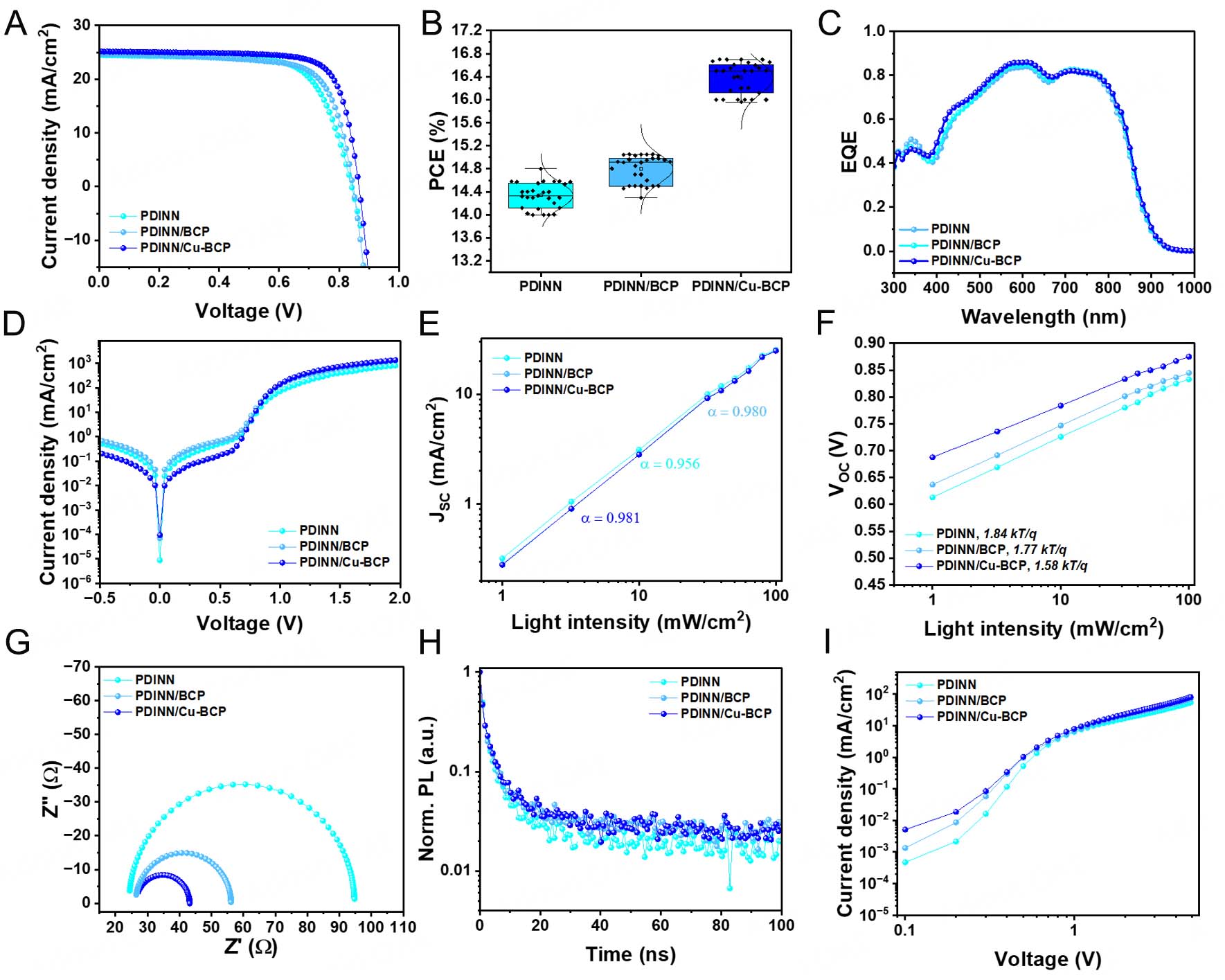
Figure 3. Device performance and interfacial charge-transport analysis of optimized ternary PM6:L8-BO:PC71BM OSCs with different cathode interlayers. (A) Current density-voltage (J-V) curves; (B) PCE statistics; (C) external quantum efficiency (EQE); (D) dark J-V characteristics; (E) JSC and (F) VOC as functions of the light intensity; (G) EIS spectra; (H) time-resolved photoluminescence (TRPL) decay curves; (I) space-charge-limited current (SCLC) characteristics.
Device performance parameters of PM6:L8-BO:PC71BM-based inverted OSCs employing various CILs and 2PACz/MoOx as the HTL with an active area of 0.14 cm2
| CILs | VOC (V) | JSC (mA/cm2) | JSC (calculated from IPCE, mA/cm2) | FF (%) | PCE (%) |
| PDINN | 0.84 | 24.48 | 23.23 | 71 | 14.58a (14.35 ± 0.23)b |
| PDINN/BCP | 0.85 | 24.70 | 23.63 | 72 | 15.05a (14.75 ± 0.23)b |
| PDINN/Cu-BCP | 0.87 | 25.18 | 24.40 | 76 | 16.70a (16.44 ± 0.23)b |
where J is the current density, ε0 is the vacuum permittivity, εr is the assumed relative dielectric constant of 3.5, d is the thickness of the active layer set at 120 nm, V is the applied bias voltage, and μe is the electron mobility. The effective device area of electron-only devices was 0.14 cm2. The extracted μe values are listed in Supplementary Table 7. A progressive enhancement in electron mobility was observed, increasing from
This study aims to improve the long-term durability of OSCs by improving the stability of the cathode-side interface. Accordingly, the operational durability of devices based on PDINN, PDINN/BCP, and PDINN/Cu-BCP was evaluated under three different aging conditions, as summarized in Figure 4. The air-storage test [Figure 4A] was conducted at RT with unencapsulated devices, whereas the thermal-humidity (65 °C/65% RH, Figure 4B) and photostability (1 sun, 25 °C/25% RH, Figure 4C) tests were performed on encapsulated devices. Among all configurations, the PDINN/Cu-BCP device consistently exhibited the slowest decay in normalized PCE, demonstrating the most robust cathode-side stability. The evolution of the individual photovoltaic parameters, including VOC, JSC, and FF, is further shown in
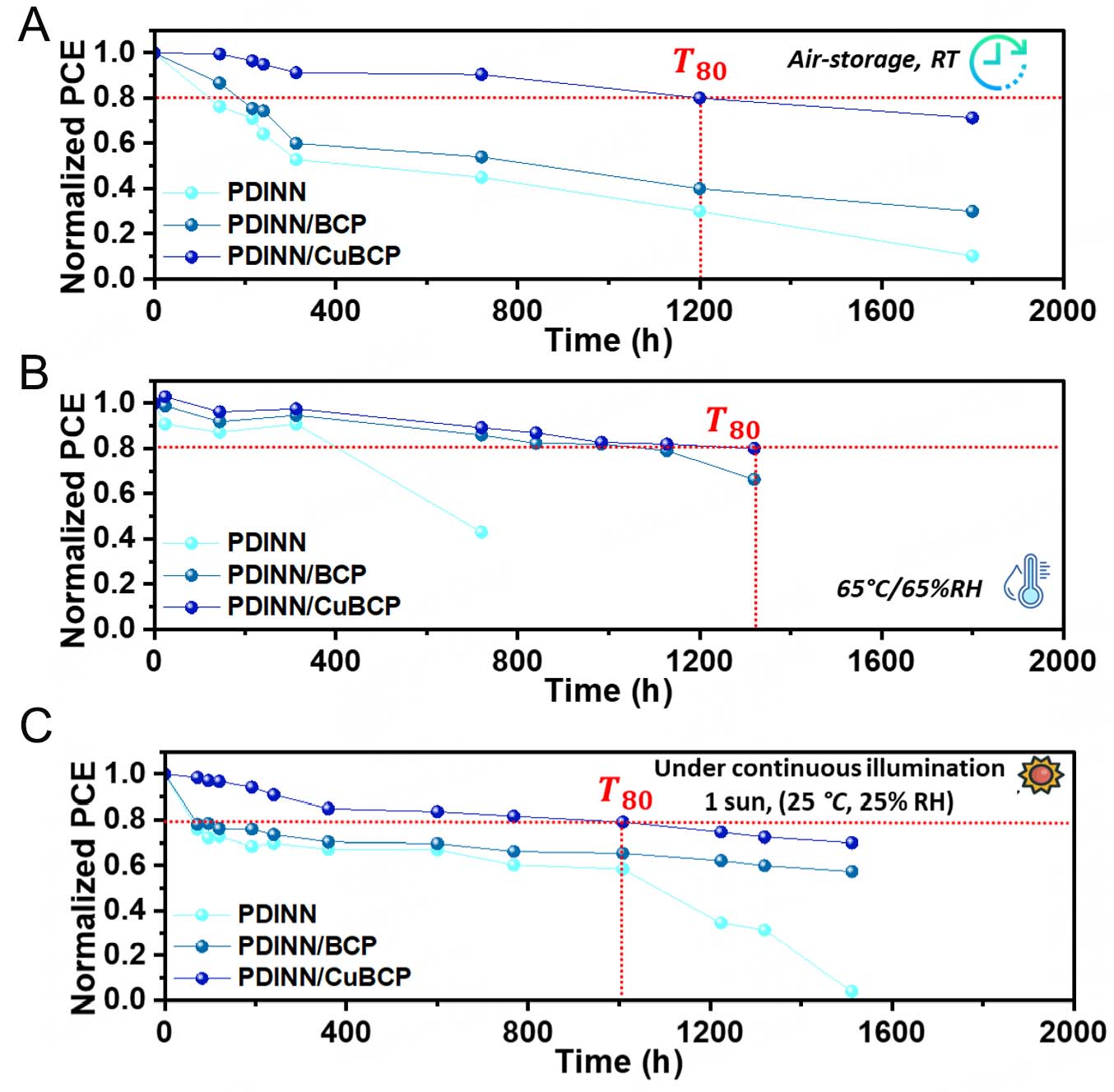
Figure 4. Stability characteristics of inverted OSCs employing different CILs. (A) Normalized PCE retention of devices with PDINN, PDINN/BCP, and PDINN/Cu-BCP during air storage at RT; (B) normalized PCE retention under thermal-humidity aging at 65 °C/65% RH. (C) normalized PCE retention under continuous 1 sun illumination at 25 °C and 25% RH.
T80 lifetime comparison of OSC devices based on different CIL under various stress conditions
| Stress condition | PDINN | PDINN/BCP | PDINN/Cu-BCP |
| Air storage, RT | 144 h | 216 h | 1,200 h |
| Thermal-humidity, 65 °C/65% RH | 400 h | 1,080 h | 1,320 h |
| Continuous 1-sun, 25 °C/25% RH | 60 h | 72 h | 1,008 h |
To verify the practical capability of the coordination-engineered PDINN/Cu-BCP, large-area OSC modules were fabricated on a 10 × 10 cm2 glass/ITO substrate with an active area of 54 cm2. A photograph of the fabricated module devices is presented in Figure 5A. As shown in Figure 5B and summarized in Table 3, the module performance strongly depends on the CIL configuration. The PDINN-based module exhibited a PCE of 12.33%, which increased to 13.16% after introducing the BCP overlayer. The highest module PCE of 14.57% was achieved with PDINN/Cu-BCP, corresponding to a CTM ratio of 87%. These results demonstrate the scalability of the Cu-BCP-modified cathode interface for large-area OSC modules.
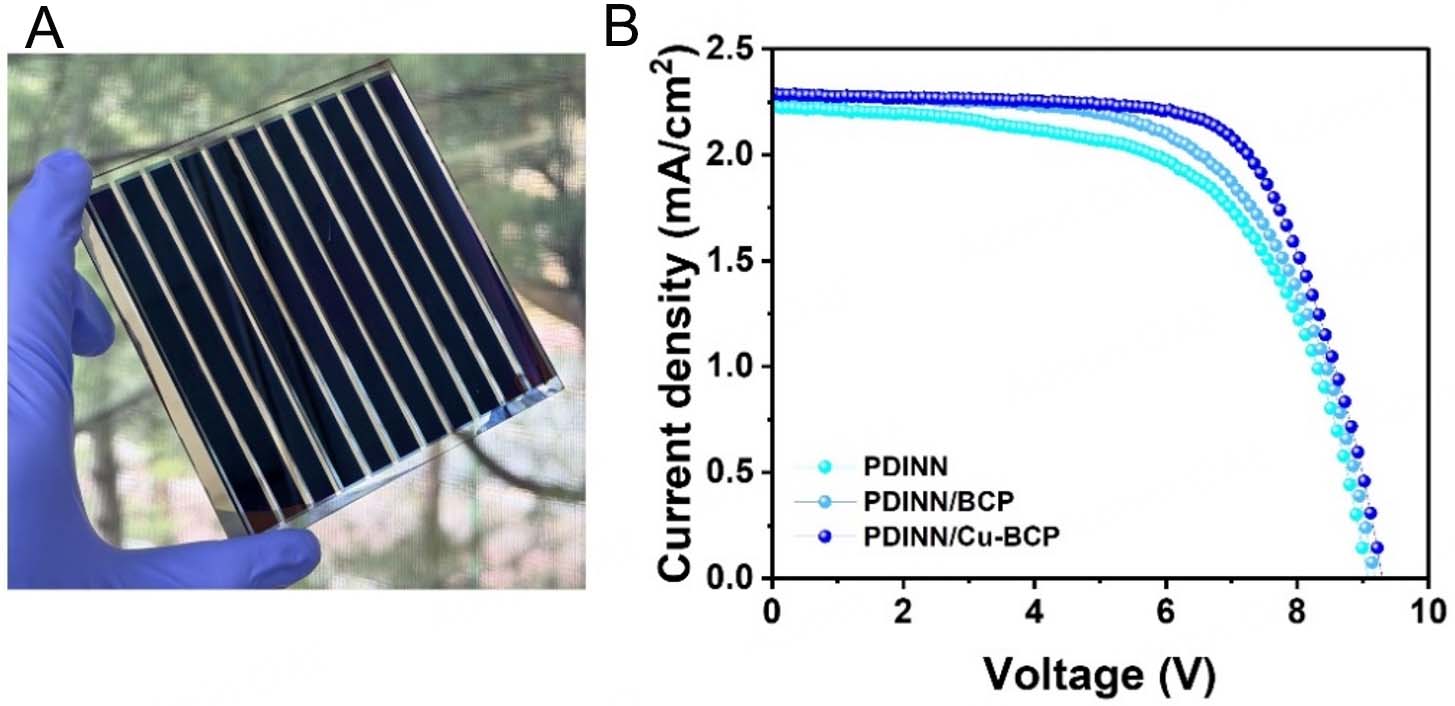
Figure 5. (A) Representative photograph of the fabricated module device (photographed by the authors); (B) J-V curves of the large-area module device with various CILs.
Performance parameters of 54-cm2 PM6:L8-BO:PC71BM-based OSC modules employing different CILs
| CILs | VOC (V) | JSC (mA/cm2) | FF (%) | PCE (%) |
| PDINN | 9.07 | 2.23 | 61 | 12.33 |
| PDINN/BCP | 9.18 | 2.28 | 63 | 13.16 |
| PDINN/Cu-BCP | 9.30 | 2.30 | 68 | 14.57 |
CONCLUSIONS
We demonstrated a bilateral bilayer interfacial engineering approach that simultaneously enhances the photovoltaic performance and operational durability of inverted OSCs. An ultrathin Cu-coordinated BCP overlayer was incorporated onto PDINN, forming a chemically stabilized, electron-selective contact within the CIL region. Unlike conventional BCP, Cu-BCP provides additional stabilization through Cu-N coordination, which modifies the nitrogen electronic environment of BCP and improves the chemical robustness of the cathode-side interface while maintaining efficient electron extraction. When combined with the 2PACz/MoOx anode bilayer, the resulting bilateral bilayer interface enables high-performance inverted OSCs. With this interfacial design, the optimized device delivered a high PCE of 16.70%, outperforming the PDINN (14.58%) and PDINN/BCP (15.05%) controls. More importantly, the optimized device consistently exhibited enhanced stability under multiple independent stress conditions, retaining about 80% of its initial efficiency after 1,200 h in air storage, 1,320 h at 65 °C/65% RH, and
DECLARATIONS
Authors’ contributions
Conceptualization and design of the study: Wardani, N. K.
Data curation, visualization, resources, formal analysis, writing - original draft: Wardani, N. K.; Jahandar, M.
Funding acquisition, project administration: Kim, S.; Lim, D. C.
Supervision: Kim, Y. H.; Kim, S.; Lim, D. C.
Writing - review and editing: Wardani, N. K.; Jahandar, M.; Kim, Y. H.; Kim, S.; Lim, D. C.
Availability of data and materials
The data supporting our findings can be found in Supplementary Materials.
AI and AI-assisted tools statement
Not applicable.
Financial support and sponsorship
This research was supported by the National Research Council of Science & Technology (NST) grant by the Korean government (PNKA910) and the Fundamental Research Program of the National Research Foundation of Korea (RS-2024-00429694).
Conflicts of interest
All authors declared that there are no conflicts of interest.
Ethical approval and consent to participate
Not applicable.
Consent for publication
Not applicable.
Copyright
© The Author(s) 2026.
Supplementary Materials
REFERENCES
1. Yadagiri, B.; Narayanaswamy, K.; Sharma, G. D.; Singh, S. P. Carbazole core derived dyes: new non-fullerene acceptor for all small-molecule organic solar cells with very high open-circuit voltage of 1.12 V. Dyes. Pigm. 2021, 194, 109606.
2. Xiao, X.; Chalh, M.; Loh, Z. R.; et al. Strategies to achieve efficiencies of over 19% for organic solar cells. Cell. Rep. Phys. Sci. 2025, 6, 102390.
4. Liu, B.; Sandberg, O. J.; Qin, J.; et al. Inverted organic solar cells with an in situ-derived SiOxNy passivation layer and power conversion efficiency exceeding 18%. Nat. Photonics. 2025, 19, 195-203.
5. Chen, C.; Wang, L.; Xia, W.; et al. Molecular interaction induced dual fibrils towards organic solar cells with certified efficiency over 20%. Nat. Commun. 2024, 15, 6865.
6. Shahid, A. M.; Rong, H. C.; Zhang, H.; et al. Manipulating heavy halogenated asymmetric terminals affords regio-regular hetero-fluorinated/brominated dual asymmetric acceptor with a binary photovoltaic efficiency of 20.3%. Angew. Chem. Int. Ed. 2026, 65, e3817518.
7. Kadam, K. D.; Kim, H.; Khan, M. F.; et al. Role of interface engineering in amorphous InGaZnO ETL for non-fullerene organic solar cells. Surf. Interfaces. 2024, 44, 103626.
8. Jin, W.; Ginting, R. T.; Jin, S.; Kang, J. Highly stable and efficient inverted organic solar cells based on low-temperature solution-processed PEIE and ZnO bilayers. J. Mater. Chem. A. 2016, 4, 3784-91.
9. Xu, X.; Li, D.; Yuan, J.; Zhou, Y.; Zou, Y. Recent advances in stability of organic solar cells. EnergyChem 2021, 3, 100046.
10. Lee, S.; Jin, J. S.; Moon, H.; et al. Long-term thermal stability of nonfullerene organic solar cells via facile self-assembled interface passivation. ACS. Energy. Lett. 2023, 8, 3989-98.
11. Liang, H.; Bi, X.; Chen, H.; et al. A rare case of brominated small molecule acceptors for high-efficiency organic solar cells. Nat. Commun. 2023, 14, 4707.
12. Xu, X.; Xiao, J.; Zhang, G.; et al. Interface-enhanced organic solar cells with extrapolated T80 lifetimes of over 20 years. Sci. Bull. 2020, 65, 208-16.
13. Liu, B.; Qin, J.; Luo, Q.; Ma, C. Multifunctional interface engineering enables efficient and stable inverted organic photovoltaics. Nat. Commun. 2025, 16, 4880.
14. Günther, M.; Lotfi, S.; Rivas, S. S.; et al. The neglected influence of zinc oxide light-soaking on stability measurements of inverted organic solar cells. Adv. Funct. Mater. 2023, 33, 2209768.
15. Günther, M.; Blätte, D.; Oechsle, A. L.; et al. Increasing photostability of inverted nonfullerene organic solar cells by using fullerene derivative additives. ACS. Appl. Mater. Interfaces. 2021, 13, 19072-84.
16. Yu, Y.; Wang, J.; Cui, Y.; et al. Cost-effective cathode interlayer material for scalable organic photovoltaic cells. J. Am. Chem. Soc. 2024, 146, 8697-705.
17. Nie, H.; Huang, S.; Lai, C.; et al. Water/Alcohol-soluble conjugated polymers based on cyclopentadithiophene and fluorene as cathode interlayers elevate the stability and efficiency in organic solar cells. ACS. Appl. Energy. Mater. 2022, 5, 9495-502.
18. Kang, Q.; Ye, L.; Xu, B.; et al. A printable organic cathode interlayer enables over 13% efficiency for 1-cm2 organic solar cells. Joule 2019, 3, 227-39.
19. Wang, Y.; Zhou, D.; Lan, S.; et al. Small molecule perylene diimide derivatives with different bay site modifications as cathode interface layers for organic solar cells. Chem. Eng. J. 2024, 496, 154206.
20. Shan, C.; Liu, T.; Zhou, J.; et al. High-performance organic solar cell and self-power photodetector with chemically robust, near-infrared acceptor enabled by strengthening interfacial contact and compositional modulation. Chem. Eng. J. 2023, 471, 144451.
21. Yao, J.; Qiu, B.; Zhang, Z.; et al. Cathode engineering with perylene-diimide interlayer enabling over 17% efficiency single-junction organic solar cells. Nat. Commun. 2020, 11, 2726.
22. Liu, T.; Sun, L.; Xie, C.; Wang, W.; Qin, F.; Zhou, Y. Bathocuproine as a cathode interlayer for nonfullerene organic solar cells with efficiency over 17%. J. Mater. Chem. A. 2021, 9, 23269-75.
23. Yoshida, H. Electron transport in bathocuproine interlayer in organic semiconductor devices. J. Phys. Chem. C. 2015, 119, 24459-64.
24. Wang, X.; Liang, Q.; Zhang, A.; et al. Amide-based cathode interfacial layer with dual-modification mechanisms enables stable organic solar cells with high efficiency achieving 20%. J. Am. Chem. Soc. 2025, 147, 9261-72.
25. Alishan, Y.; Joseph, A.; Pillai, A. B.; et al. Metal nanoclusters for interface engineering and improved photovoltaic performance in organic solar cells. ACS. Nano. 2024, 18, 35383-92.
26. Jahandar, M.; Prasetio, A.; Lee, C.; et al. Highly efficient flexible organic photovoltaic modules for sustainable energy harvesting under low-light condition via suppressing voltage-drop by metal-mediated cross-linkable polymer interfacial layer. Chem. Eng. J. 2022, 448, 137555.
27. Fukagawa, H.; Suzuki, K.; Ito, H.; et al. Understanding coordination reaction for producing stable electrode with various low work functions. Nat. Commun. 2020, 11, 3700.
28. Hao, X.; Wang, S.; Fu, W.; Sakurai, T.; Masuda, S.; Akimoto, K. Novel cathode buffer layer of Ag-doped bathocuproine for small molecule organic solar cell with inverted structure. Org. Electron. 2014, 15, 1773-9.
29. Sathyadevan, Nair. A. C.; Rajan, A.; Raj, K. P. A.; et al. Fine tuning the work function of ZnO cathode buffer layers in organic solar cells by phenanthroline coordination. ACS. Appl. Energy. Mater. 2024, 7, 9011-22.
30. Jing, J.; Dong, S.; Zhang, K.; et al. In-situ self-organized anode interlayer enables organic solar cells with simultaneously simplified processing and greatly improved efficiency to 17.8%. Nano. Energy. 2022, 93, 106814.
31. Jeong, S.; Rana, A.; Kim, J. H.; et al. New ternary blend strategy based on a vertically self-assembled passivation layer enabling efficient and photostable inverted organic solar cells. Adv. Sci. 2023, 10, 2206802.
32. Bin, Z.; Dong, G.; Wei, P.; et al. Making silver a stronger n-dopant than cesium via in situ coordination reaction for organic electronics. Nat. Commun. 2019, 10, 866.
33. Huang, Q.; Jing, J.; Zhang, K.; et al. Simultaneous improvement of efficiency and stability of inverted organic solar cellvia composite hole transport layer. J. Mater. Chem. A. 2022, 10, 23973-81.
34. Lin, Y.; Zhang, Y.; Magomedov, A.; et al. 18.73% efficient and stable inverted organic photovoltaics featuring a hybrid hole-extraction layer. Mater. Horiz. 2023, 10, 1292-300.
35. Chambon, S.; Derue, L.; Lahaye, M.; Pavageau, B.; Hirsch, L.; Wantz, G. MoO3 thickness, thermal annealing and solvent annealing effects on inverted and direct polymer photovoltaic solar cells. Materials 2012, 5, 2521-36.
36. Zhou, D.; Quan, J.; Zhang, H.; et al. Small-molecule electron transport layer with siloxane-functionalized side chains for nonfullerene organic solar cells. ACS. Appl. Mater. Interfaces. 2022, 14, 54063-72.
37. Xu, X.; Peng, Q. Hole/Electron transporting materials for nonfullerene organic solar cells. Chem. A. Eur. J. 2022, 28, e202104453.
38. Hu, L.; Liu, Y.; Mao, L.; et al. Chemical reaction between an ITIC electron acceptor and an amine-containing interfacial layer in non-fullerene solar cells. J. Mater. Chem. A. 2018, 6, 2273-8.
39. Lai; X; Chen; S; Gu; X; et al. Phenanthroline-carbolong interface suppress chemical interactions with active layer enabling long-time stable organic solar cells. Nat. Commun. 2023, 14, 3571.
40. Jiang, P.; Hu, L.; Sun, L.; Li, Z.; Han, H.; Zhou, Y. On the interface reactions and stability of nonfullerene organic solar cells. Chem. Sci. 2022, 13, 4714-39.
41. Lai, T.; Tsang, S.; Manders, J. R.; Chen, S.; So, F. Properties of interlayer for organic photovoltaics. Mater. Today. 2013, 16, 424-32.
42. Walker, B.; Choi, H.; Kim, J. Y. Interfacial engineering for highly efficient organic solar cells. Curr. Appl. Phys. 2017, 17, 370-91.
43. Alharbi, N. S.; Wang, C.; Alsaadi, F. E.; Rabah, S. O.; Tan, Z. A general approach of adjusting the surface-free energy of the interfacial layer for high-performance organic solar cells. Adv. Sustain. Syst. 2020, 4, 2000054.
44. Yin, Z.; Wei, J.; Zheng, Q. Interfacial materials for organic solar cells: recent advances and perspectives. Adv. Sci. 2016, 3, 1500362.
45. Schilinsky, P.; Waldauf, C.; Brabec, C. J. Recombination and loss analysis in polythiophene based bulk heterojunction photodetectors. Appl. Phys. Lett. 2002, 81, 3885-7.
46. Hartnagel, P.; Kirchartz, T. Understanding the light-intensity dependence of the short-circuit current of organic solar cells. Advcd. Theory. Sims. 2020, 3, 2000116.
47. Zeiske, S.; Li, W.; Meredith, P.; Armin, A.; Sandberg, O. J. Light intensity dependence of the photocurrent in organic photovoltaic devices. Cell. Rep. Phys. Sci. 2022, 3, 101096.
Cite This Article
 Open Access
How to Cite
Download Citation
Export Citation File:
Type of Import
Tips on Downloading Citation
Citation Manager File Format
Type of Import
Direct Import: When the Direct Import option is selected (the default state), a dialogue box will give you the option to Save or Open the downloaded citation data. Choosing Open will either launch your citation manager or give you a choice of applications with which to use the metadata. The Save option saves the file locally for later use.
Indirect Import: When the Indirect Import option is selected, the metadata is displayed and may be copied and pasted as needed.
About This Article
Special Topic
Copyright

Data & Comments
Data
0











Comments
Comments must be written in English. Spam, offensive content, impersonation, and private information will not be permitted. If any comment is reported and identified as inappropriate content by OAE staff, the comment will be removed without notice. If you have any queries or need any help, please contact us at [email protected].