

Graphdiyne-enabled interfacial transport sieving for efficient and sustainable carbon-based perovskite photovoltaics
 0
Graphical Abstract
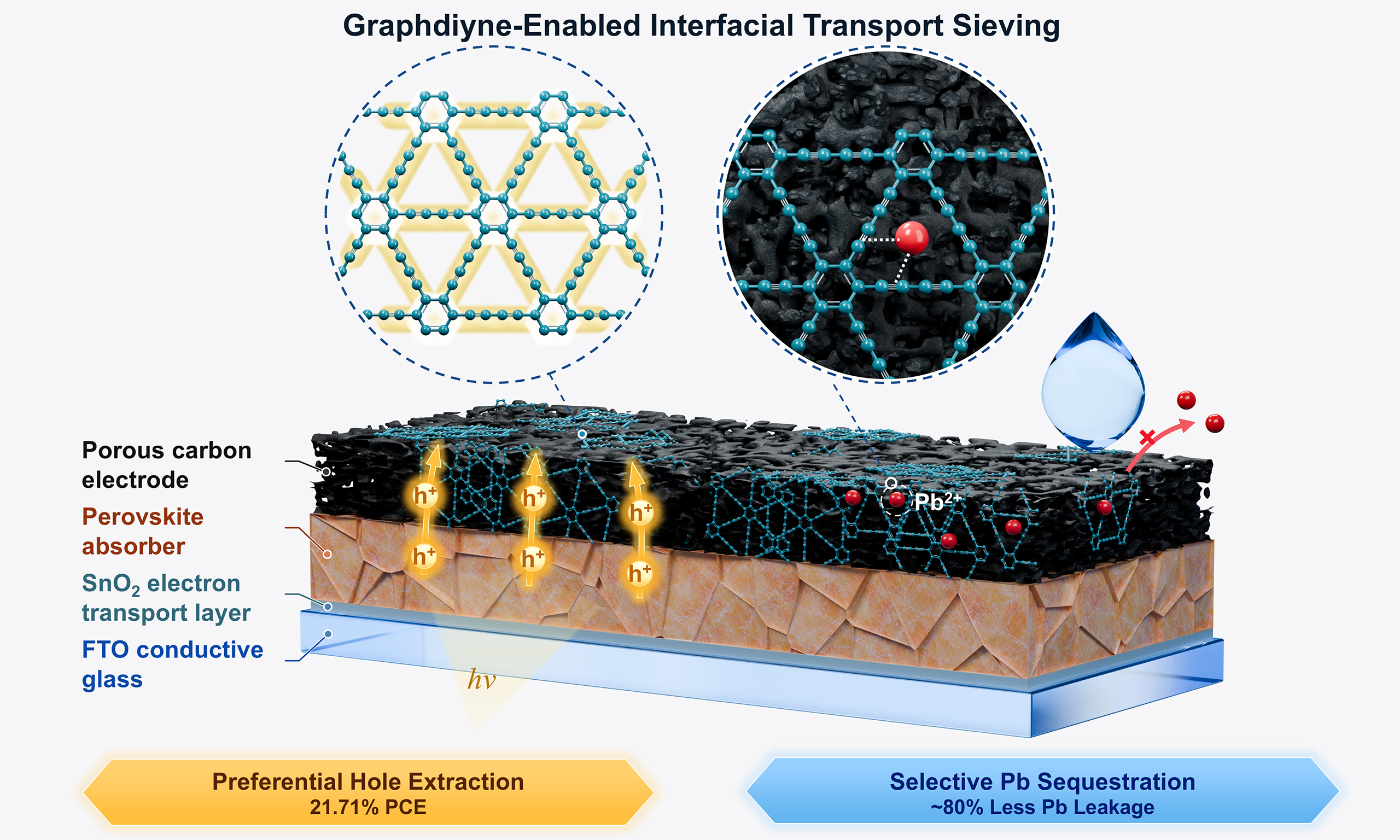
Abstract
Sluggish hole extraction and toxic Pb leakage remain two critical barriers to carbon electrode-based perovskite solar cells (PSCs). Here, graphdiyne (GDY) is incorporated into the carbon electrode to establish an interfacial transport-sieving effect arising from differentiated electronic coupling and chemical affinity, enabling preferential hole transport while selectively retaining hazardous Pb species. The π-conjugated framework of GDY bridges the energy-level mismatch at the perovskite/carbon interface and provides an energetically favorable pathway for hole extraction. Meanwhile, its electron-rich π system, particularly the acetylenic π sites, interacts with undercoordinated Pb2+ defects through π-electron coupling and interfacial charge redistribution, suppressing defect-related trap states and nonradiative recombination. Consequently, the space-charge-limited-current (SCLC)-derived effective hole mobility increases by approximately ninefold. Beyond its electronic functions, the abundant sp-hybridized acetylenic linkages strongly bind Pb2+, reducing lead leakage by up to 80%. Experimental analyses implicate the acetylenic motifs in Pb binding, while density functional theory (DFT) calculations identify the corner configuration of the acetylenic ring as the energetically preferred adsorption geometry. Leveraging this transport-selective interface, the optimized device achieves a champion power conversion efficiency (PCE) of 21.71% while enhancing operational and storage stability. These findings establish interfacial transport sieving as a promising strategy for efficient and environmentally responsible perovskite photovoltaics.
Keywords


 Download PDF
INTRODUCTION
The remarkable progress of metal halide perovskites has driven perovskite solar cells (PSCs) toward their theoretical efficiency limit, shifting increasing attention toward scalability, durability, and environmental sustainability[1-3]. However, conventional high-performance PSCs commonly rely on expensive thermally evaporated Au/Ag electrodes and organic hole-transport layers (HTLs) containing hygroscopic dopants, thereby increasing fabrication costs and energy consumption while compromising long-term stability[4-7]. Carbon-contact PSCs that operate without a separate HTL offer a potentially simpler and less expensive alternative, with the added benefit of intrinsically stable electrode materials[8-10]. Their performance, however, is constrained by imperfect electronic contact between perovskite and carbon: weak interfacial coupling and mismatched energy levels slow hole extraction and increase recombination losses[11,12]. Meanwhile, toxic Pb leakage from damaged devices remains a critical environmental concern[13-15]. Accordingly, carbon electrode-based PSCs require an interface that can simultaneously facilitate efficient charge extraction and suppress the release of hazardous Pb species.
Considerable efforts have therefore been devoted to improving interfacial charge-transfer kinetics and mitigating Pb leakage. Lewis acids/bases[16-18], alkali-metal ions[19], and halide species[20] have been employed to passivate interfacial defects, tune energy-level alignment, and promote carrier extraction and transport. Functional polymers[21] and conjugated polymers[22], as well as two-dimensional materials such as graphene[23], MXenes[24], covalent organic frameworks[25], and phosphorene nanoribbons[26], have also been explored to regulate interfacial electronic structure and defect chemistry. Reduced-dimensional perovskites have likewise been introduced to suppress surface defects, optimize band alignment, and facilitate charge transfer[27]. In parallel, Pb-sequestration strategies relying on strong chemical binding have been developed using phosphonic-acid-containing molecules, thermally or ultraviolet-initiated polymerizable molecules, and mesoporous resins[28-31]. Nevertheless, these strategies generally address either electronic-transport losses or Pb immobilization, whereas their simultaneous regulation remains comparatively underexplored, particularly at the perovskite/carbon interface. These limitations highlight the need for a transport-selective interface that preferentially facilitates photogenerated-hole extraction while selectively retaining hazardous Pb species.
Graphdiyne (GDY) offers a distinctive platform for transport-selective interface engineering because its two-dimensional carbon network combines sp-hybridized linkages with sp2-hybridized aromatic units[32-34]. Its extended π-conjugated framework and suitable electronic structure enable efficient electronic coupling and energetically favorable hole extraction[35,36], while the periodically distributed sp-hybridized acetylenic linkages furnish electron-rich π sites with strong affinity toward Pb species[37,38]. Importantly, these functionalities are intrinsically integrated within the same conjugated carbon framework rather than acting as independent structural motifs. The electron-rich π system, particularly the acetylenic π sites, can interact with undercoordinated Pb2+ defects through π-electron coupling and interfacial charge redistribution, thereby attenuating defect-related trap states. Meanwhile, the acetylenic motifs can provide strong binding sites for released Pb species. The coexistence of favorable electronic coupling and strong chemical affinity therefore provides a molecular basis for selectively promoting beneficial carrier transport while retaining hazardous Pb species.
Herein, we incorporate GDY into the carbon electrode to establish a graphdiyne-enabled interfacial transport-sieving effect in carbon electrode-based PSCs. Rather than relying on conventional size-exclusion mechanisms based on physical pore dimensions, this transport selectivity arises from species-dependent electronic coupling and chemical affinity at the perovskite/carbon interface. The π-conjugated framework of GDY bridges the energetic mismatch between the perovskite and carbon electrode, providing an energetically favorable pathway for hole extraction and increasing the space-charge-limited-current (SCLC)-derived effective hole mobility by approximately ninefold. Simultaneously, its electron-rich π system, particularly the acetylenic π sites, interacts with undercoordinated Pb2+ defects through π-electron coupling and interfacial charge redistribution, thereby suppressing defect-related trap states and nonradiative recombination. Upon device damage, the sp-hybridized acetylenic sites further exhibit strong chemical affinity toward released Pb species, reducing Pb leakage by up to 80%; density functional theory calculations identify the corner sites of the acetylenic rings as the energetically preferred adsorption sites. Consequently, the optimized device achieves a champion power conversion efficiency (PCE) of 21.71% together with enhanced operational and storage stability. These results establish interfacial transport sieving as a design principle for reconciling preferential carrier transport with selective Pb retention in efficient and environmentally responsible perovskite photovoltaics.
EXPERIMENTAL
Materials
Patterned fluorine-doped tin oxide (FTO) glass (thickness, 2.2mm; sheet resistance, 15 Ω sq-1) was obtained from Advanced Electron Technology Co., Ltd. An aqueous SnO2 colloid (15 wt%) was obtained from Alfa Aesar. The perovskite precursors formamidinium iodide (FAI, 99.9%), methylammonium iodide (MAI, 99.9%), methylammonium chloride (MACl, 99.9%), and PbI2 (99.999%) were supplied by Xi’an Yuri Solar Technology Co., Ltd. Sigma-Aldrich provided anhydrous N,N-dimethylformamide (DMF, 99.8%), dimethyl sulfoxide (DMSO, ≥ 99.9%), chlorobenzene (CB, 99.8%), acetone (99.8%), isopropanol (IPA, 99.5%), and lead(II) acetate (99.999%). The commercial DD-10 carbon paste, purchased from Guangzhou Saidi Technology Co., Ltd., contained graphite flakes and carbon black together with ethyl cellulose as the organic binder and terpineol as the solvent. Unless otherwise noted, the reagents were used without additional purification.
Graphdiyne synthesis
GDY powder was synthesized via copper(II) acetate-mediated homocoupling of deprotected hexaethynylbenzene in pyridine, using a modified solution-phase synthesis protocol reported previously[39]. Copper(II) acetate (20 mg) was first introduced into pyridine (20 mL), and the mixture was sonicated for
Device fabrication
Patterned FTO glass was successively cleaned with deionized water, ethanol, acetone, and IPA for 20 min and dried under a nitrogen stream. A 30 min UV-ozone treatment was then applied before coating. To form the SnO2 electron-selective layer, the commercial colloid was diluted with deionized water at a dispersion-to-water volume ratio of 1:3, spun onto FTO at 3000 rpm for 30 s, and heated at 150 °C for 30 min. The perovskite absorber was formed by a sequential two-step deposition inside a nitrogen-filled glovebox in which both H2O and O2 were maintained below 0.1 ppm. In the first step, PbI2 (1.5 M) dissolved in DMF/DMSO (9:1, v/v) was coated onto SnO2 at 1,500 rpm for 30 s and subsequently heated at 70 °C for
GDY-containing carbon contacts were fabricated from commercial carbon paste after removal of its residual moisture and organic solvents by heating at 120 °C for 10 h. GDY was then blended with the dried paste to obtain nominal loadings of 0, 3, 6, and 9 wt%; each percentage refers to the GDY mass divided by the combined mass of GDY and dried carbon paste. For each composition, 4.5 g of the mixture was placed in a ball-milling jar with zirconia balls (5 mm diameter; ball-to-powder mass ratio, 10:1), and chlorobenzene
Characterization
Photovoltaic current density-voltage (J-V) measurements were made with a Keithley 2450 source meter under simulated Air Mass 1.5 Global (AM 1.5G) sunlight from an ENLITECH SS-X100R system
Microstructural examination comprised surface and cross-sectional field-emission scanning electron microscopy (FESEM, FEI QUANTA 3D; accelerating voltage, 5 kV) and ambient atomic force microscopy (AFM, Bruker Dimension Icon). For AFM, a Pt/Ir-coated SCM-PIT probe with a nominal spring constant of 2.8 N m-1 was employed. Raman data were obtained at room temperature on a Horiba Jobin Yvon HR800 confocal microscope using a 532 nm excitation beam. An Edinburgh Instruments FLS1000 spectrometer was used for steady-state photoluminescence (PL) and time-resolved PL (TRPL). Steady-state emission was excited from the perovskite side at 475 nm with a 450 W xenon arc lamp. TRPL excitation was supplied by an EPL-475 pulsed diode laser (20 nJ cm-2, 1 MHz), and the emission was monitored at 800 nm. Transient photocurrent (TPC) and transient photovoltage (TPV) were acquired using the measurement setup at the Institute of Physics, Chinese Academy of Sciences. A 532 nm pulsed laser (Opotek RADIANT 532 LD,
Ultraviolet photoelectron spectroscopy (UPS) was performed with a PHI 5000 VersaProbe III analyzer using He I photons (21.22 eV) and a -9.0 V bias applied to the sample. A sputter-cleaned Au reference provided the Fermi-edge calibration (EF = 0 eV), and all reported binding energies were corrected for the sample bias. X-ray photoelectron spectra (XPS) were collected on a Thermo Fisher Scientific ESCALAB 250Xi equipped with monochromatic Al Kα radiation (1,486.6 eV). The high-resolution scans used a pass energy of 20 eV, with a low-energy dual-beam flood gun compensating for sample charging; the C 1s signal at 284.8 eV served as the binding-energy reference. Peak deconvolution employed a Shirley background and Gaussian-Lorentzian product profiles (30% Lorentzian contribution). For the Pb 4f doublet, the spin-orbit separation and integrated-area ratio were constrained to 4.86 eV and 4:3 (Pb 4f7/2:Pb 4f5/2), respectively. The PbI2+GDY specimen was prepared by sonicating a 1:1 mass mixture of PbI2 and GDY in chlorobenzene for 30 min, drop-casting the dispersion onto a Si wafer, and vacuum-drying at 70 °C for 2 h.
Capacitance-voltage (C-V) and electrochemical impedance spectroscopy (EIS) were carried out in the dark using a CS310MA electrochemical workstation. The C-V sweep spanned -0.2 to 1.2 V relative to the open-circuit potential, with a 5 kHz probing frequency and a 0.01 V AC excitation. For EIS, a 0.02 V AC perturbation was applied over 100 kHz to 0.1 Hz. Dissolved Pb in aqueous samples was quantified by inductively coupled plasma mass spectrometry (ICP-MS, Agilent 7800). Operational tests following ISOS-L-1 [International Summit on Organic Photovoltaic Stability light-soaking protocol (level 1)] were conducted on unencapsulated devices in an environmental chamber, with continuous white-LED illumination at an intensity equivalent to approximately 1 sun and maximum-power-point (MPP) tracking throughout. Storage stability was evaluated following the ISOS-D-1 [International Summit on Organic Photovoltaic Stability dark-storage protocol (level 1)] protocol. Unencapsulated devices were stored in the dark under open-circuit conditions in a temperature- and humidity-controlled chamber
Computational methods
First-principles calculations were carried out in the Vienna ab initio Simulation Package (VASP) using the projector-augmented-wave (PAW) treatment of electron-ion interactions[40,41]. A kinetic-energy cutoff of
For the slab models, Brillouin-zone sampling employed a Γ-centered 2 × 2 × 1 Monkhorst-Pack k-point mesh. The FAPbI3 (001) slab comprised two layers of PbI6 octahedra, terminated by PbI2, with an undercoordinated Pb2+ site introduced at the surface. More than 15 Å of vacuum separated adjacent slab images along the surface normal, where a dipole correction was also applied. GDY adsorption and electronic-structure analyses used a monolayer GDY unit cell with an optimized lattice constant of 9.460 Å; a 20 Å vacuum region was included perpendicular to the sheet to reduce spurious interactions between periodic replicas[42]. To assess the spatial character of the frontier states, the valence-band-maximum (VBM) Kohn-Sham wavefunctions were extracted and visualized for both the Pb-defective FAPbI3 surface and its GDY-modified counterpart.
RESULTS AND DISCUSSION
GDY was synthesized through a Cu2+-catalyzed acetylenic coupling reaction of hexaethynylbenzene[32,43]. Its expected framework, shown in Supplementary Figure 1, contains aromatic sp2-carbon units linked by sp-carbon diyne segments. Raman spectroscopy provides supporting structural evidence
Figure 1A summarizes the fabrication route for the GDY-containing carbon contact. Commercial carbon paste was first heated at 120 °C for 10 h to remove the original solvent, after which GDY was introduced at 0, 3, 6, and 9 wt%. The mixtures were redispersed in chlorobenzene and ball-milled for 12 h, followed by doctor-blade coating and a 30 min treatment at 100 °C. The underlying perovskite absorber was prepared by sequential two-step deposition. Top-view scanning electron microscopy (SEM) and AFM images show a compact and smooth perovskite surface with large grains [Figure 1B and Supplementary Figure 3], while the cross-sectional microscopy confirms the FTO/SnO2/perovskite/carbon stack architecture [Figure 1C]. Incorporating GDY into the carbon contact therefore provides a direct route to regulate the perovskite/carbon interface without introducing an additional interlayer.
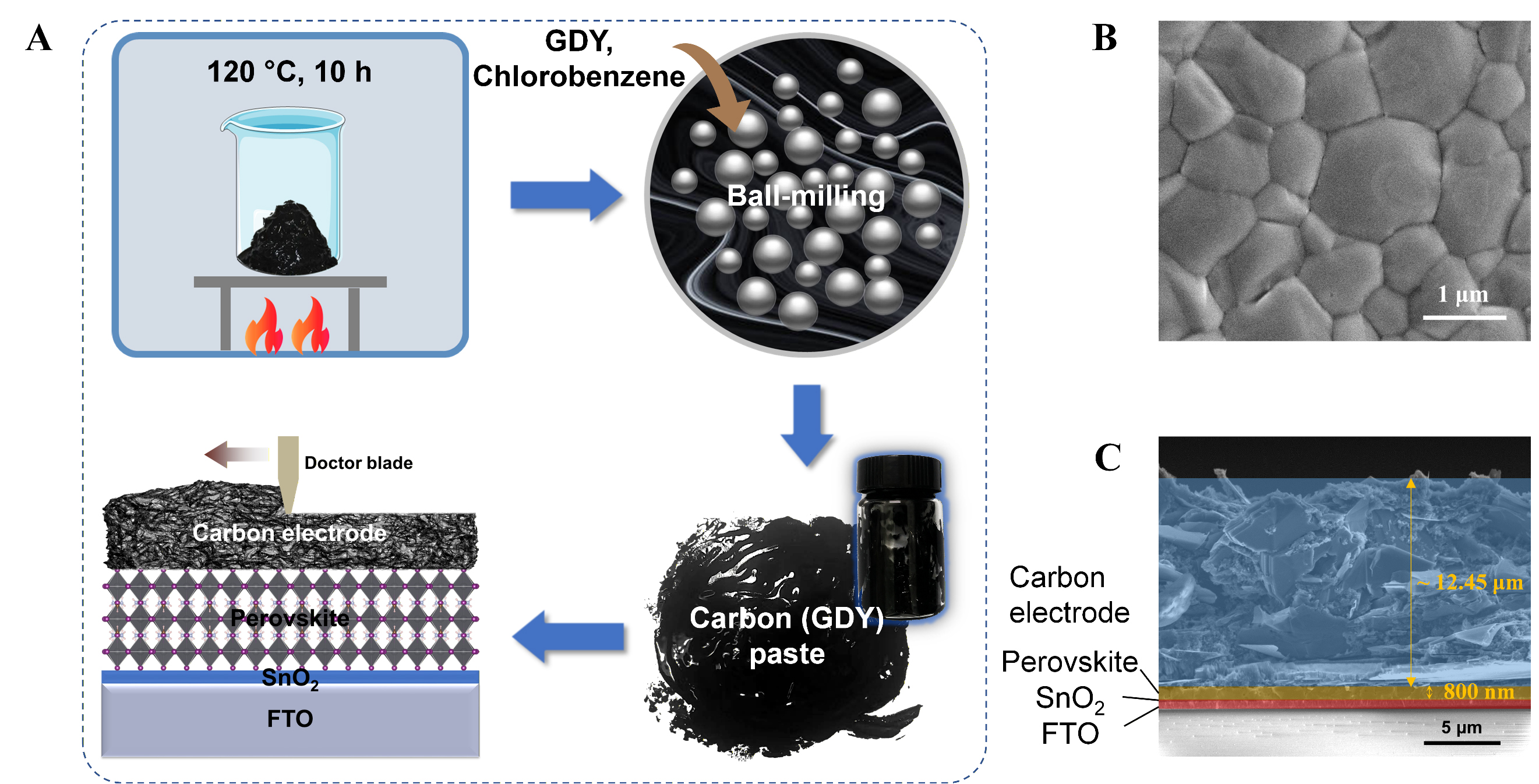
Figure 1. (A) Schematic illustration of the preparation of GDY-modified carbon electrode; (B) Top-view SEM image of perovskite film; (C) Cross-section SEM image of PSC. GDY: Graphdiyne; PSC: perovskite solar cell; FTO: fluorine-doped tin oxide; SEM: scanning electron microscopy.
To clarify the carrier-transport branch of the proposed interfacial transport-sieving effect, UPS was used to determine the energetic positions on separately prepared thin films of the perovskite, GDY, and different carbon electrodes. Figure 2A presents the secondary-electron cutoff (Ecutoff) and valence-band-edge
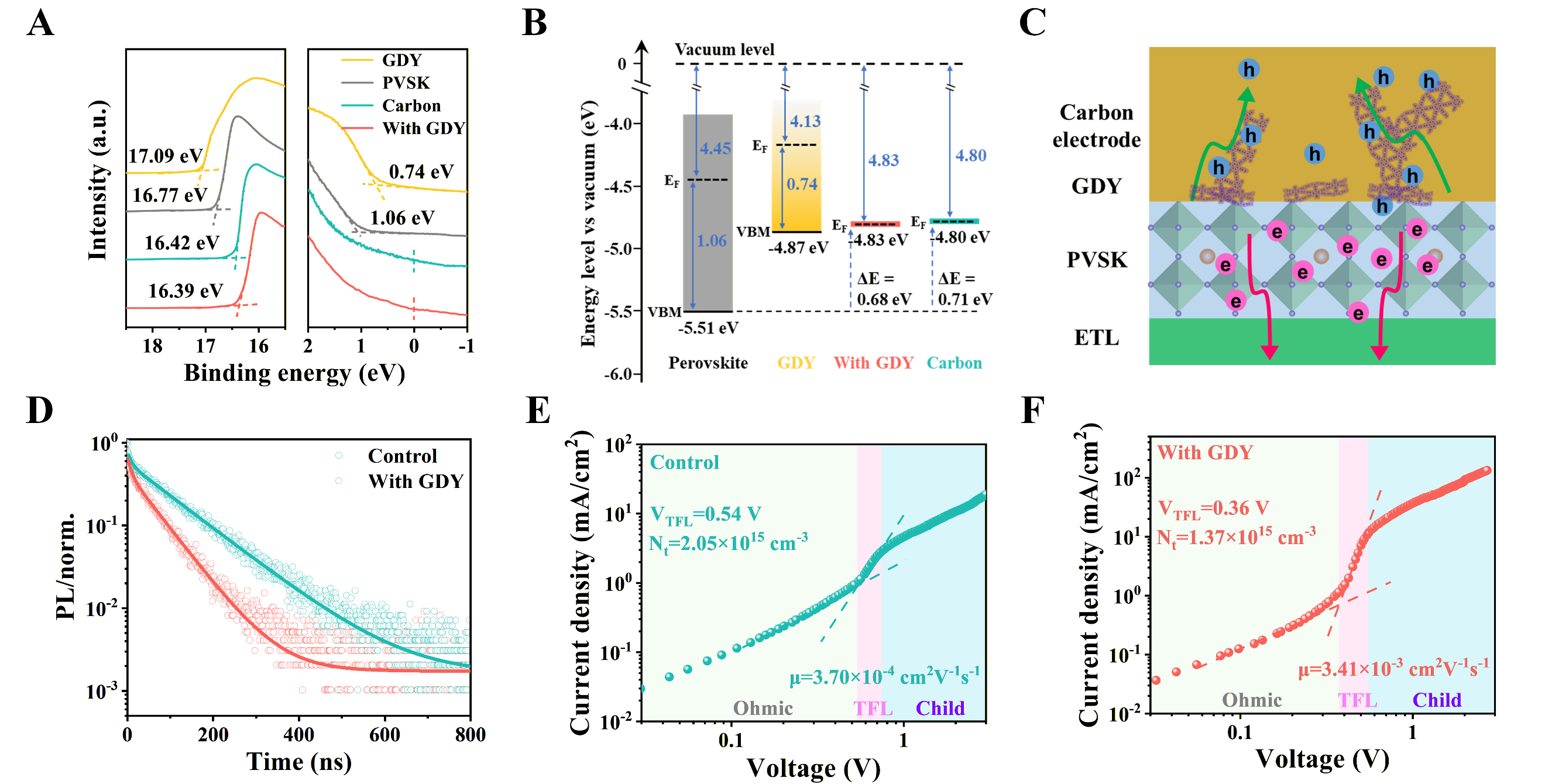
Figure 2. (A) UPS spectra of GDY, perovskite film, and different carbon electrodes; (B) Energy-level diagram for interfacial hole transfer; (C) Schematic diagram of photogenerated carrier transport via GDY as a hole-transfer pathway; (D) TRPL decay curves of perovskite devices without and with GDY modification; Dark J-V curves of hole-only devices (E) without and (F) with GDY modification. UPS: Ultraviolet photoelectron spectroscopy; GDY: graphdiyne; PL: photoluminescence; TRPL: time-resolved PL; J-V: current density-voltage; PVSK: perovskite; ETL: electron transport layer; TFL: trap-filled-limit.
Steady-state PL and TRPL measurements were subsequently performed on FTO/perovskite/carbon contacts to probe the effect of GDY on charge separation behavior. The GDY-containing contact shows marked PL quenching relative to the control [Supplementary Figure 5], which suggests that the photogenerated holes can be more efficiently transported from perovskite to carbon layer. Besides, TRPL was conducted to further verify the above conclusion. As seen in Figure 2D, the device with GDY modification shows a faster PL decay curve. The decay curves were fitted using a biexponential function[44]:
The average PL lifetime decreases from 109.29 ns for the control to 63.74 ns after GDY incorporation [Supplementary Table 1]. In the presence of an extracting carbon contact, the combined PL quenching and shortened lifetime are consistent with more rapid interfacial carrier extraction, particularly when considered together with the UPS-derived energetic alignment.
To further elucidate the influence of GDY on hole transport at the perovskite/carbon contact, SCLC analysis was conducted using hole-only structures [FTO/poly(3,4-ethylenedioxythiophene):poly(styrenesulfonate) (PEDOT:PSS)/perovskite/carbon]. The corresponding dark J-V curves are plotted on a logarithmic scale in Figure 2E and F. Three bias-dependent responses can be distinguished: an approximately linear Ohmic regime at low voltage, a steep current rise associated with trap filling at intermediate voltage, and a high-bias region described by Child’s law. The trap-filled-limit voltage (VTFL) is determined from the transition between the Ohmic and trap-filled-limit (TFL) regimes, from which the apparent trap density (Nt) can be estimated according to[45]:
where ε = 22 is the assumed relative permittivity of perovskite; ε0 = 8.85 × 10⁻¹² F m-1 is the vacuum permittivity; q = 1.6 × 10⁻¹⁹ C is the elementary charge; and L = 800 nm is the absorber thickness. The GDY-modified device exhibits a substantially lower VTFL of 0.36 V than the control device (0.54 V), corresponding to a decrease in the apparent trap density from 2.05 × 1015 cm-3 for the reference to 1.37 × 1015 cm-3 after GDY introduction. This reduction is consistent with the suppression of electrically active trap states upon GDY incorporation. As discussed below, the electron-rich π-conjugated framework of GDY, particularly its acetylenic π sites, can interact with undercoordinated Pb2+ defects through π-electron coupling and interfacial charge redistribution, thereby attenuating defect-related electronic states and associated trapping losses.
In the Child’s-law region (above 1.0 V), the current density is proportional to the square of the applied voltage, allowing the SCLC-derived effective hole mobility to be estimated using the Mott-Gurney relation[46]:
where J is the dark current density, μ is the SCLC-derived effective hole mobility, and V is the applied voltage. Upon GDY incorporation, the SCLC-derived effective hole mobility increases markedly from 3.70 × 10⁻⁴ cm2 V-1 s-1 for the control device to 3.41 × 10⁻³ cm2 V-1 s-1 for the GDY-modified device, corresponding to an approximately ninefold enhancement. Future work will compute the direction-resolved effective masses and carrier mobilities of the GDY/perovskite heterostructure using the Boltzmann transport formalism, to quantitatively link the observed electronic-structure changes to the experimentally measured mobility enhancement[47,48]. These results indicate that the π-conjugated GDY framework establishes an energetically favorable transport pathway while mitigating trap-assisted losses, thereby supporting the preferential hole-transport branch of the interfacial transport-sieving effect.
The influence of GDY on charge accumulation and recombination was next examined by capacitance-voltage analysis. Mott-Schottky plots measured at 5 kHz are shown in Figure 3A. The apparent carrier density (NA) was estimated from the slope of the C-2-V response using[49]:
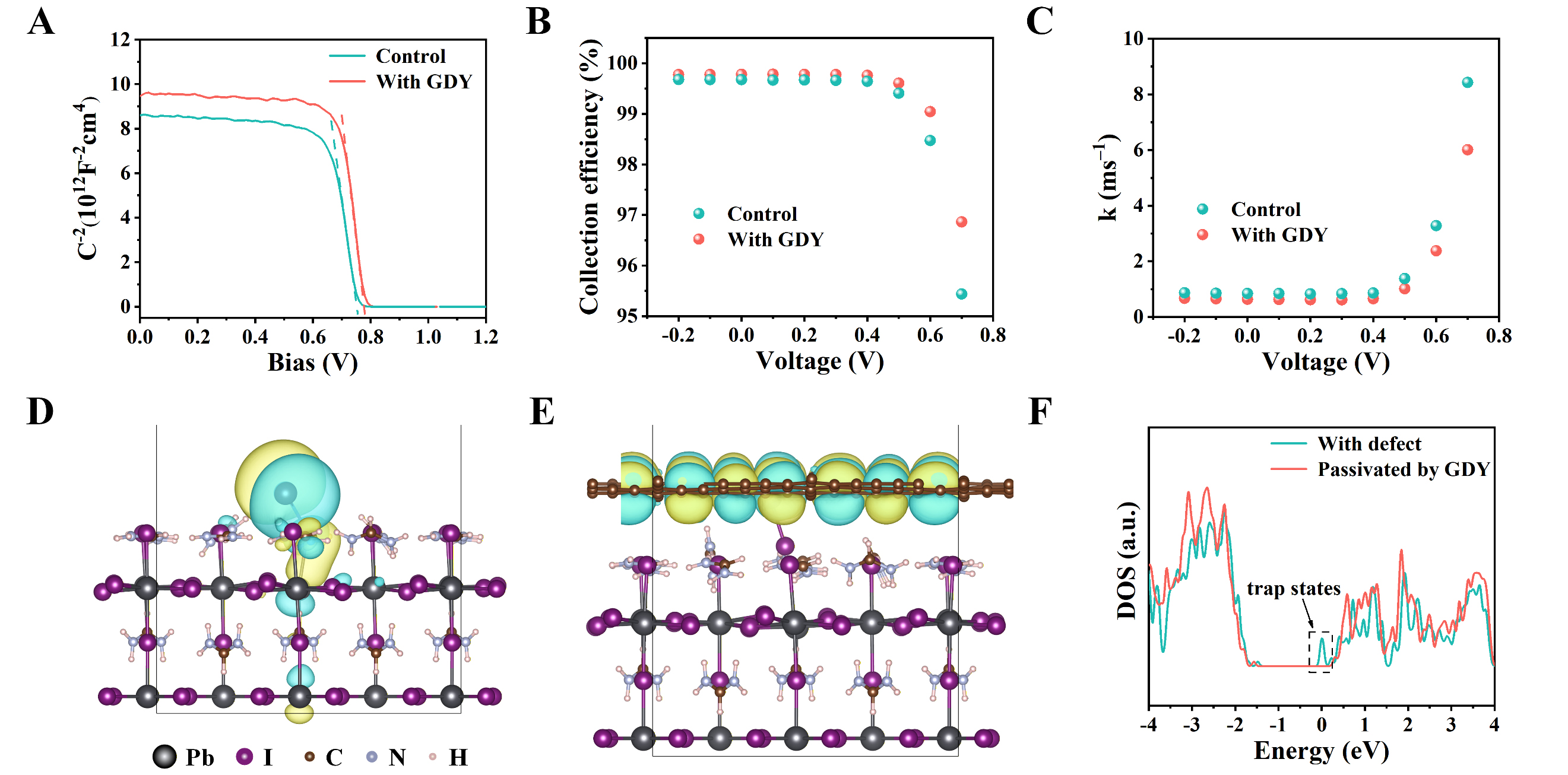
Figure 3. (A) Mott-Schottky analysis of PSCs without and with GDY modification measured at 5 kHz; (B) Charge-collection efficiency and (C) recombination rate derived from TPC and TPV measurements under different bias voltages; Spatial distributions of the VBM Kohn-Sham wavefunctions for (D) an undercoordinated Pb2+ defect and (E) the corresponding GDY-modified configuration. The yellow and cyan isosurfaces represent the positive and negative signs of the displayed wavefunction component, respectively. The black, purple, brown, cyan, and pink spheres denote Pb, I, C, N, and H, respectively; (F) DOS of the defective perovskite and the corresponding GDY-modified model. PSCs: Perovskite solar cells; GDY: graphdiyne; TPC: transient photocurrent; TPV: transient photovoltage; VBM: valence-band-maximum; DOS: density of states.
The slopes of the Mott-Schottky plots are -9.15 × 10¹³ and -1.14 × 10¹⁴ (F/cm2)-2 V-1 for the control and GDY-modified devices, respectively, corresponding to calculated NA of 7.02 × 1016 cm-3 and 5.63 × 1016 cm-3. The Mott-Schottky-derived carrier density represents an apparent rather than intrinsic bulk carrier density, given possible contributions from geometric capacitance, carrier injection, interfacial polarization, and ionic redistribution. Nonetheless, the reduced Mott-Schottky-derived apparent carrier density suggests a change in the interfacial electrostatic response after GDY incorporation. Together with the TPC/TPV and dark-current results, this behavior is consistent with alleviated interfacial charge accumulation and recombination. Flat-band potential (VFB) was also obtained by extending the fitting line of the linear part of the curve to the x-axis. The PSCs with GDY exhibited a higher VFB of 0.778 V compared with 0.750 V for the control PSCs, consistent with an increased built-in potential, which may facilitate charge separation and contribute to the enhanced VOC[50-52]. In addition, the GDY-modified PSC exhibits a lower dark current density
Light-intensity-dependent VOC measurements provide an additional probe of trap-assisted recombination. The data in Supplementary Figure 7 were analyzed according to[54]:
where n, k, T, and I represent the ideality factor, Boltzmann constant, absolute temperature, and incident light intensity, respectively. The extracted n decreases from 1.60 for the reference to 1.48 for the GDY-modified device, suggesting a reduced contribution from trap-assisted nonradiative recombination.
To further elucidate the charge-transport and recombination dynamics, modulated TPC and modulated TPV were measured to get a deeper insight into charge transport and recombination processes within the devices[55]. The TPC and TPV decay time constants (τC and τV, respectively) were extracted by fitting the decay portions of the corresponding transient curves at different bias voltages using a single-exponential decay function [Supplementary Figures 8 and 9]. The fitted values are summarized in Supplementary Tables 2 and 3, respectively. The TPC decay is faster for the GDY-containing device over the investigated bias range [Supplementary Figure 8 and Supplementary Table 2], consistent with more rapid charge extraction. In contrast, the TPV decay is prolonged after GDY incorporation [Supplementary Figure 9 and Supplementary Table 3], indicating slower photovoltage decay and reduced recombination. The charge-collection efficiency (ηcoll) was calculated from ηcoll = 1 -τC/τV, with τC and τV expressed in consistent time units [Supplementary Table 4]. As summarized in Figure 3B, the GDY-containing device exhibits a higher ηcoll across the investigated bias range, demonstrating a more efficient charge extraction and transport process within the target device, thereby contributing to the enhanced VOC and JSC. The interfacial recombination rate (kr), estimated as kr = 1/τV, is correspondingly lower [Figure 3C]. Together, these transient measurements support accelerated extraction accompanied by suppressed trap-mediated recombination.
To identify the microscopic origin of the reduced defect activity, density functional theory (DFT) calculations were carried out for a representative FAPbI3 crystal model containing an undercoordinated Pb2+ defect [Supplementary Figure 10]. The VBM Kohn-Sham wavefunction of the defective perovskite exhibits pronounced spatial localization around the Pb center [Figure 3D]. When GDY is brought into contact with the defective surface, its electron-rich π-conjugated network, particularly the acetylenic π sites, interacts electronically with the undercoordinated Pb2+ center. This interaction leads to a markedly more delocalized VBM wavefunction across the GDY/perovskite interface [Figure 3E and Supplementary Figure 11], accompanied by substantial suppression of the defect-related density of states (DOS) feature [Figure 3F][56]. These simulation results therefore support a defect-passivation mechanism based on π-electron coupling and interfacial charge redistribution. By reducing the electronic localization associated with the undercoordinated-Pb defect, GDY suppresses trap-mediated nonradiative recombination while preserving the extended π network required for carrier transport.
The second branch of interfacial transport sieving concerns the selective retention of hazardous Pb species after device damage. Owing to the electron-rich and chemically accessible acetylenic motifs within GDY, the modified carbon electrode is expected to provide high-affinity binding sites for released Pb species. To evaluate this function at the device level, control and GDY-modified PSCs (1 cm2 carbon electrode on
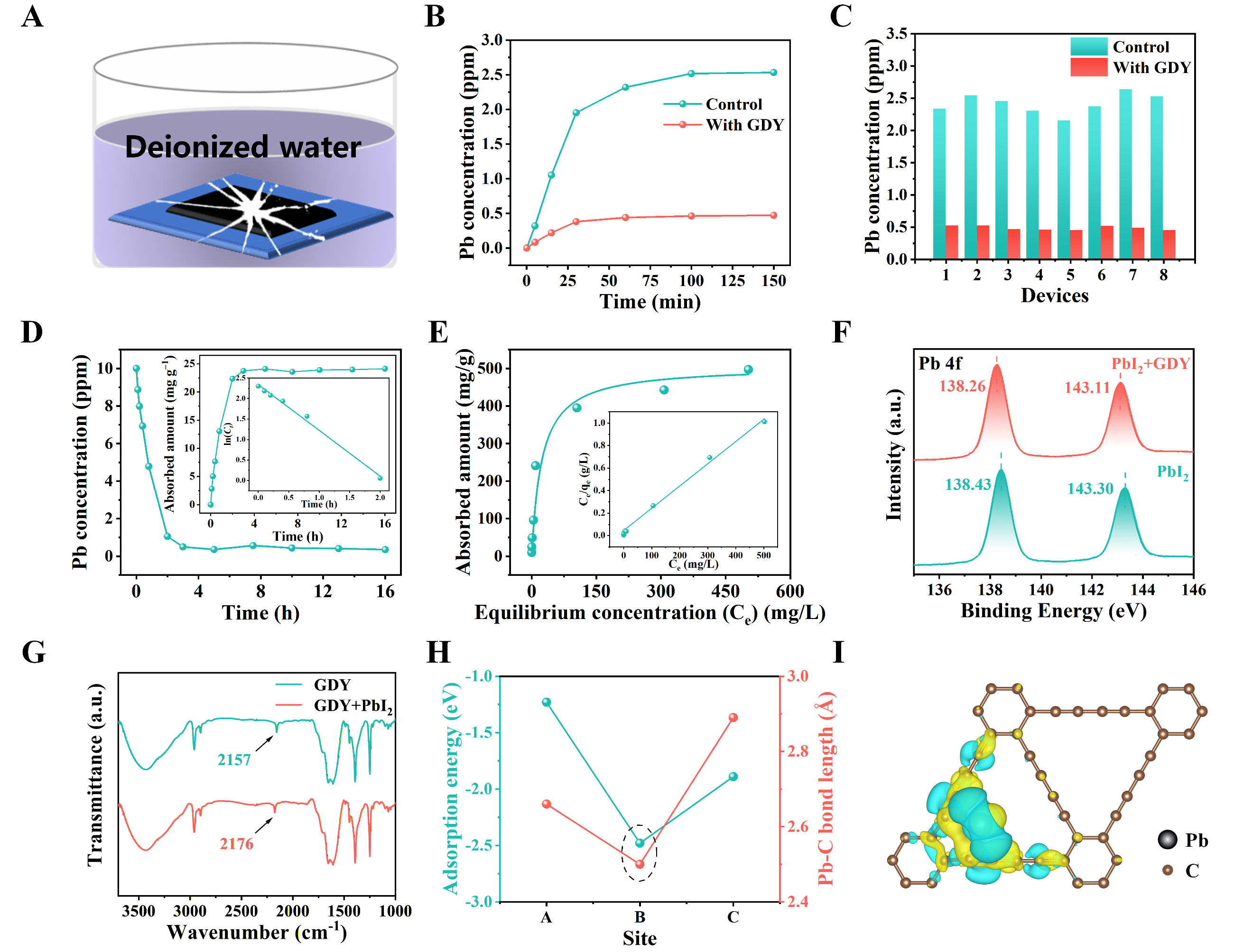
Figure 4. (A) Schematic diagram of Pb leakage test; (B) Time-dependent Pb concentration in deionized water after immersion of mechanically damaged PSCs at 25 ± 1 °C (ambient temperature); (C) Pb concentration measured for eight devices per condition; (D) Pb2+ sorption kinetics of GDY at an initial Pb2+ concentration of 10.0 ppm; the insets show the adsorbed amount and apparent first-order kinetic analysis; (E) Langmuir sorption isotherm of Pb2+ on GDY; The inset is the linearized Langmuir fit; (F) Pb 4f XPS spectra of PbI2 and PbI2+GDY; (G) FTIR spectra of GDY and GDY+PbI2; (H) Calculated adsorption energies and Pb-C bond lengths for three Pb adsorption configurations on GDY; (I) Charge-density difference map for the preferred Pb/GDY configuration. Yellow and cyan isosurfaces denote charge accumulation and charge depletion, respectively, at isovalues of ±0.001 e Å-3. PSCs: Perovskite solar cells; GDY: graphdiyne; XPS: X-ray photoelectron spectra; FTIR: Fourier-transform infrared.
The Pb-binding capability of the GDY-containing carbon electrode was further examined independently of the complete device. Carbon films without and with GDY were immersed in a 10 ppm Pb2+ solution for
Spectroscopic measurements were used to identify the structural motifs involved in Pb binding. The Pb 4f7/2 and Pb 4f5/2 peaks of PbI2 are located at 138.43 and 143.30 eV, respectively, and shift to 138.26 and 143.11 eV after interaction with GDY [Figure 4F]. The downshift indicates a changed electronic environment of Pb and is consistent with interfacial charge redistribution upon Pb-GDY binding. The spectral changes
DFT calculations were further used to compare three representative adsorption configurations for a Pb atom on GDY [Supplementary Figure 17]. After structural relaxation, all three configurations exhibit local distortion of the GDY framework, reflecting appreciable Pb-GDY interaction[58]. The adsorption energy was calculated as Eads = E(Pb+GDY) - E(GDY) - E(Pb), where E(Pb+GDY) is the total energy of the Pb-adsorbed GDY system,
The photovoltaic performance of this dual interfacial function was finally evaluated using devices containing different GDY loadings. Figure 5A compares the best-performing J-V curves, with the corresponding photovoltaic parameters given in Supplementary Table 5. The 6 wt% GDY device delivers the highest PCE of 21.71%, with JSC = 24.71 mA cm-2, VOC = 1.128 V, and FF = 77.9%, compared with 17.89% for the control device (JSC = 24.32 mA cm-2, VOC = 1.093 V, and FF = 67.3%). The simultaneous increases in VOC and FF are consistent with reduced recombination losses and more favorable interfacial hole extraction. The reduced hysteresis upon GDY incorporation suggests more efficient and balanced charge extraction, consistent with the improved interfacial contact and reduced defect density at the perovskite/carbon interface [Supplementary Figure 18]. Statistical analysis of 40 devices per group (n = 40 for each condition) [Figure 5B] shows the average PCE increases from 17.05 ± 0.47% for the control devices to 20.92 ± 0.35% for the GDY-modified devices, with both a higher mean performance and a narrower PCE distribution after GDY incorporation, indicating improved device reproducibility. The integrated JSC values derived from EQE spectra are 24.61 and 24.20 mA cm-2 for the GDY-modified and control devices, respectively [Figure 5C], in close agreement with the corresponding J-V measurements. To evaluate the scalability of the GDY-modified carbon electrode, we further fabricated 1 cm2 devices and measured their J-V characteristics [Supplementary Figure 19]. The optimal 1 cm2 GDY-modified device achieved a champion PCE of 18.39% under reverse scan.
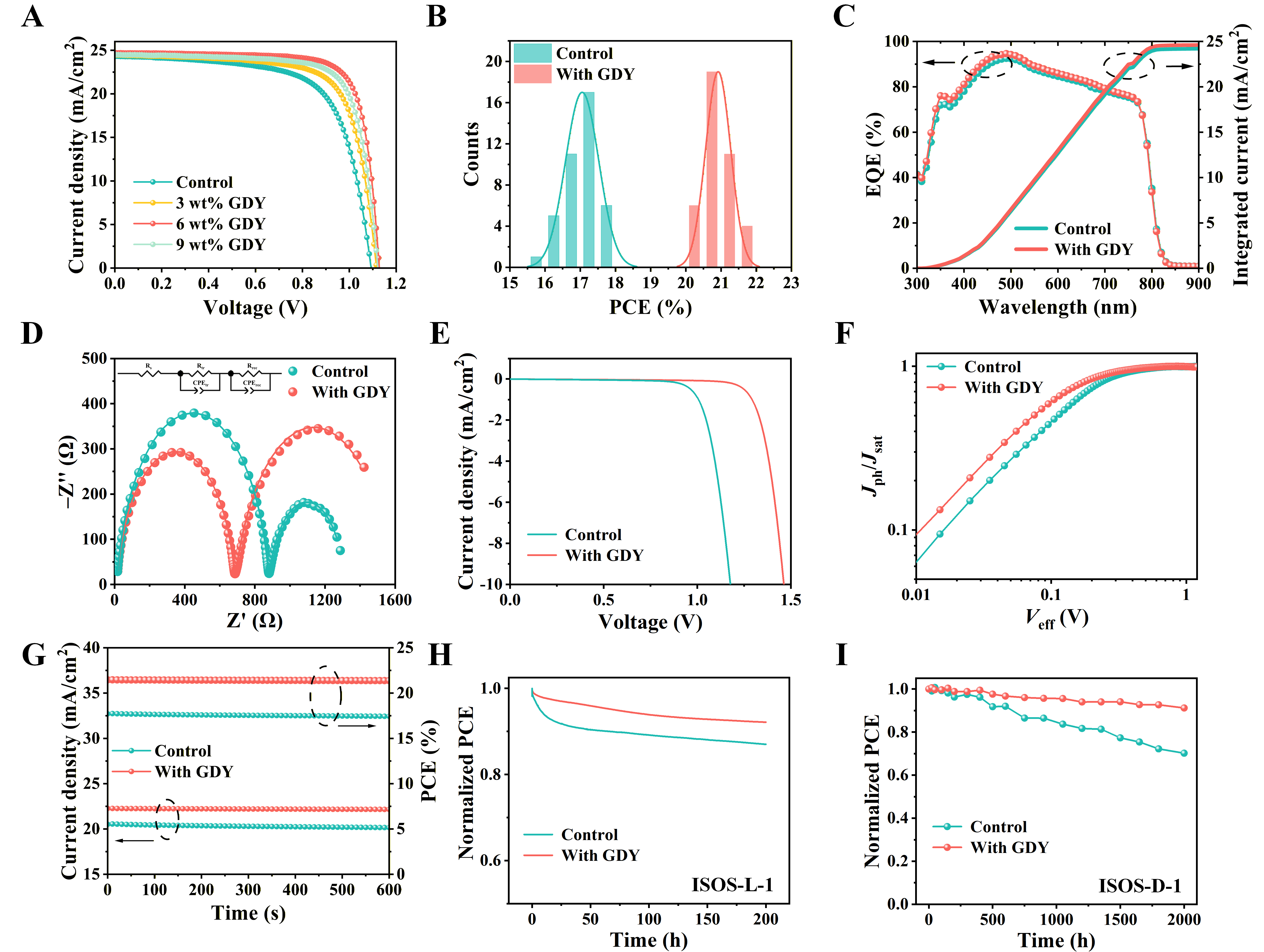
Figure 5. (A) J-V curves for PSCs containing different GDY loadings under one-sun illumination; (B) PCE statistical distribution of control and optimized GDY-modified PSCs; (C) EQE and integrated JSC curves; (D) Nyquist plots measured in the dark at a bias of 0.8 V, with the equivalent circuit model shown in the inset; (E) J-V curves under dark conditions; (F) Photocurrent density (Jph) as a function of effective voltage (Veff); (G) Stabilized current density and PCE under maximum-power-point tracking at one-sun illumination; (H) Operational stability under continuous illumination at the maximum-power point under the ISOS-L-1 protocol; (I) Long-term storage stability (ISOS-D-1) of unencapsulated devices in ambient air (30%-40% relative humidity) under dark conditions. Perovskite solar cells; GDY: graphdiyne; EQE: external quantum efficiency; J-V: current density-voltage; JSC: short-circuit current density; ISOS-L-1: International Summit on Organic Photovoltaic Stability light-soaking protocol (level 1); ISOS-D-1: International Summit on Organic Photovoltaic Stability dark-storage protocol (level 1); Rs: series resistance; Rtr: transport resistance; Rrec: recombination resistance; CPEtr: constant phase element associated with charge transport; CPErec: constant phase element associated with charge recombination; PCE: power conversion efficiency.
The electrical response of the contacts was further probed by impedance spectroscopy at 0.8 V in the dark [Figure 5D]. Two features in the Nyquist spectra were assigned, using the stated equivalent-circuit model, to transport resistance (Rtr) at high frequency and recombination resistance (Rrec) at lower frequency. As summarized in Supplementary Table 6, the GDY-modified device exhibits a lower Rtr of 673 Ω than the control device (867 Ω), indicating facilitated interfacial charge extraction and transport. Meanwhile, Rrec increases from 435 to 899 Ω, suggesting suppressed charge recombination after GDY incorporation. These results are consistent with the improved energetic alignment and carrier-transport characteristics discussed above, further supporting preferential hole transport at the GDY-modified perovskite/carbon interface. Charge collection was also examined by plotting the photocurrent density (Jph) against the effective voltage (Veff), with the quantities defined as follows[59]:
where JL and JD refer to current densities recorded under one-sun illumination and in the dark; V0 is the voltage at which Jph becomes zero, and Vapp is the externally applied voltage. As shown in Figure 5E and F, Jph approaches saturation more rapidly for the GDY-modified device. At the maximum-power point, the Jph/Jsat ratio increases from 0.842 for the control to 0.869 after GDY incorporation, indicating a higher charge-collection probability. This electrical response is consistent with the preferential carrier-transport function expected from the electronically coupled GDY/perovskite/carbon interface.
The stability of unencapsulated PSCs was subsequently evaluated. During maximum-power-point tracking (MPPT) under one-sun conditions [Figure 5G], the reference exhibits a stabilized current density of
CONCLUSIONS
In summary, we establish a graphdiyne-enabled interfacial transport-sieving effect in carbon electrode-based perovskite solar cells, reconciling efficient charge extraction with effective Pb sequestration at the perovskite/carbon interface. The π-conjugated framework of GDY bridges the energy-level mismatch and provides an energetically favorable pathway for hole extraction, increasing SCLC-derived effective hole mobility by approximately ninefold. Meanwhile, its electron-rich π system passivates undercoordinated Pb2+ defects through π-electron coupling and interfacial charge redistribution, thereby reducing trap-state density and suppressing nonradiative recombination. Beyond these carrier-transport functions, the uniformly distributed sp-hybridized acetylenic linkages exhibit strong chemical affinity toward released Pb species, reducing lead leakage by up to 80%. Experimental analyses implicate the acetylenic motifs in Pb binding, while DFT calculations identify the corner configuration of the acetylenic ring as the energetically preferred adsorption geometry. Benefiting from this transport-selective interface, the optimized device achieves a champion PCE of 21.71% together with enhanced operational and storage stability. Further direct characterization of the contact interface will provide deeper mechanistic insight into the electronic selectivity. These findings establish interfacial transport sieving as a promising design principle for selectively facilitating desirable carrier transport while retaining hazardous Pb species, offering a new avenue toward efficient and environmentally responsible perovskite photovoltaics.
DECLARATIONS
Acknowledgments
The authors sincerely acknowledge Prof. Jiangjian Shi and Prof. Qingbo Meng of the Institute of Physics, Chinese Academy of Sciences for their assistance with transient photocurrent and transient photovoltage characterizations.
Authors’ contributions
Conceptualization: Sun, H.; Kang, Z.; Zhang, Y.
Methodology, writing - original draft: Sun, H.; Fan, W.; Xu, C.
Investigation: Sun, H.; Liu, Y.; Yu, L.
Formal analysis: Xu, C.; Wang, H.; Hu, L.
Data curation: Wang, H.; Hu, L.; Lu, Y.
Software: Xu, C.; Liu, Y.
Validation: Fan, W.; Yu, L.; Lu, Y.
Writing - review & editing, resources, supervision, funding acquisition: Liang, Z.; Kang, Z.; Zhang, Y.
Availability of data and materials
The data supporting the findings of this study are available within this Article and its Supplementary Materials. Further data are available from the corresponding authors upon request.
AI and AI-assisted tools statement
Not applicable.
Financial support and sponsorship
This work was supported by the National Key Research and Development Program of China (No. 2021YFA1201800), National Natural Science Foundation of China (Nos. 52188101, 52122208, and 52402217), Scientific Research Innovation Capability Support Project for Young Faculty (No. FRF-U40-25-001), Fundamental and Interdisciplinary Disciplines Breakthrough Plan of the Ministry of Education of China (No. JYB2025XDXM411), National Key Research and Development Program of China (Nos. 2018YFA0703503, 2022YFA1204502, and 2023YFF1500402), State Key Laboratory for Advanced Metals and Materials (Nos. 2022Z-08 and 2023-Z13), Fundamental Research Funds for the Central Universities (Nos. GNYZ-2024-26, FRF-AT-25-007, GJJ2022-08, and FRF-TP-2021-03C1), and China Postdoctoral Science Foundation (Nos. GZB20240005 and 2024M750096).
Conflicts of interest
All authors declare that there are no conflicts of interest.
Ethical approval and consent to participate
Not applicable.
Consent for publication
Not applicable.
Copyright
© The Author(s) 2026.
Supplementary Materials
REFERENCES
1. Wu, X.; Kou, W.; Li, Z.; et al. Electronic-resonance enhanced molecule for perovskite solar cells. Nature 2026, 656, 861-8.
2. Harit, A. K.; He, Z.; Kuang, Y.; et al. Taking perovskite photovoltaics from promise to product. Nat. Rev. Clean. Technol. 2026, 2, 453-66.
3. Li, B.; Gao, D.; Zhang, C.; et al. Closed-loop manufacturing for sustainable perovskite photovoltaics. Nat. Rev. Mater. 2026, 11, 10-25.
4. Bach, U.; Lupo, D.; Comte, P.; et al. Solid-state dye-sensitized mesoporous TiO2 solar cells with high photon-to-electron conversion efficiencies. Nature 1998, 395, 583-5.
5. Shin, Y. S.; Lee, J.; Sung, M. J.; Jeon, I.; Jeon, N. J.; Kim, D. S. Intrinsic and extrinsic determinants of stability in Spiro-OMeTAD-based hole-transporting layers in perovskite solar cells: mechanistic insights and strategic perspectives. Adv. Mater. 2025, 37, e13270.
6. You, S.; Zeng, H.; Liu, Y.; et al. Radical polymeric p-doping and grain modulation for stable, efficient perovskite solar modules. Science 2023, 379, 288-94.
7. Liu, Y.; Zhang, Z.; Wu, T.; et al. Cost effectivities analysis of perovskite solar cells: will it outperform crystalline silicon ones? Nano-Micro. Lett. 2025, 17, 219.
8. Penukula, S.; Tippin, F.; Li, M.; Khawaja, K. A.; Yan, F.; Rolston, N. Use of carbon electrodes to reduce mobile ion concentration and improve reliability of metal halide perovskite photovoltaics. Energy. Mater. 2024, 4, 400060.
9. Sajid, M.; Batool, H. S.; Su, Y.; Chen, F.; Lee, S. Recent advances in carbon-based materials for hole transport layer-free perovskite solar cells: a mini review. Chin. Chem. Lett. 2026, 113323.
10. Yu, B.; Shi, J.; Li, Y.; et al. Regulating three-layer full carbon electrodes to enhance the cell performance of CsPbI3 perovskite solar cells. Nat. Commun. 2025, 16, 3328.
11. Zouhair, S.; Yoo, S.; Bogachuk, D.; et al. Employing 2D-perovskite as an electron blocking layer in highly efficient (18.5%) perovskite solar cells with printable low temperature carbon electrode. Adv. Energy. Mater. 2022, 12, 2200837.
12. Zhang, C.; Liang, S.; Liu, W.; et al. Ti1-graphene single-atom material for improved energy level alignment in perovskite solar cells. Nat. Energy. 2021, 6, 1154-63.
13. Zhang, H.; Lee, J. W.; Nasti, G.; et al. Lead immobilization for environmentally sustainable perovskite solar cells. Nature 2023, 617, 687-95.
14. Lin, D.; Huang, Y.; Chen, Q.; et al. Mitigating lead toxicity towards safer commercialization of perovskite solar cells. Nat. Energy. 2026, 11, 805-17.
15. Cao, X.; Hu, T.; Qi, Y.; Niu, W.; Tang, B.; Zhang, S. Dual dynamic covalent bond adaptive networks for high-performance, HTL-free carbon-based perovskite solar cells. Small 2026, 22, e74903.
16. Wang, W. T.; Holzhey, P.; Zhou, N.; et al. Water- and heat-activated dynamic passivation for perovskite photovoltaics. Nature 2024, 632, 294-300.
17. Yang, Y.; Chen, H.; Liu, C.; et al. Amidination of ligands for chemical and field-effect passivation stabilizes perovskite solar cells. Science 2024, 386, 898-902.
18. Cai, Y.; Bai, Z.; Chen, C.; et al. Machine learning prediction of small molecule passivators and their impacts on the passivation and photocatalytic performance of organic-inorganic hybrid perovskite interfaces. Energy. Mater. 2025, 5, 500043.
19. Xu, C.; Chen, X.; Ma, S.; et al. Interpretation of rubidium-based perovskite recipes toward electronic passivation and ion-diffusion mitigation. Adv. Mater. 2022, 34, e2109998.
20. Zhou, S.; Fu, S.; Wang, C.; et al. Aspartate all-in-one doping strategy enables efficient all-perovskite tandems. Nature 2023, 624, 69-73.
21. Wang, S.; Gong, X. Y.; Li, M. X.; Li, M. H.; Hu, J. S. Polymers for perovskite solar cells. JACS. Au. 2024, 4, 3400-12.
22. Chen, J.; Shao, C.; Wang, L.; et al. Conjugated polymer semiconductors enabled multifunctional interfacial engineering for high-performance inverted perovskite solar cells. Adv. Mater. 2026, 38, e73850.
23. Li, Q.; Zheng, Y.; Wang, H.; et al. Graphene-polymer reinforcement of perovskite lattices for durable solar cells. Science 2025, 387, 1069-77.
24. Agresti, A.; Pazniak, A.; Pescetelli, S.; et al. Titanium-carbide MXenes for work function and interface engineering in perovskite solar cells. Nat. Mater. 2019, 18, 1228-34.
25. Zhao, P.; Shuang, Y.; Huo, J.; et al. Hybrid perovskite toughened by covalent organic framework fibers for mechanically reliable solar cells. Trans. Mater. Res. 2026, 2, 100398.
26. Macdonald, T. J.; Clancy, A. J.; Xu, W.; et al. Phosphorene nanoribbon-augmented optoelectronics for enhanced hole extraction. J. Am. Chem. Soc. 2021, 143, 21549-59.
27. Dai, K.; Wang, H.; Huang, W.; et al. Thermally independent interfacial reconstruction for phase-pure n = 1 2D perovskites with mixed-orientation surface architecture. Adv. Mater. 2026, 38, e74247.
28. Li, X.; Zhang, F.; He, H.; Berry, J. J.; Zhu, K.; Xu, T. On-device lead sequestration for perovskite solar cells. Nature 2020, 578, 555-8.
29. Zhuang, Q.; Xu, Z.; Li, H.; et al. Molecular polymerization strategy for stable perovskite solar cells with low lead leakage. Sci. Adv. 2025, 11, eado7318.
30. Ma, J.; Fan, S.; Shao, C.; et al. Double-chain copolymer network via in situ polymerization enables high-stability and lead-safe perovskite solar cells. Angew. Chem. Int. Ed. 2025, 64, e202425578.
31. Chen, S.; Deng, Y.; Xiao, X.; Xu, S.; Rudd, P. N.; Huang, J. Preventing lead leakage with built-in resin layers for sustainable perovskite solar cells. Nat. Sustain. 2021, 4, 636-43.
32. Li, G.; Li, Y.; Liu, H.; Guo, Y.; Li, Y.; Zhu, D. Architecture of graphdiyne nanoscale films. Chem. Commun. 2010, 46, 3256-8.
33. Fang, Y.; Liu, Y.; Qi, L.; Xue, Y.; Li, Y. 2D graphdiyne: an emerging carbon material. Chem. Soc. Rev. 2022, 51, 2681-709.
34. Kuang, J.; Yu, J.; Zhang, Q.; et al. Graphdiyne production in a flash: high-yield direct synthesis by electron beam irradiation. Adv. Mater. 2025, 37, e2506979.
35. Zhang, X.; Chai, J.; Wang, C.; et al. Graphdiyne as a hole-transport channel in carbon nitride heterojunctions for synergistic CO2 reduction and γ-butyrolactone synthesis. Angew. Chem. Int. Ed. 2026, 65, e3147768.
36. Zhang, S.; Xu, C.; Fan, W.; et al. Sp-hybridized carbon enabled crystal lattice manipulation, pushing the limit of fill factor in β-CsPbI3 perovskite solar cells. Matter 2024, 7, 3205-20.
37. Liu, R.; Zhou, J.; Gao, X.; et al. Graphdiyne filter for decontaminating lead-ion-polluted water. Adv. Elect. Mater. 2017, 3, 1700122.
38. Yuan, T.; Xiong, S.; Shen, X. Coordination of actinide single ions to deformed graphdiyne: strategy on essential separation processes in nuclear fuel cycle. Angew. Chem. Int. Ed. 2020, 59, 17719-25.
39. Zhu, J.; Liu, D.; Li, C.; et al. Facile and large-scale synthesis of polymorphic graphdiyne catalyzed by transition metal salts for organic pollutant removal. RSC. Adv. 2021, 11, 35408-14.
41. Kresse, G.; Joubert, D. From ultrasoft pseudopotentials to the projector augmented-wave method. Phys. Rev. B. 1999, 59, 1758.
42. Li, J.; Zhong, L.; Tong, L.; et al. Atomic Pd on graphdiyne/graphene heterostructure as efficient catalyst for aromatic nitroreduction. Adv. Funct. Mater. 2019, 29, 1905423.
43. Wang, Z.; Zheng, Z.; Xue, Y.; He, F.; Li, Y. Acidic water oxidation on quantum dots of IrOx/graphdiyne. Adv. Energy. Mater. 2021, 11, 2101138.
44. Tan, Q.; Li, Z.; Luo, G.; et al. Inverted perovskite solar cells using dimethylacridine-based dopants. Nature 2023, 620, 545-51.
45. Bu, T.; Li, J.; Li, H.; et al. Lead halide-templated crystallization of methylamine-free perovskite for efficient photovoltaic modules. Science 2021, 372, 1327-32.
46. Wang, W.; Chen, P.; Chiang, C.; Guo, T.; Wu, C.; Feng, S. Synergistic reinforcement of built-in electric fields for highly efficient and stable perovskite photovoltaics. Adv. Funct. Mater. 2020, 30, 1909755.
47. Wang, Z.; Han, Y.; Lin, X.; Cai, J.; Wu, S.; Li, J. An ensemble learning platform for the large-scale exploration of new double perovskites. ACS. Appl. Mater. Interfaces. 2022, 14, 717-25.
48. Li, Y.; An, D.; Zhu, B.; Huang, Y.; Tang, G. Carrier mobility trends in nitride perovskites: first-principles insights and phenomenological models. Phys. Rev. B. 2026, 114.
49. Clarke, T. M.; Durrant, J. R. Charge photogeneration in organic solar cells. Chem. Rev. 2010, 110, 6736-67.
50. Yang, G.; Wang, C.; Lei, H.; et al. Interface engineering in planar perovskite solar cells: energy level alignment, perovskite morphology control and high performance achievement. J. Mater. Chem. A. 2017, 5, 1658-66.
51. Li, M.; Liu, S.; Qiu, F.; Zhang, Z.; Xue, D.; Hu, J. High-efficiency CsPbI2Br perovskite solar cells with dopant-free poly(3-hexylthiophene) hole transporting layers. Adv. Energy. Mater. 2020, 10, 2000501.
52. Bai, C.; Shu, H.; Zhang, S.; Zhang, W.; Xu, Y.; Yang, S. Synergistic bulk and interface engineering of SnO2 via ammonium formate for efficient and stable perovskite solar cells. Trans. Mater. Res. 2026, 2, 100335.
53. Duan, L.; Liang, H.; Wu, L.; et al. Suppressing alkyl ammonium deprotonation with low-pKa solvent for reproduceable and stable high-efficiency perovskite solar cells. Angew. Chem. Int. Ed. 2026, 65, e10623.
54. Glowienka, D.; Galagan, Y. Light intensity analysis of photovoltaic parameters for perovskite solar cells. Adv. Mater. 2022, 34, e2105920.
55. Shi, J.; Li, Y.; Li, Y.; et al. From ultrafast to ultraslow: charge-carrier dynamics of perovskite solar cells. Joule 2018, 2, 879-901.
56. Jin, H.; Debroye, E.; Keshavarz, M.; et al. It’s a trap! On the nature of localised states and charge trapping in lead halide perovskites. Mater. Horiz. 2020, 7, 397-410.
57. Liang, Y.; Song, P.; Tian, H.; et al. Lead leakage preventable fullerene-porphyrin dyad for efficient and stable perovskite solar cells. Adv. Funct. Mater. 2022, 32, 2110139.
58. Wang, N.; Li, X.; Tu, Z.; et al. Synthesis and electronic structure of boron-graphdiyne with an sp-hybridized carbon skeleton and its application in sodium storage. Angew. Chem. Int. Ed. 2018, 57, 3968-73.
Cite This Article
 Open Access
How to Cite
Sun, H.; Fan, W.; Xu, C.; Liu, Y.; Wang, H.; Hu, L.; Liang, Z.; Yu, L.; Lu, Y.; Kang, Z.; Zhang, Y. Graphdiyne-enabled interfacial transport sieving for efficient and sustainable carbon-based perovskite photovoltaics. Energy Mater. 2026, 6, 600165. https://dx.doi.org/10.20517/energymater.2026.309
Download Citation
If you have the appropriate software installed, you can download article citation data to the citation manager of your choice. Simply select your manager software from the list below and click on download.
Export Citation File
Type of Import
Tips on Downloading Citation
Citation Manager File Format
Type of Import
Direct Import: When the Direct Import option is selected (the default state), a dialogue box will give you the option to Save or Open the downloaded citation data. Choosing Open will either launch your citation manager or give you a choice of applications with which to use the metadata. The Save option saves the file locally for later use.
Indirect Import: When the Indirect Import option is selected, the metadata is displayed and may be copied and pasted as needed.
About This Article
Special Topic
Copyright

Data & Comments
Data
0












Comments
Comments must be written in English. Spam, offensive content, impersonation, and private information will not be permitted. If any comment is reported and identified as inappropriate content by OAE staff, the comment will be removed without notice. If you have any queries or need any help, please contact us at [email protected].