
fig1
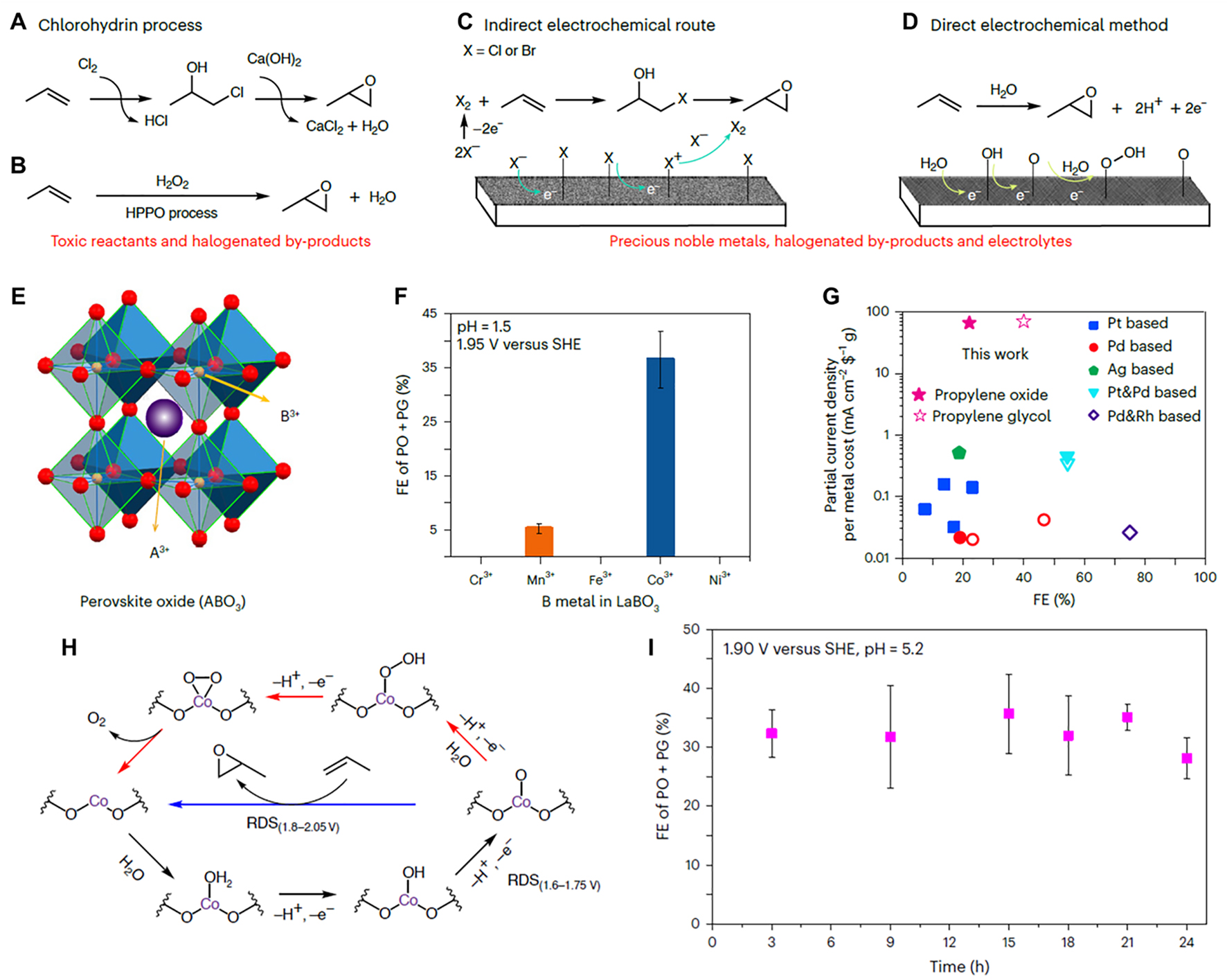
Figure 1. Perovskite oxides as a family of viable electrocatalysts for D-EPEP. (A-D) Comparison of several existing propylene epoxidation routes including chlorohydrin process (A), HPPO process (B), indirect electrochemical route (C), and direct electrochemical route (D-EPEP) (D). (E) Illustration of the perovskite oxide structure. (F) Propylene epoxidation selectivity over LaBO3 series (B = Cr, Mn, Fe, Co, Ni) at 1.95 V vs. SHE (pH = 1.5). (G) Benchmarking with noble metal-based catalysts. (H) A proposed mechanism for the D-EPEP over LaCoO3 perovskite. (I) Stability data showing changes of epoxidation FE at different time intervals for 24 h at 1.90 V vs. SHE (pH = 5.2). The figure is reproduced with permission from Ref.[7], Copyright © 2026 Springer Nature. SHE: Standard hydrogen electrode; FE: faradaic efficiency.