

Earth-abundant perovskite oxide catalysts enabling direct electrochemical propylene epoxidation in aqueous electrolytes
 0



 Download PDF
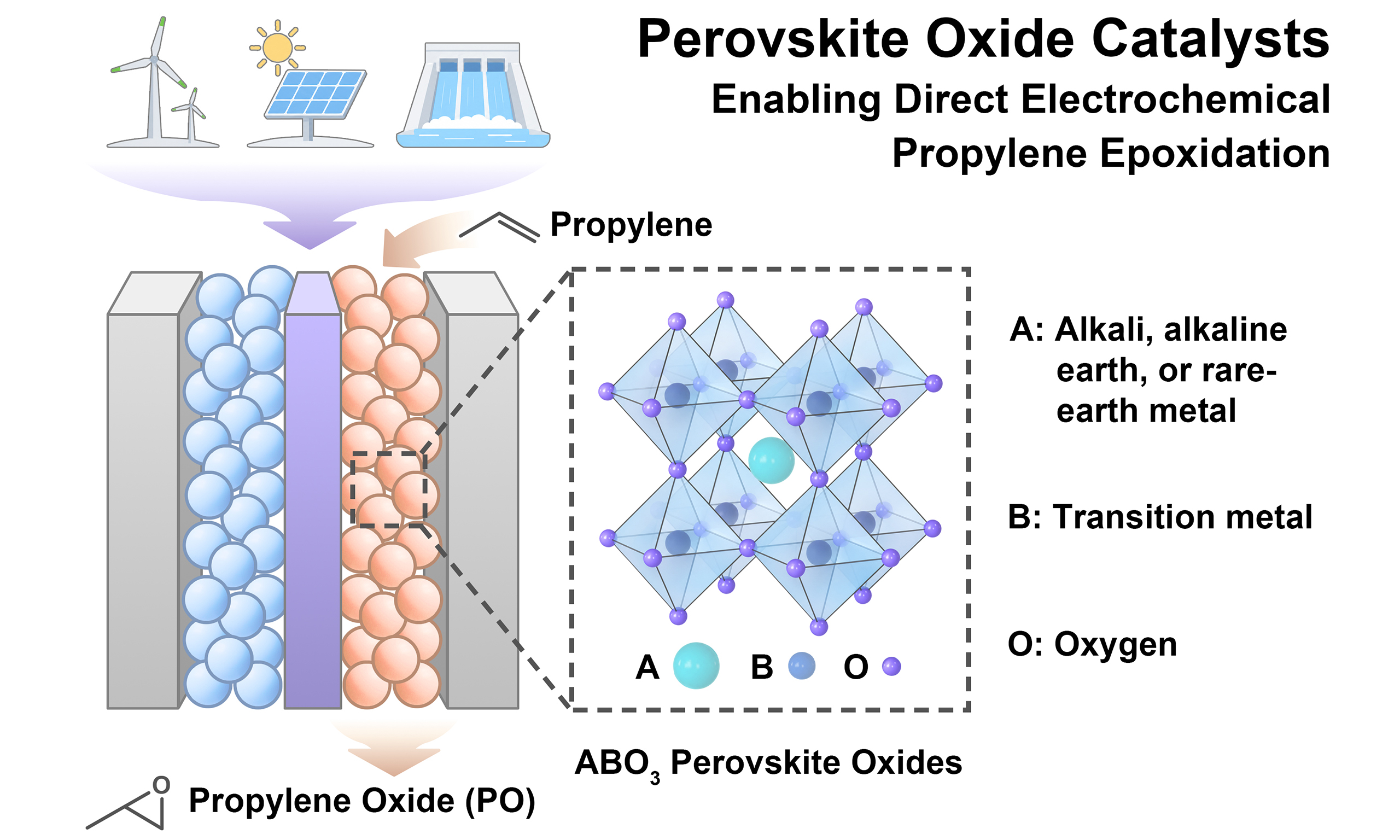
Propylene oxide (PO) and its hydrolysis product, propylene glycol (PG), represent important industrial intermediates that can be used for the manufacture of polyurethanes and polyesters, among many other commodity chemicals. Conventionally, PO is industrially produced by two major approaches[1]: the chlorohydrin process [Figure 1A] and the hydrogen peroxide to propylene oxide (HPPO) process [Figure 1B]. These methods, however, are heavily dependent on strong oxidants such as chlorine and hydrogen peroxide, posing considerable environmental and safety risks, respectively. Recently, electrochemical propylene epoxidation (EPEP) has emerged as a potentially more sustainable alternative, particularly when powered by electricity generated from renewables (solar, wind, etc.). This reaction can occur under ambient conditions, either through an indirect pathway mediated by halides such as chlorides or bromides (which is a mimic of the chlorohydrin process) [Figure 1C][2], or via a direct pathway in which water serves as the oxygen source [Figure 1D][3]. Comparatively speaking, the direct pathway (full-cell reaction: C3H6 + H2O → C3H6O + H2; standard cell voltage: 0.77 V) is more attractive compared to the indirect pathway as it avoids the formation of hazardous, halogenated by-products, while generating green hydrogen as a more value-added by-product. However, the direct electrochemical propylene epoxidation (D-EPEP) (half-reaction: C3H6 + H2O → C3H6O + 2H+ + 2e-; standard equilibrium potential: 0.77 V vs. reversible hydrogen electrode (RHE)) competes with the oxygen evolution reaction (OER) (half-reaction: 2H2O → O2 + 4H+ + 4e-; standard equilibrium potential: 1.23 V vs. RHE) in aqueous water, and the currently available heterogeneous catalysts that show moderate selectivity toward D-EPEP have been largely limited to those comprising noble metals like platinum (Pt)[3,4], palladium (Pd)[4], silver (Ag)[5], and rhodium (Rh)[6]. Their scarcity and high cost present a critical barrier to the wider-scale, industrial deployment of D-EPEP.
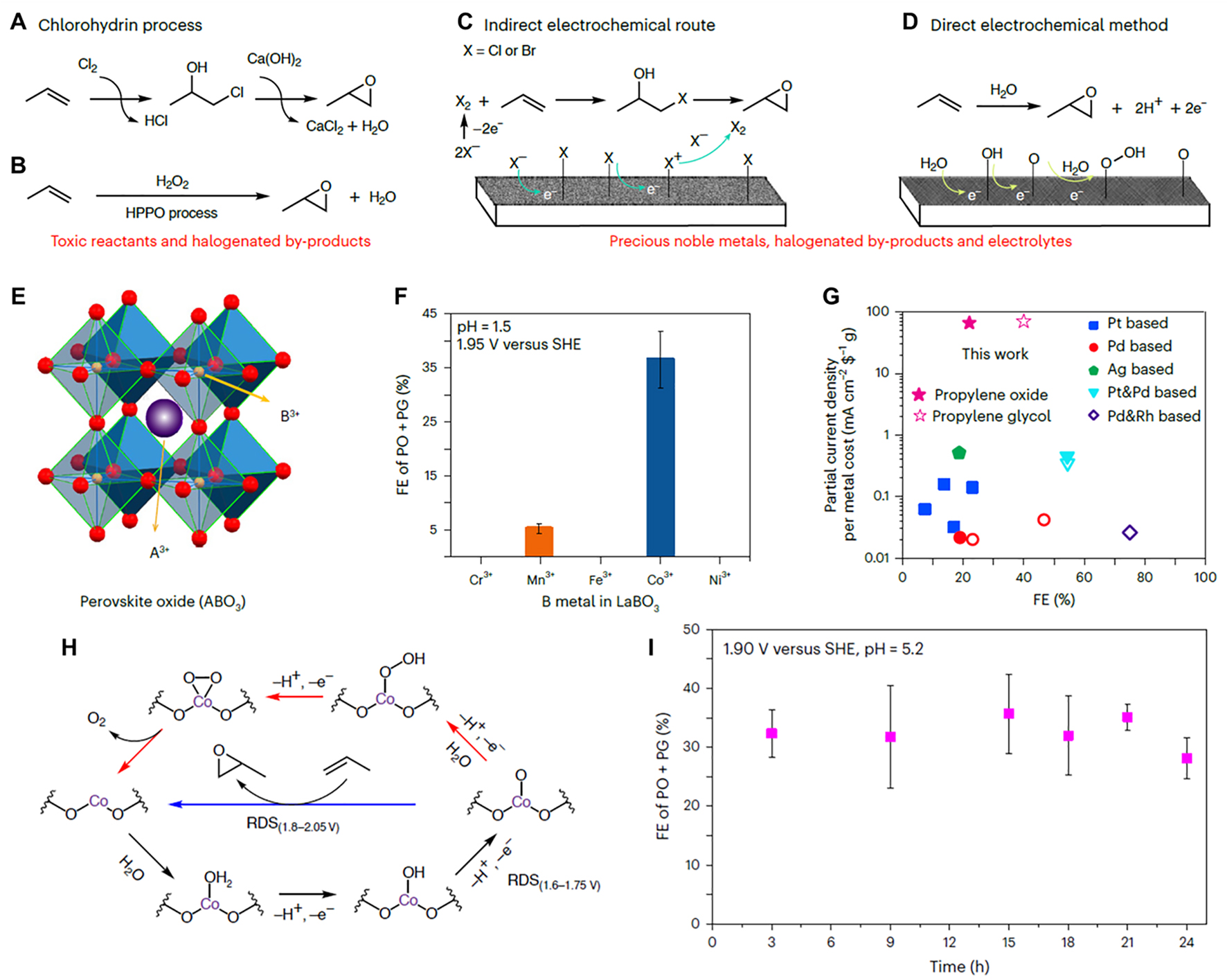
Figure 1. Perovskite oxides as a family of viable electrocatalysts for D-EPEP. (A-D) Comparison of several existing propylene epoxidation routes including chlorohydrin process (A), HPPO process (B), indirect electrochemical route (C), and direct electrochemical route (D-EPEP) (D). (E) Illustration of the perovskite oxide structure. (F) Propylene epoxidation selectivity over LaBO3 series (B = Cr, Mn, Fe, Co, Ni) at 1.95 V vs. SHE (pH = 1.5). (G) Benchmarking with noble metal-based catalysts. (H) A proposed mechanism for the D-EPEP over LaCoO3 perovskite. (I) Stability data showing changes of epoxidation FE at different time intervals for 24 h at 1.90 V vs. SHE (pH = 5.2). The figure is reproduced with permission from Ref.[7], Copyright © 2026 Springer Nature. SHE: Standard hydrogen electrode; FE: faradaic efficiency.
In a recent study published in Nature Catalysis, Koner and colleagues interrogated for the first time the perovskite oxide family as earth-abundant catalysts for facilitating D-EPEP toward selective production of PO (and PG, formed through the hydrolysis of PO) [Figure 1E-I][7]. Perovskite oxides with a general formula of ABO3, where A is an alkali, alkaline-earth, or rare-earth metal and B a transition metal, are known for their compositional and structural flexibility, allowing for structure-property relationship understanding in electrocatalysis[8]. Koner et al.’s initial screening across the ABO3 series (A = La and B = Cr, Mn, Fe, Co, Ni) identified LaMnO3 and LaCoO3 as active candidates for propylene epoxidation, with LaCoO3 delivering a more desirable epoxidation selectivity (characterized by combined PO/PG Faradaic efficiency (FE))
Considering the compositional tunability of perovskite oxides, the authors attempted to enhance the epoxidation selectivity of the screened LaCoO3 catalyst through either A-site or B-site doping[7]. Substituting the A-site La with strontium (Sr) at levels up to 20% had no obvious effect on the epoxidation selectivity, while substitution at levels greater than 20% had a detrimental effect. On the other hand, B-site doping turned out to be unsuccessful either. Partially replacing Co with Cr, Mn, Fe, or Ni did not give rise to better epoxidation selectivity, with LaCoO3 having Co alone at the B site remaining the most active candidate for epoxidation. These doping strategies did not give rise to enhanced epoxidation selectivity, suggesting that the competing OER started to prevail over those dopant-modified perovskite surfaces. Beyond catalyst composition, the authors further attempted to optimize testing parameters such as electrode preparation, electrolyte composition (e.g., electrolyte anion, cyclic phosphate additives, and electrolyte pH), and applied anodic potential. Eventually, an optimized FE of 37(±5)% toward PO and PG production was achieved on LaCoO3 loaded on a hydrophilic carbon paper support as the gas diffusion electrode and in a 1 M mixture electrolyte of H3PO4 and sodium hexametaphosphate (SHMP) (at a 3:1 molar ratio; pH 1.5) at an applied potential of 1.95 V versus the standard hydrogen electrode [Figure 1F]. Of note, the cyclic phosphate additives (i.e., SHMP) were intentionally adopted to regulate the solvation structure and orientation of water molecules near the active sites, thereby enhancing propylene epoxidation activity[10].
Koner et al. further conducted a thorough electrochemical kinetic study investigating how the partial current density for epoxidation changed with the electrolyte pH, propylene partial pressure, applied potential, and isotopic substitutions. Based on these kinetic data, a possible mechanism for D-EPEP was proposed[7]. As illustrated in Figure 1H, the propylene epoxidation over the LaCoO3 perovskite initiates with a water activation step on cobalt sites (rate-determining at lower potentials) forming reactive oxygenated intermediates, which are subsequently consumed through a competition between a further two-electron electrochemical oxidation step to form O2 and a thermochemical reaction step with propylene to form PO (rate-determining at higher potentials). Stability is also an important factor for real-world applications of electrocatalytic conversion, for example, the D-EPEP. Notably, preliminary electrochemical testing suggests that LaCoO3 exhibited excellent stability toward continuous propylene epoxidation over a 24-h period [Figure 1I].
In summary, this landmark study by Koner and colleagues represents an important step towards safer and more sustainable propylene epoxidation by replacing noble-metal catalysts and hazardous halogenated electrolytes with an earth-abundant perovskite catalyst operating in aqueous media. While a plausible reaction mechanism was proposed over the amorphized perovskite catalyst, the mechanistic understanding remains incomplete. Further insight will require combined in situ/operando characterizations and theoretical calculations to establish a robust structure–activity relationship, which can, in turn, be utilized to develop improved catalysts based on perovskite oxides. Moving forward, researchers can leverage the tunability of the wider perovskite oxide family, including not just ABO3 single perovskites but also A2B2O6 double perovskites and An+1BnO3n+1 Ruddlesden-Popper layered perovskites[8], to explore further possibilities for electrocatalytic propylene epoxidation and other possible organic conversions. To go one step further toward practical applications, future efforts should be devoted to enhancing the epoxidation selectivity, partial current density, and operating lifetime to industrially relevant levels, through combined materials and device engineering[11].
DECLARATIONS
Authors’ contributions
Conceptualization and supervision: Xu, X.
Manuscript preparation and revision: Han, X.; Luo, S.; Xu, X.
Availability of data and materials
Not applicable.
AI and AI-assisted tools statement
Not applicable.
Financial support and sponsorship
This work was supported by the Australian Research Council Discovery Early Career Researcher Award (No. DE240101013).
Conflicts of interest
Xu, X. is a Guest Editor of the Special Issue “Earth-Abundant Materials for Electrocatalytic Small Molecule Conversion” of the journal Energy Materials. Xu, X. was not involved in any steps of editorial processing, including reviewers’ selection, manuscript handling, and decision-making, while the other authors have declared that they have no conflicts of interest.
Ethical approval and consent to participate
Not applicable.
Consent for publication
Not applicable.
Copyright
© The Author(s) 2026.
REFERENCES
1. Wang, Z.; Han, J.; Usama; et al. Recent advances in design of heterogeneous electrocatalyst for direct olefin epoxidation with water as the oxygen source. Adv. Synth. Catal. 2026, 368, e70582.
2. Leow, W. R.; Lum, Y.; Ozden, A.; et al. Chloride-mediated selective electrosynthesis of ethylene and propylene oxides at high current density. Science 2020, 368, 1228-33.
3. Iguchi, S.; Kataoka, M.; Hoshino, R.; Yamanaka, I. Direct epoxidation of propylene with water at a PtOx anode using a solid-polymer-electrolyte electrolysis cell. Catal. Sci. Technol. 2022, 12, 469-73.
4. Chung, M.; Maalouf, J. H.; Adams, J. S.; Jiang, C.; Román-Leshkov, Y.; Manthiram, K. Direct propylene epoxidation via water activation over Pd-Pt electrocatalysts. Science 2024, 383, 49-55.
5. Pi, D.; Yang, X.; Chen, M.; et al. In-situ spectroscopic insights into the dual-site synergistic electrocatalytic mechanism of propylene epoxidation over single-Ag-atom catalyst. Nat. Commun. 2025, 17, 691.
6. Huang, J. E.; Chen, Y.; Ou, P.; et al. Selective electrified propylene-to-propylene glycol oxidation on activated Rh-doped Pd. J. Am. Chem. Soc. 2024, 146, 8641-9.
7. Koner, K.; Adams, J. S.; Miu, E. V.; et al. Direct electrochemical propylene epoxidation over amorphized perovskite oxide in non-halogenated aqueous electrolyte. Nat. Catal. 2026, 9, 542-51.
8. Xu, X.; Pan, Y.; Zhong, Y.; Ran, R.; Shao, Z. Ruddlesden-Popper perovskites in electrocatalysis. Mater. Horiz. 2020, 7, 2519-65.
9. Kanan, M. W.; Nocera, D. G. In situ formation of an oxygen-evolving catalyst in neutral water containing phosphate and Co2+. Science 2008, 321, 1072-5.
10. Maki, H.; Ibaragi, K.; Fujimoto, Y.; Nariai, H.; Mizuhata, M. Transitions from simple electrolyte to polyelectrolyte in a series of polyphosphates. Colloids. Surf. A. 2015, 484, 153-63.
Cite This Article
 Open Access
How to Cite
Han, X.; Luo, S.; Xu, X. Earth-abundant perovskite oxide catalysts enabling direct electrochemical propylene epoxidation in aqueous electrolytes. Energy Mater. 2026, 6, 600164. https://dx.doi.org/10.20517/energymater.2026.300
Download Citation
If you have the appropriate software installed, you can download article citation data to the citation manager of your choice. Simply select your manager software from the list below and click on download.
Export Citation File
Type of Import
Tips on Downloading Citation
Citation Manager File Format
Type of Import
Direct Import: When the Direct Import option is selected (the default state), a dialogue box will give you the option to Save or Open the downloaded citation data. Choosing Open will either launch your citation manager or give you a choice of applications with which to use the metadata. The Save option saves the file locally for later use.
Indirect Import: When the Indirect Import option is selected, the metadata is displayed and may be copied and pasted as needed.
About This Article
Special Topic
Copyright

Data & Comments
Data
0











Comments
Comments must be written in English. Spam, offensive content, impersonation, and private information will not be permitted. If any comment is reported and identified as inappropriate content by OAE staff, the comment will be removed without notice. If you have any queries or need any help, please contact us at [email protected].