
fig5
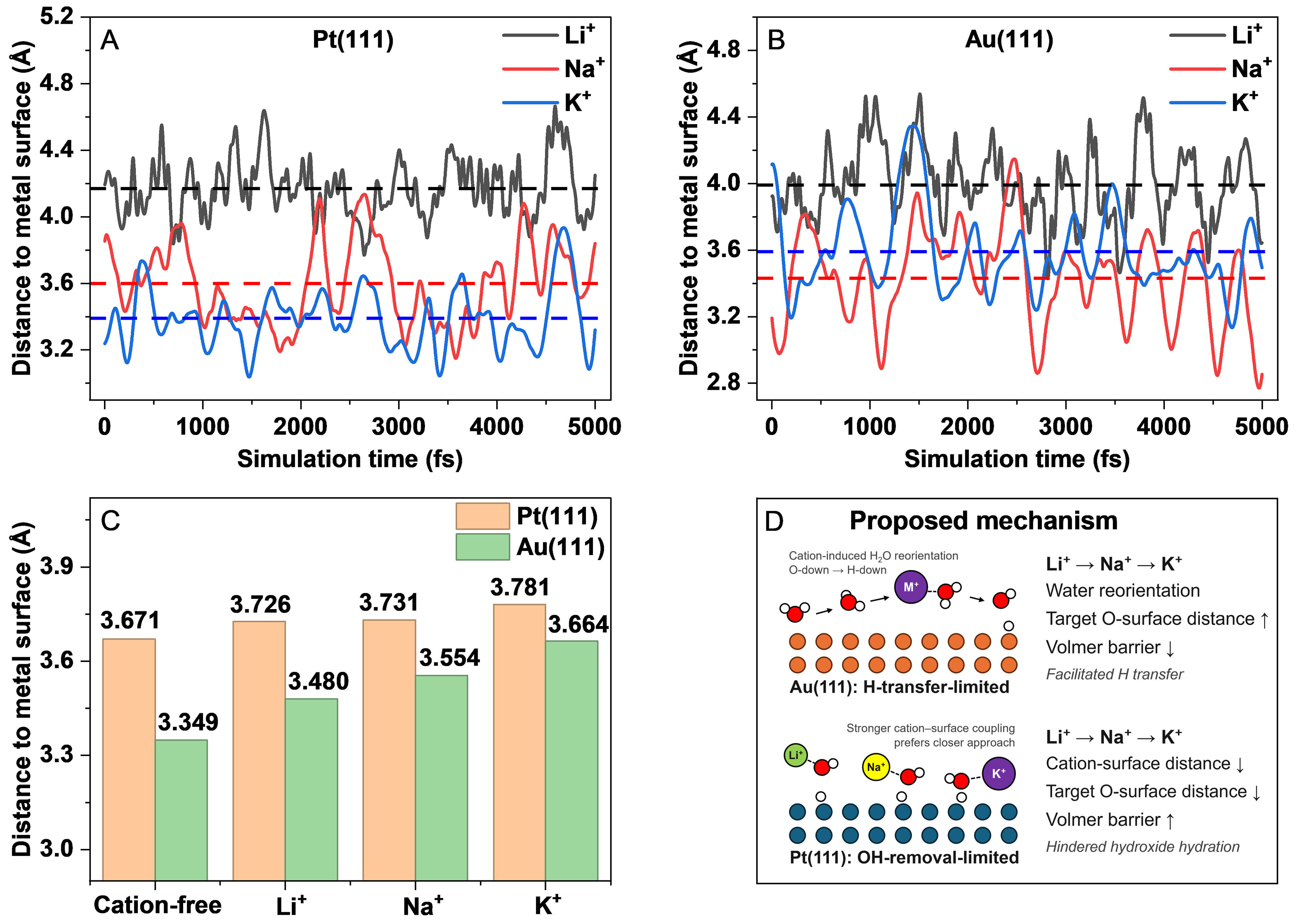
Figure 5. Cation positioning, nearest-water-layer distances, and a proposed mechanism for the metal-dependent Volmer response. (A and B) Cation-surface distances on (A) Pt(111) and (B) Au(111) during the final 5 ps of the unconstrained trajectories. Dashed lines indicate mean cation-surface distances over the 5 ps intervals. Gray, red, and blue denote Li+, Na+, and K+, respectively. (C) Mean nearest-water-layer distances on Pt(111) in orange and Au(111) in green for cation-free and single-cation models, calculated over the same interval. The reference plane is the instantaneous mean z coordinate of the topmost metal atoms. Water oxygen atoms within 5.00 Å above this plane are selected irrespective of orientation; the reported values are averages of the per-frame mean oxygen-surface distances, not density-peak positions. (D) Proposed H-transfer-limited character on Au(111) in the upper schematic and OH-removal-limited character on Pt(111) in the lower schematic. Target O denotes the reacting oxygen, and M+ denotes a generic monovalent cation. Orange, blue-green, red, and white spheres represent Au, Pt, O, and H. On Pt(111), Li+, Na+, and K+ are green, yellow, and purple, respectively.