
fig8
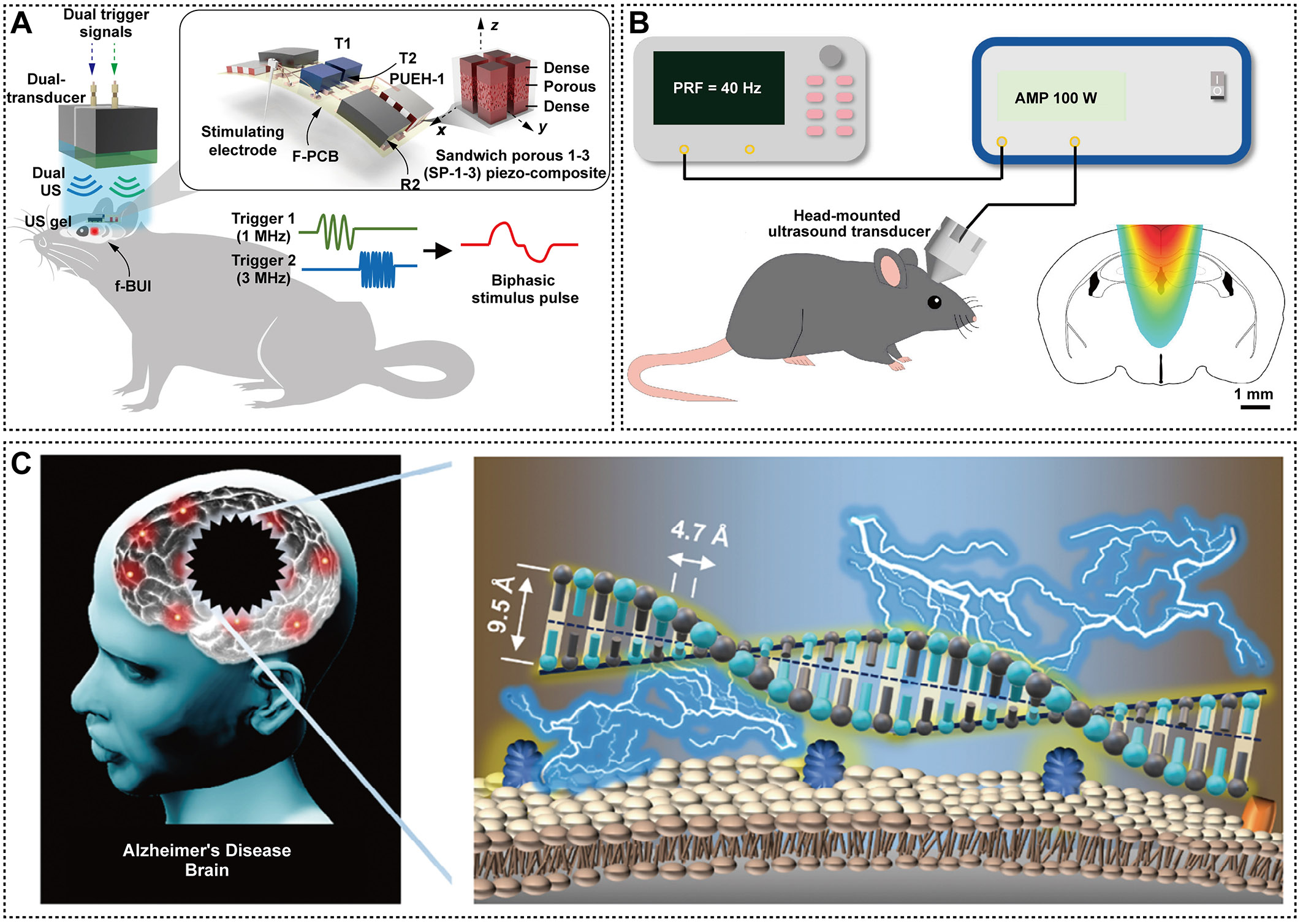
Figure 8. Representative piezoelectric mechanisms and ultrasound-enabled neuromodulation strategies relevant to Alzheimer’s disease. (A) Flexible lead-free dual-frequency piezoelectric ultrasound implant for wireless, biphasic deep-brain stimulation, adapted from Ref.[24] under CC BY 4.0 license. (B) Transcranial ultrasound stimulation pulsed at 40 Hz improves cognition and reduces neuroinflammation in female mice with Alzheimer's disease, adapted from Ref.[178], under CC BY 4.0 license. (C) Giant piezoelectricity of amyloid-β (Aβ) fibrils in Alzheimer's disease: monomeric Aβ peptides assemble into crystalline Aβ fibrils by forming dimers spaced 9.5 Å and stacking dimers spaced 4.7 Å, and the accumulation of these fibrils is associated with ion-channel hyperexcitability and neurodegeneration, adapted from Ref.[179], under CC BY 4.0 license.