

fig4
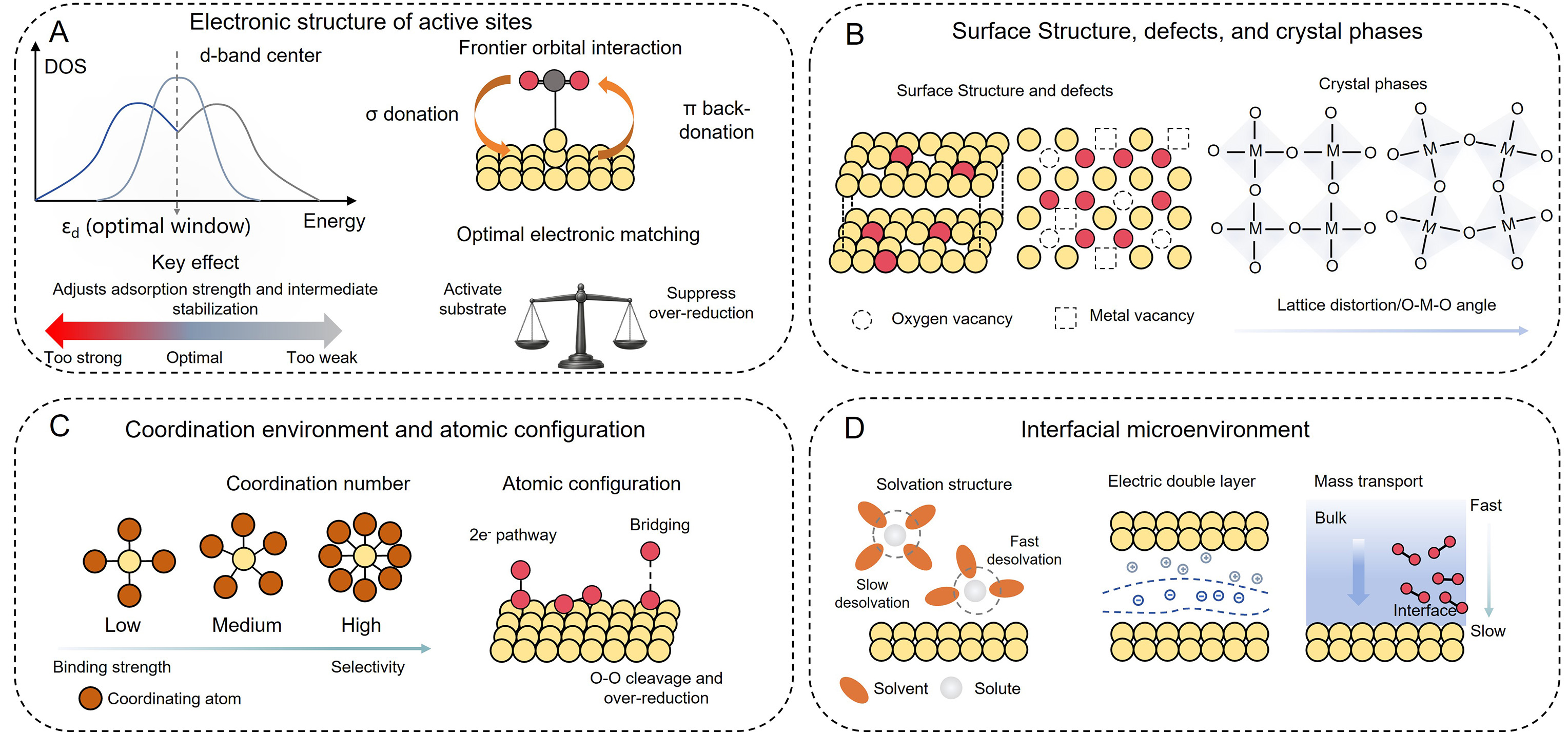
Figure 4. Schematic overview of structural regulation strategies and microenvironmental engineering for selective two-electron electrocatalysis. (A) Electronic structure of active sites, highlighting the d-band center, frontier orbital interactions, and the optimal electronic matching window to balance substrate activation and suppress over-reduction. (B) Surface structure and defects, including oxygen vacancies and metal vacancies, as well as crystal phases characterized by lattice distortion and O-M-O angles. (C) Coordination environment and atomic configuration, showing the impact of coordination number on binding strength and selectivity, alongside typical 2e- pathways. (D) Interfacial microenvironment, covering solvation structure, electric double layer properties, and mass transport dynamics between the bulk solution and the interface.