
fig3
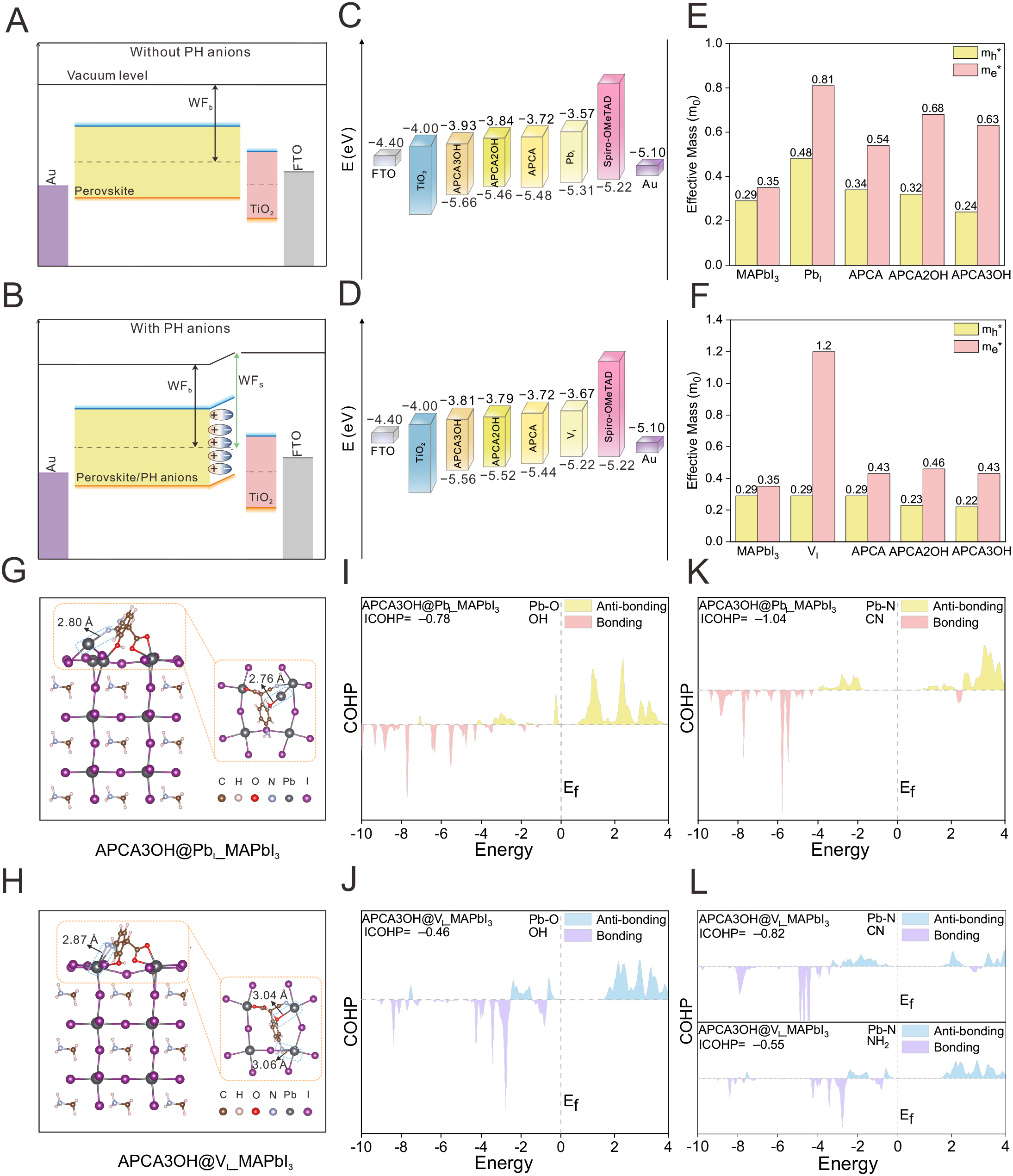
Figure 3. Simulated energy-level and work function diagrams of the surfaces (A) before and (B) after PH anion passivation. Energy-level alignment of the (C) PbI and (D) VI defective systems before and after PH anion passivation within the complete device architecture; Electron and hole effective masses of the pristine, defective, and PH-anion-passivated systems for (E) PbI and (F) VI defects; Interactions between the APCA3OH PH anion and surface Pb atoms on the defective surfaces of (G) PbI_MAPbI3 and (H) VI_MAPbI3; COHP analysis of the Pb-O interactions in (I) APCA3OH@PbI_MAPbI3 and (J) APCA3OH@VI_MAPbI3, and the Pb-N interactions in (K) APCA3OH@PbI_MAPbI3 and (l) APCA3OH@VI_MAPbI3. PH: Pseudohalide; WF: work function; COHP: crystal orbital Hamilton population; ICOHP: integrated COHP; FTO: fluorine-doped Tin oxide.