

Anion-participating solvation enables compositionally graded interphases for durable subzero lithium-ion batteries
 0
0 
Graphical Abstract
Abstract
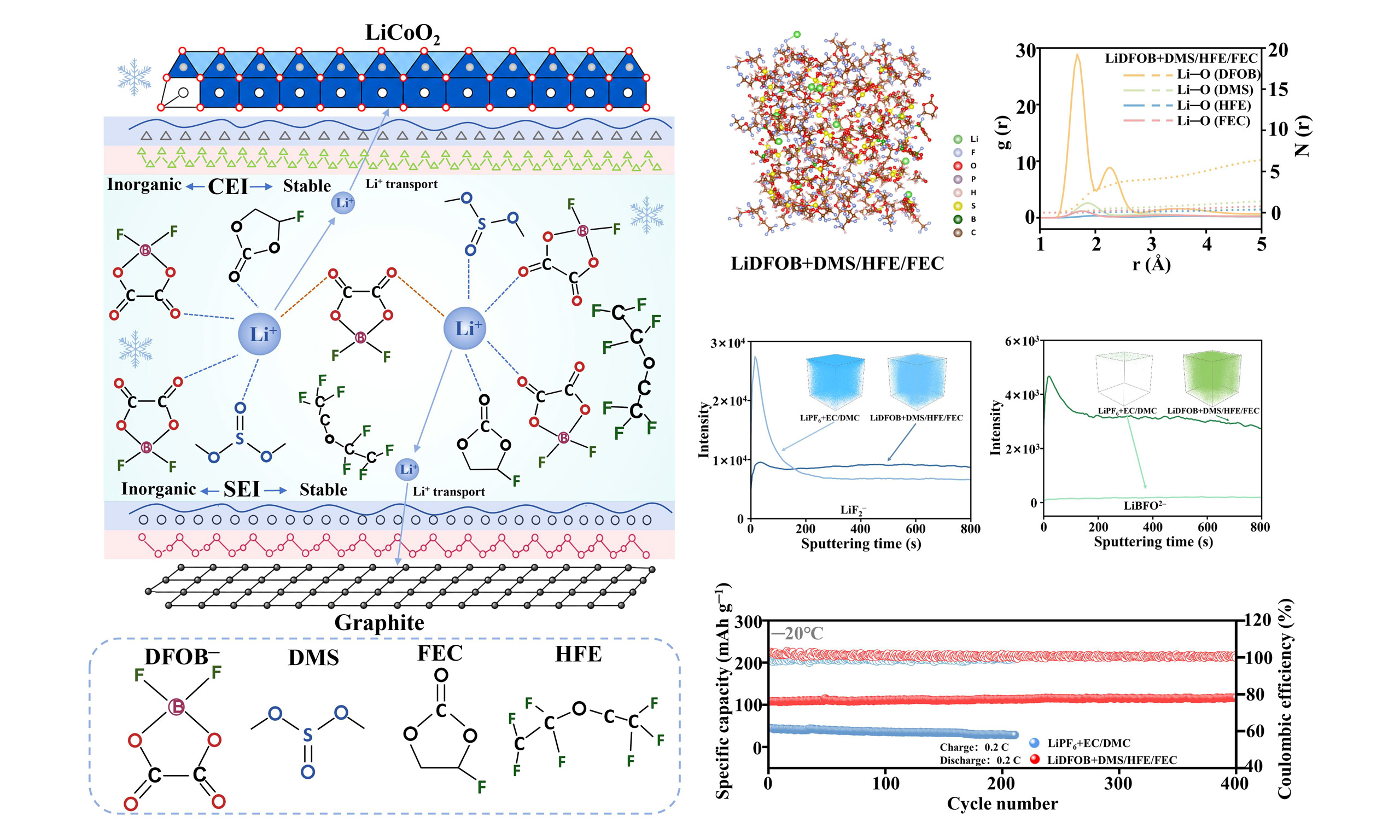
Low-temperature operation remains a critical bottleneck for lithium-ion batteries (LIBs), since the coupled limitations in Li+ transport, desolvation and interfacial stability severely undermine energy delivery and long-term cyclability. Here, rather than merely relying on low-freezing-point solvents to improve electrolyte fluidity, we design a lithium difluoro(oxalato)borate (LiDFOB)-based electrolyte combining fluoroethylene carbonate (FEC), dimethyl sulfite (DMS) and 1,1,2,2-Tetrafluoroethyl-2,2,2-trifluoroethyl ether (HFE) to simultaneously regulate the solvation structure and interfacial reactions under subzero conditions. Molecular dynamics simulations reveal that the LiDFOB + DMS/HFE/FEC electrolyte reconstructs the Li+ solvation sheath from solvent-dominated coordination in LiPF6 + ethylene carbonate/dimethyl carbonate to an anion-dominated, aggregate-rich structure. Sputtering-time-dependent X-ray photoelectron spectroscopy reveals a compositionally graded graphite solid electrolyte interphase in which LiF remains the predominant fluorine-containing species and the relative contribution of Li-O-containing species increases with continued sputtering, while total-ion-normalized time-of-flight secondary ion mass spectrometry provides complementary semiquantitative trends for selected interphase fragments. A compositionally differentiated hybrid cathode interphase containing borate-related components and reduced organic accumulation is also observed on LiCoO2. As a result, LiCoO2||Li cells using the LiDFOB-based electrolyte retain 93.77% of the initial discharge capacity after 500 cycles at 1.0 C and 25 °C. Even at -20 °C, they deliver 139.6 mAh g-1 and retain
Keywords


 Download PDF
INTRODUCTION
Lithium-ion batteries (LIBs) have become the dominant power source for portable electronics and electric vehicles, and are increasingly deployed in large-scale grid storage enabled by their high energy density and extended cycle life[1-3]. However, their widespread adoption in high-latitude regions, aerospace and high-altitude applications is severely hampered by a sharp decline in both power capability and energy efficiency at subzero temperatures[4-6]. This performance degradation originates from two coupled kinetic limitations that become increasingly severe as temperature drops, namely higher bulk electrolyte resistance that impedes ionic transport, and sluggish interfacial charge-transfer kinetics that amplify polarization and reduce accessible capacity[7]. More critically, prolonged low-temperature operation can destabilize the electrode-electrolyte interphases, leading to continuous loss of cyclable lithium and accelerating capacity decay over long cycling[8,9].
Addressing these intertwined limitations requires a holistic electrolyte design strategy that can simultaneously mitigate bulk transport resistance, reduce interfacial desolvation penalties, and construct interphases resilient enough for prolonged low-temperature operation. As temperature decreases, increased electrolyte viscosity leads to a reduction in ionic conductivity, impeding Li+ migration in the bulk electrolyte and intensifying ohmic polarization[10]. Furthermore, the Li+ desolvation process at the electrode-electrolyte interface becomes significantly hindered at low temperature because solvent and anion coordination must be disrupted prior to charge transfer and insertion, thereby imposing an activation barrier that becomes more consequential upon cooling[11,12]. Accordingly, Li+ desolvation and subsequent transport across the interphase are widely regarded as rate-limiting steps during low-temperature intercalation, particularly for graphite anodes, where Li+ must first traverse a compact solid electrolyte interphase (SEI) before insertion[13]. This dual requirement, balancing kinetics with interfacial stability, poses a fundamental challenge to conventional carbonate-based electrolytes (e.g., LiPF6 in ethylene carbonate (EC)/dimethyl carbonate (DMC)), which typically form solvent-derived, organic-rich SEI layers with limited mechanical robustness and relatively low ionic conductivity, thereby amplifying interfacial resistance and accelerating capacity loss during low-temperature cycling[14,15]. In addition, the intrinsic instability of LiPF6 further aggravates these limitations. It is highly susceptible to hydrolysis and decomposition, generating reactive species such as PF5 and HF, which not only corrode electrode surfaces but also accelerate the dissolution of transition metals from the cathode, thereby triggering degradation processes that undermine both interphase integrity and bulk electrode stability[16,17].
To mitigate these limitations, recent advances have established molecular-level electrolyte design as a powerful approach for coordinating low-temperature molecular mobility and ion-solvent interactions[18-20]. More recently, temperature-adaptive fluorine chemistry in weakly solvating sulfonamide electrolytes has promoted the formation of conductive LiFx-containing interphases and sustained lithium-metal battery operation at -30 °C[21]. Meanwhile, weakly coordinating fluorinated and sulfonamide-based solvents have been explored to reshape solvation environments toward contact ion pairs (CIP) and aggregate-rich structures, thereby promoting inorganic-rich interphases and reducing interfacial polarization during low-temperature operation[22,23]. Although these strategies improved the rate capability and energy output of LIBs at low temperature, sustaining such performance over prolonged cycling remains a formidable challenge because interfacial stability and electrode integrity become increasingly critical under these conditions. Extensive studies have demonstrated that regulating the Li+ solvation structure is an effective way to couple bulk ion transport with interphase formation, especially at low temperatures where the desolvation process and subsequent interfacial reactions increasingly govern the overall cell kinetics and stability[24]. By modulating the relative binding affinities among solvent molecules, Li+ and anions, the primary solvation sheath can be engineered to favor anion participation. This shift in coordination fundamentally alters the interfacial decomposition chemistry and can steer the SEI and cathode-electrolyte interphase (CEI) formation toward different compositional pathways[25]. Among promising lithium salts, lithium difluoro(oxalato)borate (LiDFOB) offers the borate- and fluorine-containing anion chemistry that can favor inorganic-rich interphase formation while avoiding PF6-derived reaction pathways often associated with interphase instability[26]. Importantly, the DFOB- anion exhibits a stronger tendency to coordinate with Li+ and this tendency becomes more pronounced when solvent donor strength is moderated, which promotes anion participation in the solvation sheath and can lower the reliance on solvent-dominated coordination at low temperature[27]. Furthermore, the reductive decomposition of LiDFOB can yield a hybrid inorganic matrix composed of LiF and boron-containing species (e.g., borates). Such inorganic-rich frameworks can combine mechanical resilience to withstand electrode volume changes and sufficient Li+ conductivity to facilitate interfacial charge transfer, which is particularly beneficial for stable low-temperature cycling[28,29].
Beyond lithium salt selection, the design of the solvent plays an equally pivotal role, governing the thermodynamics of Li+ solvation and dictating transport properties at low temperatures, which in turn fundamentally shapes the chemistry of the resulting interphases. Conventional carbonate solvents, owing to their strong solvating power, effectively promote salt dissociation and ensure high ionic conductivity at ambient temperature. However, this strong coordination reinforces Li+-solvent interaction within the primary solvation sheath, thereby elevating the energetic penalty for interfacial desolvation, which becomes prohibitively severe as the temperature drops[30]. By contrast, weakly coordinating solvents can attenuate Li+-solvent binding, whereas low-viscosity co-solvents can improve bulk transport, both of which become increasingly beneficial as temperature decreases[31]. Fluorinated solvents or diluents can further reshape interfacial reactivity by biasing reductive decomposition toward fluoride-rich inorganic motifs while simultaneously depressing the formulation’s freezing point to preserve fluidity[32]. Therefore, salt chemistry and solvent engineering must be integrated so that bulk conductivity, desolvation kinetics and interfacial robustness can be optimized in a cooperative manner rather than traded off independently. Nevertheless, the mechanistic linkage among anion-involved solvation, depth-dependent interphase organization in the SEI and CEI, and sustained long-term cycling stability at low temperature remains insufficiently understood. In particular, how salt chemistry and solvent coordination jointly regulate interphase composition across different depths while maintaining low-temperature electrochemical durability remains largely unexplored.
Rather than optimizing solvation or interphase chemistry in isolation, this work connects solvation regulation with depth-dependent interphase evolution and uses this coupling as a design principle for low-temperature durability. Herein, we report a rationally designed electrolyte, comprising LiDFOB as the key salt, along with FEC, DMS and HFE as co-solvents, that simultaneously addresses the coupled demands of bulk transport, interfacial kinetics and interphase stability for long-cycling, low-temperature LIBs. The choice of DMS and HFE is important because DMS helps modulate Li+ coordination and reduce the dominance of solvent-controlled interfacial reactions, while HFE preserves fluidity without strongly coordinating Li+. Meanwhile, HFE acts as an inert fluorinated diluent that preserves bulk fluidity at subzero temperatures without significantly disturbing the anion-involved solvation structure. This salt and solvent combination reshapes the Li+ solvation sheath toward stronger anion participation and steers interfacial reactions toward a graded graphite SEI enriched in LiF, Li-O-containing species, and borate-related components, together with a compositionally graded hybrid CEI on the LiCoO2 cathode. These interphase features help reconcile the inherently conflicting demands of low-temperature kinetics and long-term interfacial stability, as elucidated by systematic depth-profiling X-ray photoelectron spectroscopy (XPS) and time-of-flight secondary ion mass spectrometry (TOF-SIMS) analyses. This synergistic stabilization translates into outstanding electrochemical performance, as the LiCoO2||Li cell with a LiDFOB-based electrolyte achieves a capacity retention of 95.1% after 500 cycles at 0.2 C and -20 °C. In contrast, the conventional LiPF6-based carbonate electrolyte exhibits severe capacity degradation at -20 °C and fails much earlier during cycling. Moreover, the LiCoO2||graphite exhibits gradual activation during cycling at -20 °C, with its discharge capacity increasing from 108.1 mAh g-1 in the first cycle to 116.8 mAh g-1 after 400 cycles at 0.2 C. Collectively, these results show that solvation regulation and interphase chemistry must be engineered in a coordinated manner, since low-temperature durability is ultimately dictated by the coupled effects of Li+ solvation structure and the resultant electrode-electrolyte interphases.
EXPERIMENTAL
Electrode preparation
Commercial LiCoO2 (D50 = 6 µm, 99.5%) and graphite powder (NF-A, 99.5%) were purchased from Ningbo Chuangli New Material Technology Co., Ltd. and used as received. The LiCoO2 cathode slurry was prepared by dispersing LiCoO2 (75 wt%), poly(vinylidene fluoride) (PVDF, 15 wt%, Solef 5130, Solvay), and Super C65 carbon black (10 wt%, Imerys) in N-methyl-2-pyrrolidone (NMP) to form a homogeneous suspension. The slurry was doctor-bladed onto 18 µm aluminum foil (Showa Denko, Japan) with a wet thickness of 200 µm. Graphite anodes were fabricated by dispersing graphite powder (75 wt%), PVDF (15 wt%, Solef 5130, Solvay), and Super C65 carbon black (10 wt%, Imerys) in NMP to form a homogeneous suspension. The slurry was doctor-bladed onto copper foil with a wet thickness of 50 µm. All electrodes were dried under dynamic vacuum at 100 °C for 8 h and subsequently punched into disks (12 mm for cathodes and 14 mm for anodes) before cell assembly.
Electrolyte formulation
The LiDFOB + DMS/HFE/FEC electrolyte was formulated by dissolving 1.5 M LiDFOB (99.9%) in a mixed solvent of DMS (99%), HFE (99.8%, battery grade), and FEC (99.9%, battery grade) with a volume ratio of 5:4:1 (v/v/v). DMS and LiBF4 were purchased from Aladdin (China), while the remaining solvents were obtained from Dodo Chem Co., Ltd. (China). For comparison, a commercial carbonate electrolyte (LB-063, 1.0 M LiPF6 in EC/DMC = 3:7, v/v) was purchased from Dodo Chem Co., Ltd. (China) and used as the reference electrolyte. The detailed compositions of all electrolyte formulations investigated in this work are summarized in Supplementary Table 1. (The reported molar concentration was defined as the number of moles of lithium salt divided by the final electrolyte volume measured after complete salt dissolution at
Electrochemical measurements
CR2032-type LiCoO2||Li half cells and LiCoO2||graphite full cells were assembled in an Ar-filled glovebox (H2O and O2 < 0.01 ppm, Universal series, Mikrouna (Shanghai) Industrial Intelligent Technology Co., Ltd., China) using a PP separator (Celgard 2400). After assembly, the cells were rested for 12 h to ensure complete wetting and then equilibrated at the target temperature in a programmable chamber (-60 to 120 °C, JD-8002-80L, Dongguan Jiedong Test Equipment Co., Ltd.) before electrochemical testing. LiCoO2||Li half cells were used to evaluate the intrinsic electrochemical behavior of the LiCoO2 electrode and electrolyte compatibility. The half cells were tested within a voltage range of 2.8-4.2 V at both 25 and -20 °C. Cycling tests were performed at 1.0 C at 25 °C and 0.2 C at -20 °C based on the active LiCoO2 mass. LiCoO2||graphite full cells were assembled to evaluate practical battery performance. The graphite and LiCoO2 electrodes had active-material loadings of 0.8-1.0 and 1.6-1.8 mg cm-2, respectively. Based on nominal reversible specific capacities of approximately 300 mAh g-1 for graphite and 140 mAh g-1 for LiCoO2, these loadings corresponded to areal capacities of approximately 0.24-0.30 and 0.22-0.25 mAh cm-2, respectively. Electrodes within these loading ranges were matched to maintain a nominal N/P capacity ratio of approximately 1.1. Each full cell contained 120 μL of electrolyte. The electrolyte-to-capacity ratio of approximately
Characterization
Raman spectra were collected at -20 and 25 °C using a DXR2xi Raman spectrometer (DXR2xi, Thermo Fisher Scientific, USA) equipped with a 785 nm laser excitation. The surface morphologies of pristine and cycled electrodes were examined by a field-emission scanning electron microscope (FE-SEM, SU8220, Hitachi High-Tech Corporation, Japan). SEM images were acquired at an accelerating voltage of 5 kV and a beam current of 10 µA. XPS was performed on a VersaProbe 4 X-ray photoelectron spectrometer (PHI VersaProbe 4, ULVAC-PHI, Inc., Japan) with Al Kα radiation (1,486.6 eV) to probe surface chemical states and interphase compositions of the electrodes. Under the applied sputtering conditions, calibration against a certified Ta2O5 thin-film standard yielded a nominal Ta2O5-equivalent sputtering rate of approximately
Theoretical calculations and molecular simulations
Molecular dynamics (MD) simulations were performed using LAMMPS (2023 release). The simulation box for the LiPF6 electrolyte contained 10 LiPF6 formula units, 37 EC molecules and 71 DMC molecules. The LiDFOB-based electrolyte model consisted of 10 LiDFOB formula units, 14 FEC molecules, 26 HFE molecules and 59 DMS molecules, and all components were described using the OPLS-AA force field. Simulations were carried out at 298.15 K with a 1 fs timestep. After adequate equilibration (including density relaxation when applicable), production trajectories were collected for statistical analysis. Radial distribution function (RDF) and coordination numbers between Li+ ions and anions/solvent molecules species were computed from equilibrated production trajectories, with coordination numbers obtained by integrating RDFs to the first minimum. Accordingly, the reported values describe the average numbers of the selected atoms within the corresponding Li+ coordination shells rather than the absolute numbers of molecular species surrounding each Li+. The distribution of characteristic solvation motifs, including CIP, aggregates (AGG) and solvent-separated ion pairs (SSIP), was quantified using distance-based criteria defined from the Li+-anion RDF. The MD simulation snapshots and the representative Li+ solvation configurations shown in Supplementary Figure 1 were rendered using Visual Molecular Dynamics software. Quantum chemical calculations on the relevant electrolyte molecules were performed using Gaussian 09 to evaluate the frontier molecular orbitals. Geometry optimizations were conducted at the B3LYP/6-311+G(d,p) level, and the highest occupied molecular orbital (HOMO) and lowest unoccupied molecular orbital (LUMO) energies were extracted from the optimized structures. The corresponding frontier-orbital isosurfaces were rendered using GaussView 6.
RESULTS AND DISCUSSION
Designing low-temperature electrolytes for LIBs necessitates a synergistic balance among low viscosity, depressed freezing/melting points, high ionic conductivity and sufficient salt dissociation. Molecular orbital energy calculations [Figure 1A] indicate that LiDFOB and FEC possess comparatively LUMO energies compared to the other electrolyte components, suggesting that they are more susceptible to reduction and can preferentially initiate interphase formation on the anode during initial cycles. Such preferential reduction is expected to form an inorganic-enriched SEI that facilitates rapid Li+ transport and effectively passivates the anode against continuous electrolyte decomposition. Conversely, HFE exhibits a low-lying HOMO together with a relatively high LUMO, confirming its enhanced oxidative and reductive stability, which supports its function as an electrochemically inert diluent in the formulation. Simultaneously, the very low freezing points of DMS (-114 °C) and HFE
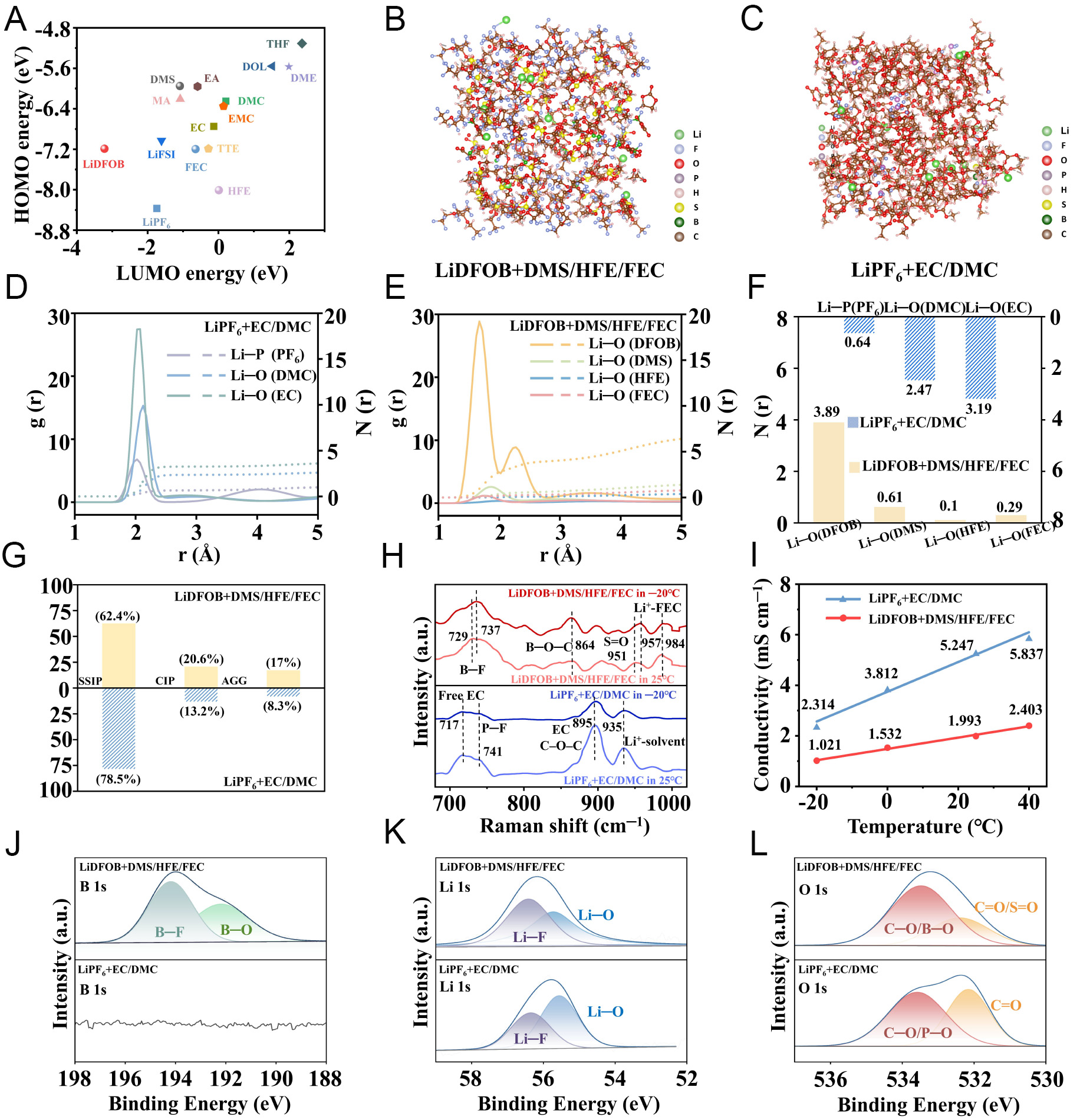
Figure 1. (A) Calculated HOMO and LUMO energy levels of the main electrolyte components. (B and C) MD simulation snapshots of Li+ solvation structures. RDFs of (D) LiPF6 + EC/DMC and (E) LiDFOB + DMS/HFE/FEC electrolytes. (F) Coordination numbers of LiDFOB + DMS/HFE/FEC and LiPF6 + EC/DMC electrolytes. (G) The percentages of SSIPs, CIPs, and AGGs. (H) Raman spectra of both electrolytes at different temperatures. (I) Ionic conductivity as a function of temperature. (J-L) B 1s, Li 1s and O 1s XPS spectra of vacuum-treated electrolyte-derived residue films prepared from the two formulations.
Consistent with the RDF trends, ion-pair speciation statistics further reveal distinct solvation states for the two electrolytes [Figure 1G and Supplementary Figure 1]. Specifically, the LiDFOB + DMS/HFE/FEC formulation manifests increased proportions of CIPs (increased by 1.56 times) and aggregated ion clusters (AGG, increased by 2.05 times), accompanied by a concomitant decrease in SSIPs from 78.5% to 62.4%, compared to the baseline carbonate electrolyte. These speciation changes suggest more anion-associated Li+ species and fewer free solvent molecules, which can alleviate solvent-dominated interfacial kinetics and support improved low-temperature performance. Figure 1H compares the temperature-dependent Raman spectra of the two electrolytes and reveals a distinct evolution of Li+ solvation and ion-association structures upon cooling. At 25 °C, the Raman spectrum of the LiDFOB + DMS/HFE/FEC electrolyte exhibits characteristic bands at 729 cm-1 (attributed to B-F vibration from DFOB-) and 951 cm-1 (assigned to the S=O-related mode of DMS)[35], together with additional features in the 850 to 1,000 cm-1 region. As the temperature decreases, both bands shift to higher wavenumbers, from 729 to 737 cm-1 and from 951 to
To compare the chemical compositions retained after evacuation, XPS measurements were performed on residue films derived from the LiDFOB + DMS/HFE/FEC and LiPF6 + EC/DMC formulations using identical deposition, airtight transfer, and XPS load lock evacuation procedures. The survey spectra reveal clear formulation-dependent differences in the elemental signatures retained in the resulting residue films [Supplementary Figure 7]. In the residue film derived from the LiDFOB-based electrolyte, the B 1s spectrum contains two components centered at 194.2 eV (assigned to a B-F environment, indicative of fluoroborate-like motifs) and 192.1 eV (assigned to a B-O environment, consistent with borate/oxalate-derived species) [Figure 1J], consistent with the presence of boron-containing species originating from the LiDFOB salt. As expected, no B 1s signal is detectable in the residue film derived from the B-free LiPF6 + EC/DMC formulation, confirming the specificity of the boron features to the LiDFOB-based formulation. The Li 1s spectra of both residue films can be deconvoluted into two peaks located at 55.5 and 56.3 eV, corresponding to Li-O and Li-F-related chemical states, respectively [Figure 1K]. However, the relative contribution of the Li-F component is markedly greater in the residue film derived from LiDFOB + DMS/HFE/FEC. This enhancement indicates a higher relative abundance of Li-F-related species retained in the LiDFOB-based residue film after vacuum treatment and provides complementary information regarding the distinct chemical compositions of the two formulations. In the O 1s spectra [Figure 1L], the LiDFOB-based residue film displays components near 532.3 and 533.5 eV that can be assigned to C=O or S=O and C-O or B-O environments, respectively, whereas the relative C=O contribution is markedly suppressed. This suppression of the carbonyl signal reflects the distinct oxygen-containing chemical states retained from the LiDFOB-based formulation after vacuum treatment. Collectively, these spectroscopic signatures demonstrate formulation-dependent differences in the chemical states retained within the electrolyte-derived residue films and complement the solvation trends independently revealed by MD simulations and Raman spectroscopy.
To evaluate the performance of the two electrolytes at both room and low temperatures, LiCoO2||Li cells were assembled and their electrochemical profiles at 25 and -20 °C were systematically compared.
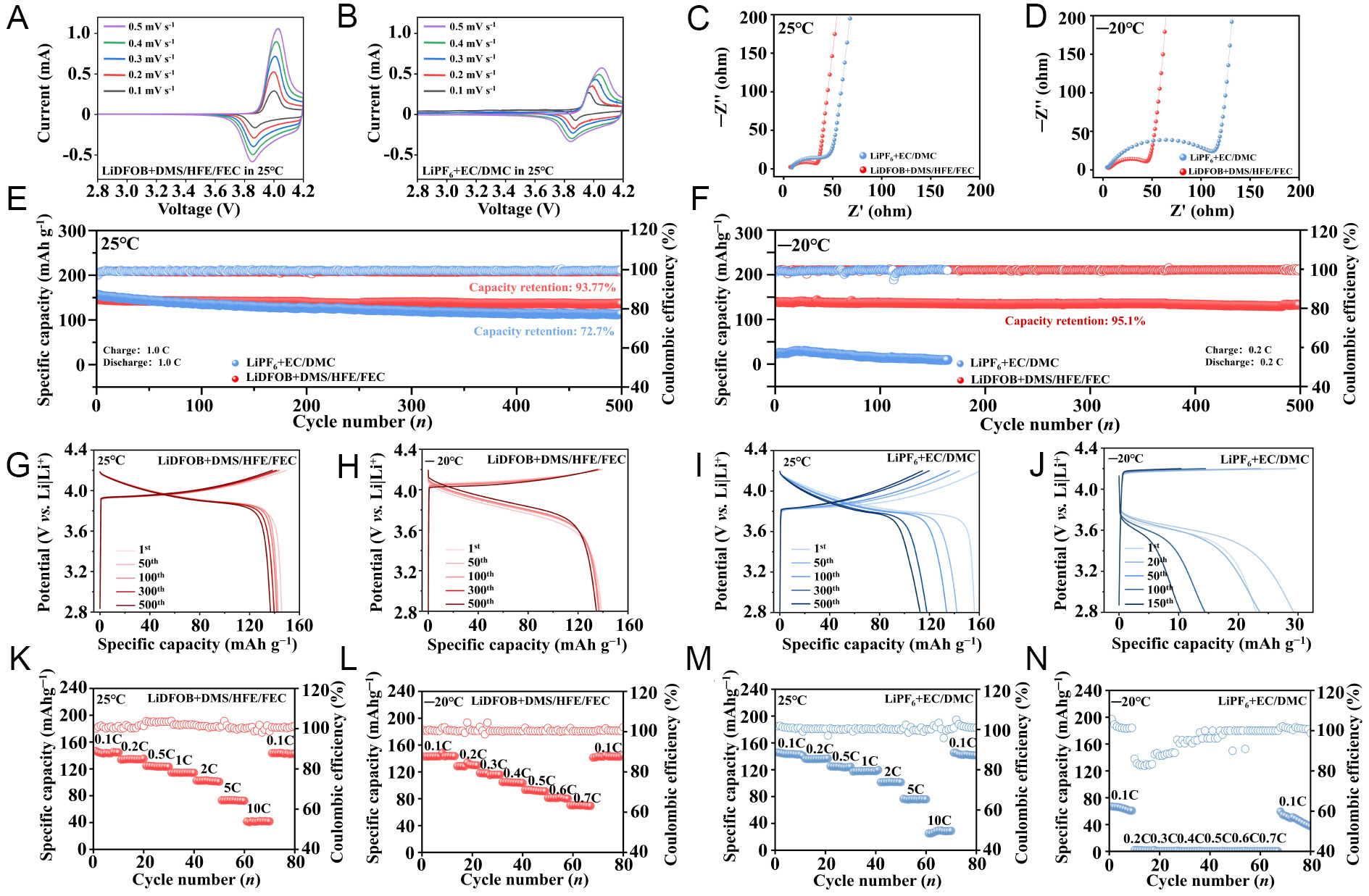
Figure 2. CV curves at 25 °C with different scan rates of (A) LiDFOB + DMS/HFE/FEC and (B) LiPF6 + EC/DMC electrolytes. Nyquist plots at (C) 25 °C and (D) -20 °C. Long-term cycling performance of LiCoO2||Li cells with different electrolytes at (E) 25 °C and (F) -20 °C.
As depicted in Figure 2G and H, the LiDFOB + DMS/HFE/FEC electrolyte exhibits highly overlapping galvanostatic charge/discharge curves during cycling at both 25 and -20 °C, with only minor shifts in plateau voltage and limited polarization growth. In contrast, the LiPF6 + EC/DMC system shows an evident downward shift and broadening of the discharge plateaus with cycling in Figure 2I and J, suggesting aggravated kinetic limitations and gradual degradation of the interfacial layer. Particularly under low-temperature conditions, the carbonate-based electrolyte struggles to maintain stable and reversible plateaus, showing a significant voltage drop that reflects severely impeded interfacial kinetics upon cooling in the solvent-dominated solvation environment. This improved plateau stability and lower polarization with LiDFOB + DMS/HFE/FEC can be attributed to a more robust inorganic-rich interphase that provides persistent Li+ transport pathways, consistent with its anion-involved coordination environment. Rate capability assessments at room temperature [Figure 2K] demonstrate that the LiDFOB + DMS/HFE/FEC system enables reversible capacities of 144.8, 134.7, 123.5, 114.1, 102.1, 72.6 and 46.4 mAh g-1 at current rates of 0.1 C, 0.2 C, 0.5 C, 1 C, 2 C, 5 C and 10 C, respectively. Upon returning the current to 0.1 C after high-rate cycling, the capacity recovers to 143.4 mAh g-1 with 99.03% capacity retention relative to the initial value, underscoring the excellent reversibility of the electrode processes and the structural integrity of the interphase under the designed electrolyte.
The rate performance of the LiDFOB + DMS/HFE/FEC electrolyte remains favorable under low-temperature conditions [Figure 2L]. At -20 °C, the cell maintains a reversible capacity of approximately 70.6 mAh g-1 even at 0.7 C. When the current rate is restored to 0.1 C, the capacity recovers to 98.91% of its initial value, demonstrating the preserved reversibility of Li+ transport and interfacial reaction processes under subzero conditions. For comparison, the LiPF6 + EC/DMC electrolyte exhibits comparable rate performance at 25 °C [Figure 2M], confirming that both electrolyte systems provide sufficient ionic transport under ambient conditions. However, a pronounced difference emerges at -20 °C [Figure 2N], where the LiPF6 + EC/DMC cell suffers from severe kinetic limitations and cannot sustain stable operation even at a moderate rate of
Prior to the final electrolyte selection, different LiDFOB-based solvent combinations were compared in LiCoO2||Li cells at -20 °C [Supplementary Figure 12], among which the LiDFOB + DMS/HFE/FEC formulation delivered the most stable cycling behavior and was therefore selected for subsequent systematic investigation. To establish a more comprehensive comparison and further highlight the low-temperature advantages of the designed LiDFOB + DMS/HFE/FEC electrolyte, a LiBF4-based electrolyte, commonly used as a low-temperature reference salt system[36], was evaluated under identical test conditions.
Beyond subzero operation, we further assessed the high-temperature performance of various electrolyte systems. Supplementary Figure 17 displays the cycling stability of LiCoO2||Li cells operated at 40 °C using LiDFOB + DMS/HFE/FEC and LiPF6 + EC/DMC electrolytes. The LiDFOB-based electrolyte enables highly stable cycling behavior at 40 °C, maintaining a discharge capacity of about 122.9 mAh g-1 after 200 cycles at 1.0 C, equivalent to 100% capacity retention relative to its first discharge profile, with Coulombic efficiency consistently near 100% throughout. In contrast, the LiPF6 + EC/DMC electrolyte suffers from rapid capacity fading at 40 °C, with the discharge capacity continuously dropping from 125.5 mAh g-1 to below 44.6 mAh g-1 after 200 cycles, translating to a mere 35.5% capacity retention. The divergence in cycling stability is further corroborated by the evolution of the corresponding galvanostatic charge/discharge profiles. For the LiDFOB + DMS/HFE/FEC cell, the charge and discharge profiles remain nearly perfectly overlapped from the 1st to the 200th cycle, showing negligible polarization growth and well-preserved voltage plateaus
To elucidate the role of electrolyte chemistry in governing electrode/electrolyte interphase evolution, post-cycling morphological and surface chemical analyses were performed on both composite LiCoO2 cathodes and Li metal anodes recovered from cells employing the different electrolyte formulations. As shown in Figure 3A and B, compared with the pristine LiCoO2 particles, the LiCoO2 cathode cycled in the LiDFOB + DMS/HFE/FEC system retains a relatively smooth and dense surface morphology, coated with a thin and conformal passivation layer. This morphology suggests a more uniform and compact interphase that can promote homogeneous Li+ flux across the electrode surface and reduce localized current concentration, which in turn helps mitigate parasitic reactions at the electrode-electrolyte interface. The apparent continuity and conformality of this interphase further imply enhanced mechanical integrity and chemical stability, both of which are critical for maintaining intimate electrode/electrolyte contact and accommodating volume fluctuations during repeated Li+ insertion/extraction. In contrast, the LiCoO2 cathode cycled in LiPF6 + EC/DMC electrolyte shows irregular granular deposits and a more porous, heterogeneous surface
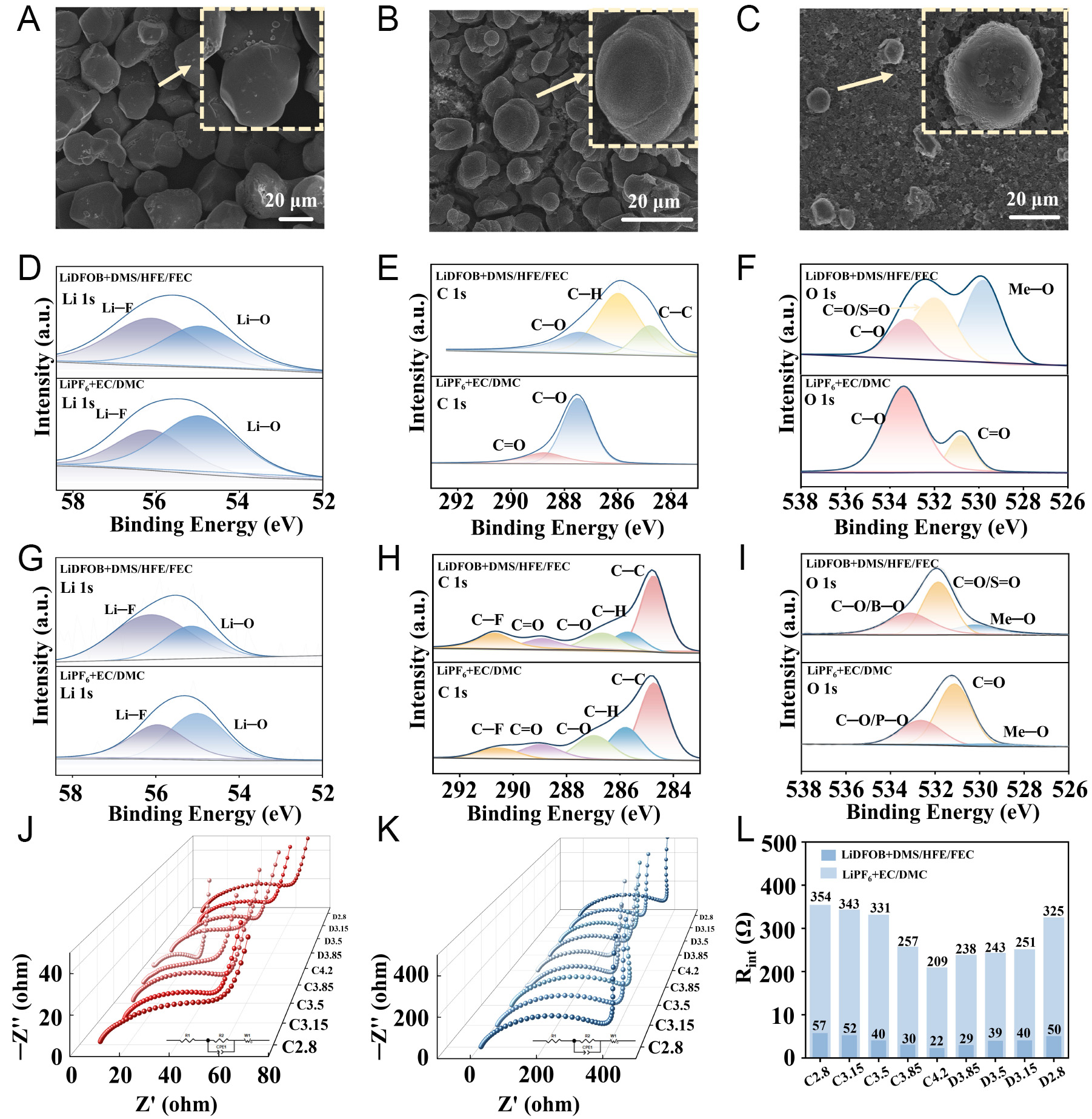
Figure 3. SEM images of (A) pristine LiCoO2, (B) cycled LiCoO2 electrode collected from cell operated in LiDFOB + DMS/HFE/FEC and (C) LiPF6 + EC/DMC electrolyte. High-resolution XPS spectra of Li anodes after cycling in both electrolytes: (D) Li 1s, (E) C 1s and (F) O 1s. High-resolution XPS spectra of LiCoO2 cathode after cycling in both electrolytes: (G) Li 1s, (H) C 1s and (I) O 1s. Nyquist plots of LiCoO2||Li cell recorded with (J) LiDFOB + DMS/HFE/FEC and (K) LiPF6 + EC/DMC electrolytes. (L) Comparison of Rint values extracted by equivalent circuit fitting based on the EIS spectra.
XPS profiling reveals fundamentally distinct interphase chemical compositions dictated by electrolyte speciation. Figure 3D presents the high-resolution Li 1s spectra of the cycled Li-anode surfaces. In the Li 1s region, the anode cycled in the LiDFOB + DMS/HFE/FEC electrolyte exhibits a dominant LiF signal at
Complementing the anode analysis, XPS was also performed on the LiCoO2 cathodes recovered after cycling to probe the chemical composition of CEI formed in each electrolyte. The Li 1s signal detected on the cathode surface [Figure 3G] is weaker than on the anode, consistent with distinct interphase chemistries, namely an oxidation-derived CEI on the cathode versus reduction-derived products that enrich LiF on the Li-metal anode. Deconvolution of the C 1s spectra [Figure 3H] resolves five distinct components at binding energies of 284.8, 285.8, 287.0, 288.9, and 290.7 eV, which are assigned to C-C, C-H, C-O, C=O and C-F-related species, respectively. Compared with LiDFOB + DMS/HFE/FEC, the LiPF6 + EC/DMC electrolyte shows stronger oxygenated carbon contributions in the C 1s spectra, consistent with a higher fraction of carbonate-derived organic species on the cathode surface. The O 1s spectrum of the cathode cycled in LiDFOB + DMS/HFE/FEC shows additional components, including a C-O/B-O contribution and an O=S-related feature[39], that are much less evident in LiPF6 + EC/DMC [Figure 3I], suggesting the incorporation of borate- and sulfur-containing oxygen environments from DFOB- and DMS into the CEI. This assignment is further supported by the corresponding high-resolution B 1s spectra as shown in
Figure 3J and K displays the Nyquist plots of LiCoO2||Li cells collected at selected charge and discharge voltages from 2.8 to 4.2 V at -20 °C. Across the entire voltage window, the semicircles in the Nyquist plots for the LiDFOB + DMS/HFE/FEC cell are substantially smaller than those for the LiPF6 + EC/DMC cell, indicating a consistently lower Rint for the designed electrolyte across all measured states. Equivalent-circuit fitting summarized in Figure 3L quantifies this difference clearly. The LiDFOB + DMS/HFE/FEC cell exhibits Rint values ranging from approximately 22 to 57 Ω depending on the applied voltages, whereas the LiPF6 + EC/DMC cell shows substantially higher Rint values ranging from 209 to 354 Ω under identical conditions, corresponding to approximately 6.2-9.5 times higher resistance than the LiDFOB-based electrolyte. These observations are consistent with the impedance results in Figure 2C and D, which demonstrated that the LiDFOB + DMS/HFE/FEC electrolyte not only exhibits lower Rint but also maintains a weaker temperature dependence of its interfacial kinetics. This persistently lower resistance also aligns with the XPS results, which showed a LiF-rich and inorganic-dominant SEI on the Li-metal anode together with a boron/ sulfur-containing hybrid CEI on the LiCoO2 cathode in LiDFOB + DMS/HFE/FEC. Such interphases can help stabilize both electrode surfaces and preserve more favorable Li+ transport pathways across the electrode-electrolyte interfaces, thereby alleviating kinetic limitations. Moreover, the anion-involved and aggregate-rich solvation structure elucidated by MD simulations and Raman spectroscopy is expected to mitigate solvent-dominated interfacial limitations and facilitate Li+ transport across the electrode/electrolyte interfaces, which is consistent with the improved charge-transfer kinetics observed under high-rate and subzero-temperature conditions, as evidenced by the EIS and rate capability measurements.
To extend the investigation to a more practical configuration and elucidate the role of electrolyte chemistry in governing the performance of LiCoO2||graphite full cells, post-cycling morphology and surface chemical analyses were conducted on electrodes cycled at -20 °C and disassembled at 0% state of charge. As shown in Figure 4A-C, graphite anodes cycled in the two electrolytes exhibit markedly different surface textures, highlighting the profound impact of electrolyte formulation on the integrity and uniformity of the anode interphase. The pristine graphite anode displays a typical stacked flake-like morphology with well-defined sharp edges and a relatively clean, smooth surface, providing a clear baseline without obvious surface deposits or morphological damage. In comparison, the graphite anode cycled in the LiDFOB + DMS/HFE/FEC electrolyte largely retains a recognizable flake-like morphology with clearly discernible particle boundaries together with only sparse fine deposits. The preservation of the underlying flake morphology and the absence of extensive cracking or exfoliation suggest limited mechanical degradation of the graphite particles. This observation confirms that the uniform, inorganic-rich interphase formed in this electrolyte effectively protects the anode structure during repeated Li+ insertion/extraction, mitigating the volume change-induced stress that often plagues graphite electrodes. In contrast, the graphite anode cycled in the LiPF6 + EC/DMC electrolyte shows much rougher surface coverage that obscures the native flake texture, together with agglomerated deposits and blurred particle edges. Such morphology suggests a more heterogeneous anode interphase and more severe parasitic reactions, which can promote local resistance buildup and accelerate the loss of effective active surface during cycling.
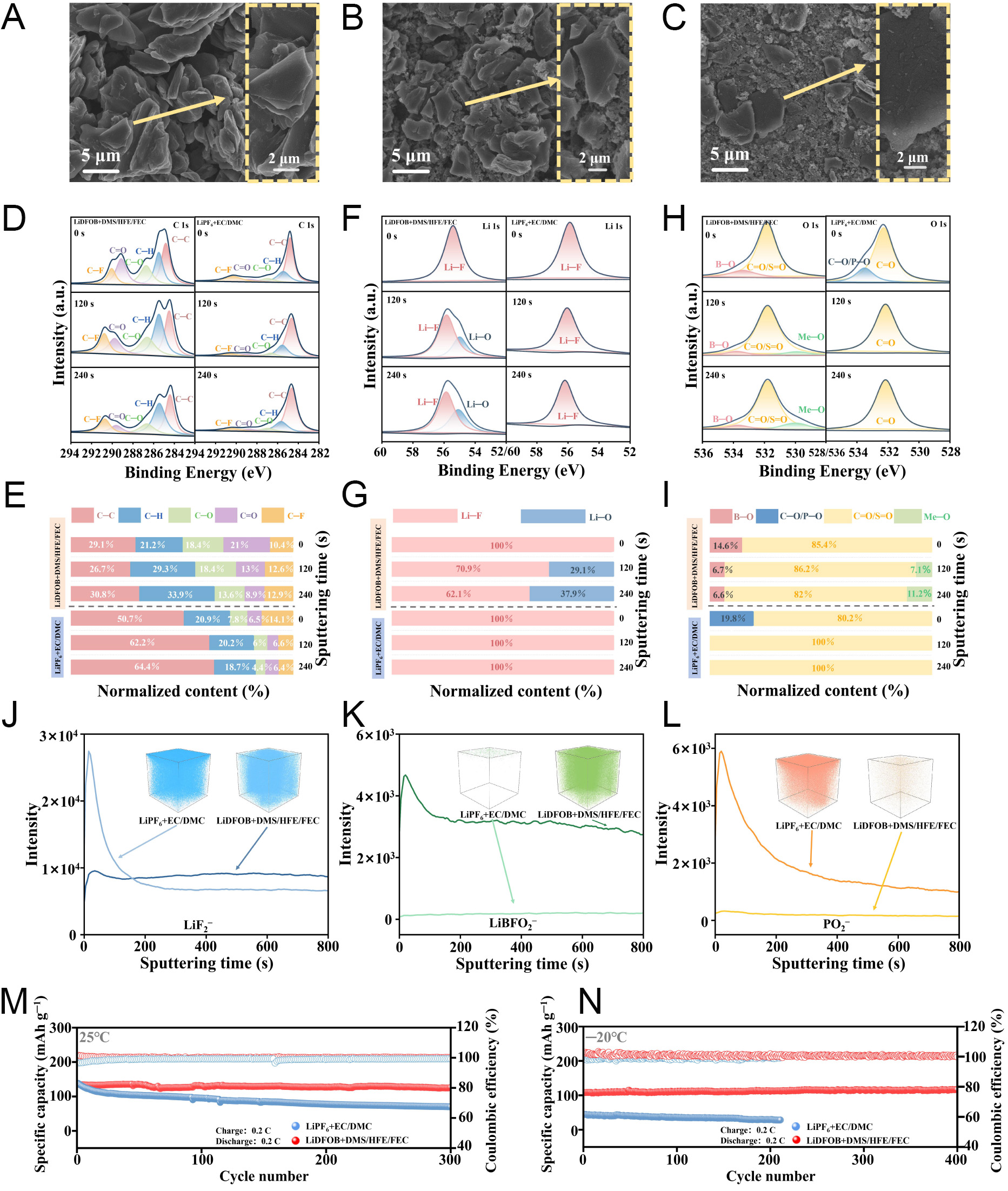
Figure 4. SEM images of (A) pristine graphite anode and cycled graphite anodes in (B) LiDFOB + DMS/HFE/FEC and (C) LiPF6 + EC/DMC electrolytes. Depth-profiling XPS spectra of the graphite anode at different sputtering times: (D) C 1s, (F) Li 1s and (H) O 1s regions. Normalized relative contents of representative chemical bonds of graphite anodes as a function of sputtering time: (E) C 1s, (G) Li 1s and (I) O 1s. The 3D TOF-SIMS rendering images and corresponding sputtering-time profiles using different electrolytes: (J) LiF2-, (K) LiBFO2- and (L) PO2-. Long-term cycling performance of LiCoO2||graphite cells with different electrolytes (M) at 25 °C and (N) at -20 °C.
Sputtering-time-dependent XPS was used to examine the compositional evolution of the SEI formed on the cycled graphite anodes at sputtering times of 0, 120 and 240 s. Since sputtering-time-dependent XPS mainly reflects the relative chemical states exposed after sequential ion etching, the following discussion focuses on the compositional evolution within the probed depth region rather than an absolute layer-by-layer reconstruction of the SEI. As shown in Figure 4D, the C 1s spectra can be deconvoluted into components at 284.8, 285.5, 286.7, 289.2 and 290.1 eV, which are assigned to C-C, C-H, C-O, carbonyl-related species and C-F-related species, respectively, while the 284.8 eV contribution can also include graphitic carbon from the substrate. In the LiDFOB + DMS/HFE/FEC system, the relative contribution of C-C species remains lower than that in the LiPF6 + EC/DMC electrolyte throughout the sputtering process. According to Figure 4E, it stays in the range of 29.1%, 26.7% and 30.8% at 0, 120 and 240 s, respectively, for LiDFOB + DMS/HFE/FEC, compared with 50.7%, 62.2%, and 64.4% for LiPF6 + EC/DMC at the same sputtering times. Coupled with the concurrently more intense signals from oxygenated and fluorinated species in the LiDFOB + DMS/HFE/FEC-derived SEI, this trend suggests that the graphite interphase is less dominated by hydrocarbon-like carbon. At the corresponding sputtering times, the LiPF6 + EC/DMC-derived SEI exhibits a larger relative C-C contribution and smaller relative fractions of oxygenated and fluorinated components. Meanwhile, when combined with the weaker oxygenated and fluorinated contributions, the overall profile is consistent with a less uniform and less effectively passivating SEI on graphite along with the continued electrolyte decomposition upon cycling. Complementary TOF-SIMS measurements were used to examine the sputtering-time-dependent evolution of representative fragments within each sample, which provide semi-quantitative depth-dependent distributions of representative organic fragments across the SEI rather than relying only on the outermost surface signal. As shown in Supplementary Figure 22, the total-ion-normalized C2H5O- signal in the LiDFOB + DMS/HFE/FEC-derived interphase, taken here as a representative solvent-derived organic species[40], is relatively pronounced during the initial sputtering stage and attenuates rapidly with continued sputtering, consistent with a predominantly surface-associated contribution within this sample. In the LiPF6 + EC/DMC-derived interphase, the normalized C2H5O--related signal attenuates more gradually and remains detectable over a longer sputtering interval within that sample, indicating that solvent-derived organic species remain detectable over a larger sputtering depth within the interphase. This behavior reflects a less sharply stratified SEI and a weaker separation between an organic-rich outer region and a more passivating inner layer.
The sputtering-time-dependent Li 1s spectra [Figure 4F] further reveal changes in the relative contributions of lithium-containing species over the probed sputtering interval, complementing the C 1s analysis and serving as a bridge to the subsequent discussion of the O 1s spectra. In the SEI formed in the LiDFOB + DMS/HFE/FEC electrolyte, LiF remains the predominant lithium-containing species within the probed sputtering depth, whereas the relative proportion of the Li-O fraction increases progressively with depth from 0% at the surface (0 s) to 29.1% after 120 s of sputtering and further to 37.9% at 240 s [Figure 4G]. This depth-dependent compositional evolution reveals a well-stratified SEI architecture in which LiF is present from the outer surface to the interior, while Li-O-containing species become increasingly prominent toward the inner region. Such a vertically graded structure, featuring a continuous distribution of inorganic species throughout the probed depth, is characteristic of a stable, effectively passivating interphase that can facilitate uniform Li+ transport and withstand repeated cycling. The depth-dependent F 1s spectra in
Complementing the XPS depth profiling, TOF-SIMS analysis of the LiF2- fragment was performed to further evaluate the depth distribution of LiF-related inorganic species within the SEI. For the LiPF6 + EC/DMC-derived SEI, the apparent increase in the relative LiF contribution after sputtering mainly arises from the rapid attenuation of surface-enriched organic fluorinated species, such as C-F, rather than from an absolute enrichment of LiF in the inner SEI. This interpretation is supported by the TOF-SIMS result in Figure 4J, where the LiF2- signal decreases rapidly with sputtering time, indicating that LiF-related species are mainly concentrated in the outer region and become progressively depleted toward the inner SEI. This attenuation is consistent with a less persistent LiF-related fragment response during sputtering, rather than a depth-persistent LiF-rich inorganic framework. In contrast, the LiDFOB + DMS/HFE/FEC-derived SEI maintains a much more stable LiF2- signal throughout the sputtering process, demonstrating that LiF-related inorganic species are more uniformly distributed across the SEI. Such a continuous LiF-containing framework can provide more effective interfacial passivation and mechanically robust Li+ transport pathways, thereby contributing to the improved low-temperature cycling stability. Moreover, the anion-specific TOF-SIMS signals in Figure 4K and L indicate markedly different anion-derived contributions to SEI formation on graphite for the two electrolytes. In LiDFOB + DMS/HFE/FEC, the LiBFO2- signal remains comparatively elevated and persists over the sputtering duration, indicating that borate-related species derived from the anion are not merely surface-adsorbed but are integrally incorporated into the SEI matrix, forming a continuous, depth-persistent inorganic framework that reinforces the interphase. By contrast, LiPF6 + EC/DMC system shows a markedly stronger PO2--related signal, consistent with phosphorus-containing species generated from LiPF6-derived decomposition chemistry. The progressive decrease of this signal with sputtering time suggests that phosphorus-containing species are enriched near the outer surface and become much less abundant at greater depth, rather than forming a depth-persistent inorganic network. This spatial confinement is consistent with more heterogeneous interphase formation in LiPF6 + EC/DMC, which in turn is associated with weaker passivation and reduced interfacial stability on graphite during prolonged cycling. The depth-resolved XPS results for the cycled LiCoO2 cathode further clarify the electrolyte-dependent compositional evolution of the cathode interphase in the two electrolyte systems. The C 1s depth profiles
Together, this cathode interphase architecture and the robust graphite-anode SEI establish synergistic stabilization of both electrode-electrolyte interfaces, collectively supporting the exceptional low-temperature durability and long-term cycling stability demonstrated by the LiDFOB + DMS/HFE/FEC-based full cells. The long-term cycling stability of LiCoO2||graphite full cells was evaluated both at 25 and -20 °C to validate the practical effectiveness of the designed electrolyte under realistic operating conditions
CONCLUSIONS
In summary, this work develops a LiDFOB-based electrolyte for low-temperature LIBs through the coordinated regulation of solvation structure and anion-involved interfacial chemistry. Unlike conventional low-temperature electrolyte designs that mainly focus on improving bulk ionic conductivity or solvent fluidity, this work identifies anion-participating Li+ solvation as a molecular-level handle to regulate the depth-dependent chemistry of both anode and cathode interphases. By rationally integrating the low-freezing-point polar co-solvent DMS, the fluorinated diluent HFE and FEC as a film-forming additive, the Li+ coordination environment was effectively modulated toward anion participation in the primary solvation sheath, which can alleviate solvent-dominated interfacial desolvation under subzero conditions. Spectroscopic and electrochemical analyses consistently support this underlying mechanism. Depth-resolved XPS results reveal a graded inorganic organization within the graphite SEI, in which LiF persists through the probed depth, Li-O-containing species become more prominent inward, and borate-related species are enriched mainly in the outer to middle regions. Complementary TOF-SIMS depth profiling further shows that borate-related fragments remain detectable through a substantial fraction of the interphase depth in the LiDFOB-based electrolyte, in contrast to the less clearly stratified and more organic-rich SEI formed in LiPF6 + EC/DMC. This graded inorganic framework can help suppress continued parasitic reactions and improve the stability of the graphite interface. Electrochemically, LiCoO2||Li cells employing the LiDFOB + DMS/HFE/FEC electrolyte deliver markedly enhanced cycling stability at -20 °C. Notably, the LiCoO2||Li cell using the LiDFOB + DMS/HFE/FEC electrolyte retains 95.1% of its initial discharge capacity after 500 cycles at -20 °C and 0.2 C. Under the same temperature and rate conditions, the LiPF6 + EC/DMC cell delivers an initial discharge capacity of only 30.2 mAh g-1 and retains 32.8% of this initial value before failing within 200 cycles, whereas the LiBF4-based reference retains approximately 89.5% of its initial capacity after 500 cycles. Meanwhile, the improved rate capability and reduced polarization further support faster interfacial Li+ transport and alleviated solvent-dominated kinetic limitations. At -20 °C, the LiDFOB + DMS/HFE/FEC full cell shows an initial discharge capacity of 108.1 mAh g-1 and evolves to a stable capacity of
DECLARATIONS
Authors’ contributions
Performed experiments and wrote the manuscript: Peng, S.
Participated in study design: Zhang, B.; Zhao, Z.; Shi, M.; Li, X.; Xiao, B.; Gu, X.; Zhi, M.; Chubenko, E.; Bondarenko, V.; Bandarenka, H.; Pan, Y.; Hua, S.
Revised and edited the manuscript: Yin, Q.; Li, Z.
Secured funding and conducted the review: Sui, Y.
Availability of data and materials
The original contributions presented in this study are included in the article and Supplementary Materials. Further inquiries can be directed to the corresponding authors upon reasonable request.
AI and AI-assisted tools statement
During the preparation of this manuscript, the AI tool ChatGPT (version GPT-5.6) was used solely for language editing under full author supervision. The tool did not influence the study design, data collection, analysis, interpretation, or the scientific content of the work. All authors take full responsibility for the accuracy, integrity and final content of the manuscript.
Financial support and sponsorship
This work was supported by the National Key R&D Program of China (2024YFE0108500) and the Fundamental and Interdisciplinary Disciplines Breakthrough Plan of the Ministry of Education of China (JYB2025XDXM308).
Conflicts of interest
Pan, Y. and Hua, S. are affiliated with Guoneng Nanjing Electric Power Testing and Research Co., Ltd., while the other authors have declared that they have no conflicts of interest.
Ethical approval and consent to participate
Not applicable.
Consent for publication
Not applicable.
Copyright
© The Author(s) 2026.
Supplementary Materials
REFERENCES
1. Wei, Y.; Wang, M.; Zhang, M.; Cai, T.; Huang, Y.; Xu, M. Advancements, challenges, and future trajectories in advanced battery safety detection. Electrochem. Energy. Rev. 2025, 8, 10.
2. Tang, Y.; Yang, Y.; Pan, M.; et al. Critical review of thermal reduction processes for sustainable recovery of valuable metals from cathode materials in spent lithium-ion batteries. Adv. Funct. Mater. 2025, 36, e13322.
3. Liu, Y.; Zhao, Y.; Liu, J.; et al. High-entropy safe electrolyte toward industrial-level lithium-ion battery. Energy. Storage. Mater. 2025, 83, 104744.
4. Meng, F.; Li, Y.; Wang, S.; et al. Grain-boundary-rich cathode enabling fast ion diffusion kinetics for low-temperature and high-rate lithium-ion batteries. Energy. Environ. Sci. 2025, 18, 4775-86.
5. Xiong, Z.; Meng, F.; Chen, J.; Yang, Z.; Hu, R.; Zhu, M. Electrolyte modulation strategies towards cathode-electrolyte interphase engineering in subzero-temperature lithium-ion batteries. Rev. Mater. Res. 2025, 1, 100012.
6. Fan, X.; Ji, X.; Chen, L.; et al. All-temperature batteries enabled by fluorinated electrolytes with non-polar solvents. Nat. Energy. 2019, 4, 882-90.
7. Sun, J.; Yao, Y.; Cui, X.; et al. Improving low-temperature tolerance of a lithium-ion battery by a localized high-concentration electrolyte based on the weak solvation effect. Battery. Energy. 2025, 4, e20240106.
8. Qu, Y.; Su, C.; Wang, L.; et al. Interface engineered electrolyte design strategy for ultralong-cycle solid-state lithium batteries over wide temperature range. Angew. Chem. Int. Ed. 2025, 64, e202506731.
9. Huang, R.; Wei, G.; Wang, X.; et al. Revealing the low-temperature aging mechanisms of the whole life cycle for lithium-ion batteries (nickel-cobalt-aluminum vs. graphite). J. Energy. Chem. 2025, 106, 31-43.
10. Cheng, M.; Chen, A.; Zhang, Z.; Sheng, C.; Zhou, H.; He, P. Regulating lithium intercalation/plating competition to enhance low-temperature performance of Li-ion batteries. J. Am. Chem. Soc. 2025, 147, 40776-87.
11. Lei, Y.; Xu, X.; Yin, J.; et al. Regulating Li-ion solvation structure and electrode-electrolyte interphases via triple-functional electrolyte additive for Lithium-Metal batteries. Chem. Eng. J. 2024, 497, 154927.
12. Piao, Z.; Gao, R.; Liu, Y.; Zhou, G.; Cheng, H. M. A review on regulating Li+ solvation structures in carbonate electrolytes for lithium metal batteries. Adv. Mater. 2023, 35, 2206009.
13. Zhang, X.; Zhao, D.; Quan, Y.; et al. A solid-liquid hybrid electrolyte with weak-solvated solvent to reduce Li+ transfer barrier at electrode and solid electrolyte interphase. Battery. Energy. 2025, 4, e70042.
14. Song, G.; Yi, Z.; Su, F.; et al. Boosting the low-temperature performance for Li-ion batteries in LiPF6-based local high-concentration electrolyte. ACS. Energy. Lett. 2023, 8, 1336-43.
15. Xia, Y.; Zhu, D.; Hou, W.; et al. Rational lithium salt selection principle for designing high-entropy electrolytes toward high-performance lithium metal batteries. J. Am. Chem. Soc. 2026, 148, 3538-50.
16. Zhao, D.; Ding, M.; Tao, M.; et al. Advanced interfacial engineering of graphite anodes for next-generation lithium-ion batteries. Small 2025, 22, e12150.
17. Lee, M. A.; Jang, H. Y.; Lee, J.; et al. Underlying mechanism of electrolyte compositional engineering based on additive solvation-structure governing solid electrolyte interphase formation in lithium-ion batteries. Small 2024, 21, 2407910.
18. Holoubek, J.; Liu, H.; Wu, Z.; et al. Tailoring electrolyte solvation for Li metal batteries cycled at ultra-low temperature. Nat. Energy. 2021, 6, 303-13.
19. Cui, X.; Li, Q.; Chang, G.; et al. Asymmetric sulfonamide design enabling high-voltage sodium-ion pouch cells in wide temperature. Nat. Commun. 2026, 17, 4378.
20. Chen, Y.; He, Q.; Zhao, Y.; et al. Breaking solvation dominance of ethylene carbonate via molecular charge engineering enables lower temperature battery. Nat. Commun. 2023, 14, 8326.
21. Li, Y.; Huang, Y.; Han, X.; et al. Temperature-adaptive fluorine in electrolyte for lithium-metal batteries at low temperatures. ACS. Energy. Lett. 2025, 10, 3610-9.
22. Han, X.; Wang, C.; Xu, L.; et al. Dilute electrolyte with vehicular aggregates for stable high-energy lithium-metal batteries. Adv. Mater. 2025, 38, e12236.
23. Xu, L.; Han, X.; Sung, J.; et al. 4.5-V-class safe lithium-ion batteries with silicon-majority-graphite anodes enabled by self-limiting interphase. Adv. Mater. 2025, 38, e15562.
24. Jin, C. B.; Yao, N.; Xiao, Y.; et al. Taming solvent-solute interaction accelerates interfacial kinetics in low-temperature lithium-metal batteries. Adv. Mater. 2022, 35, 2208340.
25. Gu, R.; Zhang, D.; Xu, S.; et al. Thermoresponsive ether-based electrolyte for wide temperature operating lithium metal batteries. Nat. Commun. 2025, 16, 5474.
26. Wang, M.; Li, M.; Wu, J.; et al. Fluoroethylene carbonate-enabled gel polymer electrolyte for stable high-voltage lithium metal batteries. Adv. Mater. 2025, 37, 2502076.
27. Zhang, Y.; Liu, Z.; Xiong, J.; et al. Ternary-anions-driven minimized solvent coordination for extreme condition-adaptive weakly solvating lithium-ion batteries electrolytes. Adv. Funct. Mater. 2025, 36, e29170.
28. Ma, K.; Cao, Y.; Zhang, S.; et al. Exceptional rate performances of Li-rich Mn-based cathodes enabled by boron-based additives-driven self-optimized interface. Nano. Lett. 2024, 24, 8826-33.
29. Yang, X.; Huang, Y.; Li, J.; et al. Understanding of working mechanism of lithium difluoro(oxalato)borate in Li||NCM85 battery with enhanced cyclic stability. Energy. Mater. 2023, 3, 300029.
30. Qu, Z.; Xue, P.; Hu, X.; et al. Strongly and weakly solvating solvents co-coordinated electrolyte for stable lithium metal batteries. ACS. Energy. Lett. 2025, 10, 2913-23.
31. Meng, X.; Zhang, X.; Shi, L.; et al. A competitive coordination effect to simultaneously achieve high-energy and stable cycles in a Li-metal pouch cell at -40 °C. Energy. Environ. Sci. 2025, 18, 9907-16.
32. Lee, K.; Kwon, S.; Kim, J.; et al. Fluorinated cyclic ether diluent for high-voltage lithium metal batteries. ACS. Energy. Lett. 2024, 9, 2201-11.
33. Hu, C.; Dai, L.; Huang, F.; et al. Carboxylate-based electrolyte with bilateral functions enable working sodium-metal batteries at -60°C. Angew. Chem. Int. Ed. 2025, 64, e202508584.
34. Huang, Y.; Fang, H.; Geng, J.; Zhang, T.; Hu, W.; Li, F. Anionic solvation transition at low temperatures for reversible anodes in lithium-oxygen batteries. J. Am. Chem. Soc. 2024, 146, 26516-24.
35. Zhang, Y.; Li, F.; Cao, Y.; et al. Tuning the FEC-related electrolyte solvation structures in ether solvents enables high-performance lithium metal anode. Adv. Funct. Mater. 2024, 34, 2315527.
36. Qin, N.; Chen, J.; Lu, Y.; et al. Trace LiBF4 enabling robust LiF-rich interphase for durable low-temperature lithium-ion pouch cells. ACS. Energy. Lett. 2024, 9, 4843-51.
37. Li, G.; Jiang, H.; Kou, R.; et al. A superior carbonate electrolyte for stable cycling Li metal batteries using high Ni cathode. ACS. Energy. Lett. 2022, 7, 2282-8.
38. Tran, T. N.; Cao, X.; Xu, Y.; et al. Enhancing Cycling stability of lithium metal batteries by a bifunctional fluorinated ether. Adv. Funct. Mater. 2024, 34, 2407012.
39. Zhang, H.; Wu, X.; Kong, W.; et al. Tailoring electrolyte solvation of dimethyl sulfite with fluoride dominant via electrolyte engineering for enabling low-temperature batteries. Energy. Storage. Mater. 2025, 74, 103955.
40. Jiang, Y.; Li, T.; Liang, Y.; Zheng, R.; Zheng, Y. Stable-cycling lithium metal batteries enabled by strategic lithium kinetics engineering. Energy. Storage. Mater. 2026, 84, 104848.
41. Huang, W.; Ye, Y.; Chen, H.; et al. Onboard early detection and mitigation of lithium plating in fast-charging batteries. Nat. Commun. 2022, 13, 7091.
Cite This Article
 Open Access
How to Cite
Peng, S.; Yin, Q.; Zhang, B.; Zhao, Z.; Shi, M.; Li, X.; Li, Z.; Xiao, B.; Gu, X.; Zhi, M.; Chubenko, E.; Bondarenko, V.; Bandarenka, H.; Pan, Y.; Hua, S.; Sui, Y. Anion-participating solvation enables compositionally graded interphases for durable subzero lithium-ion batteries. Energy Mater. 2026, 6, 600131. https://dx.doi.org/10.20517/energymater.2026.199
Download Citation
If you have the appropriate software installed, you can download article citation data to the citation manager of your choice. Simply select your manager software from the list below and click on download.
Export Citation File
Type of Import
Tips on Downloading Citation
Citation Manager File Format
Type of Import
Direct Import: When the Direct Import option is selected (the default state), a dialogue box will give you the option to Save or Open the downloaded citation data. Choosing Open will either launch your citation manager or give you a choice of applications with which to use the metadata. The Save option saves the file locally for later use.
Indirect Import: When the Indirect Import option is selected, the metadata is displayed and may be copied and pasted as needed.
About This Article
Special Topic
Copyright

Data & Comments
Data
0












Comments
Comments must be written in English. Spam, offensive content, impersonation, and private information will not be permitted. If any comment is reported and identified as inappropriate content by OAE staff, the comment will be removed without notice. If you have any queries or need any help, please contact us at [email protected].