

fig3
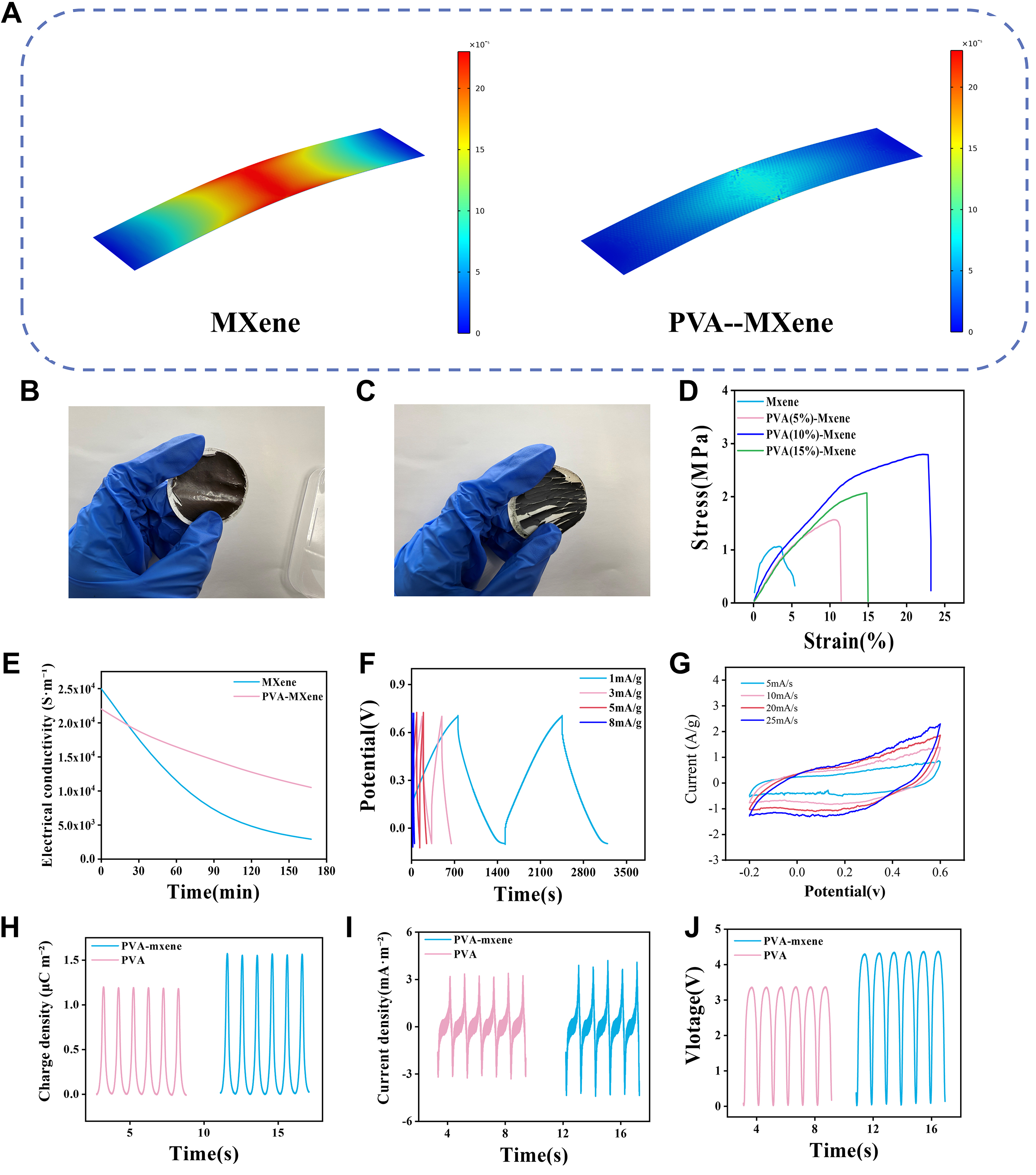
Figure 3. Mechanical robustness, anti-oxidation stability, electrochemical behavior, and triboelectric performance comparison of pure MXene and PVA/MXene composite films. (A) Computational simulation profiles of the bending tests for pure MXene and PVA/MXene films. (B and C) Digital photographs showing the physical appearance of the films during environmental oxidation-stability testing. (D) Tensile stress-strain curves showing the mechanical stretchability and tensile strength. (E) Evaluation curves showing the degradation of electrical conductivity. (F) Galvanostatic charge-discharge (GCD) profiles. (G) Cyclic voltammetry (CV) curves. (H-J) Comparison of the triboelectric output metrics. Simulation parameters: two-layer geometry (MXene, 5 cm × 1 cm × 10 μm; PVA, 5 cm × 1 cm × 220 μm; a representative strip of the actual 5 cm × 3 cm film), EMXene ≈ 300 GPa, EPVA ≈ 2 GPa, ν ≈ 0.3, tetrahedral mesh with a 0.5 mm maximum element size (0.05 mm at the interface), bottom fixed and top subjected to a 25 N cyclic load. Peak stress drops from ≈2.0 × 10⁸ Pa in bare MXene to < 5.0 × 10⁷ Pa after PVA coating (full parameter table in Supplementary Table 3).