

Synergistic internal-external disorder to activate electrochemically inert maricite NaFePO4
 0
0 Graphical Abstract
Abstract
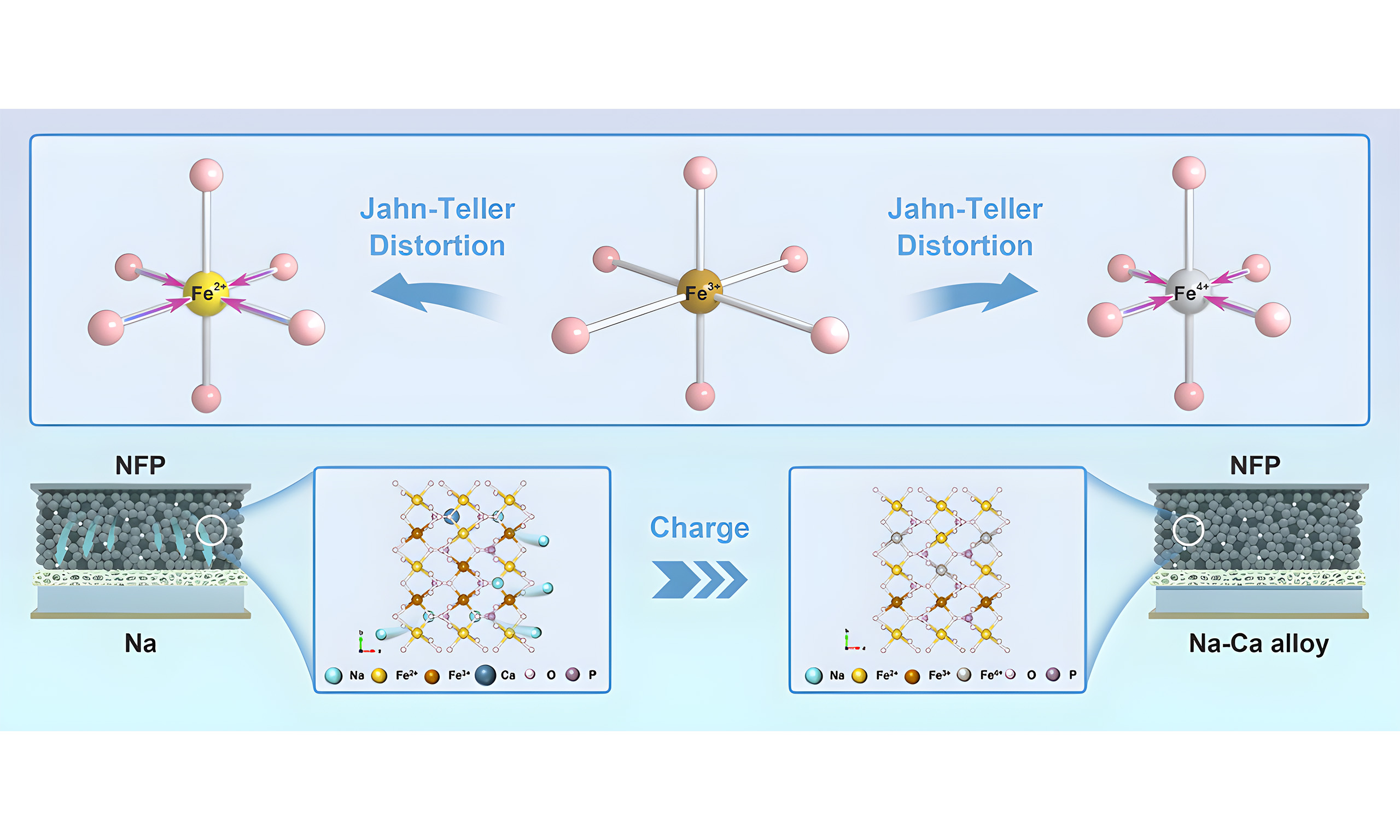
NaFePO4 (NFP) is a promising alternative to LiFePO4, offering advantages such as the abundance of natural sodium resources. However, its common crystal phase, maricite, is typically electrochemically inert. This study presents a novel, synthesis-controllable, and rechargeable maricite NFP cathode material, specifically Na0.33Fe0.95Ca0.06PO4, for sodium-ion batteries. The structure provides two main benefits: Ca2+ doping broadens the bulk sodium-ion transport channels, while the dynamic and persistent Jahn-Teller distortion caused by the coexistence of Fe4+, Fe3+, and Fe2+ induces internal lattice distortion, effectively activating its electrochemical activity. Additionally, nanocrystallization introduces external structural disorder, further shortening the ion diffusion path. This cathode exhibits a high reversible capacity of
Keywords


 Download PDF
INTRODUCTION
Sodium-ion batteries have demonstrated significant potential for large-scale energy storage due to the abundance of sodium resources, low cost, and environmental friendliness[1-5]. Among various cathode materials, NaFePO4 (NFP) is considered a highly promising candidate because of its chemical similarity to the industrialized and commercialized lithium-based cathode material, LiFePO4[6-9]. Although olivine NFP offers a high theoretical specific capacity of 155 mAh g-1, its practical application is hindered by thermodynamic instability and complex synthesis routes[10-12]. In contrast, the thermodynamically favored maricite NFP has been shown to be electrochemically inactive due to its closed framework structure, which lacks effective Na+ diffusion pathways within the crystal lattice[13-16]. Furthermore, the inherently low electronic conductivity of phosphate-based electrode materials further limits their practical use[17]. Therefore, developing rational and efficient modification strategies to construct sodium-ion diffusion channels and enhance the conductivity of maricite NFP has become a key research focus.
To overcome the intrinsic ion transport limitations of NFP, various modification strategies have been proposed. One common approach is reducing particle size to shorten the sodium-ion diffusion pathway[18,19]. Liu et al.[20] prepared ultra-fine maricite NaFePO4@C nanoparticles (3 nm) assembled into NFP nanoclusters, which deliver a high reversible capacity of 149.2 mAh g-1 at 0.2 C and exhibit excellent rate capability. Carbon coating has also been employed to construct conductive networks and improve electron transport[21].
To address these challenges, this study proposes a novel cathode material for sodium-ion batteries: Na0.33Fe0.95Ca0.06PO4 (denoted as NFP/C-HT0.02). The crystal disorder induced by the dynamic Jahn-Teller effect, combined synergistically with Ca2+ doping, broadens sodium-ion migration pathways and reduces the diffusion energy barrier, thereby significantly enhancing bulk ionic conductivity. Additionally, the implementation of a nanostructuring strategy introduces external structural disorder. This unique “internal-external synergistic disordering” structural design reconstructs the sodium-ion transport pathways at the crystalline level, markedly improving sodium-ion transport kinetics and the electrochemical activity of the material. Benefiting from this distinctive structure, the cathodes exhibit outstanding electrochemical performance, achieving a high reversible capacity of 178.6 mAh g-1 at a current density of 50 mA g-1 and an energy density of 415 Wh kg-1.
EXPERIMENTAL
Material synthesis
Graphite oxide was dispersed in deionized water, followed by the addition of equimolar amounts of Fe(NO3)3·9H2O, NaH2PO4, and citric acid. The mixture was continuously stirred at 80 °C until a homogeneous sol formed, which was then dried to obtain the precursor. This precursor was freeze-dried, ground, and subsequently calcined at 350 °C for 4 h, followed by calcination at 600 °C for 8 h under an Ar/H2 atmosphere. The resulting product was designated NFP/C.
The NFP/C material was stirred in a 0.3 M HCl solution for 1 h and then washed until neutral, yielding the acid-treated product labeled NFP/C H. In a separate procedure, the precursor was mixed with nano CaCO3 at a mass ratio of 1:0.01, ground, and uniformly dispersed in deionized water. After freeze-drying and calcination under the same conditions described above, the resulting product was washed and designated NFP/C T0.01.
Furthermore, the precursor was mixed with nano-CaCO3 at mass ratios of 1:0.01, 1:0.02, and 1:0.03, respectively. Each mixture was homogenized in deionized water, freeze-dried, ground, and calcined under identical conditions. The calcined products were then ground again, stirred in diluted HCl for 1 h, and washed until neutral. The final products were labeled NFP/C-HT0.01, NFP/C-HT0.02, and NFP/C-HT0.03, respectively.
Material characterization
The elemental composition of the samples was determined by inductively inductively coupled plasma optical emission spectrometry (ICP-OES) using an Optima 8000 instrument. The crystal structure was analyzed with an X-ray diffractometer (XRD, SmartLab SE) employing Cu Kα radiation. The carbon content of the materials was measured by thermogravimetric analysis (TGA) using a HITACHI STA7300. The chemical states of surface elements were investigated via X-ray photoelectron spectroscopy (XPS) with a Thermo Scientific K-Alpha system. X-ray absorption fine structure (XAFS) spectroscopy was performed in transmission mode on a Rapid XAFS 2M instrument (Anhui Absorption Spectroscopy Instrument Co., Ltd.) at 20 kV and 20 mA. For iron analysis, a Ge (620) spherical bent crystal analyzer with a curvature radius of 500 mm was employed. The morphology and structural characteristics of the materials were examined by scanning electron microscopy (SEM, Hitachi S-4800), transmission electron microscopy (TEM, FEI Tecnai F20), high-resolution TEM (HRTEM), selected-area electron diffraction (SAED), and energy-dispersive X-ray spectroscopy (EDS) elemental mapping. Dispersion stability was evaluated using a zeta potential analyzer (Zetasizer Pro 46500). Nitrogen adsorption-desorption isotherms were obtained with an Autosorb-iQ physisorption analyzer (Micromeritics APSP 2460). The specific surface area was calculated using the Brunauer-Emmett-Teller (BET) method, and the pore size distribution was determined by the Barrett-Joyner-Halenda model.
Electrochemical measurements
The electrochemical performance of the samples was evaluated using a LAND battery test system (CT2001A, Wuhan, China) and a CHI760D electrochemical workstation. The active material, Ketjen black, and polyvinylidene fluoride were mixed in a mass ratio of 7:2:1 and dispersed in N-methyl-2-pyrrolidone (NMP) to form a homogeneous slurry. This slurry was cast onto carbon-coated aluminum foil and dried to form the cathode. The electrode films were vacuum-dried at 110 °C for 12 h. The mass of active material on each electrode sheet was approximately 0.8 mg. Coin-type half-cells were assembled in an argon-filled glove box. The cathode electrolyte (TC-E201) was purchased from Tianjin Tianchi Materials Technology Co., Ltd. Metallic sodium was used as both the counter and reference electrode. Electrochemical measurements of the cathodes were conducted within a voltage range of 1.5 to 4.3 V. Electrochemical impedance spectroscopy (EIS) was recorded over a frequency range of 0.01 Hz to 100 kHz. The electrolyte consisted of 1 M NaClO4 in a mixture of ethylene carbonate and propylene carbonate (v/v, 1:1), with 5% fluoroethylene carbonate added as a high-voltage additive. A glass fiber GF/F membrane was used as the separator.
RESULTS
Electrochemical activation of maricite NFP
The samples were prepared using a conventional sol-gel method. A schematic illustration of the synthesis process is presented in Figure 1A. To elucidate the individual and combined effects of the nano-CaCO3 template and HCl washing, control samples NFP/C-T0.01 and NFP/C-H were also synthesized. The XRD patterns of NFP/C, NFP/C-T0.01, NFP/C-H, and NFP/C-HT0.01 are shown in Figure 1B. All diffraction peaks correspond well with the reference pattern of maricite NFP (JCPDS no. 29-1216)[23], and no impurity peaks were detected, confirming the phase purity of the as-prepared samples. Notably, NFP/C exhibits the sharpest diffraction peaks, indicating the highest crystallinity[24]. In contrast, NFP/C-T0.01, which includes the template agent, shows weakened peak intensities. The acid-washed sample NFP/C-H displays a significant reduction in peak intensity, while the NFP/C-HT0.01 sample, treated with both templating and acid washing, demonstrates the lowest crystallinity[25], indicating that the combined treatment effectively reduces the material's crystallinity and likely introduces a considerable number of random crystal defects, thereby disrupting its long-range ordered structure.
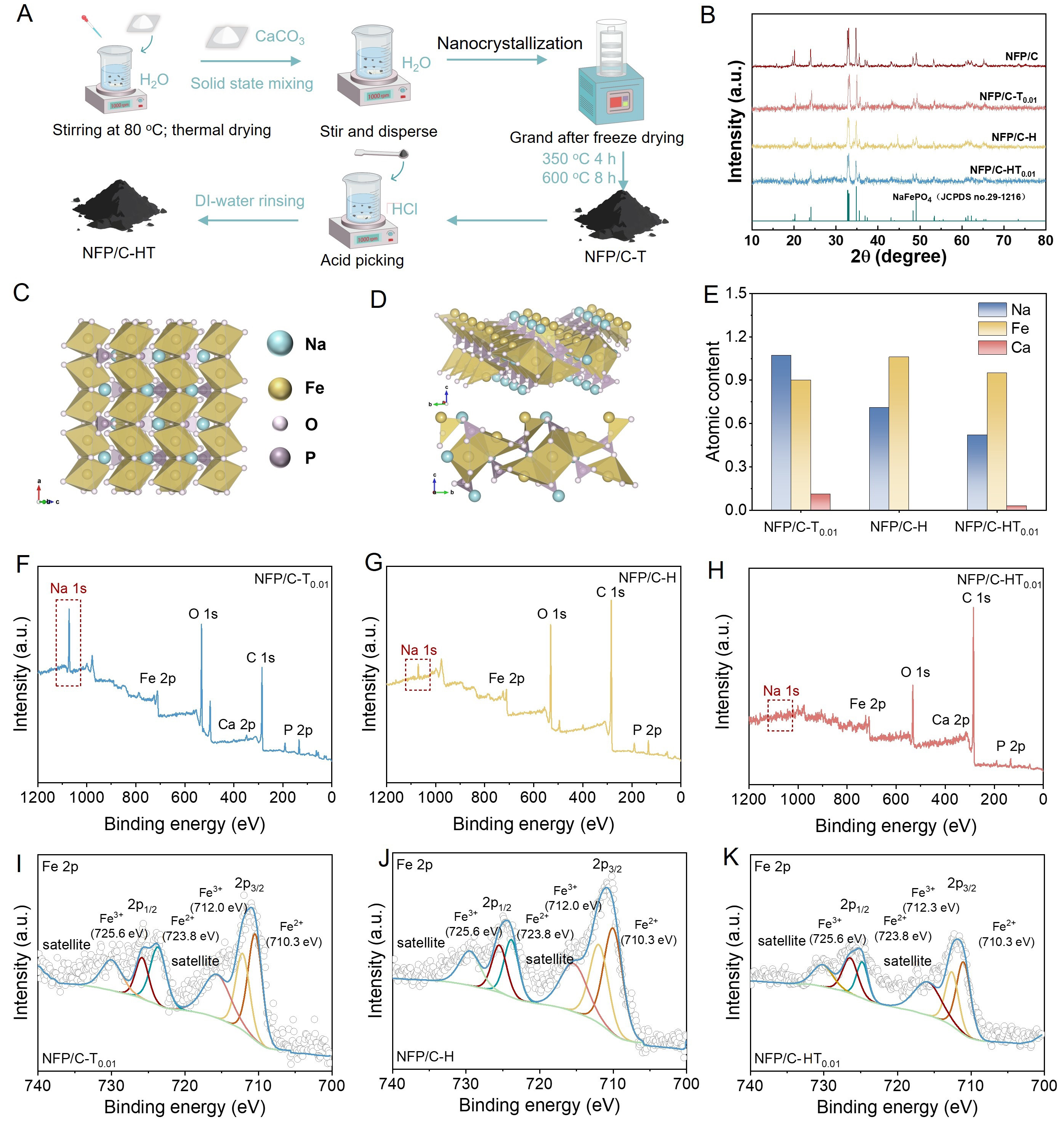
Figure 1. Sample preparation and structural characterizations. (A) Schematic diagram of the synthesis process for the NFP/C-HT sample; (B) XRD patterns of NFP/C, NFP/C-T0.01, NFP/C-H, and NFP/C-HT0.01 samples; (C) schematic of the maricite NFP crystal; (D) crystal structure diagram sectioned along the (111) plane; (E) ICP results for the NFP/C-T0.01, NFP/C-H, and NFP/C-HT0.01 samples; (F-H) full XPS spectra of samples NFP/C-T0.01, NFP/C-H, and NFP/C-HT0.01; and (I-K) Fe 2p XPS spectra of NFP/C-T0.01, NFP/C-H, and NFP/C-HT0.01.
The morphology of the samples was characterized by SEM [Supplementary Figure 1]. As shown in
The morphology of NFP/C-T0.01 and NFP/C-H was further examined using TEM. As shown in
Figure 1C illustrates the crystal structure of maricite NFP, with additional orientations shown in Supplementary Figure 3. TEM analysis confirms that the (111) plane is the primary exposed facet, and a cross-sectional view of this plane is presented in Figure 1D. In the pristine maricite structure, sodium ions are confined between [FeO6] octahedra and [PO4] tetrahedra within a closed framework, which impedes efficient Na+ diffusion and results in electrochemical inactivity. In contrast, after our processing method, the (111) facet in maricite NFP effectively exposes sodium ions, facilitating their release from the lattice and enabling rapid Na+ transport.
ICP-OES analysis was performed to examine the chemical composition [Figure 1E]. A trace amount of Ca was detected in NFP/C-T0.01, accompanied by partial Fe loss, suggesting possible lattice doping by the templating agent. It should be noted that the samples were thoroughly washed, eliminating the possibility of Ca residue. In the acid-treated sample NFP/C-H, the Na content decreased to 0.71, indicating the formation of sodium vacancies while the maricite structure remained intact, as confirmed by XRD [Figure 1B]. These results demonstrate that the template mildly tunes the composition and microstructure of maricite NFP, whereas acid washing introduces sodium defects and disrupts the long-range order. This structural change breaks the closed framework and creates efficient pathways for Na+ migration. The surface chemical states of NFP/C-T0.01, NFP/C-H, and NFP/C-HT0.01 were analyzed by XPS. As shown in Figure 1F-H, all samples contain Na, Fe, P, O, and C as the primary elements. The acid-washed samples NFP/C-H and NFP/C-HT0.01 exhibit a clear reduction in Na XPS intensity, further confirming sodium loss due to acid treatment. Trace Ca is detected in the templated samples NFP/C-T0.01 and NFP/C-HT0.01, consistent with ICP-OES results. The Fe 2p XPS spectra are presented in Figure 1I-K. A higher binding energy is observed for the Fe 2p peaks in NFP/C-H and NFP/C-HT0.01, indicating an elevated Fe oxidation state[33,34]. This shift results from charge compensation following Na+ removal, which promotes the oxidation of Fe2+ to Fe3+. Peak fitting analysis
Raman spectroscopy was performed on NFP/C-T0.01, NFP/C-H, and NFP/C-HT0.01 to investigate the defect structure of the amorphous carbon in the composites. As shown in Supplementary Figure 5, all samples exhibit distinct characteristic peaks at 1,586.5 cm-1 (G band, representing graphitic carbon) and 1,343.2 cm-1 (D band, associated with structural defects)[35,36]. The ID/IG ratios for NFP/C-T0.01, NFP/C-H, and NFP/C-HT0.01 are 0.78, 0.91, and 0.92, respectively. The higher ID/IG values of NFP/C-H and NFP/C-HT0.01 indicate a lower degree of structural order in the carbon, suggesting that acid treatment effectively disrupts the surface regularity and introduces more defects and disordered structures[37]. Among them, NFP/C-HT0.01 shows the highest ID/IG ratio, reflecting the greatest defect concentration and structural disorder in its carbon layers. These structural defects can serve as active sites during electrochemical processes, thereby enhancing reaction activity. The specific surface area and pore structure of the samples were characterized by BET measurements. As shown in Supplementary Figure 6A, all samples display type IV isotherms with clear hysteresis loops in the P/P0 range of 0.4-1.0, confirming their mesoporous nature. The specific surface areas of NFP/C-T0.01, NFP/C-H, and NFP/C-HT0.01 are 52.0, 109.7, and 123.7 m2·g-1, respectively. The markedly higher surface area of the acid-treated samples suggests that acid treatment induces surface restructuring and increases the accessible area, consistent with SEM and zeta potential analyses. Pore size distribution profiles
The electrochemical performance of the prepared cathodes was evaluated in coin-type half-cells over a voltage range of 1.5 to 4.3 V. At a current density of 100 mA g-1 [Supplementary Figure 7A], the initial discharge capacities of NFP/C, NFP/C-T0.01, NFP/C-H, and NFP/C-HT0.01 were 55.8, 67.2, 79.8, and
Rate performance data are presented in Supplementary Figure 7B. NFP/C-HT0.01 delivers capacities of 112.1, 94.8, 84.9, 79.5, 75.9, and 69.4 mAh g-1 at current densities of 0.05, 0.1, 0.2, 0.3, 0.5, and 1 A g-1, respectively. When the current density is returned to 0.05 A g-1, the capacity recovers to 110.4 mAh g-1, demonstrating excellent reversibility and rate capability. These results confirm that the combination of templating and acid treatment effectively optimizes the microstructure and lattice disorder of NFP/C-HT0.01. The resulting porous network and sodium defects synergistically facilitate Na+ diffusion, underpinning the remarkable cycling stability and rate performance.
Excavating the electrochemical potential of maricite NFP
To investigate the influence of the template ratio on electrochemical behavior, NFP/C HT0.02 and NFP/C HT0.03 were synthesized with precursor-to-template mass ratios of 1:0.02 and 1:0.03, respectively. XRD patterns [Figure 2A] show that both samples retain the maricite-type NFP crystal structure. As the template ratio increases, the intensity of the diffraction peaks gradually decreases, indicating reduced crystallinity and increased structural disorder. Rietveld full-pattern refinements yield lattice parameters for pristine NFP
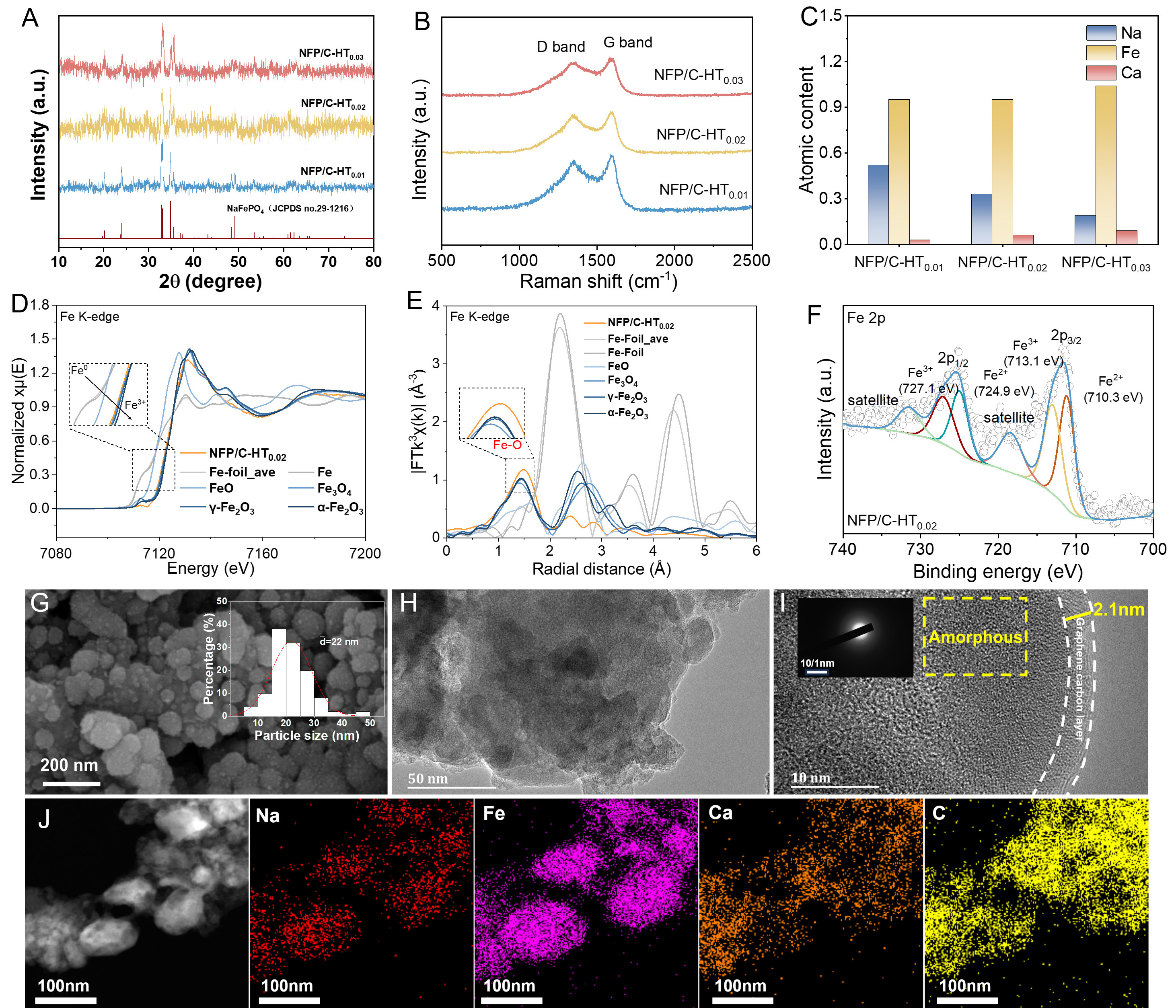
Figure 2. Structural characterizations: (A) XRD patterns of NFP/C-HT0.01, NFP/C-HT0.02, and NFP/C-HT0.03 samples; (B) Raman spectra of NFP/C-HT0.01, NFP/C-HT0.02, and NFP/C-HT0.03 samples; (C) ICP results for NFP/C-HT0.01, NFP/C-HT0.02, and NFP/C-HT0.03 samples; (D) XANES spectra of NFP/C-HT0.02; (E) normalized Fe EXAFS spectra of NFP/C-HT0.02; (F) Fe 2p spectra of NFP/C-HT0.02; (G-J) SEM, TEM, HRTEM, and EDS images of NFP/C-HT0.02 (inset shows the particle size distribution histogram).
Raman spectroscopy was employed to investigate the effect of the template ratio on the carbon structural order of NFP/C-HT0.02 and NFP/C-HT0.03 [Figure 2B]. Both samples exhibit characteristic G band
To investigate the surface and porous structural characteristics, N2 adsorption-desorption tests were performed [Supplementary Figure 10A]. NFP/C-HT0.02 exhibits a specific surface area of
The Fe K-edge X-ray absorption near-edge structure (XANES) spectra [Figure 2D] exhibit a distinct shift to higher energy for NFP/C-HT0.02 compared to low-valent references (FeO, Fe foil), indicating an iron oxidation state approaching +3. This shift is attributed to the loss of sodium ions, which triggers the oxidation of some Fe2+ to Fe3+ to maintain charge balance, resulting in a mixed Fe2+/Fe3+ valence state. The presence of mixed Fe2+/Fe3+ valence is crucial for inducing structural disorder. In pristine NFP, the absence of Fe3+ ensures high structural stability without Jahn-Teller distortion. However, the introduction of low-spin Fe3+(t2g5eg0) promotes Jahn-Teller distortion around high-spin Fe2+(t2g4eg2) centers, leading to local lattice distortion and further structural disorder. This disordered configuration broadens sodium migration pathways and enhances Na+ diffusion kinetics[38,39].
The Fourier transform-extended X-ray absorption fine structure (FT-EXAFS) spectrum of NFP/C-HT0.02 [Figure 2E] reveals a significant increase in the Fe-O bond length. This change can be attributed to local lattice distortion induced by the Jahn-Teller effect, which optimizes the electronic structure and enhances electron transport within the electrode material, thereby facilitating faster electron transfer during charge and discharge processes[40]. In the Fe 2p XPS spectra [Figure 2F], the Fe 2p peaks shift further toward higher binding energies, indicating a gradual increase in the iron oxidation state. This shift results from the oxidation of Fe2+ to Fe3+ to maintain charge balance during desodiation, leading to an elevated average Fe oxidation state. This conclusion is consistent with the absorption edge shift observed in the XANES spectra.
The SEM characterization [Figure 2G] reveals that NFP/C-HT0.02 consists of small nanospheres with an average particle size of approximately 22 nm and significantly improved dispersion. This refined microstructure increases the specific surface area, facilitating rapid Na+ insertion and extraction while reducing volume strain during cycling, thereby enhancing structural stability and cycle life[41]. In contrast, although NFP/C-HT0.03 also exhibits a nano-spherical morphology [Supplementary Figure 11A andB], the excess template causes pore collapse and severe particle agglomeration, resulting in poor dispersion. This observation is further supported by zeta potential measurements shown in Supplementary Figure 12.
TEM images [Figure 2H] reveal a uniform graphene coating on the nanospheres in NFP/C-HT0.02, which enhances electrical conductivity and provides additional pathways for Na+ migration. HRTEM [Figure 2I] shows no distinct lattice fringes, and the corresponding SAED pattern lacks clear diffraction rings, confirming a highly disordered structure. This disorder, induced by Jahn-Teller lattice distortion, facilitates Na+ migration by lowering the diffusion energy barrier and creating more ion transport channels. Furthermore, the NFP/C-HT0.02 particles are uniformly coated with an amorphous carbon layer approximately 2.1 nm thick. This thin, continuous carbon shell accelerates electron conduction, shortens Na+ diffusion distances, and buffers lattice volume changes during sodiation and desodiation, synergistically enhancing the electrode’s electrochemical kinetics and cycling stability. EDS mapping [Figure 2J] demonstrates a homogeneous distribution of Na, Fe, and C, with Na content notably lower than Fe, consistent with ICP-OES results. Trace Ca, derived from the template agent, is also detected.
The electrochemical performance of the as-prepared cathodes was evaluated using coin-type half-cells within a voltage range of 1.5-4.3 V. As shown in the cyclic voltammetry (CV) curves [Figure 3A], NFP/C-HT0.01, NFP/C-HT0.02, and NFP/C-HT0.03 all exhibit a pair of redox peaks at approximately 2.1 and 2.9 V, corresponding to the Fe2+/Fe3+ redox reaction associated with Na+ extraction and insertion. Notably, NFP/C-HT0.02 displays sharper and more symmetric redox peaks, indicating enhanced electrochemical reversibility and improved charge transfer kinetics. This improved performance is attributed to the highly disordered structure induced by the Jahn-Teller effect, combined with Ca2+ incorporation, which synergistically promotes rapid Na+ diffusion. EIS measurements [Figure 3B] further reveal that NFP/C-HT0.02 possesses the smallest charge transfer resistance (Rct), significantly lower than those of NFP/C-HT0.01 and NFP/C-HT0.03, confirming its superior ion electrochemical kinetic characteristics. At a current density of 100 mA g-1, NFP/C-HT0.02 delivers an initial charge capacity of 65.1 mAh g-1 [Figure 3C]. The theoretical specific capacity of NFP/C-HT0.02 is 55.9 mAh g-1, calculated from the ICP-OES-derived formula of Na0.33Fe0.95Ca0.06PO4 (molar mass 158.02 g mol-1). The slightly higher initial charge capacity relative to the theoretical value is mainly attributed to the additional extraction of Ca2+ and partial oxidation of Fe3+ to Fe4+ during the first charge.
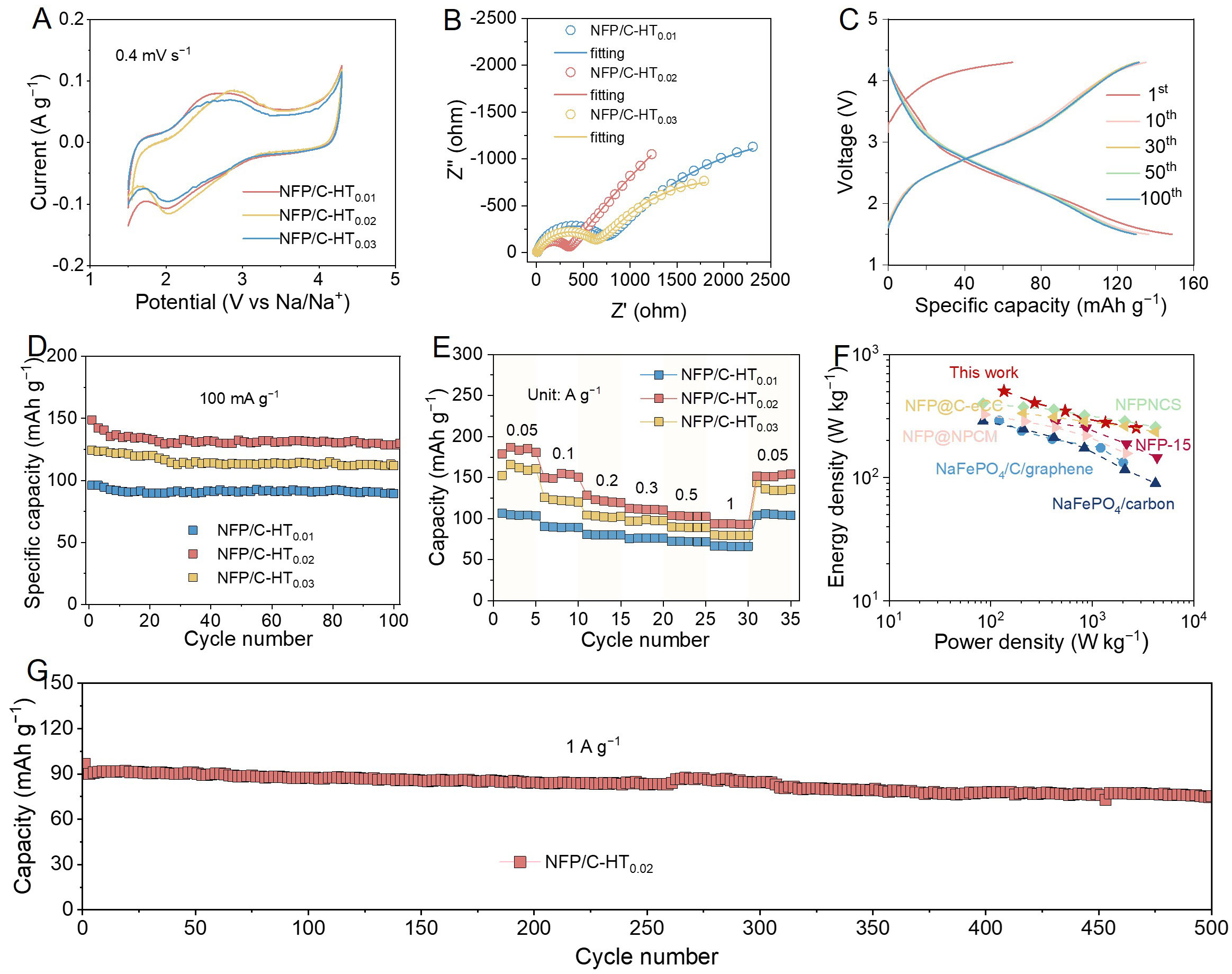
Figure 3. Electrochemical performance: (A and B) CV curves and EIS plots of NFP/C-HT0.01, NFP/C-HT0.02, and NFP/C-HT0.03 samples; (C) charge and discharge curves of NFP/C-HT0.02 at 100 mA g-1; (D and E) cycling performance at a current density of 100 mA g-1 and rate performance of NFP/C-HT0.01, NFP/C-HT0.02, and NFP/C-HT0.03 samples; (F) Ragone plots of NFP/C-HT0.02 and other NFP materials for SIBs[16,20-22,42,43]; (G) long-term cycling performance at 1 A g-1 of NFP/C-HT0.02.
The slightly higher charging capacity may be attributed to the extraction of Ca2+ from the crystal structure. During the discharging process, a high reversible capacity of 148.7 mAh g-1 is achieved. Even after 100 cycles, a reversible capacity of 128.3 mAh g-1 is maintained [Figure 3D]. The rate performance evaluated at different current densities is shown in Figure 3E. NFP/C-HT0.02 exhibits outstanding rate capability, delivering reversible capacities of 178.6, 149.4, 128.6, 112.6, 108.7, and 93.8 mAh g-1 at current densities ranging from 0.05 to 1 A g-1. This high reversible capacity of 178.6 mAh g-1 corresponds to the reversible insertion and extraction of one electron per formula unit of the Na0.33Fe0.95Ca0.06PO4 cathode. In contrast, NFP/C-HT0.03 shows poor rate performance due to excessive template use, which causes structural collapse and hinders Na+ transport and storage. In the Ragone plot [Figure 3F], NFP/C-HT0.02 demonstrates higher energy and power densities than other recently reported NFP cathodes, highlighting its practical potential. Moreover, after 500 cycles at 1 A g-1 [Figure 3G], NFP/C-HT0.02 retains a reversible capacity of 75.8 mAh g-1 with 77.8% capacity retention, confirming the advantages of its durable porous framework and optimized Na+ insertion/extraction kinetics for long-term cycling.
Galvanostatic intermittent titration technique (GITT) measurements were performed to evaluate the Na+ diffusion coefficients (DNa+) of various samples [Supplementary Figure 13]. The NFP/C-HT0.02 electrode exhibits a DNa+ of 5.3 × 10⁻¹² cm2 s-1, which is notably higher than that of bulk NFP (3.3 × 10⁻¹² cm2 s-1). This enhancement can be attributed to the reduced particle size, which shortens the solid-state diffusion length, as well as the moderate lattice disorder induced by Jahn-Teller distortion, facilitating Na+ migration within the crystal structure. To further assess the interfacial charge-transfer kinetics, temperature-dependent EIS was conducted from 293.15 to 313.15 K in 5 K intervals [Supplementary Figure 14A]. The Nyquist plots show a high-frequency semicircle whose diameter decreases markedly upon heating, indicating that Rct is strongly temperature-dependent. Arrhenius fitting of Rct-1 yields an apparent activation energy of 0.417 eV [Supplementary Figure 14B], which is significantly lower than values reported for iron-based polyanion cathodes in the literature[44,45]. This quantitative agreement between the low Ea and the high DNa+ from GITT demonstrates that both interfacial charge transfer and bulk ionic diffusion are synergistically optimized in NFP/C-HT0.02.
DISCUSSION
Relationship between structural evolution and electrochemical performance
Ex situ XRD and in situ EIS analyses of NFP/C-HT0.02 were performed to elucidate the relationship between structural evolution and electrochemical performance. During the discharge process, the diffraction peaks at 33° and 35°, corresponding to the (121) and (301) crystal planes, respectively, showed no significant shift, indicating excellent structural stability of the sample. Notably, when discharged below 2.5 V, these two peaks gradually broadened, primarily due to the reduction of Fe3+ to Fe2+. The strong Jahn-Teller distortion associated with Fe2+ causes the structure to deviate from ideal octahedral coordination, resulting in decreased crystallinity and increased amorphous characteristics of the material [Figure 4A]. The corresponding evolution of the unit cell volume is shown in Figure 4B, displaying an initial contraction followed by expansion, which correlates with the in situ EIS results during the discharge process [Figure 4C]. The in situ EIS spectra of NFP/C-HT0.02 during discharge [Figure 4C] reveal a clear decrease in Rct below 2.5 V. This decline is attributed to the stronger Jahn-Teller effect of Fe2+ compared to Fe3+, which induces greater structural disorder and unit cell expansion, thereby accelerating the electrode’s charge transfer rate.
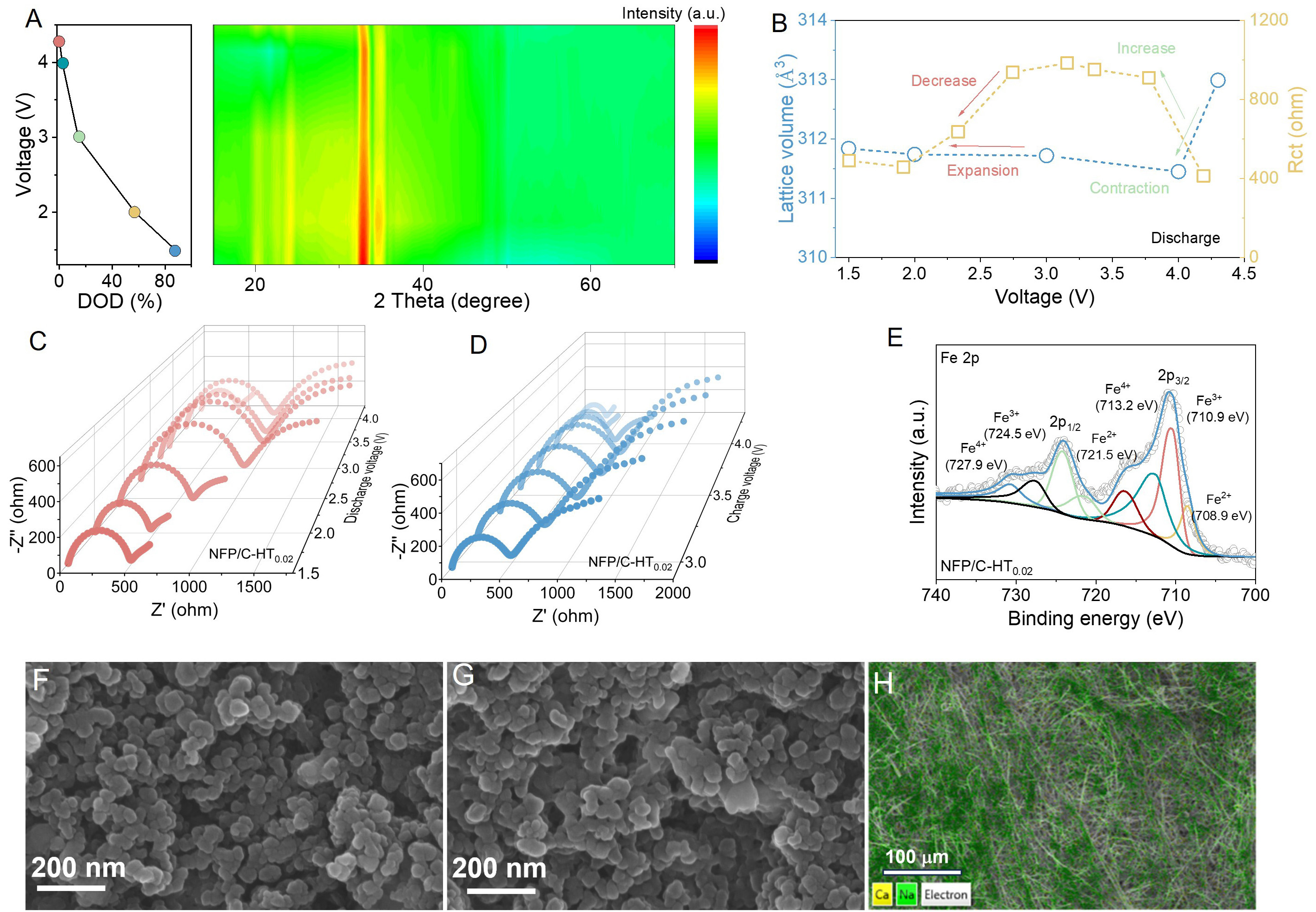
Figure 4. (A) Investigation of the sodium-storage mechanism: Ex situ XRD of NFP/C-HT0.02 during discharge; (B) evolution of the unit cell volume and in situ impedance Rct of NFP/C-HT0.02 during discharge; in situ EIS spectra of NFP/C-HT0.02 during discharge (C) and charge (D); (E) Fe 2p spectra of NFP/C-HT0.02 after charging; SEM images of NFP/C-HT0.02 after charging (F) and after long-term cycling (G); (H) elemental mapping of the metallic sodium surface on the counter electrode after charging of NFP/C-HT0.02.
It should be noted that in a well-ordered structure, whether composed entirely of symmetric units (e.g., Fe3+O6, PO4) or entirely of asymmetric units (e.g., Fe2+O6), the stability of the structure is determined by these fundamental building blocks. If unstable factors arise, specifically a mixed phase containing both symmetric and asymmetric units (e.g., Fe2+O6, Fe3+O6, or even Fe4+O6), the overall structural stability is compromised. This results in dynamic Jahn-Teller disorder, which prevents the structure from maintaining a stable phase consistent with thermodynamic equilibrium. Instead, the system undergoes continuous transformations between dynamically unstable phases, resembling a metastable equilibrium state.
The in situ EIS results during the charging process are presented in Figure 4D. As the charging voltage increases, the Rct gradually rises, primarily due to the oxidation of Fe2+ to Fe3+ and the relatively weak Jahn-Teller effect associated with Fe3+. When the voltage exceeds 4.0 V, Rct decreases significantly. This decrease can be attributed to the formation of Fe4+ (t2g3eg1), which exhibits an extremely strong Jahn-Teller effect, causing distortion and deformation of the sample structure and thereby creating more Na+ transport channels. The fitted results of the in situ EIS spectra at various charging voltages are shown in Supplementary Figure 15. To verify the oxidation of Fe3+ to Fe4+ during charging, high-resolution Fe 2p XPS spectra were collected after the process. The presence of distinct Fe4+ peaks in Figure 4E provides direct evidence of this reaction. The valence change of iron induces a structural transition toward an amorphous state, which enhances Na+ migration and interface reactivity, thereby significantly improving the electrochemical kinetics of the electrode material[46,47].
The dynamic Jahn-Teller effect maintains the material in a distorted state, facilitating rapid Na+ migration. Schematic structures with different iron valences are shown in Supplementary Figure 16. Although dynamic Jahn-Teller lattice distortion occurs continuously during cycling, NFP/C-HT0.02 retains a uniform and intact nanospherical morphology without particle cracking or pulverization after charging and extended cycling [Figure 4F and G]. This remarkable structural stability results from the high surface charge density of the particles, which inhibits the agglomeration of ultrafine nanoparticles through electrostatic repulsion. The hierarchical pores accommodate lattice volume variations caused by Na+ deintercalation and intercalation, while the continuous outer carbon coating preserves the integrity of the conductive network. The synergy of these three factors mitigates internal stress accumulation during cycling.
Elemental mapping of the metallic sodium surface on the counter electrode after charging NFP/C-HT0.02 is shown in Figure 4H. Notably, calcium was detected alongside sodium. Since physical adsorption on the anode has been accounted for, the calcium signal must originate from the extraction of Ca2+ ions from the cathode during charging. This finding corresponds with the observed higher initial charging capacity, which exceeds the theoretical value, confirming the successful Ca2+ doping of the NFP/C-HT0.02 lattice. Although the standard electrode potential of Ca2+/Ca (-2.87 V vs. SHE) is more negative than that of Na+/Na (-2.71 V vs. SHE), kinetic factors, including interfacial polarization and local potential changes during Na+ extraction, enable partial co-migration of Ca2+ during charging. The resulting calcium deposition (1.55 on the Mohs hardness scale) on the sodium metal surface (0.4 on the Mohs hardness scale) can also suppress dendrite growth. Furthermore, the stable incorporation of larger Ca2+ ions expands Na+ migration pathways within the lattice structure, enhancing the ionic transport kinetics of maricite NFP[48,49].
Multiscale activation of electrochemically inert materials
Throughout the entire text, a multiscale and universal strategy to activate these potentially electrochemically inert materials is proposed as follows.
(1) Configuring intrinsic structural disorder. The dynamic Jahn-Teller effect in transition metal ions (e.g., Fe2+, Mn3+) induces persistent lattice distortions during cycling[50,51]. This disrupts long-range order and promotes an amorphous-like structure, creating widened three-dimensional ion migration channels that lower diffusion barriers and enhance intrinsic electrochemical activity[52,53]. Other chemical methods can also increase the intrinsic disorder of crystal structures. For example, high-entropy design, where multiple principal elements cause significant lattice distortion, leading to chemical structural disorder; doping, which introduces vacancies and point defects that cause lattice relaxation; and non-equilibrium preparation, which limits atomic migration to form metastable disorder.
(2) Reconstructing external material disorder (i.e., altering particle size and morphology). Manual nanosizing of the material not only creates more active sites but also introduces cation and oxygen vacancies. These defects generate preferential migration pathways and additional active centers, while synergistically shortening ion and electron transport distances to enhance external disorder[54,55]. This paper introduces nanostructures through chemical methods such as templating agents and acid etching. In practical production, a series of high-entropy oxides or ceramics can be prepared using methods like co-precipitation, sol-gel, and mechanochemical synthesis. Additionally, alloy-type materials can be obtained through techniques such as arc melting, mechanical alloying, and magnetron sputtering. Rapid quenching or melt spinning is also a classic and commonly used method for preparing amorphous alloys (metallic glasses). Through the mechanical impact and shear forces provided by high-energy ball milling, powder particles of different materials continuously undergo plastic deformation, cold welding, and fracture, eventually diffusing and mixing at the atomic scale. This is our most fundamental method for inducing external structural disorder.
(3) Achieving interface and process stabilization. First, interactions between particles must be minimized to enhance overall flowability. For example, a high surface charge (zeta potential) prevents particle aggregation through electrostatic repulsion. Dispersants firmly adsorb onto particle surfaces via “anchor groups,” while their long chains extend into the solvent, forming a protective layer. The physical overlap of these long chains and the resulting entropic repulsion generate a strong repulsive force. Surface coatings (e.g., carbon, polymers), elemental doping, and heterostructure construction create conductive networks that improve electron transfer and cycling stability[56,57]. Through process optimization, such as refining powder characteristics, ensuring thorough mechanical dispersion, using an appropriate feeding sequence, and judiciously applying other additives, strong repulsive forces can be introduced between particles, surpassing van der Waals attractions. This enables particles to remain stable and uniformly dispersed in the solvent, effectively achieving “de-agglomeration.” Such slurries exhibit low viscosity, good flowability, and desirable rheological properties, including shear thinning.
In summary, the coordinated implementation of internal structural disorder and external material disorder, combined with interface stabilization, constitutes an effective "internal-external" synergistic strategy. This multiscale approach systematically optimizes charge and ion transport pathways, providing a general principle for developing high-performance electrochemical energy materials.
CONCLUSIONS
In summary, this work successfully activates the typically inert maricite NFP through a synergistic multiscale design. The introduction of Ca2+ doping broadens the Na+ transport channels, while the dynamic Jahn-Teller effect, arising from mixed-valence Fe ions, induces beneficial internal lattice distortions. Coupled with external disorder introduced via nanocrystallization, which shortens ion diffusion paths, the resulting Na0.33Fe0.95Ca0.06PO4 cathode exhibits remarkable electrochemical performance, achieving a high reversible capacity of 178.6 mAh g-1 and an impressive material-based energy density of 415 Wh kg-1. This study not only demonstrates a feasible pathway to unlock the potential of maricite-type cathodes but also provides a general strategy for activating electrochemically inert materials, paving the way for the development of sustainable and high-performance sodium-ion batteries.
DECLARATIONS
Authors’ contributions
Designed and conducted the experiments, interpreted the results, and wrote the manuscript: Hu, W.;
Assisted with data interpretation and reviewed and edited the manuscript: Zhang, Y.; Tang, B.
Contributed to data collection and analysis: Wu, Y.; Li, J.
Provided methodology and supervision: Zhou, Z.
Supported the experimental setup and offered guidance throughout the research process: Tang, Y.; Liu, L.
Availability of data and materials
The data supporting the findings of this study are available within this Article and its Supplementary Materials. Further data are available from the corresponding authors upon request.
AI and AI-assisted tools statement
During the preparation of this manuscript, the AI tool DeepSeek-V3 (version V3, released 2024-12-26) was used solely for language editing. The tool did not influence the study design, data collection, analysis, interpretation, or the scientific content of the work. All authors take full responsibility for the accuracy, integrity, and final content of the manuscript.
Financial support and sponsorship
Hu, W.; Dong, S. contributed equally to this work. This work was supported by the National Natural Science Foundation of China (22368047, 22468048, 22508330), the Funded by the Xinjiang Talent Development Fund (XJRC-2025-KJ-PY-KJLJ-016), the “Tianshan Talents” Science and Technology Innovation Team of Xinjiang Uygur Autonomous Region (2024TSYCTD0002), and the Natural Science Foundation of Henan Province (252300423746).
Conflicts of interest
All authors declared that there are no conflicts of interest.
Ethical approval and consent to participate
Not applicable.
Consent for publication
Not applicable.
Copyright
© The Author(s) 2026.
Supplementary Materials
REFERENCES
1. Sada, K.; Darga, J.; Manthiram, A. Challenges and prospects of sodium-ion and potassium-ion batteries for mass production. Adv. Energy. Mater. 2023, 13, 2302321.
2. Zhao, Y.; Kang, Y.; Wozny, J.; et al. Recycling of sodium-ion batteries. Nat. Rev. Mater. 2023, 8, 623-34.
3. Usiskin, R.; Lu, Y.; Popovic, J.; et al. Fundamentals, status and promise of sodium-based batteries. Nat. Rev. Mater. 2021, 6, 1020-35.
4. Singh, A. N.; Islam, M.; Meena, A.; et al. Unleashing the potential of sodium-ion batteries: current state and future directions for sustainable energy storage. Adv. Funct. Mater. 2023, 33, 2304617.
5. Li, S.; Zhao, Y.; Dang, Q.; Qin, J.; Hu, Q. Research progress on LT performance of sodium-ion battery electrolytes. Energy. Mater. 2026, 6, 600021.
6. Liao, H.; Zhang, Z.; Zheng, Y.; Gao, Y. NaFePO4 for sodium-ion batteries: mechanism, synthesis and optimization strategies toward commercialization. Energy. Storage. Mater. 2024, 65, 103157.
7. Zhang, Z.; Du, Y.; Wang, Q. C.; et al. A yolk-shell-structured FePO4 cathode for high-rate and long-cycling sodium-ion batteries. Angew. Chem. Int. Ed. 2020, 59, 17504-10.
8. Kim, J.; Seo, D.; Kim, H.; et al. Unexpected discovery of low-cost maricite NaFePO4 as a high-performance electrode for Na-ion batteries. Energy. Environ. Sci. 2015, 8, 540-5.
9. Guo, Z.; Yao, X.; Tian, H.; Cai, Y.; Su, Z. Effect of Zn-doping on the electrochemical performance of NaFePO4/C cathode material for lithium ion battery. Int. J. Electrochem. Sci. 2021, 16, 210758.
10. Tang, W.; Song, X.; Du, Y.; et al. High-performance NaFePO4 formed by aqueous ion-exchange and its mechanism for advanced sodium ion batteries. J. Mater. Chem. A. 2016, 4, 4882-92.
11. Hwang, J.; Matsumoto, K.; Orikasa, Y.; et al. Crystalline maricite NaFePO4 as a positive electrode material for sodium secondary batteries operating at intermediate temperature. J. Power. Sources. 2018, 377, 80-6.
12. Avdeev, M.; Mohamed, Z.; Ling, C. D.; et al. Magnetic structures of NaFePO4 maricite and triphylite polymorphs for sodium-ion batteries. Inorg. Chem. 2013, 52, 8685-93.
13. Zaghib, K.; Trottier, J.; Hovington, P.; et al. Characterization of Na-based phosphate as electrode materials for electrochemical cells. J. Power. Sources. 2011, 196, 9612-7.
14. Kapaev, R.; Chekannikov, A.; Novikova, S.; et al. Mechanochemical treatment of maricite-type NaFePO4 for achieving high electrochemical performance. J. Solid. State. Electrochem. 2017, 21, 2373-80.
15. Hilder, M.; Howlett, P. C.; Saurel, D.; et al. Stable cycling of NaFePO4 cathodes in high salt concentration ionic liquid electrolytes. J. Power. Sources. 2018, 406, 70-80.
16. Ma, X.; Xia, J.; Wu, X.; Pan, Z.; Shen, P. K. Remarkable enhancement in the electrochemical activity of maricite NaFePO4 on high-surface-area carbon cloth for sodium-ion batteries. Carbon 2019, 146, 78-87.
17. Zhu, Y.; Xu, Y.; Liu, Y.; Luo, C.; Wang, C. Comparison of electrochemical performances of olivine NaFePO4 in sodium-ion batteries and olivine LiFePO4 in lithium-ion batteries. Nanoscale 2013, 5, 780-7.
18. Liu, Y.; Zhang, N.; Wang, F.; Liu, X.; Jiao, L.; Fan, L. Z. Approaching the downsizing limit of maricite NaFePO4 toward high-performance cathode for sodium-ion batteries. Adv. Funct. Mater. 2018, 28, 1801917.
19. Heubner, C.; Heiden, S.; Schneider, M.; Michaelis, A. In-situ preparation and electrochemical characterization of submicron sized NaFePO4 cathode material for sodium-ion batteries. Electrochim. Acta. 2017, 233, 78-84.
20. Liu, B.; Zhang, Q.; Li, L.; et al. Achieving highly electrochemically active maricite NaFePO4 with ultrafine NaFePO4@C subunits for high rate and low temperature sodium-ion batteries. Chem. Eng. J. 2021, 405, 126689.
21. Rahman, M. M.; Sultana, I.; Mateti, S.; Liu, J.; Sharma, N.; Chen, Y. Maricite NaFePO4/C/graphene: a novel hybrid cathode for sodium-ion batteries. J. Mater. Chem. A. 2017, 5, 16616-21.
22. Wang, D.; Wu, Y.; Lv, J.; Wang, R.; Xu, S. Carbon encapsulated maricite NaFePO4 nanoparticles as cathode material for sodium-ion batteries. Colloids. Surf. A. Physicochem. Eng. Asp. 2019, 583, 123957.
23. Zhao, L.; Yu, L.; Wan, G.; et al. Co-manipulation of ultrafine nanostructure and uniform carbon layer activates maricite-structured NaFePO4 as a high-performance cathode for sodium-ion batteries. Small. Sci. 2023, 3, 2300122.
24. Zhou, J.; Xing, C.; Huang, J.; et al. Direct upcycling of leached FePO4 from spent lithium-ion batteries toward gradient-doped LiMnxFe1-xPO4 cathode material. Adv. Energy. Mater. 2023, 14, 2302761.
25. Meng, J.; Liu, X.; Li, J.; et al. General oriented synthesis of precise carbon-confined nanostructures by low-pressure vapor superassembly and controlled pyrolysis. Nano. Lett. 2017, 17, 7773-81.
26. Gao, S.; He, Y.; Yue, G.; et al. Pea-like MoS2@NiS1.03-carbon heterostructured hollow nanofibers for high-performance sodium storage. Carbon. Energy. 2023, 5, e319.
27. Song, X.; Li, S.; Sun, Q.; Yang, C.; Zhu, J. One-pot room-temperature synthesis of high-rate sodium vanadium oxyfluorophosphate positive electrode with high ionic and electronic conductivity for sodium-ion batteries. Chem. Eng. J. 2025, 510, 161617.
28. Liang, Z.; Nafis, M. S.; Rodriguez, D.; Ban, C. Surface science and engineering for electrochemical materials. Acc. Chem. Res. 2024, 57, 3102-12.
29. Zhao, W.; Dong, H.; Xing, Z.; et al. Advances and challenges of porous structure on solid-liquid interfaces in polyanionic sodium-ion batteries. Adv. Energy. Mater. 2024, 14, 2402720.
30. Xu, L.; Liu, Y.; Hu, X.; Wu, Y.; Wen, Z.; Li, J. 3D hierarchical micro/nanostructures for sodium-based battery anode materials. Acc. Mater. Res. 2024, 5, 822-35.
31. Yang, Z.; Katsuyama, Y.; Huang, A.; et al. Ultrafast sodium-ion batteries based on vanadium oxide and laser-scribed graphene electrodes. Chem. Mater. 2024, 36, 8359-68.
32. Han, L.; Chen, K.; Chen, X.; et al. A 3.7 V amorphous Na2VO(SO4)2 cathode with boosted electrode kinetics for advanced sodium-ion batteries. Nano. Energy. 2025, 139, 110986.
33. Zhang, X.; Yin, X.; Xie, J.; et al. Lanthanum-doped Na4Fe3(PO4)2P2O7/C as cathode materials in sodium-ion batteries: enhanced ion diffusion kinetics and embedded pseudocapacitance. J. Power. Sources. 2025, 635, 236531.
34. Ma, R.; Meng, J.; Su, X.; et al. A bifunctional Na-deficient strategy induced pure phase NaxFe3(PO4)2P2O7 cathode with high capacity for sodium-ion batteries. J. Mater. Chem. A. 2025, 13, 2631-41.
35. Zhao, X.; Geng, S.; Zhou, T.; et al. Unlocking deep and fast potassium-ion storage through phosphorus heterostructure. Small 2023, 19, 2301750.
36. Liang, Y.; Xu, L.; Chen, Z.; Ning, D.; Sun, Z. Recent research progress in the application of Na3V2(PO4)2F3 cathode materials in sodium-ion batteries: synthesis, modification, and battery optimization. Energy. Mater. 2025, 5, 500115.
37. Li, Z.; Deng, L.; Kinloch, I. A.; Young, R. J. Raman spectroscopy of carbon materials and their composites: graphene, nanotubes and fibres. Prog. Mater. Sci. 2023, 135, 101089.
38. Li, H.; Wang, X.; Liu, F.; et al. Reduced bond covalency and anisotropic lattice distortion enable high Fe-Mn redox activation in a mixed-polyanionic cathode. ACS. Nano. 2025, 19, 35712-23.
39. Fei, W.; Zhang, X.; Sun, K.; et al. Dual-site defects engineering to eliminate impurities and optimize reversible reaction kinetics of Na4Fe3(PO4)2P2O7 cathode for superior performance sodium ion batteries. Energy. Storage. Mater. 2024, 73, 103848.
40. Halldin, Stenlid. J.; Görlin, M.; Diaz-Morales, O.; et al. Operando characterization of Fe in doped Nix(Fex)OyHz catalysts for electrochemical oxygen evolution. J. Am. Chem. Soc. 2025, 147, 4120-34.
41. Wang, Z.; Song, Y.; Wang, J.; et al. Vanadium oxides with amorphous-crystalline heterointerface network for aqueous zinc-ion batteries. Angew. Chem. Int. Ed. 2023, 62, e202216290.
42. Liu-Théato, X.; Indris, S.; Hua, W.; et al. Self-standing, collector-free maricite NaFePO4/carbon nanofiber cathode endowed with increasing electrochemical activity. Energy. Fuels. 2021, 35, 18768-77.
43. Xiong, F.; An, Q.; Xia, L.; et al. Revealing the atomistic origin of the disorder-enhanced Na-storage performance in NaFePO4 battery cathode. Nano. Energy. 2019, 57, 608-15.
44. Heubner, C.; Heiden, S.; Matthey, B.; Schneider, M.; Michaelis, A. Sodiation vs. lithiation of FePO4: a comparative kinetic study. Electrochim. Acta. 2016, 216, 412-9.
45. Kavaliukė, V.; Nesterova, I.; Kežionis, A.; et al. Combined conductivity and electrochemical impedance spectroscopy study of Na2FeP2O7 cathode material for sodium ion batteries. Solid. State. Ion. 2022, 385, 116024.
46. Li, Y. J.; Zhu, Y. F.; Chen, B. B.; et al. Jahn-teller effect in sodium layered oxide cathodes: inducement mechanisms, mitigation strategies, and rational utilizations. Adv. Funct. Mater. 2025, 35, 2504096.
47. Sun, J.; Meng, X.; Hui, Y.; et al. Structurally controlled Na4VMn(PO4)3 cathodes via alkali metal cation substitution for high-performance sodium-ion batteries. Nano. Energy. 2025, 134, 110587.
48. Hogrefe, K.; Königsreiter, J.; Bernroitner, A.; Gadermaier, B.; Ashbrook, S. E.; Wilkening, H. M. R. Length-scale-dependent ion dynamics in Ca-doped Na3PS4. Chem. Mater. 2024, 36, 980-93.
49. Glück, H.; Morscher, A.; Hallweger, S. A.; Kieslich, G.; Zeier, W. G. On the high-temperature Ca2+ conduction in NASICON-type CaxInxZrx(PO4)3. Chem. Mater. 2025, 37, 8392-402.
50. Ashraf, M. A.; Javid, A.; Kim, J.; Park, C. Structurally stable P3-type K0.45MnO2 cathode with a KTaO3 protective layer for high-performance potassium-ion batteries. Energy. Storage. Mater. 2025, 80, 104387.
51. Li, F.; Gu, X.; Cui, A.; et al. In situ structure modulation of cathode-electrolyte interphase for high-performance potassium-ion battery. Adv. Funct. Mater. 2024, 34, 2313146.
52. Li, Z.; Ning, F.; Ma, X.; et al. Manganese vacancy motivated structural disorder-to-order transformation to boost fast-charging and long-lasting sodium-ion battery P2-type layered cathode. Energy. Storage. Mater. 2025, 76, 104114.
53. Li, X.; Yu, S.; Zhao, X.; Liu, J. Structural stability of layered oxides for sodium-ion batteries: insights and strategies. Energy. Storage. Mater. 2025, 79, 104303.
54. Liu, Y.; Zhang, C.; Lin, L.; et al. Intrinsic highly conductive and mechanically robust Li-rich cathode materials enabled by microstructure engineering for enhanced electrochemical properties. Adv. Funct. Mater. 2023, 34, 2308494.
55. Li, S.; Liu, Y.; Zhang, Y.; et al. Multi-functionalized full-interface integrated engineering towards highly reversible Li-rich Mn-based cathode. Energy. Storage. Mater. 2024, 66, 103241.
56. Muruganantham, R.; Tseng, T.; Lee, M.; Kheawhom, S.; Liu, W. Artificial interface modification of Ni-rich ternary cathode material to enhance electrochemical performance for Li-ion storage through RF-plasma-assisted technique. Chem. Eng. J. 2023, 464, 142686.
Cite This Article
 Open Access
How to Cite
Hu, W.; Dong, S.; Zhang, Y.; Tang, B.; Wu, Y.; Tang, Y.; Li, J.; Liu, L.; Zhou, Z. Synergistic internal-external disorder to activate electrochemically inert maricite NaFePO4. Energy Mater. 2026, 6, 600129. https://dx.doi.org/10.20517/energymater.2026.173
Download Citation
If you have the appropriate software installed, you can download article citation data to the citation manager of your choice. Simply select your manager software from the list below and click on download.
Export Citation File
Type of Import
Tips on Downloading Citation
Citation Manager File Format
Type of Import
Direct Import: When the Direct Import option is selected (the default state), a dialogue box will give you the option to Save or Open the downloaded citation data. Choosing Open will either launch your citation manager or give you a choice of applications with which to use the metadata. The Save option saves the file locally for later use.
Indirect Import: When the Indirect Import option is selected, the metadata is displayed and may be copied and pasted as needed.
About This Article
Copyright

Data & Comments
Data
0












Comments
Comments must be written in English. Spam, offensive content, impersonation, and private information will not be permitted. If any comment is reported and identified as inappropriate content by OAE staff, the comment will be removed without notice. If you have any queries or need any help, please contact us at [email protected].