



Proton tunneling interfacial engineering enables selective CO2 electroreduction on CoZn oxide nanoflowers
 0
0 Abstract
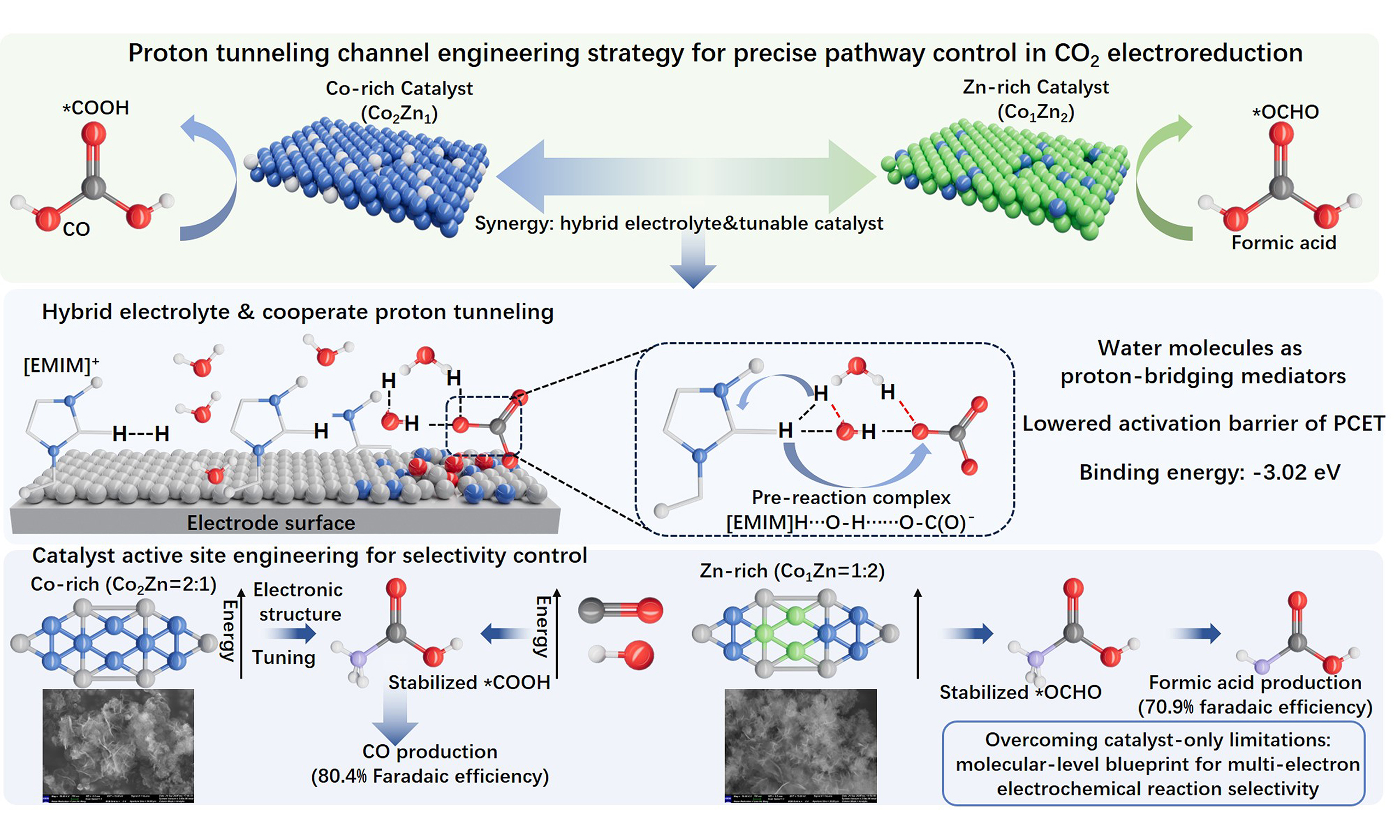
The electrochemical CO2 reduction reaction (CO2RR) holds great promise for closing the anthropogenic carbon cycle, yet conventional aqueous electrolytes epitomized by KHCO3 suffer from intrinsically low CO2 solubility, sluggish mass transport, and poor product selectivity, which collectively hamper catalytic efficiency and pathway controllability. Here, we report a rationally designed hybrid electrolyte system comprising 1-ethyl-3-methylimidazolium chloride ([EMIM]Cl) supplemented with KHCO3, integrated with composition-tunable CoZn oxide nanoflower catalysts, that enables highly efficient and precisely switchable conversion of CO2 to either CO or formic acid (HCOOH). Through an integrated approach combining electrochemical measurements, in situ infrared spectroscopy, and multiscale theoretical simulations (density functional theory + ab initio molecular dynamics), we uncover a previously unrecognized cooperative proton tunneling mechanism: water molecules act as proton-bridging mediators, constructing a linear [EMIM]-H···O-H···O-C(O)- pre-reaction complex at the electrode interface that dramatically lowers the activation barrier of the proton-coupled electron transfer step. Critically, the Co:Zn ratio dictates the electronic structure of active sites; Co centers stabilize *COOH intermediates for CO evolution, whereas Zn centers favor *OCHO stabilization for HCOOH formation. Under optimized conditions, the Co:Zn = 2:1 catalyst achieves a Faradaic efficiency of 80.4% for CO, whereas the Co:Zn = 1:2 counterpart delivers 70.9% for HCOOH. This work establishes a paradigm of “proton tunneling channel engineering” via electrolyte-catalyst synergy, offering a molecular-level blueprint for precise control over multi-electron electrochemical transformations beyond CO2RR.
Keywords
INTRODUCTION
The electrochemical CO2 reduction reaction (CO2RR) offers a transformative route to convert waste CO2 into value-added chemicals using renewable electricity, thereby closing the anthropogenic carbon cycle. Among the possible products, C1 molecules such as carbon monoxide (CO) and formic acid (HCOOH) are particularly attractive from both economic and industrial standpoints: CO is a key syngas component for the Fischer-Tropsch process, while HCOOH serves as a promising hydrogen carrier and platform chemical[1-3]. However, CO2RR inherently involves multi-electron/proton transfer steps, competing reaction intermediates, and the ubiquitous hydrogen evolution reaction (HER), which collectively impose stringent challenges in achieving high Faradaic efficiency (FE), low overpotential, and precise product selectivity[4,5]. Consequently, the rational design of CO2RR systems that can selectively steer the reaction toward a single C1 product, either CO or HCOOH, represents a central frontier in electrocatalysis.
Considerable efforts have been devoted to developing cost-effective, earth-abundant alternatives to noble metal catalysts. The earliest strategy employed monometallic catalysts: cobalt-based materials selectively reduce CO2 to CO via favorable *COOH binding, achieving FE of 60%-80% but suffering from pronounced hydrogen evolution, *CO poisoning, and an inability to produce HCOOH; conversely, zinc-based catalysts favor the *OCHO intermediate for HCOOH generation yet exhibit poor intrinsic activity, rapid corrosion, and FE typically below 70%[6-9]. Neither monometallic Co nor Zn can simultaneously achieve high activity, high selectivity, and long-term stability for a single C1 product. To overcome these limitations, bimetallic CoZn oxide systems leverage complementary properties: Co provides high intrinsic activity for CO2 activation, while Zn modulates the electronic structure of adjacent Co sites via ligand and strain effects and introduces its own selectivity toward *OCHO. The synergistic effects manifest as (i) d-band center tuning that optimizes intermediate adsorption energies, (ii) geometric ensemble effects that isolate Co sites to suppress C-C coupling, (iii) bifunctional active sites where Co activates CO2 and Zn facilitates subsequent protonation, and (iv) composition-dependent selectivity switching that steers the dominant product from CO (Co-rich) to HCOOH (Zn-rich). Indeed, adjusting the Co:Zn ratio enables precise control over the reaction trajectory. Despite these advances, catalyst-centric optimization alone quickly reaches performance ceilings imposed by conventional aqueous electrolytes such as KHCO3, which suffer from low CO2 solubility (≈34 mM), an electric double layer that poorly stabilizes the key *CO2- intermediate, and a high overpotential for CO2 activation[10,11]. As a result, even optimally tuned bimetallic catalysts in KHCO3 exhibit restricted reaction rates, persistent HER competition, and moderate FE ceilings (typically < 85% for CO and < 75% for HCOOH). Thus, there is an urgent need to move beyond purely catalyst-focused strategies and develop innovative electrolyte systems that synergistically interact with the catalyst, rather than serving merely as inert conductive media.
Beyond the constraints of conventional electrolytes, the CO2RR field faces more fundamental challenges that cannot be resolved by catalyst engineering alone. The reaction operates at a gas-liquid-solid three-phase interface, where multiple competing processes CO2 dissolution and diffusion, proton transfer from the electrolyte to the catalyst surface, and electron/proton injection into adsorbed intermediates must be orchestrated simultaneously. From a thermodynamic perspective, the linear scaling relationship between binding energies of key intermediates (*COOH, *CO, *OCHO) imposes an intrinsic limitation: optimizing the catalyst for one intermediate inevitably destabilizes others, making it difficult to achieve both high activity and exclusive selectivity for a single C1 product[12-15]. Moreover, the initial one-electron reduction of CO2 to *CO2- requires a highly negative equilibrium potential (-1.90 V vs. standard hydrogen electrode), representing a substantial thermodynamic barrier that is poorly mitigated by most catalyst designs. From a kinetic standpoint, the proton-coupled electron transfer (PCET) step, the hydrogenation of *CO2- to *COOH (or *OCHO), is rate-determining for most CO2RR pathways. The kinetics of this step are exquisitely sensitive to the interfacial proton availability and local electric field, yet these parameters are difficult to control in conventional aqueous electrolytes where water serves as both the proton source and the solvent[16,17].
The poorly defined hydrogen-bonding network at the electrode/electrolyte interface leads to inefficient proton delivery, forcing the reaction to proceed through high-energy transition states. Furthermore, the competing HER pathway, which involves more facile PCET kinetics, often outruns CO2RR in aqueous media, especially at high overpotentials. These thermodynamic and kinetic bottlenecks represent field-wide challenges that call for innovative strategies beyond conventional catalyst optimization. Recent advances have further demonstrated that interfacial electrolyte engineering can effectively modulate the local reaction environment to enhance CO2RR performance[18,19]. Herein, we report a conceptually distinct hybrid electrolyte system composed of [EMIM]Cl with a controlled amount of KHCO3, which not only retains the CO2-activation benefits of the ionic liquid but also improves mass transfer and supplies a necessary proton source. Integrated with composition-tunable CoZn oxide nanoflower catalysts, this electrolyte-catalyst ensemble achieves a remarkable performance leap: the Co:Zn = 2:1 catalyst delivers a FE of 80.4% for CO, whereas switching the ratio to Co:Zn = 1:2 shifts the selectivity to HCOOH with an FE of 70.9%. Using in situ infrared spectroscopy and density functional theory (DFT) calculations, we unravel the interfacial origin of this enhancement. In conventional KHCO3, the weak K+-H2O interaction yields a loosely structured interface with weak CO2 adsorption and sluggish kinetics. In neat [EMIM]Cl, proton transfer is severely hindered by steric constraints and the high energy barrier for C2-H bond cleavage. Remarkably, in the hybrid [EMIM]Cl/KHCO3 electrolyte, water molecules establish a linear hydrogen-bonded chain [EMIM]-H···O-H···O-C(O)- forming a “pre-reaction complex” that enables a cooperative proton tunneling mechanism. This mechanism synergistically couples proton transfer with electron donation, achieves functional separation (water as the proton shuttle, [EMIM]+ as the proton reservoir), and markedly reduces the activation barrier of the PCET step. By systematically correlating macroscopic electrochemical performance with molecular-level interfacial dynamics, this work establishes a rational electrolyte catalyst design strategy for precise pathway control in CO2RR and underscores the transformative potential of proton tunneling channel engineering for advancing sustainable CO2 conversion technologies beyond conventional catalyst-centric paradigms.
EXPERIMENTAL
Materials
All chemical reagents were used as received without further purification. Specifically, cobalt (II) nitrate hexahydrate (Co(NO3)2·6H2O, 99%), zinc chloride (ZnCl2), tetraethyl orthosilicate (TEOS, > 99%), urea (99.5%), ammonium hydroxide solution (25%~28%), and cetyltrimethylammonium bromide (CTAB) were purchased from Sinopharm Chemical Reagent Co., Ltd. Deionized water was employed for the preparation of all solutions throughout the experimental process.
Material synthesis
Synthesis of mesoporous SiO2 nanospheres
Mesoporous SiO2 nanospheres (MSN) were synthesized according to a reported method[20]. In a typical procedure, 53.2 mL of deionized water was mixed with 64 mL of n-butanol under stirring for 5 min. Then, 2.56 g of CTAB was added, and the mixture was stirred for another 10 min. Subsequently, 28 mL of ammonium hydroxide was quickly injected, and the container was sealed, followed by stirring for 30 min. Finally, 11.2 mL of TEOS was added, and the reaction was allowed to proceed under sealed conditions with continuous stirring for 24 h. The entire process was conducted at a constant temperature of 27 °C. After the reaction, the white solid product was collected, thoroughly washed alternately with deionized water and ethanol, and dried overnight in an oven at 85 °C. The resulting yellowish solid was calcined at 500 °C for 6 h to obtain the final MSN support.
Synthesis of CoZn oxide catalysts
Three catalysts with different Co/Zn molar ratios were prepared. The general synthesis procedure was as follows: A total of 2.5 mmol of cobalt nitrate and ZnCl2 (specific quantities for each ratio are listed in
Metal precursor ratios for the three CoZn oxide catalysts
| Catalyst ID | Co (NO3)2·6H2O/mmol | ZnCl2/mmol | Co:Zn molar ratio |
| 1 | 1.25 | 1.25 | ≈1:1 |
| 2 | 1.70 | 0.80 | ≈2:1 |
| 3 | 0.83 | 1.67 | ≈1:2 |
Physical characterization
Scanning electron microscopy (SEM) was conducted on a Zeiss GeminiSEM300 instrument (Carl Zeiss Microscopy Ltd.). Transmission electron microscopy (TEM) and high-angle annular dark-field scanning TEM (HAADF-STEM) with energy-dispersive X-ray spectroscopy mapping were performed using a FEI Talos F200X instrument (Thermo Fisher Scientific, Waltham, MA, USA). X-ray photoelectron spectroscopy (XPS) was carried out on an ESCALAB 250Xi instrument (Thermo Fisher Scientific, Waltham, MA, USA) using monochromatic Al Kα radiation. X-ray diffraction (XRD) patterns were collected on a Rigaku Ultimate IV diffractometer (Rigaku Corporation, Tokyo, Japan) with Cu Kα radiation. Nitrogen adsorption-desorption isotherms were measured using a Micromeritics 3Flex instrument (Micromeritics Instrument Corporation, Norcross, GA, USA). For in situ attenuated total reflection-fourier-transform infrared spectroscopy (ATR-FTIR) studies, a Thermo Fisher Nicolet IS 50 FTIR spectrometer configured with an MCT/B detector and a VeeMAX III ATR accessory was utilized. A custom three-electrode spectroelectrochemical cell was employed. The working electrode was fabricated by applying a catalyst film onto a gold-sputtered silicon prism. An Ag/AgCl electrode and a platinum wire served as the reference and counter electrodes, respectively. The electrochemical environments consisted of two separate electrolyte systems: (i) 0.1 M KHCO3 aqueous solution saturated with CO2, and (ii) the hybrid electrolyte system composed of 0.06 M KHCO3 + 0.1 M [EMIM]Cl saturated with CO2. The cell was interfaced with a potentiostat, and IR spectra were collected during controlled potential holds across a range from open-circuit potential, 0 to -1.1 V vs. reversible hydrogen electrode (RHE).
Electrochemical evaluation
The electrochemical measurements were performed using a CHI760E electrochemical workstation (CH Instruments, Shanghai) in a conventional two-compartment H-cell separated by a Nafion 117 membrane. A standard three-electrode configuration was employed, consisting of a catalyst-coated working electrode, an Ag/AgCl reference electrode, and a Pt sheet counter electrode. Electrochemical characterization involved linear sweep voltammetry (LSV) conducted at a scan rate of 5 mV/s in CO2-saturated and Ar-saturated electrolytes. The hybrid electrolyte system was prepared by mixing 0.1 M KHCO3 aqueous solution with 1-ethyl-3-methylimidazolium chloride ([EMIM]Cl) in a 3:2 volume ratio. (The hybrid electrolyte system was prepared by first diluting commercial [EMIM]Cl (≥ 98% purity, molecular weight 146.62 g/mol) with deionized water to prepare a 0.25 M [EMIM]Cl stock solution. e.g., 30 mL of 0.1 M KHCO3+20 mL of [EMIM]Cl for larger-scale preparations, or 15 mL + 10 mL for smaller-scale experiments, 0.06 M KHCO3 + 0.1 M [EMIM]Cl. The final electrolyte thus contains approximately 0.06 M KHCO3 and 0.1 M [EMIM]Cl. Electrochemical impedance spectroscopy (EIS) measurements were carried out over a frequency range of
RESULTS AND DISCUSSION
Hierarchical CoZn oxide nanoflowers: morphology, phase and pore architecture
The CoZn oxide catalysts supported on MSN were first examined by SEM and TEM. Regardless of the Co:Zn ratio, all catalysts self-assemble into uniform three-dimensional (3D) flower-like architectures composed of interlaced nanosheets (SEM images of the catalysts are provided in Supplementary Figure 1). This open hierarchical structure provides a high density of accessible active sites and facilitates reactant diffusion, a distinct structural advantage for CO2RR[21,22]. Increasing the Zn content systematically reduces the nanoflower size [Figure 1A-C]. Mechanistically, Zn2+ ions promote nucleation while suppressing Ostwald ripening, acting as a “morphology-directing agent” that balances nucleation promotion and growth inhibition[23,24]. Elemental mapping [Figure 1D] confirms homogeneous distribution of Co, Zn, and Si, verifying successful catalyst loading.
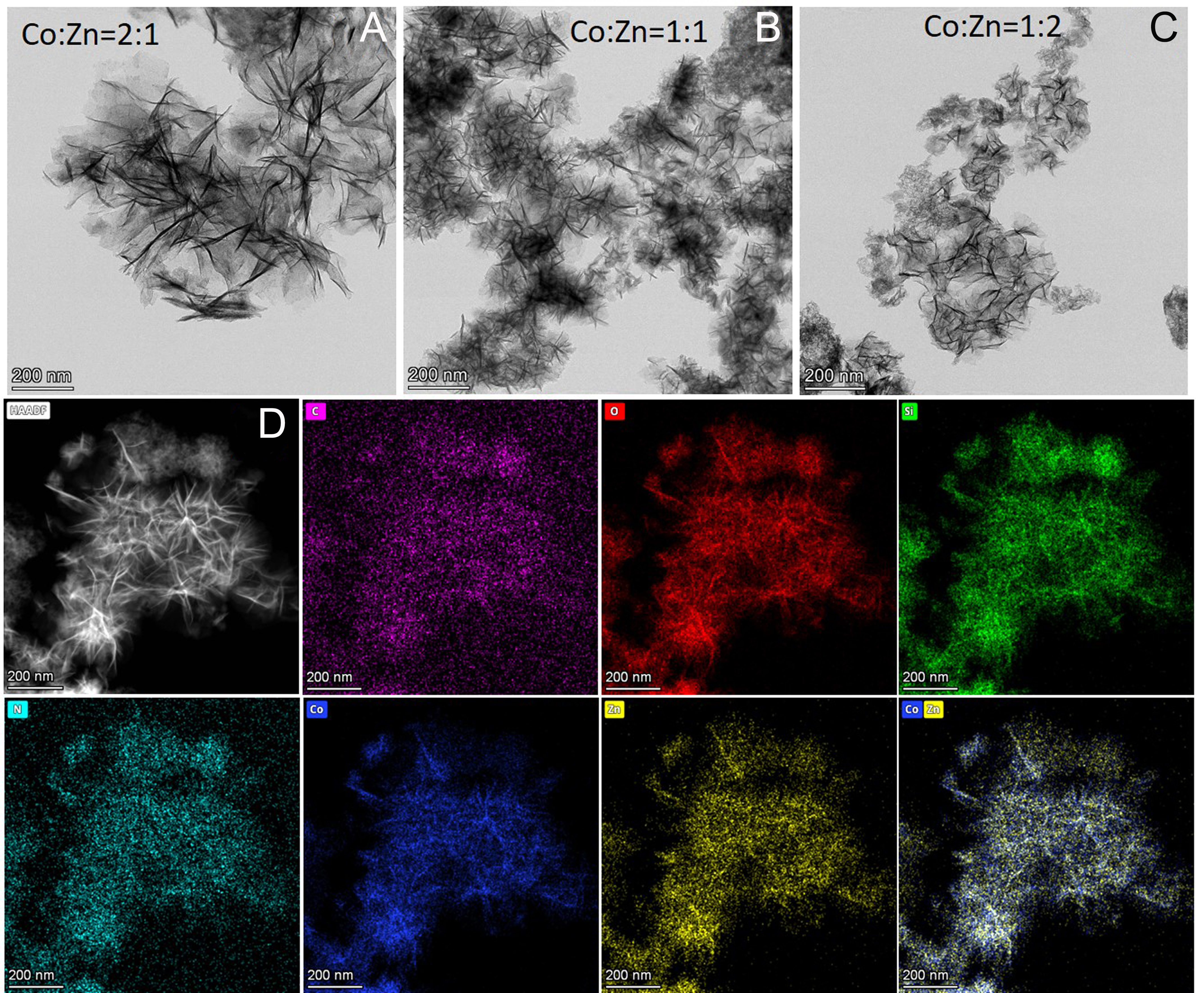
Figure 1. (A-C) TEM images of the three-dimensional flower-like hierarchical catalysts with different Co/Zn molar ratios, revealing their fine morphological features. (D) High-angle annular dark-field scanning TEM image and the corresponding elemental maps of C, O, Si, N, Co, and Zn for the catalyst with a Co/Zn molar ratio of 2:1, confirming the spatially homogeneous distribution of each element within the architecture.
The crystal phase composition and structural evolution of the mesoporous SiO2-supported CoZn oxide catalysts were probed by XRD. As depicted in Figure 2A, the bare mesoporous SiO2 (SiO2-supported CoZn oxide catalysts) support exhibits a characteristic broad diffraction halo centered at around 22.47°, which is indicative of its amorphous nature. Upon the integration of Co and Zn species, distinct crystalline phases emerge. For the catalysts with Co:Zn ratios of 2:1 and 1:1, the XRD patterns reveal well-defined diffraction peaks at 35.31° and 58.90°[25,26]. These peaks can be indexed to the characteristic eflections of a cobalt-zinc composite oxide phase, suggestive of the formation of a crystalline spinel-type structure (e.g., ZnCo2O4)[27]. Notably, a significant phase evolution is observed with a further increase in Zn content. Specifically, the pattern for the Co:Zn = 1:2 catalyst not only retains the aforementioned peaks but also manifests an additional distinct peak at 64.64°. The emergence of this new diffraction feature coincides with the overall pattern more closely aligning with that of a zinc-rich phase, such as ZnO (zincite, JCPDS No. 36-1451), where the peak at ~64.64° corresponds to its (103) crystal
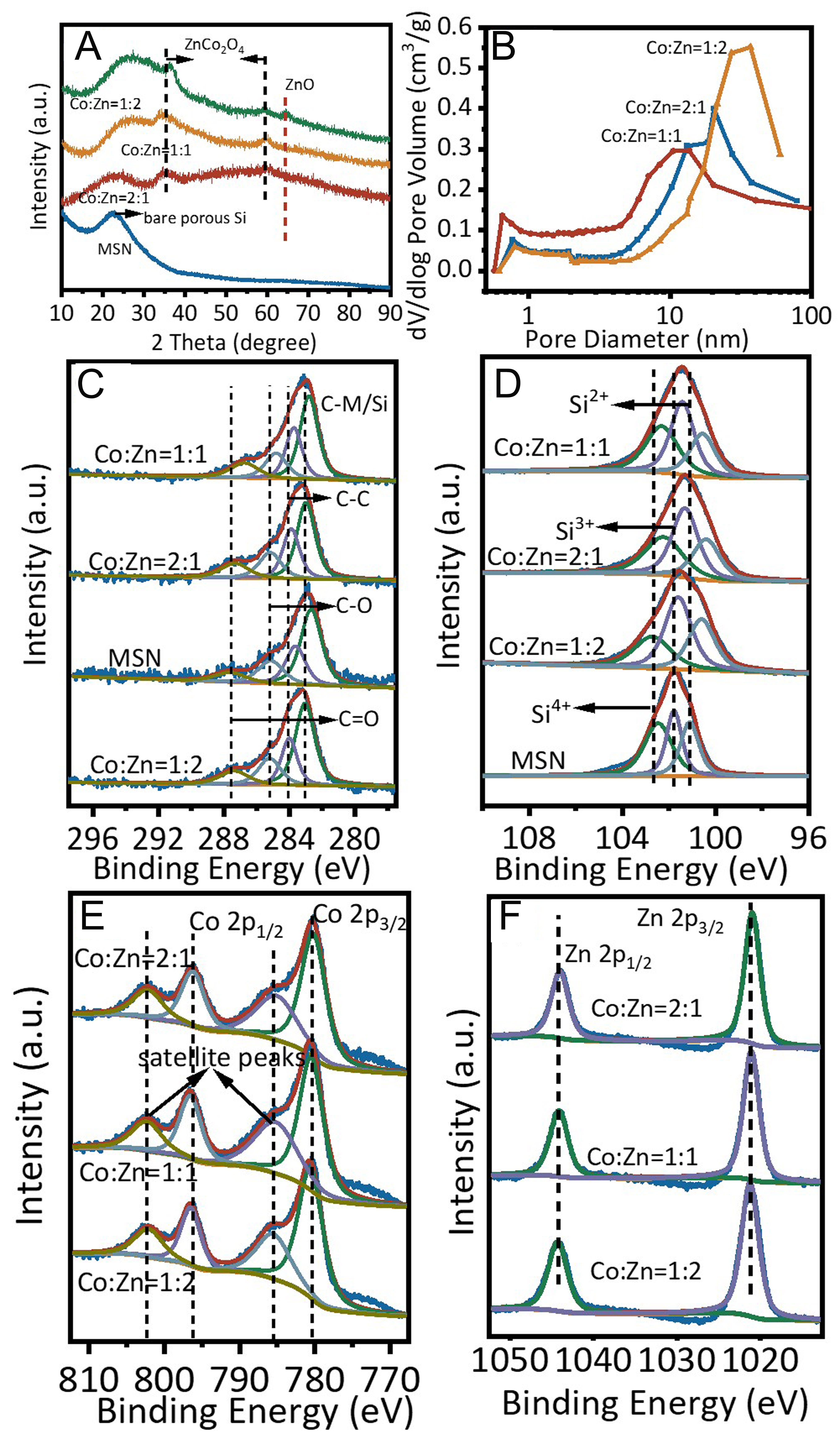
Figure 2. (A) XRD patterns of the three-dimensional flower-like hierarchical catalysts with varied Co/Zn molar ratios. (B) Pore size distribution curves derived from N2 adsorption-desorption isotherms for the corresponding three catalysts. (C-F) High-resolution XPS spectra of catalysts with different Co/Zn molar ratios: (C) C 1s, (D) Si 2p, (E) Co 2p, and (F) Zn 2p core levels.
Electronic structure modulation by Co:Zn ratio: the origin of selectivity switching
To establish a comprehensive correlation between catalyst composition, physicochemical properties, and CO2RR performance, we first conducted systematic compositional and textural characterization of the three CoZn oxide nanoflower catalysts. Inductively coupled plasma optical emission spectroscopy (ICP-OES) analysis [Supplementary Table 1] confirms that the actual Co:Zn molar ratios (0.98:1, 1.95:1, and 0.49:1 for the three catalysts, respectively) are in excellent agreement with the nominal target ratios (≈1:1, ≈2:1, and ≈1:2), validating our precise synthetic control over catalyst composition. Complementary Brunauer-Emmett-Teller (BET) surface area and total pore volume measurements [Supplementary Table 2] reveal systematic textural variations as a function of composition. The Co:Zn = 2:1 catalyst exhibits a BET surface area of
Dramatic enhancement of CO2RR kinetics in hybrid [EMIM]Cl/KHCO3 electrolyte
EIS analysis reveals significant differences between the conventional KHCO3 electrolyte and the innovative [EMIM]Cl/KHCO3 composite electrolyte in the electrocatalytic CO2RR. Bode plots demonstrate that the impedance modulus of the composite electrolyte system is markedly lower than that of the pure KHCO3 system at the same applied potential, indicating a substantial reduction in interfacial charge transfer resistance (Nyquist plots, Figure 3A and B). The difference is most pronounced at less negative potentials and diminishes at more negative potentials due to the increased driving force for charge transfer, which accelerates the kinetics in both systems. Quantitative analysis using equivalent circuit fitting
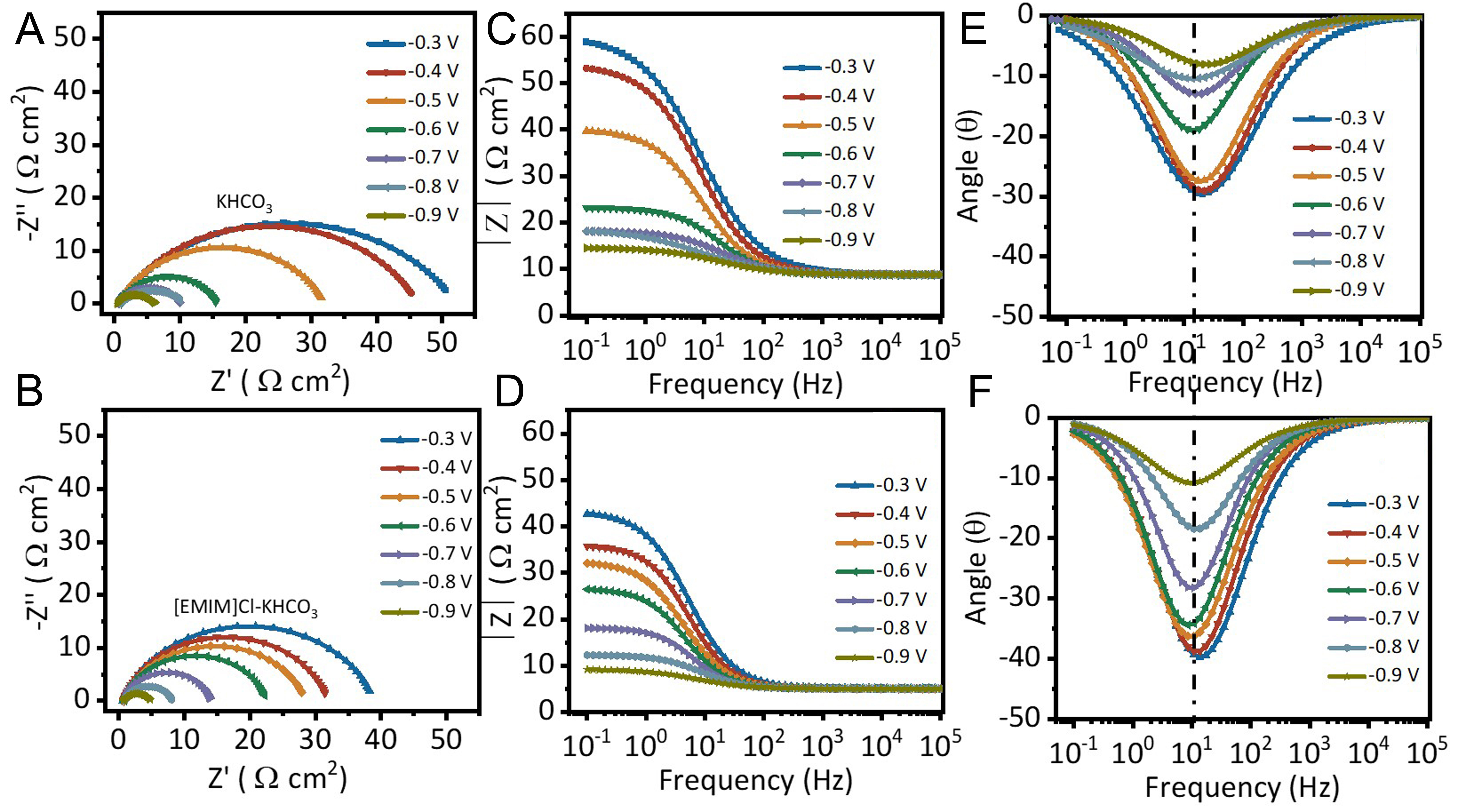
Figure 3. Electrochemical impedance spectroscopy of the catalyst with a Co/Zn molar ratio of 2:1 in (A, C, E) 0.1 M KHCO3 and (B, D, F) 0.06 M KHCO3 + 0.1 M [EMIM]Cl electrolyte. (A and B) Nyquist plot, (C and D) Bode magnitude plot, and (E and F) Bode phase angle plot.
Precise pathway switching: CO vs. HCOOH with record selectivities
This study systematically investigates the regulatory mechanism and synergistic enhancement effects of CoZn oxide nanoflower catalysts in a [EMIM]Cl/KHCO3 composite electrolyte system for the electrocatalytic CO2RR. In the conventional KHCO3 electrolyte [Figure 4A], the LSV curves of all CoZn oxide catalysts under CO2 and Ar atmospheres are nearly superimposable, indicative of negligible electrocatalytic activity toward CO2RR. Here, the current response for CO2RR is indistinguishable from the background current associated with the HER, highlighting the inefficiency of bare KHCO3 in facilitating CO2 activation. In stark contrast, incorporation of the [EMIM]Cl/KHCO3 electrolyte [Figure 4B] elicits a dramatic enhancement in cathodic current density for all catalysts under CO2, with the Co:Zn = 2:1 catalyst exhibiting a significantly enhanced current density (P < 0.01, Student's t-test, n =3) compared to the other compositions. This observation unequivocally demonstrates that the composite electrolyte synergizes with the CoZn oxide catalysts to accelerate CO2RR kinetics and suppress parasitic side reactions. In the pure KHCO3 electrolyte [Figure 4C-E], the product landscape is dominated by CO, HCOOH, and H2, with substantial HER contribution across all potentials and catalyst compositions. A clear composition-dependent selectivity trend emerges: increasing Zn content shifts the primary product from CO (Co:Zn = 2:1) to HCOOH (Co:Zn = 1:2), while the Co:Zn = 1:1 catalyst yields a mixed distribution of CO and HCOOH [Table 2]. This selectivity divergence stems from intrinsic differences in intermediate binding energies at Co and Zn active sites: Co sites bind *COOH and *CO intermediates with moderate strength, favoring the sequential proton-electron transfer steps leading to CO desorption. Conversely, Zn sites exhibit negligible affinity for *CO and preferentially stabilize the *OCHO intermediate, thus steering the reaction toward HCOOH formation via the formate pathway. The product distribution is profoundly altered in the [EMIM]Cl/KHCO3 electrolyte [Figure 4F-H]. Most notably, the Co:Zn = 2:1 catalyst achieves a total FE of 89.5% for C1 products (CO + HCOOH) at a low overpotential of -0.9 V vs. RHE in the [EMIM]Cl/KHCO3 hybrid electrolyte [Figure 4F]. The maximum total C1 FE of 93.81% ± 1.8% is achieved at -1.0 V vs. RHE, accompanied by a marked suppression of HER[7,44-47]. This performance enhancement is attributed to the multi-faceted synergistic effects of the ionic liquid component: (1) [EMIM]+ cations form a robust interfacial adsorption layer, where their C2-H moieties engage in strong non-covalent interactions with negatively charged *CO2- intermediates, stabilizing this high-energy species and lowering the activation barrier for CO2 reduction; (2) the high CO2 solubility and viscosity of the ionic liquid establish a CO2-enriched microenvironment at the electrode electrolyte interface, ensuring a sustained supply of reactant; (3) the unique electric double-layer structure induced by [EMIM]Cl generates a strong interfacial electric field, which polarizes and activates CO2 molecules, while simultaneously excluding water molecules from the active sites to kinetically suppress HER. Collectively, these effects enable the precise compositional tuning of Co/Zn ratios to act as a "selectivity switch" for CO2RR pathways, underscoring the critical role of electrolyte-catalyst engineering in achieving efficient and selective CO2 conversion. To evaluate the stability of [EMIM]Cl under our operating conditions, we performed 1H NMR (nuclear magnetic resonance) spectroscopy on the [EMIM]Cl/KHCO3 hybrid electrolyte before and after 12 h of chronoamperometry at -1.0 V vs. RHE, which corresponds to the optimal CO2RR potential for the Co:Zn = 2:1 catalyst. The NMR spectra (presented in
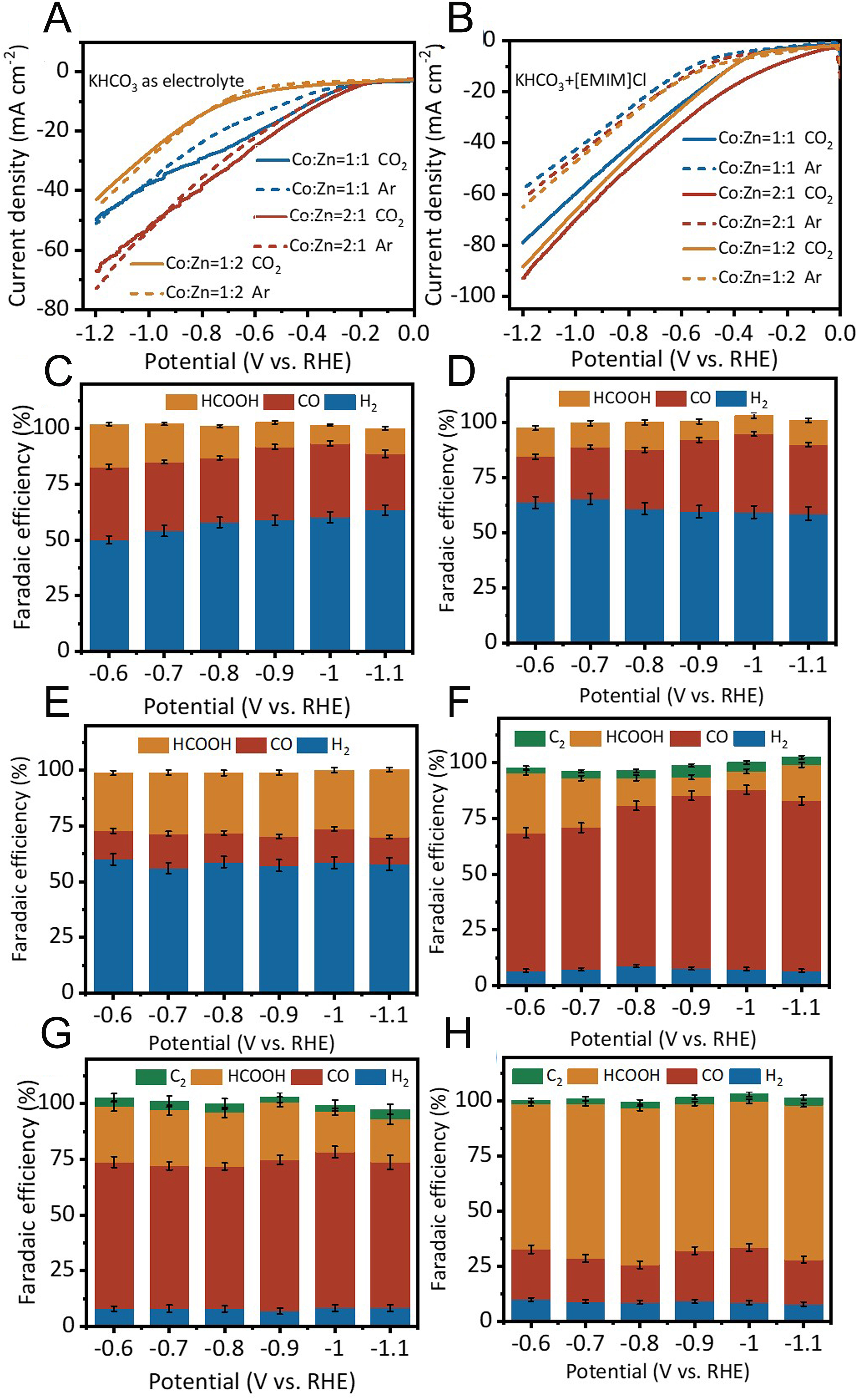
Figure 4. (A) CO2RR polarization curves of catalysts with different Co/Zn molar ratios in 0.1 M KHCO3 electrolyte. (B) CO2RR polarization curves of catalysts with different Co/Zn molar ratios in the composite electrolyte of 0.06 M KHCO3 + 0.1 M [EMIM]Cl. (C-E) Faradaic efficiencies for major products at various applied potentials in 0.1 M KHCO3 electrolyte: (C) Co:Zn = 2:1, (D) Co:Zn = 1:1, (E) Co:Zn = 1:2. (F-H) Faradaic efficiencies for major products at various applied potentials in the composite electrolyte: (F) Co:Zn = 2:1, (G) Co:Zn = 1:1, (H) Co:Zn = 1:2. All potentials are reported vs. the reversible hydrogen electrode (RHE). All error bars represent the standard deviation (SD) from n = 3 independent measurements performed using separately prepared catalyst samples and fresh electrolytes.
Comparison of CO2RR performance under different catalysts and electrolyte conditions
| Catalyst | Electrolyte system | Main product | Faradaic efficiency (%) at -0.9 V vs. RHE | Total faradaic efficiency CO + HCOOH (%) at -0.9/-1.0 V vs. RHE |
| Co:Zn = 2:1 | 0.1 M KHCO3 | CO | 33.1 ± 1.4 | 51.82 ± 1.2 |
| Co:Zn = 2:1 | 0.06 M KHCO3 + 0.1 M [EMIM]Cl | CO | 80.4 ± 2.1 | 89.5 ± 2.3/93.81 ± 1.8 |
| Co:Zn = 1:2 | 0.1 M KHCO3 | HCOOH | 30.1 ± 2.8 | 42.22 ± 1.3 |
| Co:Zn = 1:2 | 0.06 M KHCO3 + 0.1 M [EMIM]Cl | HCOOH | 70.9 ± 1.5 | 89.97 ± 1.9/91.49 ± 2.5 |
In situ spectroscopy reveals enhanced intermediate stabilization
In situ Fourier transform infrared spectroscopy was employed to systematically compare the mechanistic pathways of CO2RR over CoZn oxide catalysts in conventional KHCO3 vs. a [EMIM]Cl/KHCO3 electrolytes. In the conventional KHCO3 electrolyte [Figure 5A and B], the characteristic spectral signals corresponding to the C-OH deformation and asymmetric O-C-O stretching vibrations of the *COOH intermediate (within the 1,190-1,350 cm-1 region) and chemisorbed *CO (at 1,015 cm-1) remained weak, showing only a gradual increase as the potential shifted negatively. This indicates limited catalytic activity toward the CO formation pathway under these conditions. In contrast, within the [EMIM]Cl/KHCO3 electrolyte [Figure 5C and D], the signal intensities in the same spectral regions were substantially enhanced and rose rapidly with increasingly negative potential. This observation can be attributed to the ionic liquid's role in elevating the local CO2 concentration and modulating the interfacial electric field, thereby effectively promoting the formation of the *COOH intermediate and the desorption of *CO. Simultaneously, the Zn-C vibrational peak observed around ~842 cm-1 reveals the synergistic role of Zn sites, whose electronic interaction with the ionic liquid may further optimize the electronic structure of adjacent Co active centers.
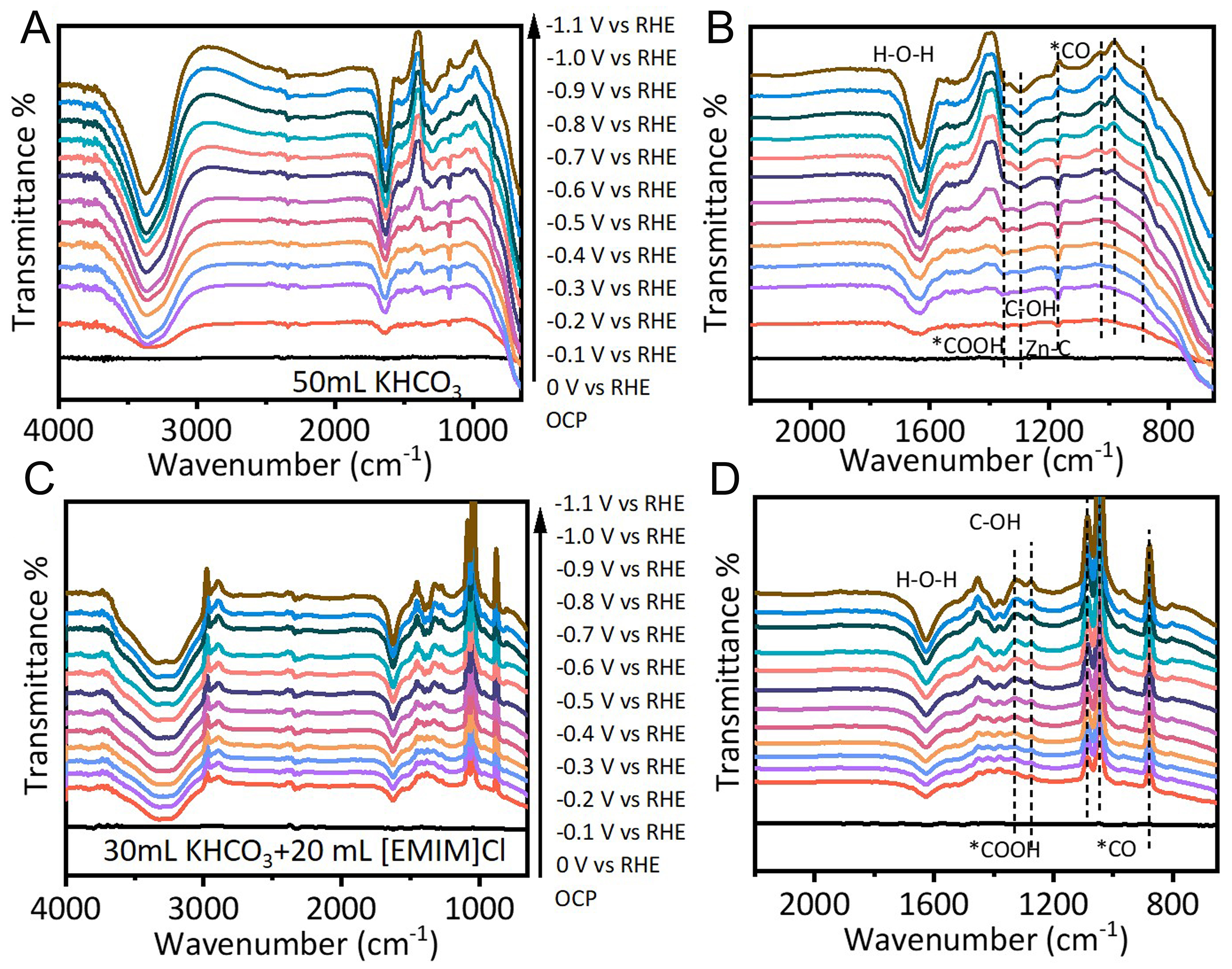
Figure 5. In situ infrared spectra acquired at different applied potentials for the catalyst with Co:Zn = 2:1 in (A and B) KHCO3 and (C and D) KHCO3/[EMIM]Cl electrolyte, showing (A and C) the full-range spectra and (B and D) the spectral features in specific wavenumber regions. All four subfigures share the same color scheme, where each color corresponds to a specific applied potential (from 0 to -1.1 V vs. RHE, as indicated in the legend of (A), which applies to all panels.
Molecular mechanism: cooperative proton tunneling via a linear hydrogen-bonded pre-reaction complex
To systematically elucidate the intrinsic influence of the electrolyte microenvironment on the performance of the electrocatalytic CO2RR, this study integrates macroscopic electrochemical experiments with multiscale theoretical simulations. By constructing three characteristic interfacial models, namely, the conventional KHCO3 aqueous solution, the anhydrous [EMIM]Cl ionic liquid, and [EMIM]Cl/KHCO3, and combining DFT calculations with ab initio molecular dynamics (AIMD) simulations, we unravel at the molecular level the regulatory mechanism of the interfacial hydrogen-bonding network on proton transfer pathways and reaction energy barriers. The computational results reveal that in the conventional KHCO3 system, the interface features a disordered weak interaction network of K+···OH-···OC(O)- formed by water molecules and K+, with a binding energy of only -1.1 eV [Figure 6A]. This nonspecific adsorption is identified as the key factor responsible for the high overpotential. In the pure [EMIM]Cl system, although [EMIM]+ cations are enriched at the cathode interface, proton transfer is severely hindered due to steric hindrance between the imidazole ring and the ·CO2- intermediate, as well as the excessively high energy barrier for direct cleavage of the C2-H bond. The binding energy is even lower (-0.73 eV, Figure 6B), confirming the thermodynamic and kinetic unfavorability of the direct proton transfer pathway in the absence of a proton carrier. Upon introducing water to form the [EMIM]Cl/KHCO3 hybrid electrolyte, the interfacial proton transfer mechanism undergoes a fundamental transformation. DFT calculations reveal that water molecules act as proton-bridging media, simultaneously forming strong hydrogen bonds with the C2-H of [EMIM]+ and the oxygen atom of ·CO2-, thereby constructing a linear [EMIM]-H···O-H···O-C(O)- pre-reaction complex. This configuration, through cooperative hydrogen bonding, substantially enhances the binding energy to -3.02 eV [Figure 6C], greatly stabilizing the key intermediate. The core of this mechanism lies in the synergistic proton tunneling process: the formation of the hydrogen-bond chain weakens the C2-H and O-H bonds, coupling proton transfer with electron donation. This process achieves functional separation [EMIM]+ serves as the proton donor, while water molecules act as an efficient proton transfer shuttle, thereby substantially reducing the activation energy of the PCET step.
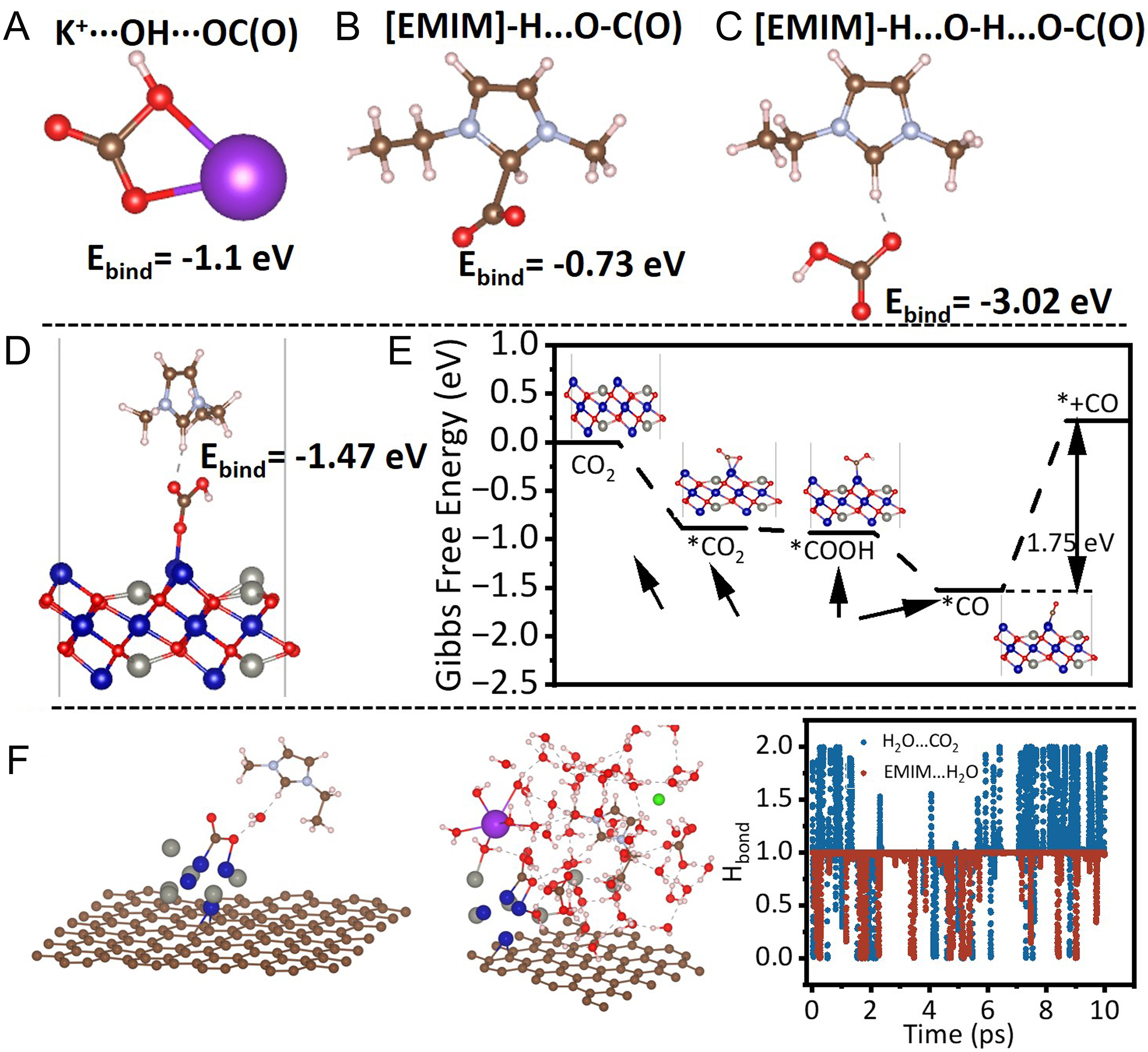
Figure 6. (A) Disordered K+···OH-···OC(O)- in conventional KHCO3: weak interactions, -1.1 eV. (B) Pure [EMIM]Cl: steric hindrance lowers binding to -0.73 eV, hindering direct proton transfer. (C) Linear [EMIM]-H···O-H···O-C(O)- network in [EMIM]Cl/KHCO3 hybrid: binding enhanced to -3.02 eV, highlighting water as proton-bridging mediator. (D) Adsorption of key [EMIM]-H···O-H··· complex on CoZn oxide nanoflower: binding energy -1.47 eV, confirming active species stabilization. (E) Reaction free energy diagram: thermodynamic favorability of CO production pathway validated. (F) AIMD snapshot (10 ps): transient linear H-bonding network between [EMIM]+ and ·CO2- mediated by water, evidencing the synergistic proton tunneling mechanism.
Furthermore, the adsorption behavior of the pre-reaction complex [EMIM]-H···O-H··· on the CoZn oxide nanoflower catalyst surface was calculated, yielding a binding energy as high as -1.47 eV [Figure 6D], confirming the effective stabilization of this active species on the catalyst surface. Combined with the analysis of the reaction free energy diagram [Figure 6E], the thermodynamic favorability of this pathway for CO production is validated. To capture the dynamic interfacial behavior under realistic operating conditions, we performed AIMD simulations [Figure 6F]. The results show that during a 10 ps dynamic evolution, water molecules continuously construct and reconstruct transient linear [EMIM]-H···O-H···O-C(O)- hydrogen-bond networks between [EMIM]+ and ·CO2-. This dynamic hydrogen-bridging mechanism provides atomistic evidence for the existence and sustainability of the aforementioned synergistic proton tunneling pathway, revealing the efficient synergy between proton supply and transfer channels in the hybrid electrolyte system. These findings offer a clear molecular-level foundation for designing low-overpotential electrolyte environments for CO2RR.
CONCLUSION
In summary, we have established a synergistic electrolyte-catalyst engineering strategy that enables precise manipulation of CO2 reduction pathways through a cooperative proton tunneling mechanism. By integrating a hybrid [EMIM]Cl/KHCO3 electrolyte with composition-tunable CoZn oxide nanoflower catalysts, we achieved exceptional selectivity control: the Co:Zn = 2:1 catalyst delivers a FE of 80.4% for CO, while the Co:Zn = 1:2 counterpart yields 70.9% for HCOOH, both at substantially reduced overpotentials compared to conventional KHCO3 systems. Mechanistically, we unraveled a previously unrecognized cooperative proton tunneling pathway enabled by the unique interfacial hydrogen-bonding network. Water molecules act as proton-bridging mediators, constructing a linear [EMIM]-H···O-H···O-C(O)- pre-reaction complex at the electrode/electrolyte interface. This configuration dramatically enhances the binding energy to -3.02 eV and lowers the activation barrier of the PCET step, as revealed by DFT calculations. AIMD simulations further demonstrate the dynamic persistence of this hydrogen-bonded architecture under operating conditions, confirming its functional role in sustaining efficient proton transfer. Critically, the electronic structure modulation arising from tunable Co/Zn ratios, evidenced by systematic XPS binding energy shifts, governs the adsorption energetics of key intermediates (*COOH vs. *OCHO), thereby dictating the ultimate product selectivity. The hybrid electrolyte does not merely serve as a passive medium; it actively participates in the rate-determining PCET step, amplifying the intrinsic selectivity differences between Co and Zn sites. This work introduces the concept of “proton tunneling channel engineering” as a design principle for next-generation CO2 reduction systems. Beyond achieving record-high selectivities, our findings establish a molecular-level blueprint for electrolyte-catalyst synergy that transcends conventional catalyst-centric paradigms. The demonstrated strategy opens new avenues for precise control over multi-electron electrochemical reactions, including but not limited to CO2RR, and underscores the transformative potential of rational electrolyte design in advancing sustainable energy conversion technologies.
DECLARATIONS
Authors' contributions
Made substantial contributions to formal analysis, visualization, and writing, review and editing: Hu, Y.; Wang, N.
Made substantial contributions to project administration, funding acquisition, and supervision: Lin, X.;
All authors have read and approved the final manuscript.
Availability of data and materials
The data supporting the findings of this study are available within the article and its Supplementary Materials. Additional raw data (including original microscopy images, electrochemical measurements, and DFT calculation inputs and outputs) are available from the corresponding authors upon reasonable request.
AI and AI-assisted tools statement
During the preparation of this manuscript, the AI tool Deepseek (version DeepSeek-V3.2, released 2025-12-01) was used solely for language polishing and grammar checking. The tool did not influence the study design, data collection, analysis, interpretation, or the scientific content of the work. All authors take full responsibility for the accuracy, integrity, and final content of the manuscript.
Financial support and sponsorship
This work was supported by the National Natural Science Foundation of China (No. 52174255), funding of the Department of Education of Guangdong province (2022KQNCX072), Natural Science Foundation of Top Talent of SZTU (grant GDRC202315), Guangdong Basic and Applied Basic Research Foundation (2024A1515012363), and Pingshan District Innovation Platform Project of Shenzhen Hi-tech Zone Development Special Plan in 2022 (29853M-KCJ-2023-002-02). This work was supported by the project of the research on the electrochemical reaction mechanism of the anode of medium-low temperature direct ammonia SOFCs (2022ZDZX3024), the project of all solid-state high energy density energy storage system (20221063010031), and the project of Shenzhen Overseas Talent upon Industrialization of 1 kW stack for direct ammonia SOFCs (GDRC202102).
Conflicts of interest
All authors declared that there are no conflicts of interest.
Ethical approval and consent to participate
Not applicable.
Consent for publication
Not applicable.
Copyright
© The Author(s) 2026.
Supplementary Materials
REFERENCES
1. Zhang, W.; Jin, Z.; Chen, Z. Rational-designed principles for electrochemical and photoelectrochemical upgrading of CO2 to value-added chemicals. Adv. Sci. 2022, 9, 2105204.
2. Jiang, M.; Wang, H.; Zhu, M.; et al. Review on strategies for improving the added value and expanding the scope of CO2 electroreduction products. Chem. Soc. Rev. 2024, 53, 5149-89.
3. Kumar De, S.; Won, D.; Kim, J.; Kim, D. H. Integrated CO2 capture and electrochemical upgradation: the underpinning mechanism and techno-chemical analysis. Chem. Soc. Rev. 2023, 52, 5744-802.
4. Liu, L.; Deng, C.; Xu, Y.; et al. Advancing CO2 upgrading to multicarbon products: synergies between photo/electrochemical and biological conversion. Adv. Funct. Mater. 2025, 36, e13716.
5. Wang, C.; Lv, Z.; Feng, X.; Yang, W.; Wang, B. Recent advances in electrochemical CO2-to-multicarbon conversion: from fundamentals to industrialization. Adv. Energy. Mater. 2023, 13, 2302382.
6. Chen, Z.; Zhang, G.; Du, L.; Zheng, Y.; Sun, L.; Sun, S. Nanostructured cobalt-based electrocatalysts for CO2 reduction: recent progress, challenges, and perspectives. Small 2020, 16, 2004158.
7. Li, N.; Si, D.; Wu, Q.; Wu, Q.; Huang, Y.; Cao, R. Boosting electrocatalytic CO2 reduction with conjugated bimetallic Co/Zn polyphthalocyanine frameworks. CCS. Chem. 2023, 5, 1130-43.
8. Zhu, W.; Zhang, L.; Liu, S.; et al. Enhanced CO2 electroreduction on neighboring Zn/Co monomers by electronic effect. Angew. Chem. Int. Ed. 2020, 59, 12664-8.
9. Gong, Y.; Yang, X.; Zhang, Y.; et al. Constructing asymmetric-electron-density Pd-Zn dual-atoms on N-doped defective mesoporous carbon for electrochemical reduction of CO2. Chem. Eng. J. 2024, 500, 156603.
10. Khiarak, B. N.; Da Silva, G. T. S. T.; Lai, H. D. T.; et al. Integrated carbon dioxide capture and electrochemical conversion: chemistry, electrode and electrolyzer design, and economic viability. Adv. Energy. Mater. 2025, 16, e02564.
11. Lai, W.; Qiao, Y.; Wang, Y.; Huang, H. Stability issues in electrochemical CO2 reduction: recent advances in fundamental understanding and design strategies. Adv. Mater. 2023, 35, 2306288.
12. Zeng, S.; Zhang, X.; Bai, L.; et al. Ionic-liquid-based CO2 capture systems: structure, interaction and process. Chem. Rev. 2017, 117, 9625-73.
13. Wang, Y.; Wang, Y.; Zhao, Y.; Fu, J.; Liu, Z. Ionic liquids promoted transformation of carbon dioxide. Chem. Rev. 2025, 125, 6057-129.
14. Fortunati, A.; Risplendi, F.; Re Fiorentin, M.; et al. Understanding the role of imidazolium-based ionic liquids in the electrochemical CO2 reduction reaction. Commun. Chem. 2023, 6, 84.
15. Dongare, S.; Zeeshan, M.; Aydogdu, A. S.; et al. Reactive capture and electrochemical conversion of CO2 with ionic liquids and deep eutectic solvents. Chem. Soc. Rev. 2024, 53, 8563-631.
16. Eisele, L.; Bica-Schröder, K. Photocatalytic carbon dioxide reduction with imidazolium-based ionic liquids. ChemSusChem 2025, 18, e202402626.
17. Fu, Z.; Zhang, J.; Wu, H.; et al. Ionic liquids functionalized copper catalytic systems for electrocatalytic carbon dioxide reduction. ChemCatChem 2024, 16, e202401049.
18. Liu, M.; Zhang, C.; Ying, Y.; et al. Optimization strategies for enhancing the stability of Cu-based catalysts. Mater. Rep. Energy. 2025, 5, 100355.
19. Ke, X.; Xu, W.; Liu, C.; et al. Innovative electrode designs for low-temperature electrochemical CO2 reduction with ampere-level performance. Energy. Environ. Sci. 2025, 18, 7792-858.
20. Song, J.; Sun, H.; Yao, S.; et al. Semi-confinement effect enhances CH4 and C2H4 production in CO2 electrocatalytic reduction. Small 2025, 21, 2411491.
21. Long, Y.; Tao, Y.; Shang, T.; et al. Roles of metal ions in MXene synthesis, processing and applications: a perspective. Adv. Sci. 2022, 9, 2200296.
22. Cai, G.; Yan, P.; Zhang, L.; Zhou, H.; Jiang, H. Metal-organic framework-based hierarchically porous materials: synthesis and applications. Chem. Rev. 2021, 121, 12278-326.
23. Chu, L.; Shen, H.; Wei, H.; Chen, H.; Ma, G.; Yan, W. Morphology engineering of ZnO micro/nanostructures under mild conditions for optoelectronic application. Int. J. Miner. Metall. Mater. 2024, 32, 498-503.
24. Zheng, Y.; Yang, J.; Liu, Z.; Qiao, Z. A. Multi-component crystalline mesoporous materials: synthesis principle and application. Adv. Mater. 2025, 37, e10911.
25. Lin, Z.; Li, L.; Xi, C.; et al. Fabrication of the hollow dodecahedral NiCoZn layered double hydroxide for high-performance flexible asymmetric supercapacitor. J. Colloid. Interface. Sci. 2024, 657, 91-101.
26. Han, G.; Liu, C.; Pan, Y.; et al. Artificial photosynthesis over tubular In2O3/ZnO heterojunctions assisted by efficient CO2 activation and S-scheme charge separation. Adv. Sustain. Syst. 2022, 7, 2200381.
27. Khlifi, N.; Ihzaz, N.; Toulemonde, O.; et al. Cobalt-doped ZnO nanoparticles and PLD-deposited thin film forms: structure, optical properties and nature of magnetic anisotropy. RSC. Adv. 2024, 14, 27622-33.
28. Meng, K.; Zhang, J.; Cheng, B.; et al. Plasmonic near-infrared-response S-scheme ZnO/CuInS2 photocatalyst for H2O2 production coupled with glycerin oxidation. Adv. Mater. 2024, 36, 2406460.
29. Hao, H.; Wang, Y.; Katyal, N.; et al. Molybdenum carbide electrocatalyst in situ embedded in porous nitrogen-rich carbon nanotubes promotes rapid kinetics in sodium-metal-sulfur batteries. Adv. Mater. 2022, 34, 2106572.
30. Shao, W.; Ling, Y.; Peng, H.; et al. Ion irradiation-induced coordinatively unsaturated Zn sites for enhanced CO hydrogenation. J. Am. Chem. Soc. 2025, 147, 5703-13.
31. Dong, C.; Mu, R.; Li, R.; et al. Disentangling local interfacial confinement and remote spillover effects in oxide-oxide interactions. J. Am. Chem. Soc. 2023, 145, 17056-65.
32. Deng, S.; Li, J.; Zewdie, G. M.; et al. Mg-doped porous silicon derived from silica aerogels for fast and stable zinc-ion hybrid capacitors with high capacitance. Adv. Funct. Mater. 2023, 34, 2311259.
33. Zhao, Y.; Zhang, L.; Liu, Q.; et al. An ultrafast charge-driven topological intercalation prelithiation strategy for carbon-silicon composite anodes. Adv. Sci. 2025, 12, e06636.
34. Mittal, S. K.; Yadav, K. L. A sustainable synthesis of mesoporous Mn1-xNixCo2O4 nanoparticles: exploring calcination effects on supercapacitor performance. Nanoscale 2025, 17, 26257-70.
35. França, M. C.; Lima, I. S.; Ghorbani, A.; et al. Co(1–x-y)FexZny-glycerolate microspheres as electrocatalysts for the oxygen evolution reaction. ACS. Appl. Energy. Mater. 2025, 8, 12618-26.
36. Wang, Z.; Wu, P.; Zou, X.; et al. Optimizing the oxygen-catalytic performance of Zn-Mn-Co spinel by regulating the bond competition at octahedral sites. Adv. Funct. Mater. 2023, 33, 2214275.
37. Jiang, H.; Zhang, Y.; Waqar, M.; et al. Anomalous Zn2+ storage behavior in dual-ion-in-sequence reconstructed vanadium oxides. Adv. Funct. Mater. 2022, 33, 2213127.
38. Nkurunziza, F.; Dongare, S.; Chatterjee, S.; et al. Alkali cation inhibition of imidazolium-mediated electrochemical CO2 reduction on silver. J. Am. Chem. Soc. 2025, 147, 7564-77.
39. Dongare, S.; Coskun, O. K.; Cagli, E.; et al. A bifunctional ionic liquid for capture and electrochemical conversion of CO2 to CO over silver. ACS. Catal. 2023, 13, 7812-21.
40. Wang, Q.; Liu, Y.; Tan, Y.; et al. Enhanced acidic CO2-to-C2+ reduction via ionic liquid layer modification. Small 2025, 21, 2412293.
41. Chi, L. P.; Zhang, Y. C.; Niu, Z. Z.; et al. Acidic CO2 electrolysis with near-ideal selectivity and carbon efficiency enabled by overcoming its inherent trade-off. Angew. Chem. Int. Ed. 2025, 64, e202503539.
42. Zhang, Q.; Musgrave, C. B.; Song, Y.; et al. A covalent molecular design enabling efficient CO2 reduction in strong acids. Nat. Synth. 2024, 3, 1231-42.
43. Zhang, H.; Liu, S.; Zhang, C.; et al. Lattice hydrogen participation and mass transport acceleration improve CO2 electroreduction to C2 products. Angew. Chem. Int. Ed. 2025, 65, e18519.
44. Liu, T.; Luo, H.; Ouyang, T.; Liu, Z. Q. In situ exsolved CuZn alloy electrocatalysts for CO2 conversion to tunable syngas production. Adv. Funct. Mater. 2024, 35, 2415367.
45. Rooney, C. L.; Lyons, M.; Wu, Y.; et al. Active sites of cobalt phthalocyanine in electrocatalytic CO2 reduction to methanol. Angew. Chem. Int. Ed. 2023, 136, e202310623.
46. Rosen, J.; Hutchings, G. S.; Lu, Q.; Forest, R. V.; Moore, A.; Jiao, F. Electrodeposited Zn dendrites with enhanced CO selectivity for electrocatalytic CO2 reduction. ACS. Catal. 2015, 5, 4586-91.
Cite This Article
 Open Access
How to Cite
Download Citation
Export Citation File:
Type of Import
Tips on Downloading Citation
Citation Manager File Format
Type of Import
Direct Import: When the Direct Import option is selected (the default state), a dialogue box will give you the option to Save or Open the downloaded citation data. Choosing Open will either launch your citation manager or give you a choice of applications with which to use the metadata. The Save option saves the file locally for later use.
Indirect Import: When the Indirect Import option is selected, the metadata is displayed and may be copied and pasted as needed.
About This Article
Special Topic
Copyright

Data & Comments
Data
0











Comments
Comments must be written in English. Spam, offensive content, impersonation, and private information will not be permitted. If any comment is reported and identified as inappropriate content by OAE staff, the comment will be removed without notice. If you have any queries or need any help, please contact us at [email protected].