

fig6

Synergistic dipole and pseudo-hydrogen bonding in phosphate electrolytes for stable elevated temperature lithium batteries

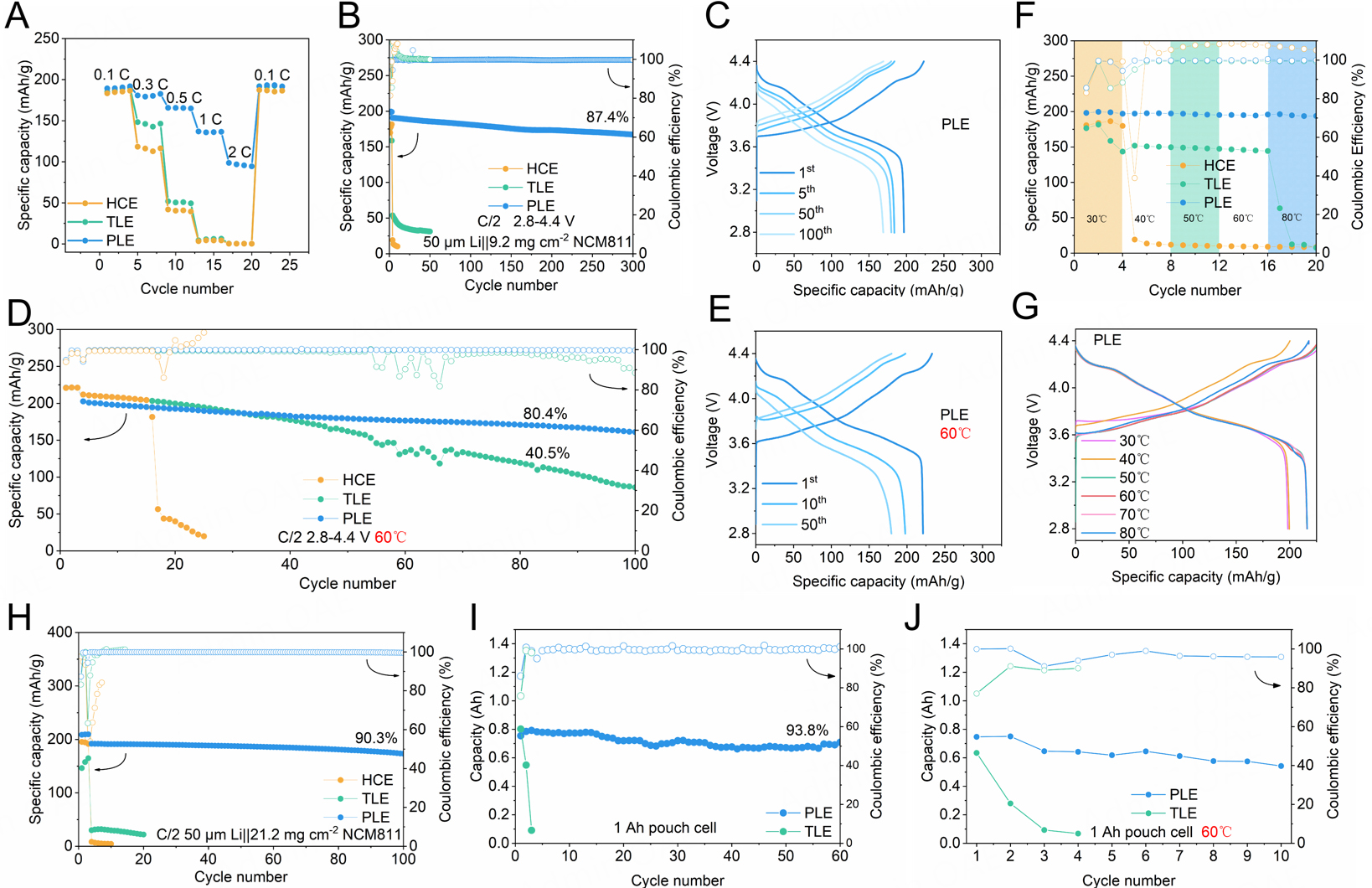
Figure 6. Electrochemical properties. (A) Rate capability of Li||NCM811 cells with HCE, TLE and PLE electrolytes. (B) Cycling performance of Li (50 μm) || NCM811 (9.2 mg cm-2) cells with HCE, TLE and PLE electrolytes at 30 °C. (C) Charge/discharge curves of a Li||NCM811 cell with PLE electrolyte at 30 °C. (D) Cycling performance of the Li (50 μm)||NCM811 (9.2 mg cm-2) cells with HCE, TLE and PLE electrolytes at 60 °C and (E) Charge/discharge curves. (F) Temperature-controlled cycling performance of the Li (50 μm) || NCM811 (9.2 mg cm-2) cells and (G) Corresponding charge/discharge curves. (H) Cycling performance of the Li (50 μm) || NCM811 (21.2 mg cm-2) cells with HCE, TLE and PLE electrolytes at 30 °C. (I) Cycling performance of 1 Ah Li||NCM811 pouch cell using PLE under a 3-4.3 V operating voltage window at 30 °C. (J) Cycling performance of 1 Ah Li||NCM811 pouch cell at 60 °C.

Energy Materials
ISSN 2770-5900 (Online)
Follow Us

Portico

All published articles are preserved here permanently:

https://www.portico.org/publishers/oae/

Portico

All published articles are preserved here permanently:

https://www.portico.org/publishers/oae/