
fig3

Insights on electrolyte engineering toward aqueous zinc-ion batteries

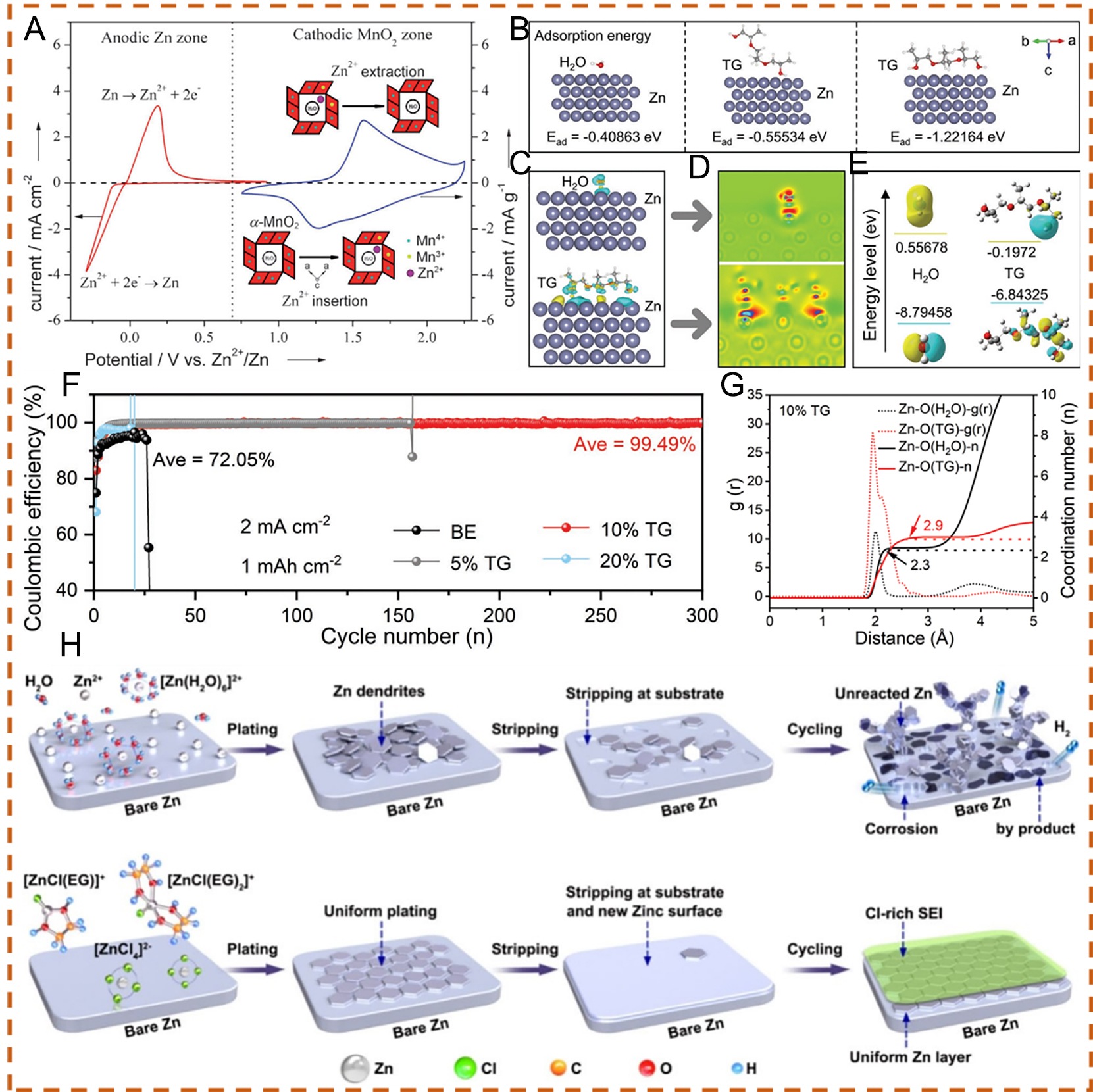
Figure 3. (A) Cyclic voltammograms of the Zn anode (red line) and the amorphous manganese dioxide (a-MnO2) cathode (blue line) at 2 mVs-1 in 0.1 mol L-1 Zn(NO3)2 aqueous electrolyte (pH 5.2) (Reproduced with permission from[96]. Copyright 2012, Wiley-VCH Verlag GmbH & Co. KGaA, Weinheim). (B) Comparison of the absorption energies of H2O and TG molecules on the Zn (002) crystal plane. (C) Difference in charge density between Zn slabs placed in parallel with TG or H2O, along with the corresponding isosurfaces (yellow and green clusters represent electron density accumulation and depletion, respectively). (D) Corresponding two-dimensional (2D) contour map showing the interaction between Zn metal and TG or H2O. (E) Lowest unoccupied molecular orbital (LUMO) and highest occupied molecular orbital (HOMO) isosurfaces of H2O (left) and TG molecules (right). (F) Coulombic efficiency of Zn/Cu cells in different electrolytes at 2 mA cm-2 and 1 mAh cm-2. (G) Radial distribution functions and coordination numbers of Zn-O (TG) and Zn-O (H2O) in 10% TG electrolytes. (B-G) Reproduced with permission from[74]. Copyright 2023, Wiley-VCH GmbH. (H) Schematic illustrations of Zn plating/stripping in aqueous electrolytes (top) and deep eutectic solvent (DES)-4 (bottom) (Reproduced with permission from[75]. Copyright 2022, Wiley-VCH GmbH).

Energy Materials
ISSN 2770-5900 (Online)
Follow Us

Portico

All published articles are preserved here permanently:

https://www.portico.org/publishers/oae/


Portico

All published articles are preserved here permanently:

https://www.portico.org/publishers/oae/