

fig5
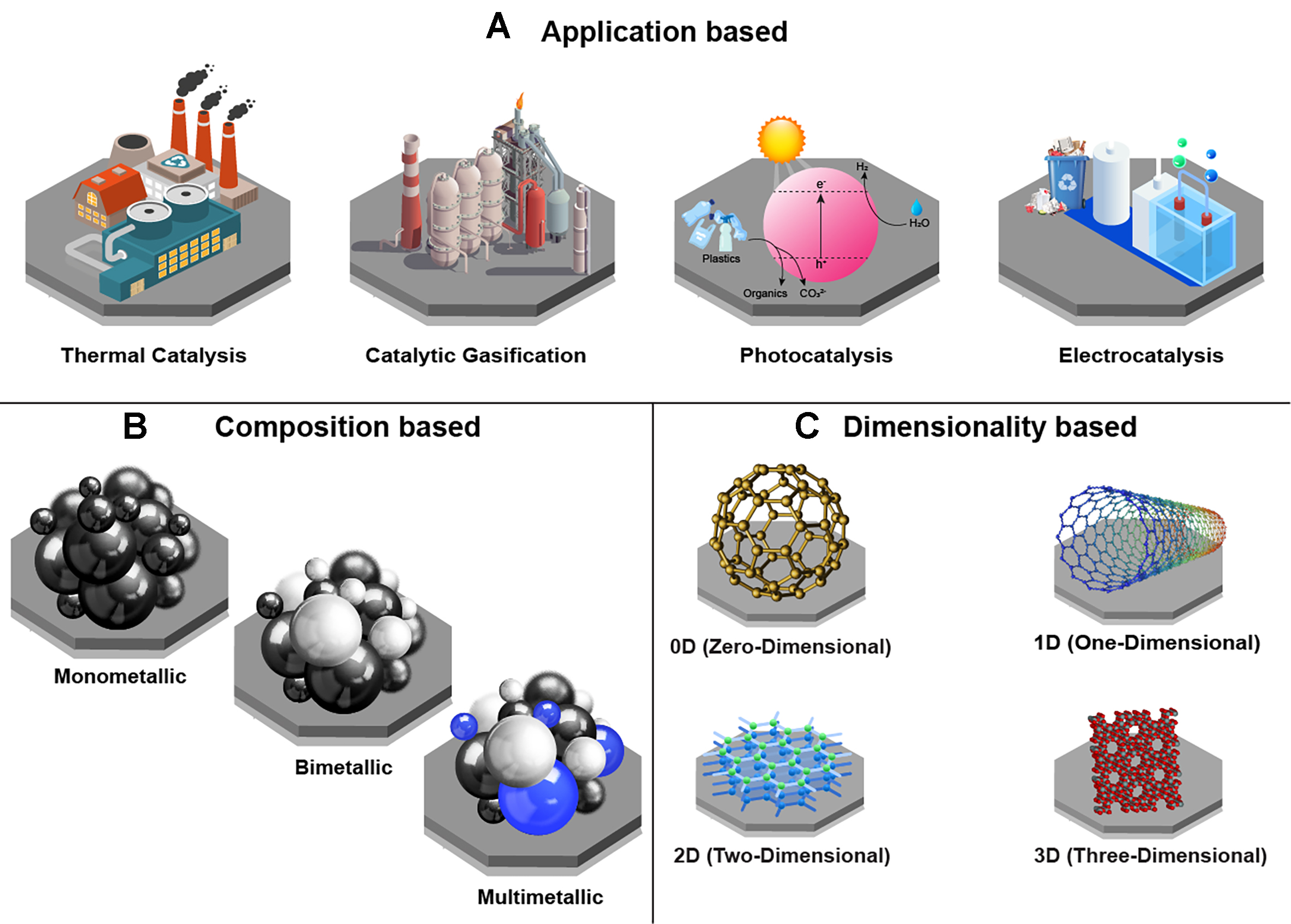
Figure 5. Illustration of catalyst types (A) Application-based classes: thermal catalysis, catalytic gasification, photocatalysis, and electrocatalysis (B) Composition-based classes: monometallic, bimetallic, and multimetallic catalysts. The coloured spheres represent different elemental species within the catalyst, where grey/black spheres denote primary metal atoms and differently coloured spheres (e.g., blue and white) indicate secondary metals or dopant elements. (C) Dimensionality-based nanomaterials: 0D, 1D, 2D, and 3D architectures. The spheres represent atomic positions within the nanostructures, while different colours are used to distinguish atomic arrangements or lattice coordination in various dimensional configurations (e.g., nanoparticles, nanotubes, nanosheets, and bulk structures).