

fig3
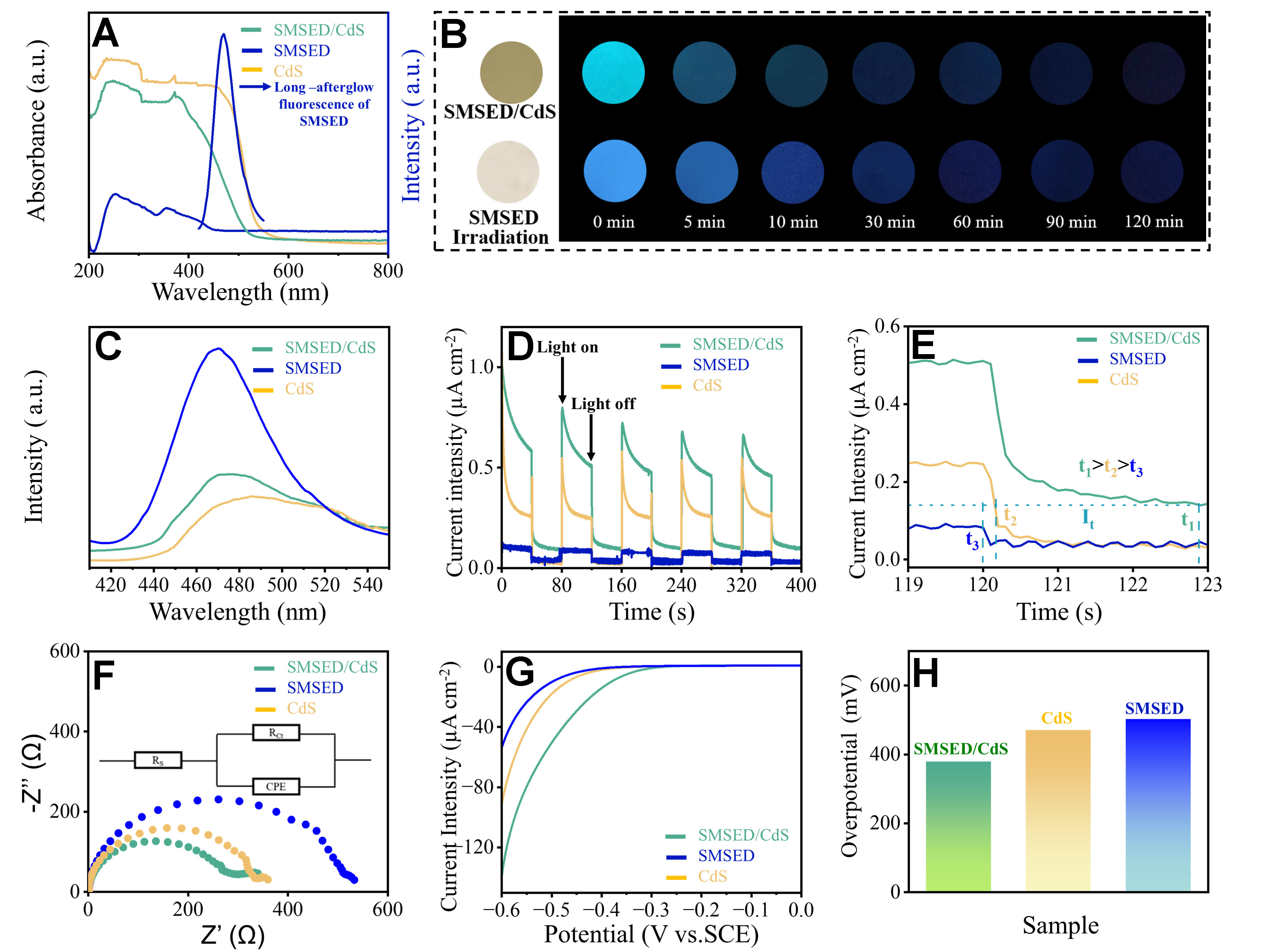
Figure 3. (A) UV-vis DRS of CdS, SMSED, and SMSED/CdS, as well as the long-afterglow spectra of SMSED under 380 nm excitation; (B) Photographs of SMSED/CdS and SMSED under light irradiation (left) and in the dark (right, black background); (C) Photoluminescence spectra; (D) Transient photocurrent responses obtained from chopped I-t curves; (E) Charge lifetime analysis derived from photocurrent decay kinetics, where t1 (SMSED/CdS), t2 (CdS), and t3 (SMSED) represent the time required to reach current density It after light interruption; (F) EIS and the equivalent Randle circuit; CPE accounts for the constant phase element, Rct is the charge transfer impedance at solid/liquid interface, and Rs is the bulk solution resistance; (G) Polarization curves; (H) Overpotential of CdS, SMSED, and SMSED/CdS. SMSED: Sr2MgSi2O7:(Eu,Dy); UV-vis: ultraviolet-visible; DRS: diffuse reflectance spectra; EIS: electrochemical impedance spectroscopy; CPE: constant phase element; SCE: saturated calomel electrode.