
fig5
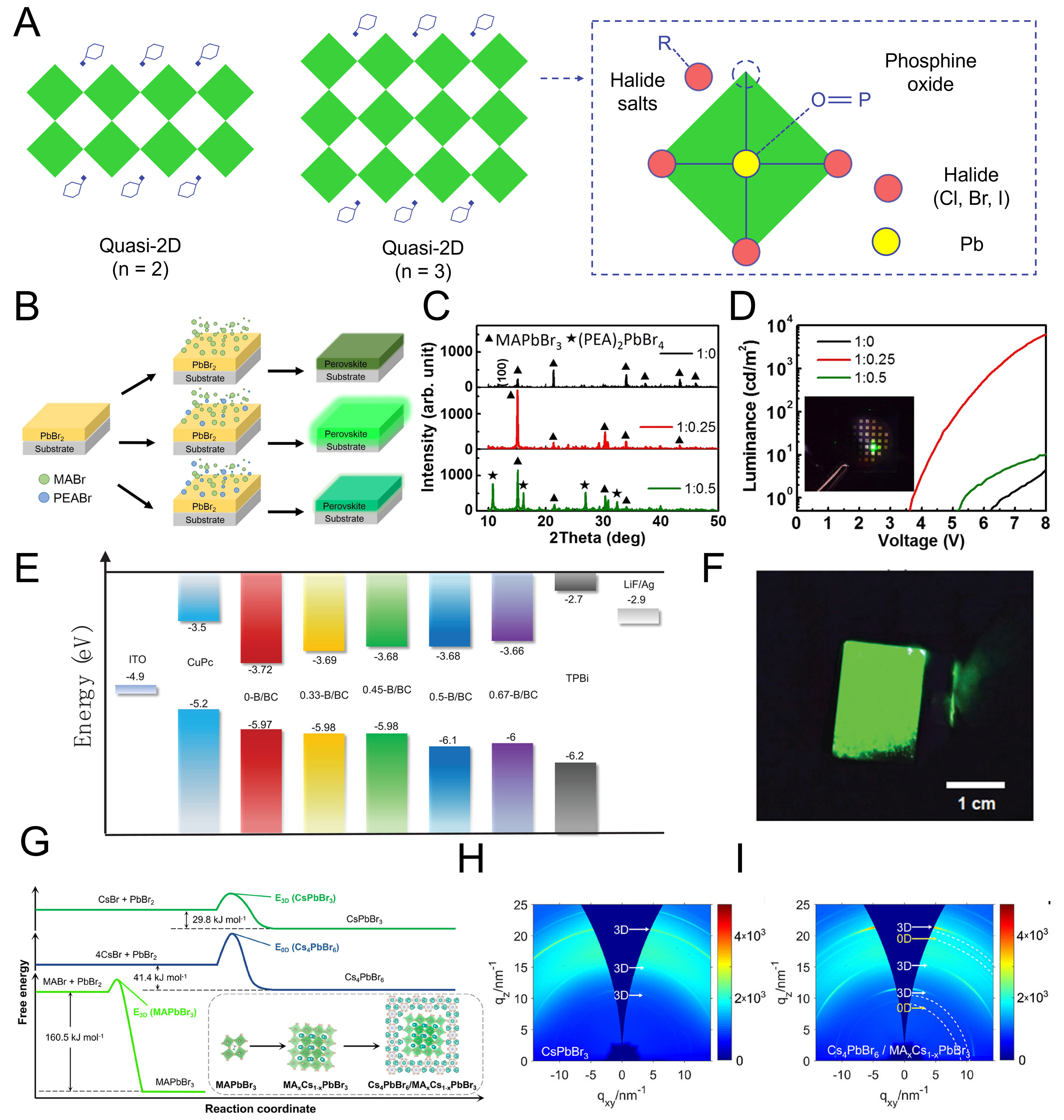
Figure 5. Improvement of perovskite films and devices by organic additives. (A) The structure of quasi-2D MHPs with organic spacer (left) and the effect of diverse organic additive (right); (B) Schematic illustration of PEABr incorporation into MAPbBr3; (C) XRD patterns with varying MABr:PEABr ratios from 1:0 to 1:0.5; (D) luminance-voltage characteristics of LEDs fabricated with different MABr:PEABr ratios[98]. Copyright 2017 American Chemical Society; (E) energy level alignment of perovskite layers with different BABr contents for quasi-2D structures; (F) electroluminescence image of a 0.5B/BC-based LED under 5 V bias[100]. Copyright 2020 John Wiley & Sons; (G) mechanism of formation energies for CsPbBr3 and Cs4PbBr6 with or without MABr during CsPbBr3 fabrication; (H) GIWAXS pattern of pristine CsPbBr3, and (I) GIWAXS pattern of CsPbBr3 with MABr incorporation[101]. Copyright 2025 John Wiley & Sons. MHPs: Metal halide perovskites; PEABr: phenethylammonium bromide; MAPbBr3: methylammonium lead bromide; XRD: X-ray diffraction; LED: light-emitting diode; BABr: butylammonium bromide; GIWAXS: grazing-incidence wide-angle X-ray scattering; MABr: methylammonium bromide.