

fig3
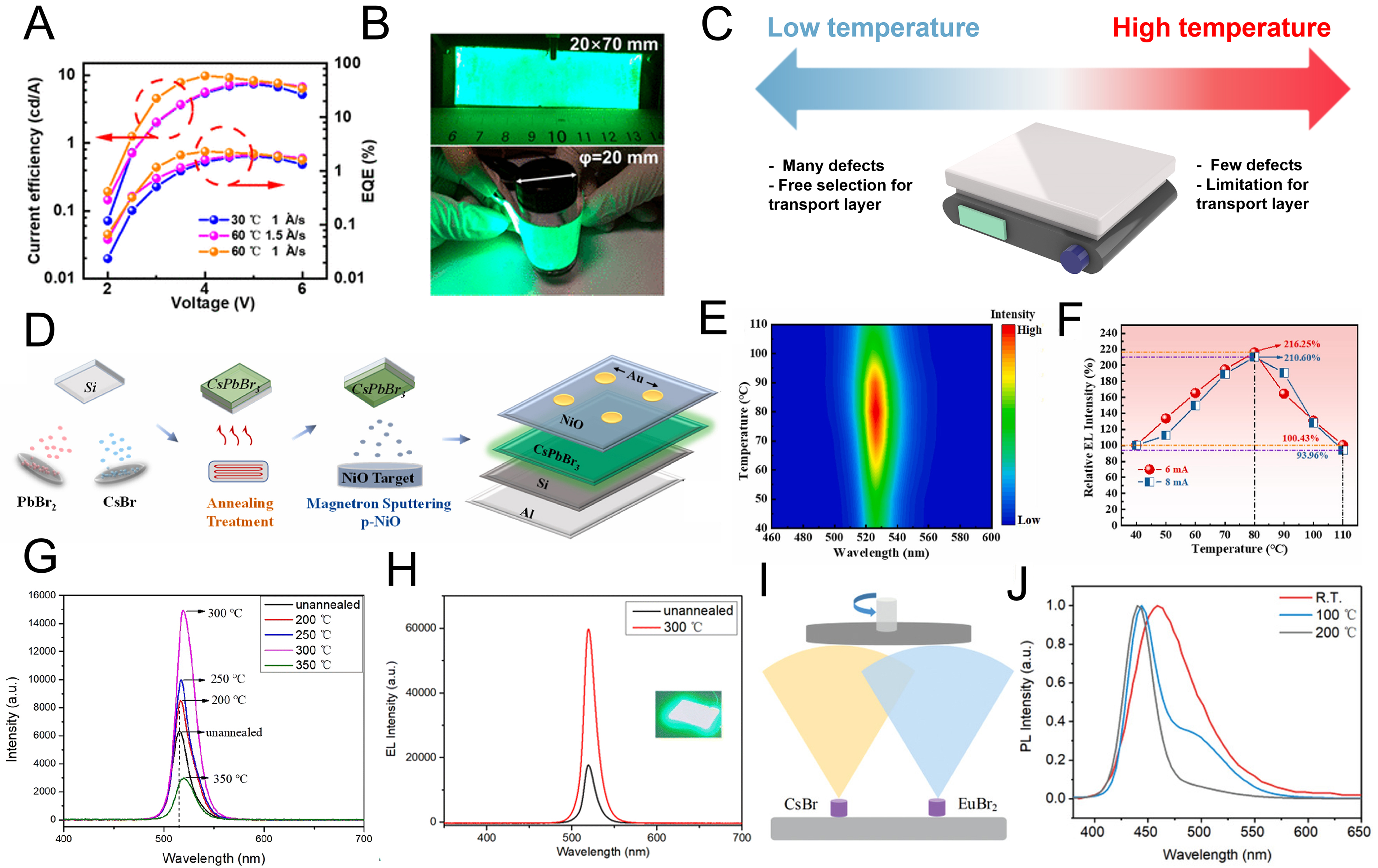
Figure 3. Characterizations of PeLED depending on the temperature of substrate and post-annealing. (A) Current efficiency and EQE of PeLEDs fabricated by TE with varied substrate temperature and rate; (B) The image of deposited MHP films with large substrate and flexible substrate[66]. Copyright 2020 American Chemical Society; (C) The scheme of illustrating the effect depending on the temperature of substrate; (D) Scheme of the process for fabricating the PeLED with high temperature annealing; (E) PL spectra of CsPbBr3 post-annealing at 240 °C depending on the measured temperature; (F) Graph for relative EL intensity according to temperature from 40 to 110 °C[72]. Copyright 2023 Elsevier; (G) PL spectra of CsPbBr3 films with post-annealing from 200 to 350 °C and pristine film; (H) PL spectra of CsPbBr3 films with post-annealing at 300 °C and pristine film[73]. Copyright 2023 Royal Society of Chemistry; (I) The image of fabricating CsEuBr3 with multi-source TE, and (J) PL spectra depending on the post-annealing from RT to 200 °C[74]. Copyright 2021 John Wiley & Sons. PeLED: Perovskite light-emitting diode; EQE: external quantum efficiency; TE: thermal evaporation; MHP: metal halide perovskite; PL: photoluminescence; EL: electroluminescence; RT: room temperature.